




SiBCN/FeSiAl composite torsion gradient cavity metamaterial enables microwave absorption at elevated temperature
 0
0 
Abstract
In high-temperature, broadband microwave stealth applications, conventional absorbing materials fail to reconcile thermal stability with strong absorption and wide-spectrum microwave dissipation. To overcome the challenge, this study proposes and validates high-temperature-resistant torsion gradient cavity metamaterial absorbers composed of a SiBCN ceramic matrix and flake-shaped FeSiAl. The torsion gradient cavity structure induces four electromagnetic resonances within the 2~18 GHz range, enabling the real part of the effective complex permittivity (ε’eff) to be broadly tuned from -3.2 to 88 and that of the equivalent complex permeability (μ’eff) from -53.7 to 34.0. Meanwhile, the imaginary part of the permeability (μ”eff) is substantially elevated from near zero in the pristine dielectric medium to a range of 1.8~92.2. These characteristics activate multiple synergistic microwave loss mechanisms, achieving simulated full-band absorption coverage across 2~18 GHz, while the measured effective absorption bandwidth is 2.4~18 GHz at room temperature and 3.0~18 GHz at 800 °C, with the minimum reflection loss (RLmin) values below -20 dB at all temperatures. Thereby realizing the synergistic optimization of high-temperature tolerance and broadband, high-efficiency microwave absorption. The experimental results are in good agreement with simulations, enriching the design methodology and technological implementation pathways for microwave-absorbing materials deployed in high-temperature extreme environments.
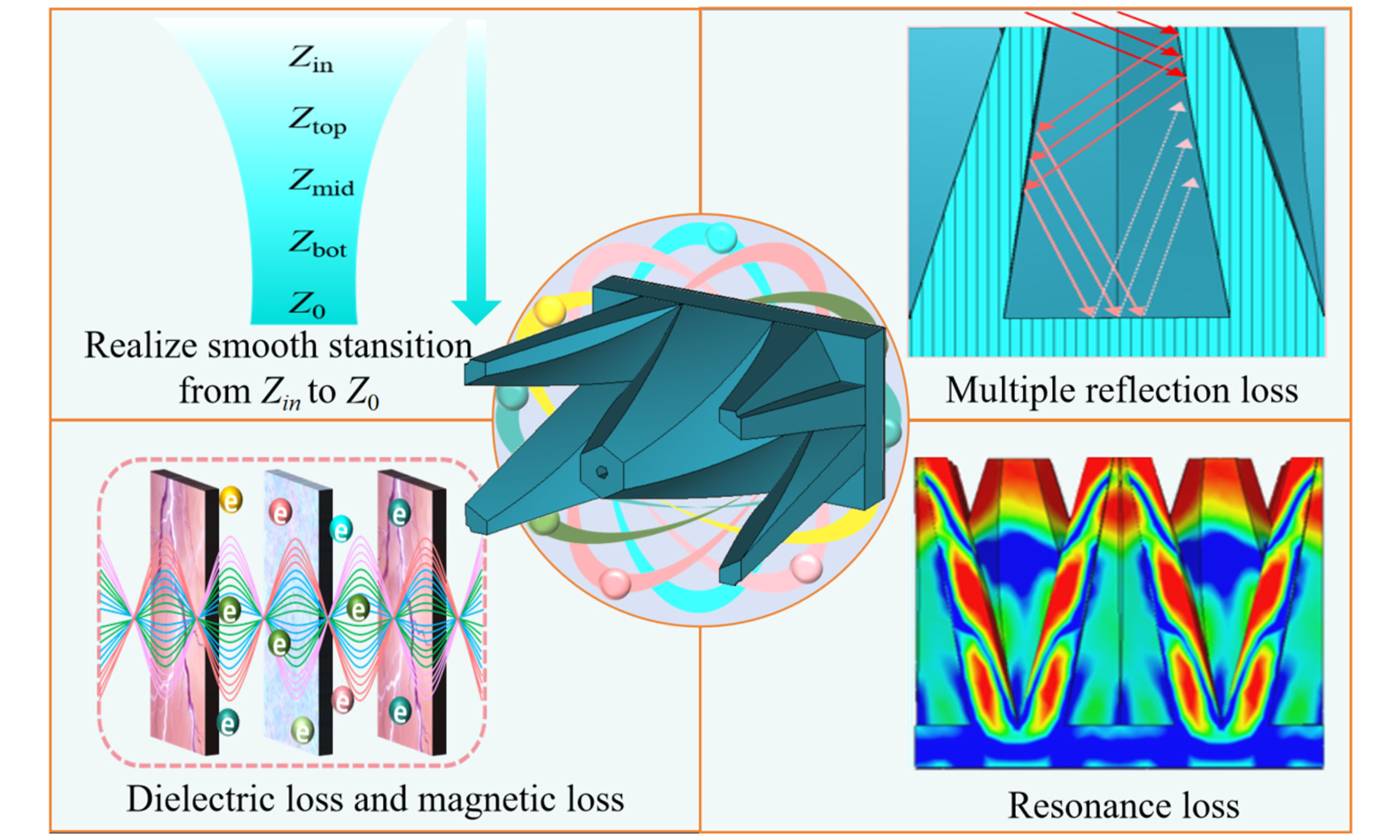
Keywords
INTRODUCTION
The rapid development of electronic devices and wireless communication technologies has not only improved human life but also exacerbated the problem of electromagnetic radiation pollution[1]. On the one hand, electromagnetic pollution causes interference to electronic equipment, resulting in signal loss or interruption, known as electromagnetic interference (EMI). On the other hand, it poses adverse effects on human health[2]. To address these challenges, there is an urgent need to develop microwave-absorbing materials capable of absorbing and converting electromagnetic energy[3-5]. Conventional microwave absorbers achieve absorption under resonant thickness by tuning their dispersion characteristics. However, owing to the λ/4 resonance effect, the required matching thickness at low frequencies is excessively large, while the absorption bandwidth remains narrow, severely limiting their practical applications.
Metamaterial absorbers, enabled by artificially engineered subwavelength structures, have demonstrated remarkable potential for extending effective absorption bandwidths [EAB, Reflection Loss (RL) ≤ -10 dB][6-8]. Various innovative strategies have been employed to broaden their bandwidth in current research, including structural symmetry design, gradient sizing, fractal geometries, lumped elements, and multilayer stacking, positioning them as highly promising candidates for applications such as stealth technology, electromagnetic compatibility, and wireless communications[9-13]. Among these material systems, SiBCN ceramics stand out due to their exceptional high-temperature structural stability and tunable electromagnetic loss characteristics. Furthermore, their electromagnetic parameters can be effectively tailored through compositional engineering and microstructural design, rendering SiBCN an ideal platform for constructing high-performance electromagnetic wave-absorbing metamaterials capable of operating across wide temperature and frequency ranges[14-17].
Leveraging the inherent excellent microwave absorption potential of SiBCN, its integration with metamaterials through judicious geometric parameter design enables it to operate over a wide temperature range. Huang et al.[18] employed SiCx/SiBCN composites as the structural backbone. By optimizing the metamaterial architecture and geometric parameters, the resulting truncated pyramid array of SiCx/SiBCN composites exhibited outstanding broadband and temperature-insensitive microwave absorption properties. Attributable to the gradient impedance matching optimization and multiple attenuation effects arising from the multiscale design, the material maintained an effective absorption bandwidth of 12.5 GHz (5.5-18 GHz) at 1,100 °C, covering 89% of the tested frequency range. Liu et al.[14] fabricated ceramic metamaterials with triply periodic minimal surface (TPMS) structures using photopolymerization molding with preceramic polymers. The low-density helical architecture enhanced multiple reflection losses of microwaves within the macro-scale interpenetrating channel structure. At a thickness of 2.21 mm, this structure achieved an EAB of 3.09 GHz and an RLmin as low as -70.6 dB. Liu et al.[15] combined additive manufacturing (AM), impregnation, pyrolysis, and polymer-derived ceramic (PDC) techniques. Using porous Al2O3 as the matrix and depositing a polymer-derived SiBCN coating on the surface of a nano-layered Mo2C-PyC absorber (SiBCN-Mo2C/PyC- Al2O3), they developed a novel intercalated hierarchical lattice metamaterial. Benefiting from the superior impedance matching enabled by the hierarchical structure and the strong intrinsic electromagnetic attenuation capacity of the absorber, the as-prepared metamaterial achieved an ultra-wide effective absorption bandwidth of 36 GHz covering the 4~40 GHz range at 500 °C, with a RLmin of -32.7 dB. Although the above SiBCN-based metamaterial structures have achieved broadband absorption to some extent, realizing full band microwave absorption, particularly in the low-frequency S and C bands
One of the core bottlenecks in achieving low-frequency and broadband absorption is the excessive thickness of the absorber. The key to reducing thickness lies in increasing the refractive index of the material, defined as the real part of the geometric mean of the complex permittivity and complex permeability. Two primary strategies are typically employed: introducing magnetic absorbers to enhance permeability, or increasing the filling ratio of conductive absorbers to raise permittivity. However, a high concentration of conductive fillers tends to cause large dielectric losses, leading to impedance mismatch between the absorber and free space[19]. FeSiAl possesses favorable permeability and conductivity, enabling effective absorption and attenuation of microwave waves. By adjusting the size and thickness of flake-shaped FeSiAl, microwave absorption at different frequencies can be achieved[20-22]. Therefore, in this study, SiBCN and flake-shaped FeSiAl are adopted as the matrix material to investigate their microwave characteristics at varying mixing ratios. Furthermore, through metamaterial structural design, the design, fabrication, and microwave properties of SiBCN/FeSiAl based bioinspired microwave metamaterials are systematically studied.
MATERIALS AND METHODS
Preparation of SiBCN/FeSiAl composites
To prepare SiBCN/FeSiAl composites, we first fabricated SiBCN ceramics via a polymer precursor method[23]. Subsequently, SiBCN ceramics with a flake-like graphene structure were obtained through high-energy ball milling. The prepared SiBCN was then incorporated into flake-shaped FeSiAl to tailor the microwave properties. Epoxy resin was selected as a temporary binder to take advantage of its good processability for fabricating complex-shaped green bodies. The preparation procedure is illustrated in Figure 1. Specifically, the SiBCN and flake-shaped FeSiAl were weighed according to a predetermined ratio and placed into a ball milling jar. Ball milling was conducted at a ball-to-powder ratio of 5:1 and a rotational speed of 300 r/min for one hour. The as-obtained composite powder was uniformly blended with epoxy resin. Subsequently, the slurry was poured into a pre-designed mold. After drying and solidification, the material was released from the mold to obtain the green body. After green-body forming, the debinding process was carried out under an argon atmosphere. First, heating to 50 °C at 1 °C/min, then to 300 °C at 0.2 °C/min with a 1 h hold, followed by heating to 500 °C at 0.1 °C/min with a 2 h hold, and finally to 800 °C at 0.5 °C/min with a 2 h hold to ensure complete decomposition and volatilization of the resin. The sample was then sintered at
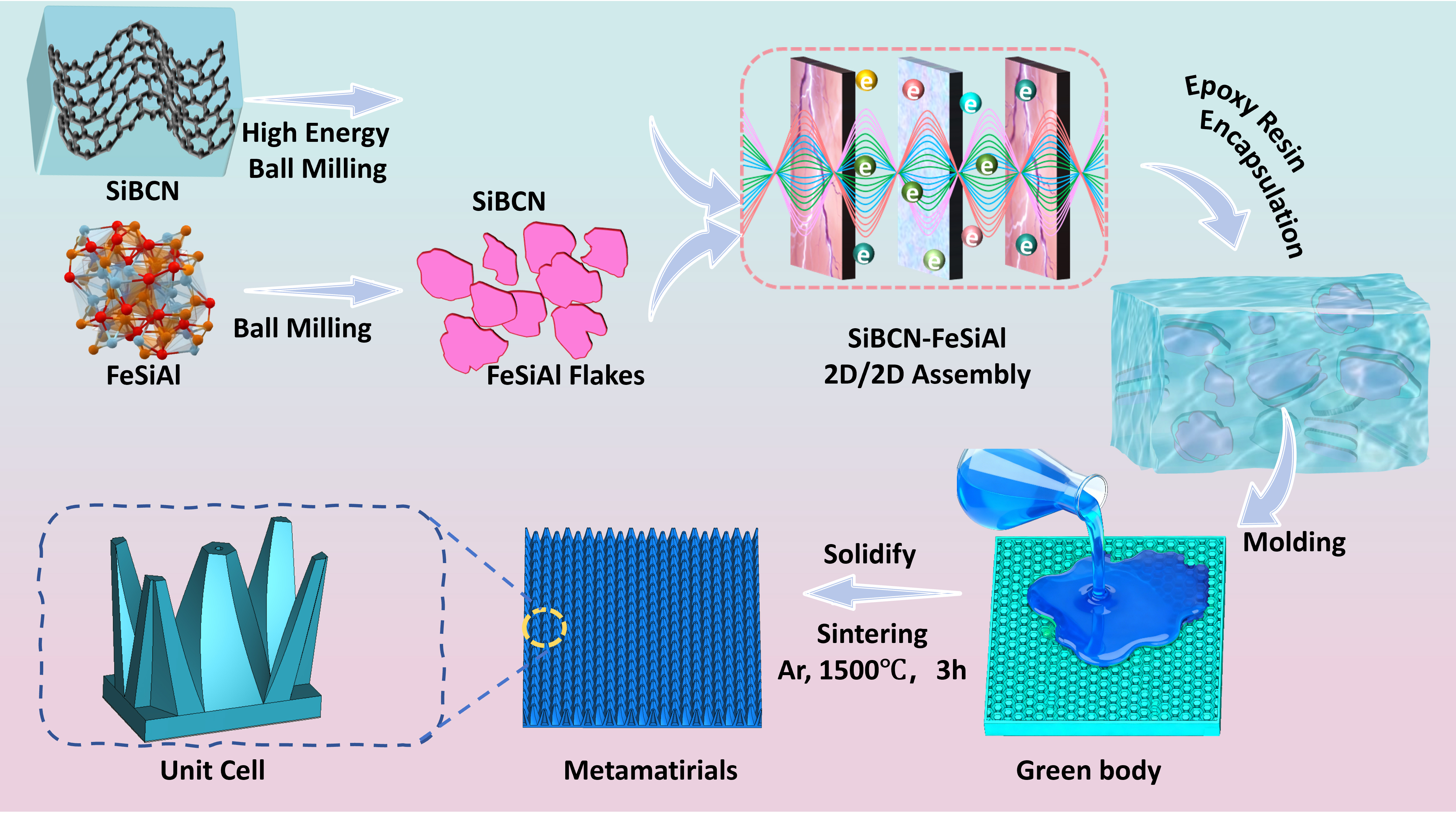
Figure 1. Schematic illustration of the preparation of SiBCN/FeSiAl metamaterial absorber.
Electromagnetic performance of SiBCN/FeSiAl composites
The microstructures of flake-shaped FeSiAl powder and the composite powder were characterized using field-emission scanning electron microscopy (FESEM, Nova 400 NanoSEM, USA). Coaxial ring (inner diameter of
As shown in the X-ray diffraction (XRD) pattern [Figure 2A], the final sample is a fully inorganic ceramic matrix composite, composed of BN, FeSiAl, SiC, CN, FeSi and graphene, together with the residual amorphous SiBCN matrix (corresponding to the broad diffuse hump in the pattern), where the sharp diffraction peaks superimposed on the amorphous hump indicate that the SiBCN matrix underwent partial crystallization at 1,500 °C, which is consistent with the reported high-temperature crystallization behavior of SiBCN ceramics in the literature. Figure 2B-D presents the matrix material with 20% SiBCN. As shown in Figure 2B, FeSiAl exhibits a flake-like structure. FeSiAl alloy possesses a high saturation magnetization (Ms). When applied in the GHz frequency range, this alloy achieves effective dissipation of microwave wave energy primarily through eddy current loss mechanisms and natural resonance effects. The flake-shaped FeSiAl exhibits magnetocrystalline anisotropy, which can overcome the Snoek limit and enhance the magnetic loss capability. According to previous studies, the main constituents of SiBCN ceramics are Si3N4, SiC, and graphite. The high-energy collisions and local instantaneous high temperatures generated during high-energy ball milling induce exfoliation, amorphization, and even vaporization-redeposition of graphite, thereby producing flake-like graphene. The dielectric loss generated by its excellent electrical conductivity can combine with the microwave synergy effect formed after compositing with FeSiAl to efficiently absorb and attenuate microwave waves.
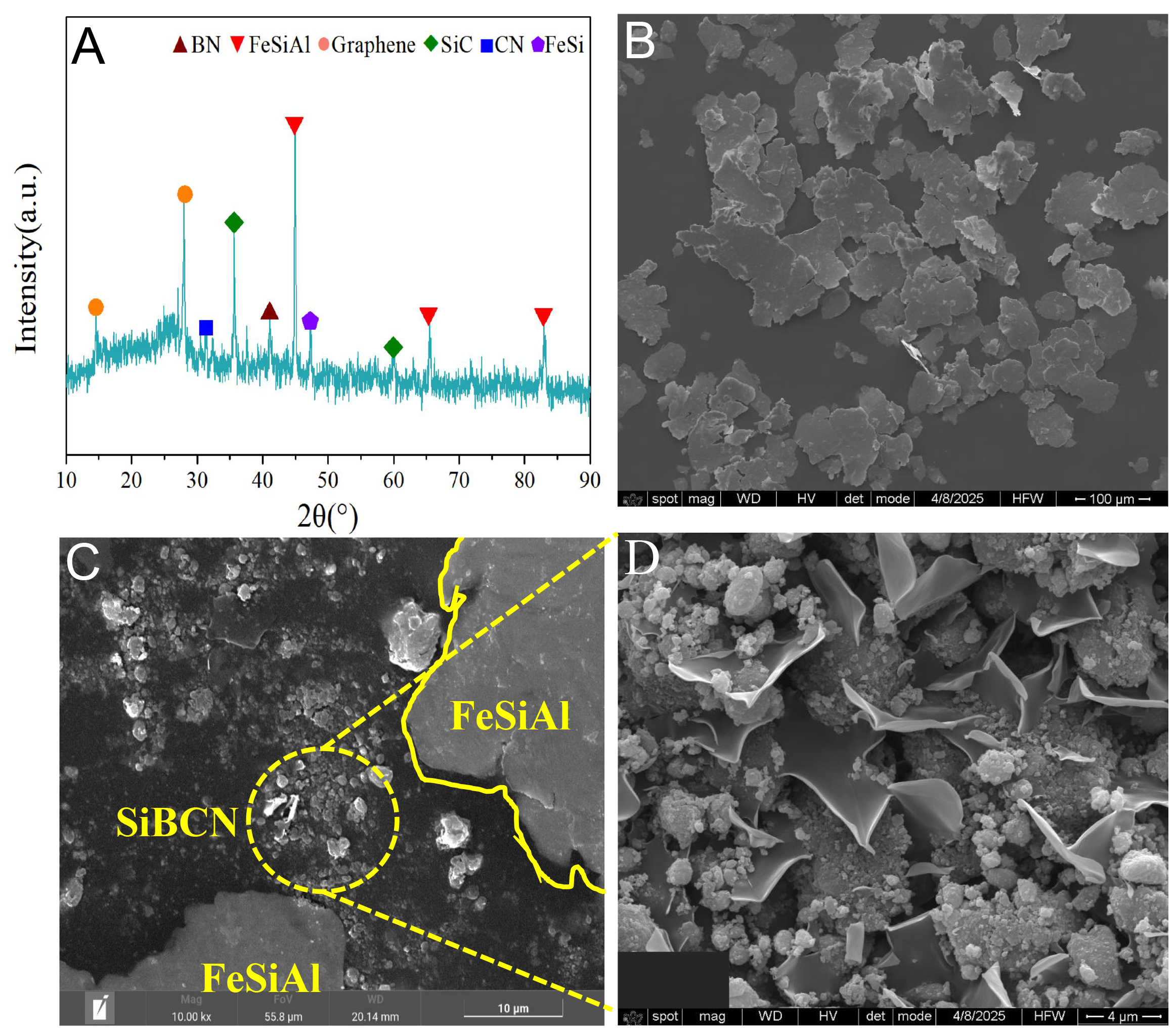
Figure 2. (A) XRD patterns of the sintered sample, (B-D) SEM images of the matrix material with 20%SiBCN. XRD: X-ray diffraction; SEM: scanning electron microscopy.
Figure 3A-D presents the complex permittivity (εr = ε’ - iε”) and relative complex permeability (μr = μ’ - iμ”) of SiBCN/FeSiAl composites with varying SiBCN proportions after heat treatment. The measurements were conducted using the coaxial transmission line method with a VNA, over the frequency range of 2 to 18 GHz at room temperature. The hysteresis effect between dielectric polarization and the alternating microwave wave gives rise to frequency dispersion characteristics in ε’. As shown in Figure 3A, the ε’ values of the composites with different SiBCN proportions vary within the ranges of 38.26~26.96, 40.19~26.41, and 32.48~23.06, respectively. Among them, the sample containing 20% SiBCN exhibits the largest ε’. Furthermore, this sample demonstrates the highest ε” and μ” values compared to the other samples, indicating stronger microwave attenuation capability. In addition, the tanδe value of the 20% SiBCN sample is also the highest. Therefore, the 20% SiBCN sample exhibits the optimal microwave attenuation performance.
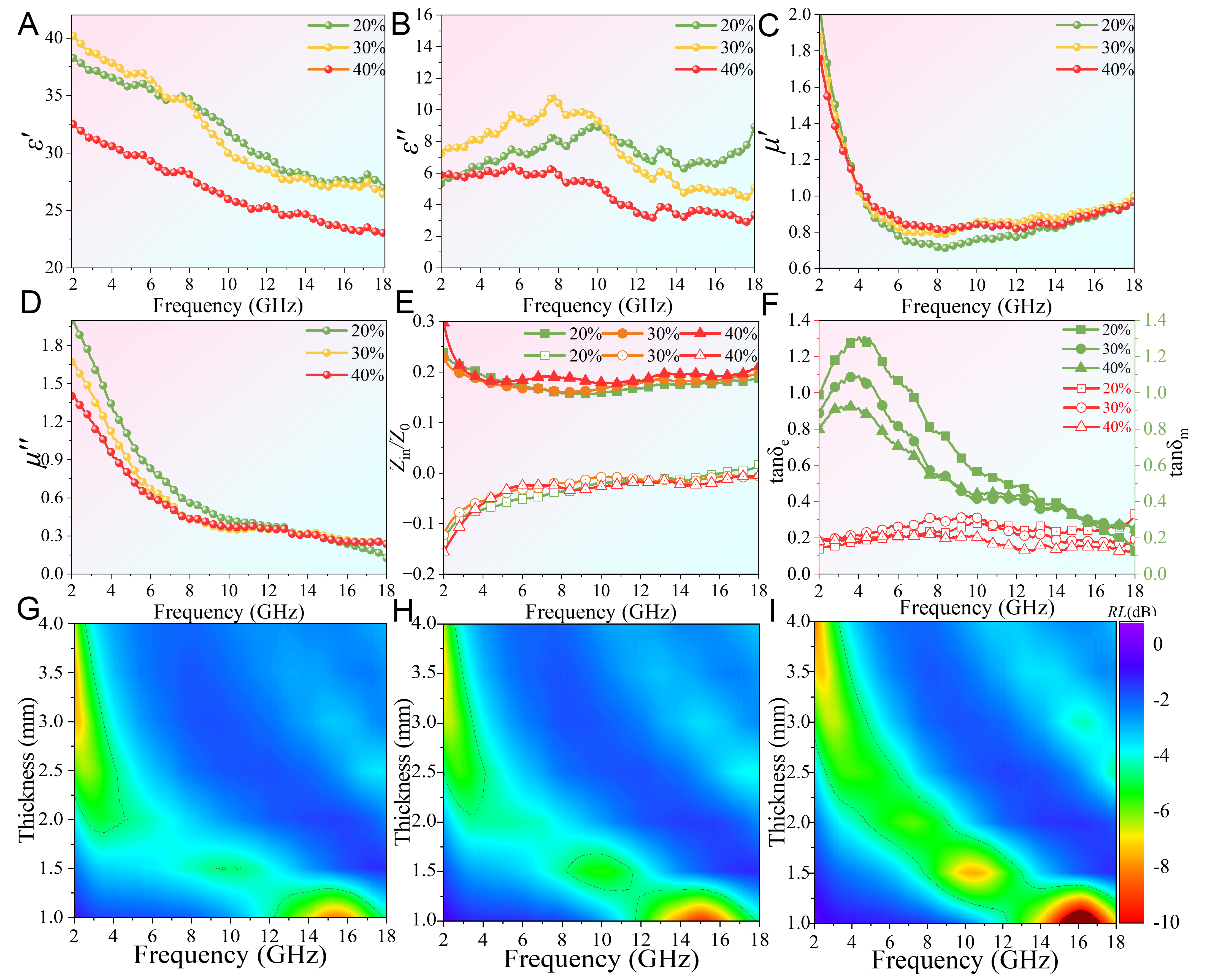
Figure 3. The refractive electromagnetic parameters (A) ε’, (B) ε”, (C) μ’, (D) μ”′, (E) Impedance matching, (F) tanδe, and RL with different proportions of SiBCN in the SiBCN/FeSiAl composite material (G) 20%, (H) 30%, (I) 40%. RL: Reflection less.
Impedance matching characteristics represent one of the key factors determining whether microwaves can enter the absorbing material in large quantities to be dissipated. Figure 3E shows the impedance matching curves of the composite ceramics with different SiBCN contents with a thickness of 5 mm. It can be observed from the figure that as the SiBCN content increases, the impedance matching value of the composite gradually improves. This indicates that the addition of SiBCN enables more microwaves to enter the ceramic and be dissipated. The dielectric loss tangent (tanδε) and magnetic loss tangent (tanδm) of the composite ceramics with different SiBCN contents are shown in Figure 3F.
According to transmission line theory, for a single-layer electromagnetic medium, the microwave absorption performance can be characterized by the RL values. Therefore, the RL values of the SiBCN/FeSiAl composites with different proportions can be calculated based on the complex permittivity and complex permeability as follows[24]:
where Zin is the input impedance at the interface between the material and free space, Z0 is the characteristic impedance of free space (377 Ω), f is the frequency, d is the thickness, and c is the speed of light in vacuum. The RL of the composites with different proportions was calculated, and the results are shown in Figure 3G-I.
It can be observed from the figures that when the SiBCN content is 20%, the microwave attenuation capability of the composite ceramic is relatively weak. The RLmin is only -8.3 dB at 15.44 GHz, and the bandwidth with RL below -5 dB is 9.44 GHz. When the SiBCN content is increased to 30%, as shown in Figure 3H, the RLmin and the bandwidth for RL < -5 dB are -9.34 dB and 10.72 GHz, respectively. For the sample with 40% SiBCN content, as shown in Figure 3I, the RLmin and the bandwidth for RL < -5 dB reach -12.72 dB and 16 GHz, respectively. The reason why the RL performance of the composite gradually enhances with increasing SiBCN content can be explained by Figure 3C. Although the 20% SiBCN sample exhibits the highest ε” and tanδe, its relatively high complex permittivity leads to poor impedance matching with free space, causing most of the incident microwaves to be reflected at the surface rather than entering the absorber. In contrast, the 40% SiBCN sample, despite showing a slightly lower dielectric loss, provides a complex permittivity-to-permeability ratio that is closer to the ideal matching condition (Zin/Z0 → 1), allowing more microwaves to penetrate into the material and be effectively dissipated, which ultimately yields the lowest RLmin and the broadest effective absorption bandwidth.
Design and simulation of the torsion metamaterial
The Nautiloidea represents an elegant gradient spiral architecture. Through the impedance-gradient design of this spiral composite structure, microwaves can gradually dissipate energy when penetrating the material rather than being directly reflected. The constant angle of the spiral ensures directional wave transmission, while the gradient dimensional variation corresponds to the isometric increase of the nautilus shell chambers, which is expected to achieve smooth wave energy attenuation. Therefore, leveraging the spatial hierarchy of the spiral structure, this study designed a torsion gradient cavity metamaterial absorber using the composite ceramic with SiBCN/FeSiAl. The structure is illustrated in Figure 4. The torsion gradient cavity metamaterial absorber consists of periodically arranged unit cells. Here, h1 represents the height of the gradient structure, h2 represents the height of the matrix layer, α1 and β1 are the twist angle and tilt angle of the gradient structure, respectively, while α2 and β2 are the twist angle and tilt angle of the inner chamber structure. Additionally, r1 and r2 represent the radii of the upper and lower bases of the unit cell, respectively.
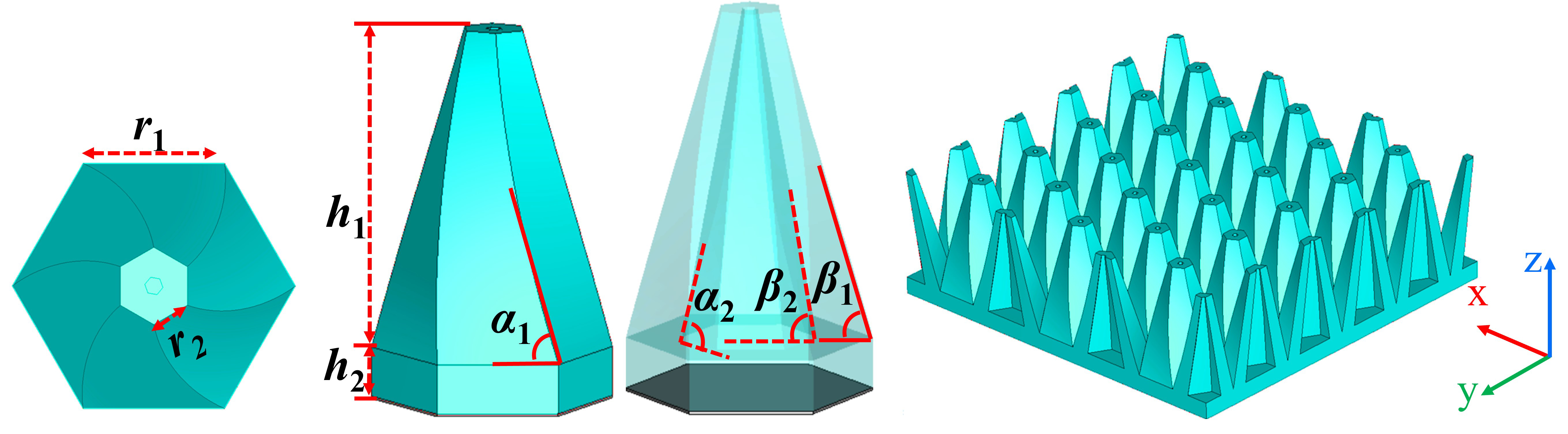
Figure 4. Schematic diagram of the SiBCN/FeSiAl torsion gradient cavity metamaterial.
Numerical simulations of the torsion gradient cavity metamaterial’s microwave absorption were performed using the frequency-domain solver of Computer Simulation Technology (CST) Microwave Studio. The analysis focused on the 2~18 GHz band, which covers key operational bands for Wireless Local Area Network (WLAN), satellite links, and military radar. The incident wave was generated via a Floquet port, defined with its electric field in the +X direction and magnetic field in the +Y direction. As in the reflectivity measurements, a perfect electric conductor boundary was introduced behind the test sample, acting as an equivalent to the metal reflector plate employed in the actual RL testing.
Figure 5 illustrates the significant variation in the RL of the torsion gradient cavity metamaterial, designed with the 20% SiBCN ceramic matrix as an example, as a function of structural parameters. The influence of parameter h1 on the RL of the torsion gradient cavity metamaterial is presented in Figure 5A and E. As h1 increases, the microwave transmission path is prolonged, which enhances energy dissipation and thereby improves the RL performance. Concurrently, the resonance wavelength undergoes a redshift, with the reflection band shifting toward the lower-frequency regime. A reduced RL value corresponds to superior absorption capability. Specifically, an RL below -10 dB signifies that over 90% of the incident microwave energy is absorbed. At h1 =10 mm, the EAB extends across the entire 2-18 GHz range, with a strong-absorption bandwidth (RL < -20 dB, absorptivity > 99%) of 6.2 GHz. Moreover, when h1 is increased to 11 mm, a minimum RL of -50.1 dB is achieved at 12.73 GHz, demonstrating outstanding absorption performance under this condition. Further increments in h1, however, lead to a saturation trend in the absorption bandwidth. As shown in Figure 5B and F, as r1 increases from 3.5 mm to 6.5 mm, the bandwidth of the strong microwave absorption region first decreases from 9.4 GHz to 3.5 GHz, then gradually broadens to 6.1 GHz, and subsequently decreases to 2.4 GHz. The size of r1 directly determines the unit cell dimension of the metamaterial, thereby affecting the resonance frequency, electromagnetic localization effect, and impedance matching performance of the metamaterial. A smaller unit cell size leads to a higher resonance frequency, as smaller structures can support microwave resonance at higher frequencies. An appropriate unit cell size can enhance the local microwave field, thereby improving absorption efficiency. Moreover, a smaller unit cell size typically increases the surface current path, enhancing absorption.
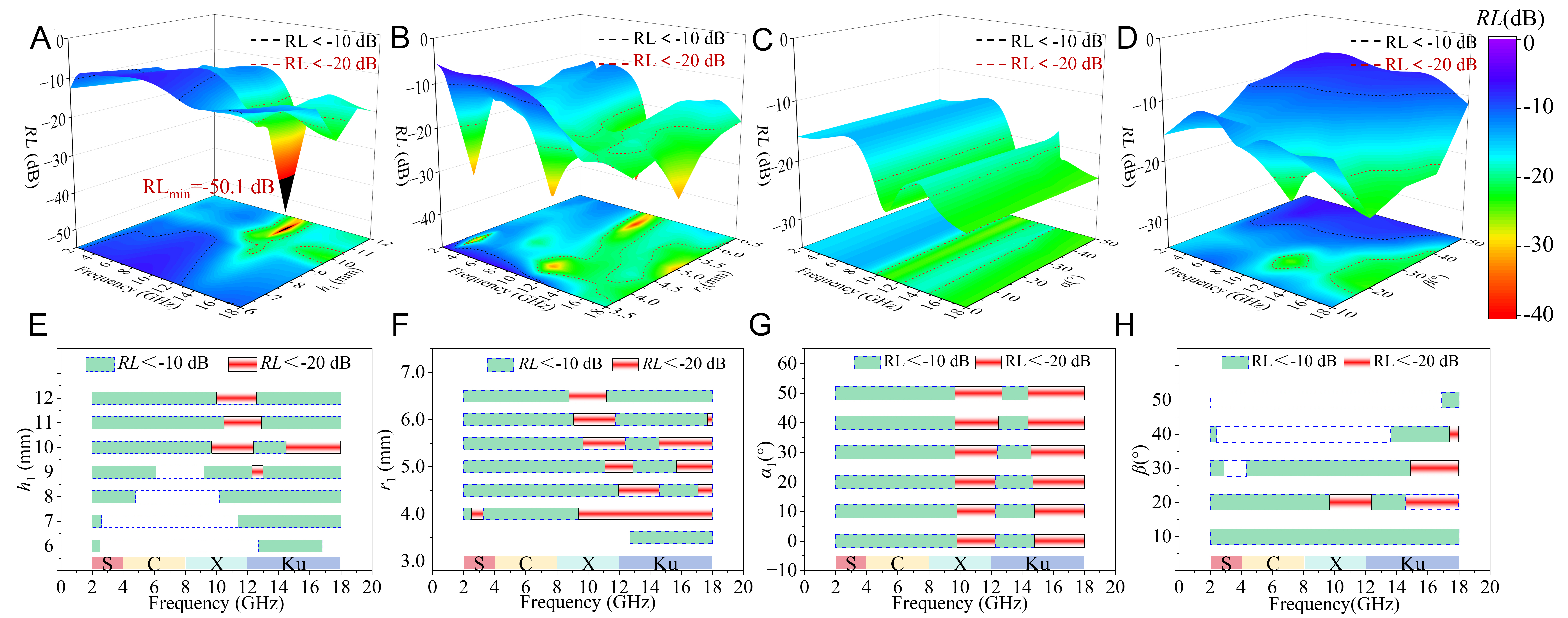
Figure 5. Simulating results of RL values and of torsion metamaterial with different structure parameters: (A and E) h1, (B and F) r1, (C and G) α1, (D and H) β1. RL: Reflection less.
As observed in Figure 5C and G, with fixed parameters h1 = 13 mm, h2 = 2 mm, r1 = 5.5 mm, r2 = 3.0 mm, α2 = 10°, β1 = -10°, β2 = -15°, both the microwave loss performance and the loss bandwidth gradually increase with increasing α1. The EAB consistently covers 2~18 GHz. Within the strong absorption region, the bandwidth expands from 5.7 GHz to 6.6 GHz, while the reflection peak value slightly intensifies from -25.2 dB to
RESULTS AND DISCUSSION
Electromagnetic wave absorption performance of torsion gradient cavity metamaterial
Based on the optimized structural parameters, the electromagnetic parameters of SiBCN/FeSiAl composite materials were simulated at different ratios. The results are shown in Figure 6A. The EAB of the metamaterial structure calculated based on different electromagnetic parameter materials all cover
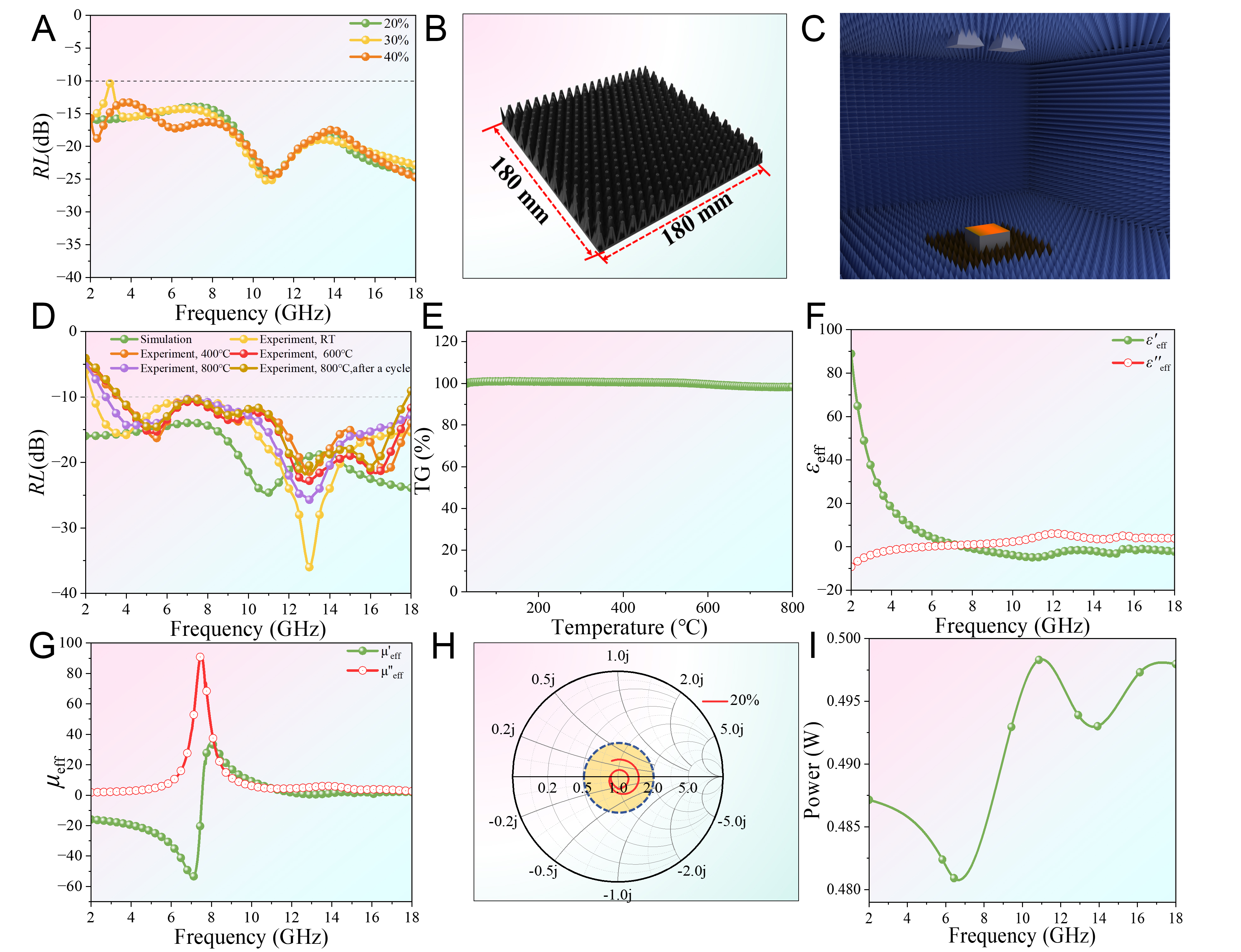
Figure 6. (A) RL with different proportions of SiBCN/FeSiAl metamaterial, (B) test sample, (C) test environment, (D) measured RL curves of the sample, (E) TG curve of the matrix material with 20% SiBCN, (F) effective dielectric constant εeff, (G) effective magnetic permeability μeff, (H) Smith chart of the metamaterial absorbers (the orange shadowed region represents impedance near perfect matching impedance; (I) Power at different frequencies of the metamaterial absorbers. TG: Thermogravimetry; RT: room temperature; RL: reflection less.
The absorption peak frequency shifts from 10.86 GHz in simulation to 13.0 GHz in experiment, with a deviation of +2.14 GHz (approximately 19.7%). The RLmin changes from -24.4 dB to -36 dB, with a deviation of 11.6 dB. The EAB changes from 16 GHz (2~18 GHz) to 15.6 GHz (2.4~18 GHz), with a deviation of
The equivalent dielectric constant (εeff) and equivalent magnetic permeability (μeff) of the structure were calculated using the equivalent medium theory[25,26]. As shown in Figure 6F and G, the real part of the effective complex dielectric constant of the structure is distributed between -3.2 and 88. The real part of the effective complex magnetic permeability is distributed between -53.7 and 34.0, and the imaginary part of the permeability increases from 0 of the dielectric material to 1.8~92.2, indicating that the design of the torsion gradient cavity metamaterial significantly improves the microwave loss performance of the material. As a representative technology in the field of electronics, the Smith Chart provides a fast, low-computation, and graphical method to evaluate impedance-matching performance. The Smith impedance spectrum of the torsion gradient cavity metamaterial is shown in Figure 6H. The metamaterial has four intersections with the horizontal real axis, indicating that the metamaterial structure has four resonances, and the projection of the real axis of the impedance curve is between 0.5 and 2, indicating that the impedance of the structure is nearly ideal and meets the requirement of RL < -10 dB. This is something that a single material cannot achieve. Figure 6I shows the power at different frequencies of the metamaterial absorber.
Broadband microwave absorption mechanism of torsion gradient cavity metamaterial
The microwave loss mechanism of the torsion gradient cavity metamaterial is visually demonstrated by analyzing the electric field distribution, magnetic field distribution, and power loss density distribution at the start frequency (2.00 GHz), the RLmin frequency point (10.86 GHz), and the ending frequency point
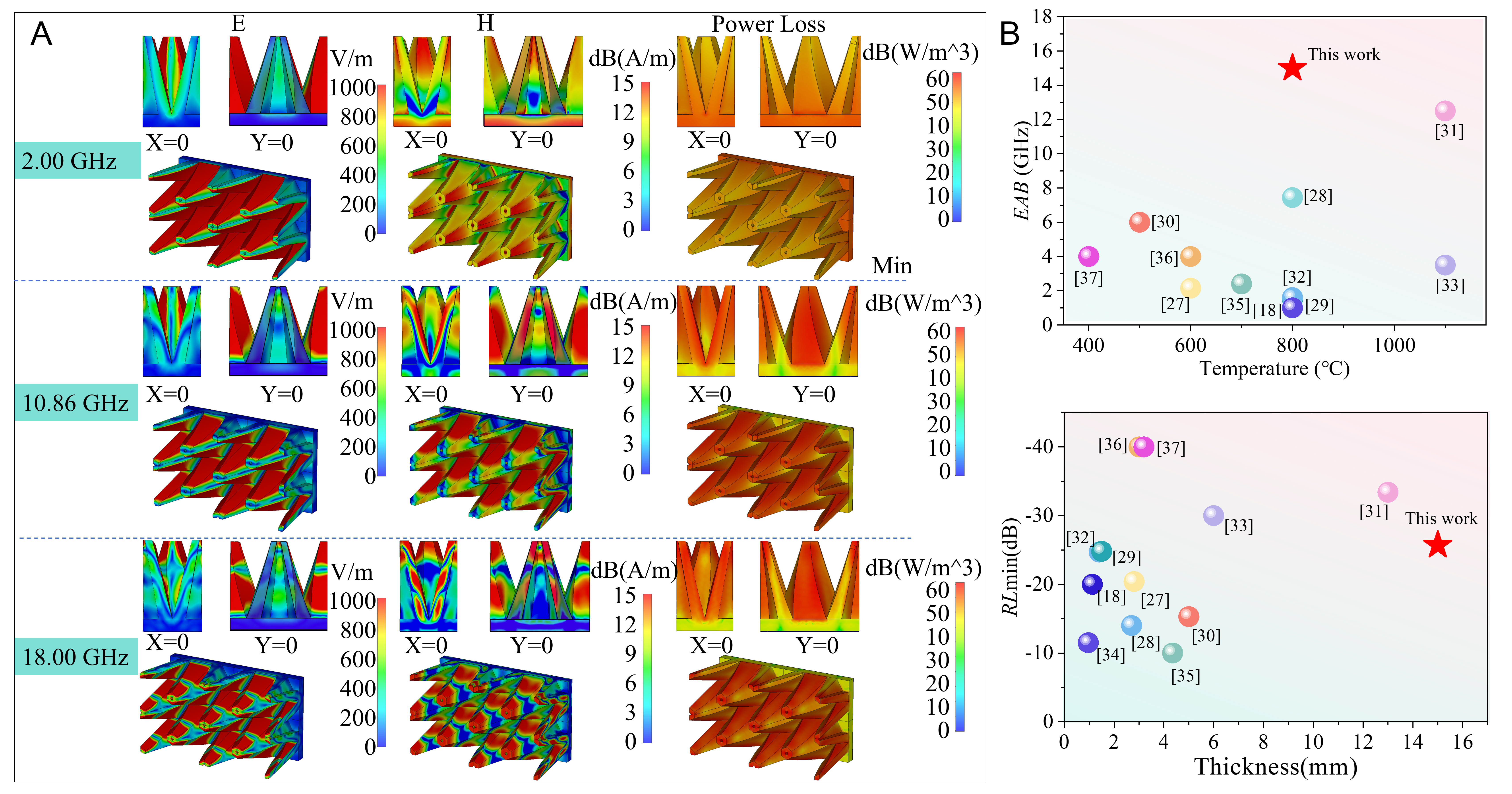
Figure 7. (A) Distributions of the electric field, magnetic field, and power loss density of the metamaterial absorber at 2 GHz, 10.86 GHz, and 18 GHz; (B) Comparisons of EMW absorption bandwidth RLmin and thickness (The performance data of the referenced samples are compiled from Ref.[18,27-37]). EMW: Electromagnetic wave.
A comparison between the torsion gradient cavity metamaterial designed in this work and the high-temperature-resistant metamaterial structures previously reported in the literature is presented in Figure 7B. The figure shows that the operating temperature range of previously reported metamaterials for microwave absorption spans from 400 °C to 1,100 °C. Due to thermal attenuation of the complex permeability and complex permittivity at elevated temperatures, impedance mismatch is aggravated, while the increased electrical conductivity enhances surface reflection. Consequently, the microwave absorption bandwidth at high temperatures is often limited, typically below 8 GHz. In contrast, the metamaterial designed in this work achieves a microwave absorption bandwidth of 15 GHz while maintaining a low RLmin value. Therefore, the SiBCN/FeSiAl torsion gradient cavity metamaterial not only demonstrates excellent electromagnetic wave absorption capability but also offers high-temperature resistance, a wide frequency band, strong absorption, and multi-functional integration compared to other composite materials. This work further demonstrates its distinctive strengths in high-temperature suitability and structural integrability.
CONCLUSION
This paper proposes a robust microwave absorber design based on strong magnetoelectric coupling loss between SiBCN ceramics and flake-shaped FeSiAl, with a torsion gradient cavity metastructure constructed via a bioinspired strategy. A regional optimization algorithm was employed to optimize the structural parameters of this metamaterial. Owing to synergistic microwave loss mechanisms involving resonance loss, dielectric loss, and magnetic loss, the absorption bandwidth was effectively regulated. The metamaterial exhibits near-perfect simulated absorption performance over the frequency range of 2 GHz to 18 GHz, while the measured EAB is 2.4~18 GHz at room temperature and 3.0~18 GHz at 800 °C. Experimental results demonstrate that the proposed metamaterial exhibits excellent high-temperature stable microwave absorption performance. The material-structure synergistic approach presented in this study provides an efficient and systematic technical route for the design of high-temperature broadband microwave absorbing metamaterials.
DECLARATIONS
Authors’ contributions
Made substantial contributions to conception and design of the study and performed data analysis and interpretation: Qiao, M.; Li, X.
Performed data acquisition, as well as provided administrative, technical, and material support: Chen, P.; Zhu, Y.; Chen, F.; Wu, J.; Luo, G.
Availability of data and materials
The data generated and analyzed in this study are available from the corresponding author upon reasonable request.
AI and AI-assisted tools statement
Not applicable.
Financial support and sponsorship
This work is supported by the National Natural Science Foundation of China (U2541259, 52304410), National Key Research and Development Program of China(2024YFB3714603), and Major Project of Hubei Province (Functional Coating and Materials, 2023BAA003-1).
Conflicts of interest
All authors declared that there are no conflicts of interest.
Ethical approval and consent to participate
Not applicable.
Consent for publication
Not applicable.
Copyright
© The Author(s) 2026.
REFERENCES
1. Zhang, X.; Qiao, J.; Wu, N.; et al. Conductive bimetal-organic frameworks with volcano-type fine-tuned dielectric properties for electromagnetic wave absorption. ACS. Nano. 2025, 19, 26761-9.
2. Ma, J.; Zhao, B.; Xiang, H.; et al. High-entropy spinel ferrites MFe2O4 (M = Mg, Mn, Fe, Co, Ni, Cu, Zn) with tunable electromagnetic properties and strong microwave absorption. J. Adv. Ceram. 2022, 11, 754-68.
3. Peng, Y.; Liu, J.; Feng, Z.; et al. Multi-component heterogeneous interface engineering and magnetic domain evolution for broadband electromagnetic wave attenuation. Chem. Eng. J. 2025, 524, 168991.
4. You, Y.; Fang, G.; Fan, M.; Guo, J.; Li, Q.; Wan, J. Leveraging novel microwave techniques for tailoring the microstructure of energy storage materials. Microstructures 2024, 4, 2024034.
5. Wang, Q.; An, W.; Bai, X.; Gao, Z.; Wu, H. Ultra-wideband metamaterial absorber based on a hybrid structure of resistor-reinforced cross kite frame. Mater. Des. 2026, 264, 115833.
6. Qu, N.; Sun, H.; Sun, Y.; et al. 2D/2D coupled MOF/Fe composite metamaterials enable robust ultra-broadband microwave absorption. Nat. Commun. 2024, 15, 5642.
7. Tan, R.; Zhou, J.; Chen, P. Chainmail-inspired conformable and switchable microwave metamaterial absorber. Nat. Commun. 2026, 17, 11.
8. Li, T.; Du, J.; Sun, J.; et al. Bioinspired free-space architecture engineering for broadband electromagnetic absorption and thermal management in graphene-based fibrous textiles. Adv. Funct. Mater. 2026, 36, e30666.
9. Guan, C.; Chen, J.; Sun, F.; et al. Realization and characterization of broadband absorbing FRCM via microwave curing process. Adv. Compos. Hybrid. Mater. 2026, 9, 1738.
10. Zhou, Q.; Shi, T.; Xue, B.; et al. Gradient carbonyl-iron/carbon-fiber reinforced composite metamaterial for ultra-broadband electromagnetic wave absorption by multi-scale integrated design. Int. J. Miner. Metall. Mater. 2023, 30, 1198-206.
11. Jin, H.; Pang, H.; Guan, R.; et al. Topological fractal multifunctional metamaterial with broadband microwave absorption and hydrophobic characteristics. Mater. Today. Phys. 2025, 55, 101757.
12. Liu, Y.; Ibrahim, S.; Majid, N. A.; et al. Adaptive impedance matching in microwave and terahertz metamaterial absorbers using PIN diodes and GaN HEMTs. J. Phys. D. Appl. Phys. 2024, 57, 315101.
13. An, Z.; Huang, Y.; Zhang, R. High-temperature multispectral stealth metastructure from the microwave-infrared compatible design. Compos. Part. B. Eng. 2023, 259, 110737.
14. Liu, C.; Guo, X.; Tong, Y.; et al. Vat photopolymerization 3D printing SiBCN ceramic metamaterials with strong electromagnetic wave absorption. Addit. Manuf. 2024, 87, 104239.
15. Liu, X.; Zhou, Q.; Ma, X.; et al. Intercalated SiBCN-Mo2C/PyC-Al2O3 ceramic hierarchical lattice metastructure: a new paradigm for ultrabroad bandwidth-to-thermal electromagnetic absorption. Adv. Funct. Mater. 2026, 36, e75349.
16. Zhang, Q.; You, X.; Wang, Y.; et al. Permittivity qualification, prediction, and regulation of absorption composites for high-efficiency microwave compatibility and management. Adv. Compos. Hybrid. Mater. 2026, 9, 1604.
17. Liu, Z.; He, Z.; Liu, H.; et al. Hierarchical SiBCNFe composite ceramics enabling broadband electromagnetic wave absorption and corrosion resistance. J. Adv. Ceram. 2025, 14, 9221213.
18. Huang, B.; Cao, Y.; Ye, F.; Liang, J.; Li, C.; Fan, X. Multiscale synergistic design of SiCf/SiBCN-based metamaterial for high-performance electromagnetic wave absorption in a wide temperature domain. J. Mater. Sci. Technol. 2026, 249, 203-13.
19. Li, D.; Ma, Q.; Lin, C.; et al. Ultrahigh permittivity of surface-state-dominated Bi2Te3 nanosheets for low-frequency microwave absorption. Research 2025, 8, 0886.
20. Zou, B.; Zhang, Y.; Wang, Y.; Cao, X. Microwave-absorbing functionalization of LaMgAl11O19 composite thermal barrier coatings by atmospheric plasma spraying. J. Adv. Ceram. 2024, 13, 1523-34.
21. Yang, X.; Wu, L.; Hou, J.; et al. Symmetrical growth of carbon nanotube arrays on FeSiAl micro-flake for enhancement of lithium-ion battery capacity. Carbon 2022, 189, 93-103.
22. Yan, X.; Zhao, H.; Liu, F.; Yu, C.; Jiang, X.; Guo, J. Dual-layer self-healing composites with temperature-responsive intelligent broadband microwave absorption. Mater. Horiz. 2026, 13, 1582-94.
23. Qiao, M.; Li, X.; Chen, P.; Zhu, Y. Enhanced microwave absorption of refractory SiBCN metamaterials. J. Am. Ceram. Soc. 2024, 107, 3360-7.
24. Li, T.; Qiao, M.; Chen, F.; Li, X. Electrostatic self-assembled CS/Ti3C2Tx/Co@CNT composites with gradient carbon structure and wideband microwave absorption. Nano. Res. 2025, 18, 94907696.
25. Qiao, M.; Li, X.; Chen, P.; Zhu, Y. Bionic metamaterial microwave blackbody with temperature insensitivity for C~Ku bands. Plasmonics 2024, 19, 2537-43.
26. Qiao, M.; Li, X.; Liao, Z.; Chen, P.; Zhu, Y. Multioctagonal ring metamaterial with broadband microwave absorption at elevated temperature. Phys. Status. Solidi. Rapid. Res. Lett. 2023, 17, 2200478.
27. Gui, B.; Wang, J.; Zhu, Y.; et al. High temperature infrared-radar compatible stealthy metamaterial based on an ultrathin high-entropy alloy. Opt. Express. 2022, 30, 45426-35.
28. Zheng, L.; Feng, R.; Qiao, Y.; et al. Broadband metamaterial absorber with temperature scalability up to 1000 °C. IEEE. Trans. Antennas. Propag. 2025, 73, 8909-21.
29. Zhao, S.; Ma, H.; Sui, S.; et al. High temperature insensitive ultra-thin electromagnetic metasurface based on ytterbium monosilicate ceramic coating. Ceram. Int. 2021, 47, 31860-7.
30. Zhao, S.; Ma, H.; Shao, T.; et al. High temperature metamaterial enhanced electromagnetic absorbing coating prepared with alumina ceramic. J. Alloys. Compd. 2021, 874, 159822.
31. Zhou, Q.; Yin, X.; Ye, F.; et al. Multiscale designed SiCf/Si3N4 composite for low and high frequency cooperative electromagnetic absorption. J. Am. Ceram. Soc. 2018, 101, 5552-63.
32. Luo, W.; Wang, X.; Chen, X.; et al. Perfect absorption based on a ceramic anapole metamaterial. Mater. Horiz. 2023, 10, 1769-79.
33. Li, Y.; Li, W.; Wang, Y.; Cao, J.; Guan, J. Refractory metamaterial microwave absorber with strong absorption insensitive to temperature. Adv. Opt. Mater. 2018, 6, 1800691.
34. Yang, J.; Liu, X.; Gong, W.; Wang, T.; Wang, X.; Gong, R. Temperature-insensitive and enhanced microwave absorption of TiB2/Al2O3/MgAl2O4 composites: design, fabrication, and characterization. J. Alloys. Compd. 2022, 894, 162144.
35. Shao, T.; Ma, H.; Wang, J.; et al. Ultra-thin and high temperature NiCrAlY alloy metamaterial enhanced radar absorbing coating. J. Alloys. Compd. 2020, 832, 154945.
36. Zhao, M.; Zhu, H.; Qin, B.; et al. High-temperature stealth across multi-infrared and microwave bands with efficient radiative thermal management. Nano. Micro. Lett. 2025, 17, 199.
Cite This Article
 Open Access
How to Cite
Download Citation
Export Citation File:
Type of Import
Tips on Downloading Citation
Citation Manager File Format
Type of Import
Direct Import: When the Direct Import option is selected (the default state), a dialogue box will give you the option to Save or Open the downloaded citation data. Choosing Open will either launch your citation manager or give you a choice of applications with which to use the metadata. The Save option saves the file locally for later use.
Indirect Import: When the Indirect Import option is selected, the metadata is displayed and may be copied and pasted as needed.
About This Article
Special Topic
Copyright

Data & Comments
Data
0










Comments
Comments must be written in English. Spam, offensive content, impersonation, and private information will not be permitted. If any comment is reported and identified as inappropriate content by OAE staff, the comment will be removed without notice. If you have any queries or need any help, please contact us at [email protected].