

fig3
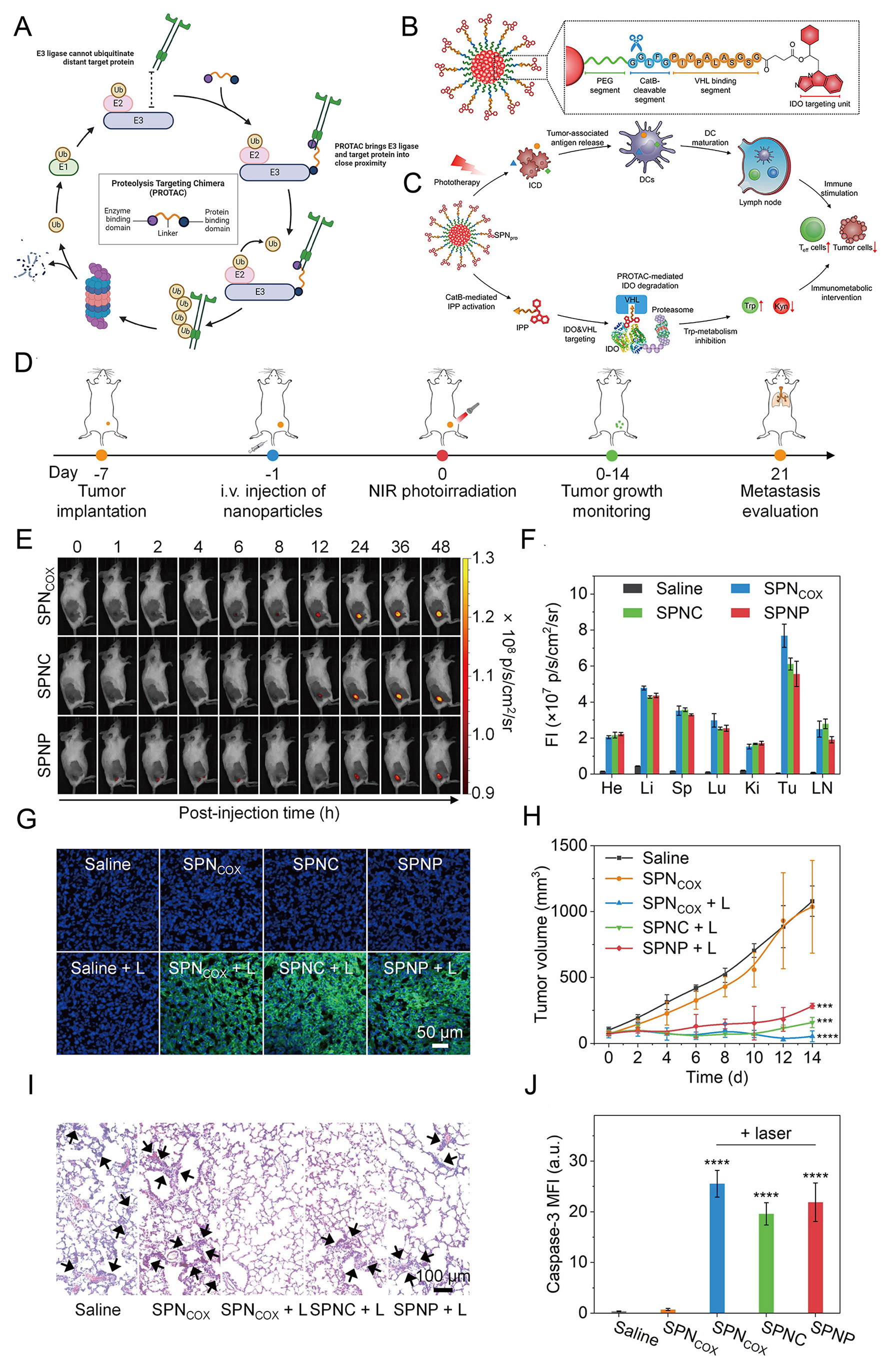
Figure 3. Mechanism and therapeutic evaluation of SPNpro-mediated PROTAC phototherapy in 4T1 tumors. (A) The mechanism of PROTAC was elucidated. Copyright 2024[82]. (B) The structure and activation mechanism of SPNpro, a cathepsin B-specific probe, were characterized. (C) SPNpro-mediated activatable photo-immunometabolic therapy employed a dual-action mechanism. Copyright 2021[83]. (D) The experimental timeline for 4T1 tumor implantation and treatment was outlined. (E) Post-intravenous injection, biodistribution of various formulations in 4T1 tumor-bearing mice was assessed at different time intervals. (F) Quantitative analysis of major organs was performed. (G) Confocal imaging of tumors treated with different formulations, with or without NIR irradiation, detected ROS generation via SOSG probe (green fluorescence). (H) Over 14 days of observation, tumor growth curves in 4T1-bearing mice followed various treatments. (I) H&E staining of lung tissues revealed metastatic lymph nodes. (J) Caspase-3 expression, quantified in tumors across treatment groups, showed statistical significance. Copyright 2022[84]. PROTAC: Proteolysis-targeting chimeras; SPNpro: semiconducting polymer nano-PROTAC; SPNCOX: smart nano-PROTACs. Significance thresholds were defined as follows: ***P < 0.001, and ****P < 0.0001.