



Three-dimensional quasi-periodic ferroelectric domain structure and its second harmonic generation effect in potassium tantalate niobate crystal
 0
0 Abstract
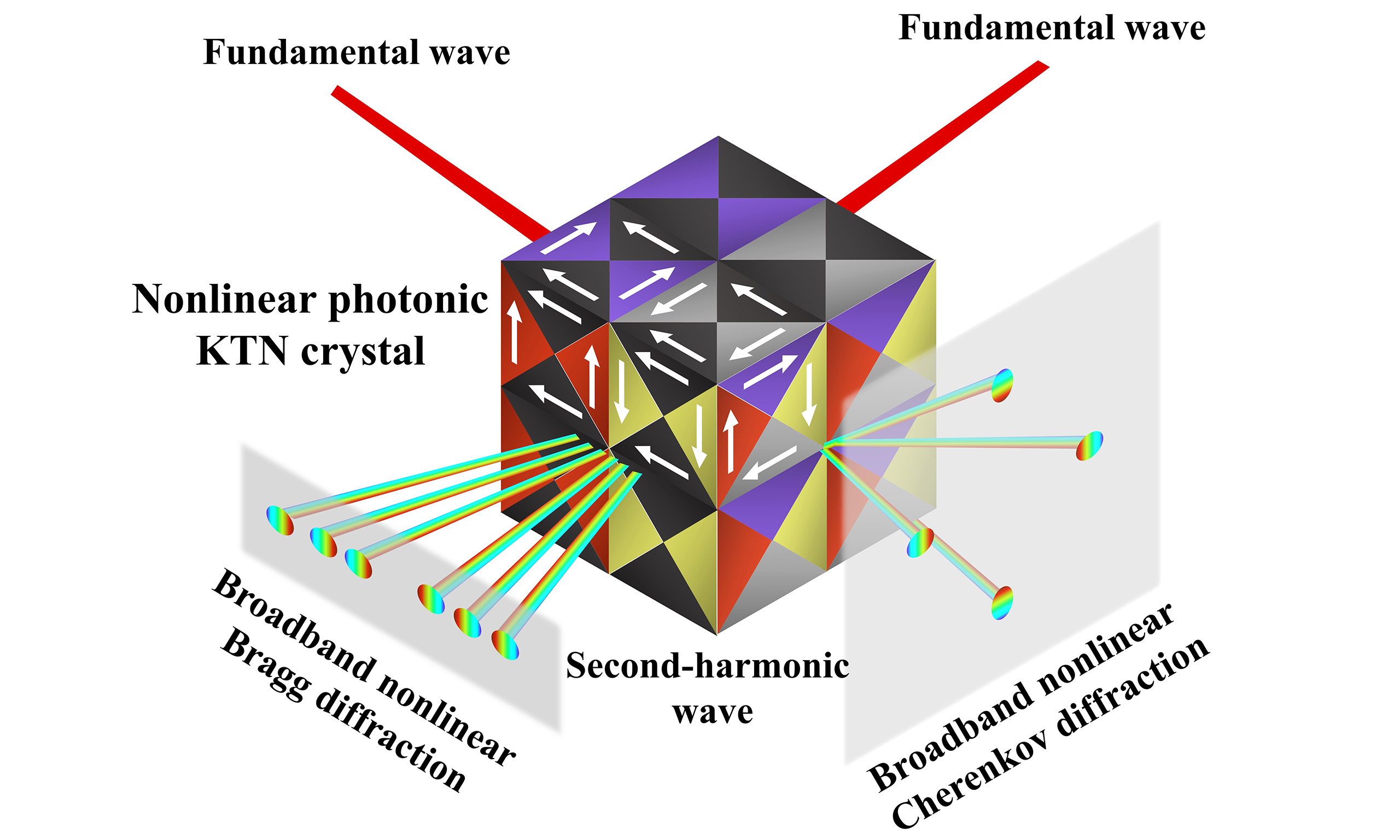
Nonlinear photonic crystals (NPCs) have garnered significant attention due to their capability to manipulate and enhance optical interactions via quasi-phase-matching. The periodic domain inversion structures inside NPCs, corresponding to periodically modulated second-order nonlinear coefficients χ(2), enable the generation of light at new frequencies. However, due to the internal stress and defects, forming a structurally perfect superlattice in naturally grown crystals is challenging, and artificial engineering often entails high costs and complex procedures. In this study, we successfully fabricated a unique three-dimensional (3D) potassium tantalate niobate (KTN) NPC using a direct current poling treatment. Nonlinear Cherenkov diffraction occurs when the fundamental light propagates parallel to the poling direction, whereas nonlinear Bragg diffraction is observed when the light is incident perpendicular to the poling direction. By analyzing both the linear and nonlinear optical responses of the stably poled KTN crystal, we reveal the 3D distribution of ferroelectric domains, which advances the understanding of ferroelectric domain dynamics during the poling process and opens new avenues for research in anisotropic nonlinear optics and optoelectronic applications.
Keywords
INTRODUCTION
The intrinsic properties of most crystals stem from the periodic arrangement of atoms and molecules. Leveraging this structure-property relationship, periodic ferroelectric domain structures with inverse polarization orientations are fundamental in defining nonlinear optical properties and have been extensively explored and engineered in nonlinear photonic crystals (NPCs)[1-5]. In ferroelectric crystals, periodic domain inversion corresponds to the modulation of the second-order nonlinear coefficient χ(2), thereby enabling quasi-phase-matching (QPM) in one-, two-, and even three-dimensional (3D) configurations[6-10]. Notable examples include periodically poled lithium niobate (PPLN)[11-13], barium calcium titanate fabricated via femtosecond laser direct writing[14], and naturally grown potassium tantalite niobite[15], all of which have generated various types of second-harmonic (SH) light, expanding the application prospects in the structural analysis of matter, nonlinear beam shaping, and nonlinear imaging[16-20]. However, the presence of internal stress and defects poses significant challenges to the realization of a perfect superlattice in naturally grown ferroelectric crystals[21]. Moreover, achieving second harmonic generation (SHG) with a structurally simple pattern necessitates stringent conditions and incurs high costs[14,22], limiting practical applications. Thus, exploring innovative strategies for the design and fabrication of nonlinear photonic crystals holds significant potential for broadening their application avenues to diverse optical and photonic technologies.
Potassium tantalate niobate (KTa1-xNbxO3) crystals have attracted considerable attention owing to their giant broadband refractive index, wide transmission range, and exceptional nonlinear optical responses[23-26]. The spontaneous polarization (Ps), whose directions are parallel to three crystallographic axes in tetragonal-phase KTN crystals[27], enables the formation of complex rotational domains. These domain structures enrich the 3D reciprocal lattice vectors (RLVs), thereby effectively relaxing the stringent constraints on crystal cutting direction and incident light polarization in QPM processes[28,29]. Additionally, near the Curie temperature (TC), a phase transition occurs from the ferroelectric tetragonal phase to the paraelectric cubic phase. By precisely controlling the tantalum-to-niobium ratio during crystal growth, the TC can be tailored[30], enabling the fabrication of nonlinear photonic crystals adaptable to diverse optical applications[31,32]. A high conversion efficiency of up to 39% at 1,030 nm has been achieved in periodically poled KTN (PPKTN)[24], and nonlinear Cherenkov radiation free from diffraction and chromatic walk-off has been realized in KTN:Li crystal[33]. Wen et al. elucidated the relationship between SHG properties and ferroelectric domain structures through broadband nonlinear Bragg diffraction in KTN crystals[34]. Given the structural flexibility and diversity of KTN crystals, they are considered a highly promising nonlinear optical platform for the development of novel photonic crystals.
In this work, we induced a novel 3D KTN NPC solely through direct current (DC) poling. Broadband Nonlinear Cherenkov diffraction and nonlinear Bragg diffraction were observed when the fundamental light was incident along different crystal axes. According to QPM theory and domain width distribution obtained from the polarizing light microscope (PLM) image, the mechanism of broadband nonlinear Bragg diffraction in the fundamental wavelength (FW) from 850 to 1,375 nm was explained. Furthermore, based on the multi-polarization SHG effects, we demonstrated the feasibility of nonlinear optical imaging in the stably poled KTN. By correlating the 3D SHG patterns with the real-space imaging of visible light, the ferroelectric domain structures were clearly revealed. This unique 3D nonlinear KTN photonic crystal holds great promise for advancing research in anisotropic nonlinear optics and the development of tunable photonic devices.
MATERIALS AND METHODS
Materials preparation
First, high-quality KTN single crystals were grown using the top-seeded solution growth (TSSG) method. The KTN sample, measuring 0.30 × 1.05 × 1.96 mm3 (x × y × z), was characterized for its dielectric properties by an LCR meter (E4980A, Keysight, USA). All six planes of KTN were polished, followed by annealing from
Optical property measurements
The transmission spectrum was measured using a grating spectrometer (Omni-λ, Zhuo Li, China). The SHG response and nonlinear image propagation experiments were conducted using a mode-locked Nd: YAG nanosecond laser (EO-1064-N, CNI, China, λ = 1,064 nm, pulse width = 8 ns, repetition frequency = 20 kHz). Broadband nonlinear properties were investigated by applying an optical parametric oscillator (OPO, LS-2145, LOTIS TII, Belarus, pulse width =10 ns, repetition frequency =10 Hz). Far-field diffraction imaging was performed using a continuous-wave laser (04-01 series, Cobolt CalypsoTM, Sweden, λ = 491 nm). Light intensity distribution was recorded by a charge-coupled device (CCD, GS3-U3-41C6M-C, FLIR, USA), while images of nonlinear optical spots were captured with a camera (EOS M, Canon, Japan). In SHG experiments, the processed crystal was positioned at the focal point of a convex lens to enhance the SHG intensity and the distance l between the sample and the screen was minimized to reduce the divergence effect of the lens. The polarization state of the fundamental light was modulated using linear polarizers and a half-wave plate. The optical filter was employed to remove the fundamental wavelength. The observation screen was made of quartz glass with one frosted surface (for diffuse scattering) and one polished surface. The Galilean-type beam expander was utilized to ensure the fundamental wavelength beam size was sufficiently large for carrying object image information of templates. The “X” and “Y” templates were produced with stainless steel by laser machining techniques. The polarization beam splitter (PBS) was used to split an incident light beam into two orthogonally polarized beams: One beam is P-polarized (parallel to the plane of incidence), the other beam is S-polarized (perpendicular to the plane of incidence). The beam splitter (BS) was introduced to combine two light beams into the same optical path without introducing polarization-dependent effects.
RESULTS AND DISCUSSION
Figure 1A shows the temperature-dependent dielectric constant of the KTN crystal. The crystal exhibits a TC of 101 °C, in a tetragonal phase (P4mm) at Troom. The composition (KTa0.51Nb0.49O3) can be concluded according to the relation of Nb concentrations x vs. TC [TC (°C) = 676x - 241.15][30]. The SHG image of an annealed KTN (T-phase) exhibits a cross pattern due to the disordered distribution of ferroelectric domains[34,35], while a fully poled state with a single domain structure results in a single SHG spot[36]. In the stably poled state, however, three pairs of non-collinear SHG spots emerge on the plane parallel to the poling direction (z-axis) [Figure 1B]. These spots exhibit a strong polarization dependence. We investigated the polarization relationship between SHG and FW through the relative intensity of SHG. The linear polarized light along the z-axis was obtained using a linear polarizer (P1) and the half-wave plate (HWP) was introduced to control the polarization angle θ of fundamental light (from 0° to 180°, with an interval of 30°) by changing the angle between z-axis and optical axis of HWP without a power change of FW [Figure 1C]. We found that the four SHG spots (Type-0 and Type-I) near the center spot exhibited only a horizontal polarization component (extraordinary light), whereas the two spots (Type-II) farthest from the center exhibited only a vertical polarization component (ordinary light) when another linear polarizer (P2) was introduced into the optical path. The relative intensity of the SHG spots was obtained from pixels of the same size in the grayscale-processed RGB image without saturation. The Type-0 intensity is proportional to the square of the horizontal polarization component (Ez) of the fundamental light, the Type-I is proportional to the square of the vertical component (Ey), and the Type-II is proportional to the square of the smaller of the horizontal and vertical components [Figure 1D]. Therefore, there are three QPM processes in the y-z plane of stably poled KTN: ee → e (Type-0), oo → e (Type-I), and oe → o (Type-II)
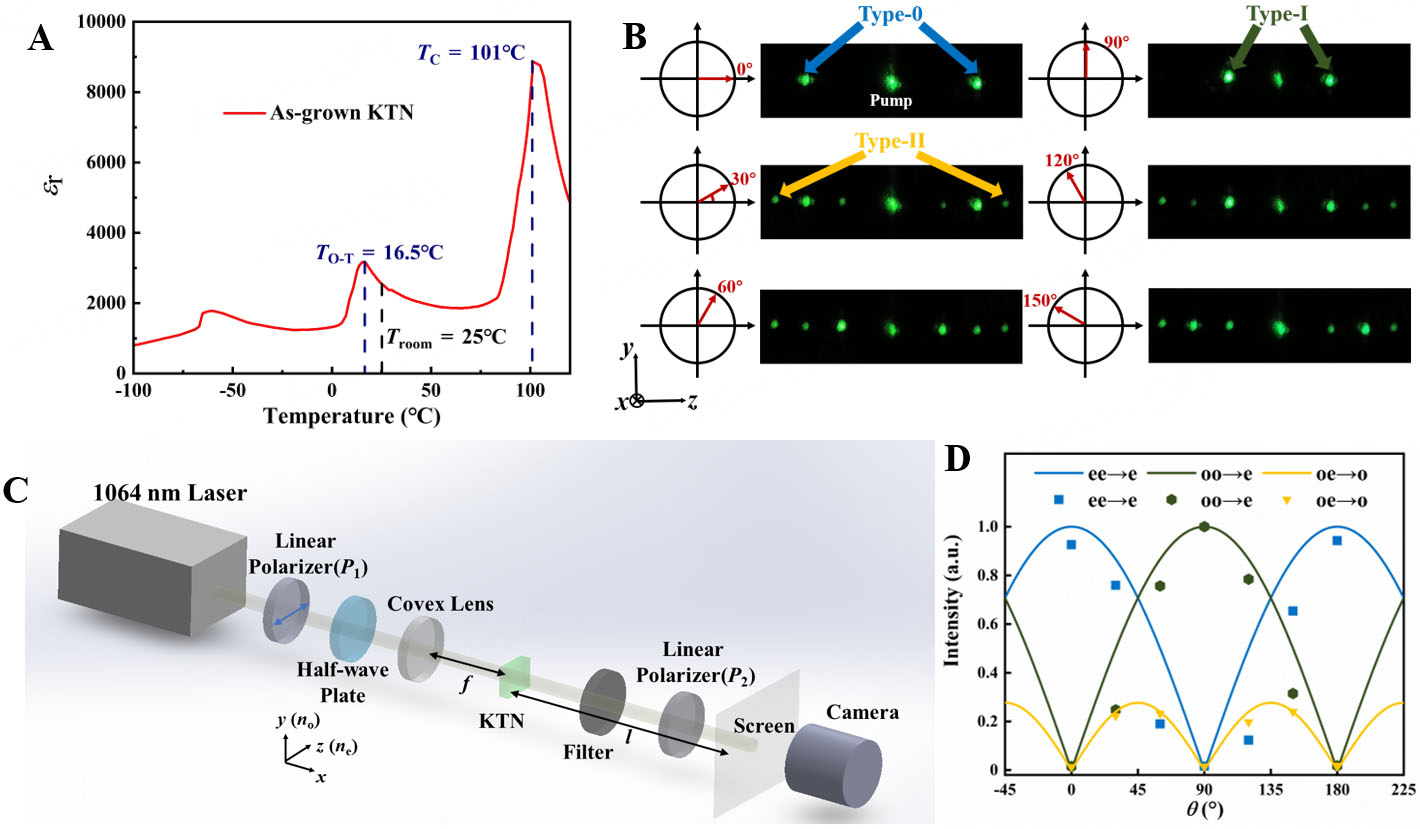
Figure 1. (A) The relative dielectric permittivity (εr) vs. temperature at 1 kHz. TO-T: the orthorhombic-to-tetragonal phase transition temperature; Troom: the room temperature; TC: Curie temperature, the tetragonal-to-cubic phase transition temperature. (B) Different polarization states (left) of the fundamental light incident along the x-axis and the corresponding SHG spots (right). (C) Optical path diagram for investigating the polarization dependence of SHG. (D) Relative intensity of SHG spots in different polarization states.
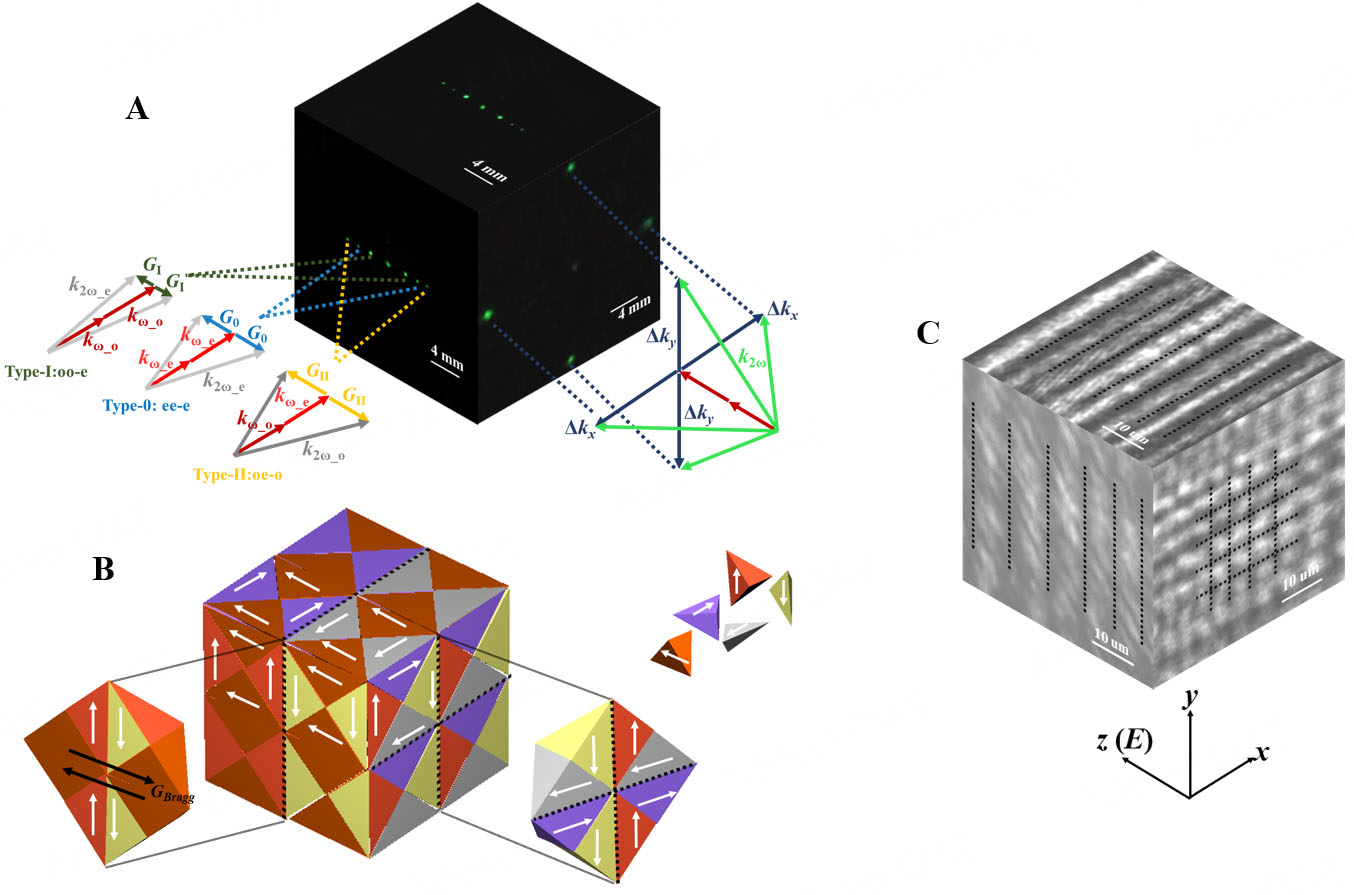
Figure 2. Stably poled KTN. (A) SHG patterns when the FW is incident along the x, y, and z directions. The left part shows three QPM processes of nonlinear Bragg diffraction, and the right part shows the phase-matching condition of nonlinear Cherenkov diffraction.
The Ps of the tetragonal samples is oriented along six possible directions ([100]C, [010]C, [001]C, and their opposites) and periodically distributed up-down Ps can provide RLVs to satisfy the QPM conditions[27]. The RLVs (G0, GI, GII) are all parallel to the poling direction (z-axis), corresponding to the periodic alternating arrangement of Ps along the y-axis[37,38] [Figure 2B, left part]. The absence of G along the y-axis means that Ps toward + z and - z originally have been reoriented to the same direction by the electric field E[34]. The real-space imaging, obtained from direct-field transmission[39,40] [Supplementary Figure 1], shows that the domain regions (bright stripes) and domain walls (black dashed lines) appear alternately in the y-z plane of Figure 2C. The domain walls are vertical and in a quasi-periodic arrangement. Considering the uniformity of Ps along the z-direction, the formation of domain walls parallel to the crystallographic orientation (y-axis) originates from opposite Ps along the y-axis in tetragonal KTN crystals[41]. Given the high consistency between the linear and nonlinear responses, the domain structures in the y-z plane shown in Figure 2B are considered reliable.
The QPM processes (Type-0, Type-I, and Type-II) were achieved in a range from 850 to 1,375 nm of FW. Using the length l and the distance d, between the side spots and the central spot, the SHG emission angles
Figure 3A shows that the θout points match the
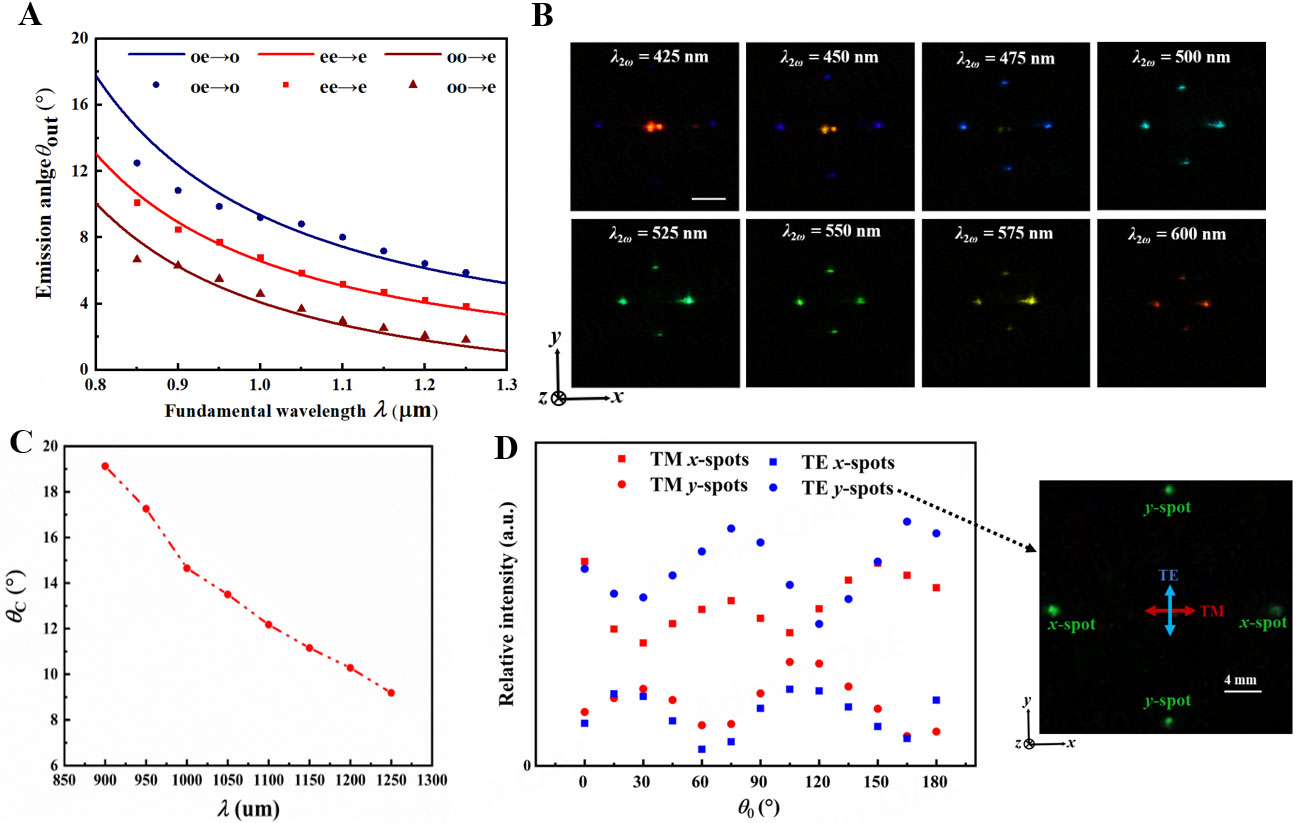
Figure 3. (A) Emission angles of Type-0, Type-I and Type-II vs. fundamental wavelength. (B) Nonlinear Cherenkov diffraction at different SHG wavelengths (425 to 600 nm, with an interval of 25 nm). l = 82.3 mm. Scale bar = 20 mm. (C) Cherenkov angle vs. fundamental wavelength. (D) Relative SHG intensity vs. the fundamental polarization angle θ0, measured with respect to the x- and y-axes. The insert shows the analyzed points in the x-y plane.
Making the fundamental light propagate along the z-axis results in a diamond-like distribution of SHG
Generally, broadband SHG capability is believed to originate from the broad range of ferroelectric domains. However, the period Λ required to satisfy broadband QPM conditions varies continuously. For the 415 to 687.5 nm SHG output, which is not absorbed by the sample [Figure 4A], Λ ranges from 2.924 to 53.074 μm in the oo → e process. Such a multitude of periodic structures nested into each other is impractical in real situations. The nonlinear Bragg diffraction arises from perfect quasi-phase-matching (QPM), that is, the reciprocal lattice vector exactly compensates the phase mismatch between the fundamental and second-harmonic wavevectors (Δk = k2ω - 2kω = G)[15]. The RLVs (G0, GI, GII) are aligned along the z-axis, which dictates that only y-polarized ferroelectric domains contribute to the nonlinear optical interaction. We explain the upper and lower limits of the SHG wavelength for Type-I, based on the domain distribution obtained from PLM. Given that Ps along the y-axis on both sides of the domain walls are opposite, the effective nonlinear optical susceptibility deff in the y-z plane exhibits an alternating positive and negative distribution[46] [Figure 4B]. The optical interaction length Lint along the z-axis in the y-z plane can be calculated based on the crystal thickness t and θi (Lint = t/tanθi) [Supplementary Figure 2]. According to the relationship between the electric field of fundamental light and SHG (Eω and E2ω) [Equation (2)], SHG variations in QPM, phase-mismatching (PMM), and real-phase-matching (RPM) at 830 nm FW are shown in Figure 4C. The situations in both PMM and RPM are similar, as neither can achieve an effective output of 415 nm light.
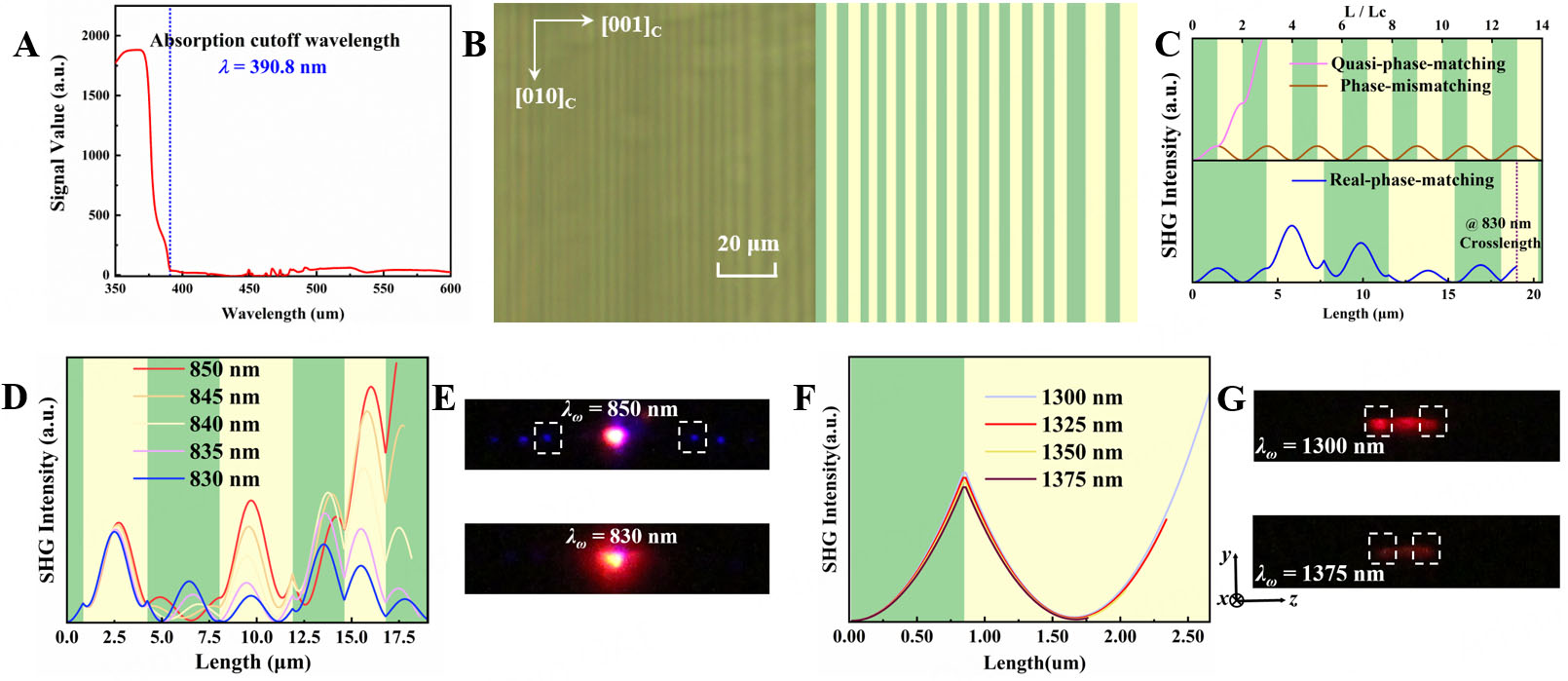
Figure 4. (A) Transmission spectrum of the stably poled KTN. (B) Polarization microscope image and corresponding deff distribution diagram (dark color represents positive and light color represents negative) of stably poled KTN in the y-z plane. (C) Schematic of the relationship between SHG (Type-I, at 830 nm FW) intensity and propagation distance under quasi-phase-matching, phase-mismatching, and real-space-matching. The intensity range is the same in both the upper and lower parts. Schematic of SHG change vs. fundamental wavelength (D) from 830 to 850 nm, with an interval of 5 nm, and (F) from 1,300 to 1,375 nm, with an interval of 25 nm. SHG spot patterns at (E) λω = 830 and 850 nm, (G) λω = 1,300 and 1,375 nm. The white dashed box encloses the SHG spots generated by the Type-I QPM process.
The coherence length Lc of the 830 nm fundamental wave is 1.562 μm, while the minimum domain width in statistical analysis is 1.977 μm [Supplementary Figure 3]. As the wavelength rises, Lc increases correspondingly [Supplementary Figure 4 and Supplementary Equation (2)], leading to better matching with the domain distribution, which enables SHG signal output, as shown in Figure 4D and E. Regarding the upper limit of SHG, the intensity gradually decreases due to the reduction in interaction length with increasing wavelength [Figure 4F and G].
Notably, the quasi-periodic structure is supposed to originate from growth striations caused by a built-in spatially periodic oscillation in composition[39,47]. The oscillation in composition can fabricate the flexoelectric field Eflexo in KTN crystals, which can control domain structures by inducing local polarization orientation[21,48]. However, the non-uniform growth temperature of cross-section and convective instabilities during the crystal pulling process introduce thermal stress that affects the domain configuration underlying the growth striations[32,49]. The application of a direct current electric field facilitates ferroelectric domain reconfiguration through domain wall migration, which relaxes the thermomechanical stresses[50]. The domains are oriented uniformly with the direction of the applied electric field (fully poled state). With the electric field removed, some domains return to their original positions due to the Eflexo (stably poled state), which can minimize the global free energy of the system[34]. Therefore, the approximately periodic striation grating is supposed to emerge with its primal morphological characteristics.
Nonlinear imaging has long been a focal point in the applications of nonlinear photonic crystals[51-53]. Building on the multi-polarization SHG effect shown in Figure 1B, we explored the nonlinear imaging potential of stably poled KTN crystals. A beam-expanded 45°-polarized 1,064 nm laser is split into the P (extraordinary) and S (ordinary) light by a PBS, to carry the object image information of the “X” and “Y” templates, respectively [Figure 5A]. Then, these two beams are combined into the same optical path along the x-axis by a BS and are focused into the stably poled KTN crystal. The Fast Fourier Transform (FFT) of the Collins formula was introduced to fit the SHG distribution, and the initial FW is set as a plane wave with a Gaussian distribution. Simulation results shown in Figure 5B present harmonic patterns at the CCD receiving plane, specifically, the e-channel (ee → e) carrying “X” information, the o-channel (oo → e) carrying “Y” information, and the mix-channel (oe → o) formed by the smaller value points of the “X” and “Y” distribution. Figure 5C-E reports the CCD images of the three channels. The discrepancies between real SHG images and simulation patterns are primarily due to the FW beam expansion, which increases the laser transmission distance, causing the fundamental light to more closely resemble spherical light. However, the “X” and “Y” CCD images still retain Gaussian distributions, with their morphologies exclusively determined by the image information encoded in the extraordinary and ordinary light components, respectively. The intensity output of the mix-channel corresponds to the overlapping regions of SHG patterns from the o-channel and e-channel [Figure 5C-E, red box regions], and there is no output outside the region, which is consistent with Type-II QPM conditions: the simultaneous presence of ordinary and extraordinary light. Based on this relationship and multi-wavelength SHG effects, designing different intensity distributions in the o- and e-channels can achieve rich and diverse nonlinear information transmission in the mix-channel.
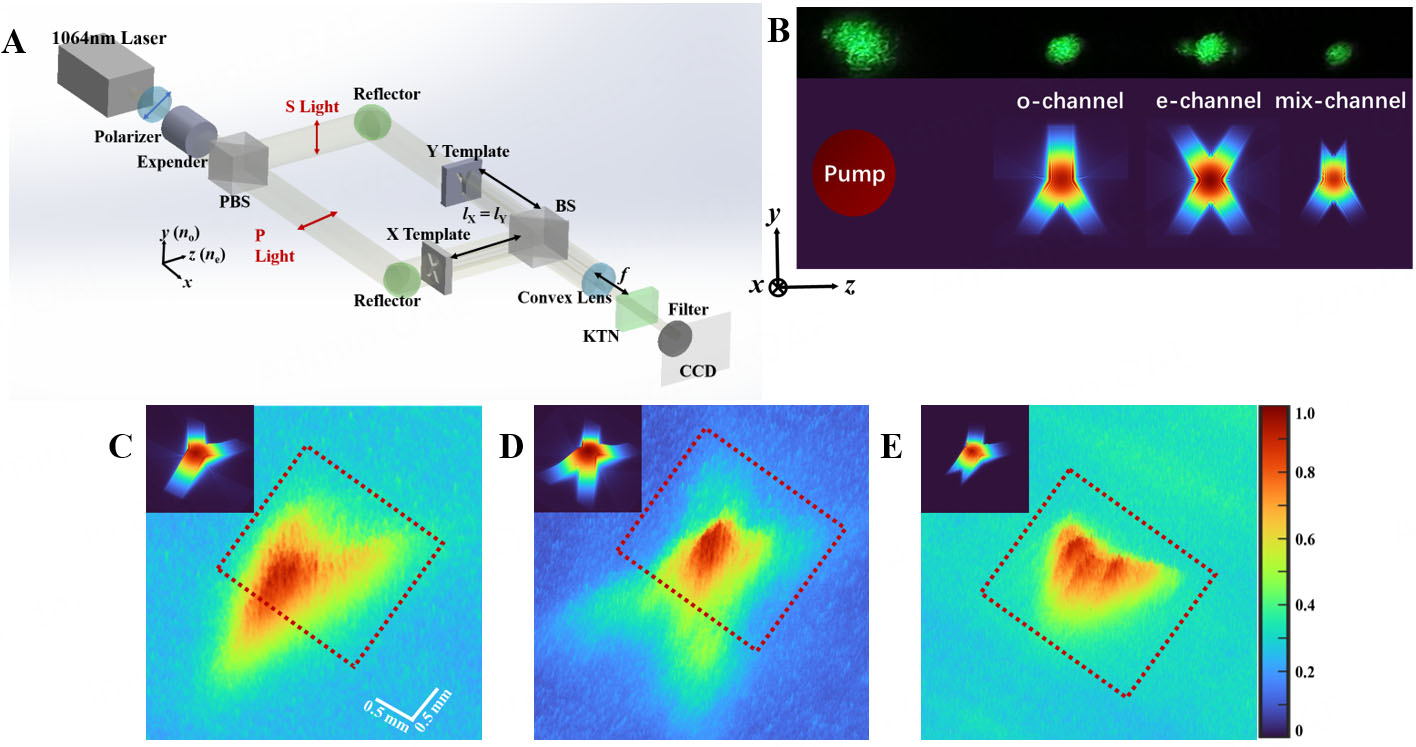
Figure 5. (A) A diagram of multi-channel nonlinear image propagation. (B) Simulated two-dimensional SHG distribution of the o-channel (oo → e), e-channel (ee → e), and mix-channel (oe → o) at the CCD receiving plane; the inversion of the image is due to the effect of the lens. The insert shows an experimentally measured SHG distribution pattern (one side), generated by a 45°-polarized 1,064 nm laser propagating through the optical setup shown in Figure 1C. Real distribution of (C) o-channel, (D) e-channel, and (E) mix-channel. The inserts show the corresponding simulated results, and the area within the red box represents the overlapping region of “X” and “Y” images. (B-E) shares a common color bar.
CONCLUSIONS
In summary, we obtain a novel 3D KNT NPC just by poling treatment. The self-assembled ferroelectric domain structures enable broadband QPM, facilitating both nonlinear Cherenkov and Bragg diffraction. The mechanisms behind the broadband Bragg diffraction effect are well explained by the domain distribution in planes parallel to the poling direction. This 3D domain configuration advances the understanding of the self-assembled dynamics of ferroelectric domains in stably poled KTN and highlights the potential of KTN-based NPCs in anisotropic nonlinear optics and tunable photonic devices. Additionally, by leveraging the polarization-dependent SHG effects, we successfully demonstrated multi-channel nonlinear imaging, which opens new avenues for advanced optical information processing and multiplexed imaging applications.
DECLARATIONS
Authors’ contributions
Materials growth and characterization: Meng, X.; Hu, C.; Wang, Y.
Optical path design and construction: Li, Z.; Zhang, Z.
Software and simulations: Wen, X.; Zhang, Z.
Data analysis and interpretation: Zhang, Z.; Tan, P.
Conception, design, writing and editing: Zhang, Z.; Tan, P.; Tian, H.; Song, Q.
All authors contributed to the manuscript and were involved in the discussion.
Availability of data and materials
The data that support the findings of this study are available within the article and its Supplementary Materials.
AI and AI-assisted tools statement
Not applicable.
Financial support and sponsorship
This work was supported by the National Natural Science Foundation of China (Grant Nos. 12474423 and 62305089), the Natural Science Foundation of Heilongjiang Province of China (Nos. YQ2022A010 and ZD2022E003), the fellowship of China National Postdoctoral Program for Innovative Talents (Grant No. BX20200111), the Open Project Program of Wuhan National Laboratory for Optoelectronics NO. 2024WNLOKF015, and the Fund of National Key Laboratory of Plasma Physics (Grant No. 6142A04240202).
Conflicts of interest
All authors declared that there are no conflicts of interest.
Ethical approval and consent to participate
Not applicable.
Consent for publication
Not applicable.
Copyright
© The Author(s) 2026.
Supplementary Materials
REFERENCES
1. Chakkoria, J. J.; Dubey, A.; Mitchell, A.; Boes, A. Ferroelectric domain engineering of Lithium niobate. OEA 2025, 8, 240139.
2. Gómez-Tornero, A.; Palacios, P.; Molina, P.; Carretero-Palacios, S.; Bausá, L. E.; Ramírez, M. O. Enhancing nonlinear interactions by the superposition of plasmonic lattices on χ(2) -nonlinear photonic crystals. ACS. Photonics. 2021, 8, 2529-37.
3. Zhang, B.; Yan, W.; Chen, F. Recent advances in femtosecond laser direct writing of three-dimensional periodic photonic structures in transparent materials. Adv. Photon. 2025, 7.
4. Aashna, P.; Lin, H. L.; Cao, Y.; et al. Periodic domain inversion in single crystal barium titanate-on-insulator thin film. Adv. Sci. 2024, 11, e2406248.
5. Li, J.; Nishikawa, H.; Kougo, J.; et al. Development of ferroelectric nematic fluids with giant-ε dielectricity and nonlinear optical properties. Sci. Adv. 2021, 7, eabf5047.
6. Liu, S.; Wang, L.; Mazur, L. M.; et al. Highly efficient 3D nonlinear photonic crystals in ferroelectrics. Adv. Opt. Mater. 2023, 11, 2300021.
7. Lai, P.; Chang, C.; Liu, X.; Wei, D. Multiplexing linear and nonlinear bragg diffractions through volume gratings fabricated by femtosecond laser writing in lithium niobate crystal. Photonics 2023, 10, 562.
8. Vogler-Neuling, V. V.; Karvounis, A.; Morandi, A.; Weigand, H.; Dénervaud, E.; Grange, R. Photonic assemblies of randomly oriented nanocrystals for engineered nonlinear and electro-optic effects. ACS. Photonics. 2022, 9, 2193-203.
9. Wang, R.; Cao, Q.; Wang, X.; Li, F. Hollow cylindrical three-dimensional nonlinear photonic crystal for annular beam generation. Appl. Phys. Lett. 2024, 125, 121113.
10. Yu, C.; Liu, S.; Xu, T.; Zhao, R.; Sheng, Y. Helically twisted nonlinear photonic crystals. Opt. Lett. 2024, 49, 4745-8.
11. Su, Y.; Zhang, X.; Chen, H.; et al. High-efficiency nonlinear frequency conversion enabled by optimizing the ferroelectric domain structure in x-cut LNOI ridge waveguide. Nanophotonics 2024, 13, 3477-84.
12. Mishra, J.; Mckenna, T. P.; Ng, E.; et al. Mid-infrared nonlinear optics in thin-film lithium niobate on sapphire. Optica 2021, 8, 921.
13. Wu, H.; Wang, W.; Hu, B.; et al. Widely tunable continuous-wave visible and mid-infrared light generation based on a dual-wavelength switchable and tunable random Raman fiber laser. Photon. Res. 2023, 11, 808.
14. Xu, T.; Switkowski, K.; Chen, X.; et al. Three-dimensional nonlinear photonic crystal in ferroelectric barium calcium titanate. Nat. Photon. 2018, 12, 591-5.
15. Li, C.; Wang, X.; Wu, Y.; et al. Three-dimensional nonlinear photonic crystal in naturally grown potassium-tantalate-niobate perovskite ferroelectrics. Light. Sci. Appl. 2020, 9, 193.
16. Reitzig, S.; Hempel, F.; Ratzenberger, J.; et al. High-speed hyperspectral imaging of ferroelectric domain walls using broadband coherent anti-Stokes Raman scattering. Appl. Phy. Lett. 2022, 120, 162901.
17. Sebastián-Vicente, C.; Imbrock, J.; Laubrock, S.; Caballero-Calero, O.; García-Cabañes, A.; Carrascosa, M. All-optical domain inversion in LiNbO3 crystals by visible continuous-wave laser irradiation. ACS. Photonics. 2024, 11, 2624-36.
18. Pan, J. T.; Zhu, B. H.; Ma, L. L.; et al. Nonlinear geometric phase coded ferroelectric nematic fluids for nonlinear soft-matter photonics. Nat. Commun. 2024, 15, 8732.
19. Wang, R.; Cao, Q.; Wang, X.; Tian, X.; Li, F. Second-harmonic flat-top beam shaping via a three-dimensional nonlinear photonic crystal. Opt. Lett. 2024, 49, 1097-100.
20. Chen, P.; Wang, C.; Wei, D.; et al. Quasi-phase-matching-division multiplexing holography in a three-dimensional nonlinear photonic crystal. Light. Sci. Appl. 2021, 10, 146.
21. Tan, P.; Tian, H.; Huang, F.; et al. Strain-gradient-controlled disorder dynamics in chemically substituted ferroelectrics. Phys. Rev. Appl. 2019, 11, 024037.
22. Wei, D.; Wang, C.; Wang, H.; et al. Experimental demonstration of a three-dimensional lithium niobate nonlinear photonic crystal. Nat. Photon. 2018, 12, 596-600.
23. Di, Mei. F.; Falsi, L.; Flammini, M.; et al. Giant broadband refraction in the visible in a ferroelectric perovskite. Nat. Photon. 2018, 12, 734-8.
24. Wu, Y.; Liu, Q.; Tian, G.; et al. Periodically poled nonlinear photonic crystal KTa0.51Nb0.49O3 Combining wide transparent range and large quadratic coefficient. Adv. Opt. Mater. 2022, 10, 2201010.
25. Gelkop, Y.; Di, Mei. F.; Frishman, S.; et al. Hyperbolic optics and superlensing in room-temperature KTN from self-induced k-space topological transitions. Nat. Commun. 2021, 12, 7241.
26. Falsi, L.; Macis, S.; Gelkop, Y.; et al. Anomalous optical properties of KTN:Li ferroelectric supercrystals. Nanomaterials 2023, 13, 899.
27. Gao, X.; Cheng, Z.; Chen, Z.; et al. The mechanism for the enhanced piezoelectricity in multi-elements doped (K,Na)NbO3 ceramics. Nat. Commun. 2021, 12, 881.
28. Ren, C. P.; Huang, H.; Hong, X. H. Conical quasi-phase-matching second harmonic generation in a 2D photonic crystal with hybrid Ewald geometric method. Opt. Express. 2024, 32, 16523-32.
29. Wu, Y.; Cui, C.; Wang, Z.; et al. Finding a novel borate ferroelectric with random domain structures for deep-UV quasi-phase-matching. Adv. Mater. 2025, e2505930.
30. Rytz, D.; Châtelain, A.; Höchli, U. T. Elastic properties in quantum ferroelectric KTa1-xNbxO3. Phys. Rev. B. 1983, 27, 6830-40.
31. Wang, X.; Mao, X.; Chen, P.; et al. Potassium tantalate niobate crystals: efficient quadratic electro-optic materials and their laser modulation technology. J. Mater. 2023, 9, 838-54.
32. Zhang, Y.; Li, S.; Liu, F.; et al. Growth and characterization of large size lead-free ferroelectric K(Ta,Nb)O3 single crystal. J. Am. Ceram. Soc. 2021, 104, 5182-91.
33. Falsi, L.; Tartara, L.; Di, Mei. F.; et al. Constraint-free wavelength conversion supported by giant optical refraction in a 3D perovskite supercrystal. Commun. Mater. 2020, 1, 77.
34. Wen, X.; Zhang, Z.; Wang, Y.; et al. Broadband nonlinear Bragg diffraction from self-assembled structures in potassium tantalate niobate crystals. Appl. Phys. Lett. 2024, 125, 191103.
35. Xu, T.; Lu, D.; Yu, H.; Zhang, H.; Zhang, Y.; Wang, J. A naturally grown three-dimensional nonlinear photonic crystal. Appl. Phys. Lett. 2016, 108, 051907.
36. Ayoub, M.; Imbrock, J.; Denz, C. Second harmonic generation in multi-domain χ2 media: from disorder to order. Opt. Express. 2011, 19, 11340-54.
37. Zhang, Y.; Zhang, Y.; Guo, Q.; et al. Characterization of domain distributions by second harmonic generation in ferroelectrics. NPJ. Comput. Mater. 2018, 4, 95.
38. Mishina, E. D.; Sherstyuk, N. E.; Barskiy, D. R.; et al. Domain orientation in ultrathin (Ba,Sr)TiO3 films measured by optical second harmonic generation. J. Appl. Phys. 2003, 93, 6216-22.
39. Pierangeli, D.; Ferraro, M.; Di, Mei. F.; et al. Super-crystals in composite ferroelectrics. Nat. Commun. 2016, 7, 10674.
40. Xin, F.; Falsi, L.; Gelkop, Y.; et al. Evidence of 3D topological-domain dynamics in KTN:Li polarization-supercrystal formation. Phys. Rev. Lett. 2024, 132, 066603.
41. Wang, J.; Gao, R.; Tang, S.; et al. General principle of ferroelectric topological domain formation. Sci. Adv. 2025, 11, eadu6223.
42. Loheide, S.; Riehemann, S.; Mersch, F.; Pankrath, R.; Krätzig, E. Refractive indices, permittivities, and linear electrooptic coefficients of tetragonal potassium tantalate-niobate crystals. Phys. Stat. Sol. (a). 1993, 137, 257-65.
44. Tunyagi, A. R.; Ulex, M.; Betzler, K. Noncollinear optical frequency doubling in strontium barium niobate. Phys. Rev. Lett. 2003, 90, 243901.
45. Ayoub, M.; Imbrock, J.; Denz, C. Ferroelectric domain diagnostics near the phase transition by Čerenkov second-harmonic generation. Opt. Mater. Express. 2017, 7, 3448.
47. Lo, Presti. L.; Parravicini, J.; Soave, R.; et al. Observation of an exotic lattice structure in the transparent KTa1-xNbxO3 perovskite supercrystal. Phys. Rev. B. 2020, 102, 214110.
48. Biancoli, A.; Fancher, C. M.; Jones, J. L.; Damjanovic, D. Breaking of macroscopic centric symmetry in paraelectric phases of ferroelectric materials and implications for flexoelectricity. Nat. Mater. 2015, 14, 224-9.
49. Scheel, H. J. Theoretical and technological solutions of the striation problem. J. Cryst. Growth. 2006, 287, 214-23.
50. Liu, M.; Fan, J.; Dong, Y.; et al. Domain size effect in Pb(Mg1/3Nb2/3)O3-0.30PbTiO3 crystals: an autocorrelation transform approach. J. Eur. Ceram. Soc. 2025, 45, 117449.
51. Arie, A. Storing and retrieving multiple images in 3D nonlinear photonic crystals. Light. Sci. Appl. 2021, 10, 202.
52. Ye, W.; Zeuner, F.; Li, X.; et al. Spin and wavelength multiplexed nonlinear metasurface holography. Nat. Commun. 2016, 7, 11930.
Cite This Article
 Open Access
How to Cite
Download Citation
Export Citation File:
Type of Import
Tips on Downloading Citation
Citation Manager File Format
Type of Import
Direct Import: When the Direct Import option is selected (the default state), a dialogue box will give you the option to Save or Open the downloaded citation data. Choosing Open will either launch your citation manager or give you a choice of applications with which to use the metadata. The Save option saves the file locally for later use.
Indirect Import: When the Indirect Import option is selected, the metadata is displayed and may be copied and pasted as needed.
About This Article
Special Topic
Copyright

Data & Comments
Data
0










Comments
Comments must be written in English. Spam, offensive content, impersonation, and private information will not be permitted. If any comment is reported and identified as inappropriate content by OAE staff, the comment will be removed without notice. If you have any queries or need any help, please contact us at [email protected].