


Health risk assessment of personal exposure to fine particulate matter and elements among blacksmith workers in Indonesia
 0
0 
Abstract
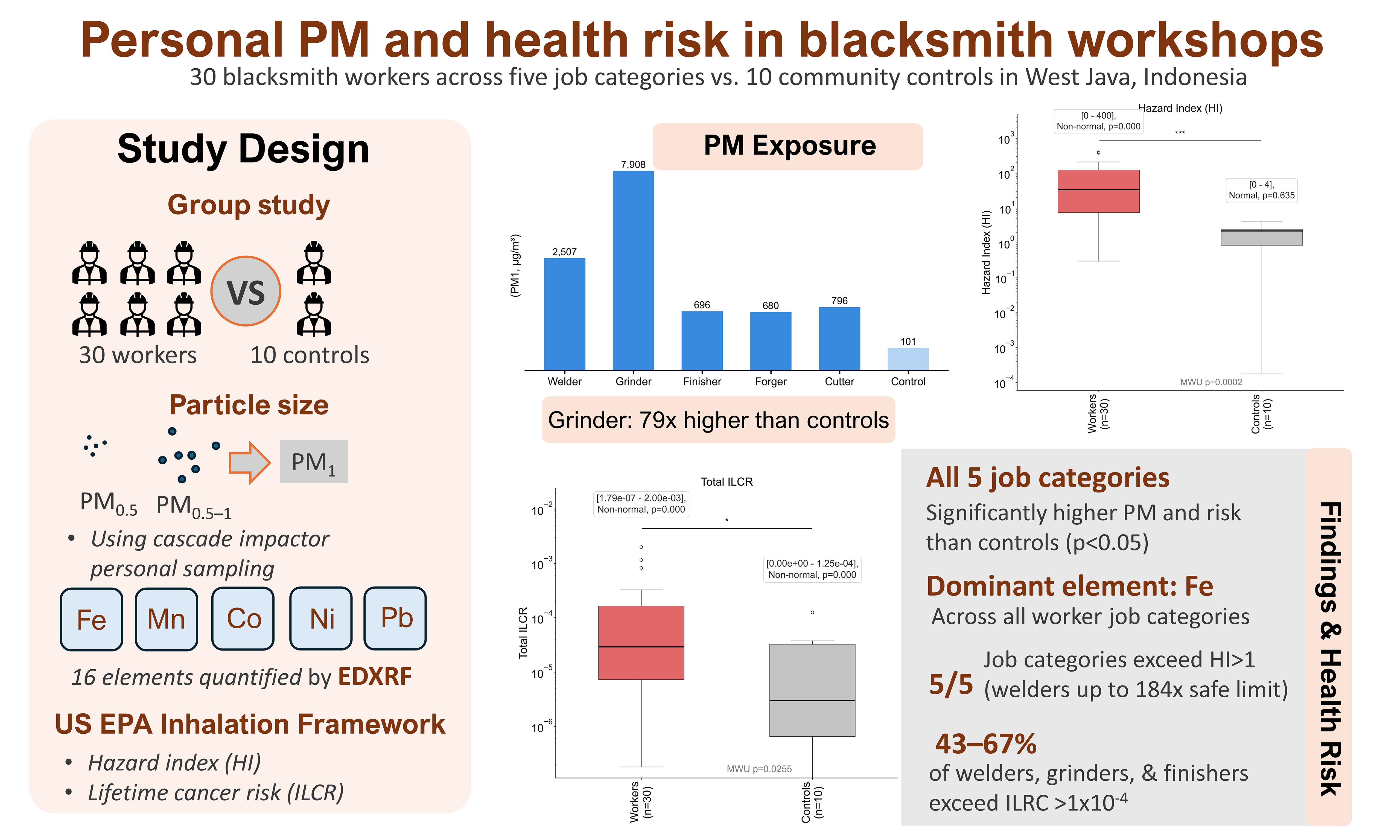
Blacksmith workers in West Java’s informal manufacturing sector face chronic inhalation exposure to metal-laden particulate matter (PM), yet quantitative health-risk data for this population remain scarce. This cross-sectional study is, to our knowledge, among the first to jointly characterize personal PM exposure across two aerodynamic size fractions (PM0.5 and PM0.5-1) among 30 male blacksmith workers spanning five job categories (Welder, n = 7; Grinder, n = 9; Finisher, n = 4; Forger, n = 7; Cutter, n = 3) and 10 non-metalworking community controls. Size-fractionated PM was collected in the breathing zone during full working shifts using a personal cascade impactor. Sixteen elements (Al, Si, S, Cl, K, Ca, Ti, Cr, Mn, Fe, Co, Ni, Cu, Zn, As, Pb) were quantified by energy-dispersive X-ray fluorescence (EDXRF), and exposure concentrations (EC) were derived using job-specific inhalation parameters. Non-carcinogenic [hazard quotient/hazard index, HQ/HI] and carcinogenic (incremental lifetime cancer risk, ILCR) risks were assessed following the US EPA framework. Total PM was highest among Grinders (7,908 ± 15,258 µg/m3) and Welders (2,507 ± 1,590 µg/m3), exceeding controls (101 ±
Keywords
INTRODUCTION
Occupational exposure to airborne particulate matter (PM) and its PM-bound toxic elemental constituents is a major yet preventable health hazard in the informal manufacturing sector, particularly in low- and middle-income countries (LMICs)[1]. Metalworking operations such as arc welding, abrasive grinding, forging, and cutting generate sub-micron PM that is commonly enriched in iron (Fe), manganese (Mn), chromium (Cr), cobalt (Co), nickel (Ni), and arsenic (As), elements that carry well-established inhalation toxicity and, in several cases, recognized carcinogenic potential in humans[2-5]. Exposure to such metal-laden PM has been consistently associated with a broad spectrum of adverse health outcomes, including pulmonary inflammation, cardiovascular dysfunction, and metabolic disruption. Yet the specific exposure levels and elemental drivers responsible for these outcomes remain poorly quantified in real-world occupational settings, particularly within the informal sector, where exposure controls are minimal, and monitoring is rare.
Numerous studies have documented that PM2.5 levels at workshop stations such as welding and grinding bays frequently exceed national and international air-quality standards, that hazard quotients (HQs) for Mn reach critical levels, and that the carcinogenic risk from Cr(VI) can surpass acceptable thresholds[6,7]. These processes commonly generate fine and even ultrafine particles (UFP), which can trigger systemic inflammation and neurological impairment, effects that have been mechanistically linked to the metal fraction of PM2.5. Elemental constituents of these particles, notably Mn, Fe, and Co, may disrupt glucose homeostasis, reduce heart-rate variability, and impair sleep quality in exposed workers[3,8-10]. Biomonitoring studies further confirm the accumulation of these metals in the biological tissues of metalworkers, underscoring the chronic nature of occupational metal exposure[11]. Despite this evidence, personal-exposure studies that jointly characterize size-segregated PM and its elemental composition remain rare, particularly among informal blacksmith workers in Southeast Asia. In Indonesia, the blacksmith industry provides livelihoods for many thousands of workers, especially on Java Island; however, most operate under semi-informal conditions with minimal occupational-health surveillance. This surveillance gap leaves the exposure–response relationship for a substantial workforce almost entirely uncharacterized.
Metalworking activities generate substantial quantities of PM spanning the ultrafine, fine, and coarse size ranges, a large fraction of which deposits deep within the alveolar region of the lung. Once deposited, the metal constituents of PM can exert local pulmonary toxicity and enter the systemic circulation[9,12,13]. These particles carry a range of harmful elemental species, including Mn, Ni, and Co. Manganese inhaled above occupational reference concentrations causes manganism, a progressive parkinsonian neurodegenerative syndrome[14-19], while chronic cobalt exposure is associated with hard-metal lung disease, hypersensitivity pneumonitis, and occupational asthma; cobalt is classified by the International Agency for Research on Cancer (IARC) as a possible (Group 2B) carcinogen by inhalation[14,20]. Hexavalent chromium, arsenic, and nickel compounds are IARC Group 1 carcinogens[21]. Despite this well-documented hazard profile, personal-exposure data quantifying PM sub-fraction composition, elemental speciation, and the associated health risk in Indonesian workplaces, particularly blacksmith workshops, are essentially absent from the peer-reviewed literature[22].
Aerodynamic size fraction is a critical determinant of both metal-source attribution and respiratory deposition. Particles smaller than 500 nm, generated chiefly by the condensation of metallic vapors during arc welding and plasma cutting, deposit efficiently in the alveolar region and can carry high concentrations of transition metals[23-25]. Particles in the 0.5-1 µm range, produced mainly by mechanical abrasion during grinding and cutting, exhibit mixed tracheobronchial and alveolar deposition and tend to be enriched in elements derived from workpiece and abrasive-wheel fragmentation[26,27]. Because personal breathing-zone monitoring captures the concentration actually inhaled by the individual worker, it constitutes the most directly relevant exposure metric for health-risk assessment[28-31]. Simultaneously characterizing both PM fractions in breathing-zone samples therefore provides a substantially more complete exposure picture than single-fraction measurements or static indoor air-quality monitoring alone[32].
Accordingly, this study addresses these gaps through a cross-sectional personal-exposure assessment conducted in traditional blacksmith workshops in Bandung Regency, West Java Province, Indonesia. The specific objectives were: (i) to quantify personal PM0.5 and PM0.5-1 concentrations across five blacksmith job categories and a community control group; (ii) to characterize individual exposure concentrations (EC) for sixteen metal constituents using the US EPA inhalation-exposure framework; (iii) to assess non-carcinogenic [HQ/hazard index (HI)] and carcinogenic [incremental lifetime cancer risk (ILCR)] health risks by job category; and (iv) to compare occupational risk levels against a non-metalworking control group in order to quantify the incremental risk attributable to metalworking activities. This comparison provides an evidence base for prioritizing and targeting occupational-health interventions.
EXPERIMENTAL
Study design and setting
A cross-sectional occupational-exposure study was conducted in traditional blacksmith workshops in Bandung Regency, West Java Province, Indonesia; a detailed description of the sampling location is available in our previous publication[22]. The workshops operate in semi-enclosed, naturally ventilated structures. The standard working day was 6 h for blacksmiths (5 h for Forgers) and 8 h for controls, with exposure frequencies of 311 days/year for blacksmiths and 365 days/year for controls, reflecting occupational and residential exposure scenarios, respectively [Supplementary Table 1]. Ethical approval was obtained from the Research Ethics Committee of Universitas Padjadjaran, Bandung, Indonesia (approval number 1151/UN6.KEP/EC/2024, issued 01 November 2024). All ethical requirements were strictly observed to protect participants’ rights and welfare, and informed consent was obtained through a two-stage process combining verbal explanation and signed handwritten consent prior to data collection.
Study participants
Thirty male blacksmith workers were enrolled across five job categories: Welder (n = 7), Grinder (n = 9), Finisher (n = 4), Forger (n = 7), and Cutter (n = 3). A non-metalworking control group of ten individuals was recruited concurrently from community occupations, including Farmer (n = 5), Tailor (n = 2), Seller (n = 1), Teacher (n = 1), and Driver (n = 1). Controls were selected using inclusion and exclusion criteria comparable to those applied to the exposed group. Eligible controls were individuals who were not blacksmiths, had never engaged in routine metalworking throughout their lives, and resided at least 5 km from any blacksmith workshop or other relevant emission source. No respiratory protective equipment (masks, respirators, or face shields) was worn by any participant during sampling; consequently, the measured breathing-zone concentrations represent the actual inhaled concentrations, without adjustment for a protection factor.
Personal airborne PM sampling
Personal airborne PM was collected using a Personal Nano Sampler (PNS), originally developed by Furuuchi et al. (2010)[33] and subsequently refined by Thongyen et al. (2015)[34] for breathing-zone nanoparticle exposure assessment. Sampling was carried out between 17 May and 19 June 2025 in West Java, Indonesia, during the transition to the early dry season. Each worker wore the PNS with the inlet positioned in the breathing zone, approximately 15-20 cm from the mouth and nose, to capture representative occupational inhalation exposure over a full working shift. PM was collected on 46.2 mm PTFE membrane filters (2 µm pore size; Whatman™, Cytiva, UK; Product No. 7592-104) supported by a polypropylene ring; filters were pre-weighed and acid-cleaned before sampling.
A portable battery-operated pump (ASP-6000; Komyo Rikagaku Kogyo K.K., Kawasaki, Japan) was connected to the PNS outlet via flexible resin tubing and operated at a flow rate of 4 L/min, with flow verified before and after each sampling event. Samples collected on the impactor and inertial-filter substrates, corresponding to the two aerodynamic size fractions PM0.5 and PM0.5-1, were selected for gravimetric and chemical analysis because these ranges encompass the respirable fraction most relevant to deep-lung deposition.
Filters were conditioned at 20 ± 2 °C and 45% ± 5% relative humidity (RH) for at least 48 h both before and after sampling to equilibrate moisture content. Pre- and post-sampling weights were determined on a Mettler Toledo MX5 semi-microbalance (Mettler Toledo, Switzerland; readability 1 µg) under these controlled conditions. Mass concentrations of PM in each size fraction were calculated from the net mass gain and the total volume of sampled air. Given the exceptionally high PM loadings recorded in Grinder samples, all post-sampling filters were visually inspected; they appeared homogeneous, with no evidence of overloading, particle breakthrough, or membrane rupture, and all samples were therefore retained for analysis.
Elemental analysis by energy-dispersive X-ray fluorescence
The chemical composition of the filter-collected PM was determined on an Epsilon 5 energy-dispersive X-ray fluorescence (EDXRF) spectrometer (PANalytical, The Netherlands) at the National Research and Innovation Agency (BRIN), Bandung, Indonesia, following US EPA Compendium Method IO-3.3 (Determination of Metals in Ambient Particulate Matter Using X-Ray Fluorescence Spectroscopy)[35]. The instrument is equipped with an Sc/W X-ray tube and a high-resolution Ge detector, and was calibrated with thin-film standards (Micromatter Technologies, P220-Prague and V149-Vienna) using least-squares regression. Quality assurance and method validation were performed using NIST SRM 2783 (Air Particulate on Filter Media). Recoveries for all sixteen analyzed elements ranged from 98%-102%, with a systematic bias of -1.99% to +1.99% and analytical precision (%CV) of 0.60%-7.23%, indicating good accuracy and reproducibility. A blank membrane filter was analyzed and used for blank subtraction across all samples, and QC samples were monitored periodically throughout each analytical run to verify instrument performance. All sixteen target elements were consistently detected above background levels in every worker sample.
XRF is a nuclear-based analytical technique that provides both qualitative and quantitative elemental determination by measuring the characteristic X-rays emitted from atoms excited by a primary X-ray source. It was selected here because it is non-destructive, preserving the samples for further analysis, and because it enables rapid multi-element detection with minimal sample preparation; the method is widely used in PM characterization studies. Sixteen elements were quantified: aluminum (Al), silicon (Si), sulfur (S), chlorine (Cl), potassium (K), calcium (Ca), titanium (Ti), chromium (Cr), manganese (Mn), iron (Fe), cobalt (Co), nickel (Ni), copper (Cu), zinc (Zn), arsenic (As), and lead (Pb). The airborne concentration of each element (CA, µg/m3) was calculated by dividing the measured elemental mass on the filter by the total volume of sampled air. The EDXRF scan covered the full active filter area, so concentrations were reported directly without area extrapolation. Because the method determines total elemental concentrations and cannot distinguish chemical species or oxidation states [e.g., Cr(III) vs. Cr(VI), or Mn2+ vs. Mn3+/Mn4+], all health-risk characterization is based on total elemental concentrations. This is a conservative assumption and is consistent with standard practice in occupational health-risk assessment when speciation data are unavailable.
Inhalation exposure assessment
CA denotes the elemental concentration measured directly in the breathing zone over full working shifts. Because no participant wore respiratory protective equipment during sampling (see previous section), CA represents the actual inhaled concentration without adjustment for a protection factor. For contextual comparison with occupational exposure limits expressed as 8-hour time-weighted averages (TWA), CA values were scaled as CA × (ET/8) for groups with ET < 8 h. This scaling is provided for reference only and does not affect the primary risk calculations.
Individual EC were calculated following the Risk Assessment Guidance for Superfund, Volume I: Human Health Evaluation Manual (Part F, Supplemental Guidance for Inhalation Risk Assessment; US EPA, 2009)[36]:
where EC = exposure concentration (µg/m3), CA = contaminant concentration in air (µg/m3), ET = exposure time (h/day), EF = exposure frequency (days/year), ED = exposure duration (years), and AT = averaging time (h). For the carcinogenic pathway, ATcar = 70 yr × 365 days × 24 h = 613,200 h for all participants; for the non-carcinogenic pathway, ATnoncar = ED × 365 × 24 and therefore varies by individual. Two EC values were computed per participant per metal, namely ECNonCar (non-carcinogenic) and ECCar (carcinogenic).
Health risk characterization
Non-carcinogenic risk was calculated as HQ = ECNonCar/RfC, and the HI as HI = ΣHQ. An HI ≤ 1 indicates acceptable risk, whereas HI > 1 indicates potential adverse non-carcinogenic effects. Inhalation reference concentrations (RfC, µg/m3) compiled from US EPA (2023), US EPA (2024), ATSDR (2021), NAAQS (2022), OSHA, and OEHHA (2024) were applied for the eight metals with adequate data: Cr (1,000), Mn (0.05), Co (0.02), Ni (0.014), Cu (100), Zn (5,000), As (0.015), and Pb (0.15) [Supplementary Table 2][36].
Carcinogenic risk was calculated as ILCR = ECCar × IUR, with ILCRtotal = ΣILCR. An ILCR between 1 × 10⁻⁶ and 1 × 10⁻⁴ is considered acceptable, whereas ILCR > 1 × 10⁻⁴ exceeds the upper threshold. Inhalation unit-risk [IUR, (µg/m3)-1] values from the US EPA IRIS database were applied for Co (9 × 10⁻³), Ni (2.4 × 10⁻⁴), As (4.3 × 10⁻³), and Pb (8 × 10⁻⁵) [US EPA IRIS, 2024; and US EPA Regional Screening Levels (RSL), 2024][36].
Statistical analysis
Descriptive statistics [mean, standard deviation (SD), median, P95, and maximum] were computed by job category. The Shapiro–Wilk test confirmed that all key variables were non-normally distributed. Kruskal–Wallis H tests assessed inter-group differences across the six groups (five worker categories plus controls), and two-sided Mann–Whitney U tests compared pooled workers with controls. Statistical significance was set at P < 0.05.
RESULTS AND DISCUSSION
PM concentrations by job category
PM concentration data are presented in Supplementary Table 3 and Figure 1, and participant characteristics with job-specific exposure parameters are summarized in Supplementary Table 1. Mean PM0.5 concentrations ranged from 193 µg/m3 (Cutters; SD 121.3) to 963 µg/m3 (Grinders; SD 1,152). For PM0.5-1, Grinders dominated, with a mean of 6,945 µg/m3 (SD 14,201) and a maximum of 44,116 µg/m3, exceeding all other groups by a factor of four or more and reflecting the intense particle generation associated with mechanical abrasion. Total PM (the sum of PM0.5 and PM0.5-1, i.e., PM1) was highest in Grinders (7,908 ± 15,258 µg/m3) and Welders (2,507 ± 1,590 µg/m3), whereas controls averaged only 101 µg/m3 (SD 35.7). The Kruskal–Wallis test confirmed significant inter-group differences (H = 30.8, P < 0.001). Individual job-category means exceeded the control mean by 25- to 78-fold (Welders and Grinders, respectively), while pooled workers as a group exceeded controls by a median factor of ~14 (median 1,467 vs. 103 µg/m3; Mann–Whitney U = 300, P = 0.000003).
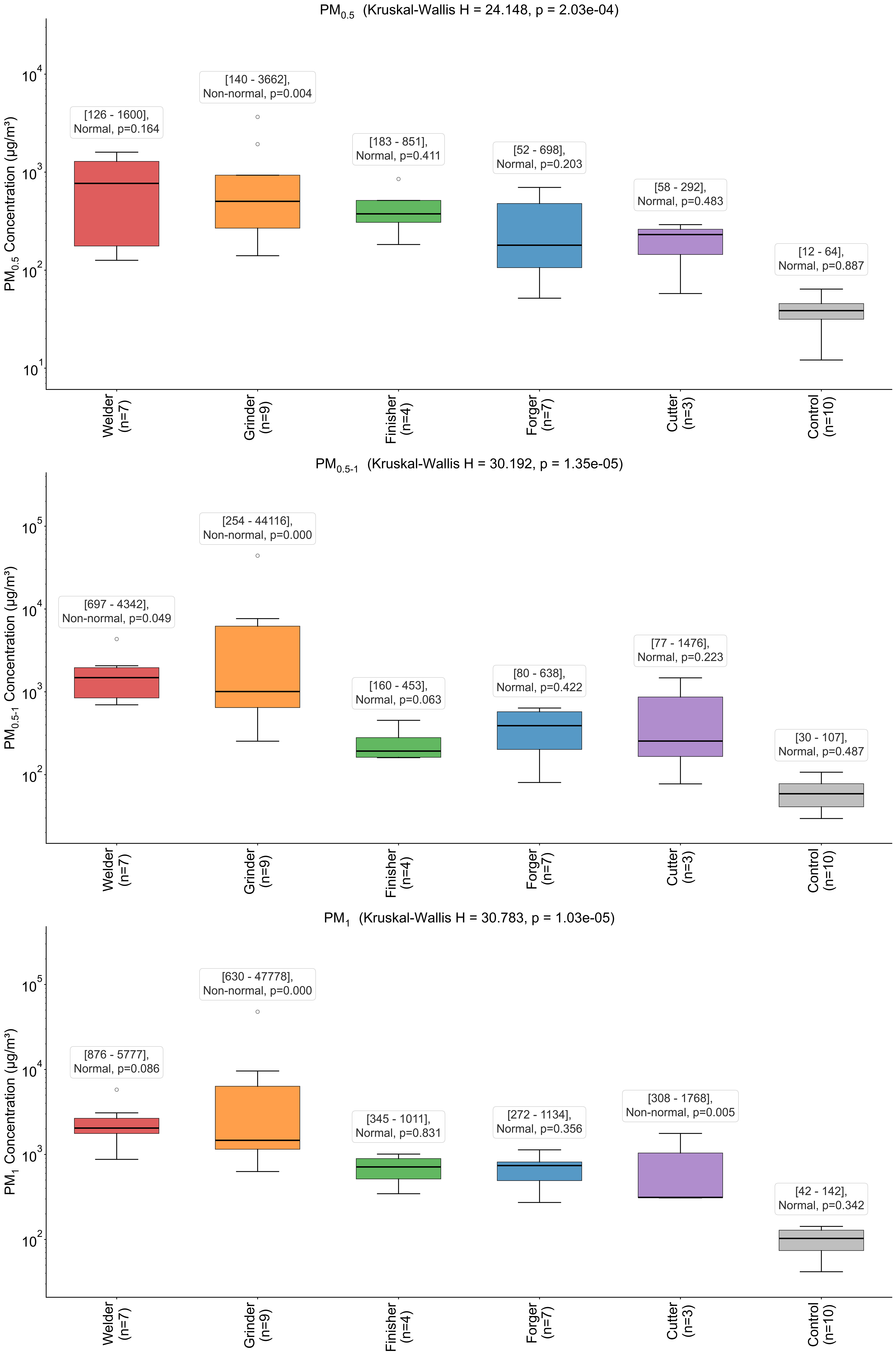
Figure 1. Box plots of PM concentration by occupation and size fraction (log scale). Boxes: 25th-75th percentile; horizontal line: median; whiskers: 1.5× IQR; circles: outliers. PM: Particulate matter; IQR: interquartile range.
The PM concentrations documented here are extreme by any international standard. Because no dedicated standard exists for any PM size fraction in indoor or occupational settings, ambient air-quality standards are commonly used as the reference; among these, PM2.5 guidelines are most frequently applied because their health effects are well established and widely recognized by bodies such as the World Health Organization (WHO). Since this study measured PM1 (the sum of PM0.5 and PM0.5-1), PM1 concentrations were compared with PM2.5 standards as the closest available reference. In our previous study[22], PM1 accounted for 85%-92% of PM2.5, indicating that the great majority of particles are sub-micron and only about 8%-15% exceed
The markedly higher PM0.5-1 concentration in Grinders (mean 6,945 µg/m3) relative to their PM0.5 concentration (963 µg/m3) indicates that grinding predominantly generates coarser particles. This is consistent with the mechanism of grinding, in which mechanical fracture of the abrasive wheel and metal surface produces particles typically in the 0.5-10 µm range. Welding, by contrast, generates much finer particles (< 0.5 µm) through the condensation and nucleation of metal fumes[40-44]. These contrasting sub-fraction profiles carry direct health implications: welding-fume particles deposit predominantly in the alveolar region and carry a high toxic-metal load per unit mass, whereas grinding particles show mixed tracheobronchial–alveolar deposition and produce total mass exposures far exceeding those of welding.
Cross-country comparisons must be interpreted cautiously because of differences in sampling methods and the particle-size fractions measured. Even so, the available evidence indicates that the PM concentration observed here, particularly for grinders and welders, is substantially higher than those reported elsewhere. For instance, PM2.5 concentrations in welding environments have been reported at roughly 132-306 µg/m3 in China[7] and up to 490-1,727 µg/m3 in metalworking settings in Kazakhstan[45], while in the United States PM1 and PM2.5 ranged from 109-196 and 112-197 µg/m3 in small fabrication shops[46]. By comparison, the mean PM1 concentration for Grinders in this study reached 7,908 µg/m3 and total PM for Welders reached
Elemental concentration profiles and source attribution
Concentrations of all sixteen elements (CA) are reported in Supplementary Table 4 and visualized in Figure 2 and Supplementary Figure 1. Iron (Fe) was the dominant metal in every blacksmith group, followed by Si and K. Welders recorded the highest CAFe (380 µg/m3; SD 334), followed by Grinders (200 µg/m3) and Finishers (199 µg/m3), whereas controls averaged only 1.0 µg/m3.
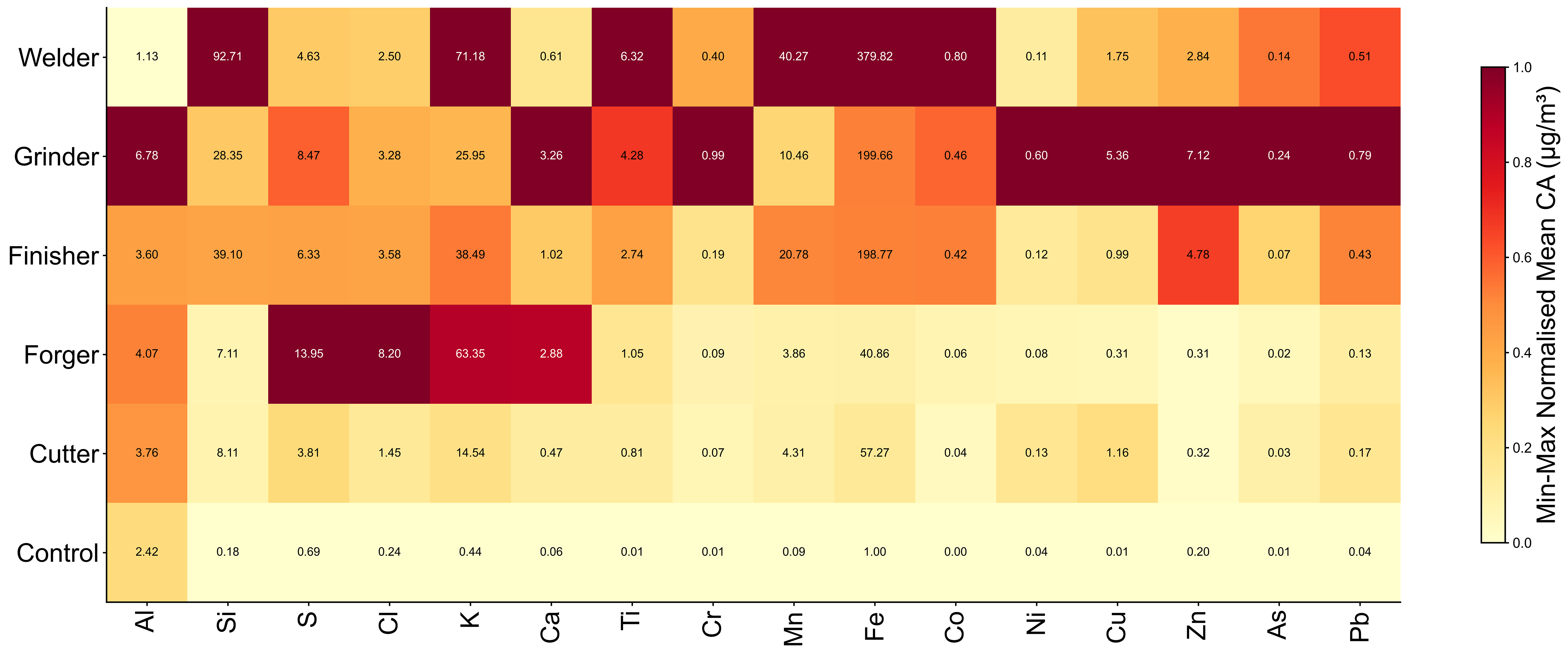
Figure 2. Normalized heatmap of mean metal concentrations (CA, µg/m3) by occupation. Color = min–max normalized value; cell annotations = raw mean CA. CA: Contaminant concentration in air.
Manganese was markedly elevated in Welders (40.3 µg/m3; SD 34.9) and Finishers (20.8 µg/m3), consistent with Mn-bearing electrode coatings. Silicon was elevated in Welders (92.7 µg/m3), most likely originating from silica-containing electrode flux. Cobalt was highest in Welders (0.80 µg/m3) and Grinders (0.46 µg/m3), consistent with Co-bonded hard-metal tool inserts, and arsenic was highest in Grinders (0.24 µg/m3) and Welders (0.14 µg/m3).
Because site-specific material-specification data were unavailable (see Limitations), the elemental signatures observed across job categories are interpreted in light of material inputs typically reported for comparable metalworking processes. The dominance of Fe reflects the carbon-steel substrate worked throughout the production chain. The much higher CAFe in Welders (380 µg/m3) than in Forgers (40.9 µg/m3) is attributable to the arc-welding process, in which electrode and workpiece Fe is volatilized and oxidized at high temperature to form sub-micron Fe-oxide fume (Fe2O3/Fe3O4)[47-50]. Forger CAFe (40.9 µg/m3), by contrast, reflects mechanical scale generation at the lower temperatures of hammer forging. The elevated K concentrations are most plausibly associated with the charcoal combustion used during forging[51,52], whereas Si reflects both its role as a minor alloying element in steel and its release during high-temperature processing[53].
Manganese concentrations were highest in Welders (40.3 µg/m3), consistent with the 0.5%-2.5% Mn content of mild-steel electrodes. In welding fume, Mn occurs predominantly as Mn3O4 and MnO, oxidation states that cross the blood–brain barrier more efficiently than others[54,55]. The mean CAMn for Welders (40.3 µg/m3 = 0.040 mg/m3), or 0.030 mg/m3 after 8-h TWA adjustment (CA × ET/8), exceeds the ACGIH Threshold Limit Value for Mn fume (0.02 mg/m3) by ~1.5-fold and is far above the levels (~0.001 mg/m3) that some studies have linked to subclinical neurological effects, indicating severe overexposure[56-58].
The higher Co levels in Welders (0.8 µg/m3) and Grinders (0.5 µg/m3) most likely arise from the use of cobalt-bonded tungsten carbide (WC–Co) tools. Cobalt exposure during the cutting and grinding of such hard metals is a well-recognized cause of hard-metal lung disease[59,60], and even low concentrations are of concern given cobalt’s high toxicity and established carcinogenic potential[61].
Non-carcinogenic risk: manganese neurotoxicity as the primary concern
Non-carcinogenic risk results are presented in Supplementary Tables 5-7, Table 1 and Figure 3. Manganese was overwhelmingly the dominant HQ contributor, accounting for > 90% of total HI in Welders and Finishers. Mean HQMn ranged from 172 (Welders) to 13.7 (Forgers) across job categories, compared with 0.63 in controls. Cobalt was the second most important driver, with mean HQCo = 8.5 (Welders), 4.9 (Grinders), and 4.5 (Finishers). Nickel produced a notable HQNi of 9.1 in Grinders (100% exceeding HQ = 1), reflecting the low RfC for Ni combined with high PM loading and long exposure duration. Arsenic contributed mean HQAs = 3.5 (Grinders) and 1.9 (Welders), whereas chromium, copper, and zinc contributed negligible HQ values (< 0.01) across all groups.
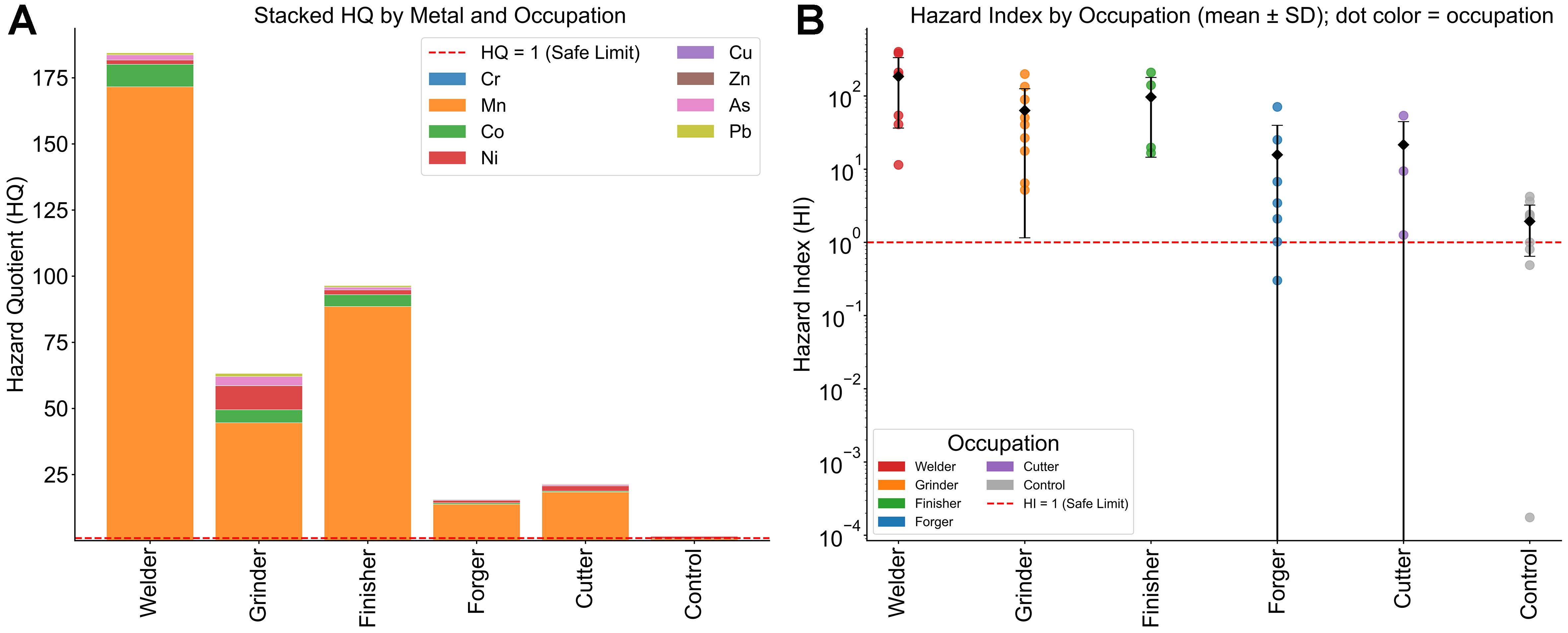
Figure 3. Non-carcinogenic risk. (A) Stacked mean HQ by metal and occupation; dashed red line: HQ = 1; (B) HI dot plot (log scale); diamonds: mean ± SD; dashed red line: HI = 1. HQ: Hazard quotient; HI: hazard index; SD: standard deviation.
Statistical test results: Kruskal–Wallis H test (all groups combined) and Mann–Whitney U test (workers pooled vs. controls)
| Variable | Test | Comparison | Statistic | P-value | Significant |
| PM total | Kruskal–Wallis | All groups | H = 30.78 | < 0.001 | Yes |
| PM total | Mann–Whitney U | Workers vs. controls | U = 300 | 0.000003 | Yes*** |
| HI | Kruskal–Wallis | All groups | H = 24.32 | < 0.001 | Yes |
| HI | Mann–Whitney U | Workers vs. controls | U = 271 | 0.0002 | Yes*** |
| ILCR total | Kruskal–Wallis | All groups | H = 18.07 | 0.003 | Yes |
| ILCR total | Mann–Whitney U | Workers vs. controls | U = 222 | 0.026 | Yes* |
| HQ_Mn | Kruskal–Wallis | All groups | H = 25.24 | < 0.001 | Yes |
| HQ_Mn | Mann–Whitney U | Workers vs. controls | U = 279 | < 0.001 | Yes*** |
| HQ_Co | Kruskal–Wallis | All groups | H = 19.63 | 0.001 | Yes |
| HQ_Co | Mann–Whitney U | Workers vs. controls | U = 264 | 0.0003 | Yes*** |
| HQ_As | Kruskal–Wallis | All groups | H = 17.24 | 0.004 | Yes |
| HQ_As | Mann–Whitney U | Workers vs. controls | U = 233 | 0.009 | Yes** |
| HQ_Ni | Kruskal–Wallis | All groups | H = 13.66 | 0.018 | Yes |
| HQ_Ni | Mann–Whitney U | Workers vs. controls | U = 208 | 0.072 | No (ns) |
| HQ_Pb | Kruskal–Wallis | All groups | H = 15.32 | 0.009 | Yes |
| HQ_Pb | Mann–Whitney U | Workers vs. controls | U = 228 | 0.013 | Yes* |
The HI exceeded the acceptable limit (HI > 1) in all five blacksmith categories [Supplementary Table 6]. Welders recorded the highest mean HI (184 ± 160; 100% exceedance), followed by Finishers (96.4 ± 94.6), Grinders (63.2 ± 65.8), Cutters (21.4 ± 28.2), and Forgers (15.7 ± 25.9; 85.7% exceedance). Controls had a mean HI of 1.9 (SD 1.4; 70% exceeding HI = 1), indicating low-level community exposure to Mn, Ni, and Co. Workers had significantly higher HI than controls (Table 1; Kruskal–Wallis H = 24.32, P < 0.001; Mann–Whitney U = 271, P = 0.0002).
Manganese dominates the non-carcinogenic risk profile, contributing 90%-95% of total HI in Welders and Finishers. The mean HI values of 184 (Welders) and 96.4 (Finishers) correspond to 184-fold and 96-fold exceedances of the acceptable HI = 1 threshold. These are among the highest values reported in the occupational Mn-exposure literature and indicate a severely elevated neurotoxic risk. Early signs of Mn neurotoxicity, including psychomotor slowing, tremor, and mood disturbances[62-64], have been documented in welders exposed to air Mn concentrations of 0.11-0.46 mg/m3[62], a range that the mean CAMn for Welders in this study (0.04 mg/m3) closely approaches, pointing to a critically elevated risk of manganism.
Cobalt is the second major non-carcinogenic risk driver, with HQCo of 8.5 (Welders), 4.9 (Grinders), and 4.5 (Finishers); values well above unity indicate an elevated risk of hard-metal lung disease. The unexpected finding of HQNi = 9.1 with 100% exceedance in Grinders, despite a relatively low absolute CANi (0.60 µg/m3), reflects the combined effect of a very low RfC (0.014 µg/m3; US EPA IRIS) and Ni concentrations elevated relative to other job categories. Because HQ is independent of exposure duration, this hazard is distinct from the duration-sensitive carcinogenic pathway and indicates that even short-term Ni exposure at this concentration carries meaningful non-carcinogenic risk. Nickel compounds are classified as carcinogenic to humans (IARC Group 1)[21], and occupational exposure has been linked to increased risks of lung and nasal cancers[65,66]; nickel exposure should therefore be monitored in Grinders as part of occupational-health surveillance.
The 70% HI > 1 exceedance among controls (mean HI = 1.93) suggests a marginal but non-negligible community-level risk from Mn and Co, likely originating from agricultural Mn inputs, road dust, and other ambient sources. Although well below worker levels, this residual community risk should be incorporated into total risk estimates when communicating findings to the affected population. and may warrant independent investigation of ambient Mn and Co sources in the surrounding community.
Carcinogenic risk: cobalt as the dominant driver
Carcinogenic risk results are presented in Supplementary Tables 5-7 and Figure 4. Cobalt was the principal ILCR driver across all blacksmith groups, with mean ILCRCo of 4.8 × 10⁻⁴ (± 7.2 × 10⁻⁴) for Welders, 1.6 × 10⁻⁴ (± 2.3 × 10⁻⁴) for Grinders, and 7.6 × 10⁻⁵ (± 8.1 × 10⁻⁵) for Finishers. Arsenic contributed a minor but non-negligible ILCR in Grinders and Welders, whereas the contributions of Ni and Pb were negligible in all groups.
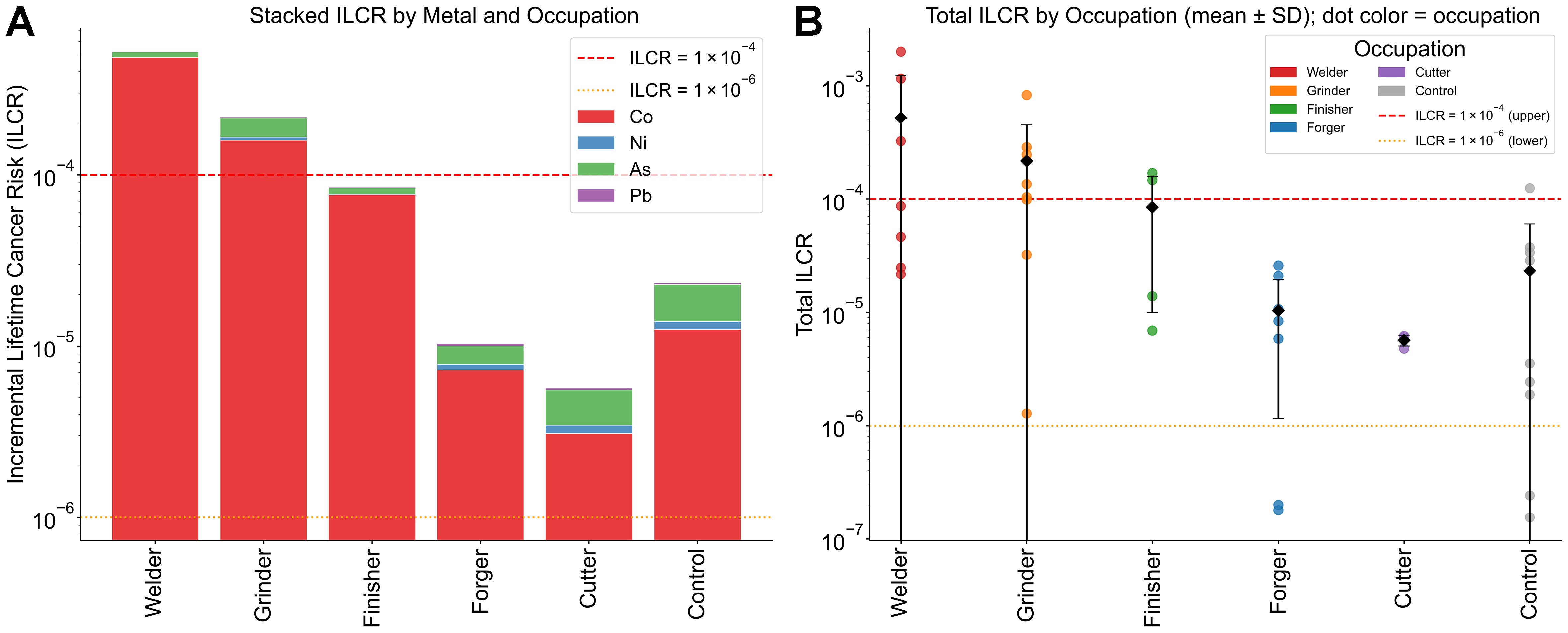
Figure 4. Carcinogenic risk. (A) Stacked ILCR by metal and occupation (log scale); dashed lines: ILCR thresholds 1 × 10⁻⁴ and 1 × 10⁻⁶; (B) Total ILCR scatter (log scale); diamonds: mean ± SD. ILCR: Incremental lifetime cancer risk; SD: standard deviation.
The upper ILCR threshold (1 × 10⁻⁴) was exceeded by 42.9% of Welders, 66.7% of Grinders, and 50.0% of Finishers [Supplementary Figure 2], while Forgers and Cutters showed no exceedance. Controls exhibited 10% exceedance, consistent with elevated ambient Co in the surrounding community. Workers had significantly higher ILCRtotal than controls (Kruskal–Wallis H = 18.07, P = 0.003; Mann–Whitney U = 222, P = 0.026; Table 1).
Mirroring the non-carcinogenic results, cobalt is the principal contributor to carcinogenic risk. Mean ILCRCo in Welders (4.8 × 10⁻⁴) and Grinders (1.6 × 10⁻⁴) lies well above the 1 × 10⁻⁴ upper acceptable threshold, whereas in Finishers the mean (7.6 × 10⁻⁵) falls just below it. This Co-dominated cancer-risk profile is unusual in the metalworking ILCR literature, which more commonly identifies Cr(VI) and Ni as the principal drivers in formal-sector manufacturing[7,59,65]. Its prominence here reflects the specific WC–Co hard-metal tooling used in West Java blacksmith production and underscores the value of job-category-specific elemental analysis over generic metalworking-exposure characterization.
Worker vs. control comparison and correlation analysis
Figure 5 and Table 1 present the direct worker-versus-control comparison. Workers had significantly higher total PM (median 1,467 vs. 103 µg/m3; Mann–Whitney U, P = 0.000003), HI (median 40.7 vs. 2.2; P = 0.0002), and ILCRtotal (P = 0.026) than controls. Spearman correlation analysis among workers [Figure 6] identified CAFe and CAMn as the elements most strongly correlated with the aggregate risk indices (CAFe–HI, ρ = 0.97; CAMn–HI, ρ = 0.98; CAFe–ILCRtotal, ρ = 0.83; CAAs–ILCRtotal, ρ = 0.85; all P < 0.001). Metal-specific scatter analyses of the pooled worker-and-control dataset [Supplementary Figure 3] resolved these relationships at the level of individual hazard and cancer indices, confirming strong positive associations between CAFe and HI (ρ = 0.951, P < 0.001), CAMn and HQMn (ρ = 0.998, P < 0.001), and CAAs and ILCRAs (ρ = 0.895, P < 0.001). Because Mn and As are major contributors to their respective risk indices, and Fe is a strong correlate of HI despite not entering its calculation, the consistency of these associations across both the worker-only [Figure 6] and pooled worker–control [Supplementary Figure 3] analyses supports a common occupational source for these elements.
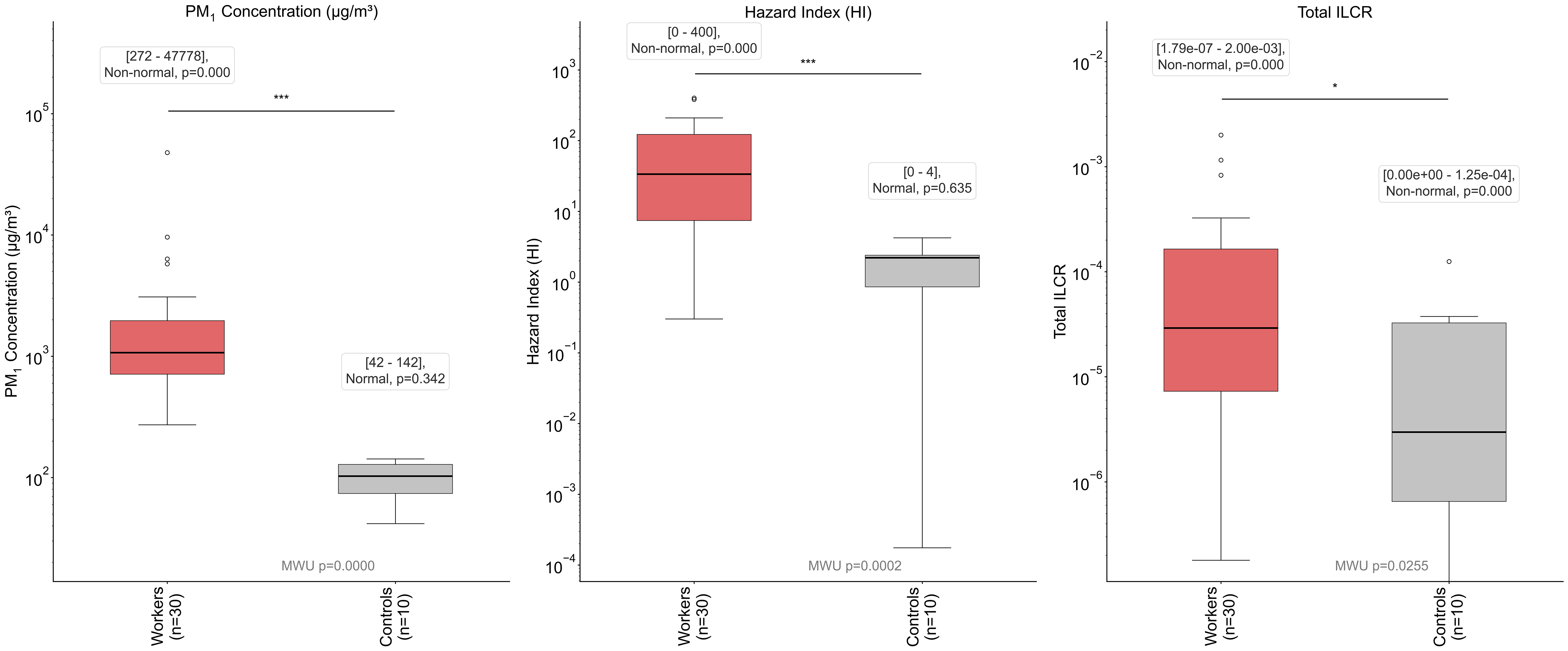
Figure 5. Box plots comparing Workers (n = 30) vs. Controls (n = 10) for total PM, HI, and ILCR_total. *P < 0.05; ***P < 0.001 (Mann-Whitney U, two-sided). PM: Particulate matter; HI: hazard index; ILCR: incremental lifetime cancer risk.
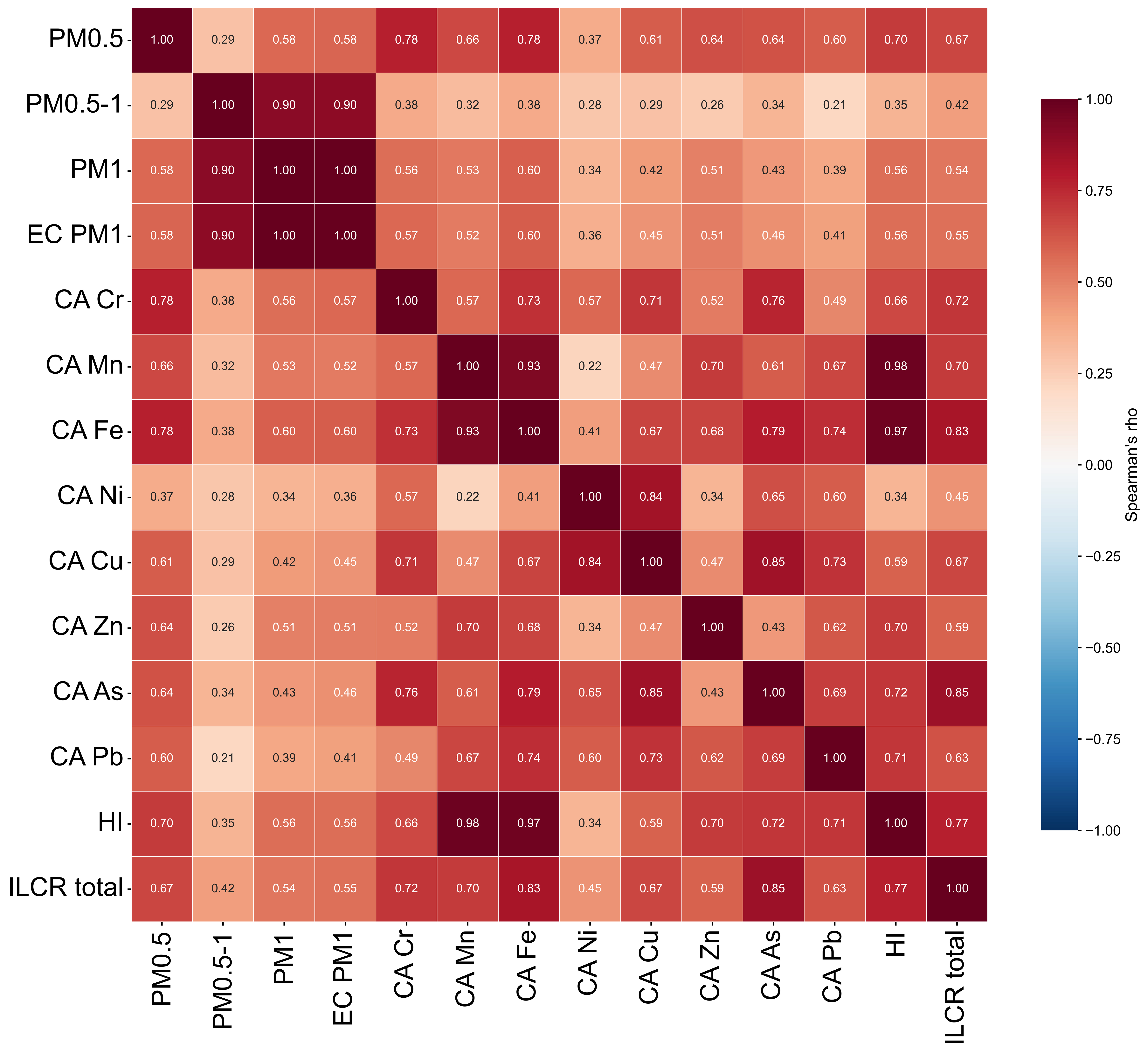
Figure 6. Spearman correlation matrix for workers: PM total, metal CA, HI, and ILCR_total. Red = positive, blue = negative correlation; values = Spearman’s rho. PM: Particulate matter; CA: contaminant concentration in air; HI: hazard index; ILCR: incremental lifetime cancer risk.
Policy implications and intervention priorities
The magnitude of the risks documented here makes intervention imperative, and three measures should take priority. First, source-directed local exhaust ventilation (LEV) installed within 0.3-0.5 m of the welding arc and grinding point can be expected to reduce breathing-zone PM and Mn by 70%-95%, based on international LEV performance data[67-69]; general dilution ventilation is inadequate given the extreme point-source emission rates observed. Second, P100 half-face respirators (≥ 99.97% filtration efficiency) should be provided and mandated for all welding, grinding, and finishing tasks. Third, a periodic biological-monitoring program for blood/urinary Mn and urinary Co should be established for all workers with more than one year of employment, given the established value of these biomarkers for manganism and cobalt-related hard-metal lung disease, respectively.
These recommendations must be viewed within the Indonesian regulatory context. The current NAAQS
Limitations
Several limitations warrant acknowledgment. First, the cross-sectional design precludes causal inference regarding health outcomes, and concurrent spirometry, neurological assessment, and biological-monitoring data were not collected. Second, the per-category sample sizes are small (Finishers, n = 4; Cutters, n = 3), limiting the statistical power of intra-category comparisons. Third, monitoring was conducted in a single season, so seasonal variation in PM and elemental concentrations cannot be excluded. Fourth, the US EPA framework applies point estimates of IUR and RfC without Monte Carlo uncertainty propagation, which may understate individual risk variability. Fifth, the PNS collected only two sub-micron fractions (PM0.5 and PM0.5-1); the full inhalable and respirable occupational fractions were not captured, and comparisons with PM2.5 standards are therefore contextual only. Sixth, EDXRF measures total elemental concentrations and cannot resolve chemical species or oxidation states, so all risk estimates reflect worst-case assumptions. Seventh, Grinder samples with extremely high PM loadings, filter overloading, particle bounce, and XRF matrix effects cannot be entirely ruled out. Eighth, concurrent ambient PM data were unavailable, preventing precise characterization of the non-occupational background contribution to control-group PM levels. Ninth, source attribution of the elemental profiles to specific material inputs (steel, electrodes, tooling) rests on consistency with the published metalworking literature rather than site-specific data, because safety data sheets and alloy-composition records were not available from the informal-sector workshops studied.
CONCLUSION
This study provides the first size-fractionated personal PM exposure and multi-element health-risk assessment for informal blacksmith workers in Indonesia. Total PM (PM1) in Grinders (7,908 µg/m3) and Welders (2,507 µg/m3) exceeded the WHO 24-h PM2.5 guideline by up to 527-fold and surpassed controls by 78- and 25-fold, respectively (P < 0.001). The contrasting size-fraction profiles, fume-dominated PM0.5 in Welders vs. mechanically generated PM0.5-1 in Grinders, call for task-specific rather than uniform mitigation.
Manganese is the overwhelming non-carcinogenic hazard, contributing > 90% of total HI in Welders (mean 184) and Finishers (96.4); all five job categories exceeded HI > 1, and 8-h TWA-adjusted breathing-zone Mn surpassed the ACGIH TLV by ~1.5-fold. Cobalt is the dominant carcinogenic risk driver, an unusual profile attributable to WC–Co tooling rather than the Cr(VI)/Ni pattern typical of formal metalworking, with 42.9% of Welders, 66.7% of Grinders, and 50.0% of Finishers exceeding the upper ILCR threshold (1 × 10⁻⁴). The strong correlations between CAMn and HQMn (ρ = 0.998) and between CAFe and HI (ρ = 0.951) are consistent with occupational source attribution, while the 70% HI > 1 exceedance among controls signals a community-level risk that warrants separate attention.
Three priority interventions are recommended: source-directed LEV within 0.3-0.5 m of welding and grinding points; mandatory P100 respirators for welding, grinding, and finishing tasks; and periodic biological monitoring of blood manganese and urinary cobalt for all workers with more than one year of employment. In parallel, Indonesian occupational-health regulation should be extended to include enforceable workplace exposure limits for Co, Mn, Ni, and other toxic metals. Implementing these measures before this Co- and Mn-dominated risk profile progresses to diagnosed disease is both feasible and urgent.
DECLARATIONS
Acknowledgments
The authors thank the head of Mekarmaju village and staff, together with the owner of the blacksmith workshop, for supporting this study. The authors also acknowledge the Atmospheric Environment and Pollution Control Engineering Laboratory, Kanazawa University, for lending the Personal Nano Sampler used in this study.
Authors’ contributions
Conceptualization: Regia, R. A.; Suharyanto; Amin, M.; Oginawati, K.
Methodology: Regia, R. A.; Suharyanto; Amin, M.; Santoso, M.; Oginawati, K.
Investigation: Regia, R. A
Resources: Suharyanto; Amin, M.; Santoso, M.; Oginawati, K.
Data curation: Regia, R. A.; Oginawati, K.; Santoso, M.; Amin, M.
Writing - original draft preparation: Regia, R. A.
Writing - review and editing: Suharyanto; Amin, M.; Soemarko, D. S.; Oginawati, K.
Supervision: Suharyanto; Soemarko, D. S.; Amin, M.; Oginawati, K.
Project administration: Suharyanto; Oginawati, K.
Funding acquisition: Suharyanto; Oginawati, K.
All authors have read and agreed to the published version of the manuscript.
Availability of data and materials
The data supporting the findings of this study are available from the corresponding author upon reasonable request. They are not publicly available because they contain information that could compromise the privacy of research participants.
AI and AI-assisted tools statement
During the preparation of this manuscript, the AI tool Claude Sonnet 4.6 (Anthropic, claude.ai, released 2026-02-17) was used for two purposes: (i) language editing, including grammar checking and prose refinement; and (ii) generating Python code templates for data analysis, which were subsequently executed, verified, and validated by the authors in a Python environment. The AI tool did not influence the study design and data collection. All authors take full responsibility for the accuracy, integrity, and final content of the manuscript.
Financial support and sponsorship
This research was supported by the P2MI Program, Institut Teknologi Bandung, and by a Ph.D. scholarship awarded to the first author through the Indonesian Education Scholarship (Beasiswa Pendidikan Indonesia), funded by the Indonesia Endowment Fund for Education (LPDP) and administered by the Center for Higher Education Funding and Assessment (PPAPT), Ministry of Higher Education, Science, and Technology of the Republic of Indonesia (Kemendikbudristek). The funding bodies had no role in the study design; data collection, analysis, or interpretation; or the writing of the manuscript.
Conflicts of interest
All authors declared that there are no conflicts of interest.
Ethical approval and consent to participate
This study was approved by the Research Ethics Committee of Universitas Padjadjaran, Bandung, Indonesia (approval number 1151/UN6.KEP/EC/2024, issued 01 November 2024). The ethical clearance is valid for one year from the date of issue. All ethical requirements were strictly observed to protect participants’ rights and welfare, and informed consent was obtained through a two-stage process combining verbal explanation and signed handwritten consent prior to data collection.
Consent for publication
Not applicable.
Copyright
© The Author(s) 2026.
Supplementary Materials
REFERENCES
1. Quintero Santofimio, V.; Amaral, A. F. S.; Feary, J. Occupational exposures in low- and middle-income countries: a scoping review. PLOS. Glob. Public. Health. 2024, 4, e0003888.
2. Abdullahi, I. L.; Sani, A. Welding fumes composition and their effects on blood heavy metals in albino rats. Toxicol. Rep. 2020, 7, 1495-501.
3. Gupta, G. A.; Vishwakarma, P.; Ramkumar, J.; Patil, S.; Gupta, T. Occupational exposure to hazardous emissions in Indian manufacturing: source analysis, control measures, and safety strategies. npj. Clean. Air. 2025, 1, 29.
4. Gobba, N. A. E. K.; Hussein Ali, A.; El Sharawy, D. E.; Hussein, M. A. The potential hazardous effect of exposure to iron dust in Egyptian smoking and nonsmoking welders. Arch. Environ. Occup. Health. 2018, 73, 189-202.
5. Oginawati, K.; Faiqah, N. S. A.; Suharyanto; Regia, R. A.; Amin, M. Indoor PM2.5 and heavy metal composition in blacksmithing factories: a pilot study in Bandung regency, Indonesia. Urban. Sci. 2024, 8, 230.
6. Yen, P.; Chung, H.; Cheng, W.; et al. Physicochemical characterization of welding and grinding fine particulates at a machinery plant: a comprehensive case study of workers’ health risk assessment. Atmos. Environ. X. 2025, 25, 100319.
7. Liu, S.; Wang, X.; Guo, Z.; et al. Health impact assessment of occupational exposure to PM2.5 during welding operations. J. Hazard. Mater. 2026, 501, 140987.
8. Su, T.; Jeng, H. A.; Hsu, Y.; Lai, C.; Pan, C. Impact of heavy metals in ambient air on insulin resistance of shipyard welders in Northern Taiwan. Sustainability 2021, 13, 13924.
10. Baj, J.; Flieger, W.; Barbachowska, A.; et al. Consequences of disturbing manganese homeostasis. Int. J. Mol. Sci. 2023, 24, 14959.
11. Čargonja, M.; Mekterović, D.; Žurga, P.; Ravlić‐Gulan, J.; Bogdanović Radović, I.; Žauhar, G. Elemental analysis of particulate matter in a metal workshop and of biological samples from exposed workers. X. Ray. Spectrom. 2021, 50, 68-79.
12. Ellwanger, J. H.; Ziliotto, M.; Chies, J. A. B. Lung deposition of particulate matter as a source of metal exposure: a threat to humans and animals. Toxics 2025, 13, 788.
13. Leikauf, G. D.; Kim, S. H.; Jang, A. S. Mechanisms of ultrafine particle-induced respiratory health effects. Exp. Mol. Med. 2020, 52, 329-37.
14. Afridi, H. I.; Kazi, T. G.; Kazi, N. G.; et al. Evaluation of arsenic, cobalt, copper and manganese in biological samples of steel mill workers by electrothermal atomic absorption spectrometry. Toxicol. Ind. Health. 2009, 25, 59-69.
15. Ngwa, H. A.; Bargues-Carot, A.; Jin, H.; Anantharam, V.; Kanthasamy, A.; Kanthasamy, A. G. Manganese and vanadium co-exposure induces severe neurotoxicity in the olfactory system: relevance to metal-induced Parkinsonism. Int. J. Mol. Sci. 2024, 25, 5285.
16. Hong, H.; Liu, S.; Yang, T.; et al. Manganese exposure induces parkinsonism-like symptoms by Serpina3n-TFEB-v/p-ATPase signaling mediated lysosomal dysfunction. Cell. Biol. Toxicol. 2025, 41, 34.
17. Jomova, K.; Alomar, S. Y.; Valko, R.; Nepovimova, E.; Kuca, K.; Valko, M. The role of redox-active iron, copper, manganese, and redox-inactive zinc in toxicity, oxidative stress, and human diseases. EXCLI. J. 2025, 24, 880-954.
18. Lucchini, R.; Tieu, K. Manganese-induced Parkinsonism: evidence from epidemiological and experimental studies. Biomolecules 2023, 13, 1190.
19. Bargues-Carot, A.; Kondru, N.; Haller, M.; et al. Neurotoxic effect of manganese and vanadium co-exposure in animal models of Parkinson’s disease. Int. J. Mol. Sci. 2026, 27, 1757.
20. Motlagh, A. A.; Kashefi, T.; Soleimani, Y.; Rahman, S. A.; Al-Marzouqi, A.; Jarrahi, A. M. The role of cobalt exposure in the incidence of cancer: a systematic review and meta-analysis. BMC. Public. Health. 2026, 26, 955.
21. IARC. Arsenic, metals, fibres, and dusts. IARC Monographs on the Evaluation of Carcinogenic Risks to Humans Volume 100C. 2012. https://publications.iarc.who.int/Book-And-Report-Series/Iarc-Monographs-On-The-Identification-Of-Carcinogenic-Hazards-To-Humans/Arsenic-Metals-Fibres-And-Dusts-2012. (accessed on 29 Jul 2026).
22. Regia, R. A.; Oginawati, K.; Suharyanto; Soemarko, D. S.; Amin, M.; Santoso, M. Characterization of size-segregated (PM0.1) and its trace and major elemental composition in blacksmith factories, Indonesia. J. Environ. Expo. Assess. 2025, 4, 38.
23. Cena, L. G.; Chisholm, W. P.; Keane, M. J.; Chen, B. T. A field study on the respiratory deposition of the nano-sized fraction of mild and stainless steel welding fume metals. J. Occup. Environ. Hyg. 2015, 12, 721-8.
24. Darquenne, C. Aerosol deposition in health and disease. J. Aerosol. Med. Pulm. Drug. Deliv. 2012, 25, 140-7.
25. Fasanmi, K. T. Respiratory symptoms, ventilatory function and health related quality of life of arc welders in South West Nigeria. Ann. Pulm. Res. Med. 2020, 1, 1001. https://www.remedypublications.com/open-access/respiratory-symptoms-ventilatory-function-and-health-related-quality-of-life-10112.pdf. (accessed on 29 Jul 2026).
26. Abdillah, S. F. I.; Wang, Y. F. Ambient ultrafine particle (PM0.1): sources, characteristics, measurements and exposure implications on human health. Environ. Res. 2023, 218, 115061.
27. Asgharian, B.; Price, O.; Borojeni, A. A. T.; et al. Influence of alveolar mixing and multiple breaths of aerosol intake on particle deposition in the human lungs. J. Aerosol. Sci. 2022, 166, 106050.
28. Young, L.; Lin, Y.; Lin, T.; et al. Field application of a newly developed personal nanoparticle sampler to selected metalworking operations. Aerosol. Air. Qual. Res. 2013, 13, 849-61.
29. Hashimoto, H.; Yamada, K.; Hori, H.; et al.; Expert Division of Occupational Hygiene & Ergonomics, the Japan Society for Occupational Health, “The Committee for Personal Exposure Monitoring”. Guidelines for personal exposure monitoring of chemicals: Part IV. J. Occup. Health. 2018, 60, 103-10.
30. Johnston, J. D.; Collingwood, S. C.; LeCheminant, J. D.; et al. Personal exposure to fine particulate air pollution among brick workers in Nepal. Atmosphere 2023, 14, 1783.
31. Payne-Sturges, D. C.; Burke, T. A.; Breysse, P.; Diener-West, M.; Buckley, T. J. Personal exposure meets risk assessment: a comparison of measured and modeled exposures and risks in an urban community. Environ. Health. Perspect. 2004, 112, 589-98.
32. Koehler, K. A.; Peters, T. M. New methods for personal exposure monitoring for airborne particles. Curr. Environ. Health. Rep. 2015, 2, 399-411.
33. Furuuchi, M.; Choosong, T.; Hata, M.; et al. Development of a personal sampler for evaluating exposure to ultrafine particles. Aerosol. Air. Qual. Res. 2010, 10, 30-7.
34. Thongyen, T.; Hata, M.; Toriba, A.; et al. Development of PM0.1 personal sampler for evaluation of personal exposure to aerosol nanoparticles. Aerosol. Air. Qual. Res. 2015, 15, 180-7.
35. USEPA. Compendium of methods for the determination of inorganic compounds in ambient air. 1999. https://www.epa.gov/sites/default/files/2019-11/documents/iocompen.pdf. (accessed on 29 Jul 2026).
36. USEPA. Risk assessment guidance for superfund (RAGS): Part F. https://www.epa.gov/risk/risk-assessment-guidance-superfund-rags-part-f. (accessed on 29 Jul 2026).
37. USEPA. 40 CFR Parts 50, 53, and 58. Reconsideration of the National Ambient Air Quality Standards for Particulate Matter 2024. https://www.uschamber.com/assets/documents/Federal-Register-Rule-Reconsideration-of-the-National-Ambient-Air-Quality-Standards-for-Particulate-Matter-Final-Rule.pdf?utm_source.com. (accessed on 29 Jul 2026).
38. WHO. WHO global air quality guidelines: particulate matter (PM2.5 and PM10), ozone, nitrogen dioxide, sulfur dioxide, and carbon monoxide. 2021. https://www.who.int/publications/i/item/9789240034228?utm_source.com. (accessed on 29 Jul 2026).
39. Government of Indonesia. Government Regulation No. 22 of 2021 on environmental protection and management. 2021. https://leap.unep.org/en/countries/id/national-legislation/government-regulation-no-22-2021-environmental-protection. (accessed on 29 Jul 2026).
40. Golbabaei, F.; Khadem, M. Air pollution in welding processes - assessment and control methods. In: Nejadkoorki F, editor. Current air quality issues. InTech; 2015.
41. Kim, J. Y.; Chen, J. C.; Boyce, P. D.; Christiani, D. C. Exposure to welding fumes is associated with acute systemic inflammatory responses. Occup. Environ. Med. 2005, 62, 157-63.
42. Lee, M.; Jung, S.; Do, G.; Yang, Y.; Kim, J.; Yoon, C. Measurement of airborne particles and volatile organic compounds produced during the heat treatment process in manufacturing welding materials. Saf. Health. Work. 2023, 14, 215-21.
43. Pili, S.; Lecca, L. I.; Pedrazzi, T.; et al. Exposure assessment to fine and ultrafine particulate matter during welding activity in the maintenance shop of a steelmaking factory. Heliyon 2024, 10, e40815.
44. Zhuang, J.; Diao, Y.; Shen, H. Numerical investigation on transport characteristics of high-temperature fine particles generated in a transiently welding process. Int. J. Heat. Mass. Transf. 2021, 176, 121471.
45. Vinnikov, D.; Tulekov, Z. Plasma cutting and exposure to PM2.5 metal aerosol in metalworking, Almaty, Kazakhstan, 2020. Occup. Environ. Med. 2021, 78, 218-20.
46. Insley, A. L.; Maskrey, J. R.; Hallett, L. A.; et al. Occupational survey of airborne metal exposures to welders, metalworkers, and bystanders in small fabrication shops. J. Occup. Environ. Hyg. 2019, 16, 410-21.
47. Kornberg, T. G.; Stueckle, T. A.; Antonini, J. A.; et al. Potential toxicity and underlying mechanisms associated with pulmonary exposure to iron oxide nanoparticles: conflicting literature and unclear risk. Nanomaterials 2017, 7, 307.
48. Oprya, M.; Kiro, S.; Worobiec, A.; et al. Size distribution and chemical properties of welding fumes of inhalable particles. J. Aerosol. Sci. 2012, 45, 50-7.
49. Park, J. H.; Mudunkotuwa, I. A.; Kim, J. S.; et al. Physicochemical characterization of simulated welding fume from a spark discharge system. Aerosol. Sci. Technol. 2014, 47, 768-76.
50. Stanislawska, M.; Halatek, T.; Cieslak, M.; et al. Coarse, fine and ultrafine particles arising during welding - analysis of occupational exposure. Microchem. J. 2017, 135, 1-9.
51. Boman, C.; Nordin, A.; Boström, D.; Öhman, M. Characterization of inorganic particulate matter from residential combustion of pelletized biomass fuels. Energy. Fuels. 2004, 18, 338-48.
52. Johansson, L.; Tullin, C.; Leckner, B.; Sjövall, P. Particle emissions from biomass combustion in small combustors. Biomass. Bioenergy. 2003, 25, 435-46.
53. Cunat, P. J. Alloying elements in stainless steel and other chromium-containing alloys. 2004. https://www.researchgate.net/publication/242216672_Alloying_Elements_in_Stainless_Steel_and_Other_Chromium-Containing_Alloys. (accessed on 29 Jul 2026).
54. Stebounova, L. V.; Gonzalez-Pech, N. I.; Peters, T. M.; Grassian, V. H. Physicochemical properties of air discharge-generated manganese oxide nanoparticles: comparison to welding fumes. Environ. Sci. Nano. 2018, 2018, 696-707.
55. Hanley, K. W.; Andrews, R.; Bertke, S.; Ashley, K. Manganese fractionation using a sequential extraction method to evaluate welders’ shielded metal arc welding exposures during construction projects in oil refineries. J. Occup. Environ. Hyg. 2015, 12, 774-84.
56. Balkhyour, M. A.; Goknil, M. K. Total fume and metal concentrations during welding in selected factories in Jeddah, Saudi Arabia. Int. J. Environ. Res. Public. Health. 2010, 7, 2978-87.
57. Mehrifar, Y.; Bahrami, M.; Sidabadi, E.; Pirami, H. The effects of occupational exposure to manganese fume on neurobehavioral and neurocognitive functions: an analytical cross-sectional study among welders. EXCLI. J. 2020, 19, 372-86.
58. Ramzani, S.; Khanjani, N.; Mohammadyan, M.; Babanezhad, E.; Yazdani-Charati, J. Occupational exposure to manganese among welders: association between airborne manganese concentration and blood manganese levels. Health. Scope. 2022, 11, e120968.
59. Adams, T. N.; Butt, Y. M.; Batra, K.; Glazer, C. S. Cobalt related interstitial lung disease. Respir. Med. 2017, 129, 91-7.
60. Lin, I. F.; Shen, H. C.; Lin, S. F.; Chang, H. C.; Chen, T. T. Interstitial lung disease related to occupational hard metal exposure: two case reports. J. Med. Case. Rep. 2023, 17, 312.
61. Andersson, L.; Hedbrant, A.; Persson, A.; et al. Inflammatory and coagulatory markers and exposure to different size fractions of particle mass, number and surface area air concentrations in the Swedish hard metal industry, in particular to cobalt. Biomarkers 2021, 26, 557-69.
62. Bowler, R. M.; Gocheva, V.; Harris, M.; et al. Prospective study on neurotoxic effects in manganese-exposed bridge construction welders. Neurotoxicology 2011, 32, 596-605.
63. Mergler, D.; Baldwin, M. Early manifestations of manganese neurotoxicity in humans: an update. Environ. Res. 1997, 73, 92-100.
64. Kulshreshtha, D.; Ganguly, J.; Jog, M. Manganese and movement disorders: a review. J. Mov. Disord. 2021, 14, 93-102.
65. Prueitt, R. L.; Li, W.; Chang, Y. C.; Boffetta, P.; Goodman, J. E. Systematic review of the potential respiratory carcinogenicity of metallic nickel in humans. Crit. Rev. Toxicol. 2020, 50, 605-39.
66. Yang, S. Y.; Lin, J. M.; Lin, W. Y.; Chang, C. W. Cancer risk assessment for occupational exposure to chromium and nickel in welding fumes from pipeline construction, pressure container manufacturing, and shipyard building in Taiwan. J. Occup. Health. 2018, 60, 515-24.
67. Zaidi, S.; Sathawara, N.; Kumar, S.; Gandhi, S.; Parmar, C.; Saiyed, H. Development of indigenous local exhaust ventilation system: reduction of welders exposure to welding fumes. J. Occup. Health. 2004, 46, 323-8.
68. Flynn, M. R.; Susi, P. Local exhaust ventilation for the control of welding fumes in the construction industry - a literature review. Ann. Occup. Hyg. 2012, 56, 764-76.
Cite This Article
 Open Access
How to Cite
Download Citation
Export Citation File:
Type of Import
Tips on Downloading Citation
Citation Manager File Format
Type of Import
Direct Import: When the Direct Import option is selected (the default state), a dialogue box will give you the option to Save or Open the downloaded citation data. Choosing Open will either launch your citation manager or give you a choice of applications with which to use the metadata. The Save option saves the file locally for later use.
Indirect Import: When the Indirect Import option is selected, the metadata is displayed and may be copied and pasted as needed.
About This Article
Copyright

Data & Comments
Data
0










Comments
Comments must be written in English. Spam, offensive content, impersonation, and private information will not be permitted. If any comment is reported and identified as inappropriate content by OAE staff, the comment will be removed without notice. If you have any queries or need any help, please contact us at [email protected].