

Ionogels: materials design, properties, and emerging applications in advanced electrochemical and bioelectronic systems
 0
Graphical Abstract
Abstract
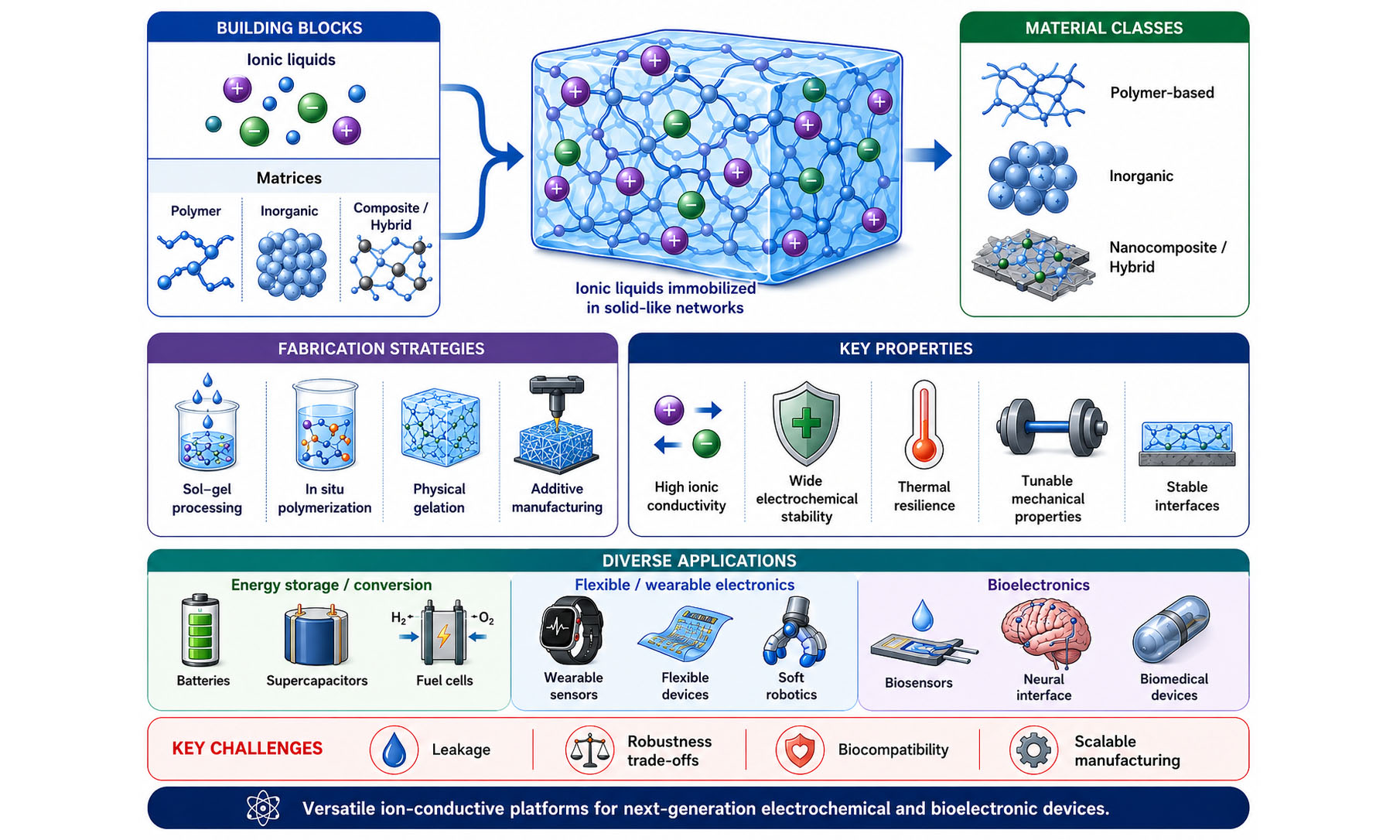
Ionogels are hybrid materials formed by immobilizing ionic liquids within polymeric, inorganic, or composite matrices, combining high ionic conductivity and electrochemical stability with the mechanical integrity of solid-like networks. This review examines the fundamental principles governing ionic liquid confinement and the design of polymer-based, inorganic, and nanocomposite ionogels incorporating fillers such as carbon nanotubes, graphene derivatives, MXenes, and metal nanoparticles. Key fabrication strategies, including sol-gel processing, in situ polymerization, physical gelation, and emerging additive manufacturing, are discussed alongside the resulting physicochemical and electrochemical properties. Particular emphasis is placed on how ionic liquid chemistry, matrix architecture, interfacial interactions, and network structure collectively determine ionic conductivity, electrochemical stability, thermal resilience, mechanical performance, and device-level functionality. These properties enable applications spanning lithium- and sodium-ion batteries, metal-air batteries, supercapacitors, fuel cells, flexible and wearable electronics, soft robotics, biosensors, and neural interfaces. Despite substantial progress, challenges remain in balancing conductivity and mechanical robustness, minimizing ionic liquid leakage, ensuring long-term biocompatibility and stability, and achieving scalable, reproducible manufacturing. This review further highlights structure-property-application relationships and identifies key considerations for translating ionogels from material platforms to functional devices. Overall, ionogels represent a versatile and rapidly evolving materials platform with significant potential for next-generation electrochemical, electronic, and bioelectronic technologies.
Keywords


 Download PDF
INTRODUCTION
Ionic liquids (ILs) are molten salts that remain liquid at or near room temperature. Paul Walden first reported an ethylammonium nitrate salt with a melting point of 12 °C[1,2], a landmark discovery in 1914 that established the existence of ILs. Over the past century, ILs have been prized for their unique properties, including their non-volatility, non-flammability, high ionic conductivity, good thermal stability, tunable polarity, and wide electrochemical stability windows[3,4]. These qualities make ILs attractive as liquid electrolytes, but as liquids they pose challenges of containment and safety; flammable organic electrolytes in batteries can raise leakage, flammability, and safety concerns, risks that can be reduced by using non-volatile ILs[5].
In order to combine IL performance with solid-state stability, researchers have developed ionogels. Ionogels are composite electrolytes in which an IL is immobilized within a solid matrix[6]. In ionogels, the liquid IL is dispersed throughout a three-dimensional host network, typically a polymer or inorganic framework[7]. The concept of ionogels emerged around 2005, when early polymeric and inorganic IL-containing gels were demonstrated[8,9]. These early IL-polymer gels showed that one could achieve ionic conductivities approaching those of liquid electrolytes while forming self-supporting films and exhibiting tunable properties. Essentially, ionogels harness the IL’s high conductivity but endow it with solid-like mechanical strength and shapeability.
Because the IL remains contained within the host material, ionogels, when synthesized optimally, retain a significant amount of the IL’s advantageous traits. This can greatly reduce leakage while preserving the wide voltage window and thermal stability of the IL[10]. Ionogels have excellent flexibility, which is also tunable; this enables them to withstand deformations such as folding, stretching, and bending, making them prime candidates for flexible electronic devices[11]. In practice, ionogels can be cast into thin films, fibers, or three-dimensional shapes with tunable elasticity, yet still conduct ions nearly as well as the pure ILs. For example, compared to a pure liquid electrolyte, a solid ionogel can withstand bending and stretching without leaking or evaporating, greatly improving device safety[12]. This combination of conductivity, stability, and mechanical compliance is highly desirable in flexible electronics.
These combined properties have led to ionogels being investigated across many fields of study. In energy storage, ionogels serve as solid electrolytes in batteries (Li-ion, Na-ion, metal-air) and supercapacitors[13-16]. They offer the safety of non-volatile materials along with liquid-like ion transport, and have been shown to suppress issues like dendrite growth[17]. In flexible and wearable electronics, ionogels are used as stretchable conductors, soft electrodes, and dielectric gels. For instance, ionogel films can act as transparent, deformable electrolytes for foldable supercapacitors or as electronic sensing skins that bend and stretch[18,19]. Similarly, in soft robotics and actuation, ionogels function in artificial muscles and ionic actuators due to their ability to carry charge under deformation[20]. In the biomedical realm, biocompatible ionogels are explored as soft bioelectrodes, neural interfaces, and biosensor matrices[21,22]. In short, ionogels bridge energy storage, flexible electronics, soft robotics, and bioelectronics by combining ionic-liquid conductivity with a solid-state form. Collectively, these examples illustrate how the combination of ionic conductivity, mechanical compliance, and tunable material properties allows ionogels to function across conventional electrochemical devices as well as flexible, soft, and biointegrated systems[23-25].
In recent years, ionogel research has expanded well beyond its traditional role as solid-state electrolytes for electrochemical energy storage. Advances in materials engineering have enabled ionogels with increasingly sophisticated mechanical, electrical, and multifunctional properties, driving their integration into emerging technologies such as bioelectronics, wearable and flexible electronics, soft robotics, neural interfaces, and multifunctional sensing systems. As these applications become increasingly complex, material selection and device performance are no longer independent considerations; instead, successful ionogel design requires balancing ionic conductivity, mechanical compliance, electrochemical stability, biocompatibility, processability, and long-term durability according to the specific demands of each device architecture. Although several excellent reviews have examined individual aspects of ionogel research, recent literature has largely provided focused perspectives on areas such as mechanical toughening and stretchability, polymer ionogels for flexible ionic devices, wearable ionogels, cellulose-based ionogels, and biomedical or drug delivery applications[3,26-28]. These studies provide substantial insight within their respective material or application domains; however, an important need remains for a cross-domain framework that explicitly traces how ionic-liquid chemistry, host-network architecture, and interfacial interactions translate into material properties and, ultimately, device-level performance. The present review addresses this need by organizing ionogel development through a coupled structure-property-application perspective rather than treating materials, properties, and applications as independent topics. Particular emphasis is placed on how ionic-liquid selection, polymeric or inorganic network design, nanocomposite reinforcement, and interfacial confinement influence ionic transport, mechanical compliance, electrochemical stability, durability, and manufacturability. These relationships are then considered in the context of device-specific constraints, including electrode-electrolyte interfacial compatibility in energy-storage systems, deformation and environmental stability in flexible electronics, and mechanical matching, biocompatibility, and tissue-material interactions in bioelectronic interfaces. In this way, the review extends beyond broad coverage of ionogel applications by emphasizing the design decisions and trade-offs that govern translation from ionogel chemistry to functional device performance.
In this review, we first introduce the fundamental principles underlying ionic liquids and the mechanisms by which they are immobilized in solid networks. We then survey key ionogel materials and architectures (polymer matrices, inorganic frameworks, nanocomposites, etc.) and outline common synthesis and fabrication strategies. We then examine the physicochemical and electrochemical properties of ionogels, including ionic conductivity, mechanical and thermal behavior, stability, and emerging functions such as self-healing. The second half of the paper focuses on applications, covering ionogel use in energy storage and conversion systems, followed by an integrated discussion of flexible, soft, wearable, and bioelectronic technologies, including stretchable conductors, gating dielectrics, sensors, neural interfaces, and soft robotic systems. We conclude with a discussion of the major challenges (stability, manufacturability, toxicity) and future outlook for next-generation ionogel materials and devices. Figure 1 provides an overview of the major application domains enabled by ionogels, including energy storage, biosensing, neural interfacing, drug delivery, actuation, and soft robotics. Throughout these sections, representative systems are evaluated not only according to reported performance metrics, but also according to the underlying material-design choices, interfacial considerations, and application-specific constraints that produce those outcomes. This approach is intended to provide application-oriented design guidance for selecting ionogel chemistries and architectures according to the requirements of next-generation electrochemical, flexible, and bioelectronic devices.
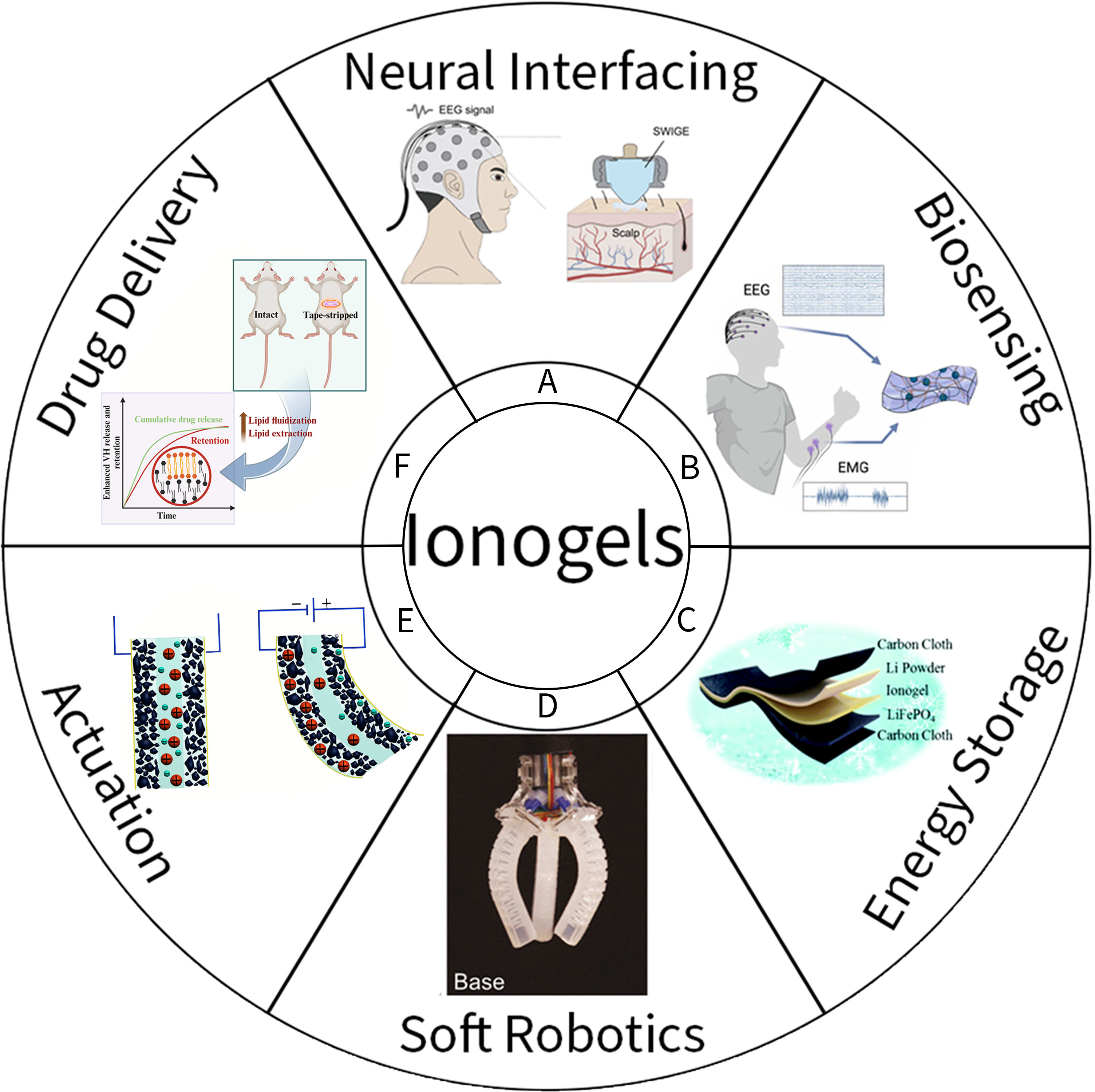
Figure 1. Emerging applications of ionogels. (A) Bioinspired SWIGE for EEG signal acquisition and applications (Reproduced with permission from ref.[25], Copyright 2026, Wiley-VCH GmbH); (B) Schematic illustrating the key characteristics of ionogel and eutectogel suitable for EEG and EMG signal recording (adapted from ref [29], under the CC BY 4.0 license; modifications were made to the original figure); (C) Schematic illustration of the flexible battery (Reproduced with permission from ref.[30], Copyright 2021, RSC); (D) Photograph of the soft gripper, base-only (center), actuation at inflation pressure of 140 kPa (Reproduced with permission from ref.[31], Copyright 2019, IEEE); (E) Schematic diagram of BMIMBF4-gel-electrolyte-based actuator based on an ion transfer mechanism (reproduced as a cropped excerpt from ref.[32], under the CC BY-NC-ND 4.0 license; the depicted content was not altered); (F) Visual Abstract (reproduced as a cropped excerpt from ref.[33], under the CC BY 4.0 license; the depicted content was not altered). EEG: Electroencephalography; EMG: electromyography; SWIGE: self-wetting ionogel electrode.
IONOGEL MATERIALS & ARCHITECTURES
Organic and inorganic ionogels
Ionogels can be built from a wide array of host materials, broadly classified as polymer-based, inorganic, or hybrid (polymer-inorganic) systems. In polymer-based ionogels, a liquid-like IL is trapped within a cross-linked or entangled polymer network. Common polymers include poly(methyl methacrylate) (PMMA), poly(vinylidene fluoride) (PVDF), poly(ethylene glycol) (PEG), polyurethane (PU), poly(vinyl alcohol) (PVA), and others[27,34]. Each polymer brings distinct advantages of its own. For instance, PMMA yields transparent, mechanically robust films, PVDF offers chemical and thermal stability, and PEG-based networks impart high flexibility and low glass transition temperatures[35-37]. Polyurethanes and polyacrylamides are also widely used for their elasticity and toughness. Notably, polymer matrices allow facile processing (casting, printing, fiber spinning) and tuning of mechanical properties via polymer chemistry and cross-link density[38]. Table 1 summarizes representative polymer matrices and their key features. In general, polymer-based ionogels are valued for their flexibility and tunable mechanics, though their thermal limits are often governed by the polymer.
Common polymer matrices used in ionogels and their corresponding key features and advantages
| Polymer matrix | Key features / Advantages | Reference |
| Poly(methyl methacrylate) (PMMA) | • High optical transparency (> 93%) • Good mechanical integrity • Stretchable • Well-suited for wearable/flexible electronics | [39] |
| Poly(vinylidene fluoride) (PVDF) | • Excellent chemical and aging resistance • High mechanical strength and thermal stability • Inherent piezoelectric, pyroelectric, and ferroelectric properties • Processable into films, fibers, and membranes | [40,41] |
| Poly(ethylene glycol) (PEG) | • Biocompatible and low toxicity • Easily modifiable • Acts as a plasticizer, enhancing IL miscibility • Mechanically flexible across wide temperature ranges • Highly processable with a scalable synthesis | [11,27] |
| Polyurethane (PU) | • High stretchability (> 300%) • Good tensile strength and tunable modulus • Optically transparent • Suitable for wearable sensors | [42,43] |
| Poly(vinyl alcohol) (PVA) | • Intrinsic self-healing capability due to a strong hydrogen bonding network • Wide thermal processing window • Excellent toughness • Biocompatible, low-cost, and non-toxic • Tunable mechanical properties | [44,45] |
By contrast, inorganic ionogels rely on rigid oxide or silica networks to immobilize ILs. Representative examples are silica-based ionogels, often prepared via a sol-gel route or by dispersing silica nanoparticles in ILs[46,47]. These silica networks impart very high thermal and mechanical stability. For instance, Horowitz et al. showed that an ionic liquid 1-ethyl-3-methylimidazolium bis(trifluoromethylsulfonyl)imide ([EMIM][TFSI]) confined in a silica gel yielded an ionogel with superior mechanical strength relative to previous silica-based gels[48]. Other metal oxide networks (TiO2, Al2O3, ZrO2, etc.) have been used similarly; for example, a TiO2-based ionogel was reported to function in an actuator under harsh temperatures[32]. Generally, inorganic ionogels offer broad thermal windows, often up to 200-300 °C, nonflammability, and chemical robustness, although they can be more brittle than polymer-based systems. Table 2 outlines common inorganic matrices and their benefits.
Representative inorganic ionogel matrices and their corresponding advantages
| Inorganic matrix | Key features / Advantages | Reference |
| SiO2 (silica) | • Effective IL confinement • Excellent mechanical properties • Optically Transparent • Highly processable • Compatible with luminescent and multifunctional IL dopants | [46,49] |
| TiO2 (titania) | • Produces ionogels with uniform pore size distribution • Exhibits excellent thermal stability • Inherent photocatalytic activity • Tunable thermal properties | [50] |
| Al2O3, ZrO2, etc. (ceramics) | • Enhance both mechanical and electrochemical properties of ionogels • Produce self-standing, flexible membranes • Non-flammable and reduced thermal shrinkage • ZrO2 specifically improves Li+ transport | [14,51] |
| Siloxane-based (sol-gel) | Produces a nanofluidic state while remaining macroscopically solid • Preserves high ionic conductivity and a wide electrochemical window of the IL • Non-flammable • Highly tunable | [52,53] |
Nanocomposite and hybrid ionogels
Nanocomposite ionogels embed conductive or reinforcing nanomaterials within the polymer/IL matrix. Common nanofillers include carbon-based fillers (carbon nanotubes (CNTs), graphene or graphene oxide, fullerenes), MXenes, and metal nanoparticles (Au, Ag, Ti, etc.)[54]. These fillers form percolating networks that boost electrical conductivity and mechanical strength. For example, CNT/IL ionogels, known as bucky gels, can form by mechanically mixing CNTs with ILs, where cation–π and electrostatic interactions between the ionic liquid and nanotube surfaces promote the formation of a physically interconnected gel network[32]. Similarly, graphene oxide or reduced graphene oxide can enhance mechanical modulus and provide additional ion-transport pathways[55]. MXenes have recently attracted interest due to the fact that their 2D sheets can support electronic conduction, ion transport, and photothermal functionality in appropriately designed composites[56]. In one study, a MXene composite ionogel achieved ~ 2 MPa tensile strength and > 600% stretch, along with high ionic conductivity of 22.7-37.5 mS/cm[57]. MBenes, an emerging class of transition-metal borides (the boron analogs of MXenes), have been integrated to construct a stretchable giant magnetoresistance (GMR) ionogel framework for advanced magnetoelectronics[58]. By capitalizing on the robust surface electronegativity of delaminated FeBTx MBenes, ferromagnetic domains are electrostatically self-assembled and uniformly dispersed within a nonmagnetic ionic matrix composed of 1-ethyl-3-methylimidazolium ethyl sulfate (EMIMS) and a poly(acrylamide)-co-poly(acrylic acid) network [P(AAm-co-AA)][58]. Rather than suffering from the severe particle sedimentation or magnetic inhomogeneity typical of standard particle-filled elastomers, this uniform architecture utilizes a hybrid coupling model to explain the transport mechanisms under external magnetic fields. Under magnetic stimulation, the FeB domain moments realign owing to their intrinsic perpendicular magnetic anisotropy, modulating local electrostatic interactions and reconfiguring ionic transport pathways. This magnetically driven ion-pathway modulation produces a relative response of approximately 73%, comparable to values reported for rigid Co-Cu granular thin films[58]. Metal nanoparticles, such as Ag and Au, are also incorporated to introduce plasmonic or catalytic functionality, as well as to further enhance conductivity[59]. Liu et al. incorporated silver nanowires into an ionogel matrix to develop highly stretchable, tissue-like nanocomposites for sensitive body motion and temperature monitoring[60]. In short, nanocomposite ionogels leverage the synergistic effects of nanofillers and ILs to achieve multifunctional, mechanically robust, highly conductive gels. Table 3 highlights representative nanofillers and their contributions to the ionogel system.
Representative nanofillers utilized in ionogels and their corresponding functional roles
| Nanofiller | Role/Benefit | Reference |
| Carbon nanotubes (CNTs) | • Improved electrical conductivity • Mechanical reinforcement • Enhanced strain/pressure sensing sensitivity | [61] |
| Graphene / Graphene oxide | • Mechanical reinforcement • Improved electrical and thermal conductivity • Enable additional cross-linking • Improve thermal stability | [62] |
| MXene (e.g., Ti3C2Tx) | • Mechanical reinforcement • Very high metallic conductivity • Biocompatible and environmentally stable • Enhances self-healing and adaptability • High sensing sensitivity | [63] |
| MBene (e.g., FeBTx) | • Giant magnetoimpedance under external fields • Enhanced fatigue threshold and crack-deflection • Bimodal motion recognition • Neuromorphic short-term memory | [58] |
| Metal nanoparticles (Au, Ag, etc.) | • Enhanced mechanical properties • Improved ionic conductivity • Enhanced electrical and thermal stability • Some add antimicrobial function to the polymer matrix | [11,60,64] |
| Silica nanoparticles | • Improved mechanical properties • Enhanced thermal stability • Optically transparent • Thermally insulating • Non-volatile • High ionic conductivity | [65,66] |
Hybrid ionogels combine multiple classes (polymer, inorganic, nanofiller) into hierarchical designs. Many recently developed high-performance ionogels employ hybrid architectures that combine polymeric and inorganic components, such as silica nanoparticle networks integrated with polymer networks and ionic liquids, or other interpenetrating organic-inorganic network structures[65]. Such hybrids can be prepared by sol-gel polymerization in the presence of ILs and nanofillers, or by physical blending of preformed components[67,68]. The goal is to merge advantages, such as a polymer-silica hybrid that might offer the elasticity of the polymer with the heat resistance of silica. Others incorporate metal-organic frameworks or 2D nanosheets into a polymer-IL network. By carefully designing the interface and network architecture, hybrid ionogels can achieve combinations of high strength, toughness, ionic conductivity, and multifunctionality not attainable by any single component.
In summary, ionogel materials span from purely organic polymer gels to entirely inorganic networks, with many composite blends in between. Polymer-based ionogels are valued for flexibility and ease of fabrication, whereas inorganic ionogels excel in thermal and chemical robustness[69,70]. Nanocomposite and hybrid systems integrate the best of both worlds. For example, MXene-reinforced PU ionogels simultaneously achieve high stretchability and conductivity[57]. These diverse materials and architectures enable ionogels to be tailored for specific applications, whether it be a soft wearable or a high-temperature battery electrolyte.
SYNTHESIS & FABRICATION STRATEGIES
Ionogels can be synthesized by a variety of methods that lock ionic liquids into solid matrices. A common approach is the sol-gel method, where ILs are mixed with inorganic precursors, such as metal alkoxides, and then gelled via hydrolysis and condensation[71]. In a typical silica sol-gel process, for example, tetramethoxysilane (TMOS) is hydrolyzed and polycondensed in the presence of an IL and a catalyst. As the inorganic network forms, the IL becomes physically entrapped in the growing pores. The result is a silica ionogel with very high IL loading (often > 80 wt.% IL) yet a continuous solid framework. Such ionogels exhibit ionic conductivities and stability close to those of the neat IL[48]. Horowitz et al. reported a straightforward sol-gel process yielding a silica-supported ionogel that remained mechanically robust and highly conductive across a wide range of temperatures[48]. Sol-gel routes allow tuning pore size and connectivity by adjusting precursor ratios and aging conditions. Sol-gel ionogels have been prepared using silica and other metal-oxide networks, including titania, and are valued for their thermal stability and nonvolatility[46,50,52]. One drawback is that sol-gel processes can involve multi-step complex chemistry and require control of humidity and pH. Nevertheless, they are widely used for fabricating thin-film or fiber-shaped ionogels in which the IL is immobilized in an inorganic scaffold.
Another major class of synthesis is in situ polymerization. In this approach, monomers (or oligomers) and initiators are mixed directly with the IL, and then polymerized to form a gel. For example, researchers often use acrylate monomers, such as poly(ethylene glycol) diacrylate (PEGDA) or poly(ethylene glycol) methyl ether methacrylate (PEGMA), dissolved in an IL with a photoinitiator, then cure the mixture with ultraviolet (UV) light or heat[72,73]. This locks the IL inside a cross-linked polymer network. Such polymeric ionogels can be prepared in one pot and easily cast into desired shapes like films, coatings, and fibers. Beyond simply immobilizing the IL, interactions between the polymer network and IL can be engineered to introduce additional structural and mechanical functionality. For example, Wang et al. developed a cellulose-reinforced ionogel by copolymerizing DMAA and HEMA in [BMIM]Cl[74]. The incorporation of cellulose regulates polymer-IL interactions and enables reversible crystallization and melting of the ionic liquid, allowing the material to switch between a tough and stretchable gel state and a stiff, rigid state[74]. Many studies have exploited double-network polymerization or zwitterionic monomers to further enhance mechanical strength and ion dissociation within in situ gels[75]. In situ methods are highly versatile; by choosing monomer chemistry and cross-link density, as well as polymer-IL interactions, one can tailor elasticity, ionic pathways, solvent retention, and mechanical response. The main challenges are ensuring uniform polymerization, in order to avoid IL leaching, and controlling shrinkage[76]. Nevertheless, in situ polymerized ionogels are widely used in battery and supercapacitor research because they combine easy processing with strong electrode adhesion and high conductivity.
Physical gelation via non-covalent assembly is another common synthesis method. In this approach, no additional permanent covalent cross-linking is required for gel formation; instead, the IL is immobilized by physical interactions and phase behavior. Many types of synthesis fall into this category, such as thermoreversible gelation, hydrogen-bonded supramolecular assembly, co-solvent evaporation synthesis, and phase separation gelation[77-79]. An example of physical gelation ionogel synthesis is that certain block copolymers or complex copolymer systems bearing hydrogen-bonding or metal coordination motifs will self-assemble in an IL to form gel networks. Lee et al. developed an ionogel through dual association of two complex copolymers, in which IL-phobic interactions promote the formation of micellar cores while reversible hydrogen bonding between polymer segments provides an additional physical cross-linking mechanism[80]. Together, these associations form a dynamic supramolecular network that provides stretchability, self-healing, and adhesion while retaining the IL within the gel structure. This can be as simple as cooling an IL-rich polymer solution to induce phase separation, or adding small molecules that gel the IL. Physical gels are attractive for soft robotics and wearable devices/sensors due to their self-healing and stimuli-responsiveness. However, they generally require higher polymer content or specialized monomers to achieve mechanical integrity, which can lower ionic conductivity[81].
In recent years, advanced manufacturing techniques like 3D printing have begun to be applied to ionogels. One approach is vat-photopolymerization (VPP), which forms ionogels by selectively curing a liquid precursor resin with UV or visible light layer-by-layer[82]. The photopolymerizable resin is typically formulated by combining photocurable acrylate-based monomers or oligomers, a photoinitiator, an ionic liquid, and additional formulation components as needed[83]. This resin can then be patterned via stereolithography or digital light processing to produce complex ionogel architectures in one step. Nechausov et al. demonstrated a 3D-printable ionogel composite containing carbon nanotubes for stretchable electrodes. The printed parts achieved conductivity comparable to that of cast gels[84]. Advanced fabrication techniques include layer-by-layer assembly, roll-to-roll coatings, and solvent-casting techniques for large-area films. Polymer-ionic-liquid ion-gel electrolyte sheets have also been integrated with carbon-nanotube wire microjunctions to produce mechanically robust, flexible solid-state supercapacitors for wearable electronics[85]. Overall, while 3D printing of ionogels, along with other advanced manufacturing techniques, is still emerging, early work shows that the combination of additive manufacturing and tailored resin chemistries can create devices such as miniature supercapacitors or soft sensors in customized geometries. The mentioned ionogel synthesis and formation strategies are illustrated in Figure 2 and summarized for easier comparison in Table 4.
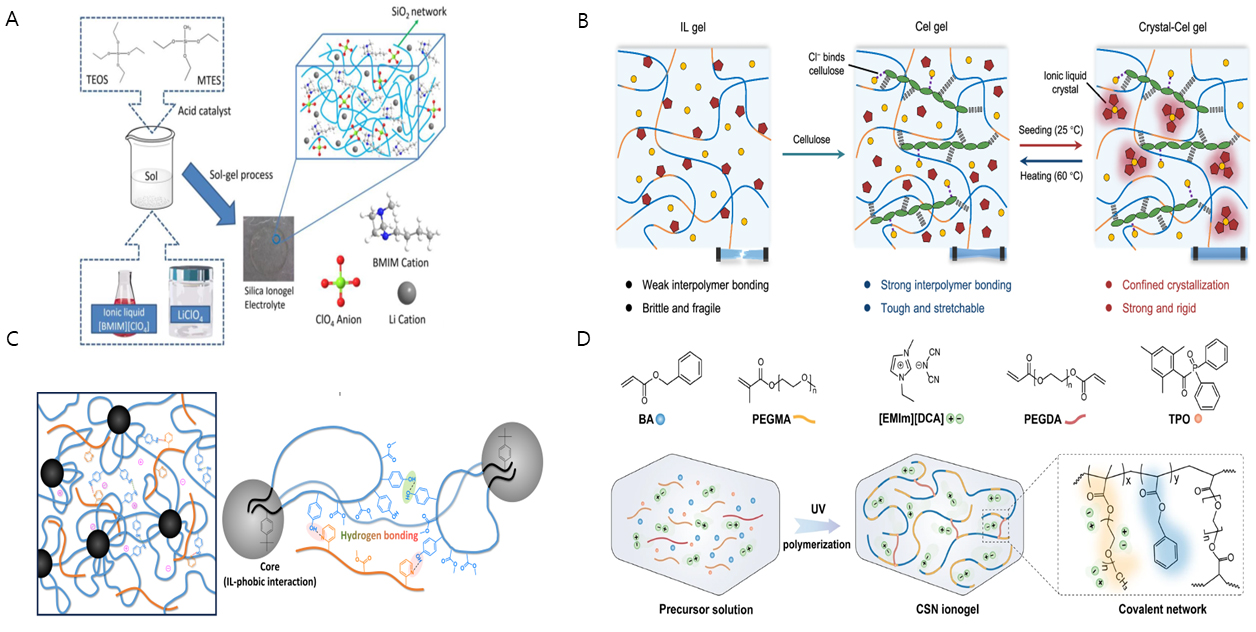
Figure 2. Illustrations of representative ionogel synthesis and formation strategies. (A) Sol-gel fabrication of a silica-based ionogel electrolyte, in which TEOS and MTES precursors form a SiO2 network that immobilizes the ionic liquid, LiClO4, and mobile ions within the gel matrix. (A) is reproduced from ref.[46], under the CC BY 4.0 license, without any modifications. (B) Cellulose-mediated reinforcement and reversible crystallization of an ionic-liquid-containing gel, where cellulose strengthens interpolymer interactions and controlled ionic-liquid crystallization enables reversible switching between soft and rigid gel states. (B) is reproduced as a cropped excerpt from ref.[74], under the CC BY-NC-ND 4.0 license; the depicted content was not altered; (C) Supramolecular ionogel formation through dual association involving IL-phobic micellar interactions, polymer bridging, and reversible hydrogen bonding between the constituent copolymers. (C) is reproduced as a cropped excerpt from ref.[80], under the CC BY-NC 3.0 Unported license; the depicted content was not altered; (D) UV-induced photopolymerization of an ionogel precursor containing BA, PEGMA, PEGDA, and [EMIM][DCA], resulting in a covalently cross-linked conductive and stretchable nanostructured (CSN) ionogel network. (D) is reproduced as a cropped excerpt from ref.[86], under the CC BY-NC-ND 4.0 license; the depicted content was not altered. IL: Ionic liquid; UV: ultraviolet; BA: benzyl acrylate; PEGMA: poly(ethylene glycol) methyl ether methacrylate; PEGDA: poly(ethylene glycol) diacrylate; [EMIM][DCA]: 1-ethyl-3-methylimidazolium dicyanamide; TEOS: tetraethyl orthosilicate; MTES: methyltriethoxysilane.
Summary of the principal synthesis and fabrication strategies discussed in this section, highlighting their respective advantages, limitations, scalability, compatible matrices, and representative applications
| Synthesis method / Refs. | Advantages | Drawbacks | Scalability | Compatible matrices | Typical applications |
| Sol-gel synthesis [46,48,50,52] | High IL loading (> 80 wt.%) Excellent thermal stability Tunable pore structure High conductivity | Multi-step process Sensitive to pH/humidity Complex chemistry | Moderate (mostly thin films, coatings, and fibers) | Silica TiO2 SnO2 Al2O3 ZrO2 Other metal oxides | Solid-state electrolytes Thin films Fibers |
| In situ polymerization [72-76] | One-pot synthesis Easy processing Strong electrode adhesion Tunable mechanical properties | Polymerization shrinkage Risk of IL leakage Requires uniform curing | High | PEGDA PEGMA DN Polymers Zwitterionic polymers | Batteries Supercapacitors Flexible electronics |
| Physical gelation [77-81] | Mild processing Self-healing Stimuli-responsive Reversible interactions | Lower mechanical strength Higher polymer content Reduced ionic conductivity | Moderate | Block copolymers Supramolecular polymers Hydrogen-bonded networks | Soft robotics Wearable devices Responsive sensors |
| 3D printing [82-84] | Complex geometries Customized structures Rapid prototyping Precise patterning | Limited printable resins Emerging technology | High (but still in development) | Photocurable ionogel resins CNT composites | Soft sensors Stretchable electronics Miniature supercapacitors |
PHYSICOCHEMICAL & ELECTROCHEMICAL PROPERTIES
Ionogels combine a nonvolatile ionic liquid electrolyte with a solid matrix. The IL phase provides ionic transport, electrochemical stability, and a wide electrochemical stability window (ESW), while the polymer or inorganic host provides mechanical integrity, structural support, and reduces ionic liquid leakage. Consequently, ionogel performance depends on both components and, more importantly, on their interactions. Key design parameters include the ionic liquid chemistry, ionic liquid loading, matrix composition, network architecture, and cross-link density, all of which collectively influence ionic conductivity, mechanical behavior, thermal and electrochemical stability, and long-term device performance[26,87]. Different application areas also place different demands on these properties. For example, energy storage devices prioritize high ionic conductivity and wide ESWs, whereas wearable electronics and bioelectronic systems require soft mechanics, fatigue resistance, and biocompatibility. Therefore, optimizing ionogels requires balancing multiple often competing material properties according to the intended application. The following sections discuss the major physicochemical and electrochemical properties that govern ionogel performance, including ionic conductivity, mechanical behavior, electrochemical and thermal stability, and adaptive functionalities such as self-healing and stimuli responsiveness.
Ionic conductivity
Ionogel ionic conductivity arises from the motion of ions in the IL phase, and is typically on the order of 10-6-10-2 S/cm at room temperature[8,10,88]. Conductivity usually follows a Vogel-Tammann-Fulcher (VTF) temperature dependence, reflecting the IL viscosity and polymer matrix constraints[89]. As temperature increases, ionogel ionic conductivity generally increases in a VTF-like manner, consistent with enhanced ion mobility[90].
Ionic conductivity in ionogels is governed by several interconnected factors, including the type of ionic liquid, ionic liquid loading, polymer network structure, and the presence of additives. Generally, low-viscosity ionic liquids with highly mobile ions, such as imidazolium- or ammonium-based ILs containing bis(trifluoromethanesulfonyl)imide (TFSI) and bis(fluoromethanesulfonyl)imide (FSI) anions, produce higher conductivities due to reduced ion-pair interactions and enhanced ion mobility[91]. Increasing IL concentration typically improves conductivity by increasing the number of available charge carriers and conductive pathways; although in mixtures with excessively high mole fractions of ionic liquid, the conductivity tends to decrease due to increased viscosity, strong ion-ion interactions, and hindered ion diffusion[92]. This relationship is outlined in Figure 3. The structure of the host matrix also plays a critical role in ionic conductivity. Loosely cross-linked, porous, or double-network architectures provide greater free volume and facilitate ionic motion compared to rigid or densely cross-linked systems[93]. In some cases, additives such as water or low-volatility solvents further enhance conductivity, though often come with the trade-off of worse electrochemical or thermal stability[94,95]. Table 5 summarizes representative ionic conductivity values reported for various ionogel systems and highlights the influence of composition and architecture on ion transport performance.
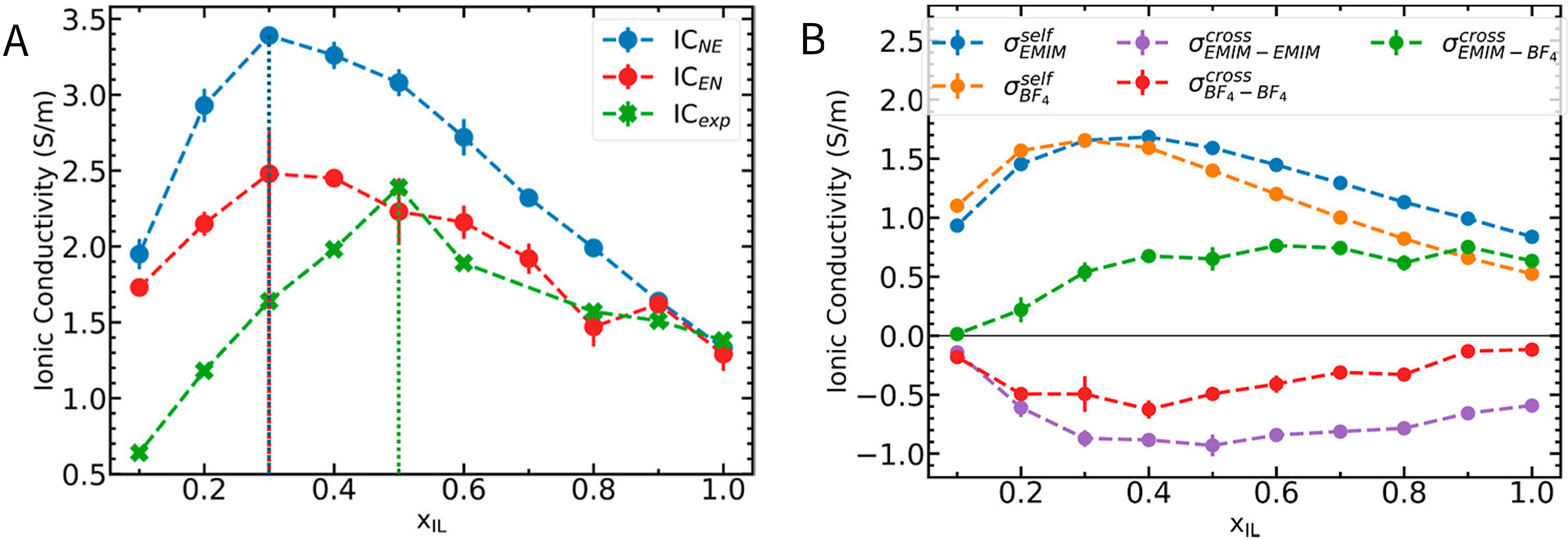
Figure 3. Relationship between ionic conductivity and mole fraction of ILs. (A) Trends in ionic conductivity as a function of the [EMIM][BF4] concentration at 298 K. Nernst-Einstein conductivity (ICNE) and Einstein conductivity (ICEN) compared with experimental values (ICexp). Vertical lines indicate mole fractions with peak conductivity values; (B) Contribution to ionic conductivity from self-correlation of cations (blue) and anions (orange); and cross-correlation between cation-cation (purple), anion-anion (red), and cation-anion (green). (A and B) are adapted from ref.[92], under the CC BY 4.0 license; two source figures were cropped and arranged side-by-side without alteration to the depicted data. IL: ionic liquid; [EMIM]: 1-Ethyl-3-methylimidazolium; [BF4]: tetrafluoroborate.
Comparison of ionic conductivity (σ) at room temperature (20-25 °C) for various ionogel systems categorized by ionic liquid chemistry and host polymer matrix architecture
Mechanical properties
Ionogel mechanics span a wide spectrum, from very soft gels to ultra-tough elastomers, depending on the polymer/IL ratio and network architectures. Simple single-network ionogels typically have a modulus in the kPa-MPa range and elongation at break (strain) of a few hundred percent[26]. However, advanced ionogel designs achieve far higher strength and toughness by introducing sacrificial or reinforcing elements[100,101]. For example, Wang et al. reported an acrylamide/acrylic acid ionogel with in situ phase separation that reached a fracture strength of 12.6 MPa, Young’s modulus of 46.5 MPa, and a ~ 600% elongation before failure[102]. Li et al. achieved 975% stretch with a 3.29 MPa tensile strength and 13.15 MJ/m3 toughness in a nanocellulose cross-linked ionogel[103]. Double-network (DN) gels similarly allow tuning of mechanical properties. Jiang et al. fabricated an [EMIM]Cl/PAM-PVA DN ionogel with tensile strength adjustable from 0.06-5.30 MPa and fracture elongation of 363%-1,373%[104]. In general, adding rigid domains greatly increases strength and toughness, at the cost of some elasticity.
Some of the highest mechanical benchmarks come from biomimetic or composite ionogels. Sun et al. designed a “mussel-inspired” ionogel with salt-bridge bonds and reported a tensile strength of ~ 34.0 MPa and toughness of ~ 58.3 MJ/m3, values that are comparable to high-performance elastomers[105]. Li et al. even demonstrated a PVA/halometalate ionogel with an ultimate fracture stress of 63.1 MPa, a strain of 5,248%, and a reported toughness of ~ 1,946 MJ/m3[106]. Similarly, Xia et al. developed a metal-organic framework (MOF)-reinforced PVA ionogel, exhibiting a modulus of 58 MPa and a toughness of 25 MJ/m3 while being able to endure an 11,000% stretch[107]. These examples show that rational molecular and network design can greatly improve the mechanical robustness of ionogels, allowing some systems to approach the performance of high-strength elastomers.
Despite these extremes, many functional ionogels balance strength and elasticity. Typical stretchable devices use gels with moduli < 10 MPa and strains between 100% and 1,000%[79]. In such cases, mechanics are governed by polymer chain flexibility and cross-link density. Lower cross-linking yields highly stretchable, soft gels, whereas DN or filler-reinforced matrices produce tougher, stiffer materials[108-110]. For instance, incorporating a second brittle network, or a sacrificial network, can dramatically boost toughness with only modest loss in conductivity. Nanoparticles or reinforcing polymers also act as load-bearing fillers to dissipate energy[111]. In practice, designers of ionogels tune polymer chemistry and IL content to achieve the desired trade-off between stiffness and compliance. As a result, modern ionogels can span from soft, highly stretchable materials to tough, mechanically reinforced networks through control of polymer chemistry and network architecture[26,108,109].
Some ionogels are designed to exhibit excellent fatigue resistance under cyclic deformation. Reversible interactions, including hydrogen bonding and dynamic network rearrangement, can enable ionogels to partially recover after mechanical damage[108,112]. This combination of flexibility and toughness is crucial for wearable devices. For example, Jiang et al. designed a poly(ethyl acrylate) ionogel that maintained stable ionic conductivity across extreme temperature ranges and after thousands of stretch and release cycles[113]. In summary, ionogel mechanical properties are highly tunable; by varying IL loading, polymer cross-link density, and network structure, one can design gels ranging from rubbery to ultra-tough. The relationship between mechanical tensile strength and DN versus single-networked ionogels is shown in Figure 4.
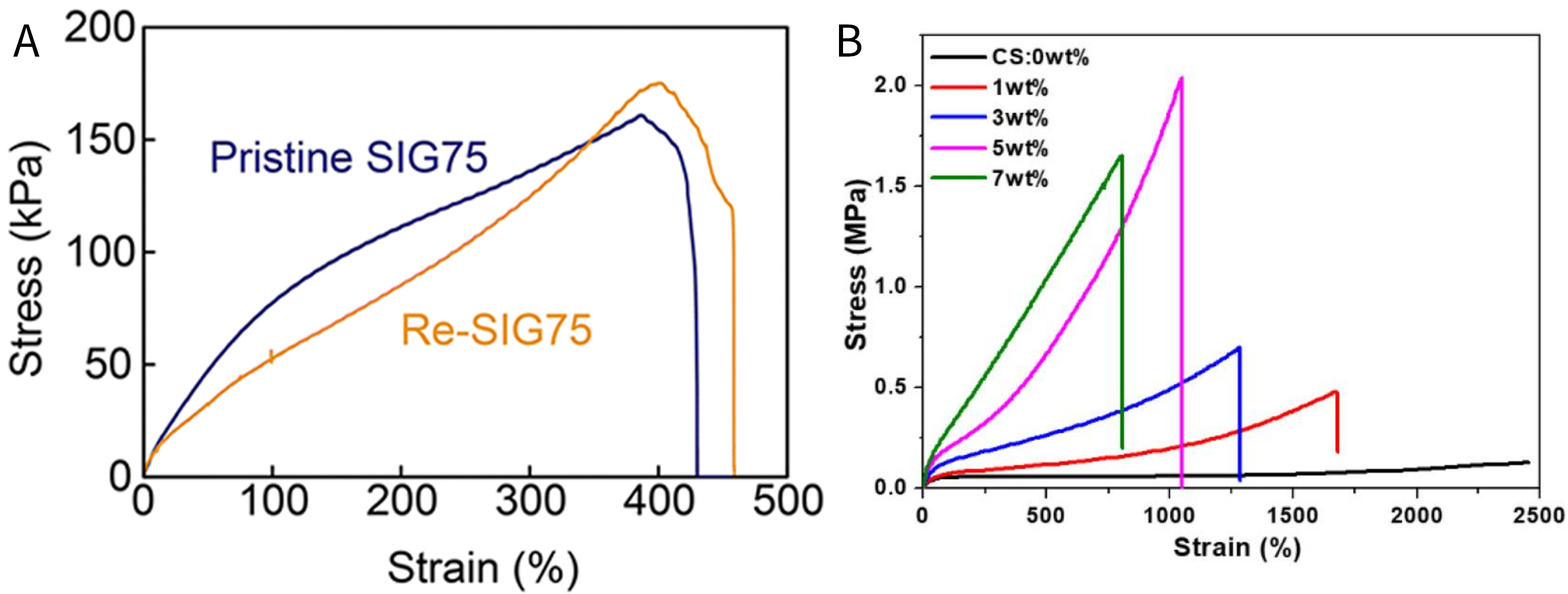
Figure 4. Comparison of stress-strain curves of a soft, self-healing, single-network ionogel (left) and a DN ionogel designed for harsh conditions (right). Note that the y-axis of the single-networked gel is in kPa while the DN gel is in MPa. (A) Comparison of the tensile-strain curves of pristine and reconfigured SIG75-89k-99+%. (Reproduced with permission from ref.[112], Copyright 2025, Royal Society of Chemistry); (B) Tensile properties of the CS/PAA DN ionogels: tensile stress-tensile strain curves. (B) is reproduced as a cropped excerpt from ref.[110], under the CC BY 4.0 license; the depicted content was not altered. DN: Double-network; CS: chitosan; PAA: polyacrylic acid.
Electrochemical and thermal stability
Ionogels inherit the remarkable thermal and electrochemical resilience of their IL phase. Due to most ILs having melting points well below 100 °C, they remain liquid from well below 0°C and up to 300-400 °C before reaching thermal decomposition[114]. Thus, ionogels typically operate over a broad temperature window, ranging from -20 °C to > 100 °C. The solid matrix limits the extremes somewhat, but advanced systems exploit ILs to extend the range. For example, Hu et al. reported an ionogel that remained stretchable at -80 °C due to a hybrid ionic crystal/gel phase[115]. Zhuo et al. not only reported an ionogel that remained stretchable at -80 °C, but also an ionogel that could work as a wire at -60 °C[116]. Overall, ionogels can tolerate much higher temperatures than aqueous gels, and unlike organic electrolytes, they exhibit negligible volatility.
Electrochemically, ionogels are similarly robust. Common ILs (especially [TFSI] and [FSI]-based) have a very wide electrochemical stability window (ESW), often ~ 4-5 V, although some have wider ESWs (up to 7 V)[117]. This means ionogels can be used at voltages well beyond the ~ 1.2 V limit of aqueous gels. The polymer network of an ionogel is usually electrochemically inert, so the gel’s electrochemical window is essentially that of the IL. For example, an [EMIM][TFSI]-based ionogel will typically support up to 4.19 V without oxidation or reduction[117]. Several studies confirm that solid-state ionogel batteries can cycle at high voltages safely; by choosing appropriate ILs and additives, one can achieve ESW operation well above 4 V[117-119].
Crucially, the solid nature of ionogels also improves safety. The negligible vapor pressure of ILs means ionogels are essentially non-volatile and non-flammable. Ionogels replace volatile, flammable organic solvents with stable ionic liquids confined in a solid or semi-solid polymer matrix[120]. This reduces leakage and flammability risks, improving battery safety compared with traditional liquid electrolytes. Because of the low volatility of ILs, some silica-based ionogels show minimal weight loss at elevated temperatures and retain ion transport properties close to those of the neat ionic liquid[121]. The combination of broad ESWs and high thermal stability means that ionogels have been shown to reliably operate under harsh conditions, including wide temperature and voltage ranges.
Overall, ionogels exhibit exceptional stability; they remain ionically conductive at very low temperatures, resist thermal decomposition up to > 300°C, and maintain the IL’s wide voltage window. These traits make ionogels well-suited for demanding electrochemical applications. The combination of thermal resilience and electrochemical inertness is therefore a defining feature of ionogels.
Self-healing and stimuli responsiveness
Beyond passive stability, many ionogels are engineered for adaptive behaviors. Self-healing is often achieved by incorporating reversible cross-links into the polymer matrix via hydrogen bonds, metal-ligand bonds, or dynamic covalent bonds[122,123]. For example, a supramolecular PVA-choline-lactate ionogel healed 39% and 45% of its original fracture stress and strain, respectively, after being cut, thanks to dynamic hydrogen bonding[112]. Similarly, networks with Zn2+ or other metal-ion coordination can re-form bonds after damage[124]. Li et al. demonstrated an ionogel with Zn2+-mediated cross-links that recovered ~ 60% of its tensile strength after healing[103]. Gels such as these self-heal when the broken surfaces are brought together, regaining significant functionality. Importantly, in some self-healing ionogels, ionic pathways can be re-established after damage, allowing conductivity to be largely retained after healing[123,125]. This self-healing ability improves device longevity and safety.
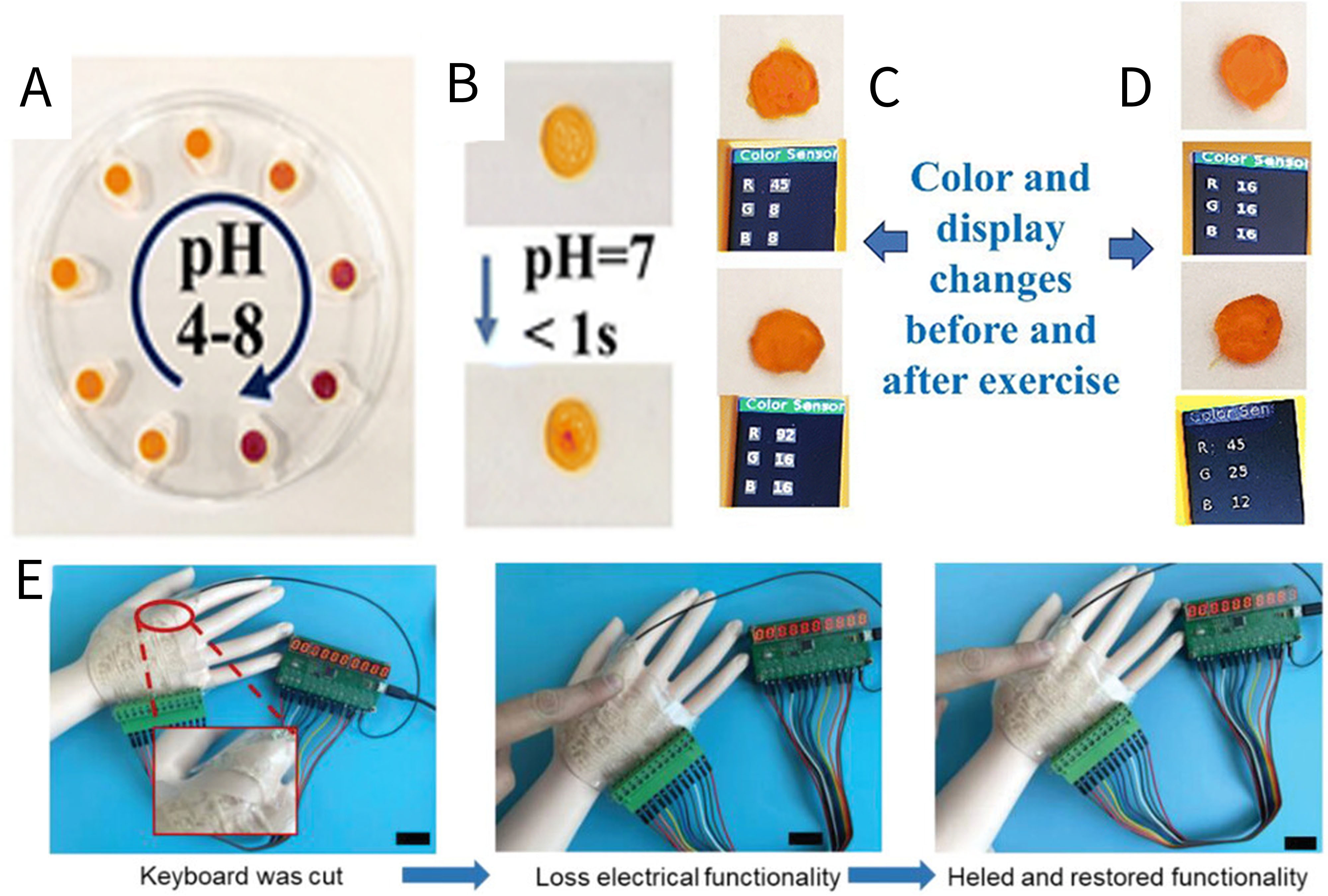
Figure 5. Demonstrations of a pH-sensitive ionogel used in a biosensor and a self-healing ionogel. (A) The color responses of phenol red in the PPH ionogels to different pH buffer solutions. pH values: 4, 4.5, 5, 5.5, 6, 6.5, 7, 7.5, and 8; (B) Optical image of the fast-response ionogel. pH value: 7; (C and D) RGB values (C) before and (D) after exercise in pH-responsive ionogel. (A-D) Reproduced with permission from ref.[127], Copyright 2024, Royal Society of Chemistry; (E) The flexible keyboard was cut off and lost electrical functionality. Then, the stretchable keyboard healed and restored the electrical function after 1 h (scale bar: 2 cm); (E) is reproduced as a cropped excerpt from ref.[123], under the CC BY 4.0 license; the depicted content was not altered. RGB: Red, green, and blue; PPH: pH-responsive material designation.
Ionogels can also be made responsive to external stimuli. One example is shape-memory behavior. Wang et al. noted that their phase-separated DN ionogel not only self-healed but also exhibited a thermally triggered shape-memory effect[102]. More broadly, temperature-responsive ILs or polymers can be used to create thermochromic or thermoresponsive gels. Other common stimuli include light, pH, and mechanical strain[126]. To give an example, Zhi et al. found that doping an ionogel with a pH-sensitive dye, phenol red, produced a flexible gel that visibly changed color with sweat pH, enabling real-time wearable pH sensing [Figure 5A-D][127]. Electric and magnetic fields can also induce responses if the gel contains appropriate additives. In each case, the IL matrix provides fluidity and ionic conductivity, while the functional component imparts the stimulus response.
These adaptive properties broaden ionogel applications; self-healing gels serve as long-lived electronic skin, while stimuli-responsive gels function as active sensors or actuators. For example, an ionogel whose resistance changes with temperature or bending can act as a stretch or thermal sensor. The combination of ionic conduction and dynamic networks makes ionogels ideal for soft robotics and electronic skin, where materials must adjust to the environment and recover from damage. In summary, modern ionogels are stable, but beyond that, they are adaptable. By careful design, one can create gels that automatically heal cracks [Figure 5E], change properties with a change in stimuli, or even self-adhere. All of these are capabilities that are being exploited in emerging bioelectronic and sensing devices.
Structure-property-application design framework
The performance of an ionogel cannot be optimized through any single compositional variable because ionic-liquid chemistry, ionic-liquid loading, matrix composition, network architecture, and cross-link density simultaneously influence ionic conductivity, mechanical behavior, electrochemical and thermal stability, and long-term device performance[3,26]. Accordingly, ionogel design is best approached by first identifying the dominant requirements of the intended application and then selecting the ionic phase, matrix architecture, and interfacial chemistry needed to satisfy those constraints.
For example, electrochemical energy-storage systems generally prioritize high ionic conductivity, wide electrochemical stability windows, thermal stability, and stable electrode-electrolyte interfaces[128,129], whereas wearable and bioelectronic devices additionally require mechanical compliance, stretchability, fatigue resistance, stable interfacial contact, and, where appropriate, biocompatibility[29,130].
Increasing ionic-liquid loading can increase the number of mobile charge carriers and enhance ionic conductivity; however, high IL loading can simultaneously reduce the mechanical integrity of the supporting network, creating an inherent conductivity-mechanical stability trade-off[92,131,132]. Conversely, increasing network constraint through cross-linking, double-network architectures, or reinforcing fillers can improve strength, toughness, and durability, but must be balanced against the need to preserve ionic mobility and mechanical compliance[109,111].
Interfacial engineering provides an additional design parameter. In electrochemical devices, favorable ionogel-electrode contact can improve ionic transport and cycling behavior, as demonstrated in double-network ionogel electrolytes designed to provide strong electrode-electrolyte contact while suppressing electrolyte leakage[129,132]. In wearable and biomedical systems, conformal ionogel interfaces can reduce dehydration and interfacial impedance during electrophysiological recording[29,131], while bioadhesive and ion-selective interfaces can regulate ion exchange and improve contact with neural tissue[133,134].
Thus, the optimum ionogel architecture depends not on maximizing a single property, but on balancing ionic transport, mechanical performance, stability, and interfacial behavior according to the constraints of the intended device. Table 6 summarizes these interconnected design relationships and provides an application-oriented framework linking material selection and network design to resulting properties and device-level performance. Because interfacial behavior represents a distinct link between bulk ionogel properties and device-level performance, the following section examines electrode-ionogel and tissue-ionogel interfaces in greater detail.
Structure-property-application design framework for ionogels
| Design parameter / Refs. | Effect on key properties | Main design trade-offs | Application relevance |
| Ionic-liquid chemistry [72,91,117,135] | Controls ion mobility, ion pairing, ESW, thermal stability, and biological compatibility | High conductivity and electrochemical stability must be balanced against biological and environmental compatibility | Batteries, supercapacitors, bioelectronics |
| IL loading [92] | Alters the concentration and continuity of mobile ionic pathways and therefore ionic transport | Increasing IL content can improve charge-carrier availability, but excessive concentrations can increase viscosity and ion-ion interactions | Electrolytes, soft conductors, sensors |
| Polymer chemistry / cross-link density [26,109] | Controls modulus, stretchability, toughness, IL confinement, and network mobility | Loosely constrained networks favor softness and deformation, whereas greater network constraint favors mechanical robustness | Wearables, flexible electronics, structural electrolytes |
| Double / Dynamic networks [109,123] | Improve toughness, fatigue resistance, damage tolerance, self-healing, and structural integrity | Additional reinforcement or reversible cross-links may alter softness and ionic mobility | Flexible batteries, sensors, soft robotics |
| Inorganic matrices [48,50,65] | Provide porous IL confinement and dimensional stability; properly engineered inorganic or inorganic-organic networks can maintain ionic conduction and mechanical integrity at elevated temperatures | Rigid inorganic networks can be brittle unless their microstructure or hybrid architecture is engineered for compliance | High-temp electrolytes, batteries, actuators |
| Nanocomposite / hybrid architectures [63,65] | Introduce reinforcing, conductive, or multifunctional domains that can enhance mechanics, transport, and sensing behavior | Filler concentration, dispersion, and interfacial interactions must be controlled to avoid losses in flexibility or transport | Sensors, flexible electronics, soft robotics |
| Electrode-ionogel interface [129,132] | Influences physical contact, interfacial resistance, ion-flux distribution, and cycling stability | Strong and stable interfacial contact must be achieved while preserving ion transport and processability | Batteries, supercapacitors |
| Tissue-ionogel interface [133,136] | Influences conformal contact, interfacial impedance, adhesion, ion exchange, and physiological signal quality | Ionic conductivity and adhesion must be balanced against leakage, toxicity, biofouling, and long-term tissue compatibility | Biosensors, epidermal devices, neural interfaces |
Interfacial considerations in ionogel devices
Although bulk ionic conductivity, mechanical properties, and electrochemical stability establish the intrinsic performance of an ionogel, device-level behavior also depends on how effectively the ionogel couples to adjacent electrodes, semiconductors, or biological tissues. These interfaces can impose requirements that are not captured by bulk measurements alone, making interfacial contact, adhesion, ion transport, and mechanical compatibility important design considerations alongside ionogel composition and network architecture.
In electrochemical devices, the ionogel-electrode interface is particularly important because inadequate contact can limit the benefits of high bulk ionic conductivity. Solid-state battery systems, for example, must maintain stable electrolyte-electrode contact while supporting ion transport during repeated cycling. Liang et al. identified poor electrolyte-electrode contact as a major limitation of solid-state electrolytes and demonstrated a double-network ionogel that combined high ionic conductivity with stable electrochemical performance[129]. Interfacial modification can also regulate ion transport directly. Li et al. introduced an ultrathin metal-organic-framework layer between an ionogel electrolyte and lithium metal that promoted more uniform lithium dissolution/deposition, inhibited dendrite growth, and improved cycling stability[132]. Similar considerations apply to sensing systems, where stable contact between the ionogel and electronic components is required to convert ionic responses into reproducible electrical measurements. Bai et al., for example, used a flexible conductive ionogel electrode as a conformal top contact to form highly reproducible protein junctions under physiologically relevant conditions[137].
The ionogel-tissue interface introduces an additional set of requirements because electrical coupling must be maintained while accommodating soft, hydrated, and mechanically dynamic biological environments. Mechanical compliance and stable adhesion can help preserve intimate contact, while interfacial impedance and ion exchange influence electrical recording or stimulation. Isik et al. demonstrated that cholinium-based ion gels used between the skin and an electrode reduced skin impedance to levels comparable to conventional Ag/AgCl electrodes and supported stable electrophysiological recording for up to 72 h[131]. For implantable interfaces, Kim et al. developed a multi-cross-linked membrane-ionogel assembly in which a bioadhesive interface promoted tissue contact while the membrane limited exchange between biological and synthetic ions, enabling non-Faradaic neurostimulation[133]. Collectively, these examples demonstrate that ionogel interfaces should be engineered together with bulk material properties because device performance ultimately depends on the transfer of ions, charge, and mechanical stresses across these boundaries.
IONOGELS IN ENERGY STORAGE & CONVERSION
Ionogels have become increasingly important in electrochemical energy storage and conversion because they combine the ionic conductivity of liquid electrolytes with the structural integrity and safety of solid-state materials. Conventional liquid electrolytes used in batteries, capacitors, and electrochemical conversion systems often suffer from leakage, flammability, solvent evaporation, and limited electrochemical stability windows[138-140]. By immobilizing ILs within a polymeric, inorganic, or hybrid matrix, ionogels address many of these shortcomings while preserving favorable ion transport properties. Their nonvolatile nature, mechanical flexibility, broad thermal operating ranges, and electrochemical robustness have positioned ionogels as promising materials for next-generation solid-state energy devices.
In energy storage systems, ionogels primarily function as quasi-solid-state or solid-like electrolytes[141,142]. In this role, they facilitate ionic transport between electrodes while simultaneously acting as physical separators and structural supports. Compared with conventional liquid electrolytes, ionogels exhibit enhanced thermal stability, reduced leakage risk, and improved mechanical confinement of electrochemically active species[143,144]. Furthermore, because ionic liquids often possess wide electrochemical stability windows, ionogel electrolytes can enable higher operating voltages and safer cycling conditions than aqueous or carbonate-based electrolytes.
Interest in ionogel-based energy systems has accelerated in recent years due to increasing demand for safer, flexible, and high-power-density technologies for electric vehicles, wearable electronics, and grid-scale storage[144,145]. Ionogels have now been investigated across a broad spectrum of applications, including lithium-ion batteries, sodium-ion batteries, metal-air batteries, supercapacitors, and fuel cells, where their tunable physicochemical properties enable performance optimization for highly specific operational environments.
Ionogel electrolytes for batteries
Lithium-ion batteries
Lithium-ion batteries (LIBs) represent the most extensively studied application area for ionogel electrolytes. Conventional LIBs typically rely on volatile carbonate solvents such as ethylene carbonate and dimethyl carbonate, which provide high ionic conductivity but pose substantial safety concerns due to flammability and the risk of thermal runaway[146,147]. Ionogel electrolytes have emerged as promising alternatives because they retain liquid-like ion transport while reducing solvent leakage and improving thermal resilience[128,148].
One of the major advantages of ionogels in LIBs is their potential to help suppress lithium dendrite growth while maintaining acceptable ionic conductivity[132]. Dendrites form during repeated lithium plating and stripping, eventually penetrating separators and causing short circuits. Due to their mechanically constrained structure and uniform ion transport pathways, ionogels can distribute lithium-ion flux more evenly and reduce localized current density gradients associated with dendrite nucleation[132,149]. Additionally, many ionogels exhibit an ESW of 4-5 V or more, allowing compatibility with high-voltage cathode materials while improving safety under abusive conditions. Recent advances in related solid polymer electrolytes further demonstrate the importance of molecular-level electrolyte design in simultaneously regulating ion transport, electrochemical stability, and electrode-electrolyte interfaces. Chen et al. employed a tri-functional molecular design incorporating complementary functional groups to promote lithium-salt dissociation and stabilize electrode interfaces, achieving an ionic conductivity of 1.13 mS cm-1 at 25 °C, a Li+ transference number of 0.68, and operating reliably at high cutoff voltages up to 4.7 V[150]. Although this system is a solid polymer electrolyte rather than an ionogel, it illustrates transferable design principles for ionogels, in which matrix chemistry and functional-group selection can be tailored to balance ionic transport with high-voltage and interfacial stability.
Temperature tolerance is another major advantage. Conventional LIB electrolytes experience severe conductivity degradation at low temperatures due to solvent freezing and viscosity increases[151]. Ionogels, however, can maintain ionic transport under harsh thermal conditions because ILs possess low freezing points and negligible vapor pressure. Tang et al. reported a freeze-resistant ionogel electrolyte capable of enabling lithium-metal battery operation at -30 °C with high capacity retention and long cycle stability, highlighting the suitability of ionogels for aerospace, military, and cold-climate applications[30].
Substantial progress has also been made toward flexible and high-performance lithium-ion systems. Liang et al. developed a DN poly(IL)-based ionogel electrolyte exhibiting a strong ionic conductivity of 1.8 × 10⁻³ S/cm, a wide ESW up to 5.0 V, and stable cycling over 200 charge-discharge cycles in LiFePO4-based cells[129]. The DN architecture simultaneously enhanced flexibility, suppressed electrolyte leakage, and promoted favorable electrode-electrolyte contact, illustrating how ionogel chemistry and network design can help address limitations associated with conventional solid-state electrolytes[129]. Similarly, zwitterion-stabilized ionogels have demonstrated improved lithium salt dissociation and ion transport through ion-dipole interactions, enhancing electrochemical performance in secondary lithium batteries[152].
Sodium-ion batteries
Sodium-ion batteries (SIBs) have gained increasing attention as lower-cost alternatives to LIBs due to the abundance and low cost of sodium relative to lithium[153]. However, the larger ionic radius of Na+ introduces transport challenges, including slower diffusion kinetics and structural strain during charge-discharge cycling. Ionogels have emerged as promising solid-state electrolytes for SIBs because their tunable architectures enable improved sodium-ion conduction while maintaining electrochemical and thermal stability[154].
Ionogel electrolytes for sodium systems often utilize mesoporous silica or polymer matrices infused with sodium salts dissolved in IL phases. These materials stabilize sodium-metal interfaces while preventing electrolyte leakage and limiting dendritic deposition[155]. Sol-gel-derived pseudo-solid ionogel electrolytes have demonstrated Na+ conductivity alongside electrochemical windows exceeding 4 V, enabling compatibility with energy-dense cathodes. In sodium-metal cells, ionogels also improve Coulombic efficiency and reduce polarization during repeated plating and stripping processes[153].
Sodium batteries can particularly benefit from the high thermal stability of ionogel electrolytes, which have enabled stable electrochemical operation at elevated temperatures[156]. Sodium-ion technologies are frequently targeted toward stationary storage and harsh-environment operation, where thermal resilience and cost-effectiveness outweigh energy density concerns. Since ionic liquids remain stable across wide temperature ranges, ionogel-based SIBs exhibit reduced flammability and enhanced elevated temperature performance relative to conventional solvent electrolytes[157].
Metal-air batteries
Metal-air batteries, including lithium-air, zinc-air, and sodium-air systems, are attractive due to their exceptionally high theoretical energy densities, which stem from using oxygen from the surrounding atmosphere as a reactant[158]. However, practical implementation remains difficult because conventional liquid electrolytes are prone to evaporation, parasitic reactions, instability at electrode interfaces, and dendritic metal deposition[159]. Ionogels provide an appealing alternative because they stabilize electrolyte interfaces while maintaining ionic conductivity and suppressing leakage.
In metal-air architectures, gel electrolytes incorporating ionic liquids can provide a quasi-solid electrolyte environment while reducing solvent evaporation and electrolyte leakage. In lithium-oxygen batteries, ionic-liquid-containing gel polymer electrolytes have been shown to improve lithium-ion transport and interfacial stability while providing improved cycling stability[160]. In flexible zinc-air batteries, self-healing ionogel electrolytes have also demonstrated suppression of dendrite and by-product formation, broad-temperature operation, and long cycling stability[161]. These characteristics highlight the potential of ionogel and ionic-liquid-containing gel electrolytes for improving the safety and durability of rechargeable metal-air batteries.
Supercapacitors
Supercapacitors are high-power energy storage systems capable of rapid charging and discharging through electrostatic charge accumulation or fast surface redox reactions[162]. Although conventional liquid electrolytes offer high ionic conductivity, they often suffer from leakage and restricted operating voltages. Ionogels have emerged as attractive quasi-solid-state electrolytes because they maintain liquid-like ion transport while enabling flexible, leakage-resistant, and mechanically stable devices.
One major advantage of ionogels in supercapacitors is the preservation of wide electrochemical stability windows. Since many ionic liquids support voltages exceeding 4 V, ionogel-based supercapacitors can achieve higher energy densities than aqueous devices, whose voltages are typically limited[163]. Additionally, ionogels can be fabricated into transparent, flexible or stretchable architectures compatible with wearable electronics and deformable energy storage systems[129,164].
Ionogels are especially advantageous in flexible supercapacitors, where electrolyte leakage during bending or stretching represents a major challenge. Polymer-based ionogels embedded within conductive electrodes can sustain repeated deformation while preserving ionic transport. DN ionogels can combine high mechanical resilience with durable electrochemical performance in flexible supercapacitors, including under repeated cycling and mechanical deformation[109].
Remaining challenges in ionogel-based supercapacitors include optimizing electrode-electrolyte interfacial compatibility and balancing ionic conductivity with mechanical robustness. Continued work in multifunctional nanocomposite ionogels and additive-assisted ion transport pathways is expected to improve electrochemical performance.
Fuel cells
Fuel cells convert chemical energy directly into electrical energy through electrochemical reactions and require efficient ion-conducting membranes to transport charge between electrodes[165]. Conventional membranes often depend on hydrated proton-conducting polymers whose performance declines under low-humidity or elevated-temperature conditions. Ionogels provide an alternative membrane platform because ILs enable ion transport without requiring water-mediated conduction[166,167].
In proton exchange membrane and alkaline fuel cells, ionogels have been explored as proton or ion-conducting separators capable of operating across broader thermal and humidity ranges than conventional membranes[167,168]. IL confinement improves dimensional stability while maintaining high ionic conductivity, enabling more durable membrane performance under harsh conditions. Furthermore, because ionic liquids exhibit negligible vapor pressure, ionogel membranes avoid dehydration issues commonly observed in Nafion-based systems at elevated temperatures[169].
Ionogel membranes have also shown promise for intermediate temperature fuel cells, where operation between roughly 100-200 °C improves reaction kinetics while minimizing catalyst poisoning[170,171]. Under these conditions, the thermal stability of ionic liquids becomes particularly advantageous, enabling proton transport without membrane degradation or water loss. Polymer-ionic liquid hybrid gels have therefore emerged as attractive alternatives to traditional polymer electrolytes for portable and stationary conversion systems.
IONOGELS IN FLEXIBLE, SOFT, AND BIOELECTRONIC SYSTEMS
Flexible electronics, wearable devices, soft robotics, and bioelectronic systems share many material requirements, including mechanical compliance, stable conductivity under deformation, interfacial conformability, and long-term environmental stability. These requirements become particularly important in biointegrated devices, where conventional rigid electronic materials can exhibit substantial mechanical and electrical mismatch with soft, hydrated biological tissues. Ionogels offer a useful bridge between these domains because their polymeric or hybrid networks provide soft and deformable mechanical behavior while the confined ionic-liquid phase enables efficient ionic transport. Depending on their composition and architecture, ionogels can therefore function as stretchable conductors, gating dielectrics, wearable sensing elements, biosensor interfaces, neural interfaces, or components of soft robotic systems.
Across these applications, the relative importance of individual material properties varies. General flexible electronics primarily require deformation-tolerant conductivity and mechanical durability, whereas skin-interfaced and bioelectronic systems additionally place greater emphasis on tissue conformability, low interfacial impedance, adhesion, biocompatibility, and resistance to dehydration or biofouling. The following sections therefore organize ionogel applications according to their device function while highlighting the common material principles that connect flexible electronics to increasingly biointegrated systems.
Stretchable conductors
Stretchable electronics are pliable circuits that are built on stretchable substrates. This allows the material to bend and deform, while still maintaining its conductive properties. Stretchable electronics are being explored for use in new innovations due to their biocompatibility, comfort, and deformability[172]. Additionally, ionogels are emerging as promising candidates for use in these biotechnologies due to their high stretchability and strong conductive properties[12]. The main challenge when dealing with most conductors is the loss of conductivity when the material is deformed. This is because most materials rely on mobile electrons or electron holes to transport currents, and when they undergo deformation, these paths can be broken. The advantage of ionic conductors is that because of the ionic liquid phase, conductive mobile ions can be incorporated into a stretchable polymer matrix allowing for deformation to occur while conductivity is preserved[173].
Recent work has shown gel polymer electrolytes can provide solid-like mechanical properties with adequate ion transfer[174]. Ionogels are unique from other electrically conductive composites as the ionic electrolytes are more prominent as the solvents, while the single-network or double-network polymers are embedded in them. This property helps maintain conductivity under deformation, however, too many solvated ionic electrolytes may lead to leakage, evaporation, or freezing provided more unfavorable conditions[175]. In a study overviewing a synthesized ionogel conductor, Wang et al. describe this engineered material consisting of double interpenetrating networks of long polymer chains to provide high stretchability[12]. The network of cross-linked hydrogen bonds allows for large energy dissipation and high tensile strength. Additionally, high ion concentrations and mobility within the gel support high conductivity at room temperature[12].
Due to the desirable properties of ionogels, interest is developing rapidly in their use for biomedical devices. Flexible strain sensors can be used to simulate human skin, and can convert external stimuli into electrical signals which have various uses from electronic skin and monitoring systems to artificial intelligence[176]. Previous research employed hydrogels for flexible strain sensors; however, hydrogels possess unwanted properties. The properties of hydrogels may change with the evaporation of water in varying temperatures[177]. This contrasts with ionogels as the ionic liquid base combined with the polymer matrix poses very low vapor pressure, a wide viable temperature range, and material stability, making them one of the most promising options for the future of stretchable conductors[178-180].
Gating dielectrics
Beyond their established utility as stretchable passive interconnects, ionogels have emerged as a pivotal class of high-performance gate dielectrics in active thin-film and field-effect transistor (FET) architectures. This prominent role is primarily underpinned by the formation of nanometer-thick electric double layers (EDLs) at the semiconductor-gel interface under an applied gate bias[181-183]. The resulting EDL configuration yields an exceptionally high specific capacitance (frequently exceeding several μF/cm2), which fundamentally circumvents the operational voltage limitations of conventional bulk inorganic dielectrics (e.g., SiO2, Al2O3)[184]. Consequently, ionogel-gated transistors, often referred to as electric double-layer transistors (EDLTs), can achieve profound charge carrier modulation and high-density channel induction at sub-2 V operating thresholds[185]. Furthermore, the inherent mechanical compliance, solution-processability, and liquid-like interfacial wetting of the immobilized ionic liquid phase allow ionogels to conform seamlessly to structurally dynamic or chemically sensitive low-dimensional semiconductor channels, suppressing interfacial voids and mitigating charge scattering. This unique ensemble of properties renders dielectric ionogels promising for driving next-generation flexible, wearable, and neuromorphic active electronics.
Capitalizing on this potent electrostatic modulation capability, pioneering work by Wu et al. successfully utilized a dielectric ionogel as the active gating component to enable highly reconfigurable complementary logic electronics paired with two-dimensional transition metal frameworks[186]. A pervasive bottleneck in matching high-capacitance ionogel gates with 2D contact electrodes is the severe Fermi-level pinning induced by metal-induced gap states (MIGS) at the contact interfaces, which typically restricts the device to single-carrier injection or yields highly asymmetric electrical responses. To resolve this challenge, the authors introduced a localized plasma oxidation strategy on conventional titanium carbide (MXene) flakes to engineer an asymmetric architectural derivative termed “Oxene” [Figure 6]. The deployment of this symmetry-engineered OXene layer successfully suppressed MIGS and unlocked the Fermi-level pinning at the contact interface. Leveraging the massive capacitive coupling of the integrated ionogel dielectric, the platform demonstrated robust, highly efficient, and perfectly symmetric modulation of charge carrier dynamics in both p-type [poly(3-hexylthiophene); P3HT] and n-type poly{[N,N′-bis(2-octyldodecyl)naphthalene-1,4,5,8-bis(dicarboximide)-2,6-diyl]-alt-5,5′-(2,2′-bithiophene)} (N2200) polymer semiconductor channels under minimal operational voltages. This synergistic combination of powerful ionogel EDL gating and contact symmetry engineering establishes a transformative paradigm for hardware-programmable, reconfigurable logic integrated circuits, providing a flexible electronics platform capable of dynamically switching between p- and n-type logic operations on demand.
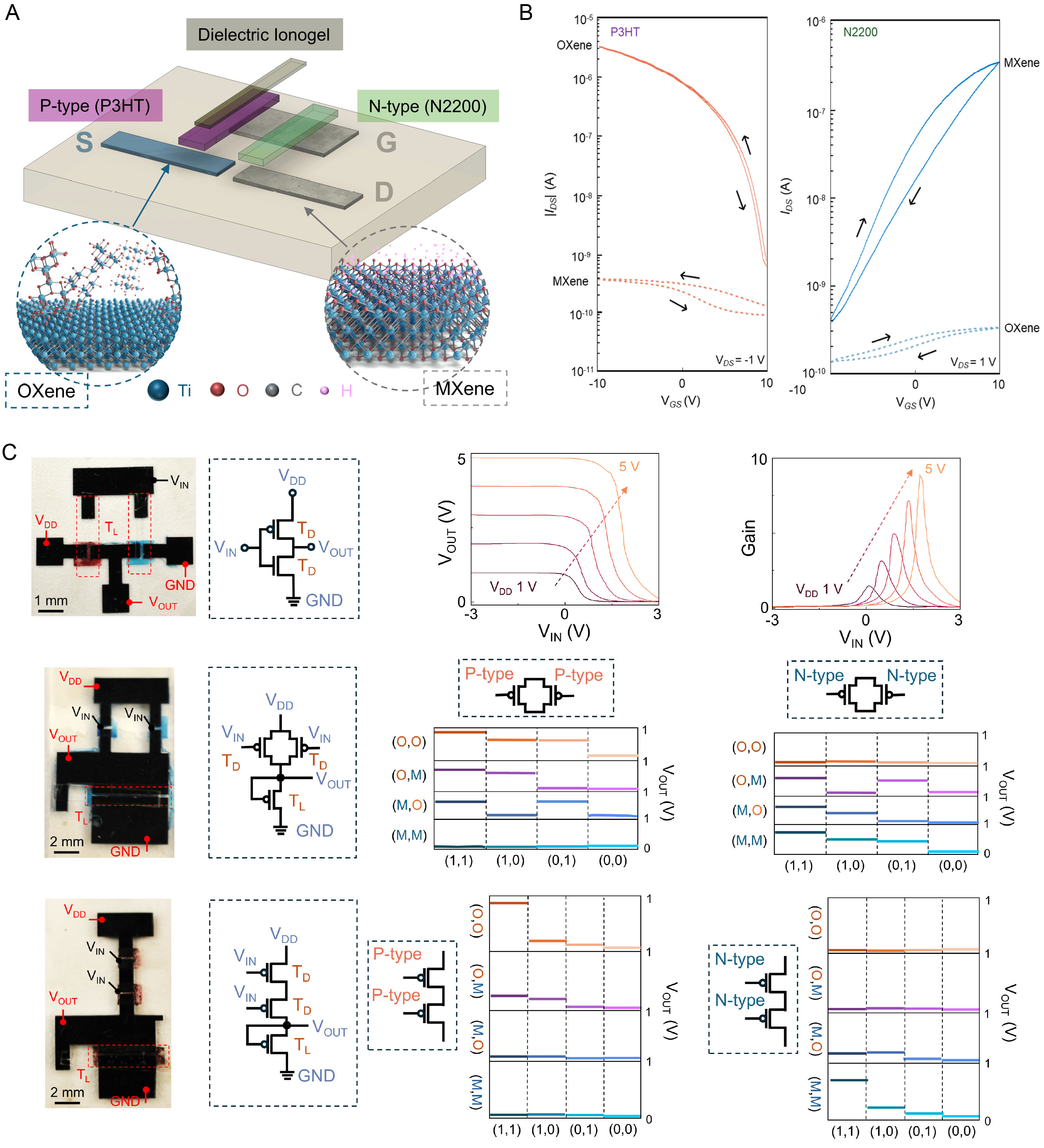
Figure 6. Dielectric ionogels for reconfigurable and contact-symmetry-engineered 2D nanoelectronics. (A) Schematic illustration of the reconfigurable field-effect transistors (FETs) gated by a high-capacitance dielectric ionogel layer, featuring complementary p-type (P3HT) and n-type (N2200) polymer semiconductor channels integrated onto symmetry-engineered asymmetric OXene contact electrodes; (B) Transfer characteristics (IDS-VGS) of transistors with a P3HT (P-type) and N2200 (N-type) semiconductor layer, respectively. The gate current around 10-12 A is omitted; (C) Reconfigurable P- and N-type logical circuits based on inverter, NAND gate, and NOR gate, including the input-output voltage and voltage gain characteristics. (A-C) Reproduced with permission from ref.[186], Copyright 2025, ACS. N2200: poly{[N,N′-bis(2-octyldodecyl)naphthalene-1,4,5,8-bis(dicarboximide)-2,6-diyl]-alt-5,5′-(2,2′-bithiophene)}; P3HT: poly(3-hexylthiophene).
This line of electronic reconfigurability heavily builds upon the foundational tenets of crystalline symmetry modulation in two-dimensional bioelectronics, where breaking intrinsic lattice symmetries unlocks emergent electrochemical and electromechanical phenomena. As elegantly demonstrated by Wu et al., coupling localized orbital symmetry breaking with inversion symmetry breaking within an OXene framework systematically optimizes the interfacial electronic states[187]. This atomic-scale restructuring drastically minimizes interfacial charging impedance and introduces strong Schottky-induced piezoelectric coupling effects, significantly augmenting the signal transduction efficiency at the bioelectronic boundary. At the device level, these symmetry-engineered OXene interfaces were integrated with a high-capacitance ionogel dielectric and P3HT-based semiconductor to form flexible transistor arrays [Figure 7]. Figure 7 illustrates the device architecture, mechanical flexibility, transistor transfer characteristics, switching-current ratios under different oxygen-plasma treatment conditions, and the response of a pressure-sensitive transistor pixel[187]. When functionally interleaved with high-capacitance dielectric ionogels, these symmetry-engineered OXene matrices transcend static routing substrates to empower fully integrated microelectrode arrays, active transistor matrices, and wireless signaling modules. Such ionogel-gated active diagnostic bio-interfaces have been robustly validated in vivo using demanding rodent and porcine myocardium models, delivering exceptionally high-fidelity electrophysiological recording and multi-channel cardiac signal amplification by seamlessly blending dense electrostatic carrier modulation with sub-tissue conformability.
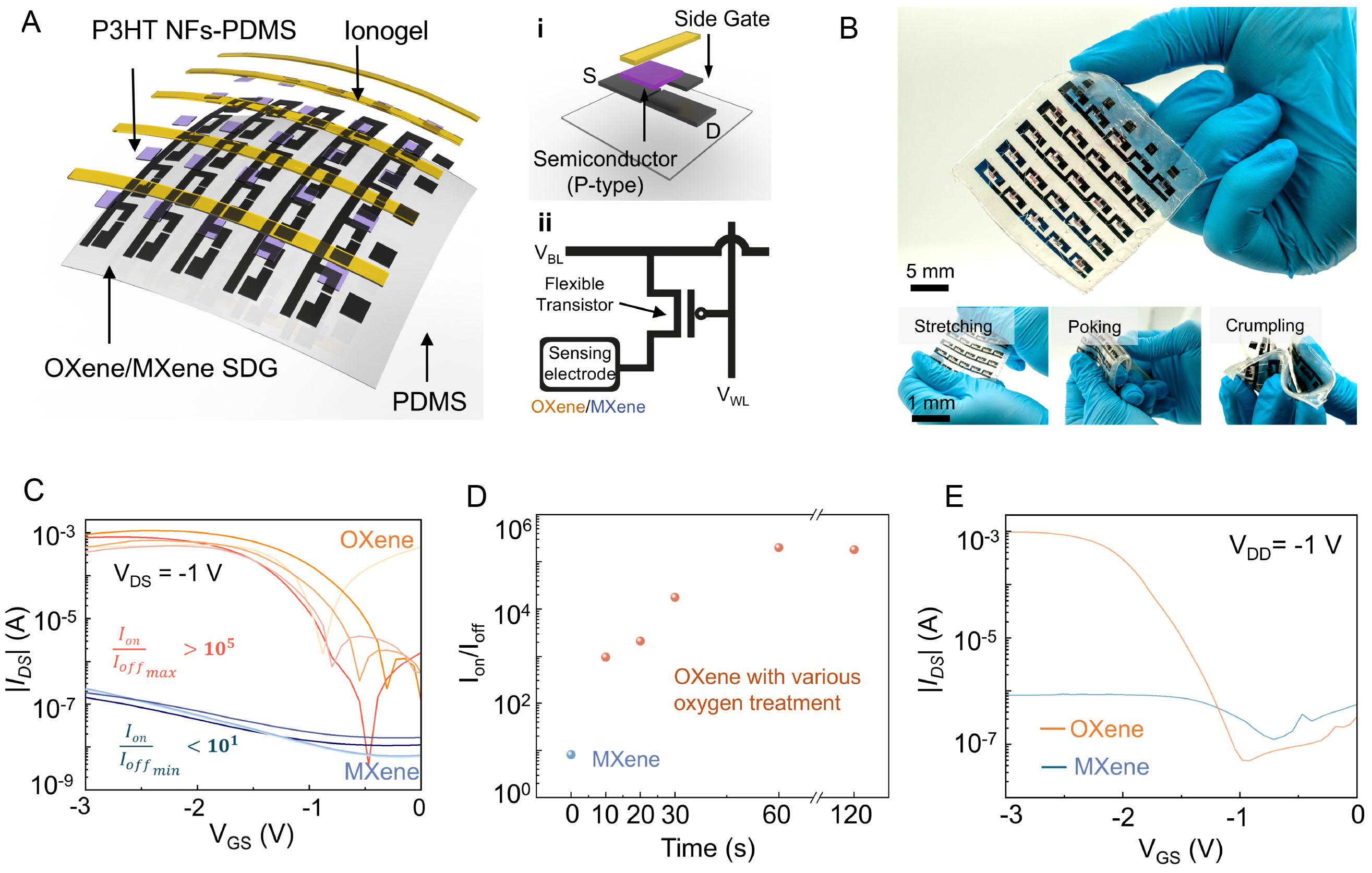
Figure 7. Symmetry engineering in OXene enables reconfigurable “0” and “1” logic interfaces as SDG layers in flexible transistor arrays. (A) An exploded schematic view of the 5 × 5 transistor array with OXene/MXene SDG layer. The constituent components include flexible Polydimethylsiloxane (PDMS, 1:10) substrates, OXene or MXene traces serve as transistor interconnects, with poly(3-hexylthiophene-2,5-diyl) nanofibrils-PDMS (labeled as P3HT NFs-PDMS) as the semiconductor, and ionogel as the flexible dielectric layer. (i) Schematic exploded view of the architecture of a transistor node; (ii) The circuit diagram for a single sensory transistor in the active matrix; (B) Optical image of transistor array under various mechanical deformations; (C) Representative transfer characteristics of the OXene/MXene transistors with a p-type P3HT NFs-PDMS semiconductor layer. The gate current, which ranged around 10-10 ~ 10-11 A, is omitted. Distinct OXene curves are attributed to different oxygen plasma treatment periods (30 cc min-1, power 200W 40 KHz, ranging from 10 s to 120 s); (D) Switching current ratios (Ion/Ioff) of OXene transistors under various oxygen treatment periods, in comparison to MXene transistors without oxygen treatment; (E) Transfer characteristics of one pressure-sensitive pixel in the active matrix with OXene or MXene SDG layer. (A-E) are reproduced as cropped excerpts from ref.[187], under the CC BY-NC-ND 4.0 license; the depicted content of the individual panels was not altered. SDG: Source-drain-gate layer; PDMS: polydimethylsiloxane; VBL: bit line voltage; VWL: word line voltage; IDS: drain-source current; VDS: drain-source voltage; VGS: gate-source voltage; NF: nanofibril.
Wearable sensors
Wearable sensors represent one of the fastest-growing application areas for ionogel technologies due to the increasing demand for continuous, non-invasive physiological monitoring in healthcare, fitness tracking, human-machine interfaces and personalized medicine. Wearable sensing systems require materials that can conform to soft biological tissues while maintaining stable electrical performance under repeated deformation. Traditional rigid electronic materials often suffer from mechanical mismatch with skin, leading to discomfort, signal degradation, and device failure during long-term use. Ionogels have emerged as highly attractive alternatives because they combine tissue-like mechanical properties with excellent ionic conductivity, thermal stability and environmental resistance[86,188-190]. Since ionogels conduct through mobile ions contained within the IL phase, sensor performance is able to be maintained even under significant bending, stretching, twisting, and compression[60,79]. Furthermore, the nonvolatile nature of ILs prevents dehydration-related performance losses commonly observed in hydrogel-based sensors[191]. As a result, ionogel-based wearable sensors can operate reliably over broad temperature and humidity ranges while maintaining long-term stability during repeated mechanical deformation.
One of the most extensively studied applications is wearable strain sensing. Human motion generates a wide range of mechanical deformations, including joint bending, muscle contractions, facial expressions and respiration-induced stretching. Ionogel strain sensors are particularly well suited for these applications because they can tolerate strains exceeding several hundred percent while maintaining stable conductivity[192]. Jiang et al. developed a double-networked ionogel strain sensor exhibiting both high stretchability and excellent sensitivity across large deformation ranges, enabling accurate monitoring of finger motion [Figure 8], wrist bending, and speech-related facial movements[104]. Similarly, MXene-reinforced ionogels have demonstrated exceptionally high gauge factors while maintaining stretchability exceeding 500%, allowing detection of both subtle physiological signals and large-scale body movements[63]. These characteristics make ionogel-based strain sensors attractive candidates for electronic skin, rehabilitation monitoring, and motion-capture systems.
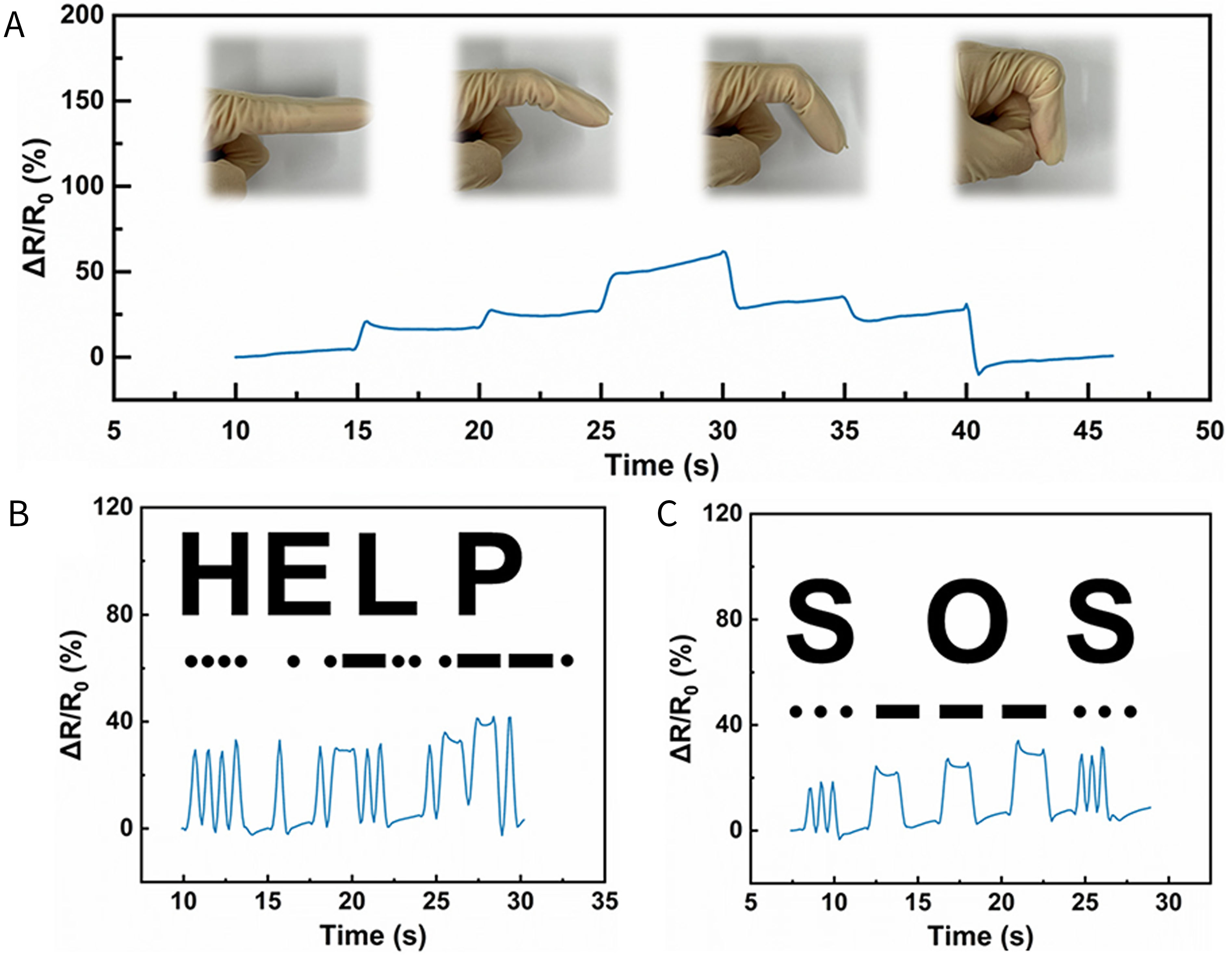
Figure 8. Ionogel-based wearable sensors for finger-movement communication. (A) Changes in resistance of ionogels with time during the detection of finger bending and recovery angles; (B and C) Electrical signals were obtained by ionogels in the process of Morse code communication. Panels (A-C) are reproduced as cropped excerpts from ref.[104], under the CC BY 4.0 license; the depicted content was not altered.
Pressure sensing represents another major area of investigation. Flexible pressure sensors are increasingly used in healthcare monitoring, robotic systems, and human-machine interfaces[193]. The compressible nature of many ionogel networks enables pressure-induced changes in ionic pathways, producing highly sensitive electrical responses. Researchers have demonstrated ionogel pressure sensors capable of detecting pressures ranging from a few Pascals to several hundred kilopascals while maintaining excellent repeatability and durability[194]. Porous ionogel architectures have been engineered to amplify pressure-induced conductivity changes by increasing compressibility and interfacial contact area, resulting in enhanced sensitivity at low pressures relevant to pulse monitoring and tactile sensing[195].
Beyond motion and pressure detection, ionogels have also been explored in physiological monitoring applications. Since ionogels are flexible and conformable to biological tissues, they can establish intimate contact with skin and enable continuous collection of physiological signals. Several studies have demonstrated ionogel-based electrodes for electrophysiological monitoring, including electrocardiography (ECG), electromyography (EMG), and electroencephalography (EEG)[29,196]. Compared with traditional gel electrodes, ionogel electrodes exhibit reduced dehydration and improved long-term stability. In addition, their low interfacial impedance facilitates high-quality signal acquisition over extended periods of operation[130,131].
Recent advances have focused on multifunctional wearable sensors capable of simultaneously monitoring multiple stimuli. By integrating conductive nanofillers, self-healing networks, and stimuli-responsive components, researchers can develop ionogel systems that detect strain, pressure, temperature, and humidity within a single device architecture[197,198]. Such multifunctional sensors are particularly attractive for electronic skin applications, where mimicking the multimodal sensing capabilities of natural skin remains a major objective. Overall, ionogel-based sensors offer a promising platform for flexible and wearable electronics, although further improvements in long-term stability, biocompatibility, device integration, and scalable fabrication are still needed. The progression from wearable physical sensors toward biosensing and electrophysiological interfaces further illustrates the role of ionogels as a bridge between mechanically compliant electronics and biological systems, where ionic transport, conformal contact, and interfacial compatibility become increasingly important.
Biosensors
A biosensor typically comprises three major parts: a biorecognition element, a transducer, and a signal processing/readout system. The biorecognition element binds to or reacts with the target analyte. There are a variety of biorecognition elements, each with a unique influence on the biosensor's overall function[199]. The transducer converts the biological interaction between the target analyte and the biorecognition element into a measurable signal. Biorecognition molecules, such as antibodies and nucleic acid aptamers, can be incorporated into ionogels to selectively bind target biomolecules, enabling ionogel sensors to detect specific analytes in complex biological samples while reducing interference from other species[11]. In ionogel-based biosensors, the ionogel can serve as a soft electrolyte, a biomolecule-supporting matrix, and a conductive interface, making it useful for flexible electrochemical sensing platforms[3,11,34].
Electrochemical biosensors can measure changes in current, potential, impedance, capacitance, resistance, and conductivity[200]. The ionic liquid phase in ionogel sensors supports ion movement, while the gel network stabilizes the system near the electrode and reduces leakage[3,34]. These properties are useful in biomedical sensors because the sensing layer often must function during motion or in contact with fluids[73].
Biosensors are often used in complex environments where sweat, fluid, blood, tissue, and other biological materials should be accounted for. These factors pose mechanical challenges for a biosensor's functionality. The body's motion, combined with moisture, can make it difficult for the sensor to adhere well to the tissue. Biological fluids introduce an additional challenge because they contain multiple ionic species, including Na+, K+, Cl-, and H+, which can influence sensor selectivity, stability, and interfacial behavior[201,202]. Ionogels address these challenges by providing a soft, ionically conductive matrix that maintains contact with biological surfaces while supporting electrochemical signal transduction[136]. Biorecognition molecules can bind to target biomolecules, enabling high selectivity and reduced interference in ionogel sensors[203].
Recent examples of ionogels demonstrate their utility in biomolecule detection and wound monitoring. In one case, a conductive rubber-like ionogel electrode was developed to understand charge transfer through proteins. The electrode was developed using acrylic monomer, an ionic liquid, and conductive carbon powder. The ionogel electrode was used to form reproducible contacts with proteins, including human serum albumin, cytochrome C, and hemoglobin[137]. Expanding on this paradigm to establish highly customizable, zero-hardware-stack point-of-care diagnostics, Zhang et al. developed a personalizable, skin-interfaced platform constructed from modular, self-healing gel “puzzle pieces” that can autonomously merge via mild thermal treatment (70 °C for 20 min) to maintain absolute structural and mechanical continuity[204]. By systematically replacing the ionic liquid EMIES with glycerol, electrostatic interactions within the polymer network are reduced, lowering the Young’s modulus to approximately 35.65 kPa and increasing the fracture strain to ~ 1,350%, thereby producing mechanical compliance comparable to that of soft skin-interfaced materials[204]. To bypass the need for extensive microfluidic channeling, the platform embeds colorimetric sensing reservoirs within an advanced bilayer microporous polymeric foam. The high-porosity lower layer rapidly wicks sweat away via capillary action to keep the skin dry, while the denser, low-porosity upper layer efficiently stores the biofluid for colorimetric interactions. This integrated architecture allows for the simultaneous tracking of glucose, creatinine, chloride, and pH levels via visual RGB color shifts, presenting a resilient, on-demand wearable solution for capturing multi-parametric metabolic profiles in real-world environments. The combination of ionogels’ conductive sensing abilities and their flexibility makes them attractive materials for biosensors. Patternable ionogels are useful for controlling sensor geometry. Zhong et al. demonstrated that structured platforms can be fabricated using highly conductive, photolithographically patternable ionogels for flexible and stretchable electrochemical devices[73]. Their softness and flexibility can reduce mechanical mismatch with biological tissues.
Despite these advantages, ionogel biosensors still face several barriers to widespread use in biomedical settings. A biosensor intended for long-term use must maintain stable performance in environments where biological materials can accumulate on the sensor surface. This process, known as biofouling, can block recognition sites, reduce sensitivity, and contribute to signal drift over time[205]. Lu et al. highlighted this problem and showed antifouling strategies. Implantable biosensors face additional challenges because they must remain stable within dynamic biological environments[206]. For ionogel systems, these issues are important because ionic liquid leaching, material stability, and biological safety must be controlled before clinical translation.
Neural interfaces
Neural interfaces create functional links between the nervous system and external devices to either record from or stimulate neural tissue. Such devices can assist or restore sensory, motor, and other neurological functions in patients with damaged nervous systems[207].
A major challenge in neural interface design is creating and maintaining electrical communication with neural tissue. Neural tissue is soft, hydrated, and electrically active, requiring neural interface materials that maintain electrical communication while limiting mechanical irritation and signal instability. Additionally, conventional electronics are often rigid and conduct via electrons, whereas neural tissue communicates via ions and electrochemical gradients[207]. The stiffness of conventional electronics can contribute to poor contact in a neural interface; therefore, useful neural interface materials must be soft enough to match biological tissue while being conductive enough to record or stimulate neural activity. Ionogels are promising in this context, as they combine ionic conductivity with flexible mechanics, enabling them to serve as soft interfacial materials between neural tissue and electronic systems.
An example of ionogel application in neural interface engineering is the multi-cross-linked membrane ionogel assembly developed by Kim et al. for reversible non-Faradaic neurostimulation[133]. Neural stimulation requires safely transferring electrical stimulation to the tissue. Faradaic stimulation involves charge-transfer reactions at the electrode-tissue interface that can cause electrode degradation and tissue damage. By contrast, non-Faradaic stimulation avoids irreversible charge-transfer reactions, which was a central design feature of the membrane-ionogel assembly developed by Kim et al.[133]. Ionogels are useful here, as their mobile ions can facilitate charge redistribution. The system combined a genipin-cross-linked biopolymeric ionogel and a dopamine-cross-linked graphene oxide membrane. The membrane-ionogel assembly helped limit ion exchange between biological ions and synthetic device ions while forming a bioadhesive contact with the target tissue. This interface was used for neurostimulation of the sciatic nerve but showed potential relevance for overactive bladder treatment[133].
Ionogels are also useful for neural recording applications. One example is electroencephalography (EEG), which requires a stable connection between the scalp and electrode for high-quality signal acquisition. Many conventional noninvasive electrodes can suffer from dehydration and mechanical mismatch over time, making it difficult to maintain stable contact during prolonged recordings[25]. Ionogel electrodes can help combat these issues by providing soft, conductive, long-term contact. Fu et al. used ionogels to develop a lipophilic self-wetting electrode for long-term high-fidelity EEG recording[25]. Wu et al. utilized orbit-symmetry-broken MXene to develop a low-interfacial-impedance ionogel-based implant for high-fidelity EEG recording and therapeutic intervention in vivo[134].
Although ionogels offer several advantages for neural interfaces, their use in long-term neural devices remains a concern. Ionic liquid leaching, biocompatibility, durability, and signal drift are all concerns when considering the longevity of ionogels in neural interfaces. Implanted interfaces are exposed to biological materials and motion, which makes long-term interface stability even more difficult. Kim et al.’s membrane-ionogel assembly addressed part of this challenge by limiting ion exchange, highlighting the importance of controlling the interfaces between the tissue and device for safe neurostimulation[133]. Before ionogel-based neural interfaces can be translated into routine biomedical use, there is a need for continued evaluation of toxicity and long-term performance.
Soft robotics and actuators
Soft robotics is a subset of robotics focused around designing and building robots from flexible materials rather than the typical, rigid material choice. Soft robots are often used in biological applications such as endoscopy, surgery, and drug delivery[208-211]. Soft robots are designed to work in shifting environments that require material compliance and high degrees of freedom to ensure adaptability[212]. In this context, ionogels are extremely useful as they possess mechanical strength and deformability as well as the conductivity of an ionic liquid, making them a prime choice for actuators.
Soft actuators are the way that soft robots are mechanized, as they are materials based on soft matter that converts a source of energy into motion[213]. These actuators are the “artificial muscles” of the robot that allow it to move and deform. For example, Truby et al. were able to use ionogels as soft sensors and actuators to develop a robotic gripping device that forms around anything it is trying to hold [Figure 9][31]. Soft actuators convert energy through various engineered mechanisms such as fluidic, electrostatic, thermal, magnetic, and biohybrid actuation[211]. Compared to hydrogels, ionogels exhibit more favorable mechanical, electrical, and biomimetic properties, as hydrogels are denser, less compliant, and not as stable as ionogels[214].
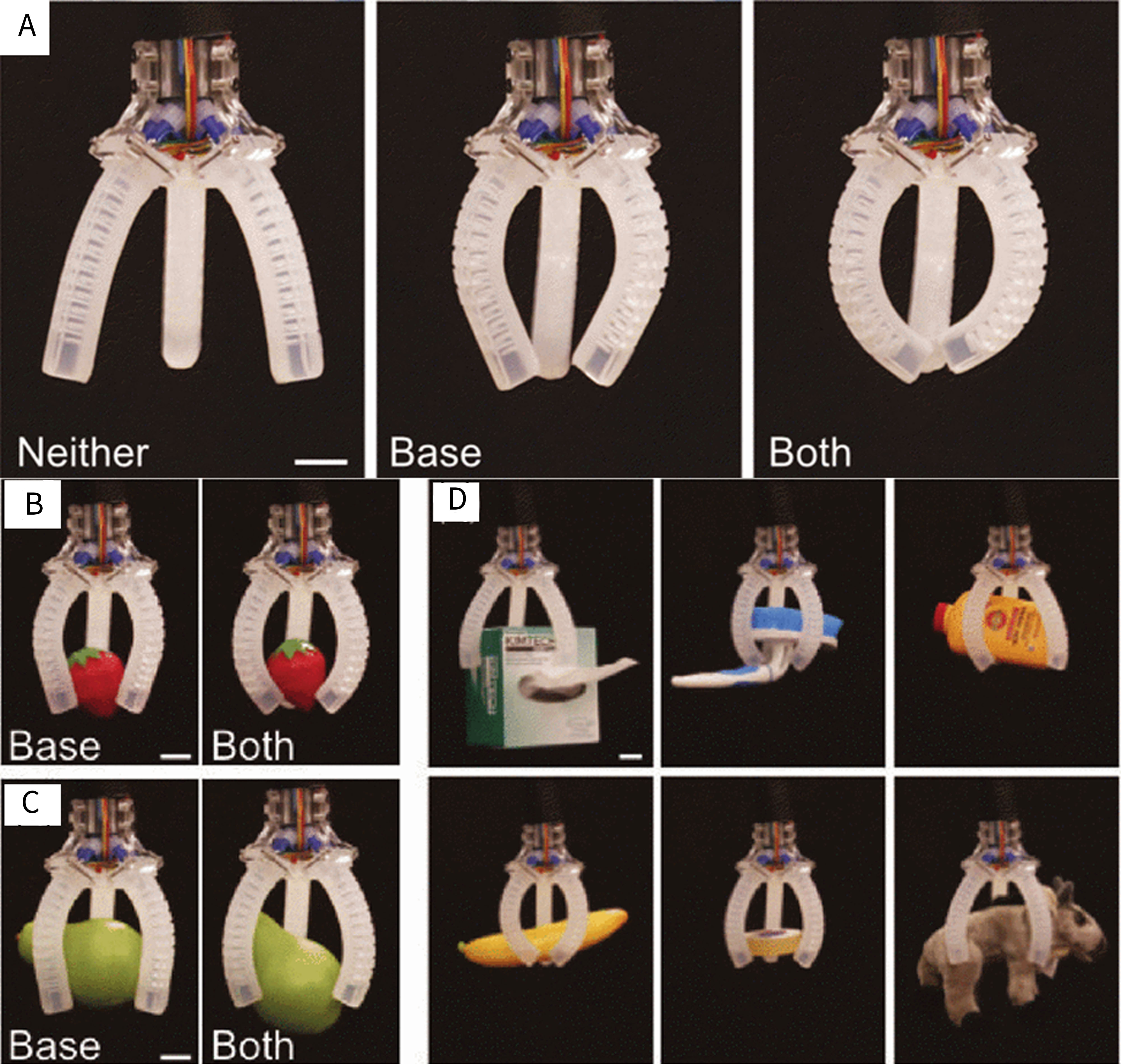
Figure 9. Flexible gripping robot utilizing ionogel sensors for object manipulation. (A) Examples of manipulator poses. Photographs of the soft gripper during no (left), base-only (center), and full-finger actuation at inflation pressure of 140 kPa. Scale bar is 15 mm; (B-D) Examples of object grasping; (B and C) Examples of grasping poses are shown for holding a toy strawberry (B) and pear (C) during base-only (left) and full-finger actuation (right); (D) Examples of objects that can be grasped by the soft gripper with appropriate pre-grasp orientation. Inflation pressure is 140 kPa in each photograph. Scale bars are 15 mm. (A-D) Reproduced with permission from ref.[31], Copyright 2019, IEEE.
Through unique combinations of cations and anions, ionogels may possess hydrophilic or hydrophobic properties, allowing them to be employed in different settings. PVA, which is a hydrophilic polymer that is rich in -OH groups, allows for hydrogen bonding. This allows the polymer matrix to effectively stabilize ionic liquids with thorough ion distribution, making them a viable option as actuators that may undergo large deformations[214]. In addition, ionogels have the ability to maintain moisture and chemical stability due to their ionic properties, further solidifying them as promising options for soft actuators[11].
Ionogel actuation is commonly done through electrode interactions, as seen in a study by Wang et al.[215]. In this ionogel actuator, the ionogel acts as an ion reservoir between activated carbon electrodes. When a voltage is applied, cations and anions migrate towards opposite electrodes which form electric double layers. Due to the size difference in cations and anions, ion accumulation produces asymmetric swelling and contraction between the cathode and the anode sides. This uneven strain causes the actuator to bend towards the anode, while the ionogel’s polymer network provides mechanical support and sustained pathways for ionic transport[32].
Ionogels have become promising materials for several soft robotics applications because they combine advantageous mechanical, conductive, and responsive properties. In microfluidic devices, ionogel actuators can function as reusable valves that regulate fluid flow through reversible swelling and shrinking[216,217]. In soft grippers and artificial muscles, ionogels enable controlled bending, contraction, bistable motion, and load lifting under electrical, thermal, electrothermal, or humidity-based stimulation[218-221]. Ionogels can also serve as soft sensors for touch, bending, pressure, and deformation, allowing for integration into soft robots for live feedback and human-machine interfaces[222-224].
Even with the number of advantages, ionogel actuators still face limitations in soft robotic applications. Many studies remain at the single-actuator level, as there are unresolved challenges in integrating sensing, actuation, power, and control into full robotic systems[214]. Performance trade-offs between response speed, strain output, durability, and load capacity also make application-specific material design necessary. Additionally, some commonly used ILs may raise toxicity or degradability concerns, although cholinium-, amino acid- and carboxylate-based ionic liquids and natural polymers such as gelatin, alginate, and chitosan may improve biocompatibility[225,226].
Drug delivery systems
Drug delivery systems deliver pharmaceutical compounds to humans and animals in ways that improve treatment effectiveness by controlling the timing, location, and amount of drug release[227]. Commonly, the solubility in an aqueous solution of many drugs creates delivery issues. Ionogels can help with this problem, as ionic liquids have been seen to dissolve substances that are otherwise less soluble.
Ionogels combine the stability of a gel network with the tunability of the ionic liquid's chemical environment, making them promising materials for drug delivery systems. The gel network can retain the therapeutic molecules, and the ionic liquid phase can influence drug solubility and interactions with biological environments[228]. Instead of relying solely on the ionic liquid as the free liquid, the ionogel provides stability, making it a useful candidate for localized and controlled therapeutic delivery[33].
An example of an ionogel in drug delivery systems is a mucoadhesive ion-liquid gel for oral delivery. Peng et al. developed a patch encapsulating CAGE in a PVA gel. The patch was designed to adhere to the intestine and to release insulin into the small intestine[229]. This example shows how ionogels can help localize drug delivery systems in the gastrointestinal environment.
Ionogels can also be engineered for stimuli-responsive delivery, in which environmental changes can alter the gel network and influence therapeutic release[126,230]. These stimuli, such as pH, temperature, light, electrical input, ionic strength, or mechanical changes, can be used to design triggers for the ionogel drug delivery system. Biological environments, such as wounds in the gastrointestinal tract, are dynamic, constantly changing chemical and physical systems. A drug delivery system that can respond to these local environmental cues while maintaining contact with the target tissue is useful, creating the possibility of more controlled release[229].
The effectiveness of ionogel drug delivery systems depends on degradability and biocompatibility[112]. Often, drug delivery materials must remain in direct contact with tissues for extended periods. There are concerns with long-term stability in ionogel drug delivery systems. Limitations include possible ionic liquid leaching, cytotoxicity, and burst release. In the future, ionogel drug delivery should be balanced with material safety[3].
Tissue engineering
Tissue engineering intersects biology and material science to create or repair tissue. Biomaterials used in tissue engineering must support tissue repair or regeneration while remaining compatible with soft biological environments[231]. In tissue engineering, the material and environment must support cellular interactions that lead to tissue formation. Metals and ceramics have been used in orthopedic applications, but polymers more closely match the chemical and physical properties of many tissues[232,233]. Ionogels can be useful in this role because their gel networks provide a soft, flexible structure with the tunability of the ionic liquid phase.
The ionic liquid in ionogels supports ion transfer while the gel network provides structure, making it promising for engineered tissues that interact with mechanically active tissues such as muscles or nerves[136,234]. Recently, artificial muscles have emerged as a promising application of ionogels. In these systems, ionogel coatings on conductive yarns can produce electrically driven contraction[235]. These systems provide a desirable mechanical response relevant to prosthetics, soft robotic assistive devices, and rehabilitative technologies. This shows how ionogels can contribute to the movement of engineered tissues. However, biocompatibility, ionic leaching, cytotoxicity, and long-term stability must be considered because tissue engineering materials come into direct contact with cells and regenerating tissue.
CHALLENGES & LIMITATIONS
Materials stability and ionic liquid retention
Despite their promise, ionogels face several practical challenges. One major issue is IL leakage and stability. Because the IL phase remains mobile within the host network and, depending on the ionogel architecture, may be retained primarily through physical confinement and noncovalent interactions, long-term retention can be incomplete. Over time, IL molecules can diffuse or leach out of the matrix under harsh conditions or when the ionogel is not optimally synthesized, causing a gradual loss of conductivity. This leakage not only degrades performance but can expose devices to the IL, raising safety and compatibility concerns. There is still a need for a careful evaluation of aging ionogels and IL loss under extensive cycling. Enhancing IL-polymer binding or adding sealants can mitigate leakage, but no universal solution exists yet.
Future studies should therefore move beyond qualitative descriptions such as “no visible leakage” and quantitatively characterize IL retention as a function of time and environmental exposure. Useful metrics include cumulative IL washout as a percentage of the initial IL content, characteristic washout times, and the corresponding retention of ionic conductivity after exposure. Kottsov et al. developed a continuous conductometric method for quantifying IL washout from ionogels and defined parameters including the half-washout time (t1/2), 10% and 90% washout times (t0.1 and t0.9), washout degree after a specified exposure time, equilibrium washout level, and washout rate constant[236]. Their measurements, independently validated using HPLC, demonstrated that IL retention can vary substantially with IL chemistry, matrix composition, sample geometry, and IL loading[236]. Gravimetric measurements can provide a complementary metric under non-aqueous or ambient conditions; for example, poly(ionic liquid) gel electrolytes have been evaluated by monitoring mass loss associated with unbound IL over time[144]. For meaningful comparison, leaching measurements should also specify the exposure medium, temperature, duration, sample geometry, agitation, and mechanical loading conditions.
Device reliability and mechanical durability
Mechanical durability is another concern with ionogels. As previously stated, there is a well-known trade-off between mechanical durability and ionic conductivity in ionogels. Ionogels are capable of being very mechanically robust at the cost of losing a large proportion of their ionic conductivity. Even mechanically robust gels can experience microcracks, network disentanglement, or even tears under cyclic deformation, eventually reducing elasticity and ionic pathways. While some reports demonstrate thousands of cycles with little degradation[113], ultimate fatigue limits are typically not reached in studies. This limits our understanding of how ionogels retain functional performance over the substantially longer service lives that may be required for long-term wearable, robotic, or implantable applications. There is still more to explore in terms of the mechanical endurance of soft ionogels before they can be reliably used in long-term applications.
Mechanical durability should therefore be evaluated as a fatigue-life problem rather than solely through monotonic tensile strength, toughness, or fracture strain. Future studies should report the applied strain or stress amplitude, loading mode, cycling frequency or strain rate, environmental conditions, and the number of cycles completed before a predefined mechanical or functional failure criterion is reached. Performance retention should also be quantified by measuring changes in properties such as modulus, peak stress, ionic conductivity, resistance, or sensor response after cyclic loading. Rather than imposing a universal cycle-life threshold, fatigue life should be reported as the number of cycles required to reach a clearly stated level of mechanical or electrical degradation, allowing the criterion to be adapted to the intended application. Recent fatigue-resistant and reinforced ionogel architectures demonstrate the importance of such cyclic testing, including MOF-cross-linked ionogels and fiber-reinforced ionogel composites designed for repeated mechanical loading[107,109,111].
Biocompatibility, toxicity, and sustainability
Environmental and toxicological concerns also limit the use of ionogels in certain devices. Many common ILs exhibit nontrivial toxicity and poor biodegradability[135]. For instance, some ILs are known to be harmful to aquatic life and can bioaccumulate. When contained in a polymer matrix, their impact is reduced, but any IL leakage raises ecological or health risks. Moreover, the polymer hosts themselves often lack biodegradability, emphasizing the need to reduce the environmental risk since often neither the host polymers nor ILs readily degrade. Biocompatible ionogel alternatives have been explored, but trade-offs in performance often arise. In summary, the long-term biocompatibility and lifecycle impact of ionogel components are not yet fully understood or standardized.
For biomedical ionogels, biological compatibility is also strongly application-dependent because materials may contact environments ranging from skin and sweat to blood, wound fluid, cells, and soft tissue. The biological response therefore depends not only on material composition but also on the location, duration, and route of exposure. Safer design strategies include selecting less-toxic or biodegradable ionic liquids, improving confinement of the ionic-liquid phase to minimize release, and incorporating bio-derived components where appropriate[28,112]. For example, bio-derived ionic liquids combined with polymers such as PVA have been investigated as a route toward more biodegradable ionogel systems[112].
For biomedical applications, biocompatibility should similarly be evaluated using quantitative, time-dependent criteria rather than inferred from the nominal biocompatibility of individual components. At minimum, in vitro studies should report cell viability relative to an untreated control as a function of exposure duration and ionogel or extract concentration, while clearly specifying the cell type, sample preparation, extraction conditions, and experimental controls. ISO 10993-5 provides established methods for evaluating in vitro cytotoxicity of medical-device materials, while ISO 10993-12 provides guidance for sample preparation, reference materials, controls, and preparation of extracts[237,238]. For materials intended for prolonged skin contact or implantation, short-term cell-viability measurements should be supplemented by extended or repeated exposure studies and, where appropriate, evaluation of inflammatory response, tissue compatibility, and IL release. Studies of cholinium-based ionogels and biocompatible supramolecular ionogels demonstrate the feasibility of biologically compatible formulations, but also reinforce the need for application-specific long-term evaluation[131,225,234].
Manufacturing and scalability
The manufacturability and scalability also pose a further obstacle. Lab-scale ionogel fabrication often involves precise, multi-step chemistry that can be hard to scale uniformly. ILs themselves are typically expensive to synthesize and purify, inflating material cost. Reproducibility can suffer due to the fact that even slight variations in monomer or IL purity, processing temperature, or mixing can lead to differences in gel structure and properties across batches. For truly large-scale applications, cost-effective and robust synthesis routes will be needed. Techniques like roll-to-roll casting or 3D printing show promise of uniform synthesis, but even they must ensure consistent IL loading and network homogeneity.
Translation beyond laboratory-scale synthesis also requires quantitative evaluation of both reproducibility and cost. Rather than describing a fabrication process as simply “reproducible,” studies should report results from independently prepared batches and provide the mean, standard deviation, and coefficient of variation (CV = standard deviation/mean × 100%) for critical properties such as IL loading, ionic conductivity, modulus, sample thickness, and relevant device outputs. Reporting these statistics would distinguish true batch-to-batch reproducibility from repeated measurements performed on samples obtained from a single synthesis batch.
Economic evaluation should likewise be normalized to a clearly defined material or device basis. For materials development, reporting approximate material cost per kilogram of ionogel would facilitate comparison among formulations, while device-oriented studies may additionally report cost per unit area or per device where appropriate. Cost analyses should distinguish contributions from the IL, polymer or inorganic host, reinforcing fillers, solvents and initiators, processing energy, purification, and material recovery or recycling. Studies of IL manufacturing demonstrate that IL cost is highly dependent on precursor chemistry, synthesis route, production scale, and process intensification rather than being an intrinsic property of the material class[239]. Techno-economic analyses further show that IL recovery and reuse can substantially alter process economics, indicating that recycling efficiency should be incorporated into cost projections for scalable ionogel technologies[240].
Standardized characterization and testing
A standardized reporting framework should therefore include not only the measured value but also the experimental conditions required to interpret that value. Ionic conductivity measurements should report temperature, humidity where relevant, sample geometry, electrode configuration, measurement frequency range, and equilibration conditions. Mechanical measurements should specify specimen geometry, loading mode, strain rate or frequency, temperature, and the number of independent specimens tested. Long-term studies should report both the initial property and its percentage retention after a defined aging or cycling protocol. For manufacturing studies, the number of independently synthesized batches should also be distinguished from the number of specimens measured within a single batch. Establishing these common reporting practices would enable more meaningful cross-study comparisons and provide a clearer basis for evaluating whether improvements in laboratory-scale performance translate into improved device reliability.
Beyond standardizing experimental conditions, future benchmarking should incorporate quantitative criteria that reflect the translational limitations of ionogels. These should include time-dependent ionic-liquid loss or leaching, retention of mechanical and electrical performance during fatigue cycling, cytotoxicity as a function of exposure duration and concentration, batch-to-batch variability across independently prepared materials, normalized material and processing cost, and life-cycle environmental impacts evaluated using clearly defined functional units and system boundaries. Because acceptable values for these parameters will vary substantially among energy-storage, wearable, robotic, and biomedical applications, universal numerical pass-fail thresholds are unlikely to be appropriate; instead, consistent quantitative reporting would enable ionogel systems to be compared objectively and evaluated relative to the requirements of their intended application.
EMERGING TRENDS & FUTURE PERSPECTIVES
Ionogel research is rapidly evolving from proof-of-concept material development toward multifunctional, application-driven systems. While early studies largely focused on demonstrating ionic conductivity, thermal stability, and mechanical robustness, emerging work increasingly emphasizes adaptability, scalability, and integration into real-world technologies. Future progress in ionogels will likely be defined not by improvements in any single material property, but by the ability to simultaneously optimize electrochemical performance, mechanical resilience, manufacturability, and long-term reliability.
An important component of this transition will be a shift from record-property demonstrations toward benchmark-driven evaluation of material reliability and translational performance. Future ionogel systems should therefore be evaluated not only according to maximum ionic conductivity, toughness, stretchability, or electrochemical stability, but also according to quantitative measures of IL retention, fatigue life, biological response, batch reproducibility, manufacturing cost, and environmental impact. A material that exhibits moderately lower peak performance but maintains its properties during extended exposure and cycling, can be produced reproducibly and economically, and exhibits reduced biological and environmental risk may ultimately be more suitable for practical deployment than a material optimized around a single record-level property. Recent work on sustainable and recyclable ionogel architectures already reflects this broader direction[141,241]. At the component level, life-cycle assessment of IL synthesis further demonstrates that environmental impact depends strongly on synthetic route, scale, solvent and auxiliary use, emphasizing the importance of considering upstream material production when evaluating ionogel sustainability[242].
One important trend is the continued development of next-generation ionogel materials through increasingly sophisticated IL chemistries and hybrid network designs[243]. Future ionogels will likely prioritize tunability, environmental stability, and biocompatibility while minimizing toxicity and cost. Rather than relying on conventional formulations optimized for conductivity alone, emerging systems are expected to incorporate multifunctional chemistries capable of improving self-healing, responsiveness, mechanical durability, and interfacial compatibility. At the same time, hybrid frameworks that combine polymers, inorganic materials, and dynamic cross-linking strategies may help overcome persistent tradeoffs between softness, conductivity, and stability.
Another emerging direction is the growing emphasis on multifunctionality[244-246]. Ionogels are increasingly being designed to serve multiple purposes simultaneously, functioning not only as electrolytes but also as sensing materials, structural components, actuators, or energy-storage media. This convergence reflects broader trends in wearable electronics, soft robotics, and bioelectronics, where future devices will require materials capable of adapting to dynamic environments while maintaining electrical and mechanical performance. Rather than existing as passive components, ionogels are increasingly envisioned as active material platforms that can sense and respond during operation.
The integration of nanomaterials also represents an important future opportunity[241,247]. Conductive and reinforcing nanostructures, including carbon-based nanomaterials, metallic particles, and 2D materials such as MXenes/MBenes, continue to expand the functional capabilities of ionogels. Nanomaterial incorporation highlights a shift toward highly engineered, hierarchical material systems in which nanoscale structure is leveraged to tailor conductivity, toughness, stimuli responsiveness, and device integration. Future advances will likely emphasize rational interface design and synergistic material interactions rather than simple additive reinforcement.
The advancement of scalable manufacturing approaches is an equally important future perspective in ionogel research. Although many ionogel systems have demonstrated promising laboratory-scale performance, translation into practical technologies will require fabrication methods capable of producing reproducible, low-cost, and geometrically complex devices. Additive manufacturing techniques, including 3D printing, are increasingly explored as routes toward customizable and application-specific ionogel architectures. Advances in scalable processing may enable ionogels to move beyond laboratory demonstrations into flexible electronics, energy devices, and biomedical technologies.
Overall, the future of ionogels appears highly promising. Their unique combination of ionic conductivity, mechanical adaptability, and multifunctionality positions them as enabling materials for next-generation electrochemical and bioelectronic systems. As materials design and manufacturing techniques continue to advance, ionogels are expected to transition from emerging laboratory materials toward increasingly practical roles in flexible electronics, soft robotics, energy storage, and biomedical technologies.
Application-oriented design guidelines
Application-oriented ionogel design requires prioritizing different combinations of material properties according to the intended device rather than maximizing any single performance metric. The structure-property relationships summarized in Table 6 therefore provide a basis for selecting ionic-liquid chemistry, matrix architecture, and interfacial design according to application-specific requirements.
For lithium-based batteries, high ionic conductivity and a wide electrochemical stability window are primary requirements because the ionogel must support rapid ion transport while remaining stable across the operating voltage range. Thermal stability, mechanical integrity, suppression of electrolyte leakage, and stable electrode-electrolyte interfaces are also important for maintaining safe and durable cycling[129,132]. Supercapacitors similarly benefit from high ionic conductivity and wide electrochemical stability windows, but designs for flexible devices additionally require electrolyte retention and mechanical compliance during deformation[144].
Wearable strain sensors place greater emphasis on stretchability, fatigue resistance, mechanical compliance, and maintenance of stable ionic or electrical response during repeated deformation. In these systems, dynamic or self-healing networks can also be advantageous by restoring mechanical integrity and conductive pathways after damage[104,123]. By contrast, neural interfaces require soft mechanics and stable ionic conductivity together with low interfacial impedance, conformal tissue contact, controlled ion exchange, and biocompatibility. Long-term stability and minimization of ionic-liquid release become particularly important because these materials may remain in prolonged contact with biological tissues[131,133].
Accordingly, no single ionogel formulation is optimal across all applications. Energy-storage systems generally favor electrochemical stability and ion transport, flexible sensing systems prioritize deformation tolerance and recoverability, and bioelectronic interfaces additionally require mechanical matching and biological compatibility. Future ionogel development should therefore begin with the functional requirements of the target device and use ionic-liquid selection, network design, and interfacial engineering to achieve the required balance among conductivity, stability, mechanics, self-healing behavior, and biocompatibility.
CONCLUSION
Ionogels have emerged as uniquely versatile materials that bridge the gap between liquid-state ionic conductors and mechanically stable solid systems. By immobilizing ILs within polymeric, inorganic, or hybrid host matrices, ionogels preserve many of the desirable properties of ILs, including high ionic conductivity, broad electrochemical stability windows, non-volatility, and thermal resilience, while simultaneously providing the structural integrity required for practical device integration. As highlighted throughout this review, advances in ionogel materials design, synthesis strategies, and multifunctional architectures have enabled the development of systems with highly tunable physicochemical, electrochemical, and mechanical properties. These advances have positioned ionogels as promising candidates for applications spanning energy storage, flexible electronics, soft robotics, sensing technologies, and bioelectronic interfaces.
Despite substantial progress, ionogels remain an evolving class of materials whose broader implementation will depend on overcoming several persistent limitations. Tradeoffs between ionic conductivity and mechanical robustness, challenges associated with IL leakage and long-term durability, concerns regarding long-term toxicity and environmental sustainability, and difficulties in scalable manufacturing continue to limit widespread deployment. Moreover, inconsistencies in characterization methods and performance reporting complicate direct comparisons across studies and hinder the establishment of clear material benchmarks. Addressing these barriers will require interdisciplinary efforts that integrate materials science, electrochemistry, polymer chemistry, nanotechnology, device engineering, and manufacturing science to better understand structure-property relationships and enable reproducible, application-specific optimization.
Looking forward, the future of ionogels lies not simply in incremental improvements to conductivity or toughness, but in their continued evolution toward multifunctional and adaptive material systems capable of operating in complex real-world environments. Emerging approaches involving dynamic chemistries, nanocomposite reinforcement, bioinspired architectures, and advanced manufacturing techniques are increasingly transforming ionogels from passive electrolytes into active functional materials that can sense, heal, deform, and respond during operation. As the demand for safer energy storage systems, wearable technologies, soft robotic devices, and biointegrated electronics continues to grow, ionogels are well positioned to play an increasingly important role in enabling next-generation electrochemical and bioelectronic technologies. Continued innovation in materials design, coupled with improved standardization and scalable fabrication, will ultimately determine the pace at which ionogels transition from promising laboratory-scale materials to widely implemented technological platforms.
DECLARATIONS
Authors’ contributions
Made substantial contributions to the conception and design of the study and performed data analysis and interpretation: Langford, L.; Wu, Y.; Nosalek, S.; Moss, E.; Shin, C. J.
Provided administrative, technical, and material support: Bai, W.
Availability of data and materials
Not applicable.
Conflicts of interest
Yizhang Wu, Y.; Bai, W. are the Guest Editors of the Special Issue “Soft Iontronic Materials for Next-Generation Biointegrated Microsystems” of the journal Iontronics. Bai, W. is also an Editorial Board Member of the journal Iontronics. They were not involved in any steps of editorial processing, notably including reviewers' selection, manuscript handling, or decision-making. The other authors declare that there are no conflicts of interest.
AI and AI-assisted tools statement
During the preparation of this manuscript, the AI tool ChatGPT (version GPT 5.5, released 2026-04-23) was used solely for language editing and graphical abstract creation. The tool did not influence the study design, data collection, analysis, interpretation, or the scientific content of the work. All authors take full responsibility for the accuracy, integrity, and final content of the manuscript.
Financial support and sponsorship
None.
Ethical approval and consent to participate
Not applicable.
Consent for publication
Not applicable.
Copyright
© The Author(s) 2026.
REFERENCES
1. Walden, P. Ueber die Molekulargrösse und elektrische Leitfähigkeit einiger geschmolzenen Salze, Izvestiya Imperatorskoy AKameniy Naukъ. VI seriya, 8:6 (1914), 405-422. Available from: https://www.mathnet.ru/php/archive.phtml?wshow=paper&jrnid=im&paperid=6491&option_lang=rus.
3. Fan, X.; Liu, S.; Jia, Z.; et al. Ionogels: recent advances in design, material properties and emerging biomedical applications. Chem. Soc. Rev. 2023, 52, 2497-527.
4. Yang, Q.; Zhang, Z.; Sun, X. G.; Hu, Y. S.; Xing, H.; Dai, S. Ionic liquids and derived materials for lithium and sodium batteries. Chem. Soc. Rev. 2018, 47, 2020-64.
5. Li, Q.; Xu, Y.; Pan, Y.; Wang, W.; Yeoh, G. H. Review and future perspectives on lithium battery fire safety: focusing on design of organic components. Energy. Environ. Mater. 2025, 8, e12892.
6. Tripathi, A. K. Ionic liquid-based solid electrolytes (ionogels) for application in rechargeable lithium battery. Mater. Today. Energy. 2021, 20, 100643.
7. Bideau J, Viau L, Vioux A. Ionogels, ionic liquid based hybrid materials. Chem. Soc. Rev. 2011, 40, 907-25.
8. Susan, M. A.; Kaneko, T.; Noda, A.; Watanabe, M. Ion gels prepared by in situ radical polymerization of vinyl monomers in an ionic liquid and their characterization as polymer electrolytes. J. Am. Chem. Soc. 2005, 127, 4976-83.
9. Néouze, M. A.; Le, Bideau. J.; Leroux, F.; Vioux, A. A route to heat resistant solid membranes with performances of liquid electrolytes. Chem. Commun. (Camb). 2005, 49, 1082-4.
10. Lee, H.; Erwin, A.; Buxton, M. L.; et al. Shape persistent, highly conductive ionogels from ionic liquids reinforced with cellulose nanocrystal network. Adv. Funct. Mater. 2021, 31, 2103083.
11. Liu, Q.; Ou, X.; Zhou, Y.; Yan, F. Ionogel-based flexible electronics. Natl. Sci. Rev. 2026, 13, nwaf541.
12. Wang, Y.; Wei, Z.; Ji, T.; Bai, R.; Zhu, H. Highly ionic conductive, stretchable, and tough ionogel for flexible solid-state supercapacitor. Small 2024, 20, e2307019.
13. Chen, N.; Dai, Y.; Xing, Y.; et al. Biomimetic ant-nest ionogel electrolyte boosts the performance of dendrite-free lithium batteries. Energy. Environ. Sci. 2017, 10, 1660-7.
14. Hyun, W. J.; Thomas, C. M.; Hersam, M. C. Nanocomposite ionogel electrolytes: nanocomposite ionogel electrolytes for solid-state rechargeable batteries (Adv. Energy Mater. 36/2020). Adv. Energy. Mater. 2020, 10, 2070149.
15. Feng, L.; Wang, K.; Zhang, X.; et al. Flexible solid-state supercapacitors with enhanced performance from hierarchically graphene nanocomposite electrodes and ionic liquid incorporated gel polymer electrolyte. Adv. Funct. Mater. 2018, 28, 1704463.
16. Cho, K. G.; Kim, H. S.; Jang, S. S.; et al. Ionogels: optimizing electrochemically active surfaces of carbonaceous electrodes for ionogel based supercapacitors (Adv. Funct. Mater. 30/2020). Adv. Funct. Mater. 2020, 30, 2070199.
17. Wang, S.; Jiang, Y.; Hu, X. Ionogel-based membranes for safe lithium/sodium batteries. Adv. Mater. 2022, 34, e2200945.
18. Wang, H.; Wang, Z.; Yang, J.; Xu, C.; Zhang, Q.; Peng, Z. Ionic gels and their applications in stretchable electronics. Macromol. Rapid. Commun. 2018, 39, e1800246.
19. Hammock, M. L.; Chortos, A.; Tee, B. C.; Tok, J. B.; Bao, Z. 25th anniversary article: the evolution of electronic skin (e-skin): a brief history, design considerations, and recent progress. Adv. Mater. 2013, 25, 5997-6038.
20. Liu, Z.; Li, B.; Liu, Y. D.; Liang, Y. Integrated bending actuation and the self-sensing capability of poly(vinyl chloride) gels with ionic liquids. Adv. Funct. Mater. 2022, 32, 2204259.
21. Kong, L.; Sun, J.; Qian, C.; Wang, C.; Yang, J.; Gao, Y. Spatially-correlated neuron transistors with ion-gel gating for brain-inspired applications. Org. Electron. 2017, 44, 25-31.
22. Li, N.; He, P.; Qin, Z.; et al. Rapid self-assembly of robust ultrathin ionogel films for high-performance bioelectronics. Sci. Adv. 2026, 12, eaeb4391.
23. Li, H.; Liu, Y.; Chen, Z.; Yang, Y.; Lv, T.; Chen, T. High voltage and healing flexible zinc ion battery based on ionogel electrolyte. J. Colloid. Interface. Sci. 2023, 639, 408-15.
24. Qi, J.; Liu, Z.; Zhao, Z.; Tan, Z.; Liu, F.; Liu, N. A tough and reusable ionogel adhesive for flexible strain sensor. ACS. Appl. Polym. Mater. 2024, 6, 7659-68.
25. Fu, X.; Zhao, X.; Chen, L.; et al. Lipophilic self-wetting ionogel electrodes for long-term high-fidelity electroencephalogram recording. Adv. Mater. 2026, 38, e23019.
26. Wang, M.; Hu, J.; Dickey, M. D. Tough ionogels: synthesis, toughening mechanisms, and mechanical properties-a perspective. JACS. Au. 2022, 2, 2645-57.
27. Wen, J.; Zhou, L.; Ye, T. Polymer ionogels and their application in flexible ionic devices. SmartMat 2024, 5, e1253.
28. Zhang, Y.; Ma, K.; Chen, K.; Qiao, S. Flexible wearable ionogels: classification, fabrication, properties and applications. Sensor. Actuat. A-Phys. 2024, 372, 115325.
29. Veronica, A.; Nyein, H. Y. Y.; Hsing, I. Ionogels and eutectogels for stable and long-term EEG and EMG signal acquisition. Mater. Futures. 2024, 3, 033501.
30. Tang, J.; Zhai, B.; Liu, J.; et al. A robust, freeze-resistant and highly ion conductive ionogel electrolyte towards lithium metal batteries workable at -30 °C. Phys. Chem. Chem. Phys. 2021, 23, 6775-82.
31. Truby, R. L.; Katzschmann, R. K.; Lewis, J. A.; Rus, D. Soft robotic fingers with embedded ionogel sensors and discrete actuation modes for somatosensitive manipulation. In 2019 2nd IEEE International Conference on Soft Robotics (RoboSoft), April 14-18, 2019. pp 322-9.
32. Liu, X.; He, B.; Wang, Z.; Tang, H.; Su, T.; Wang, Q. Tough nanocomposite ionogel-based actuator exhibits robust performance. Sci. Rep. 2014, 4, 6673.
33. Datta, D.; Bandi, S. P.; Venuganti, V. V. K. Influence of choline-based ionogel on transdermal delivery of vancomycin hydrochloride. Mol. Pharm. 2025, 22, 3331-50.
34. Tomé, L. C.; Porcarelli, L.; Bara, J. E.; Forsyth, M.; Mecerreyes, D. Emerging iongel materials towards applications in energy and bioelectronics. Mater. Horiz. 2021, 8, 3239-65.
35. Xie, Z.; Jeličić, A.; Wang, F.; et al. Transparent, flexible, and paramagnetic ionogels based on PMMA and the iron-based ionic liquid 1-butyl-3-methylimidazolium tetrachloroferrate(iii) [Bmim][FeCl4]. J. Mater. Chem. 2010, 20, 9543.
36. Cowell, M.; Winslow, R.; Zhang, Q.; Ju, J.; Evans, J.; Wright, P. Composite carbon-based ionic liquid supercapacitor for high-current micro devices. J. Phys:. Conf. Ser. 2014, 557, 012061.
37. Chen, K.; Feng, Y.; Zhang, Y.; et al. Entanglement-driven adhesion, self-healing, and high stretchability of double-network PEG-based hydrogels. ACS. Appl. Mater. Interfaces. 2019, 11, 36458-68.
38. Hofmann, A. I.; Östergren, I.; Kim, Y.; et al. All-polymer conducting fibers and 3D prints via melt processing and templated polymerization. ACS. Appl. Mater. Interfaces. 2020, 12, 8713-21.
39. Lan, J.; Li, Y.; Yan, B.; Yin, C.; Ran, R.; Shi, L. Y. Transparent stretchable dual-network ionogel with temperature tolerance for high-performance flexible strain sensors. ACS. Appl. Mater. Interfaces. 2020, 12, 37597-606.
40. Sahrash, R.; Siddiqa, A.; Razzaq, H.; Iqbal, T.; Qaisar, S. PVDF based ionogels: applications towards electrochemical devices and membrane separation processes. Heliyon 2018, 4, e00847.
41. Ko, E. J.; Lee, E. J.; Choi, M. H.; Sung, T. H.; Moon, D. K. PVDF based flexible piezoelectric nanogenerators using conjugated polymer:PCBM blend systems. Sensor. Actuat. A-Phys. 2017, 259, 112-20.
42. Xu, J.; Wang, H.; Du, X.; Cheng, X.; Du, Z.; Wang, H. Highly stretchable PU ionogels with self-healing capability for a flexible thermoelectric generator. ACS. Appl. Mater. Interfaces. 2021, 13, 20427-34.
43. Xu, J.; Wang, H.; Du, X.; Cheng, X.; Du, Z.; Wang, H. Self-healing, anti-freezing and highly stretchable polyurethane ionogel as ionic skin for wireless strain sensing. Chem. Eng. J. 2021, 426, 130724.
44. Lee, L. C.; Hong, S. H.; Kim, M. S.; et al. Enhanced thermoelectric performance of PVA-based ionogels: tailoring crystallinity via additives for advanced waste heat recovery. ACS. Appl. Mater. Interfaces. 2025, 17, 38545-57.
45. Chen, G.; Chen, N.; Li, L.; Wang, Q.; Duan, W. Ionic liquid modified poly(vinyl alcohol) with improved thermal processability and excellent electrical conductivity. Ind. Eng. Chem. Res. 2018, 57, 5472-81.
46. Huang, J. C.; Chen-Yang, Y. W.; Hwang, J. J. Preparation and characterization of silica-based ionogel electrolytes and their application in solid-state lithium batteries. Polymers. (Basel). 2023, 15, 3505.
47. Ueno, K.; Hata, K.; Katakabe, T.; Kondoh, M.; Watanabe, M. Nanocomposite ion gels based on silica nanoparticles and an ionic liquid: ionic transport, viscoelastic properties, and microstructure. J. Phys. Chem. B. 2008, 112, 9013-9.
48. Horowitz, A. I.; Panzer, M. J. High-performance, mechanically compliant silica-based ionogels for electrical energy storage applications. J. Mater. Chem. 2012, 22, 16534.
49. Koç, F.; Gizli, N. Synergistic effect of ionic liquid and organo-functional silane on the preparation of silica based hybrid ionogels as solid-state electrolyte for Li-ion batteries. Ceram. Int. 2021, 47, 25398-407.
50. Verma, Y.; Tripathi, A.; Shalu; et al. Preparation and properties of titania based ionogels synthesized using ionic liquid 1-ethyl-3-methyl imidazolium thiocyanate. Mat. Sci. Eng. B-Adv. 2017, 220, 37-43.
51. Gandolfo, M.; Versaci, D.; Francia, C.; Bodoardo, S.; Amici, J. Enhancing the safety and stability of lithium metal batteries through the use of composite ionogels. Electrochimica. Acta. 2023, 463, 142857.
52. Hu, B.; Tuokkola, A.; Dunn, B. Adapting sol-gel chemistry for ionogel solid electrolytes. J. Sol-Gel. Sci. Technol. 2025, 113, 70-85.
53. Thiemann, S.; Sachnov, S. J.; Gruber, M.; et al. Spray-coatable ionogels based on silane-ionic liquids for low voltage, flexible, electrolyte-gated organic transistors. J. Mater. Chem. C. 2014, 2, 2423-30.
54. Suhail, A. What are the different types of nanocomposites? AZoNano. https://www.azonano.com/article.aspx?ArticleID=7013 (accessed 2026-09-08).
55. Pitchiya, A. P.; Slenker, B. E.; Sreeram, A.; et al. Graphene-enhanced ion transport in dual-conducting composite films of polyacetylene and an imidazolium iodide ionic liquid. Langmuir 2023, 39, 6767-79.
56. Hao, S.; Han, H.; Yang, Z.; et al. Recent advancements on photothermal conversion and antibacterial applications over MXenes-based materials. Nanomicro. Lett. 2022, 14, 178.
57. Wen, X.; Deng, Z.; Wang, H.; et al. High strength, self-healing sensitive ionogel sensor based on MXene/ionic liquid synergistic conductive network for human-motion detection. J. Mater. Chem. B. 2023, 11, 11251-64.
58. Wu, Y.; Xing, S.; Yang, D.; et al. Soft giant magnetoimpedance electronics enable contact-free human-machine interactions. Proc. Natl. Acad. Sci. U. S. A. 2026, 123, e2526097123.
59. Wang, J. L.; Ando, R. A.; Camargo, P. H. C. Investigating the plasmon-mediated catalytic activity of AgAu nanoparticles as a function of composition: are two metals better than one? ACS. Catal. 2014, 4, 3815-9.
60. Liu, S.; Wu, Y.; Jiang, L.; et al. Highly stretchable, tissue-like ag nanowire-enhanced ionogel nanocomposites as an ionogel-based wearable sensor for body motion monitoring. ACS. Appl. Mater. Interfaces. 2024, 16, 46538-47.
61. Wang, X.; Tian, M.; Wan, J.; Mei, S.; Pan, M.; Pan, Z. Enhanced carbon nanotube ionogels for high-performance wireless strain sensing. Polymers. (Basel). 2025, 17, 817.
62. Yang, X.; Zhang, F.; Zhang, L.; Zhang, T.; Huang, Y.; Chen, Y. A high-performance graphene oxide-doped ion gel as gel polymer electrolyte for all-solid-state supercapacitor applications. Adv. Funct. Mater. 2013, 23, 3353-60.
63. Ma, Z.; Ma, Z.; Lou, M.; et al. MXene-reinforced dynamic ionogels with synergistic interfacial interactions for high-performance flexible sensing applications. Mater. Solidif. , 2026, 2:9580019.
64. Wang, Y.; Zhang, M.; Yan, Z.; Ji, S.; Xiao, S.; Gao, J. Metal nanoparticle hybrid hydrogels: the state-of-the-art of combining hard and soft materials to promote wound healing. Theranostics 2024, 14, 1534-60.
65. Park, J. H.; Rana, H. H.; Kim, J. S.; Hong, J. W.; Lee, S. J.; Park, H. S. Inorganic-organic double network ionogels based on silica nanoparticles for high-temperature flexible supercapacitors. ACS. Appl. Mater. Interfaces. 2023, 15, 37344-53.
66. Marszewski, M.; King, S. C.; Yan, Y.; et al. Thick transparent nanoparticle-based mesoporous silica monolithic slabs for thermally insulating window materials. ACS. Appl. Nano. Mater. 2019, 2, 4547-55.
67. Khurana, S.; Chandra, A. Ion conducting polymer-silica hybrid ionogels obtained via non-aqueous sol-gel route. Solid. State. Ionics. 2019, 340, 115027.
68. Farooq, S.; Razzaq, H.; Razzaque, S.; Khan, B. A.; Qaisar, S. Structural and physical impacts of nanofillers in ionogels: a comprehensive overview. Polymer. Composites. 2019, 40.
69. Cao, W.; Lin, L.; Lammer, H.; et al. Ultra-tough, high-strength ionogels enabling DLP 3D printing for wearable flexible electronics. ACS. Appl. Polym. Mater. 2025, 7, 10860-7.
70. Wang, S.; Hsia, B.; Alper, J. P.; Carraro, C.; Wang, Z.; Maboudian, R. Comparative studies on electrochemical cycling behavior of two different silica-based ionogels. J. Power. Sources. 2016, 301, 299-305.
71. Sultana, S.; Ahmed, K.; Jiwanti, P. K.; Wardhana, B. Y.; Shiblee, M. D. N. I. Ionic liquid-based gels for applications in electrochemical energy storage and conversion devices: a review of recent progress and future prospects. Gels 2021, 8, 2.
72. Martins, A. P. S.; Fdz, De. Añastro. A.; Olmedo-Martínez, J. L.; et al. Influence of anion structure on thermal, mechanical and CO2 solubility properties of UV-cross-linked poly(ethylene glycol) diacrylate iongels. Membranes. (Basel). 2020, 10, 46.
73. Zhong, Y.; Nguyen, G. T. M.; Plesse, C.; Vidal, F.; Jager, E. W. H. Highly conductive, photolithographically patternable ionogels for flexible and stretchable electrochemical devices. ACS. Appl. Mater. Interfaces. 2018, 10, 21601-11.
74. Wang, S.; Liu, H.; Yu, Z.; et al. Cellulose-mediated ionic liquid crystallization enables tough-stiff switchable ionogels. Nat. Commun. 2025, 16, 9007.
75. Zhang, L.; Gao, H.; Guan, L.; Li, Y.; Wang, Q. Polyzwitterion-SiO2 double-network polymer electrolyte with high strength and high ionic conductivity. Polymers. (Basel). 2023, 15, 466.
76. Chae, W.; Kim, B.; Ryoo, W. S.; Earmme, T. A brief review of gel polymer electrolytes using in situ polymerization for lithium-ion polymer batteries. Polymers. (Basel). 2023, 15, 803.
77. Ribot, J. C.; Guerrero-Sanchez, C.; Hoogenboom, R.; Schubert, U. S. Thermoreversible ionogels with tunable properties via aqueous gelation of an amphiphilic quaternary ammonium oligoether-based ionic liquid. J. Mater. Chem. 2010, 20, 8279.
78. Gao, J.; Chen, J.; Zhou, K.; et al. Supramolecular self-assembly regulated double-network ionic gel electrolyte for advanced electrochromic device. Macromolecules 2026, 59, 4936-45.
79. Kim, M. S.; Kim, J. H.; Yoo, H.; et al. Ultrastretchable, tough, and highly conductive ionogels for multipurpose motion monitoring. ACS. Materials. Lett. 2024, 6, 4658-66.
80. Lee, H.; Kim, M. S.; Lee, M.; Kim, S.; Lee, K. H.; Kim, M. Stretchable, self-healable, and adhesive ionogels formed via dual association of complex copolymers. J. Mater. Chem. C. 2026, 14, 7322-33.
81. Zhang, J.; Yin, J.; Li, N.; et al. Simultaneously enhancing the mechanical strength and ionic conductivity of stretchable ionogels enabled by polymerization-induced phase separation. Macromolecules 2022, 55, 10950-9.
82. Islam, A.; Rahman, M. Z. Recent advances in additive manufacturing techniques: an in-depth review. Comprehensive Materials Processing. Elsevier; 2024. pp. 352-78.
83. Lin, S.; Li, Y.; Yang, Z.; et al. Photopolymerization 3D-printed dual-modal flexible sensor for glucose and pH monitoring. Sensors. (Basel). 2025, 25, 5358.
84. Nechausov, S.; Miriyev, A. 3D-Printable high-mixed-conductivity ionogel composites for soft multifunctional devices. Chem. Eng. J. 2024, 496, 153759.
85. Jha, M. K.; Jain, T.; Subramaniam, C. Origami of solid-state supercapacitive microjunctions operable at 3 V with high specific energy density for wearable electronics. ACS. Appl. Electron. Mater. 2020, 2, 659-69.
86. He, X.; Zhang, B.; Liu, Q.; et al. Highly conductive and stretchable nanostructured ionogels for 3D printing capacitive sensors with superior performance. Nat. Commun. 2024, 15, 6431.
87. Bar, N.; Ramanjaneyulu, K.; Basak, P. Quasi-solid semi-interpenetrating polymer networks as electrolytes: part I. Dependence of physicochemical characteristics and ion conduction behavior on matrix composition, cross-link density, chain length between cross-links, molecular entanglements, charge carrier concentration, and nature of anion. J. Phys. Chem. C. 2014, 118, 159-74.
88. Nozari, V.; Calahoo, C.; Tuffnell, J. M.; et al. Sodium ion conductivity in superionic IL-impregnated metal-organic frameworks: enhancing stability through structural disorder. Sci. Rep. 2020, 10, 3532.
89. Dam, T.; Ghosh, A. Ion conduction phenomenon and electrochemical performance of gel polymer electrolyte in EDLC containing blend polymer host, ionic liquid, and mixed carbonate plasticizers. J. Phys. Chem. C. 2018, 122, 27214-23.
90. Cho, K. G.; Cho, Y. K.; Kim, J. H.; Yoo, H. Y.; Hong, K.; Lee, K. H. Thermostable ion gels for high-temperature operation of electrolyte-gated transistors. ACS. Appl. Mater. Interfaces. 2020, 12, 15464-71.
91. Sabagh, S.; Izadyar, M.; Housaindokht, M. R. Molecular-level understanding of lithium ion mobility in imidazolium and Pyrrolidinium-based ionic liquids with [FSI]- and [TFSI]- anions. J. Mol. Liq. 2025, 438, 128719.
92. Thorat, A.; Verma, A. K.; Chauhan, R.; Sartape, R.; Singh, M. R.; Shah, J. K. Identifying high ionic conductivity compositions of ionic liquid electrolytes using features of the solvation environment. J. Chem. Theory. Comput. 2025, 21, 1929-40.
93. Zeng, W.; Zhang, S.; Lan, J.; et al. Double network gel electrolyte with high ionic conductivity and mechanical strength for zinc-ion batteries. ACS. Nano. 2024, 18, 26391-400.
94. Foran, G.; Mankovsky, D.; Verdier, N.; et al. The impact of absorbed solvent on the performance of solid polymer electrolytes for use in solid-state lithium batteries. iScience 2020, 23, 101597.
95. Kao, H.; Chang, P.; Chao, S.; Lee, C. 7Li NMR, ionic conductivity and self-diffusion coefficients of lithium ion and solvent of plasticized organic-inorganic hybrid electrolyte based on PPG-PEG-PPG diamine and alkoxysilanes. Electrochimica. Acta. 2006, 52, 1015-27.
96. Huang, Z.; Lai, J.; Kong, X.; et al. A solvent-anchored non-flammable electrolyte. Matter 2023, 6, 445-59.
97. Tang, Q.; Li, H.; Yue, Y.; et al. 1-Ethyl-3-methylimidazolium tetrafluoroborate-doped high ionic conductivity gel electrolytes with reduced anodic reaction potentials for electrochromic devices. Mater. Design. 2017, 118, 279-85.
98. Rao, M.; Geng, X.; Liao, Y.; Hu, S.; Li, W. Preparation and performance of gel polymer electrolyte based on electrospun polymer membrane and ionic liquid for lithium ion battery. J. Membr. Sci. 2012, 399-400, 37-42.
99. Ma, Y.; Li, L.; Gao, G.; Yang, X.; You, J.; Yang, P. Ionic conductivity enhancement in gel polymer electrolyte membrane with N-methyl-N-butyl-piperidine-bis(trifluoromethylsulfonyl) imide ionic liquid for lithium ion battery. Colloids. Surf. A. 2016, 502, 130-8.
100. Ducrot, E.; Chen, Y.; Bulters, M.; Sijbesma, R. P.; Creton, C. Toughening elastomers with sacrificial bonds and watching them break. Science , 2014, 344:186-9.
101. Guan, T.; Wang, X.; Zhu, Y.; et al. Mechanically robust skin-like poly(urethane-urea) elastomers cross-linked with hydrogen-bond arrays and their application as high-performance ultrastretchable conductors. Macromolecules 2022, 55, 5816-25.
102. Wang, M.; Zhang, P.; Shamsi, M.; et al. Tough and stretchable ionogels by in situ phase separation. Nat. Mater. 2022, 21, 359-65.
103. Li, X.; Song, X.; Qie, X.; et al. Tough and highly stretchable multifunctional ionogels based on phase-separated structure and nanocellulose macromolecular covalent cross-linker. Cell. Rep. Phys. Sci. 2024, 5, 102073.
104. Jiang, Y.; Zhao, S.; Wang, F.; Zhang, X.; Su, Z. Highly stretchable double network ionogels for monitoring physiological signals and detecting sign language. Biosensors. (Basel). 2024, 14, 227.
105. Sun, Y.; Wang, C.; Guo, B.; Zhang, S.; Niu, W. Mussel-inspired tough ionogel with robust adhesion and mechanical adaptivity for impact resistance. Chem. Eng. J. 2024, 498, 155059.
106. Li, W.; Li, L.; Liu, Z.; Zheng, S.; Li, Q.; Yan, F. Supramolecular ionogels tougher than metals. Adv. Mater. 2023, 35, e2301383.
107. Xia, Q.; Li, W.; Zou, X.; et al. Metal-organic framework (MOF) facilitated highly stretchable and fatigue-resistant ionogels for recyclable sensors. Mater. Horiz. 2022, 9, 2881-92.
108. Bui, K.; T. m Nguyen G, Vancaeyzeele C, et al. Stretchable, healable, and weldable vitrimer ionogel for ionotronic applications. Chem. Eng. J. 2023, 474, 145533.
109. Rana, H. H.; Park, J. H.; Ducrot, E.; et al. Extreme properties of double networked ionogel electrolytes for flexible and durable energy storage devices. Energy. Storage. Mater. 2019, 19, 197-205.
110. Zhu, Y.; Li, X.; Zhao, Z.; Liang, Y.; Wang, L.; Liu, Y. Highly stretchable, transparent and adhesive ionogel based on chitosan-poly(acrylic acid) double networks for flexible strain sensors. Gels 2022, 8, 797.
111. Lyu, X.; Yu, K.; Zhang, H.; Zhou, P.; Shen, Z.; Zou, Z. Tough fiber-reinforced composite ionogels with crack resistance surpassing metals. Nat. Commun. 2025, 16, 4005.
112. Yamada, S.; Honda, T. Development of supramolecular ionic gels with self-healing capability and biodegradability using a bioderived ionic liquid and poly(vinyl alcohol). Nanoscale 2025, 17, 2184-92.
113. Jiang, H.; Xie, F.; Wang, J.; et al. Tough, crack-resistant ionogels based on chain entanglement structures for health monitoring applications. ACS. Appl. Polym. Mater. 2025, 7, 7899-909.
114. Mital, D. K.; Nancarrow, P.; Ibrahim, T. H.; Abdel, Jabbar. N.; Khamis, M. I. Ionic liquid melting points: structure-property analysis and new hybrid group contribution model. Ind. Eng. Chem. Res. 2022, 61, 4683-706.
115. Hu, Y.; Shi, R.; Ren, Y.; et al. A “two-in-one” strategy for flexible aqueous batteries operated at -80 °C. Adv. Funct. Mater. 2022, 32, 2203081.
116. Zhuo, S.; Song, C.; Rong, Q.; Zhao, T.; Liu, M. Shape and stiffness memory ionogels with programmable pressure-resistance response. Nat. Commun. 2022, 13, 1743.
117. Hayyan, M.; Mjalli, F. S.; Hashim, M. A.; Alnashef, I. M.; Mei, T. X. Investigating the electrochemical windows of ionic liquids. J. Ind. Eng. Chem. 2013, 19, 106-12.
118. Luo, X.; Li, J.; Gu, Y.; et al. Talc nanosheet ionogel electrolytes with high lithium-ion conductivity for solid-state lithium metal batteries. Nano. Lett. 2025, 25, 3430-7.
119. Kim, D. E.; Kim, M. S.; Kwon, J. H.; Woo, J.; Cho, K. G.; Lee, K. H. Oxidatively stable solid-state ionogels for high-voltage lithium metal batteries. J. Energy. Storage. 2026, 145, 119870.
120. Igbaroola, B.; Demarthe, N.; Howlett, P.; et al. In-situ phase separated ionogel electrolytes with enhanced properties for lithium metal batteries. Chem. Eng. Sci. 2025, 316, 121965.
121. Ashby, D. S.; Deblock, R. H.; Lai, C.; Choi, C. S.; Dunn, B. S. Patternable, solution-processed ionogels for thin-film lithium-ion electrolytes. Joule 2017, 1, 344-58.
122. Zhou, S. W.; Yu, C.; Chen, M.; Shi, C. Y.; Gu, R.; Qu, D. H. Self-healing and shape-shifting polymers controlled by dynamic bonds. Smart. Mol. 2023, 1, e20220009.
123. Yang, L.; Sun, L.; Huang, H.; et al. Mechanically robust and room temperature self-healing ionogel based on ionic liquid inhibited reversible reaction of disulfide bonds. Adv. Sci. (Weinh). 2023, 10, e2207527.
124. Sasaki, Y.; Yamamoto, T.; Mori, H. Mechanically robust, ion-conductive, self-healing glassy hybrid materials via tailored Zn/imidazole interaction. Mater. Today. Chem. 2021, 22, 100611.
125. Chen, S.; Zhang, N.; Zhang, B.; Zhang, B.; Song, J. Multifunctional self-healing ionogels from supramolecular assembly: smart conductive and remarkable lubricating materials. ACS. Appl. Mater. Interfaces. 2018, 10, 44706-15.
126. Kavanagh, A.; Byrne, R.; Diamond, D.; Fraser, K. J. Stimuli responsive ionogels for sensing applications-an overview. Membranes. (Basel). 2012, 2, 16-39.
127. Zhi, H.; Qin, Y.; Li, Y.; Wang, F.; Feng, L. A flexible, water anchoring, and colorimetric ionogel for sweat monitoring. Biomater. Sci. 2025, 13, 677-87.
128. Hasnain, R.; Vos, A.; Stever, M.; Allu, S. G.; Flouda, P. Flexible Kevlar nanofiber ionogels with liquid-like ionic conductivity for energy storage. ACS. Appl. Nano. Mater. 2026, 9, 3384-94.
129. Liang, L.; Chen, X.; Yuan, W.; Chen, H.; Liao, H.; Zhang, Y. Highly conductive, flexible, and nonflammable double-network poly(ionic liquid)-based ionogel electrolyte for flexible lithium-ion batteries. ACS. Appl. Mater. Interfaces. 2021, 13, 25410-20.
130. Luque, G. C.; Picchio, M. L.; Martins, A. P. S.; et al. 3D printable and biocompatible iongels for body sensor applications. Adv. Elect. Mater. 2021, 7, 2100178.
131. Isik, M.; Lonjaret, T.; Sardon, H.; et al. Cholinium-based ion gels as solid electrolytes for long-term cutaneous electrophysiology. J. Mater. Chem. C. 2015, 3, 8942-8.
132. Li, F.; Zhou, H.; Meng, C.; et al. Asymmetric ionogel electrolyte with an ultrathin metal-organic framework layer for lithium dendrite inhibition in solid-state lithium-metal batteries. J. Power. Sources. 2024, 606, 234548.
133. Kim, J. S.; Kim, J.; Lim, J. W.; et al. Implantable multi-cross-linked membrane-ionogel assembly for reversible non-faradaic neurostimulation. ACS. Nano. 2023, 17, 14706-17.
134. Wu, Y.; Li, Y.; Liu, Y.; et al. Orbit symmetry breaking in MXene implements enhanced soft bioelectronic implants. Sci. Adv. 2024, 10, eadp8866.
135. Flieger, J.; Flieger, M. Ionic liquids toxicity-benefits and threats. Int. J. Mol. Sci. 2020, 21, 6267.
136. Ye, Y. S.; Jo, Y. J.; Oh, J. Y.; Jeong, J. Y.; Guo, L.; Kim, T. I. The role of ionic liquids at the biological interfaces in bioelectronics. Adv. Sci. (Weinh). 2026, 13, e14481.
137. Bai, X.; Li, P.; Peng, W.; Chen, N.; Lin, J. L.; Li, Y. Ionogel-electrode for the study of protein tunnel junctions under physiologically relevant conditions. Adv. Mater. 2023, 35, e2300663.
138. Hess, S.; Wohlfahrt-mehrens, M.; Wachtler, M. Flammability of Li-ion battery electrolytes: flash point and self-extinguishing time measurements. J. Electrochem. Soc. 2015, 162, A3084-97.
139. Ferrario, F.; Lebedeva, N.; Busini, V. Electrolyte evaporation after an electrolyte leakage in a quiescent environment: a computational fluid dynamic study. Fluid. Phase. Equilibria. 2026, 609, 114743.
140. Yun, S.; Liang, X.; Xi, J.; et al. Electrolytes for high-safety lithium-ion batteries at low temperature: a review. Polymers. (Basel). 2024, 16, 2661.
141. Li, F.; Nguyen, G. T. M.; Vancaeyzeele, C.; Vidal, F.; Plesse, C. Vitrimer ionogels towards sustainable solid-state electrolytes. RSC. Adv. 2023, 13, 6656-67.
142. Yan, M.; Qu, W.; Su, Q.; et al. Biodegradable bacterial cellulose-supported quasi-solid electrolyte for lithium batteries. ACS. Appl. Mater. Interfaces. 2020, 12, 13950-8.
143. Yang, Y.; Wu, Q.; Wang, D.; et al. Decoupling the mechanical strength and ionic conductivity of an ionogel polymer electrolyte for realizing thermally stable lithium-ion batteries. J. Membrane. Sci. 2020, 595, 117549.
144. Taghavikish, M.; Subianto, S.; Gu, Y.; Sun, X.; Zhao, X. S.; Choudhury, N. R. A poly(ionic liquid) gel electrolyte for efficient all solid electrochemical double-layer capacitor. Sci. Rep. 2018, 8, 10918.
145. Thapaliya, B. P.; Adigun, B.; Wang, T.; et al. Mechanically reinforced pseudosolid polyelectrolyte membranes via layer-by-layer assembly for high-performing lithium-metal batteries. Adv. Funct. Mater. 2025, 35, 2413966.
146. Yu, Y.; Zhang, C.; Zhang, R.; Lv, S. A review of thermal runaway mechanism, safety enhancement, monitoring and early warning of solid-state lithium batteries. J. Energy. Storage. 2025, 135, 118294.
147. Wang, Q.; Ping, P.; Zhao, X.; Chu, G.; Sun, J.; Chen, C. Thermal runaway caused fire and explosion of lithium ion battery. J. Power. Sources. 2012, 208, 210-24.
148. Du, Y.; Xie, Y.; Liu, X.; et al. In-situ formed phosphorus modified gel polymer electrolyte with good flame retardancy and cycling stability for rechargeable lithium batteries. ACS. Sustainable. Chem. Eng. 2023, 11, 4498-508.
149. Li, G.; Guan, X.; Wang, A.; Wang, C.; Luo, J. Cations and anions regulation through zwitterionic gel electrolytes for stable lithium metal anodes. Energy. Storage. Mater. 2020, 24, 574-8.
150. Chen, J.; Qian, Y.; Yin, Y.; et al. Tri-functional molecular motif-engineered polymer electrolytes for high-voltage lithium metal batteries. Energy. Storage. Mater. 2026, 84, 104835.
151. Luo, H.; Wang, Y.; Feng, Y. H.; Fan, X. Y.; Han, X.; Wang, P. F. Lithium-ion batteries under low-temperature environment: challenges and prospects. Materials. (Basel). 2022, 15, 8166.
152. Lee, J. H.; Shin, J. C.; Kim, J.; et al. Zwitterionic surfactant-stabilized ionogel electrolytes with high ionic conductivity for lithium secondary batteries. J. Power. Sources. 2023, 557, 232565.
153. Deblock, R. H.; Lai, C.; Butts, D. M.; Dunn, B. S. Sodium-ion conducting pseudosolid electrolyte for energy-dense, sodium-metal batteries. J. Power. Sources. 2023, 554, 232305.
154. Malunavar, S.; Wang, X.; Makhlooghiazad, F.; et al. Highly conductive ionogel electrolytes based on N-ethyl-N-methylpyrrolidinium bis(fluorosulfonyl)imide FSI and NaFSI mixtures and their applications in sodium batteries. J. Phys. Mater. 2021, 4, 044005.
155. Gu, Y.; Ein-Eli, Y.; Hyun, W. J. Size-controlled talc nanosheet ionogel electrolytes for dendrite suppression in solid-state sodium metal batteries. Small. Sci. 2025, 5, 2500399.
156. Zheng, S.; Huang, H.; Dong, Y.; et al. Ionogel-based sodium ion micro-batteries with a 3D Na-ion diffusion mechanism enable ultrahigh rate capability. Energy. Environ. Sci. 2020, 13, 821-9.
157. Hilder, M.; Howlett, P. C.; Saurel, D.; et al. Small quaternary alkyl phosphonium bis(fluorosulfonyl)imide ionic liquid electrolytes for sodium-ion batteries with P2- and O3-Na2/3[Fe2/3Mn1/3]O2 cathode material. J. Power. Sources. 2017, 349, 45-51.
158. Rai, S.; Prachi, P.; Kant, C. R.; Jha, R. Metal-air batteries: from fundamental mechanisms to practical applications. J. Alloys. Compd. 2025, 1033, 180805.
159. Nazir, G.; Rehman, A.; Lee, J. H.; et al. A review of rechargeable zinc-air batteries: recent progress and future perspectives. Nanomicro. Lett. 2024, 16, 138.
160. Woo, H.; Son, H.; Min, J.; Rhee, J.; Lee, H.; Kim, D. Ionic liquid-based gel polymer electrolyte containing zwitterion for lithium-oxygen batteries. Electrochimica. Acta. 2020, 345, 136248.
161. Li, H.; Xu, F.; Li, Y.; Sun, J. Self-healing ionogel-enabled self-healing and wide-temperature flexible zinc-air batteries with ultra-long cycling lives. Adv. Sci. (Weinh). 2024, 11, e2402193.
162. Salleh, N. A.; Kheawhom, S.; Ashrina, A. Hamid. N.; Rahiman, W.; Mohamad, A. A. Electrode polymer binders for supercapacitor applications: a review. J. Mater. Res. Technol. 2023, 23, 3470-91.
163. Pan, S.; Yao, M.; Zhang, J.; et al. Recognition of ionic liquids as high-voltage electrolytes for supercapacitors. Front. Chem. 2020, 8, 261.
164. Watanabe, M.; Thomas, M. L.; Zhang, S.; Ueno, K.; Yasuda, T.; Dokko, K. Application of ionic liquids to energy storage and conversion materials and devices. Chem. Rev. 2017, 117, 7190-239.
165. Vázquez, C. I.; Iglesias, R. A. Engineered nanomaterials for energy applications. In: Handbook of Nanomaterials for Industrial Applications. Elsevier; 2018. pp. 751-67.
166. Ebrahimi, M.; Kujawski, W.; Fatyeyeva, K.; Kujawa, J. A review on ionic liquids-based membranes for middle and high temperature polymer electrolyte membrane fuel cells (PEM FCs). Int. J. Mol. Sci. 2021, 22, 5430.
167. Kim, S. Y.; Kim, S.; Park, M. J. Enhanced proton transport in nanostructured polymer electrolyte/ionic liquid membranes under water-free conditions. Nat. Commun. 2010, 1, 88.
168. Zou, M.; Luo, J.; Wang, X.; Tan, S.; Wang, C.; Wu, Y. In situ polymerized protic ionogels for fuel cells at elevated temperatures. Ind. Eng. Chem. Res. 2021, 60, 3589-96.
169. Karimi, M. B.; Mohammadi, F.; Hooshyari, K. Recent approaches to improve Nafion performance for fuel cell applications: a review. Int. J. Hydrogen. Energy. 2019, 44, 28919-38.
170. Zhu, T.; Zhu, D.; Liang, J.; Zhang, L.; Huang, F.; Xue, L. Gel-state polybenzimidazole proton exchange membranes with flexible alkyl sulfonic acid side chains for a wider operating temperature range (25-240 °C). J. Energy. Chem. 2023, 85, 91-101.
171. Ye, H.; Huang, J.; Xu, J.; Kodiweera, N.; Jayakody, J.; Greenbaum, S. New membranes based on ionic liquids for PEM fuel cells at elevated temperatures. J. Power. Sources. 2008, 178, 651-60.
172. Zhao, Y.; Kim, A.; Wan, G.; Tee, B. C. K. Design and applications of stretchable and self-healable conductors for soft electronics. Nano. Converg. 2019, 6, 25.
173. Du, Q.; Wu, P.; Sun, S. Damage-tolerant stretchable ionic conductors. Fundam. Res. 2025, 5, 2850-61.
174. Yue, L.; Ma, J.; Zhang, J.; et al. All solid-state polymer electrolytes for high-performance lithium ion batteries. Energy. Storage. Mater. 2016, 5, 139-64.
175. Lei, Z.; Wu, P. A highly transparent and ultra-stretchable conductor with stable conductivity during large deformation. Nat. Commun. 2019, 10, 3429.
176. Zhang, X.; Song, M.; Wu, X.; Yu, J.; Li, X.; Song, P. Transparent, stretchable, and adherable ionogel with high electrical conductivity for flexible strain sensors. ACS. Appl. Polym. Mater. 2024, 6, 10635-43.
177. Guo, Y.; Bae, J.; Fang, Z.; Li, P.; Zhao, F.; Yu, G. Hydrogels and hydrogel-derived materials for energy and water sustainability. Chem. Rev. 2020, 120, 7642-707.
178. Sun, L.; Chen, S.; Guo, Y.; et al. Ionogel-based, highly stretchable, transparent, durable triboelectric nanogenerators for energy harvesting and motion sensing over a wide temperature range. Nano. Energy. 2019, 63, 103847.
179. Cui, J.; Li, Y.; Chen, D.; Zhan, T. G.; Zhang, K. D. Ionic liquid-based stimuli-responsive functional materials. Adv. Funct. Mater. 2020, 30, 2005522.
180. Luo, Z.; Li, W.; Yan, J.; Sun, J. Roles of ionic liquids in adjusting nature of ionogels: a mini review. Adv. Funct. Mater. 2022, 32, 2203988.
181. Zhai, L.; Wu, Z.; Liang, X.; et al. Design principles of soft integrated iontronics using gels. npj. Soft. Matter. 2026, 2, 27.
182. Li, Z.; Liu, J.; Wu, Q.; et al. Ion gel modulated channel interface engineering: multidimensional recognition of volatile organic compounds in a single CNTFET. ACS. Sens. 2026, 11, 2304-13.
183. Ouyang, Y.; Wang, Z. L.; Wei, D. Ionic rectification via electrical double layer modulation at hydrogel interfaces. RSC. Appl. Interfaces. 2025, 2, 873-96.
184. Lau, C. S.; Das, S.; Verzhbitskiy, I. A.; et al. Dielectrics for two-dimensional transition-metal dichalcogenide applications. ACS. Nano. 2023, 17, 9870-905.
185. Du, H.; Lin, X.; Xu, Z.; Chu, D. Electric double-layer transistors: a review of recent progress. J. Mater. Sci. 2015, 50, 5641-73.
186. Wu, Y.; Wang, J.; Yuan, G.; et al. Symmetry engineering in a 2D transition metal enables reconfigurable P- and N-type FETs. Nano. Lett. 2025, 25, 1994-2001.
187. Wu, Y.; Liu, Y.; Li, Y.; et al. Symmetry engineering in 2D bioelectronics facilitating augmented biosensing interfaces. Proc. Natl. Acad. Sci. U. S. A. 2024, 121, e2412684121.
188. Tang, J.; Zhao, C.; Luo, Q.; Chang, Y.; Yang, Z.; Pan, T. Ultrahigh-transparency and pressure-sensitive iontronic device for tactile intelligence. npj. Flex. Electron. 2022, 6, 162.
189. Gou, X.; Yang, J.; Li, P.; et al. Biomimetic nanofiber-iongel composites for flexible pressure sensors with broad range and ultra-high sensitivity. Nano. Energy. 2024, 120, 109140.
190. Zhuo, F.; Ding, Z.; Yang, X.; et al. Advanced morphological and material engineering for high-performance interfacial iontronic pressure sensors. Adv. Sci. (Weinh). 2025, 12, e2413141.
191. Wang, M.; Hu, J.; Dickey, M. D. Emerging applications of tough ionogels. NPG. Asia. Mater. 2023, 15, 514.
192. Tang, Y.; Yang, F.; Wang, D.; et al. Highly stretchable, anti-swelling, and strong adhesion fluorinated copolymer ionogel for flexible strain sensors and underwater communications. Colloids. Surf. A. 2025, 726, 138084.
193. Du, Y.; Wang, Z. L.; Chu, D.; Amaratunga, G.; Wei, D. Iontronics for adaptive and flexible pressure sensing. Iontronics 2026, 2, 13.
194. Wang, J.; Xiong, Z.; Wu, L.; Chen, J.; Zhu, Y. Highly sensitive and wide-range iontronic pressure sensors with a wheat awn-like hierarchical structure. J. Colloid. Interface. Sci. 2024, 669, 190-7.
195. Yang, Z.; Wang, J.; Wan, X.; et al. Microbubble-based fabrication of resilient porous ionogels for high-sensitivity pressure sensors. Microsyst. Nanoeng. 2024, 10, 177.
196. Zhang, H.; Jia, W.; Sun, M.; et al. High-strength and fracture-resistant ionogels via solvent-tailored interphase cohesion in nanofibrous composite networks. Sci. Adv. 2025, 11, eaea6883.
197. Liao, Y.; Niu, L.; Song, J.; et al. Multifunctional composite ionogel-based sensors for chronic disease surveillance and health monitoring. Compos. Part. B-Eng. 2025, 299, 112450.
198. Jin, Z.; An, L.; Zhang, H. Highly Stretchable, self-repairable, and super-adhesive multifunctional ionogel for a flexible wearable sensor. ACS. Appl. Polym. Mater. 2023, 5, 2704-15.
199. Morales, M. A.; Halpern, J. M. Guide to selecting a biorecognition element for biosensors. Bioconjug. Chem. 2018, 29, 3231-9.
200. Bhalla, N.; Jolly, P.; Formisano, N.; Estrela, P. Introduction to biosensors. Essays. Biochem. 2016, 60, 1-8.
201. Jalal, N. R.; Madrakian, T.; Ahmadi, M.; et al. Wireless wearable potentiometric sensor for simultaneous determination of pH, sodium and potassium in human sweat. Sci. Rep. 2024, 14, 11526.
202. Gao, F.; Liu, C.; Zhang, L.; et al. Wearable and flexible electrochemical sensors for sweat analysis: a review. Microsyst. Nanoeng. 2023, 9, 1.
203. Li, C.; Zheng, H.; Zhang, X.; Pu, Z.; Li, D. Zwitterionic hydrogels and their biomedical applications: a review. Chem. Synth. 2024, 4, 17.
204. Zhang, A.; Yue, Z.; Grove, B.; et al. Highly-soft, scalable, personalizable skin-interfaced systems via self-healing gels. Adv. Funct. Mater. 2025, 35, e07821.
205. Lu, S.; Fu, B.; Zhang, Z. Zwitterionic polymers coating antibiofouling photoelectrochemical aptasensor for in vivo antibiotic metabolism monitoring and tracking. Anal. Chem. 2022, 94, 14509-16.
206. Rebelo, R.; Barbosa, A. I.; Correlo, V. M.; Reis, R. L. An outlook on implantable biosensors for personalized medicine. Engineering 2021, 7, 1696-9.
207. Hatsopoulos, N. G.; Donoghue, J. P. The science of neural interface systems. Annu. Rev. Neurosci. 2009, 32, 249-66.
208. Bernth, J. E.; Arezzo, A.; Liu, H. A novel robotic meshworm with segment-bending anchoring for colonoscopy. IEEE. Robot. Autom. Lett. 2017, 2, 1718-24.
209. Abidi, H.; Gerboni, G.; Brancadoro, M.; et al. Highly dexterous 2-module soft robot for intra-organ navigation in minimally invasive surgery. Int. J. Med. Robot. 2018, 14.
210. Hu, W.; Lum, G. Z.; Mastrangeli, M.; Sitti, M. Small-scale soft-bodied robot with multimodal locomotion. Nature 2018, 554, 81-5.
211. Yasa, O.; Toshimitsu, Y.; Michelis, M. Y.; et al. An overview of soft robotics. Annu. Rev. Control. Robot. Auton. Syst. 2023, 6, 1-29.
213. Debije, M.; Schenning, A. Stimuli-responsive liquid crystalline materials. Reference module in materials science and materials engineering. Elsevier; 2016.
214. Cao, D.; He, D.; Zhao, Y.; Jin, D.; Zhang, J.; Wang, W. Ionogel actuators: a review. SmartBot 2026, 2, e70026.
215. Wang, Z.; He, B.; Liu, X.; Wang, Q. Development and modeling of a new ionogel based actuator. J. Intel. Mat. Syst. Str. 2017, 28, 2036-50.
216. Saez, J.; Glennon, T.; Czugala, M.; et al. Reusable ionogel-based photo-actuators in a lab-on-a-disc. Sens. Actuators. B:. Chem. 2018, 257, 963-70.
217. Benito-Lopez, F.; Antoñana-Díez, M.; Curto, V. F.; Diamond, D.; Castro-López, V. Modular microfluidic valve structures based on reversible thermoresponsive ionogel actuators. Lab. Chip. 2014, 14, 3530-8.
218. Deng, Y.; Liu, G.; Brûlet, A.; et al. Interpenetrating liquid crystal elastomer and ionogel as tunable electroactive actuators and sensors. Adv. Funct. Mater. 2024, 34, 2403892.
219. Lo, L.; Lin, P.; Cho, C.; Wang, H.; Yang, Y. Miniaturized ionogel-based bi-stable actuator with state-sensing capability. Sensor. Actuat. A-Phys. 2024, 370, 115220.
220. Chang, E.; Lin, M. Enhanced actuation performance of multiple stimuli responsive PDMS-based bilayer actuators by adding ionic liquid. Sens. Actuators. B:. Chem. 2024, 404, 135300.
221. Wang, Z.; Hou, X.; Duan, N.; Ren, Y.; Yan, F. Shape- and color-switchable polyurethane thermochromic actuators based on metal-containing ionic liquids. ACS. Appl. Mater. Interfaces. 2021, 13, 28878-88.
222. Yang, M.; Li, J.; Wang, C.; et al. Robust mechanically interlocked network ionogels. Angewandte. Chemie. 2025, 137, e202423847.
223. An, Y.; Yoshida, H.; Jing, Y.; Liang, T.; Okuzaki, H. Ionic shape memory polymer gels as multifunctional sensors. Soft. Matter. 2022, 18, 6791-9.
224. He, W.; Ming, X.; Xiang, Y.; et al. Bioinspired semicrystalline dynamic ionogels with adaptive mechanics and tactile sensing. ACS. Appl. Mater. Interfaces. 2022, 14, 20132-8.
225. Pedro, A. Q.; Castro, L. S.; Coutinho, J. A.; Freire, M. G. Ionogels as advanced materials for overcoming challenges in wound healing and drug delivery. Nano. Mater. Sci. 2025, 7, 599-626.
226. Amsel, A. K.; Olsson, O.; Kümmerer, K. Inventory of biodegradation data of ionic liquids. Chemosphere 2022, 299, 134385.
227. Tiwari, G.; Tiwari, R.; Sriwastawa, B.; et al. Drug delivery systems: an updated review. Int. J. Pharm. Investig. 2012, 2, 2-11.
228. Egorova, K. S.; Gordeev, E. G.; Ananikov, V. P. Biological activity of ionic liquids and their application in pharmaceutics and medicine. Chem. Rev. 2017, 117, 7132-89.
229. Peng, K.; Shi, Y.; LaBarbiera, A.; Mitragotri, S. Mucoadhesive ionic liquid gel patches for oral delivery. ACS. Biomater. Sci. Eng. 2023, 9, 2838-45.
230. Yun, M.; Langford, L.; Russell, L.; Ndiforamang, N.; Zhang, A.; Bai, W. Emerging stimuli-responsive hydrogels for enhancing chronic wound healing. RSC. Appl. Polym. 2026, 4, 53-82.
231. Wang, L.; Qi, F.; Wang, H.; et al. Highly aligned bacterial cellulose/PPy gradient conductive membranes for directed cell differentiation under electrical stimulation. Iontronics 2026, 2.
232. Navarro, M.; Michiardi, A.; Castaño, O.; Planell, J. A. Biomaterials in orthopaedics. J. R. Soc. Interface. 2008, 5, 1137-58.
233. Lavik, E.; Langer, R. Tissue engineering: current state and perspectives. Appl. Microbiol. Biotechnol. 2004, 65, 1-8.
234. Xiong, J.; Duan, M.; Zou, X.; et al. Biocompatible tough ionogels with reversible supramolecular adhesion. J. Am. Chem. Soc. 2024, 146, 13903-13.
235. Li, T.; Liu, F.; Yang, X.; et al. Muscle-mimetic highly tough, conductive, and stretchable poly(ionic liquid) liquid crystalline ionogels with ultrafast self-healing, super adhesive, and remarkable shape memory properties. ACS. Appl. Mater. Interfaces. 2022, 14, 29261-72.
236. Kottsov, S. Y.; Badulina, A. O.; Ivanov, V. K.; et al. Ionogels in aqueous media: from conductometric probing of the ionic liquid washout to the design of more stable materials. ChemEngineering 2024, 8, 111.
237. International Organization for Standardization, Biological evaluation of medical devices - Part 12: sample preparation and reference materials, ISO 10993-12:2021. https://www.iso.org/standard/75769.html.
238. International Organization for Standardization, Biological evaluation of medical devices - Part 5: tests for in vitro cytotoxicity, ISO 10993-5:2009. https://www.iso.org/standard/36406.html.
239. Chen, L.; Sharifzadeh, M.; Mac, Dowell. N.; Welton, T.; Shah, N.; Hallett, J. P. Inexpensive ionic liquids: [HSO4]- -based solvent production at bulk scale. Green. Chem. 2014, 16, 3098-106.
240. Karadaghi, L. R.; Pan, B.; Baddour, F. G.; Malmstadt, N.; Brutchey, R. L. A techno-economic approach to guide the selection of flow recyclable ionic liquids for nanoparticle synthesis. RSC. Sustainability. 2023, 1, 1861-73.
241. González-Gil, R. M.; Borràs, M.; Chbani, A.; et al. Sustainable and printable nanocellulose-based ionogels as gel polymer electrolytes for supercapacitors. Nanomaterials. (Basel). 2022, 12, 273.
242. Mathew, R.; Chen, S.; Brandt-talbot, A.; Edge, J. S.; Welton, T. Evaluation of a lab-scale ionic liquid synthesis using life cycle assessment. Green. Chem. 2026, 28, 6404-22.
243. Zhao, S.; Shui, T.; Wang, W.; et al. A unified framework to tailor multifunctional ionogel electrolytes for flexible energy storage. Matter 2026, 9, 102825.
244. Chang, L.; Yang, J.; Deng, H.; Chen, Z.; Yang, Y.; Cao, Z. Multifunctional ionogels toughened with spiropyran mechanophores for soft ionotronics. J. Mater. Chem. A. 2025, 13, 34682-95.
245. Li, N.; Qiu, Y.; Ma, J.; et al. Mechanically robust and multifunctional ionogels based on cellulose and polymerizable 1-butyl-3-methylimidazolium chloride/acrylamide deep eutectic solvent. ACS. Appl. Polym. Mater. 2023, 5, 9974-86.
246. Li, J.; Zhang, M.; He, J.; Ni, P. Development of multifunctional ionogels derived from a dynamic deep eutectic solvent. Chem. Commun. (Camb). 2023, 59, 8814-7.
Cite This Article
 Open Access
How to Cite
Langford, L.; Wu, Y.; Nosalek, S.; Moss, E.; Shin, C. J.; Bai, W. Ionogels: materials design, properties, and emerging applications in advanced electrochemical and bioelectronic systems. Iontronics 2026, 2, 33. https://dx.doi.org/10.20517/iontronics.2026.32
Download Citation
If you have the appropriate software installed, you can download article citation data to the citation manager of your choice. Simply select your manager software from the list below and click on download.
Export Citation File
Type of Import
Tips on Downloading Citation
Citation Manager File Format
Type of Import
Direct Import: When the Direct Import option is selected (the default state), a dialogue box will give you the option to Save or Open the downloaded citation data. Choosing Open will either launch your citation manager or give you a choice of applications with which to use the metadata. The Save option saves the file locally for later use.
Indirect Import: When the Indirect Import option is selected, the metadata is displayed and may be copied and pasted as needed.
About This Article
Special Topic
Copyright

Data & Comments
Data
0








Comments
Comments must be written in English. Spam, offensive content, impersonation, and private information will not be permitted. If any comment is reported and identified as inappropriate content by OAE staff, the comment will be removed without notice. If you have any queries or need any help, please contact us at [email protected].