

fig6
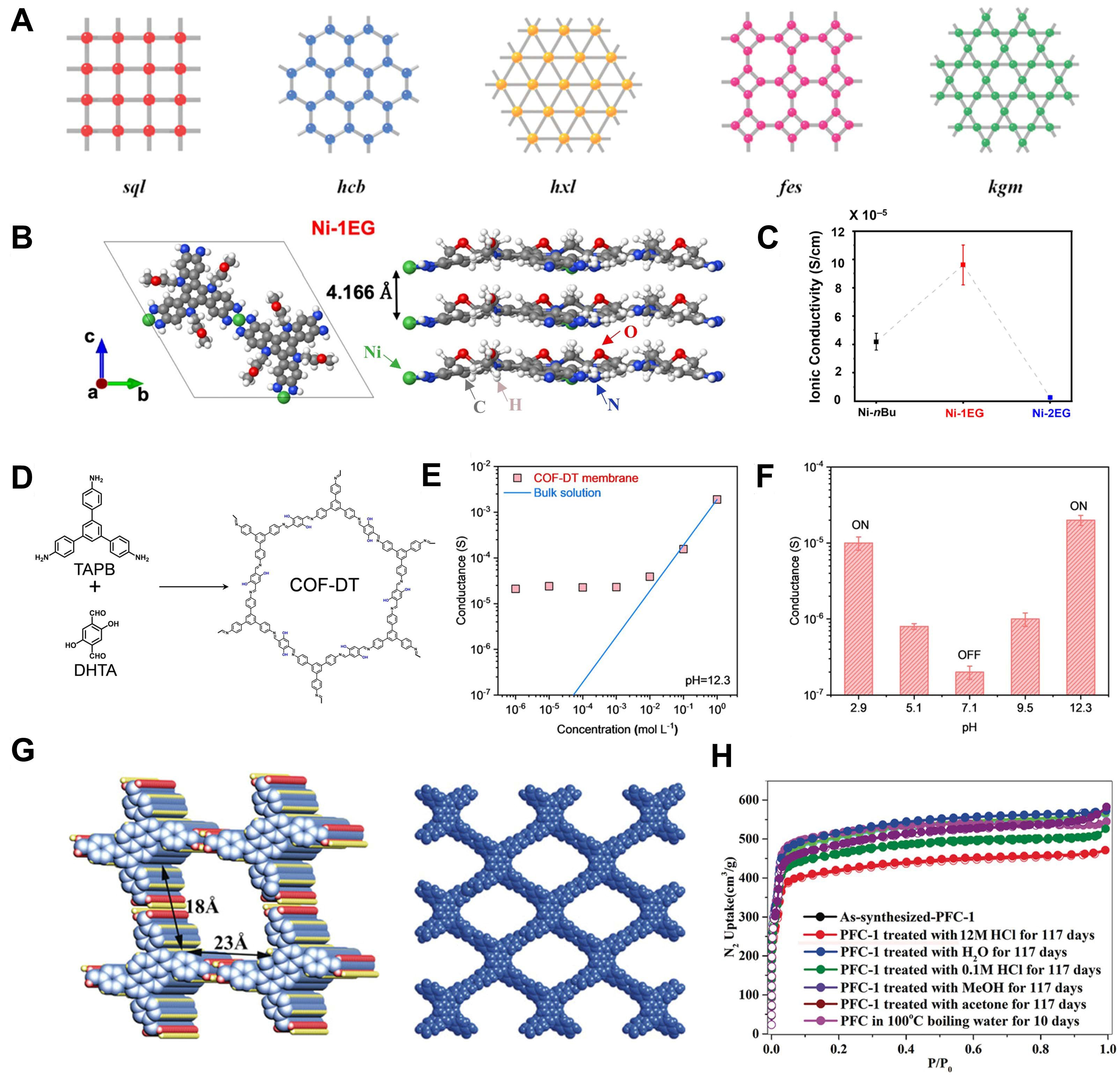
Figure 6. Typical 2D MOFs, 2D COFs and 2D HOFs structure-property correlations. (A) Schematic of some typical topologies of 2D MOFs networks: sql, hcb, hxl, fes, and kgm. (A) Ref.[114] Copyright © 2020 WILEY-VCH Verlag GmbH & Co. KGaA, Weinheim; (B) Illustration of Ni-MOF geometry. (C) Ionic conductivity of Ni-MOFs. (B and C) Ref.[118] Copyright © 2025, American Chemical Society; (D) Solvothermal synthetic reaction of the COF-DT membrane from TAPB and DHTA. (E) Ion conductance as a function of KCl concentration at pH = 12.3. (F) pH-responsive ion-gating of COF-DT membranes. (D-F) Ref.[122] Copyright © 2021 Wiley-VCH GmbH; (G) PFC-1 crystal structure of channel and porous framework. (H) N2 adsorption isotherms for as-synthesized and solution-treated PFC. (G and H) Ref.[123] Copyright © 2018 Wiley-VCH Verlag GmbH & Co. KGaA, Weinheim. sql: square; hcb: honeycomb; hxl: hexagonal; fes: four-eight square; kgm: kagomé; EG: ethylene glycol; TAPB: 1, 3, 5-tris (4-aminophenyl)-benzene; DHTA: (2, 5-dihydroxy-1, 4-benzenedicarboxaldehyde; COF-DT: a covalent organic framework synthesized from DHTA and TAPB; PFC: porous materials from the Fujian Institute of Research on the Structure of Matter, Chinese Academy of Sciences; MOF: metal-organic framework; COF: covalent organic framework; HOF: hydrogen-bonded organic framework.