

fig2
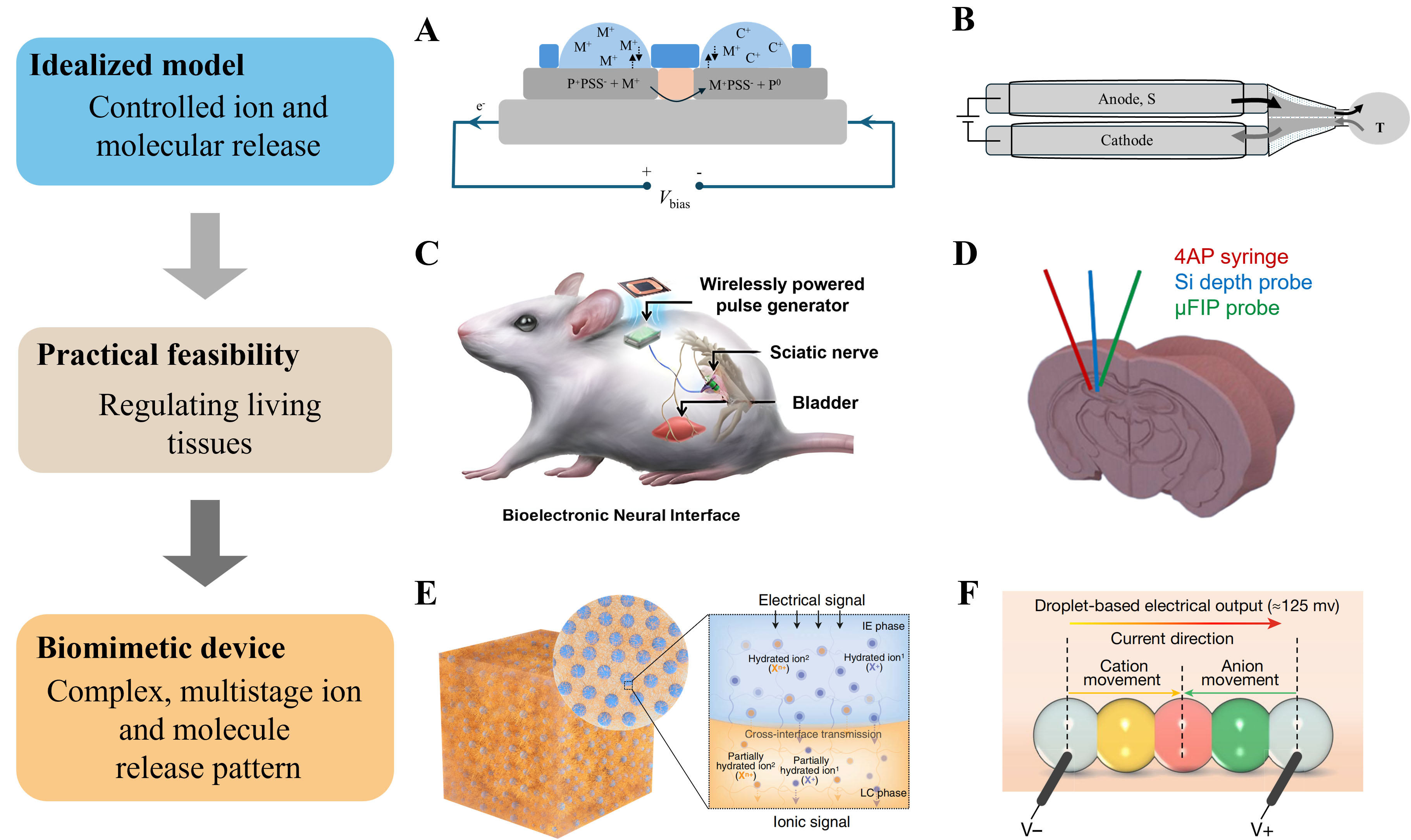
Figure 2. Advances in biotic iontronic devices. (A) The OEIP device utilizes electrochemical reactions at the cathode to drive the transport of ions from the left side to the targeted area on the right[13]; (B) The OEIP device is applied for transporting molecules[14]; (C) Implantable Ionogel assembly as a soft neural interface[20]; Reproduced with permission of ref. 20, Copyright 2023, American Chemical Society; (D) μFIP for charged molecular release, where the central region releases the neurotransmitter under a small voltage[21]; Reproduced with permission of ref. 21, Copyright 2018, The American Association for the Advancement of Science under CC BY 4.0 license http://creativecommons.org/licenses/by/4.0/; (E) The biphasic gel is applied for selective transmission of multiple ionic signals[17]; Reproduced with permission of ref. 17, Copyright 2023, The American Association for the Advancement of Science; (F) The dropletronic device of a micrometer- scale gel generates the voltage output[16]; Reproduced with permission of ref. 16, Copyright 2023, Springer Nature under CC BY 4.0 license http://creativecommons.org/licenses/by/4.0/. PSS: Poly(styrene sulfonate; Vbias: applied bias voltage; 4AP: 4-amoniopyridine; μFIP: microfluidic ion pump; OEIP: organic electronic ion pump; IE phase: ion-enriched internal phase; LC phase: low-conductive continuous phase.