

fig2
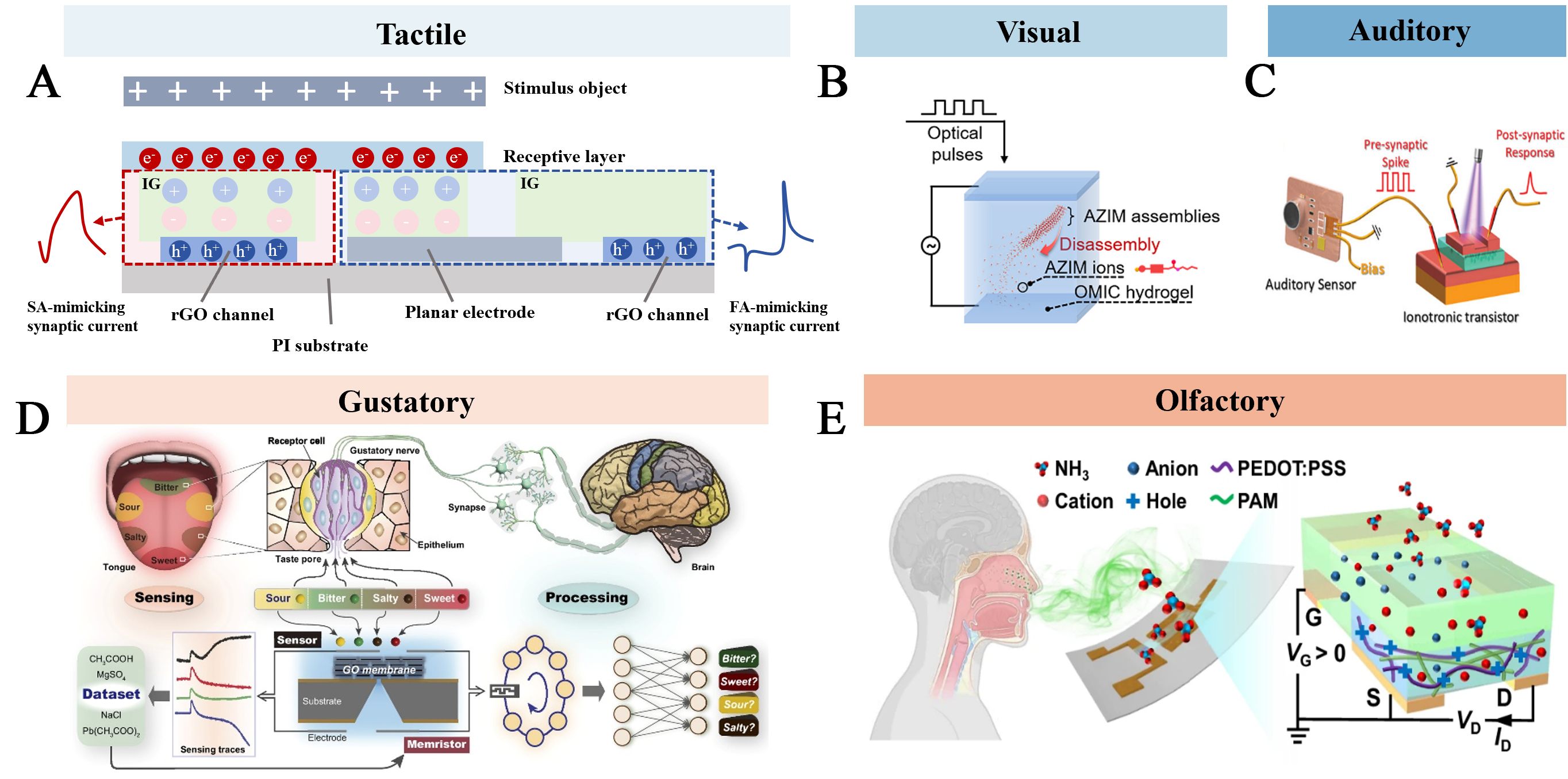
Figure 2. Iontronic neuromorphic sensors for stimulus-responsive perceiving. (A) Illustration of the SA and FA ASMR structures that mimic mechanoreceptors with synapse-like connections to afferent neurons[28]; (B) Optically modulated ionic conductivity in a hydrogel. Reproduced with permission from ref.[29]. Copyright 2023, The American Association for the Advancement of Science under CC BY 4.0 license http://creativecommons.org/licenses/by/4.0/; (C) Schematic diagram of the bionic auditory perceptive system. Reproduced with permission from ref.[30]. Copyright 2025, The Wiley under CC BY 4.0 license http://creativecommons.org/licenses/by/4.0/; (D) Schemes of the biological and GO ionic sensory memristive device-based gustatory systems. Reproduced with permission from ref.[15]. Copyright 2025, The National Academy of Sciences under CC BY 4.0 license http://creativecommons.org/licenses/by/4.0/; (E) Mechanism diagram of gas sensing of all-gel OECT. Reproduced with permission from ref.[31]. Copyright 2025, Springer Nature under CC BY 4.0 license http://creativecommons.org/licenses/by/4.0/. IG: Ionogel; SA: slow-adaptation; rGO: reduced graphene oxide; FA: fast-adaptation; AZIM: azo-benzene functionalized imidazole; PEDOT:PSS: poly(3,4-ethylenedioxythiophene): poly(styrene sulfonate); PAM: polyacrylamide; OECT: organic electrochemical transistor.