

fig4
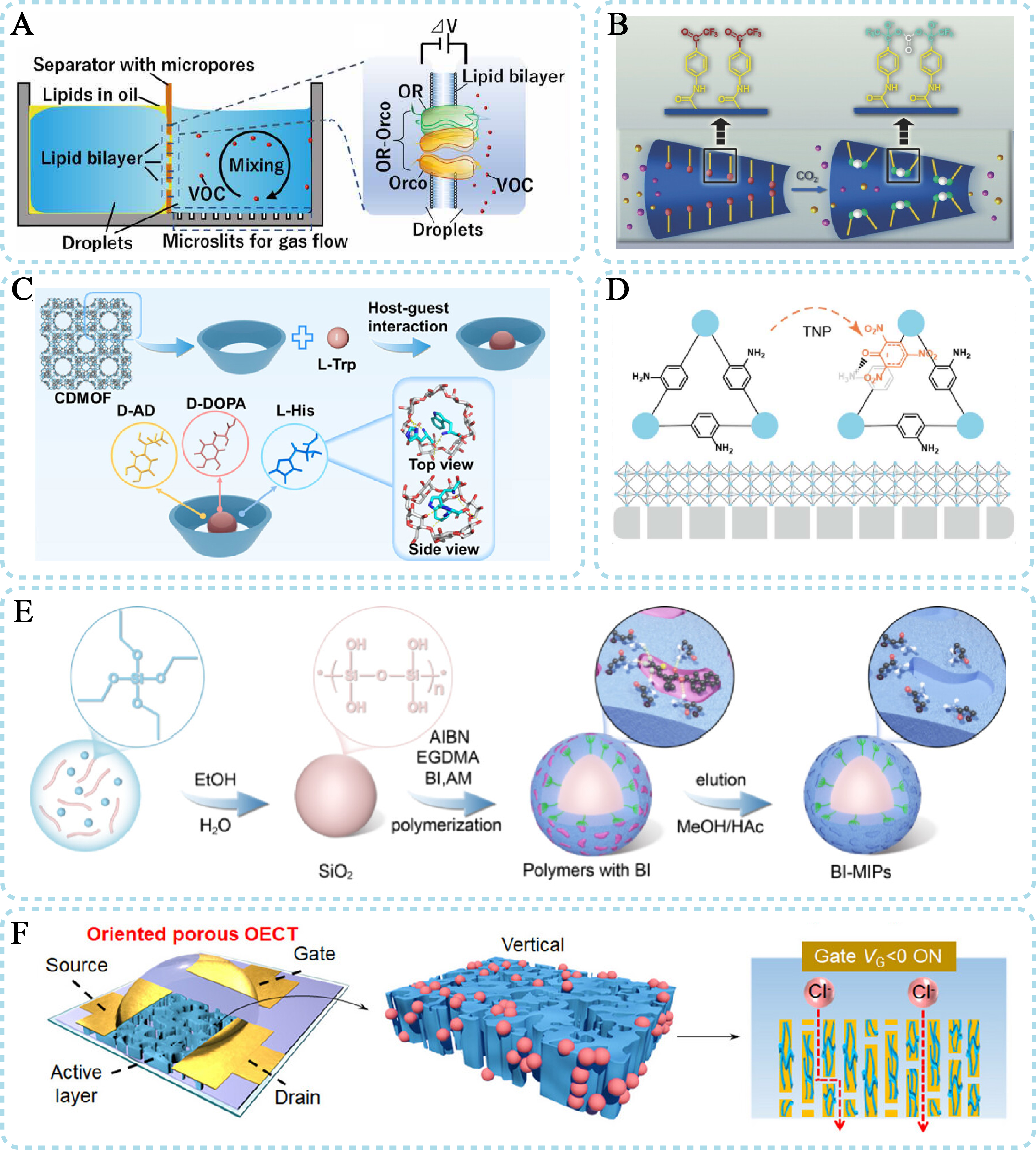
Figure 4. Olfactory-inspired nanofluidic sensors based on ionic current. Direct application of biomaterials in (A) Design of biomimetic materials in (B-E). Enhancement of mass transport in (F). (A) VOC sensor based on olfactory receptors. This figure is quoted with permission from The American Association for the Advancement of Science[53]; (B) Mosquito olfaction-inspired artificial ion gate. This figure is quoted with permission from John Wiley and Sons[54]; (C) The construction of chiral nanochannel. This figure is quoted with permission from The American Chemical Society[55]; (D) Molecular probe-integrated nanofluidic sensors. This figure is quoted with permission from The Royal Society of Chemistry[56]; (E) Molecularly imprinted polymer ion channels. This figure is quoted with permission from The American Chemical Society[49]; (F) Aligned nanochannel to reduce ion transport resistance. This figure is quoted with permission from The John Wiley and Sons[57]. HAc: Acetic acid; TNP: trinitrophenol; CDMOF: β-cyclodextrin metal−organic frameworks; D-AD: D-adrenaline; D-DOPA: D-dihydroxyphenylalanine; L-His: L-histidine; L-Trp: L-tryptophan; AIBN: 2,2'-azobis(2-methylpropionitrile; EGDMA: ethylene glycol dimethacrylate; BI: bifenthrin; MIP: molecularly imprinted polymer; VOC: volatile organic compound.