

Syngas to higher alcohols: a review of catalyst design and progress
 0
0 
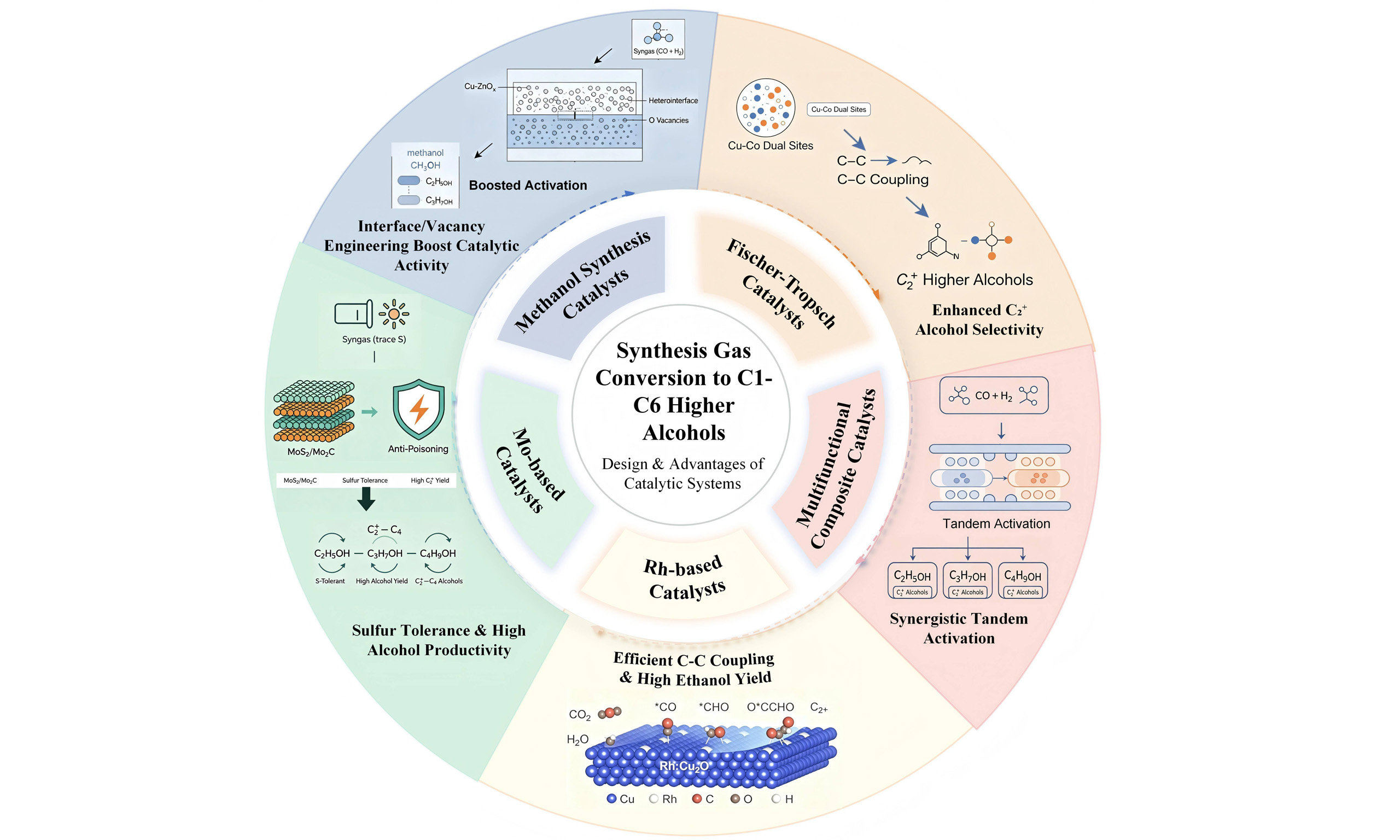
Graphical Abstract
Abstract
Syngas-derived higher alcohols (C2+OH) are vital clean fuels under dual-carbon targets, yet inherent catalytic bottlenecks hinder industrialization. This review systematically correlates core defects across five mainstream catalyst families with targeted modification strategies and structure-selectivity rules. Cu-Co catalysts exhibit overly broad product distribution and phase segregation; La/Mn doping and plasma activation accelerate C-C coupling. Cu-Fe catalysts sinter easily and undergo phase separation; Mg/K/Ce doping and carrier tuning reinforce bimetallic interfacial synergy. Modified Cu methanol catalysts lack stable active sites; particle size control, pH adjustment, and ammonia evaporation enrich Cu-ZnOx interfaces. Mo catalysts resist sulfur and carbon deposition but require harsh reaction conditions; K/La doping and porous carbon carriers improve long-chain alcohol selectivity. Rh catalysts exhibit excellent C2+OH selectivity but incur high noble-metal costs; single-atom immobilization reduces Rh consumption. Multifunctional tandem catalysts balance activity and selectivity via matched dual active sites. This study establishes a “bottleneck-modification” matching system, offering theoretical support for low-cost high-performance catalysts and industrial syngas-to-higher-alcohol technology.
Keywords


 Download PDF
INTRODUCTION
Against the backdrop of the low-carbon energy transition, technologies for efficient conversion and utilization of carbon resources are vital to mitigate reliance on fossil fuels and reduce carbon emissions[1-7]. Syngas can be produced from diverse feedstocks, including coal, biomass, and CO2, owing to its feedstock flexibility and mature industrial processes, making it a fundamentally important reaction platform with strong industrialization potential in chemical and energy conversion fields[8-11]. Direct catalytic conversion of CO2 to methanol and higher alcohols is a pivotal technology for utilizing greenhouse gases to produce high-value chemicals and fuels. Taking alcohol synthesis via CO2 hydrogenation as an example, the overall reaction process consists of two major branches: methanol synthesis and higher alcohol synthesis, accompanied by multiple mutually competitive reaction pathways, as illustrated in Figure 1A[12]. The left side depicts the reaction pathways for methanol synthesis, encompassing four distinct channels: the HCOO* pathway, r-HCOO* pathway, RWGS+CO-Hydro pathway, and trans-COOH* pathway. The right side illustrates the synthetic routes for higher alcohols, covering three prevailing mechanisms: the CO-mediated mechanism, formate-mediated mechanism, and methanol-mediated mechanism. Furthermore, the figure uses lines of different colors to distinguish C-H, C-O, C-C, and O-H bond cleavage and formation, intuitively delineating the evolution, transformation, and competitive relationships among diverse adsorbed intermediates. First, CO2 is activated to produce C1 intermediates including HCOO*, COOH*, CO*, and CHx*. Second, C-C coupling occurs between CO* and CHx* to generate C2+ oxygenated intermediates such as acetic acid, propionic acid, and butyric acid. Finally, these C2+ oxygenated intermediates undergo hydrogenation to yield C2+ alcohols[13]. Higher alcohols are compatible with existing industrial and transportation infrastructure and offer the dual benefits of energy substitution and carbon resource recycling. Compared with conventional routes such as biological fermentation and petroleum-based synthesis, syngas-to-higher-alcohols technology features a simplified process, high energy efficiency, environmental friendliness, and flexible feedstock supply, making it a promising candidate for large-scale production of higher alcohols[14-16].
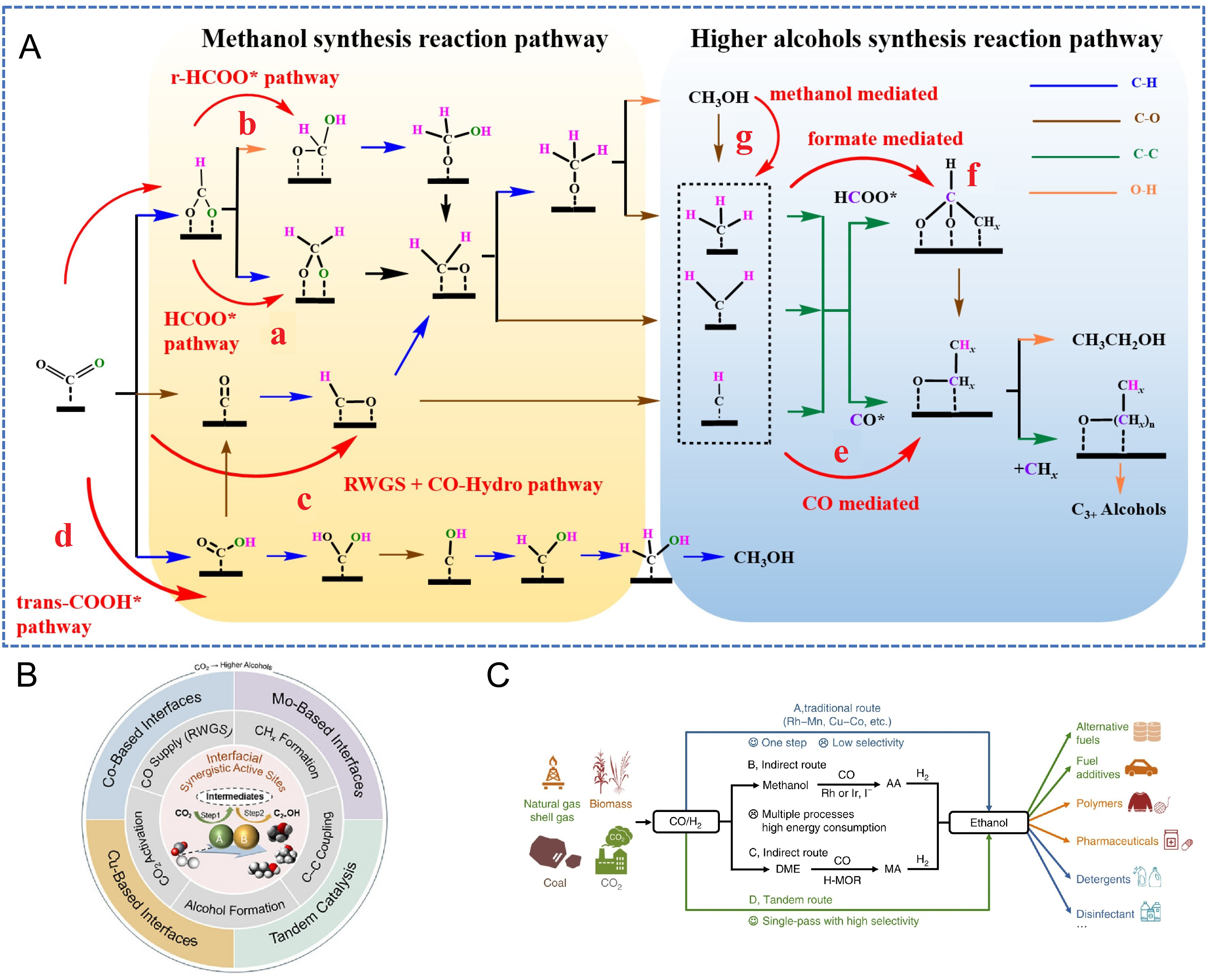
Figure 1. (A) Various reaction pathways of CO2 hydrogenation to alcohols. (a) HCOO* pathway; (b) r-HCOO* pathway; (c) RWGS + CO-Hydro pathway; (d) trans-COOH* pathway; (e) CO mediated pathway; (f) formate mediated pathway; (g) methanol mediated pathway. Blue line, C-H bond breaking or formation; brown line, C-O bond breaking or formation; green line, C-C bond coupling; orange line, O-H bond breaking or formation. (A) is reprinted with permission from Ref.[12], Copyright © 2024 MDPI; (B) Interfacial active sites play a central role in CO2 hydrogenation to higher alcohols by promoting CO2 activation, C-C coupling, and oxygenate stabilization. (B) is reprinted with permission from Ref.[33], Copyright © 2026 John Wiley and Sons; (C) Direct and indirect routes for STE conversion. (C) is reprinted with permission from Ref.[36], Copyright © 2020 Springer Nature. RWGS: Reverse water-gas shift; STE: syngas-to-ethanol; H-MOR: hydrogen-form mordenite.
Although the synthesis of higher alcohols from syngas is thermodynamically feasible, formidable technical bottlenecks remain for practical implementation. The reaction system involves an extremely intricate reaction network that requires the synergy of dual active sites responsible for CO dissociation and CO insertion, respectively[16]. Precise matching of active sites and fine-tuning of product selectivity remain challenging. Undesired side reactions readily occur, leading to low yields of target products and poor economic viability, thereby severely hindering the large-scale deployment of this technology.
Accordingly, developing catalysts with high activity, superior selectivity, and excellent stability; elucidating precise regulation strategies for dual active sites; optimizing reaction pathways; and suppressing side reactions are critical to overcoming industrialization barriers in syngas conversion to higher alcohols. On this basis, this study focuses on the optimized design and catalytic performance of catalysts for syngas-to-higher-alcohols synthesis. The structure-activity relationship among catalyst structure, active sites, and catalytic performance is systematically investigated to provide theoretical guidance and technical references for advancing the industrialization of efficient higher alcohol synthesis[13,17].
CO2 TO HIGHER ALCOHOLS
Massive emissions from fossil fuels increase demand for CO2 resource utilization. The cleavage energy of the C=O bond in CO2 reaches up to 1.9 eV, imposing substantial challenges for CO2 activation. The reverse water-gas shift (RWGS) reaction can be coupled with multiple reactions, including CO2 hydrogenation[18], Fischer-Tropsch synthesis[19], and higher alcohol synthesis from syngas[20], forming a complex competitive reaction network. Such coupling reshapes the design logic for catalytic materials considering electronic effects, interfacial interactions, mass transfer, and active sites. Regulating multivalent active sites and defective vacancies is the core strategy for efficient CO2 activation. B-site doping of Ru/V in perovskites reduces the formation energy of oxygen vacancies and strengthens orbital interactions with CO2[21,22]. For CuVxS sulfides, in situ formation of Cu-S-V linkages stabilizes Cu+/Cu2+ species, prevents excessive reduction of metallic sites, and facilitates the directional generation of methanol intermediates during thermal CO2 hydrogenation[23]. In C2+ alcohol synthesis from syngas, mismatched sites for CO activation and carbon-chain propagation, along with a broad product distribution, represent a common bottleneck for Cu-Co, Cu-Fe, Mo-based, and Rh-based catalysts[17].
The RWGS reaction exhibits dual characteristics: it supplies CO in the forward direction yet generates CO2 as a byproduct, which drastically lowers carbon utilization efficiency[24]. Two representative modulation strategies are exemplified as follows. First, confining Cu within CeO2 to construct strong metal-support interaction (SMSI) interfaces optimizes the RWGS reaction kinetics[25]. Second, hydrophobic modification of Fe catalysts creates unidirectional water channels that isolate water molecules from active sites, suppressing side reactions; accordingly, CO2 selectivity can be reduced to 14.3%[26]. Alcohol synthesis from syngas requires balanced activity of the forward and reverse water-gas shift reactions. Fe-based catalysts tend to produce CO2 as a byproduct, while monometallic Cu catalysts lack sites for carbon chain growth and cannot extend carbon chains using CO derived from RWGS. Doping Mo sulfides and carbides with K or Ni enables precise tuning of reaction compatibility, rendering such catalysts suitable for long-chain alcohol synthesis.
Distinct stabilization strategies are required under varied operating conditions. Under reducing atmospheres, Fe-Ru and Fe-Co alloy nanoparticles at the B site can be exsolved in situ from the parent lattice. Strong pinning interfaces between nanoparticles and substrates suppress particle migration and agglomeration in conventional impregnated catalysts. These catalysts operate stably at temperatures up to 800 °C with high activity and no carbon deposition over long periods[27]. Modification with composite supports (e.g., oxygen-defect-rich composite oxides and coupled hollow zeolites) expands triple-phase boundaries (TPBs), accelerates bulk O2 transport, and significantly promotes the regeneration of active oxygen vacancies, addressing sluggish reaction kinetics at high space velocities[28,29]. For thermal CO2 hydrogenation systems, heterointerface engineering, in situ construction of heteroatomic linkages, and defect modulation work synergistically. The primary design target is to dynamically maintain multivalent active sites, inhibit deep reduction of active metals and leaching of sulfur/oxygen species, ensure exclusive hydrogenation pathways for intermediates during long-term operation, and achieve high selectivity for high-value C1 products such as methanol[23].
Considering multiple constraints covering CO2 activation, RWGS coupling and synergy, and resource conversion under diverse conditions, three novel core requirements for catalyst design have been established. First, precise modulation of electronic structures. Metal doping, heterointerfaces, heteroatomic bonding, and oxygen vacancy engineering are adopted to construct synergistic multivalent active sites that balance CO2 adsorption strength with the desorption/hydrogenation kinetics of *CO and oxygen-containing intermediates. Second, enhanced interfacial and structural stability. Strategies including in situ exsolution, confinement encapsulation, SMSI construction, and hydrophobic modification are developed to address four major deactivation pathways: high-temperature sintering, carbon deposition, water-induced side reactions, and reduction/leaching of active phases. Third, multiscale coordinated mass transfer design. Integrating porous hollow architectures, oxygen-vacancy-rich supports with high lattice-oxygen mobility, and hydrophobic pore-channel regulation simultaneously optimizes gas diffusion, lattice-oxygen transport, and unidirectional water transport, reconciling intrinsic catalytic activity with macroscopic reaction flux.
CATALYSTS FAMILIES
The evolution of catalysts has been driven by shifting energy demands and technological breakthroughs. The field was pioneered in 1902 with the discovery that nickel-based heterogeneous catalysts could facilitate the reduction of CO to methane. Between 1913 and 1925, a series of catalysts, including alkali-activated cobalt/osmium oxides, alkali-modified iron filings, and iron-zinc oxides, were developed, marking a significant transition in higher hydrocarbon synthesis from high-pressure to atmospheric-pressure conditions. By the 1940s, cobalt scarcity shifted the focus to alkali-modified iron-based catalysts, which became mainstream because of their cost-effectiveness, superior stability, and flexible product distribution. The energy crisis of the 1970s subsequently accelerated the exploration of homogeneous catalysts, where metal carbonyl clusters and rhodium-based systems demonstrated exceptional selectivity. Concurrently, the emergence of specialized catalysts, such as ZSM-5 zeolites, Fe-Ti-Zn-K mixed oxides, and manganese-based systems, enabled pivotal advancements like methanol-to-gasoline conversion and the targeted synthesis of light olefins[30,31]. The catalytic conversion of syngas represents a crucial pathway for producing higher alcohols, leveraging both renewable and non-renewable carbon resources[32]. As illustrated in Figure 1B, catalytic systems for CO2 hydrogenation to higher alcohols can be broadly categorized into four classes[33]. Extensive studies indicate that, compared with biomass fermentation and petroleum refining, syngas-to-ethanol (STE) offers distinct advantages in environmental sustainability and economic viability[34,35]. Figure 1C summarizes four technical routes for ethanol synthesis from syngas[36]. Route a refers to the direct synthesis pathway employing a single catalyst, yet it suffers from low ethanol selectivity. Routes b and c correspond to multi-step indirect processes that use methanol and dimethyl ether as intermediates, respectively; these routes require multiple sets of reaction units and incur high energy consumption throughout the process. Route d represents the newly developed triple-tandem catalytic process, which achieves high-selectivity one-pass ethanol production from syngas in a single reactor, circumvents the intrinsic limitations of conventional routes, and enables the targeted synthesis of low-carbon alcohols from syngas.
Modified Fischer-Tropsch catalyst system
Fischer-Tropsch synthesis (FTS) is a pivotal technology for the conversion of syngas (CO/H2) into hydrocarbons. Pioneered by German scientists Fischer and Tropsch in 1923, the first fixed-bed FTS plant was commissioned in 1935. While early FTS processes relied predominantly on Fe-based catalysts, researchers have since developed other catalytic systems. These include Co-based catalysts, known for their high selectivity toward long-chain hydrocarbons; Ru-based catalysts, distinguished by their superior catalytic activity; and Mo-based catalysts, which exhibit notable resistance to sulfur poisoning[37-39].
Pristine unmodified transition metal nanoparticles suffer from significant drawbacks, including severe particle agglomeration and sintering, as well as facile coverage of active sites by carbon deposits. Furthermore, their uniform electronic and geometric configurations impede precise regulation of carbon chain propagation, resulting in low CO conversion, poor selectivity toward target products, and abundant byproducts during FTS. These limitations render these catalysts incapable of meeting the requirements for high-efficiency, oriented catalysis, highlighting the critical need for catalyst modification and optimization[40,41]. Current modification strategies center on tuning the catalyst microstructures. Specifically, metal doping and crystal phase engineering modulate the electronic and lattice structures of nanoparticles, while support confinement and surface functionalization immobilize active nanoparticles and optimize particle size and dispersion. Together, these approaches improve catalytic performance and boost FTS activity and selectivity toward desired products[42,43].
Figure 2A provides a comparative overview of two typical CO reduction pathways. Electrochemical CO reduction over Cu catalysts under ambient conditions proceeds via direct coupling of two adsorbed CO species; this CO-CO coupling acts as the rate-determining step, with a high energy barrier dominating the production of short-chain C2 products[44]. Conversely, thermocatalytic Fischer-Tropsch synthesis generates adsorbed hydrogen via H2 dissociation, followed by C-O bond cleavage of CO to form CHx intermediates[45]. Subsequent low-barrier CHx coupling enables continuous carbon chain propagation to afford long-chain hydrocarbons, yet high temperatures are required to facilitate CO dissociation. Fundamentally, this process converts syngas over transition-metal catalysts (e.g., Fe, Co, Ni, Ru) [Figure 2B] through a multifaceted sequence of adsorption, dissociation, intermediate transformation, and product formation[46]. This yields hydrocarbons (alkanes, alkenes) and oxygenates (alcohols, aldehydes), alongside byproducts such as H2O and CO2. The reaction is inherently synergistic, involving surface-catalyzed polymerization and hydrogenation. Furthermore, the pivotal step in FTS is carbon-carbon bond formation, which critically depends on well-dispersed transition metal nanoparticle catalysts. Both catalytic activity and product selectivity are intrinsically linked to the electronic and geometric structures of the nanoparticles, which are governed by key parameters such as particle size, morphology, and crystal phase structure[46-48].
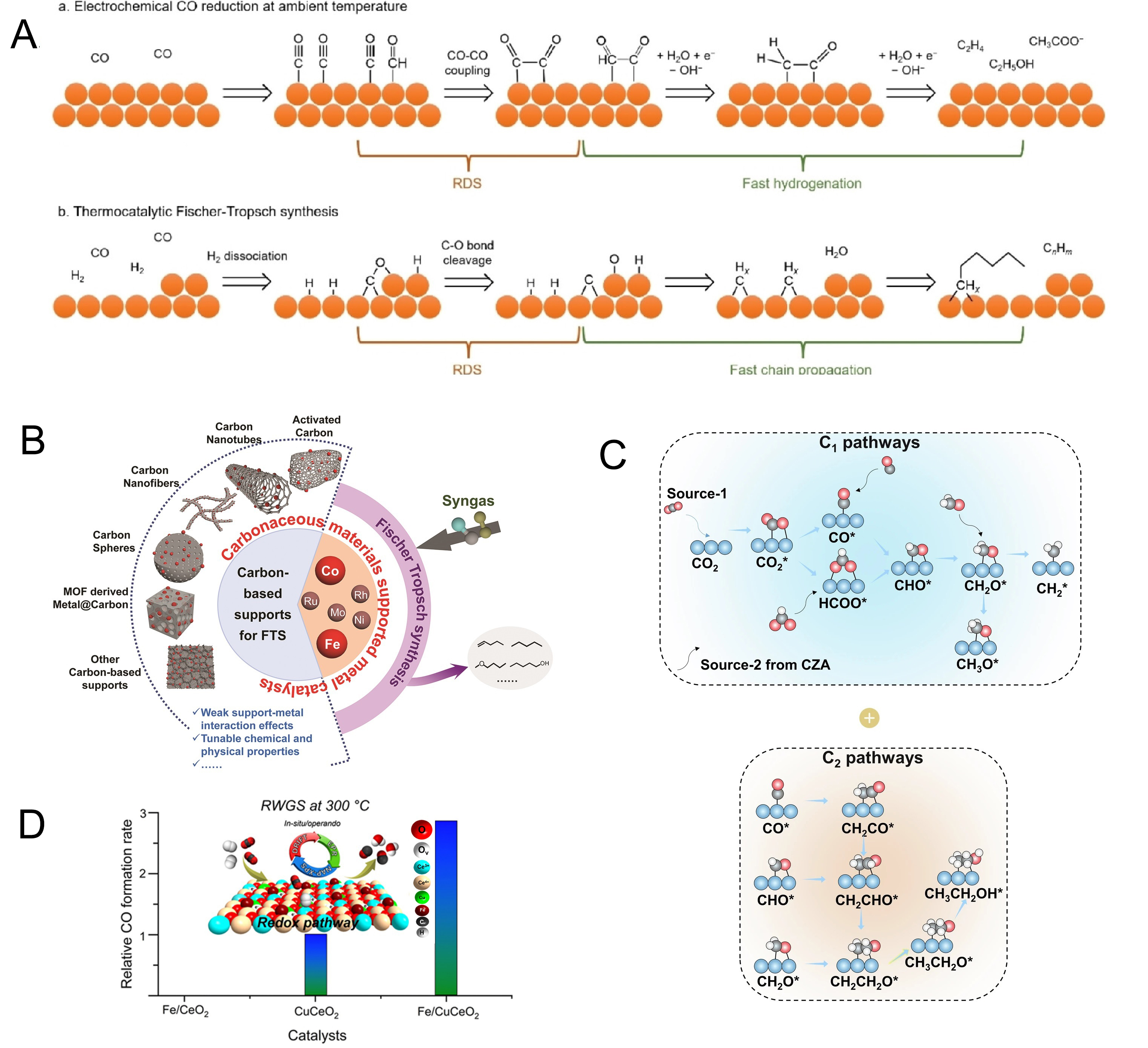
Figure 2. (A) Schematics of different COR pathways. (a) Electrochemical CO reduction at ambient temperature. (b) Thermocatalytic FTS. (A) is reprinted with permission from Ref.[44], Copyright © 2025 John Wiley and Sons; (B) Carbonaceous materials supported metal catalysts for FTS. (B) is reprinted with permission from Ref.[46], Copyright © 2021 Royal Society of Chemistry; (C) Reaction mechanism for C2+OH synthesis on the FeCo&CZA catalyst. The optimal reaction pathway for ethanol synthesis on (Fe3/4Co1/4)5C2(510) surface. Color: C: Gray, H: White, O: Red. (C) is reprinted with permission from Ref.[52], Copyright © 2025 Springer Nature; (D) Overview of the Redox Mechanism and Surface Structure Changes on the Fe/CuCeO2 Catalyst during the RWGS Reaction. (D) is reprinted with permission from Ref.[54], Copyright © 2024 American Chemical Society. RWGS: Reverse water-gas shift; FTS: Fischer-Tropsch synthesis; CZA: CuZnAl.
Fe-based catalysts exhibit dual functionality in both RWGS and FTS, achieving C5+ hydrocarbon selectivity exceeding 50%[49]. However, promoters are essential for accelerating carbide formation. Conversely, Co/Ru-based catalysts are characterized by high methane selectivity (> 90%) but are constrained by the thermodynamic limitations of the RWGS reaction, which limit CO partial pressure and necessitate advanced techniques, such as membrane reactors, to enhance CO coverage[50,51]. Wang et al.[52] doped cobalt into iron to fabricate a tandem FeCo alloy carbide/CuZnAl catalyst for CO2 hydrogenation to C2+ alcohols. The CuZnAl (CZA) component activates CO2 and produces abundant CH2O* oxygen-containing intermediates via the reverse water-gas shift reaction, which subsequently spill over onto the FeCo active sites. Co incorporation generates (Fe3/4Co1/4)5C2 alloy carbide and modulates its electronic structure to moderate oxygen affinity, thereby eliminating the drawbacks of monometallic iron carbide, including susceptibility to water oxidation and excessive cleavage of C-O bonds that favors hydrocarbon formation. Two distinct active sites on the alloy carbide surface simultaneously supply CH2O* and CH2* species, which undergo C-C coupling with a low 0.52 eV barrier. The coupled intermediates are further hydrogenated to preferentially yield ethanol. This catalytic system achieves high CO2 conversion, superior C2+ alcohol selectivity, and outstanding long-term stability [Figure 2C][52]. The resulting FTS products can be further refined into a diverse array of high-value chemicals, including light olefins, gasoline, diesel, waxes, oxygenates, and α-olefins. Consequently, these products serve as vital precursors to bulk commodities such as synthetic fibers, rubbers, plastics, lubricants, surfactants, and detergents.
Consequently, modifications to Fischer-Tropsch catalysts have been proposed. Modified Fischer-Tropsch synthesis represents an optimized advancement over conventional FTS. Its core strategy addresses the bottlenecks of traditional FTS, such as poor product selectivity, limited feedstock scope, and insufficient catalyst stability, through catalyst modification, feedstock adjustment, or process parameter optimization. This approach enables more efficient, targeted conversion of syngas (or CO2 combined with green hydrogen).
The regulatory mechanism governing the strong interaction between metals/metal oxides and zeolites, which affects catalyst structure, reducibility, mass transfer performance, and catalytic activity, is the primary reason for the enhanced catalyst performance[53]. Furthermore, as illustrated in Figure 2D[54], the gas recycle ratio, a key process parameter, also plays a crucial role in regulating the reaction behavior of CO and H2 conversion to C5-C18 olefins during Fischer-Tropsch synthesis[55].
Cu-Co catalytic systems
Conventional Cu-based catalysts suffer from several inherent drawbacks, including low single-pass CO2 conversion and severe side reactions via the RWGS pathway at elevated temperatures, which lead to insufficient methanol selectivity. Furthermore, these catalysts are prone to Cu species sintering, resulting in poor stability and unsatisfactory economic performance[56,57]. Introducing Co facilitates the formation of Co-Cu alloys and reduces Cu particle size, thereby suppressing carbon deposition, metal oxidation, and post-reaction structural evolution of the catalyst[58]. For simple CuCo catalysts without additives, surface hydroxyl groups on the support play a critical and irreplaceable role in the direct synthesis of ethanol from syngas[59]. The primary challenges for CuCo-based catalysts are constructing novel active sites for alcohol formation, suppressing hydrocarbon selectivity, and improving ethanol selectivity[36]. Figure 3A illustrates a plausible reaction pathway for n-butanol formation[60]. Taking Cu6Co3 as a typical example, Cu serves as a core regulatory component in the system compared with pure Co catalysts. Cu precisely modulates the size of Co active sites, inhibits C-O bond cleavage and the formation of hydrocarbon byproducts, stabilizes and enriches undissociated CO and HCO intermediates, and effectively lowers the energy barrier for the HCO insertion reaction[61]. Figure 3B shows the reaction network for higher-alcohol synthesis from syngas over the optimal bulk Co-Cu catalyst with a Co/Cu molar ratio of 2:1[62]. Dissociative CO adsorption produces chain-growth intermediates that either undergo β-H elimination to form olefins, which are then hydrogenated to alkanes, or undergo CO insertion to form oxygenated intermediates, which are subsequently hydrogenated to linear primary alcohols. Both hydrocarbon and alcohol products follow the same Anderson-Schulz-Flory chain-growth probabilities. Hydroformylation of ethylene to 1-propanol is a minor pathway that becomes significant only when the ethylene volume fraction exceeds 1 vol%, and its contribution to alcohol formation is negligible under conventional steady-state conditions. This reaction model enables a unified elucidation of the kinetic properties and surface adsorption behavior of bimetallic Co-Cu catalytic systems.
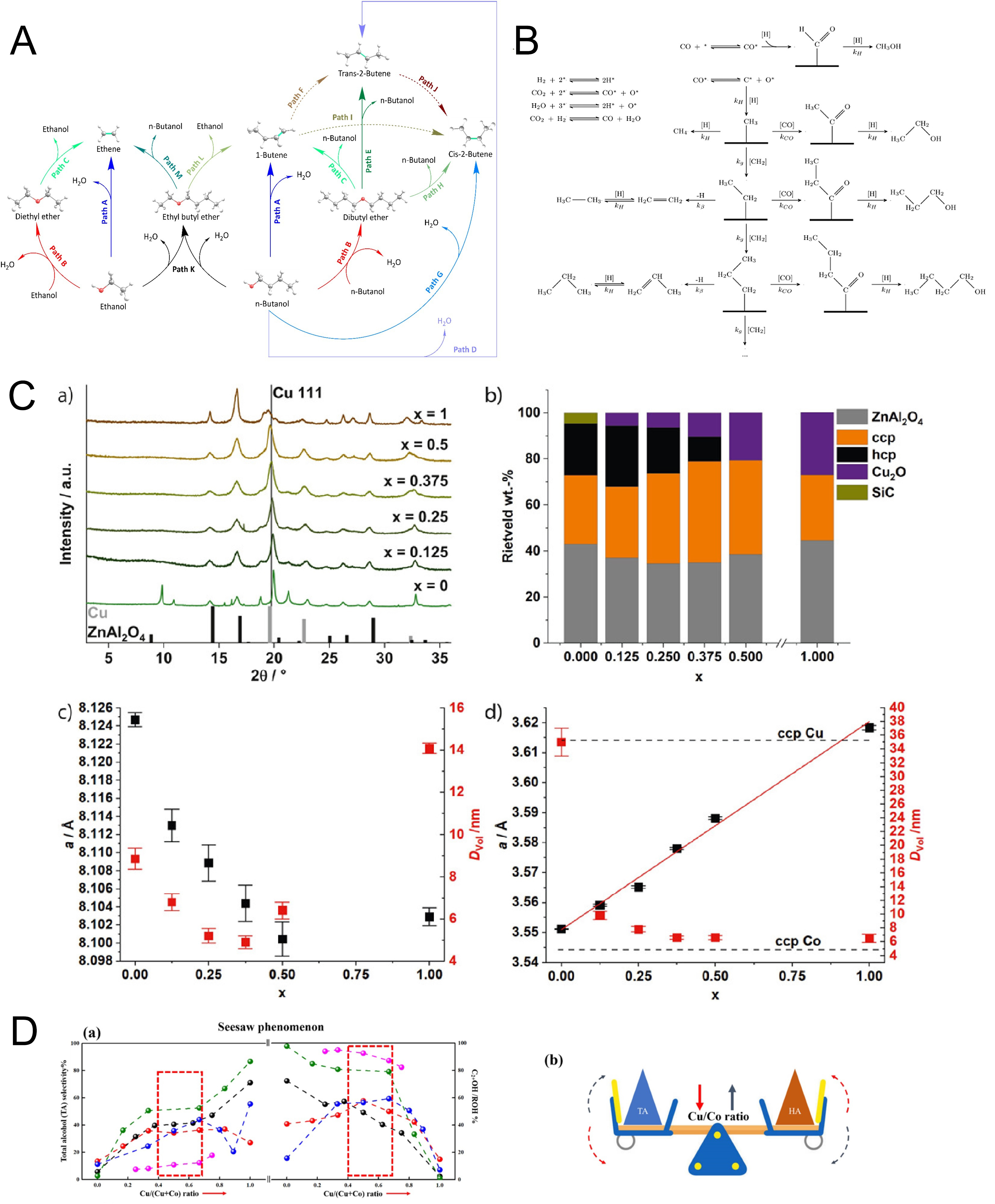
Figure 3. (A) Reaction scheme for n-butanol/ethanol dehydration and butene isomerization pathways in H-ZSM-5. (A) is reprinted with permission from Ref.[60], Copyright © 2024 Royal Society of Chemistry; (B) Simplified reaction scheme for the HAS over the CoCu catalyst. (B) is reprinted with permission from Ref.[62], Copyright © 2022 American Chemical Society; (C) Powder XRD analysis of the spent catalysts after CO hydrogenation at 20 bar-60 bar and 200-380 °C after passivation at room temperature with air. The complete pattern is visualized in (a), with the dark grey bars corresponding to the Cu (ccp) reference and the black bars corresponding to the ZnAl2O4 reference. The resulting quantification of the assigned phases by a Rietveld refinement is shown in (b). (c) Compositional dependence of the cell parameter and domain size of the spinel phase. (d) The ccp phase shows a significant expansion of the cell parameter with the copper content x. The red line is a linear fit to all data points; the dashed lines indicate the lattice parameters for bulk ccp Cu and Co taken from several entries of the ICSD (#627115, 627114, 622435, 44989). The apparent domain size shows a drastic initial decrease upon addition of copper in the catalyst system. (C) is reprinted with permission from Ref.[65], Copyright © 2022 Wiley-VCH GmbH; (D) Catalytic performance of CuCo catalysts varying Cu/Co ratio. (a) Catalytic performance of CuCo catalysts varying Cu/Co ratio; (b) Schematic diagram of “Seesaw” phenomenon [Note: the red and black arrows in (b)] represent the decrease and increase in Cu/Co ratio, respectively. (D) is reprinted with permission from Ref.[68], Copyright © 2024 MDPI. XRD: X-ray diffraction analysis.
The catalytic conversion of syngas to ethanol and higher alcohols has emerged as a prominent research hotspot in C1 chemistry. However, traditional CuCo-based catalysts often suffer from a broad product distribution and low ethanol selectivity. To address these limitations, Sun et al.[63] introduced Mn to modulate the catalyst architecture. The incorporation of Mn effectively inhibits Cu crystallite growth and enhances the dispersion of both Cu and Co species. Consequently, the resulting CuCoMn catalyst achieves highly selective direct synthesis of ethanol from syngas, attributed to its unique spherical lamellar morphology, Cu-Co synergy, and the promoting effect of Mn. Separately, Xiang et al.[64] systematically investigated the regulatory effects of activation parameters on the catalytic performance of bimetallic CoCu catalysts under four distinct gaseous atmospheres. The results show that increasing cobalt loading simultaneously enhances intrinsic catalytic activity and the Anderson-Schulz-Flory (ASF) chain-growth probability. Modulating the Co/Cu molar ratio drastically alters the fundamental physicochemical properties of the catalysts. Based on the experimental data summarized in Table 1, the total number of surface Co active sites jointly determines the upper limit of chain-growth factors for oxygenates α(ROH) and hydrocarbons α(HC), while the Cu component merely tunes product branching selectivity. This observation directly verifies that the carbon chain-growth reaction exclusively proceeds on Co active sites. Consistent with trends from two sets of comparative experiments, increasing the Co fraction improves CO conversion and hydrocarbon selectivity but markedly suppresses alcohol formation. Conversely, a higher Cu/Co ratio not only boosts catalytic activity but also facilitates selective alcohol synthesis, increasing the methanol proportion in liquid-phase products. Figure 3C presents the Rietveld-refined X-ray Diffraction (XRD) patterns of passivated spent Cu-Co/ZnAl2O4 catalysts, which visually demonstrate the regulatory effect of Cu doping ratio on phase composition, crystal structure, and metal micromorphology[65]. The ZnAl2O4 spinel support remains stable throughout all samples with a mass fraction of approximately 40%. The lattice parameter of spinel shrinks with increasing Cu content, originating from the substitution of lattice Zn2+ by Co2+ and thereby the SMSI. The monometallic Co catalyst contains both hcp and ccp metallic phases, with a metal domain size of 35 nm[66]. Incorporation of a small amount of Cu drastically refines metal crystallites, and only the ccp metallic phase is retained in Cu-containing samples, with domain size gradually decreasing to 6.5 nm as Cu proportion rises. The linear expansion of ccp lattice parameters with Cu content confirms that the hydrotalcite precursor generates intimate nanoscale Cu-Co contact interfaces that form alloy-like active sites, balancing CO dissociative and associative adsorption[62]. Only minor Cu2O originating from air passivation is detected in Cu-doped samples, without crystalline cobalt carbides. The introduction of Cu reconstructs metal crystal forms, suppresses sintering of active metal particles, and significantly alleviates carbon deposition over Co sites via bimetallic interfacial effects, further optimizing the catalytic stability for higher alcohol synthesis from the microstructural perspective.
Performance of different Co/Cu ratios
| Catalyst | CO conversion (%) | Selectivity (wt%) | Probability of ASF chain growth | Reference | ||||
| ROH | RH | R= | CO2 | α(ROH) | α(HC) | |||
| Co1Cu2 | 2.0 | 36.7 | 49.3 | 11.3 | 2.7 | 0.28 | 0.46 | [64] |
| Co1Cu1 | 3.2 | 37.4 | 49.4 | 11.3 | 1.9 | 0.30 | 0.47 | |
| Co2Cu1 | 5.7 | 37.9 | 50.5 | 10.2 | 1.4 | 0.33 | 0.47 | |
| Co4Cu1 | 11.0 | 30.8 | 53.2 | 15.0 | 1.0 | 0.37 | 0.53 | |
To address the challenges of mismatched electronic structures, facile agglomeration of active sites, and low ethanol selectivity in CuCo catalysts, Sun et al.[67] systematically elucidated, for the first time, how N-doping levels and calcination temperatures regulate the electronic synergy of CuCo and ethanol selectivity. In summary, the incorporation of various metals can significantly enhance the catalytic performance and target-product selectivity of CuCo-based catalysts. However, higher loadings of the introduced metal do not always yield better results; rather, an optimal concentration exists. Furthermore, metal doping can effectively boost overall catalytic activity, while the Co/Cu ratio and activation conditions also play a crucial role in determining catalytic performance [Figure 3D][68].
Catalytic screening was carried out under 240 °C, 40 bar and an H2/CO feed ratio of 1.5. CoCu catalysts were synthesized by thermally decomposing oxalate precursors in a continuous H2 stream at 370 °C.
Cu-Fe catalytic systems
Establishing dense and robust interfacial interactions between metallic components is essential for designing efficient catalytic systems. However, Fe-Cu bimetallic catalysts often suffer from intrinsically poor interfacial contact efficiency. Consequently, particle agglomeration and phase separation readily occur during operation, leading to rapid passivation or structural degradation of surface-active sites and resulting in interfacial instability[69]. These challenges ultimately trigger a continuous decline in catalytic activity, or even complete deactivation, thereby severely restricting the long-term stability and industrial viability of Fe-Cu-based catalysts. Furthermore, monometallic counterparts have inherent limitations: Fe-based catalysts typically show inadequate low-temperature activity, whereas Cu-based catalysts are highly prone to thermal sintering at elevated temperatures.
Conversely, the synergistic interaction between Fe and Cu in bimetallic systems effectively addresses these limitations. Specifically, Cu significantly lowers the reduction temperature of Fe, thereby facilitating mild activation, while Fe promotes the dispersion of Cu species to prevent sintering and enhance structural stability. This synergy allows the catalyst to preserve surface oxygen vacancies and active interfacial structures under in situ mild reduction conditions, ultimately delivering superior low-temperature catalytic activity[70,71].
Chen et al.[69] synthesized a series of Mg-modified FeCu-based catalysts with varying Mg contents via a co-precipitation method. They found that introducing an appropriate amount of Mg effectively suppressed metal particle agglomeration and improved dispersion. This modification regulated the catalyst’s structure, interfacial activity, and adsorption properties, thereby enhancing catalytic selectivity and product yield. In a related study, Ding et al.[72] prepared CuFeMnZnO catalysts by co-precipitation, followed by impregnation with a potassium (K) promoter (using KNO3 at loadings of 0, 0.2, 0.5, 1.0, and 1.5 wt.%). Their results showed that the K promoter facilitated the migration of bulk iron species to the catalyst surface and strengthened Fe-Cu interactions. However, it also reduced specific surface area and hindered the reduction of Cu and Fe. Optimal catalytic performance was achieved at a K loading of 0.5 wt.%; however, excessive loading (> 0.5 wt.%) reduced activity due to active-site blockage. Furthermore, Jiang et al.[73] systematically investigated CO2 conversion via Fischer-Tropsch synthesis using carbon-supported iron-based catalysts, employing three modification strategies: screening iron salt precursors, doping with a K promoter, and co-adding organic ligands. These modifications optimized the dispersion of active components, regulated the active-phase composition, and improved surface adsorption properties, enabling efficient CO2 conversion with C5+ hydrocarbon selectivity up to 55%. A subsequent study by Xu et al.[74] further confirmed that these modification strategies and their underlying mechanisms are equally applicable to the hydrogenation of CO2 to higher alcohols. Modulating structure, interface, and adsorption with Mg, Mn, and K alleviates deactivation in FeCu-based catalysts. Mg isolates metal particles to suppress sintering and carbon deposition[75]; Mn stabilizes the lattice and anchors active components[76]. Appropriate K enriches surface Fe species and strengthens Fe-Cu interaction, while excess K covers active sites and hinders metal reduction. For carbon-supported Fe catalysts, K synergizes with iron precursors and organic ligands to tune active phases and reduce carbon deposition. This modification strategy is feasible for CO2 hydrogenation to long-chain hydrocarbons and higher alcohols.
In summary, optimizing preparation methods and incorporating metal promoters can effectively enhance catalytic performance. However, metal promoters have an optimal doping concentration; excessive addition tends to block active sites, thereby compromising catalytic activity. For example, varying the Fe/Cu ratio significantly affects catalytic efficiency. Experimental evidence indicates that optimal performance is achieved at a Fe/Cu molar ratio of 1:1, with deviations from this ratio resulting in diminished catalytic effectiveness[77].
Modified methanol synthesis catalyst
Smith and Anderson first described the chain-growth process for alcohol synthesis from syngas over modified methanol catalysts in 1982 as a 1-2 carbon-addition mechanism involving α- and β-carbons[78]. As shown in Figure 4A, the synthesis of liquid fuels from CO2 and H2 follows various catalytic pathways that cover core reactions, key catalysts, intermediates, and applications. This forms a classic technical roadmap for CO2 resource utilization[79]. Figure 4B systematically illustrates the reaction pathways of CO hydrogenation to C2+ alcohols over the catalysts[80]. Differences in product distribution for syngas hydrogenation to alcohols over four CuZn-based catalysts (CZ: CuZn, CZA, CZC:CuZnCr, and CZG: CuZnGa) clarify the synergistic catalytic mechanism involving multiple active sites. From the perspective of the microscopic reaction process, Cu0 mediates CO dissociation to generate CHx species; oxygen vacancies cooperate with Cu+ to capture CO and form CHxO intermediates via non-dissociative adsorption. Znδ+ serves as the functional site for C-C coupling, driving the combination of CHₓ and CHₓO to produce C2 intermediates, which are further hydrogenated into ethanol. When Znδ+ coupling sites are scarce, CHxO* tends to be directly hydrogenated to methanol. These findings establish a progressive structure-activity relationship: promoters modulate the concentration of oxygen vacancies; oxygen vacancies coordinate the synergistic behavior of multiple active sites; and the spatial distribution of active sites regulates the carbon-chain-length distribution of alcohol products.
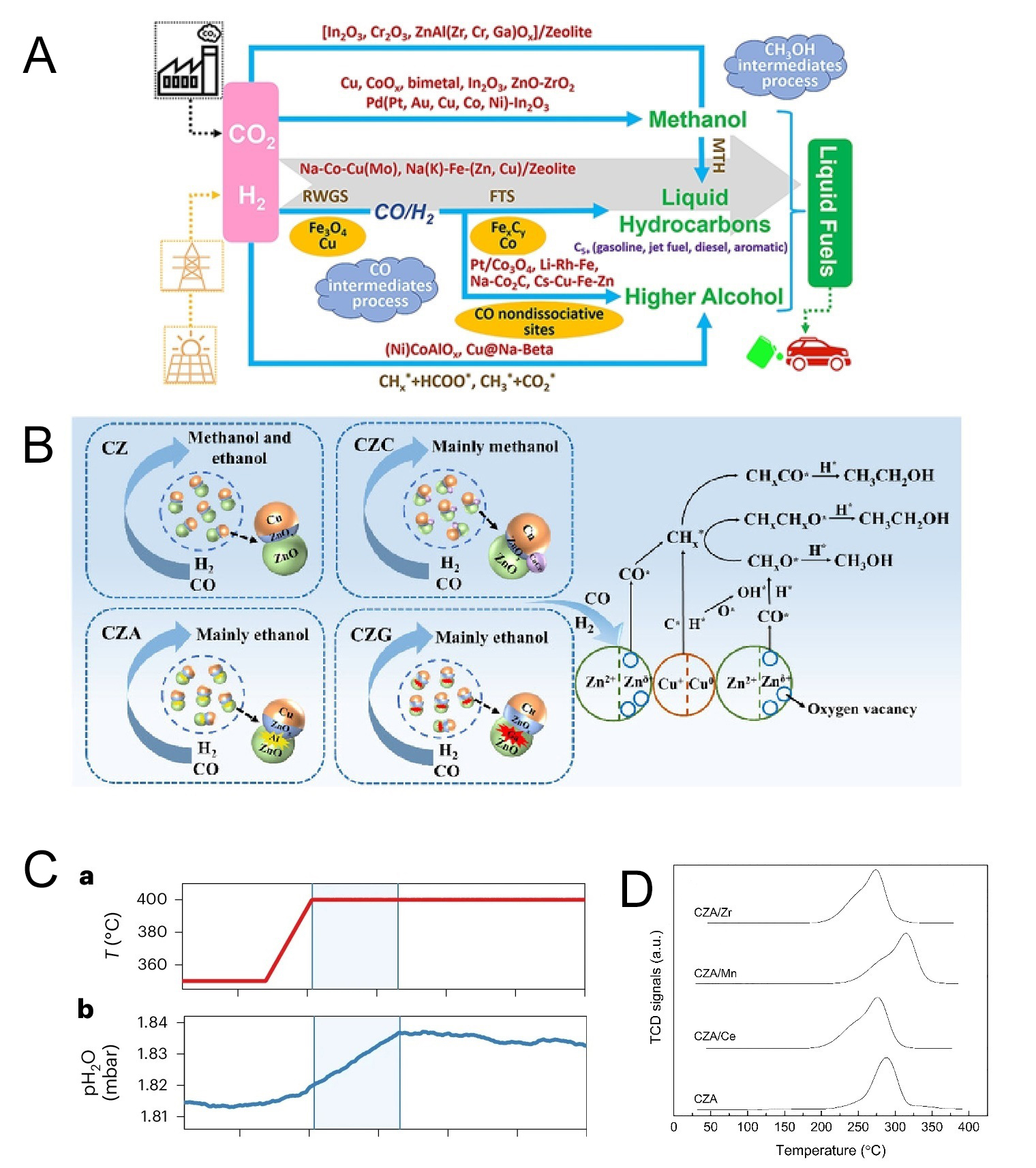
Figure 4. (A) Novel Heterogeneous Catalysts for CO2 Hydrogenation to Liquid Fuels. (A) is reprinted with permission from Ref.[79], Copyright © 2020 American Chemical Society; (B) CO hydrogenation mechanism over catalysts to C2+OH. (B) is reprinted with permission from Ref.[80], Copyright © 2026 WILEY; (C) Evolution of the Cu lattice parameter at 400 °C in H2:CO2 = 1:1 feed. (a) Temperature profile. (b) H2O partial pressure. The conditions are as follows: gas composition H2:CO2:He = 2:2:1, pressure 661 mbar, heating rate 10 K min-1, electron dose rate 3.4 e- Å-2 s-1. (C) is reprinted with permission from Ref.[82], Copyright © 2026 Springer Nature; (D) H2-TPR profiles of the calcined catalysts. (D) is reprinted with permission from Ref.[88], Copyright © 2024 WILEY. CZ: CuZn; CZA: CuZnAl; CZC: CuZnCr; CZG: CuZnGa; TPR: temperature-programmed reduction.
Historically, modified methanol synthesis catalysts can be classified into two main categories. High-temperature catalysts are primarily composed of ZnCrOx and MnCrOx systems doped with alkali metal promoters, which deliver a higher ratio of higher alcohols to methanol and eliminate the need for methanol recycling. Conversely, low-temperature catalysts represented by Cu/ZnO and Cu/Zn/Cr systems have emerged as the industrial mainstream for CO2 hydrogenation to methanol, benefiting from mild reaction conditions and the cost-effectiveness of copper-based components. Among them, Cu/ZnO/Al2O3 is the most widely adopted low-temperature copper-based catalyst, and the dynamically reversible synergistic interaction between Cu and Zn species is the primary origin of its superior methanol catalytic activity, distinguishing it from high-temperature Cr-based catalysts[81]. As illustrated in Figure 4C, the in situ generated H2O during catalysis drives the re-oxidation of transient CuZn alloys, which restores the Cu lattice parameter to the benchmark value of pure Cu and enables the continuous reversible interconversion between CuZn alloys and Cu-ZnO interfacial sites, thereby stabilizing the dynamic equilibrium required for catalytic cycles[82]. This unique dynamic redox cycle mechanism microscopically explains why low-temperature copper-based CZA catalysts are more suitable for directional methanol synthesis than high-temperature Cr-based counterparts, which in turn sustains stable catalytic activity toward CO2 hydrogenation over long-term operation and is fully consistent with their outstanding methanol synthesis performance under steady-state conditions.
Historically, modified methanol synthesis catalysts were divided into two categories. High-temperature catalysts, primarily ZnCrOx and MnCrOx+K/Cs, are noted for their high higher-alcohol-to-methanol ratio and the absence of a methanol recycling requirement. Conversely, low-temperature catalysts, such as Cu/ZnO and Cu/Zn/Cr+Cs/K, benefit from milder reaction conditions and the cost-effectiveness of Cu-based components.
He et al.[83] prepared a quaternary Cu/ZnO/ZrO2/MgO catalyst via a co-precipitation method. The introduction of Mg significantly optimized the catalyst’s microstructure, improved the dispersion of active components, and created appropriate basic sites. In terms of microstructure, Mg inhibited the agglomeration of CuO and ZnO particles, reducing particle size, increasing specific surface area and pore volume, and enhancing active-site exposure[84]. Furthermore, it regulated surface properties by constructing medium-strong basic sites, which strengthened CO2 adsorption and activation. Additionally, Mg promoted inter-species interactions, specifically enhancing the synergy between Cu and ZnO, which improved the dispersion and reducibility of Cu species, increased the content of chemisorbed oxygen, and ultimately optimized catalytic activity.
Traditional Cu/ZnO/Al2O3 catalysts still have room for performance improvement, as water produced during the reaction can induce the sintering and deactivation of Cu and ZnO. Therefore, it is imperative to develop Cu-based catalysts with both high activity and high stability. The catalytic activity of bifunctional hybrid catalysts is closely linked to the reducibility of copper oxide in the calcined products. Introducing ZrO2 into the Cu-ZnO catalyst system can effectively enhance the reducibility of copper oxide and significantly lower its reduction temperature[85]. Chang et al.[86] fixed the mass fraction of Cu at 30% to investigate the regulatory effect of the ZnO/ZrO2 mass ratio on catalytic performance. The results revealed that the ratio drastically modulates the catalyst microstructure (CuZn alloy formation and Cu dispersion) and surface adsorption properties (the number of active CO2 adsorption sites). According to the data summarized in Table 2, the CO2 desorption capacity, surface metallic Zn0 (CuZn alloy) content, and methanol space-time yield all exhibited typical volcanic trends, with the optimal catalytic performance achieved over the C3Z2Z5 catalyst at a ZnO:ZrO2 mass ratio of 2:5. In Zn-poor and Zr-rich systems, increasing the ZnO proportion facilitates CuZn alloy generation, enriches Cu-ZrO2 interfaces and CO2 activation sites, and thus continuously elevates catalytic activity. Once the ratio exceeds 2:5, insufficient ZrO2 content drastically reduces Cu-ZrO2 interfaces and aggravates Cu particle agglomeration, simultaneously lowering CO2 adsorption capacity and CuZn alloy content, which deteriorates catalytic activity. These volcanic profiles arise from the synergistic balance between two types of active sites: CuZn alloys and Cu-ZrO2 interfaces. The maximum catalytic performance is achieved when the synergistic effect of these two sites reaches an optimal balance. The synergistic effect between Cu and oxides (ZnO, ZrO2), particularly through the CuZn alloy and Cu-ZrO2 interface, is crucial for enhancing the catalytic performance of CO2 hydrogenation to methanol and provides a theoretical basis for designing high-efficiency catalysts[87].
Performance comparison of Cu/ZnO/ZrO2 catalysts with different ZnO/ZrO2 mass ratios
| Catalysts | The mass ratio of ZnO to ZrO2 | Content of Cu (wt%) | Specific surface area (m2/g) | Aperture (nm) | Cu dispersion (%) | Cu Particle size (nm) | H2 adsorption capacity (mmol/gcat) | CO2 desorption amount (mmol/gcat) | Key features | Reference |
| C3Z0Z7 | 0:7 | 28.62 | 95.5 | 13.0 | 14.6 | 13.10 | 0.0147 | 0.244 | No ZnO, only Cu-ZrO2 interface, moderate CO2 desorption amount | [86] |
| C3Z1Z6 | 1:6 | 28.89 | 94.4 | 13.1 | 21.9 | 8.82 | 0.0147 | 0.278 | The CuZn alloy content is relatively low, while CO2 desorption is relatively high | |
| C3Z2Z5 | 2:5 | 30.80 | 88.7 | 15.2 | 25.2 | 8.18 | 0.0148 | 0.311 | The CuZn alloy has the best interface synergy with Cu-ZrO2, and the CO2 desorption amount is the highest | |
| C3Z3Z4 | 3:4 | 30.73 | 80.5 | 17.1 | 28.9 | 7.13 | 0.0139 | 0.250 | The CuZn alloy has an appropriate content, and its catalytic performance is second only to C3Z2Z5 | |
| C3Z4Z3 | 4:3 | 28.54 | 71.5 | 21.9 | 38.0 | 5.02 | 0.0141 | 0.203 | The content of ZrO2 decreases, and the Cu-ZrO2 interface decreases | |
| C3Z5Z2 | 5:2 | 28.19 | 71.0 | 20.0 | 33.3 | 5.67 | 0.0155 | 0.180 | The content of ZnO is relatively high, and the tendency of Cu particles to aggregate is obvious | |
| C3Z6Z1 | 6:1 | 30.22 | 70.7 | 21.0 | 38.3 | 5.29 | 0.0161 | 0.117 | The content of ZrO2 is extremely low, and the amount of CO2 desorption has significantly decreased | |
| C3Z7Z0 | 7:0 | 31.13 | 30.7 | 28.6 | - | 0.97 | 0.0092 | 0.061 | Without ZrO2, only the Cu-ZnO system was used. Cu dispersion was poor, and adsorption capacity was the lowest |
Zr does not incorporate into the precursor lattice; instead, it integrates into the ZrO2 lattice to form a solid solution after calcination. As shown in Figure 4D, modification with CeO2 and ZrO2 lowers the reduction temperature of CuO and improves catalyst reducibility[88]. Among all samples, CZA/Zr exhibits the lowest reduction peak temperature. The strong interaction between MnO2 and Cu species significantly shifts the reduction peak toward higher temperatures, inhibiting CuO reduction. The reducibility follows the order: CZA/Zr > CZA/Ce > CZA > CZA/Mn, which directly corresponds to the differences in Cu dispersion over various catalysts and elucidates the intrinsic origin of their distinct low-temperature catalytic activities. Furthermore, López-Luque et al.[89] found that the methanol formation rate shows a volcanic trend with the surface spacing of Cu nanoparticles. Thus, in addition to mass ratio and doping elements, particle spacing is another critical design parameter for metal-oxide interface catalysts.
Mo-based catalyst
Mo-based catalysts exhibit remarkable sulfur tolerance during the conversion of CO to higher alcohols. They can tolerate trace sulfur impurities in feedstocks, thereby avoiding the need for stringent desulfurization pretreatment and broadening their practical applicability. Furthermore, their selectivity can be precisely tailored through modification strategies, including alkali metal doping, transition metal incorporation, and support optimization[90]. However, these reactions typically require harsh operating conditions (high temperature and pressure), and selectivity toward target products remains suboptimal, limiting their industrial viability[91].
In the direct synthesis of higher alcohols from syngas, Mo-based catalysts face the dual challenges of harsh reaction conditions and suboptimal product selectivity. Conventional Mo-based catalytic systems typically operate at temperatures exceeding 300 °C and pressures above 80 bar, where methanol is the dominant product, severely limiting the effective generation of C2+ alcohols[92]. Consequently, developing Mo-based catalysts that achieve high C2+ alcohol selectivity under milder conditions, especially at low pressure, holds substantial scientific significance and practical value.
In industrial practice, implementing low-pressure reaction conditions not only significantly reduces energy consumption but also simplifies facility design and decreases operational and maintenance costs. This approach simultaneously enhances both the environmental sustainability and economic competitiveness of the process, providing critical technical support for the green, large-scale production of higher alcohols[93]. Mo-based catalysts hold significant promise for converting syngas to higher alcohols because of their abundant availability and remarkable sulfur tolerance. However, their product selectivity and space-time yield still necessitate further improvement[94]. Molybdenum sulfide-based catalysts have long been a primary research focus for mixed alcohol synthesis owing to their outstanding sulfur tolerance and high activity in the water-gas shift reaction, making them appealing candidate catalysts for this reaction[95,96]. Because mixed alcohol synthesis is often coupled with the reverse water-gas shift process, efficient CO2 conversion helps tune product distribution. Related investigations on molybdenum-based catalysts further reveal that unsaturated molybdenum oxide (Mo17O47) delivers high activity toward the reverse water-gas shift reaction without pre-carburization, while maintaining stable operation at 600 °C over 2,000 h[97]. Accordingly, this review focuses on two prominent catalyst classes: Mo-S and Mo-C systems.
Mo-S catalyst
Molybdenum disulfide (MoS2)-based sulfides are a class of non-noble metal catalytic materials with significant industrial potential. Their most prominent advantage is excellent sulfur tolerance, which enables direct use with crude sulfur-containing syngas feedstocks without pre-desulfurization, thereby simplifying the overall process flow and reducing production costs. Numerous studies have shown that alkali metals (e.g., potassium) can act as modification promoters that simultaneously optimize intrinsic catalytic activity and the directional synthesis of higher alcohols in MoS2[98]. Catalytic performance depends strongly on atomic-scale regulation of MoS2’s layered nanostructure. Specifically, the type and abundance of interlayer and edge sulfur vacancies, as well as the stacking number of two-dimensional nanosheets, are key regulatory targets for product distribution in syngas conversion[99,100]. From the perspective of microscopic reaction mechanisms, Mo edge sulfur vacancies tend to drive CO insertion and promote C-C coupling reactions, facilitating preferential ethanol formation. Conversely, basal plane sulfur vacancies dominate the single-carbon hydrogenation pathway and are conducive to methanol generation[101]. Nevertheless, excessive disordered sulfur vacancies can induce complete cleavage of C-O bonds, markedly increasing selectivity toward low-carbon hydrocarbons such as methane. Accordingly, directional modulation of the main product distribution in syngas conversion can be achieved by precisely regulating the interlayer sulfur vacancy density and nanosheet morphology of MoS2[102,103].
MoS2-based sulfide catalysts inherently possess outstanding resistance to sulfur poisoning and carbon deposition. Precise construction of interlayer sulfur vacancies via metal doping and layered-structure regulation enables directional optimization of carbon-chain growth efficiency and higher alcohol selectivity. Cobalt promoters can reconstruct edge sulfur vacancies in MoS2 nanosheets, forming highly active Co-Mo-S sites that substantially improve the selectivity of C2+ alcohols and the space-time yield of total alcohols. However, the formation of inert Co9S8 phases disrupts the ordered sulfur-vacancy structure and deteriorates catalytic activity[104]. Li et al.[105] verified that pure hydrogen pretreatment can generate sulfhydryl groups at the edges of Co-Mo-S nanosheets. Electron transfer at sulfur sites anchors Co atoms, inhibits the precipitation of inert Co9S8, and stabilizes the configuration of interlayer sulfur vacancies, providing a theoretical basis for the activation mechanism of MoS2-based catalysts. For potassium-doped modified systems, intercalation of K species into MoS2 nanosheets expands the interlayer spacing, remodels interlayer sulfur vacancies and coordinatively unsaturated sites, and forms tightly coupled MoS2/KMoS2 heterogeneous dual-active interfaces. Figure 5A compares the evolution of surface species, intermediate distribution, and reaction pathways over ER-MoS2-K and PD-MoS2-K during hydrogen pretreatment and CO hydrogenation[106]. Edge-rich ER-MoS2-K generates abundant edge sulfur vacancies upon H2 reduction, which efficiently facilitate C-O cleavage of CHxO intermediates to produce CHx species. The C-C coupling intermediate CHxCO is captured, directing the reaction pathway toward carbon chain growth for the synthesis of higher alcohols such as ethanol. This catalyst exhibits lower activation energy for methanol hydrogenation and superior C-O dissociation activity. Conversely, plane-dominated PD-MoS2-K mainly possesses in-plane sulfur vacancies[107]. CH3O species readily undergo hydrogenation and desorption to form methanol, so they fail to accumulate stable C-C coupling intermediates; thus, the reaction pathway is dominated by methanol formation. Accordingly, the population and spatial distribution of sulfur vacancies dictate catalyst selectivity for lower and higher alcohols.
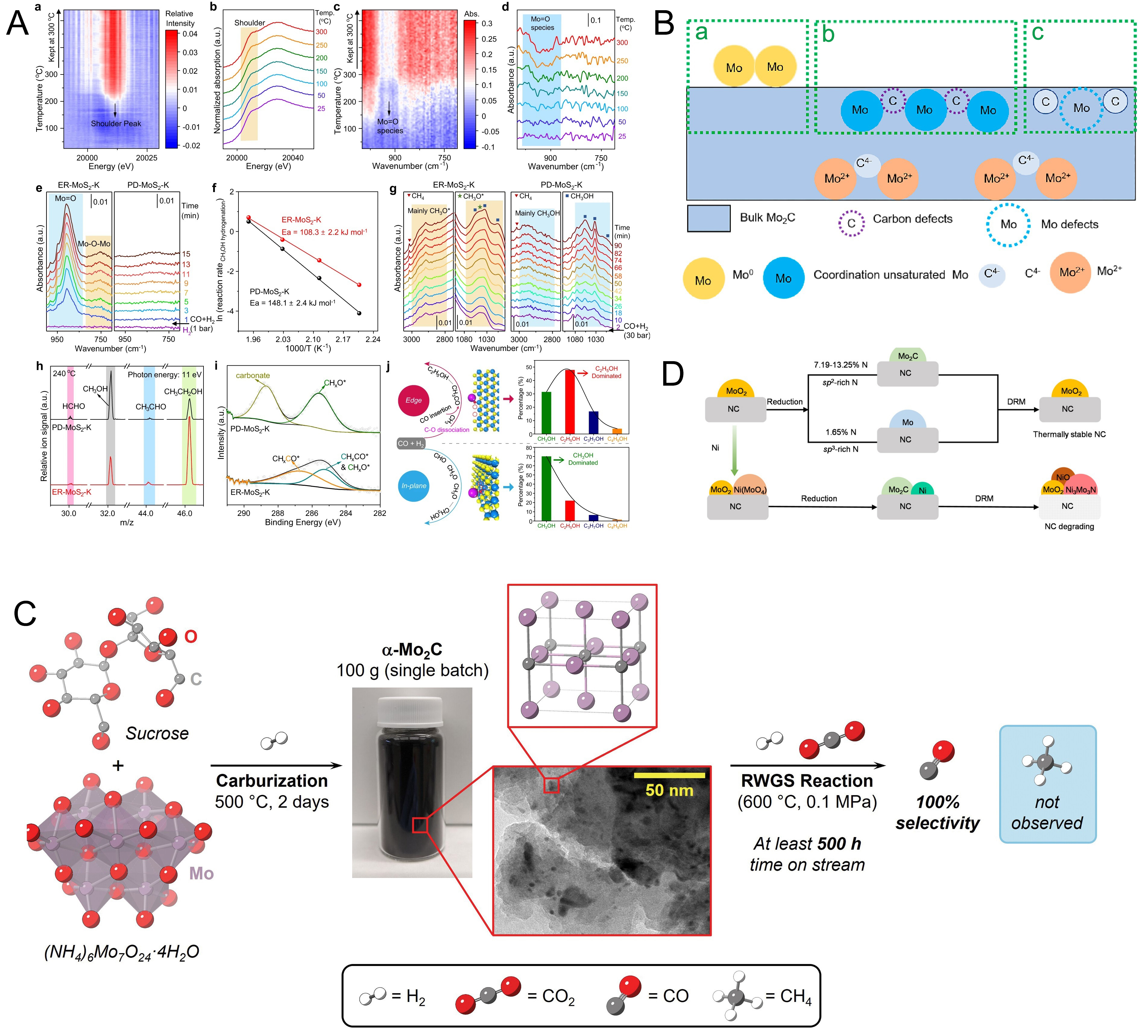
Figure 5. (A) In situ ED-XAS: (a and b) coupling in situ DRIFTS; (c and d) characterizations of ER-MoS2-K during H2 pretreatment measured with a hyphenated technology. Relative intensity in (a) was obtained by subtracting each spectrum from the first spectrum. (e) In situ DRIFT spectra of CO hydrogenation over the H2-pretreated catalysts at 25 °C, H2/CO of 2 and 1 bar. (f) Arrhenius plots calculated based on the reaction rate for methanol hydrogenation over PD-MoS2-K and ER-MoS2-K. (g) In situ DRIFT spectra of CO hydrogenation over the H2-pretreated catalysts at 240 °C, H2/CO of 2 and 30 bar. (h) In situ SVUV-PIMS detection of the CO hydrogenation intermediates and products over the H2-pretreated catalysts at 240 °C, H2/CO of 2 and 5 bar. (i) Quasi in situ SRPES detection of the CO hydrogenation intermediates. SRPES spectra were obtained after the treatment of the H2-treated catalysts with reaction gas (H2/CO = 2) at 240 °C and 5 bar for 0.5 h. (j) Proposed reaction mechanism for CO hydrogenation to methanol and ethanol on edge and in-plane sites of MoS2. (A) is reprinted with permission from Ref.[106], Copyright © 2023 Springer Nature; (B) Schematic diagram of Mo2C surface. (a) Mo0, (b) carbon defects and (c) Mo defects. (B) is reprinted with permission from Ref.[111], Copyright © 2021 MDPI; (C) Schematic of catalyst synthesis process and its performance for RWGS reaction. (C) is reprinted with permission from Ref.[113], Copyright © 2024 The American Association for the Advancement of Science; (D) Transformations of Mo/NC and Ni-Mo/NC catalysts after H2 reduction and DRM reaction. (D) is reprinted with permission from Ref.[114], Copyright © 2025 WILEY. RWGS: Reverse water-gas shift; ED-XAS: Energy-dispersive x-ray absorption spectroscopy; DRIFTS: diffuse reflectance infrared fourier-transform spectroscop; DRM: dry reforming of methane; NC: nitrogen-doped carbon; SRPES: synchrotron-radiation photoelectron spectroscopy.
Furthermore, the support plays a pivotal role in catalyst architecture. The alcohol product distribution over MMO-supported catalysts deviates significantly from the ASF distribution, exhibiting a distinct profile compared with the typical distribution of ethanol, n-propanol, and n-butanol. Notably, this catalyst yields the highest chain growth factor (α) among all samples, indicating a markedly enhanced probability of long-chain alcohol formation, substantial suppression of methanol production, and a pronounced preference for C3+ alcohols[108].
Mo-C catalyst
In recent years, research on Mo-based catalysts has increasingly focused on the Mo2C system. Compared with MoC-based catalysts, Mo2C-based catalysts exhibit superior total alcohol selectivity, largely due to abundant non-dissociative CO adsorption sites. Nevertheless, low CO conversion and insufficient selectivity toward higher alcohols remain significant bottlenecks that hinder the large-scale industrial application of Mo2C-based catalysts[109,110]. Figure 5B presents schematic diagrams of three typical structures on the Mo2C surface, namely Mo0 sites formed via over-reduction, carbon vacancy defects, and molybdenum vacancy defects, which visually distinguish the Mo species and coordination environments associated with different defects[111]. Coordinatively unsaturated Mo sites adjacent to carbon vacancies serve as the core active sites for CO hydrogenation to mixed alcohols. Conversely, Mo0 species are readily oxidized to catalytically inactive high-valent Mo6+ during catalyst passivation, leading to inferior catalytic activity[112]. Mo species associated with molybdenum vacancy defects also show weak catalytic performance. Both Mo0 and Mo vacancy defects tend to promote complete CO dissociation, producing substantial hydrocarbon by-products. This schematic clearly establishes the correlation among carbon vacancy defects, coordinatively unsaturated Mo sites, and activity toward alcohol synthesis. Furthermore, it elucidates the intrinsic mechanism underlying the volcano-type variation in catalytic performance upon Ni doping-induced modulation of lattice carbon content from the perspective of defects. This study provides visualized theoretical support for understanding the structure-activity relationship among lattice carbon content, surface defects, and catalytic selectivity.
Figure 5C illustrates the facile, scalable synthesis of cubic α-Mo2C catalysts, along with a schematic of their application in the high-temperature RWGS reaction[113]. Nanocrystalline α-Mo2C was directly synthesized by carburization under an H2 atmosphere at 500 °C, utilizing ammonium molybdate as the molybdenum precursor and sucrose as a sustainable carbon source. Under RWGS reaction conditions (600 °C, 0.1 MPa), this catalyst achieved 100% CO selectivity and maintained exceptional stability for over 500 h. Conversely, β-Mo2C can undergo electron transfer with Pd, forming SMSI.
Promoter doping remains a mainstream strategy for modifying Mo2C-based catalysts. Figure 5D illustrates the phase evolution, variations in active centers, and deactivation pathways of N-doped carbon-supported Mo2C and Ni-Mo bimetallic catalysts during H2 reduction and dry reforming of methane (DRM)[114]. This schematic clearly explains how N species and Ni promoters regulate the valence state and crystal phase of Mo species, as well as the mechanisms governing catalyst stabilization and deactivation. Although introducing Ni can facilitate reduction via hydrogen spillover and enhance initial catalytic activity, it also oxidizes Ni and Mo2C, triggers formation of the inert Ni3Mo3N phase, and accelerates gasification and degradation of carbon supports, ultimately leading to rapid catalyst deactivation.
Wang et al.[115] proposed a strategy to enhance the CO insertion capability of Mo2C-based catalysts by introducing Rhδ+ and K species, achieving excellent catalytic performance for higher alcohol synthesis (HAS) at a mild reaction pressure of 1.0 MPa. As shown in Table 3, RhK/Mo2C demonstrates optimal overall performance under identical reaction conditions. It maintains high alcohol selectivity even at low pressure, with significantly lower methane by-product selectivity compared to Rh/Mo2C. Consequently, co-modification with Rh and K significantly improves the HAS performance of Mo2C catalysts, enabling them to achieve 44.4% alcohol selectivity at low pressure and overcoming the traditional reliance of Mo-based catalysts on high-pressure conditions.
Comparison of catalytic performances of different catalysts
| Catalyst | CO conversion rate (%) | Selective alcohol property (%) | The proportion of C2+ alcohols among alcohols (%) | Methane selectivity (%) | Reaction pressure (MPa) | Reference |
| Mo2C | 51.3 | 1.1 | 17.3 | - | 3 | [115] |
| Rh/Mo2C | 65.2 | 4.2 | 1.5 | 56.9 | 3 | |
| K/Mo2C | 14.0 | 30.8 | - | - | 3 | |
| RhK/Mo2C | 9.9 | 44.4 | 85.6 | 20.7 | 1 | |
| RhK/Mo2C | 20.2 | 51.4 | 71.0 | 20.7 | 3 |
Conversely, Yang et al.[109] employed K and Ni as promoters. As in previous studies, the synergistic effect between K and Ni significantly enhanced the catalytic performance of Mo2C. Among the tested catalysts, KNiMo2C/Al2O3 exhibited the optimal performance, achieving a total alcohol selectivity of 67.6% and a remarkably high C2+ alcohol selectivity of 56%. Meng et al.[94] also synthesized a series of K- and Ni-promoted Mo2C-based catalysts via impregnation; however, they used lignin-derived carbon as the support. As highlighted in Table 4, dual promotion with K and Ni is crucial for enhancing higher-alcohol selectivity in Mo2C-based catalysts. Furthermore, catalytic performance is closely tied to support architecture: mesoporous structures facilitate mass transfer, whereas support-metal interactions influence active-site formation. Consequently, reaction conditions must be tailored to catalyst characteristics: milder temperatures and pressures favor alumina supports, whereas higher temperatures and pressures better suit the highly active sites of lignin carbon supports. Additionally, He et al.[110] successfully fabricated Mo2C catalysts with a three-dimensional hierarchical porous (3DHP) structure using a hard-template method, which significantly optimized the specific surface area, pore architecture, and active site distribution. The synergistic effect between the 3DHP structure and K modification proved pivotal for performance enhancement, offering novel insights for designing high-efficiency Mo2C-based HAS catalysts and broadening the application scope of 3DHP materials.
Comparison of the performance of the two catalysts
| Catalysts | Mo2C/Al2O3 | Mo2C@LC |
| References | [109] | [94] |
| Carrier type | γ-Al2O3 | LC |
| Carrier characteristics | Specific surface area: 121 m2/g, mesoporous structure (pore diameter: 29 nm), pore volume: 1.23 cm3/g | Specific surface area: 615.6 m2/g, open mesoporous structure (pore diameter: 5.0 nm), pore volume: 0.22 cm3/g, with defective carbon structure |
| Catalyst preparation | Excessive impregnation method + programmed temperature carbonization (at 700 °C in N2 atmosphere), M/Mo atomic ratio 0.2, stepwise loading of Mo and K/Ni | Impregnation method + programmed temperature carbonization (at 850 °C in an atmosphere of 10% H2/N2), Mo/K = 5/1, Mo/Ni = 2/1. It can be impregnated separately or simultaneously |
| The role of key additives | K: Increases the crystallinity of β-Mo2C, increases the proportion of high-valent Mo (Mo6+), and enhances the non-desorbed adsorption of CO Ni: Reduces the reduction temperature of Mo oxides, promotes the formation of Mo2+, and catalyzes the water-gas shift (WGS) reaction | K: Increases the proportion of high-valence Mo (Mo5+/Mo6+), enhances the catalyst’s alkalinity, and promotes the growth of carbon chains Ni: Facilitates Mo reduction through hydrogen overflow, increases the size of Ni particles, and balances hydrogenation capacity with carbon chain growth |
| Reaction conditions | Temperature: 300 °C, Pressure: 3.0 MPa, H2/CO = 2 | Temperature: 340-380 °C, Pressure: 7.0 MPa, H2/CO = 1 |
| Optimal catalyst | KNiMo2C/Al2O3 | Ni/K/Mo2C@LC |
| Catalytic performance | CO conversion rate: 7.2% Total alcohol selectivity: 67.6% C2+ alcohol selectivity: 56% (ethanol accounts for 37%) STY: 64.84mg/gcath (0.065g/gcath) | CO conversion rate: 47.9% (Ni/K/Mo2C@LC500)/23.0% (NiKMo2C@LC) Total alcohol selectivity: 57.9% C2+ alcohol selectivity: 76.7% (ethanol accounts for 50.9%) STY: 0.455 g/gcath (380 °C) |
| Stability | The continuous reaction lasted for 80 h, and the CO conversion rate and product selectivity remained stable | The reaction was carried out continuously for 100 h. The characteristic peaks of Mo2C and Ni were retained, and the ethanol proportion remained at approximately 40% |
| Core advantage | The reaction conditions are mild (low temperature and low pressure), with high overall alcohol selectivity and a significant inhibitory effect of methanol | The space-time production rate is extremely high (7 times that of the left), and the carrier is resource-based (utilizing paper waste), with a high proportion of C2+ alcohols |
| Insufficiency | The STY value is low, the CO conversion rate is also low, and the carrier has no resource utilization value | The reaction pressure is quite high (7 MPa), and it requires a high temperature (380 °C) to achieve the optimal performance |
Mixed alcohols can serve not only as clean fuels that substitute fossil energy but also as solvents, chemical intermediates, and gasoline additives, and directly producing them from synthesis gas (syngas, H2 + CO) - typically generated through the pyrolysis and gasification of carbonaceous feedstocks such as coal and biomass - realizes the clean and efficient utilization of carbon resources[111]. At the heart of this syngas-to-alcohol process lie the thermally driven decomposition that releases syngas and the subsequent dissociation and activation of reactant molecules on the catalyst surface; in particular, the C-O bond of CO must be activated in a controlled manner, so that the balance between dissociative CO adsorption and non-dissociative CO insertion directs the growing surface intermediates toward alcohols rather than hydrocarbons. Molybdenum carbide (Mo2C) is well suited to this activation chemistry because of its noble-metal-like electronic structure, in which the insertion of carbon atoms into the Mo lattice elongates the Mo-Mo distance, contracts the Mo 4d orbitals, and enriches the density of states near the Fermi level[116]. Shou et al.[112] further showed that Ni doping promotes CO hydrogenation to mixed alcohols on Mo2C: Ni inhibits the agglomeration of Mo2C crystallites and suppresses surface carbon deposition, thereby enlarging the active surface area, whereas the electron transfer from Ni to Mo increases the electron cloud density of the Mo species and favors the non-dissociative adsorption and insertion of CO. More importantly, decreasing the number of carbon atoms in the Mo2C lattice on the catalyst surface generates coordination-unsaturated molybdenum species that exhibit higher catalytic activity and mixed-alcohol selectivity; among the catalysts examined, MC-Ni-1.5 (Ni/Mo = 1.5:8.5), which possesses the largest amount of such species, delivers the highest space-time yield of mixed alcohols - about three times that of the undoped Mo2C catalyst - under the relatively mild conditions of 180 °C and 5 MPa.
In summary, Mo2C-based catalysts show outstanding potential for syngas-to-alcohol synthesis through multidimensional modification and broad applicability. By synergistically regulating promoters (such as Ni, Rh, and K)[117,115] and strategically selecting supports with distinct properties (e.g., lignin-derived carbon and γ-Al2O3), these catalysts can be effectively tailored to diverse reaction scenarios. Constructing three-dimensional (3D) hierarchical porous structures offers a promising direction for further enhancing catalytic performance. Mechanistic studies of chlorinated volatile organic compound (CVOC) abatement reveal that the dissociation and activation of recalcitrant molecules are governed by surface acid-base and redox properties, with C-Cl bonds dissociating on Lewis acid sites and the resulting intermediates undergoing dehydrochlorination by hydroxyl species[118]. Moreover, catalytic steam reforming over β-Mo2C/γ-Al2O3 converts refractory CVOC waste into syngas with a conversion efficiency above 95% at 600 °C[116], coupling pollutant removal with feedstock supply for alcohol synthesis and providing an innovative route for environmental remediation and carbon-resource recycling.
Rh-based catalyst
Among various catalysts for CO hydrogenation, Rh-based catalysts are considered highly promising for synthesizing C2 oxygenates from syngas, owing to their unique capability. However, the commercial application of rhodium (Rh) is significantly constrained by its high cost as a noble metal[119,120]. While traditional homogeneous Rh-based catalysts exhibit high activity and selectivity, they pose challenges for product separation. Conversely, heterogeneous catalysts, though easily recoverable, often suffer from insufficient activity and selectivity due to low ligand concentrations and limited mobility of active sites[121]. These limitations can be mitigated by using supports with high specific surface area, hierarchical pore structures, and high nitrogen content[122]. Metal particle size is a critical parameter governing the performance of heterogeneous catalysts; typically, the specific atomic activity increases markedly as particle size decreases. When the metal particle size reaches the ultra-small limit, single-atom catalysts (SACs) form[123,124].
Arevalo et al.[125] found that deep hydrogenation to produce methane readily occurs on stepped Rh surfaces; therefore, modification and promoter tuning are required to modulate the kinetic competition between CHx hydrogenation and CO insertion. Figure 6A illustrates the full reaction pathway for higher alcohol synthesis from syngas on stepped Rh (211) surfaces. The reaction is initiated by CO hydrogenation to form CHO (Formyl), from which multiple competing reaction branches diverge. The CHO intermediate can be hydrogenated to methanol or undergo dehydroxylation to yield CHx species. C1 fragments react with CO/CHO via insertion to form ethanol; ethanol can further undergo dehydroxylation to generate ethyl species, which sequentially produce n-propanol. Continuous hydrogenation of CHx species leads to methane formation. Colored arrows in the figure distinguish insertion, hydrogenation, dehydroxylation, and desorption processes, explicitly revealing the competitive mechanism that governs the formation of target alcohols and methane byproducts. Figure 6B presents catalyst structural models and density functional theory (DFT)-calculated Gibbs free energy profiles to compare the reaction energy barriers at high-coordination terrace sites of Rh (111) and low-coordination step sites of Rh (221)[126]. Theoretical calculations confirm that low-coordination Rh (221) step sites facilitate C-O bond cleavage and *CHx hydrogenation, promoting the formation of a methane byproduct, while boron oxides can spontaneously and selectively anchor and block such step sites[127]. Conversely, high-coordination Rh (111) terrace sites favor the coupling of *CH2 with CO/*CHO to produce C2 oxygenates[126]. Collectively, boron species shield active sites for methane formation and raise the energy barrier for C-O cleavage and hydrogenation while preserving sites for carbon chain coupling. This clarifies the intrinsic mechanism by which boron modification suppresses methane generation and boosts ethanol selectivity at the molecular scale.
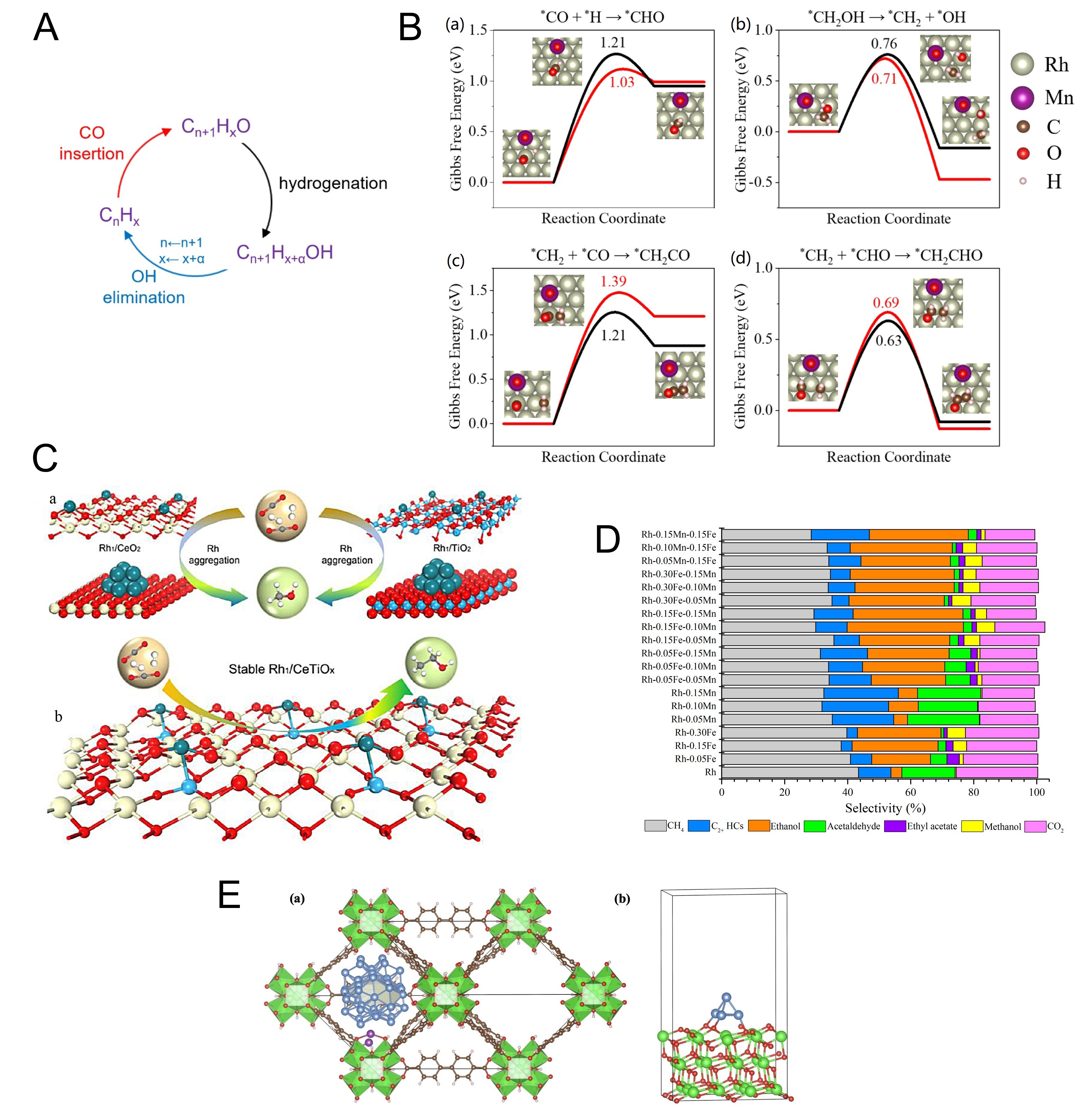
Figure 6. (A) The overall reaction cycle for HAS consisting of CO insertion (red), hydrogenation (black), and OH elimination (blue). (A) is reprinted with permission from Ref.[125], Copyright © 2024 Springer US; (B) (a-d) Gibbs free energy diagrams and configurations for four intermediate steps on Mn1O1 supported on the Rh (111) facet (black line) and (221) facet (red line) at 595 K. The insets in (a–d) show the configurations of the initial state (IS), transition state (TS) and final state (FS) on Rh (111). (B) is reprinted with permission from Ref.[126], Copyright © 2025 The Royal Society of Chemistry; (C) Schematic reaction process for long-term stability testing in CO2 hydrogenation to ethanol over single-atom Rh supported on CeO2, TiO2 (a), and CeTiOx (b). (C) is reprinted with permission from Ref.[128], Copyright © 2022 WILEY; (D) Summary of selectivities for syngas conversion over Rh/SiO2 and Rh-based multimetallic catalysts. (D) is reprinted with permission from Ref.[132], Copyright © 2017 American Chemical Society; (E) Optimized structures of Rh+-Rh0 /UiO-67 (a) and Rh0/t-ZrO2(101) (b). C, brown; O, red; H, white; Zr, green; Rh+, purple; Rh0, blue; this color code is used throughout the paper. Details of model construction and charge analyses can be found in the Supporting Information. (E) is reprinted with permission from Ref.[135], Copyright © 2024 WILEY. HAS: higher-alcohol synthesis.
Structural distortion facilitates the incorporation of Rh atoms and the formation of shorter Rh-O bonds [Figure 6C], while significantly increasing the aggregation energy barrier of Rh single-atom sites (Rh SASs)[128]. This confirms a strong interaction between Rh single atoms and surface O atoms, which endows the Rh1/CeTiOx catalyst with exceptional structural stability, thereby ensuring high catalytic performance and outstanding long-term durability for ethanol production. Consequently, regulating support doping is pivotal for optimizing single-atom catalyst performance. Notably, maintaining a low Rh loading is crucial for achieving high ethanol selectivity. Conversely, high loading tends to induce Rh cluster formation, shifting the reaction pathway toward methanol or methane formation[129].
The active centers of SACs consist of isolated metal atoms, which provide single metal sites but cannot inherently form metal-metal bonds[130]. To address this limitation, Gong et al.[131] fabricated RhFeOx/TiO2 catalysts via drying and calcination treatments using P25 (anatase/rutile mixed-phase TiO2) as the support, with iron introduced as a promoter. Benefiting from a fourfold synergistic effect, the Fe promoter constructs composite Rh0-Rhδ+-Ov-Ti3+ active sites at the anatase-rutile phase boundaries of P25. Specifically, Fe generates abundant Ov-Ti3+ defects, synchronously regulates the coexistence of Rh0 and Rhδ+ species, strengthens the SMSI at the phase junctions, and immobilizes ultrafine Rh nanoparticles at the anatase/rutile interfaces. This strategy addresses the inherent drawbacks of conventional single-atom catalysts and markedly accelerates the C-C coupling reaction.
Although introducing two promoters simultaneously can greatly improve overall selectivity toward oxygenates and C2 hydrocarbons, systematic modulation of the deposition sequence and metal molar ratio is required; random doping weakens the synergistic effect. Figure 6D compares the carbon selectivity distribution of all products across monometallic Rh, binary Rh-Fe/Rh-Mn catalysts with different molar ratios, and ternary Rh-Fe-Mn catalysts prepared via varied deposition sequences[132]. Stepwise controllable surface deposition enables independent tuning of the surface coverage of Fe and Mn sites on Rh. Fe sites continuously convert acetaldehyde to ethanol, while Mn sites selectively facilitate C2 olefin formation. Monometallic Rh mainly produces methane and acetaldehyde. Binary catalysts reduce methane selectivity and increase the proportion of ethanol or olefins, respectively. The ternary system simultaneously boosts the selectivity of ethanol and light hydrocarbons. Conversely, binary catalysts with a single promoter show competition between Fe and Mn for active sites on Rh, leading to a mutual offset of the two promoters' functions and only a limited reduction in methane selectivity[133].
Interface modulation between metal-support and metal-promoter interactions is a core strategy to tailor catalytic activity and product selectivity in CO2 hydrogenation[134]. Figure 6E compares the atomic arrangement and charge distribution between the confined dual-site model of Rh+-Rh0/UiO-67 and the oxide-supported model of metallic Rh0/t-ZrO2(101)[135]. Rh dimers anchored inside UiO-67 cavities serve as Rh+ sites, whereas intracavity Rh clusters act as Rh0 sites with direct interfacial connections. Positively charged Rh+ atoms construct a charge-differentiated dual active interface. Conversely, Rh nanoparticles on the t-ZrO2 surface are nearly zero-valent metallic Rh, lacking cationic Rh sites and heterogeneous charge interfaces[136]. Bader charge analysis confirms that the metal-organic framework (MOF) framework modulates the charge distribution of Rh atoms to intrinsically generate adjacent Rh+/Rh0 sites. Oxide supports only immobilize homogeneous Rh clusters and cannot spontaneously form neighboring dual sites with separated valence states. Metal doping modification of Rh/ZrO2 merely slightly adjusts the electron density of Rh, failing to reproduce the atomic-level valence-separated interface enabled by MOF confinement. Precise spatial confinement is a unique strategy for constructing charge-heterogeneous dual active sites.
In comparison with MOF-derived Cu/ZrO2-DM catalysts for CO2 hydrogenation to methanol, Cu-based catalysts enhance methanol yield by virtue of their large specific surface area and highly dispersed Cu active sites[137]. Conversely, Rh-based catalysts precisely manipulate reaction pathways via interfacial electronic effects. Together, these catalytic systems show that reactant adsorption and activation dictate product distribution, providing a theoretical framework for interfacial modulation in the rational design of catalysts for CO2 hydrogenation to methanol and ethanol.
Multifunctional catalyst
In recent years, 85% of global energy and most chemical production have relied on fossil fuels. The resulting massive CO2 emissions have significantly exacerbated global warming. This necessitates implementing technologies such as CO2 capture[103] and utilization (CCU)[138,139] to achieve carbon cycling. Although catalysts can significantly improve target-product yields, current transition-metal- and noble-metal-based catalysts suffer from critical limitations, including low ethanol yields and unsatisfactory selectivity. These challenges have prompted researchers to explore novel strategies for ethanol synthesis via CO2 hydrogenation[140,141].
Figure 7A illustrates the tandem reaction pathway over solid Co FTS catalysts and molecular Co reductive hydroformylation (RHF) catalysts, whose performance is predominantly governed by the spatial distance between the two components[142]. When active sites are closely adjacent and molecular catalysts can diffuse into the pores of solid supports, the in situ formed 1-alkenes are rapidly trapped and converted into higher alcohols. Conversely, a large separation between active sites facilitates re-adsorption and hydrogenation of alkenes to paraffins, and only a small fraction of linear alcohols is produced directly via FTS[142]. Short inter-site distances reduce the diffusion path of alkene intermediates and suppress undesired saturation side reactions, thereby markedly boosting alcohol selectivity. Artificially isolating active sites leads to a substantial decline in alcohol yield. Although ligands enable fine-tuning of the linear-to-branched alcohol ratio, intimate synergism within confined pore channels is a prerequisite for efficient alcohol synthesis in this tandem system; simple physical mixing fails to deliver optimal catalytic performance. Accordingly, suitable spatial separation between the two components of bifunctional catalysts is critical to optimize intermediate migration, match reaction kinetics, and improve overall catalytic performance[143-145]. For supported Cu-based catalysts applied in ethanol conversion, an unbalanced spacing between Cu dehydrogenation sites and ZrO2 acid sites impairs catalytic efficiency. Excessively large separation extends the diffusion pathway of reaction intermediates and accelerates side reactions, thereby lowering the selectivity toward ethyl acetate and substrate conversion. Conversely, an overly short distance causes metallic Cu to encapsulate zirconia acid sites, triggers sintering of Cu nanoparticles and deterioration of metal dispersion, and mismatches the reaction rates of dehydrogenation and condensation, ultimately hindering the formation of target products[146]. Figure 7B presents the Zr X-ray Photoelectron Spectroscopy (XPS) high-resolution spectra and the proportion of oxygen-deficient Zrx+ (Zr1 species) over CuCoAl, CuCoAl|m-ZrO2, and CuCoAl|t-ZrO2 catalysts[147]. The composite system incorporating tetragonal ZrO2 generates more oxygen-deficient Zrx+ sites, whereas fewer oxygen-deficient sites are formed in the monoclinic ZrO2 composite system. Oxygen vacancies facilitate the water-gas shift reaction and stabilize oxygen-containing intermediates. The disparity in oxygen-deficient-site concentration directly governs CO2 production and higher-alcohol selectivity. Accordingly, oxygen defects act as critical surface sites for modulating product distribution.
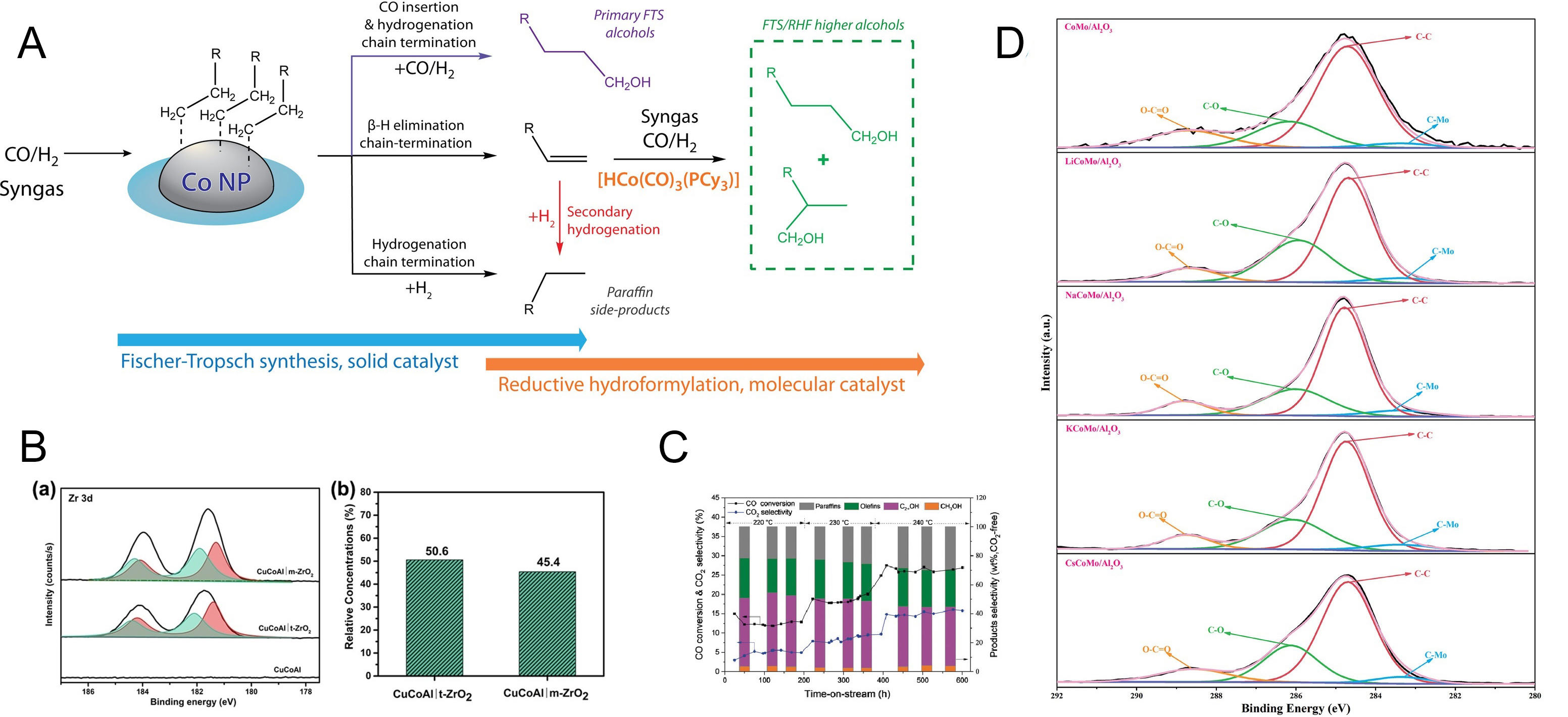
Figure 7. (A) Production of higher alcohols from syngas via the integration of Fischer-Tropsch synthesis (FTS) and reductive hydroformylation (RHF) in a tandem process. The active sites of the solid catalyst are responsible for chain growth (number of Cn in R). The ratio between β-H elimination and hydrogenation as chain termination steps determines the primary hydrocarbon selectivity, i.e., olefin-to-paraffin ratio. The activity of the molecular catalyst in olefin reductive hydroformylation relative to secondary olefin hydrogenation pathways determines the final alcohol selectivity. For completeness, the CO insertion chain-termination pathway on the FTS catalyst is also indicated as a source for primary, strictly linear higher alcohols. (A) is reprinted with permission from Ref.[142], Copyright © 2022 WILEY; (B) XPS spectra of CuCoAl, CuCoAljm-ZrO2 and CuCoAljt-ZrO2 catalysts after reduction. (a) Zr 3d, (b) The relative concentrations of ZrI species. (B) is reprinted with permission from Ref.[147], Copyright © 2021 John Wiley & Sons.; (C) Stability test of CoMn|CuZnAlZr multifunctional catalyst with mortar mixing. Reaction conditions: 6 MPa, H2/CO = 2 and 2,000 mL/(g·h). (C) is reprinted with permission from Ref.[149], Copyright © 2019 WILEY; (D) C 1s spectrum of catalyst MCoMo/Al2O3. (D) is reprinted with permission from Ref.[150], Copyright © 2025 WILEY. XPS: X-ray photoelectron spectroscopy.
To address the challenges of low selectivity and insufficient stability in the conversion of syngas to (C2+OH), Luan et al.[148] adopted a “reaction coupling strategy” to develop a bifunctional system composed of ZnCrAlOx (zinc-chromium-aluminum mixed oxide) and a K/Ni-promoted Mo-based sulfide (KNiMoS-MMO). Through component synergy, promoter modulation, and structural optimization, they achieved efficient conversion of syngas into low-carbon alcohols. Furthermore, leveraging proximity regulation, Lin et al.[149] engineered a catalyst comprising CoMn oxide and CuZnAlZr oxide. During extended operation, this catalyst maintained stable CO conversion rates, CO2 selectivity, and product distribution (specifically the ratio of oxygenates to olefins) without significant deactivation, thereby satisfying the rigorous stability requirements for industrial applications [Figure 7C]. In another advancement, Jiang et al.[73] developed a multifunctional catalytic system centered on carbon matrix-encapsulated iron-based catalysts (Fe@NC) through a triple strategy involving precursor screening, K-promoter modification, and the co-addition of organic ligands. This design not only ensures efficient coupling between the RWGS and FTS reactions but also suppresses by-product formation, substantially improving selectivity toward long-chain hydrocarbons. Figure 7D compares the chemical states of surface carbon on catalysts modified by different alkali metals. Four types of carbon characteristic peaks, namely graphitic carbon, C-Mo bonds, C-O, and C=O, can be fitted for all samples[150]. The C-Mo peak verifies the stable existence of the molybdenum carbide phase. Doping with Li, Na, K, and Cs does not alter the category of carbon species but only slightly adjusts the relative intensity of each carbon peak; the electronic effect of alkali metals exerts negligible influence on the surface carbon skeleton structure of catalysts. Compared with the unmodified catalyst, the proportion of oxygen-containing impurity carbon species in alkali-modified samples shows no obvious variation, and the peak position of the C-Mo characteristic peak remains nearly unchanged[151]. This indicates that alkali metals cannot directly regulate the electronic structure of molybdenum carbide, and the carbon carrier acts merely as a skeleton without modulating Mo valence states. Although alkali metals can tune metallic Mo active sites, they do not change the distribution of surface carbon species. Hence, carbon spectra cannot be adopted to screen the optimal promoters for alcohol synthesis. Overall catalytic performance is synergistically governed by multiple intrinsic preparation parameters, including fabrication procedures, thermal treatment temperature, and the physicochemical properties of carbon supports. Specifically, the nitrogen doping level, degree of graphitization, and porous structure of carbon supports can efficiently modulate electron-transfer efficiency and reactant mass-transport rates within the catalytic system.
In summary, multifunctional catalyst design does not follow a single, fixed paradigm. Instead, catalytic systems with target performance can be constructed by precisely combining and structurally regulating multiple components tailored to specific reaction requirements. Nevertheless, moderate proximity is imperative to achieve efficient synergy among various active sites.
INFLUENCING FACTORS
Preparation method
Currently, research on the catalytic hydrogenation of carbon dioxide to methanol has gradually focused on developing novel catalysts that are low-cost, environmentally friendly, and highly active. By regulating the interfacial contact between active metals and supports, as well as metal-support strong interactions, catalyst preparation protocols can simultaneously modulate the dispersion, reducibility, surface electronic structure of active components, and the adsorption-dissociation capacity of reactants. Meanwhile, these strategies enable precise control over the amount of target active phases formed during the reaction and improve catalyst sintering resistance[152]. Originating from the intrinsic physicochemical properties of catalysts, these approaches ultimately achieve simultaneous optimization of catalytic activity, methanol selectivity, and long-term operational stability. Accordingly, precise tuning of key physicochemical parameters (e.g., crystallite size, oxygen vacancy concentration, and the proportion of high-valence active species) via customized preparation strategies can systematically enhance the overall catalytic efficiency of CO2 hydrogenation to methanol[153-154]. Table 5 systematically compares the core characteristics of four conventional catalyst synthesis routes, namely co-precipitation, ammonia evaporation, impregnation, and hydrothermal method, and summarizes the merits, drawbacks, and optimal applicable reaction domains of each technique. Precise modulation of catalytic performance can be achieved via these versatile synthetic strategies[164]. Based on practical reaction requirements, researchers can rationally select or further modify synthetic protocols to maximize advantages and mitigate deficiencies. Catalyst physicochemical properties can be optimized along multiple dimensions, including metal dispersion, pore structure, and metal-support interaction, thereby accommodating the distinct demands of diverse catalytic reactions in terms of activity, selectivity, and stability. For example, metal-organic frameworks (MOFs) are commonly prepared via six routes: solvothermal synthesis, microwave-assisted synthesis, direct pyrolysis, the sacrificial template method, post-synthetic modification, and supercritical fluid deposition (SFD). Comparative analyses reveal that MOFs prepared via these distinct methods have unique advantages, making them suitable for specific applications[53]. Similarly, San et al.[165] investigated Cu/ZrO2 catalysts synthesized through four different methods and reached the same conclusion. Notably, compared with catalysts prepared by traditional methods, the Cu/ZrO2-DM catalyst - synthesized via ligand replacement (partial substitution of terephthalic acid with amino terephthalic acid) combined with incipient wetness impregnation for Cu loading - exhibits superior catalytic performance[165]. In the broader context of catalyst optimization, refining preparation methods remains a pivotal approach to enhancing overall efficacy. By precisely regulating process parameters (e.g., reaction temperature, precursor ratios, and post-treatment conditions), the morphological structure, active site distribution, and electronic properties of catalysts can be optimized, thereby significantly improving their catalytic activity, selectivity, and stability[153].
Comparison of core properties of Co-precipitation, ammonia evaporation, impregnation and hydrothermal methods
| Evaluation index | Impregnation (conventional wet impregnation/methanol-assisted impregnation, e.g., Ni/KIT-6, NiMo/AC) | Ammonia evaporation (for metal loading on carbon/oxide supports) | Co-precipitation (Co-, Ni-, CuZnAl multi-metal systems) | Hydrothermal (in situ encapsulation & crystallization, NiMo@CNT, MOR zeolite) |
| References | [155,156] | [157-159] | [160,161] | [162,163] |
| Metal dispersion | Moderate to poor; metal precursors tend to agglomerate with large particle sizes (15-20 nm for Ni/SiO2). Methanol modification and confined supports slightly improve dispersion | Excellent; ammonia complexes metal ions for uniform slow deposition, narrow particle size distribution; high dispersion for mono/bimetallic catalysts | Superior dispersion for multi-metals, poor for single metals. Simultaneous precipitation realizes atomic mixing of diverse metals, yet large aggregates and grain coarsening emerge after calcination | Excellent, controllable particle size (10-20 nm). Slow hydrothermal crystallization and in situ confinement suppress metal migration and agglomeration |
| Pore structure regulation | Metal particles easily block original support pores; BET surface area and pore volume drop sharply (733 → 497 m2/g for KIT-6 after impregnation); broad pore size distribution | Slight pore blockage; thin uniform metal layer coats pore walls, preserving intrinsic support texture with narrow pore distribution | Abundant mesopores in precipitates, yet severe pore collapse upon calcination, disordered pores and lost micropores; poor repeatability even with precipitant adjustment | Ordered mesopores (KIT-6, CNT, zeolites) can be precisely tailored; tubular/cage confined structures are maintained for efficient mass transfer |
| Metal-support interaction | Weak, dominated by physical adsorption; low reduction temperature (372 °C for Ni/SiO2), limited electron transfer and poor sintering resistance | Moderately strong; chemical bonding forms between metal and support hydroxyl groups with tunable electronic properties | Strong multi-interfacial interactions between metals and metal-oxides via co-crystallization, though bulky composite oxides readily form | Extremely strong dual effect of confinement and chemical bonding; directional electron transfer (Mo → Ni) generates abundant oxygen vacancies for enhanced activation |
| Advantages | Simple operation, low equipment cost, wide precursor range, accurate metal loading control, suitable for large-scale production | Optimal metal dispersion, compatible with carbon/SiO2/Al2O3 supports, narrow particle size, good repeatability | One-step synthesis of multi-metal composites, low cost, easy scale-up, abundant multi-metal synergistic interfaces | Precise control over catalyst structure and defects; accessible in situ metal encapsulation, tunable acidity for N-doped carbon/zeolites |
| Disadvantages | Severe metal sintering at high temperatures, blocked pores increase mass transfer resistance, mediocre cycling stability | Long preparation cycle (12-24 h ammonia volatilization); local agglomeration at high metal loadings | High pH sensitivity, inconsistent batch performance, residual inorganic impurities, irreversible pore collapse after calcination | High cost of high-pressure reactors, low single-batch yield, difficult industrial scale-up, sensitive to temperature/pH/time |
| Cost&Scalability | Lowest cost, fully mature industrial technique | Medium cost, widely used in labs, limited to pilot trials | Low cost; mainstream industrial route for CuZnAl methanol/DME catalysts | Highest cost, only lab-scale small-batch synthesis |
Catalyst supports
Catalytic performance can be significantly enhanced through synergistic elemental interactions, optimized structural design, and strategic selection of supporting materials[166]. Metal supports play a multifaceted role in catalysis: they regulate the dispersion and valence state of active components to optimize active site architecture; facilitate reactant adsorption, activation, and intermediate transformation to streamline reaction pathways; strengthen metal-support interactions to bolster stability; and fine-tune pore structures and surface acid-base properties to improve mass transfer and selectivity[94,104,167-169]. Collectively, these effects synergistically elevate catalytic activity, selectivity, and durability. Carbon modification, a widely adopted support engineering strategy, effectively promotes the generation of surface oxygen vacancies, thereby strengthening CO2 adsorption and activation. More importantly, carbon species intimately bound to metal components serve as efficient channels for hydrogen spillover. This saturates surface hydrogen adsorption and renders the H2 reaction order near zero, effectively overcoming the kinetic limitations inherent in CO2 hydrogenation to methanol[170]. Given the positive linear correlation between total alcohol selectivity and oxygen vacancy concentration, increasing the density of surface oxygen vacancies is a proven approach to enhance total alcohol selectivity[171]. For example, in comparative studies of monometallic (Pt, Ni, Co) and bimetallic (PtNi, PtCo, PdNi) catalysts supported on CeO2 (a reducible support) versus γ-Al2O3 (an irreducible support), the support type was found to primarily dictate catalytic activity and the extent of bimetallic bond formation[172]. As a representative reducible support, the morphology of CeO2 directly influences oxygen vacancy concentration as well as the dispersion and stability of active metal species. Furthermore, particle size, modulated by calcination temperature, alters metal-support interactions and ultimately determines overall catalytic performance. Notably, CeO2 can stabilize Rh in the +2 oxidation state, enabling efficient conversion of CO2 to methane[173,174]. Conversely, irreducible supports like γ-Al2O3 generally exhibit lower intrinsic activity but favor higher CO selectivity. Loading metals onto γ-Al2O3 also modifies the catalyst’s basicity, yielding greater energy efficiency for syngas conversion and product formation[175].
Although product selectivity in catalytic reactions is intrinsically governed by supported active metal components, supports act far beyond simple physical scaffolds. Instead, they participate deeply in catalytic cycles and modulate reaction behavior across multiple dimensions, as shown by the Cu-based modified methanol synthesis catalysts and noble-metal single-atom Rh catalytic systems discussed in the foregoing sections. Previous literature has systematically summarized four core mechanisms by which supports regulate catalytic processes: in situ generation of auxiliary active sites, stabilization of key adsorbed reaction intermediates, construction of metal-support interfaces with electronic synergies, and modulation of reaction kinetics for the conversion of reactants and intermediates[142]. Collectively, these four mechanisms alter the intrinsic catalytic properties of catalysts.
Taking the Cu/ZrO2 catalytic system for CO2 hydrogenation to methanol elaborated in earlier chapters as an example, multiple regulatory effects originating from the support directly determine CO2 conversion activity, target methanol selectivity, and long-term operational stability. ZrO2 possesses moderate Lewis acidity and outstanding high-temperature anti-sintering capacity, which can anchor Cu nanoparticles and preserve mesoporous pore structures, rendering it the most suitable support for this reaction system[176]. Furthermore, the distance between the catalyst-relevant periphery (CRP) regions on the support surface and Cu active particles must be precisely matched to generate interfacial synergy[177]. Mismatched particle spacing directly disrupts the kinetic balance between CO2 activation and formate intermediate transformation, and only optimized spacing can maximize catalytic efficiency. Such interfacial synergy rules serve as a critical prerequisite for high-efficiency production of oxygenates via CO2 hydrogenation.
Extending to the single-atom noble metal catalytic system for selective ethanol synthesis through CO2 hydrogenation discussed previously, the Rh1/CeTiOx catalyst with Ti-doped CeTiOx support further highlights the multi-functional regulatory capacity of supports[125]. This composite oxide support is not merely an inert substrate for immobilizing isolated Rh single atoms; rather, it comprehensively reconstructs the catalytic system via four coupled core effects: (1) reversible surface structural reconstruction of the support to create high-density oxygen vacancy defects; (2) generation of SMSI between the support and Rh single atoms to precisely tune the electronic states of active sites; (3) fabrication of bifunctional active centers relying on defect sites and doped heterogeneous interfaces; (4) lattice confinement effect to suppress the migration and agglomeration of Rh single atoms and significantly improve the thermal stability of catalysts. These multi-layer regulatory mechanisms jointly determine the electronic distribution, spatial configuration of active sites, and complete reaction pathway covering CO2 activation and C-C coupling, ultimately governing the overall catalytic activity, ethanol selectivity, and long-cycle durability of catalysts. This also provides clear theoretical guidance for the rational design of supports for single-atom noble metal catalysts.
Promoter
Consistent studies show that the performance of reactions represented by higher-alcohol synthesis from syngas and RWGS largely depends on modulating the surface chemical properties of catalysts[178-180]. Introducing secondary-metal or alkali-metal promoters into Mo-based (molybdenum carbide or molybdenum sulfide) catalysts is an effective way to precisely regulate the chemical structure and electronic environment of active sites[181].
The conventional RWGS reaction typically operates at elevated temperatures (400-700 °C), which not only predisposes catalysts to deactivation but also requires complex heat-exchange systems. Conversely, at lower temperatures (< 600 °C) and high pressure, CO2 hydrogenation tends to favor methane and methanol formation, resulting in extremely low CO selectivity. Therefore, there is a critical need to develop catalysts with both high activity and selectivity, and this demand can be effectively met by modifying catalysts with metal promoters. The synergistic interaction between the two metals alters the binding energies of reactants and reaction intermediates, fundamentally influencing the reaction’s chemical behavior[182-184].
Alkali metal K represents the most widely adopted modifier/promoter in catalytic systems for higher alcohol synthesis from syngas. In recent years, K has emerged as a core tuning strategy to optimize catalytic activity, C2+ alcohol selectivity, and long-term operational stability by precisely modulating the electronic environment of active sites, surface defects, and reactant adsorption configurations[185]. It is compatible with various mainstream catalytic systems, including Mo-based catalysts and bimetallic Cu-Fe catalysts, providing an efficient regulatory route to overcome the intrinsic performance bottlenecks of different catalyst families.
As summarized from the foregoing comparative investigations of MoS2 and Mo2C molybdenum-based catalysts, under identical K and Mo loadings, MoS2 sulfide catalysts construct abundant interlayer sulfur vacancies and heterogeneous MoS2/KMoS2 interfaces[104], which substantially strengthen CO insertion and C-C coupling kinetics. Accordingly, MoS2 delivers superior C2+ alcohol selectivity and space-time yield relative to Mo2C carbides. Conversely, the intrinsic active sites of Mo2C favor the single-carbon hydrogenation pathway, yielding methanol and light alkanes as dominant products accompanied by abundant surface acidic sites[106]. Standard K doping dosages fail to deliver satisfactory regulation effects for Mo2C; higher K loadings are therefore required to neutralize surface acidic sites, restructure CO adsorption modes, and ultimately elevate the fractions of total alcohols and long-chain alcohols in product distribution.
For the Mo2C/γ-Al2O3 catalytic system described in previous sections, single-K modification improves the crystallinity of the β-Mo2C phase and optimizes the valence distribution of Mo species[91]. When combined with Ni to form a dual-promoter system, K and Ni generate synergistic electronic effects that simultaneously tune the non-dissociative CO adsorption strength and balance the competing reactions of carbon chain propagation and hydrogenation. This suppresses excessive C-O bond hydrogenolysis from a kinetic perspective, mitigates the formation of hydrocarbon byproducts such as methane, and markedly boosts the yield of liquid alcohol products.
Within the bimetallic Cu-Fe catalyst category belonging to modified Fischer-Tropsch systems discussed earlier, the K promoter exerts multiple regulatory functions. On one hand, K accelerates the RWGS reaction over catalyst surfaces, continuously supplying active CO intermediates. Conversely, it modulates the electron density at metal-metal interfaces to enhance linear CO adsorption while weakening bridged CO adsorption, thereby delicately balancing the two competing pathways of CO dissociative and non-dissociative activation. Meanwhile, K lowers the energy barrier for C-C coupling and inhibits over-activation of H2, restraining alkylation side reactions at the source to reduce alkane and alkene byproducts and selectively enrich C2+ alcohols[186]. Such regulatory effects effectively alleviate the inherent drawbacks of Cu-Fe catalysts, including facile phase segregation and overly broad product distribution.
COMPARISON OF DIFFERENT CATALYSTS IN SYNGAS-TO-HIGHER-ALCOHOL SYNTHESIS
Based on the above-mentioned catalytic systems for syngas-to-higher-alcohol synthesis, Table 6 statistically evaluates modified Fischer-Tropsch catalysts, Cu-based methanol-synthesis catalysts, Mo-based catalysts, Rh single-atom catalysts, and multifunctional composite catalysts under varied operating conditions, covering optimal temperature, pressure, H2/CO molar ratio, CO conversion, total alcohol selectivity, and C2+-alcohol fraction. Combined with the intrinsic active-site configuration, support microstructure, and promoter modulation strategy of each category, this comparative analysis dissects how bimetallic interfacial interactions, defect engineering, surface electronic modulation, and tandem-site coordination govern CO activation, C-C coupling, carbon-chain propagation, and final product distribution during syngas hydrogenation. This review emphasizes the underlying working mechanism, inherent bottlenecks, and key inter-system differences among these catalyst classes.
Master performance table of catalyst systems
| Catalyst System | Optimal temperature | Optimal pressure | H2/CO feed ratio | CO conversion | Total alcohol selectivity | C2+ alcohol proportion in total alcohols | Optimal catalyst | References |
| Modified F-T Cu-Co-based catalysts | 240 °C | 40 bar (4 MPa) | 1.5 | 11.0% (Co4Cu1) | 30.8% | / | Co4Cu1 | [64] |
| Modified F-T Cu-Fe-based catalysts | 260 °C | 40 bar (4 MPa) | 2.0 | 27.3% (peak at 0.5 wt% K) | / | / | 0.5 wt% K modified CuFeMnZnO | [72] |
| Modified methanol synthesis Cu/ZnO/ZrO2 | No unified temperature & pressure for the optimal formulation C3Z2Z5 | / | / | CO2 conversion follows a volcanic curve with maximum value | Highest methanol space-time yield | Almost no C2+ alcohols | C3Z2Z5 (ZnO:ZrO2 mass ratio = 2:5) | [86] |
| MoS2 molybdenum sulfide catalysts | 300-340 °C | 3-7 MPa | 1-2 | Moderate | High | High proportion of C3+ alcohols | K & Co co-doped MoS2 | [106] |
| Mo2C molybdenum carbide supported on Al2O3 | 300 °C | 3.0 MPa | 2 | 7.2% | 67.6% | 56% (37% ethanol) | KNiMo2C/Al2O3 | [109] |
| Mo2C molybdenum carbide supported on lignin carbon (LC) | 380 °C | 7.0 MPa | 1 | 47.9% | 57.9% | 76.7% (50.9% ethanol) | Ni/K/Mo2C@LC | [94] |
| Single-atom Rh noble metal catalysts | Low temperature range: 220-270 °C | 1-3 MPa | 2 | Medium to high | Outstanding ethanol selectivity | Ethanol as the dominant product | Rh₁/CeTiOx, RhLi@SiO2 | [125] |
| RhK/Mo2C composite catalysts | No exclusive temperature marked | 1 MPa/3 MPa | / | 9.9% (1 MPa)/20.2% (3 MPa) | 44.4%/51.4% | 85.6%/71.0% | RhK/Mo2C | [115] |
| Multifunctional tandem CoMn-CuZnAlZr catalysts | 220-240 °C | 6 MPa | 2 | No obvious decay over long-term operation | High oxygenate selectivity | Stable product distribution | Composite of CoMn oxide & CuZnAlZr oxide | [149] |
| FeCo Alloy carbide/CuZnAl tandem catalyst | Working condition for CO2 hydrogenation | / | / | High CO2 conversion | High ethanol selectivity | Ethanol as the major product | (Fe3/4Co1/4)5C2/CZA | [52] |
Modified Fischer-Tropsch catalysts rely on bimetallic interfacial sites to mediate C-C coupling and carbon-chain propagation, delivering superior long-chain-building capability relative to other monometallic alternatives, which renders them promising for higher-alcohol production. Nevertheless, two intrinsic drawbacks limit their practical deployment: narrow allowable temperature-pressure windows and abundant competing side reactions, creating a performance trade-off in which high CO conversion and high higher-alcohol selectivity cannot be readily achieved simultaneously. By comparison, Cu-based methanol-synthesis catalysts activate CO and H2 via metallic Cu sites under mild conditions with low energy input; however, they lack efficient sites for C-C coupling[79]. This mechanistic deficiency fundamentally limits their capacity to generate long-chain alcohols. Moreover, Cu sites are prone to thermal sintering at elevated temperatures, leading to more severe deactivation than observed for modified Fischer-Tropsch and Mo-based counterparts.
Distinguished by unique lattice and electronic structures, Mo-based catalysts exhibit strong tolerance to sulfur and other impurities, enabling direct processing of crude, sulfur-containing syngas feedstocks - a major practical advantage that Cu-based and Rh-based catalysts cannot match. Unfortunately, their intrinsic catalytic activity is generally low, which compels harsh high-temperature/high-pressure operation to attain reasonable CO conversion and thus increases process energy consumption. In sharp contrast, Rh single-atom catalysts leverage atomically dispersed Rh sites to precisely steer reaction pathways, achieving the highest C2+ alcohol selectivity among the surveyed systems while suppressing undesired side-product formation. The principal barriers for Rh single-atom catalysts stem from material and structural aspects: high precious-metal cost, facile migration/leaching of isolated Rh sites, and complex fabrication protocols, which greatly compromise structural durability and industrial scalability compared with earth-abundant Cu- and Mo-based catalysts.
Multifunctional composite catalysts are designed to offset the weaknesses of single-component systems. Through defect engineering, surface electronic tuning, and tandem-site coordination, they integrate the carbon-chain-growth merit of modified Fischer - Tropsch catalysts, the mild-operation feature of Cu-based catalysts, the anti-poisoning robustness of Mo-based catalysts, and the high-selectivity trait of Rh-based catalysts. Such multi-site synergy enables balanced activity, alcohol selectivity, and operational stability, along with much greater flexibility in tuning product distribution than monofunctional catalysts. Even so, composite systems face formidable practical hurdles: precise component matching, sophisticated interfacial-synergy control, and unsatisfactory long-term stability, all of which pose technical barriers to real-world implementation relative to well-established single-component catalysts.
Collectively, the key distinctions across these catalyst families stem from their active-site nature: monometallic-type catalysts operate on relatively fixed reaction pathways with pronounced trade-offs among activity, selectivity, and stability, whereas composite catalysts rely on multi-site tandem synergy to break these trade-offs but require elaborate material fabrication. In terms of operational-condition compatibility, modified Fischer-Tropsch and Mo-based catalysts are adapted to harsh high-T/high-P environments, whereas Cu-based and Rh single-atom catalysts prefer milder, low-energy-consumption reaction regimes. This cross-system comparison clarifies mechanistic origins, pros and cons, and core differentiators of representative catalytic platforms, furnishing rational theoretical guidance for structural design and targeted modification of advanced syngas-to-higher-alcohol catalysts, and facilitating performance optimization and industrial-relevant evaluation of state-of-the-art syngas-conversion technologies.
CONCLUSION AND OUTLOOK
A multi-system collaborative research paradigm has been established for higher-alcohol synthesis from syngas, yet each catalyst category suffers from inherent drawbacks and limited modification options. Modified Cu-Co Fischer-Tropsch catalysts are prone to metal-phase segregation, a seesaw effect triggered by variations in the Cu/Co molar ratio, sintering, and carbon deposition. Cu-based catalysts derived from modified methanol synthesis systems readily undergo water-induced deactivation at high temperatures and exhibit mismatched active interfaces. Molybdenum-based catalysts require harsh temperature and pressure conditions, and single-alkali modification fails to balance catalytic activity and C2+ alcohol selectivity. Rhodium-based noble metal catalysts incur excessive material costs, while high Rh loadings facilitate the formation of methane byproducts. Multifunctional tandem catalysts face difficulties in precisely tuning the spatial distance between active components, resulting in unsatisfactory interfacial synergy efficiency.
Unlike conventional reviews that merely tabulate catalytic performance and isolate modification rules, this review offers unique, systematic insights. Centered on the integrated reaction network of CO/CO2 hydrogenation, it compares and analyzes CO activation and C-C coupling mechanisms across five major catalyst families. This research systematically summarizes the regulatory boundaries of four synthetic routes, supports, and promoters in modulating defect vacancies and metal-support interactions, as well as in tuning product distribution. A comprehensive structure-performance correlation framework linking synthesis procedure, microscopic morphology, active sites, and catalytic behaviors is constructed, offering systematic guidance for the rational design of high-efficiency catalysts.
Building on these advancements, future research on converting syngas to higher alcohols should focus on achieving breakthroughs in the following directions:
(i) Deepen mechanistic insights and structure-performance relationships. Leveraging advanced characterization techniques, including DFT calculations and attenuated total reflection surface-enhanced infrared absorption spectroscopy (ATR-SEIRAS), is essential for accurately elucidating the formation mechanisms of active sites, the CO adsorption-activation-coupling pathways, and the specific roles of promoters. This will provide a robust theoretical foundation for the rational and directed design of catalysts.
(ii) Advance collaborative innovation and performance optimization of catalyst systems. By integrating the structural advantages of diverse catalyst systems, high-efficiency composite catalytic materials can be developed. Research should target critical challenges - such as enhancing the activity of Mo-based catalysts and controlling the cost of Rh-based systems - by exploring novel promoter combinations and structural modification strategies to further improve C2+OH selectivity and long-term catalytic stability.
(iii) Accelerate process scale-up and industrialization. To overcome bottlenecks in process scaling, efforts must focus on optimizing reactor design and reaction conditions to establish low-cost, energy-efficient production processes tailored to China’s energy structure. Furthermore, in-depth studies of catalyst deactivation mechanisms and regeneration technologies are crucial for resolving key industrial issues, including coking and the loss of active components.
(iv) Broaden feedstock diversity and application scenarios. Aligned with the “dual carbon” goals, research should intensify efforts on the coupled conversion of CO2 and syngas into higher alcohols. Developing flexible catalytic processes adaptable to multi-feedstock systems will promote the diversified application of higher alcohols as fuels and chemical intermediates, thereby contributing to the construction of a sustainable, low-carbon energy system.
DECLARATIONS
Authors’ contributions
Data sourcing, collection, and original draft writing: Chen, G.; Mei, X.
Data sourcing: Mei, X.
Data analysis and interpretation: Guo, N.; Wang, Q.; Wang, T.; Song, X.
Editing and supervision: Chen, G.; Wang, Z.
All authors participated in preparing the manuscript.
Availability of data and materials
Not applicable.
AI and AI-assisted tools statement
Not applicable.
Financial support and sponsorship
This work was financially supported by the National Natural Science Foundation of China (22578100, 52276181), the Natural Science Foundation of Henan Province (252300421904), the Key Scientific Research Projects of Higher Education Institutions in Henan Province (25A610002), the High-level Talent Research Launch Fund of Henan University of Technology (2023BS104), and the National Key Research and Development Program of China (2023YFB4203605).
Conflicts of interest
All authors declared that there are no conflicts of interest.
Ethical approval and consent to participate
Not applicable.
Consent for publication
Not applicable.
Copyright
© The Author(s) 2026.
REFERENCES
2. Chia, S. R.; Nomanbhay, S.; Ong, M. Y.; Shamsuddin, A. H. B.; Chew, K. W.; Show, P. L. Renewable diesel as fossil fuel substitution in Malaysia: a review. Fuel 2022, 314, 123137.
3. Xu, X.; Zhou, Q.; Yu, D. The future of hydrogen energy: bio-hydrogen production technology. Int. J. Hydrogen. Energy. 2022, 47, 33677-98.
4. Gumber, S.; Gurumoorthy, A. V. Methanol economy versus hydrogen economy. In Methanol; Elsevier, 2018; pp 661-74.
5. Shindell, D.; Smith, C. J. Climate and air-quality benefits of a realistic phase-out of fossil fuels. Nature 2019, 573, 408-11.
6. Chi, Y.; Zhang, Y.; Zhang, X.; Liu, B. Potential and health impact assessment of air pollutant emission reduction: a case study of China. Clean. Techn. Environ. Policy. 2025, 27, 1053-66.
7. Pan, X.; Xu, J.; Wang, Y.; et al. A new perspective on hydrogenation of CO2 into methanol over heterogeneous catalysts. Prog. Nat. Sci. Mater. Int. 2024, 34, 482-94.
8. Weber, J. L.; Mejía, C. H.; de Jong, K. P.; de Jongh, P. E. Recent advances in bifunctional synthesis gas conversion to chemicals and fuels with a comparison to monofunctional processes. Catal. Sci. Technol. 2024, 14, 4799-842.
9. Man, Y.; Yang, S.; Qian, Y. Integrated process for synthetic natural gas production from coal and coke-oven gas with high energy efficiency and low emission. Energy. Convers. Manag. 2016, 117, 162-70.
10. Granovskiy, M. Integrated coproduction of power and syngas from natural gas to abate greenhouse gas emissions without economic penalties. ACS. Omega. 2021, 6, 16336-42.
11. Yangbin, R.; Yujing, W.; Yiqing, Z.; Chao, H.; Yulong, Z.; Qi, S. Recent advances of Mo-based catalysts for synthesizing higher alcohols from syngas. Mol. Catal. 2024, 568, 114508.
12. Cui, G.; Lou, Y.; Zhou, M.; Li, Y.; Jiang, G.; Xu, C. Review of mechanism investigations and catalyst developments for CO2 hydrogenation to alcohols. Catalysts 2024, 14, 232.
13. Zhang, Q.; Wang, S.; Dong, M.; Wang, J.; Fan, W. Recent advances in CO2 hydrogenation to higher alcohols. Sci. China. Chem. 2025, 68, 2310-21.
14. Xue, X.; Weng, Y.; Yang, S.; Meng, S.; Sun, Q.; Zhang, Y. Research progress of catalysts for synthesis of low-carbon alcohols from synthesis gas. RSC. Adv. 2021, 11, 6163-72.
15. Anekwe, I. M. S.; Nyembe, N.; Nqakala, L. C.; Madikizela, M.; Isa, Y. M. Sustainable fuels: lower alcohols perspective. Environ. Prog. Sustain. Energy. 2023, 42, e14175.
16. Luk, H. T.; Mondelli, C.; Ferré, D. C.; Stewart, J. A.; Pérez-Ramírez, J. Status and prospects in higher alcohols synthesis from syngas. Chem. Soc. Rev. 2017, 46, 1358-426.
17. Shown, B.; Gogoi, P.; Mitra, S.; Shown, I.; Bandyopadhyay, R.; Das, A. K. Emerging trends and future prospects of the catalytic conversion of syngas to higher alcohols. ACS. Omega. 2026, 11, 19963-20001.
18. Feng, J.; Badreldin, A.; Li, Y. Electrochemical CO2 reduction to multicarbon fuels and chemicals: progress and prospects of tandem electrolyzer strategies. Energy. Fuels. 2025, 39, 21175-225.
19. Meng, W.; Jong, B. C. D.; Bovenkamp, H. V. D.; et al. Selectivity control between reverse water-gas shift and fischer-tropsch synthesis in carbon-supported iron-based catalysts for CO2 hydrogenation. Chem. Eng. J. 2024, 489, 151166.
20. Zhang, S.; Wu, Z.; Liu, X.; et al. Tuning the interaction between Na and Co2C to promote selective CO2 hydrogenation to ethanol. Appl. Catal. B. Environ. 2021, 293, 120207.
21. Zhang, D.; Yang, W.; Wang, Z.; et al. Efficient electrochemical CO2 reduction reaction on a robust perovskite type cathode with in-situ exsolved Fe-Ru alloy nanocatalysts. Sep. Purif. Technol. 2023, 304, 122287.
22. Zhou, G.; Li, B.; Cheng, G.; et al. Concentrated C2+ alcohol production enabled by post-intermediate modulation and augmented CO adsorption in CO electrolysis. J. Am. Chem. Soc. 2024, 146, 31788-98.
23. Hu, X.; Zhang, Z.; Li, Z.; et al. Stable Cu+/Cu2+ species derived from in-situ growing Cu-S-V bonds in CuVxS electrocatalysts enables high efficiency CO2 electroreduction to methanol. Appl. Catal. B. Environ. Energy. 2024, 358, 124445.
24. Kang, K.; Sampei, H.; Sekine, Y. CO2 conversion to CO by reverse water gas shift and dry reforming using chemical looping. RSC. Sustain. 2025, 3, 1598-628.
25. Zhang, B.; Huang, S.; Li, Y.; Shen, J.; Tian, X.; Ding, M. Highly dispersed Cu on hollow spherical CeO2: an efficient and stable catalyst for the RWGS reaction. Appl. Catal. B. Environ. Energy. 2025, 366, 125003.
26. Xu, Y.; Zhang, Z.; Wu, K.; et al. Effects of surface hydrophobization on the phase evolution behavior of iron-based catalyst during Fischer-Tropsch synthesis. Nat. Commun. 2024, 15, 7099.
27. Xu, Y.; Ding, M. Development of hydrophobic catalysts for reducing the CO2 emission during the conversion of syngas into chemicals and fuels. Chem. Soc. Rev. 2025, 54, 2881-905.
28. Abd Aziz, A. J.; Baharuddin, N. A.; Somalu, M. R.; Muchtar, A. Layering optimization of the SrFe0.9Ti0.1O3-δ-Ce0.8Sm0.2O1.9 composite cathode. Molecules 2022, 27, 2549.
29. Chung, C.; Tu, F.; Chiu, T.; Wu, T.; Yu, W. Critical roles of surface oxygen vacancy in heterogeneous catalysis over ceria-based materials: a selected review. Chem. Lett. 2021, 50, 856-65.
30. Masters, C. The Fischer-Tropsch reaction. In Advances in Organometallic Chemistry; Catalysis and Organic Syntheses, Vol. 17; Elsevier, 1979; pp 61-103.
31. Davis, B. H. Fischer-Tropsch synthesis: overview of reactor development and future potentialities. Top. Catal. 2005, 32, 143-68.
32. Surisettya, V. R.; Dalai, A. K.; Kozinski, J. Alcohols as alternative fuels: an overview. Appl. Catal. A. Gen. 2011, 404, 1-11.
33. Kabwe, F. B.; Jiang, Q.; Wang, C. Interfacial active sites in catalysts for higher alcohol synthesis from CO2: a review. Chemistry 2026, e71373.
34. Wang, L.; Templer, R.; Murphy, R. J. Environmental sustainability of bioethanol production from waste papers: sensitivity to the system boundary. Energy. Environ. Sci. 2012, 5, 8281.
35. Liu, K.; Atiyeh, H. K.; Tanner, R. S.; Wilkins, M. R.; Huhnke, R. L. Fermentative production of ethanol from syngas using novel moderately alkaliphilic strains of Alkalibaculum bacchi. Bioresour. Technol. 2012, 104, 336-41.
36. Kang, J.; He, S.; Zhou, W.; et al. Single-pass transformation of syngas into ethanol with high selectivity by triple tandem catalysis. Nat. Commun. 2020, 11, 827.
37. Liu, G.; Yang, G.; Peng, X.; Wu, J.; Tsubaki, N. Recent advances in the routes and catalysts for ethanol synthesis from syngas. Chem. Soc. Rev. 2022, 51, 5606-59.
38. Rommens, K. T.; Saeys, M. Molecular views on Fischer-Tropsch synthesis. Chem. Rev. 2023, 123, 5798-858.
39. Schulz, H. Short history and present trends of Fischer-Tropsch synthesis. Appl. Catal. A. Gen. 1999, 186, 3-12.
40. Platero, F.; Todorova, S.; Aoudjera, L.; et al. Cobalt stabilization through mesopore confinement on TiO2 support for Fischer-Tropsch reaction. ACS. Appl. Energy. Mater. 2023, 6, 9475-86.
41. Yang, Y.; Yu, F.; Ding, D.; et al. Effect of the Nd promoter on precipitated iron-based catalysts for high-temperature Fischer-Tropsch synthesis of light olefins. RSC. Adv. 2026, 16, 29712-21.
42. Zhao, Y.; Wu, D.; Long, C.; et al. Engineering support surface to form metal alloy via atom migration for efficient CO hydrogenation. ACS. Catal. 2025, 15, 16165-75.
43. Lindley, M.; Stishenko, P.; Crawley, J. W. M.; et al. Tuning the size of TiO2-supported Co nanoparticle Fischer-Tropsch catalysts using Mn additions. ACS. Catal. 2024, 14, 10648-57.
44. Cao, B.; Li, F.; Han, S.; Xu, Q.; Gu, J. Electrocatalytic CO reduction to produce long-chain products through Fischer-Tropsch pathway. ChemElectroChem 2025, 12, e202400595.
45. Santos-carballal, D.; Cadi-essadek, A.; de Leeuw, N. H. Catalytic conversion of CO and H2 into hydrocarbons on the cobalt Co(111) surface: implications for the Fischer-Tropsch process. J. Phys. Chem. C. 2021, 125, 11891-903.
46. Chen, Y.; Wei, J.; Duyar, M. S.; Ordomsky, V. V.; Khodakov, A. Y.; Liu, J. Carbon-based catalysts for Fischer-Tropsch synthesis. Chem. Soc. Rev. 2021, 50, 2337-66.
47. Rofer-depoorter, C. K. A comprehensive mechanism for the Fischer-Tropsch synthesis. Chem. Rev. 1981, 81, 447-74.
48. Liu, J.; Wang, P.; Xu, W.; Hensen, E. J. Particle size and crystal phase effects in Fischer-Tropsch catalysts. Engineering 2017, 3, 467-76.
49. Fan, Z.; Li, Z.; Li, Y.; et al. Boosting selectivity toward long-chain α-olefins in CO2 hydrogenation through strengthening ZnO-Fe interactions with favorable iron phase regulation for Fischer-Tropsch synthesis. JACS. Au. 2026, 6, 1702-17.
50. Moulay, I.; Hossain, M. M. CO2 to sustainable aviation fuel via RWGS and Fischer-Tropsch: a comprehensive review on catalysts, kinetics, and reactor design. Mol. Catal. 2026, 596, 115881.
51. Azancot, L.; Tarifa, P.; Cazaña, F.; Monzón, A. Fe-based catalysts on cellulose-derived carbon towards low-temperature RWGS. Biomass. Bioenergy. 2025, 199, 107894.
52. Wang, W.; Guo, X.; Wang, Y.; et al. Transformation of CO2 to C2+ alcohols by tailoring the oxygen bonding via Fe-based tandem catalyst. Nat. Commun. 2025, 16, 7265.
53. Ding, J.; Liu, Q.; Ye, R.; et al. Metal-support interactions in Fe-Cu-K admixed with SAPO-34 catalysts for highly selective transformation of CO2 and H2 into lower olefins. J. Mater. Chem. A. 2021, 9, 21877-87.
54. Rabee, A. I. M.; Abed, H.; Vuong, T. H.; et al. CeO2-supported single-atom Cu catalysts modified with Fe for RWGS reaction: deciphering the role of Fe in the reaction mechanism by in situ/operando spectroscopic techniques. ACS. Catal. 2024, 14, 10913-27.
55. Zubkov, I. N.; Denisov, O. D.; Timokhina, M. A.; Savostyanov, A. P.; Yakovenko, R. Studying of the effect of gas recycle ratio on the formation of C5-C18 alkenes in the Fischer-Tropsch synthesis. Catal. Ind. 2024, 16, 443-50.
56. Lu, Z.; Guo, L.; Shen, Q.; Bi, F.; Li, C.; Zhang, X. The application of metal-organic frameworks and their derivatives in the catalytic oxidation of typical gaseous pollutants: recent progress and perspective. Sep. Purif. Technol. 2024, 340, 126772.
57. Zhao, F.; Zhang, C.; Guo, M.; et al. CO2 hydrogenation to methanol over Ni/In2O3: effects of In2O3 morphology. ACS. Catal. 2025, 15, 18404-15.
58. Wang, Z.; Cao, J.; Tang, W.; et al. Facile synthesis of low-cost Co-Cu/C alloy catalysts for hydrogen-rich syngas production from low-temperature steam reforming of biomass tar. Chem. Eng. Sci. 2023, 267, 118370.
59. Yang, J.; Xue, D.; Geng, S.; et al. The role of hydroxyl groups on SiO2 supported CuCo catalyst in the direct synthesis of ethanol from syngas. Mol. Catal. 2025, 581, 115147.
60. de Reviere, A.; Verberckmoes, A.; Sabbe, M. K. Mechanistic origins for the enhanced ethanol dehydration kinetics in H-ZSM-5 by cofeeding n-butanol. Catal. Sci. Technol. 2024, 14, 4319-40.
61. Xu, X.; Su, J.; Tian, P.; et al. First-principles study of C2 oxygenates synthesis directly from syngas over CoCu Bimetallic catalysts. J. Phys. Chem. C. 2015, 119, 216-27.
62. Telaar, P.; Schwiderowski, P.; Schmidt, S.; Stürmer, S.; Muhler, M. High-pressure CO, H2, CO2 and ethylene pulses applied in the hydrogenation of CO to higher alcohols over a bulk Co-Cu catalyst. ChemCatChem 2022, 14, e202200385.
63. Sun, K.; Tan, M.; Bai, Y.; et al. Design and synthesis of spherical-platelike ternary copper-cobalt-manganese catalysts for direct conversion of syngas to ethanol and higher alcohols. J. Catal. 2019, 378, 1-16.
64. Xiang, Y.; Barbosa, R.; Kruse, N. Higher alcohols through CO hydrogenation over CoCu catalysts: influence of precursor activation. ACS. Catal. 2014, 4, 2792-800.
65. Mockenhaupt, B.; Özcan, F.; Dalebout, R.; et al. Cu-Co/ZnAl2O4 catalysts for CO conversion to higher alcohols synthesized from Co-precipitated hydrotalcite precursors. Chem. Ing. Tech. 2022, 94, 1784-97.
66. Makgae, O. A.; Phaahlamohlaka, T. N.; Yao, B.; et al. Atomic structure and valence state of cobalt nanocrystals on carbon under syngas versus hydrogen reduction. J. Phys. Chem. C. 2022, 126, 6325-33.
67. Sun, K.; Geng, S.; Liu, Z.; et al. Nitrogen-doped activated carbon supported CuCo catalysts with electronic synergy for highly efficient syngas conversion to ethanol. Fuel 2026, 416, 138590.
68. Han, C.; Liu, J.; Li, L.; et al. Active sites on the CuCo catalyst in higher alcohol synthesis from syngas: a review. Molecules 2024, 29, 4855.
69. Chen, B.; Zhu, C.; Feng, H.; et al. Enhancing higher alcohols selectivity in CO2 hydrogenation over FeCu catalysts via Mg modification. Catal. Today. 2026, 463, 115614.
70. Yang, L.; Pastor-pérez, L.; Villora-pico, J. J.; et al. Highly active and selective multicomponent Fe-Cu/CeO2-Al2O3 catalysts for CO2 upgrading via RWGS: impact of Fe/Cu ratio. ACS. Sustain. Chem. Eng. 2021, 9, 12155-66.
71. Liu, Y.; Ma, Y.; Pu, X.; et al. Influence of supports in CuFe-based catalysts for hydrogenation of CO2 to ethanol. Fuel 2025, 395, 135192.
72. Ding, M.; Tu, J.; Qiu, M.; Wang, T.; Ma, L.; Li, Y. Impact of potassium promoter on Cu-Fe based mixed alcohols synthesis catalyst. Appl. Energy. 2015, 138, 584-9.
73. Jiang, S.; Yi, M.; Liu, Z.; Chowdhury, A. D. Tailored iron-based catalysts with carbon matrix for improved CO2-modified Fischer-Tropsch synthesis. Mater. Today. Chem. 2025, 46, 102757.
74. Xu, D.; Ding, M.; Hong, X.; Liu, G. Mechanistic aspects of the role of K promotion on Cu-Fe-based catalysts for higher alcohol synthesis from CO2 hydrogenation. ACS. Catal. 2020, 10, 14516-26.
75. Dedov, A. G.; Loktev, A. S.; Ermakov, E. V.; Bykov, M. A.; Sadovnikov, A. A.; Cherednichenko, K. A. Hydrotalcite-derived catalysts based on Al, Mg, and Ni hydroxides with untypical nickel loadings: effects of Ni loading on textural properties and catalytic performance in dry reforming of methane to syngas. Pet. Chem. 2025, 65, 778-87.
76. Yang, Q.; Fedorova, E. A.; Cao, D.; et al. Understanding Mn-modulated restructuring of Fe-based catalysts for controlling selectivity in CO2 hydrogenation to olefins. Nat. Catal. 2025, 8, 595-606.
77. Bao, Z.; Ding, W.; Li, Q. Effect of Fe/Cu ratio on the activity of Fe-Al-Cu catalysts for water gas shift reaction under hydrogen-rich atmosphere. Int. J. Hydrogen. Energy. 2012, 37, 951-5.
79. Gao, P.; Zhang, L.; Li, S.; Zhou, Z.; Sun, Y. Novel heterogeneous catalysts for CO2 hydrogenation to liquid fuels. ACS. Cent. Sci. 2020, 6, 1657-70.
80. Tian, M.; Ma, E.; Tian, X.; Huang, W.; Li, S. Modulation of oxygen vacancies on Cu/ZnO by promoter for higher alcohol synthesis from syngas. ChemistryOpen 2026, 15, e70233.
82. Boniface, M.; Götsch, T.; Dong, J.; et al. Dynamics of a Cu/ZnO/Al2O3 catalyst revealed by operando transmission electron microscopy during CO2 hydrogenation. Nat. Catal. 2026, 9, 404-13.
83. He, Q.; Li, Z.; Li, D.; et al. Mg enhanced the performance of Cu/ZnO/ZrO2 for CO2 hydrogenation to methanol and the mechanism investigation. Mol. Catal. 2024, 558, 114008.
84. Zu, H.; Wu, H.; Tian, J.; Li, A.; Wang, J. Unraveling the role of metal promoters (Zn, Cu, Co, Mn and Mg) in CO2 hydrogenation to light olefins over Fe-K catalysts. Mol. Catal. 2025, 580, 115104.
85. Singh, R.; Tripathi, K.; Pant, K. K.; Parikh, J. K. Unravelling synergetic interaction over tandem Cu-ZnO-ZrO2/hierarchical ZSM5 catalyst for CO2 hydrogenation to methanol and DME. Fuel 2022, 318, 123641.
86. Chang, X.; Zi, X.; Li, J.; et al. An insight into synergistic metal-oxide interaction in CO2 hydrogenation to methanol over Cu/ZnO/ZrO2. Catalysts 2023, 13, 1337.
87. Li, H.; Wang, L.; Gao, X.; Xiao, F. Cu/ZnO/Al2O3 catalyst modulated by zirconia with enhanced performance in CO2 hydrogenation to methanol. Ind. Eng. Chem. Res. 2022, 61, 10446-54.
88. Simanungkalit, S. P.; Okoye, C. O.; Zhang, Z.; Wu, J.; Zhang, D. Enhancing the catalytic performance of Cu/ZnO/Al2O3 catalyst in methanol synthesis from biomass-derived syngas with CeO2, MnO2 and ZrO2 as promoters. Asia-Pacific. J. Chem. Eng. 2024, 19, e3121.
89. López-Luque, I.; Hack, J.; Ródenas, T.; et al. Engineering peripheral metal-oxide catalysis: interparticle spacing in Cu/ZrO2 catalysts for methanol synthesis by CO2 hydrogenation. Angew. Chem. Int. Ed. 2025, 64, e202420126.
90. Liakakou, E.; Heracleous, E.; Triantafyllidis, K.; Lemonidou, A. K-promoted NiMo catalysts supported on activated carbon for the hydrogenation reaction of CO to higher alcohols: effect of support and active metal. Appl. Catal. B. Environ. 2015, 165, 296-305.
91. Spivey, J. J.; Egbebi, A. Heterogeneous catalytic synthesis of ethanol from biomass-derived syngas. Chem. Soc. Rev. 2007, 36, 1514-28.
92. Maximov, V. V.; Permyakov, E. A.; Dorokhov, V. S.; Wang, A.; Kooyman, P. J.; Kogan, V. M. Effect of promoter nature on synthesis gas conversion to alcohols over (K)MeMoS2/Al2O3 catalysts. ChemCatChem 2020, 12, 1443-52.
93. Khusnutdinova, J. R.; Garg, J. A.; Milstein, D. Combining low-pressure CO2 capture and hydrogenation to form methanol. ACS. Catal. 2015, 5, 2416-22.
94. Meng, S.; Gu, J.; Jiang, S.; et al. Lignin carbon-initiated Ni/K/Mo2C catalyst for efficient synthesis of higher alcohols from syngas. Chem. Eng. J. 2024, 481, 148751.
95. Fang, K.; Li, D.; Lin, M.; Xiang, M.; Wei, W.; Sun, Y. A short review of heterogeneous catalytic process for mixed alcohols synthesis via syngas. Catal. Today. 2009, 147, 133-8.
96. Rafique, M. U.; Cui, P.; Jia, W.; et al. Carbon-aerogel-confined MoO2 as a robust nanocatalyst for the reverse water-gas shift reaction. Nano. Lett. 2026, 26, 3251-7.
97. Sun, X.; Yu, J.; Zada, H.; et al. Reaction-induced unsaturated Mo oxycarbides afford highly active CO2 conversion catalysts. Nat. Chem. 2024, 16, 2044-53.
98. Zaman, S.; Smith, K. J. A Review of molybdenum catalysts for synthesis gas conversion to alcohols: catalysts, mechanisms and kinetics. Catal. Rev. 2012, 54, 41-132.
99. Osman, M. E.; Konopatsky, A. S.; Repev, N. A.; Shtansky, D. V.; Nikulshin, P. A.; Kogan, V. M. Tuning ethanol synthesis pathways from syngas: nanosheet-structured K-doped Co-MoS2 catalysts and the role of CVD sulfidation. Catal. Sci. Technol. 2025, 15, 3918-39.
100. Zhou, S.; Ma, W.; Anjum, U.; et al. Strained few-layer MoS2 with atomic copper and selectively exposed in-plane sulfur vacancies for CO2 hydrogenation to methanol. Nat. Commun. 2023, 14, 5872.
101. Sun, X.; Yu, J.; Cao, S.; et al. In situ investigations on structural evolutions during the facile synthesis of cubic α-MoC1-x catalysts. J. Am. Chem. Soc. 2022, 144, 22589-98.
102. Wang, Q.; Li, X.; Ma, X.; Li, Z.; Yang, Y. Activation of the MoS2 basal plane to enhance CO hydrogenation to methane activity through increasing S vacancies. ACS. Appl. Mater. Interfaces. 2022, 14, 7741-55.
103. Zhao, T.; Shen, C.; Liu, Y.; et al. Bifunctional catalyst MoSx@H-Beta for highly selective conversion of CO2 to C2-6 hydrocarbons. Catal. Sci. Technol. 2024, 14, 2166-77.
104. Zeng, F.; Xi, X.; Cao, H.; Pei, Y.; Heeres, H. J.; Palkovits, R. Synthesis of mixed alcohols with enhanced C3+ alcohol production by CO hydrogenation over potassium promoted molybdenum sulfide. Appl. Catal. B. Environ. 2019, 246, 232-41.
105. Li, H.; Zhang, W.; Wang, Y.; et al. Nanosheet-structured K-Co-MoS2 catalyst for the higher alcohol synthesis from syngas: synthesis and activation. J. Energy. Chem. 2019, 30, 57-62.
106. Hu, J.; Wei, Z.; Zhang, Y.; et al. Edge-rich molybdenum disulfide tailors carbon-chain growth for selective hydrogenation of carbon monoxide to higher alcohols. Nat. Commun. 2023, 14, 6808.
107. Santos, V. P.; van der Linden, B.; Chojecki, A.; et al. Mechanistic insight into the synthesis of higher alcohols from syngas: the role of K promotion on MoS2 catalysts. ACS. Catal. 2013, 3, 1634-7.
108. Morrill, M. R.; Thao, N. T.; Agrawal, P. K.; et al. Mixed MgAl oxide supported potassium promoted molybdenum sulfide as a selective catalyst for higher alcohol synthesis from syngas: MoS2/K2CO3 on mixed metal oxides for higher alcohol synthesis. Catal. Lett. 2012, 142, 875-81.
109. Yang, Z.; Luo, M.; Liu, Q.; et al. Effect of K and Ni promoters on Mo2C/Al2O3 catalyst for higher alcohols synthesis from syngas. Kinet. Catal. 2024, 65, 251-60.
110. He, S.; Qu, H.; Liu, J.; et al. Remarkably enhanced catalytic performance of three-dimensional hierarchically porous Mo2C catalysts for higher alcohols synthesis from syngas. Mol. Catal. 2024, 556, 113941.
111. Hao, Z.; Li, X.; Tian, Y.; et al. Influence of carbon content in Ni-doped Mo2C catalysts on CO hydrogenation to mixed alcohol. Catalysts 2021, 11, 230.
112. Shou, H.; Ferrari, D.; Barton, D. G.; Jones, C. W.; Davis, R. J. Influence of passivation on the reactivity of unpromoted and Rb-promoted Mo2C nanoparticles for CO hydrogenation. ACS. Catal. 2012, 2, 1408-16.
113. Ahmadi Khoshooei, M.; Wang, X.; Vitale, G.; et al. An active, stable cubic molybdenum carbide catalyst for the high-temperature reverse water-gas shift reaction. Science 2024, 384, 540-6.
114. Ren, M.; Chen, Y.; Feng, T.; et al. Methane dry reforming on N-doped carbon-supported Mo2C catalysts: impacts of N functionality and Ni addition. ChemCatChem 2025, 17, e00541.
115. Wang, C.; Yu, H.; Lin, T.; et al. Direct synthesis of higher alcohols from syngas over modified Mo2C catalysts under mild reaction conditions. Catal. Sci. Technol. 2022, 12, 1697-708.
116. Lin, F.; Chen, Z.; Gong, H.; Wang, X.; Qin, Y. Molybdenum carbide catalyst enables efficient conversion of chlorinated volatile organic waste into syngas through catalytic steam reforming. ACS. Appl. Mater. Interfaces. 2024, 16, 61868-76.
117. Liakakou, E. T.; Heracleous, E. Transition metal promoted K/Mo2C as efficient catalysts for CO hydrogenation to higher alcohols. Catal. Sci. Technol. 2016, 6, 1106-19.
118. Zhang, L.; Deng, W.; Cai, Y.; Dai, Q.; Guo, L. Comparative studies of phosphate-modified CeO2 and Al2O3 for mechanistic understanding of dichloromethane oxidation and chloromethane formation. ACS. Catal. 2020, 10, 13109-24.
119. Yu, Z. K.; Jiang, M.; Dai, S.; Zhan, W.; Wang, Z. Q.; Gong, X. Q. Valence restrictive metal-support interaction for boosting catalytic activity of Rh/CeO2 in CO2 hydrogenation. Nat. Commun. 2025, 16, 9072.
120. Palomino, R. M.; Magee, J. W.; Llorca, J.; Senanayake, S. D.; White, M. G. The effect of Fe-Rh alloying on CO hydrogenation to C2+ oxygenates. J. Catal. 2015, 329, 87-94.
121. Sun, Q.; Dai, Z.; Liu, X.; et al. Highly efficient heterogeneous hydroformylation over Rh-metalated porous organic polymers: synergistic effect of high ligand concentration and flexible framework. J. Am. Chem. Soc. 2015, 137, 5204-9.
122. Ren, Z.; Liu, Y.; Lyu, Y.; et al. Single-atom Rh based bipyridine framework porous organic polymer: a high active and superb stable catalyst for heterogeneous methanol carbonylation. J. Catal. 2019, 369, 249-56.
123. Yang, X. F.; Wang, A.; Qiao, B.; Li, J.; Liu, J.; Zhang, T. Single-atom catalysts: a new frontier in heterogeneous catalysis. Acc. Chem. Res. 2013, 46, 1740-8.
124. Erdőhelyi, A. Hydrogenation of carbon dioxide on supported Rh catalysts. Catalysts 2020, 10, 155.
125. Arevalo, R. L.; Nakanishi, H. A first principles mechanistic study of higher alcohol synthesis from syngas on a stepped rhodium surface. Catal. Lett. 2024, 154, 3418-25.
126. Xiao, J.; Wang, C.; Meng, H.; et al. Spontaneous deposition of boron oxide on a rhodium nanostructure for selective conversion of syngas to ethanol. Chem. Sci. 2025, 16, 22002-9.
127. Degerman, D.; Shipilin, M.; Lömker, P.; et al. Operando observation of oxygenated intermediates during CO hydrogenation on Rh single crystals. J. Am. Chem. Soc. 2022, 144, 7038-42.
128. Zheng, K.; Li, Y.; Liu, B.; Jiang, F.; Xu, Y.; Liu, X. Ti-doped CeO2 stabilized single-atom rhodium catalyst for selective and stable CO2 hydrogenation to ethanol. Angew. Chem. Int. Ed. 2022, 61, e202210991.
129. Inoue, T.; Iizuka, T.; Tanabe, K. Hydrogenation of carbon dioxide and carbon monoxide over supported rhodium catalysts under 10 bar pressure. Appl. Catal. 1989, 46, 1-9.
130. Peng, M.; Dong, C.; Gao, R.; Xiao, D.; Liu, H.; Ma, D. Fully exposed cluster catalyst (FECC): toward rich surface sites and full atom utilization efficiency. ACS. Cent. Sci. 2021, 7, 262-73.
131. Gong, C.; Wang, H.; Zhang, J.; et al. Construction of active Rh-TiOx interfacial sites on RhFeOx/P25 for highly efficient hydrogenation of CO2 to ethanol. ACS. Catal. 2024, 14, 17582-97.
132. Liu, Y.; Göeltl, F.; Ro, I.; et al. Synthesis gas conversion over Rh-based catalysts promoted by Fe and Mn. ACS. Catalysis. 2017, 7, 4550-63.
133. Preikschas, P.; Bauer, J.; Knemeyer, K.; Naumann d’Alnoncourt, R.; Kraehnert, R.; Rosowski, F. Formation, dynamics, and long-term stability of Mn- and Fe-promoted Rh/SiO2 catalysts in CO hydrogenation. Catal. Sci. Technol. 2021, 11, 5802-15.
134. Liu, M.; Zou, R.; Yan, W.; et al. Dynamic restructuring of Rh/In2O3-x on ZrO2 support for promoted selective hydrogenation of CO2 to methanol. ACS. Catal. 2026, 16, 4463-75.
135. Yu, J.; Liu, T.; Gu, Q.; et al. Enhanced proximity of Rh(1,2)-Rh(n) ensembles encaged in UiO-67 boosting catalytic conversion of syngas to oxygenates. Angew. Chem. Int. Ed. 2024, 63, e202401568.
136. Li, S.; Feng, L.; Wang, H.; et al. Atomically intimate assembly of dual metal-oxide interfaces for tandem conversion of syngas to ethanol. Nat. Nanotechnol. 2025, 20, 255-64.
137. Han, X.; Li, M.; Chang, X.; et al. Hollow structured Cu@ZrO2 derived from Zr-MOF for selective hydrogenation of CO2 to methanol. J. Energy. Chem. 2022, 71, 277-87.
138. Kim, Y.; Lees, E. W.; Donde, C.; et al. Integrated CO2 capture and conversion to form syngas. Joule 2024, 8, 3106-25.
139. Sarmad, S.; Lu, D.; Gao, S.; et al. Advancing syngas production: a comparative techno-economic analysis of ICCU and CCU technologies for CO2 emission reduction. J. Environ. Chem. Eng. 2024, 12, 114562.
140. Corma, A. Preface to special issue of ChemSusChem on green carbon science: CO2 capture and conversion. ChemSusChem 2020, 13, 6054-5.
141. Solomon, S.; Plattner, G. K.; Knutti, R.; Friedlingstein, P. Irreversible climate change due to carbon dioxide emissions. Proc. Natl. Acad. Sci. U. S. A. 2009, 106, 1704-9.
142. Jeske, K.; Rösler, T.; Belleflamme, M.; et al. Direct conversion of syngas to higher alcohols via tandem integration of fischer-tropsch synthesis and reductive hydroformylation. Angew. Chem. Int. Ed. 2022, 61, e202201004.
143. Xu, D.; Yang, H.; Hong, X.; Liu, G.; Edman Tsang, S. C. Tandem catalysis of direct CO2 hydrogenation to higher alcohols. ACS. Catal. 2021, 11, 8978-84.
144. Tan, K. B.; Zhan, G.; Sun, D.; Huang, J.; Li, Q. The development of bifunctional catalysts for carbon dioxide hydrogenation to hydrocarbons via the methanol route: from single component to integrated components. J. Mater. Chem. A. 2021, 9, 5197-231.
145. Li, S.; Ma, Z.; Zhong, X.; et al. Hydrogen spillover-mediated spatial decoupling process boosts syngas conversion to higher oxygenates. J. Am. Chem. Soc. 2025, 147, 47187-202.
146. Joshi, V. V.; Bollini, P. Exploiting proximity effects to improve ethyl acetate selectivity in the dehydrogenative coupling of ethanol over supported Cu catalysts. Appl. Catal. A. Gen. 2025, 697, 120228.
147. Huang, C.; Zhu, C.; Zhang, M.; et al. Direct conversion of syngas to higher alcohols over a CuCoAl|t-ZrO2 multifunctional catalyst. ChemCatChem 2021, 13, 3184-97.
148. Luan, X.; Ren, Z.; Dai, X.; et al. Selective conversion of syngas into higher alcohols via a reaction-coupling strategy on multifunctional relay catalysts. ACS. Catal. 2020, 10, 2419-30.
149. Lin, T.; Qi, X.; Wang, X.; et al. Direct production of higher oxygenates by syngas conversion over a multifunctional catalyst. Angew. Chem. Int. Ed. 2019, 58, 4627-31.
150. Yang, Z.; Luo, M.; Liu, Q.; Rahman, R. Effect of alkali metals on CoMo2C/Al2O3 catalysts for syngas to higher alcohols. ChemCatChem 2025, 17, e202402143.
151. Yang, Z.; Luo, M.; Liu, Q.; et al. Effect of transition and alkali metals on Mo2C/Al2O3 catalysts for syngas to higher alcohols. J. Environ. Chem. Eng. 2024, 12, 114455.
152. Chen, M.; Cheng, C.; Wang, Q.; et al. Effects of preparation methods on Na-modified SiO2-supported Fe catalysts for Fischer-Tropsch synthesis to light olefins. React. Kinet. Mech. Catal. 2026, 139, 1849-69.
153. Liu, L.; Mezari, B.; Kosinov, N.; Hensen, E. J. M. Al promotion of In2O3 for CO2 hydrogenation to methanol. ACS. Catal. 2023, 13, 15730-45.
154. Yang, M.; Yu, J.; Zimina, A.; et al. Unlocking a dual-channel pathway in CO2 hydrogenation to methanol over single-site zirconium on amorphous silica. Angew. Chem. Int. Ed. 2024, 63, e202312292.
155. Shen, W.; Zhang, X.; Huang, Y.; et al. Enhanced catalytic decomposition of methyl formate to carbon monoxide and methanol using palladium/activated carbon catalyst: mechanistic insights and catalyst design considerations. Fuel 2025, 381, 133099.
156. Wei, Y.; Cai, W.; Deng, S.; et al. Efficient syngas production via dry reforming of renewable ethanol over Ni/KIT-6 nanocatalysts. Renew. Energy. 2020, 145, 1507-16.
157. Zhou, Z.; Zhang, Y.; Wang, J.; et al. Synthesis of low-carbon alcohols from syngas over Cu-Fe/TiO2 catalysts with an anatase-rutile junction. ACS. Catal. 2026, 16, 4961-71.
158. Bukhtiyarova, M. V.; Bukhtiyarova, G. A. Highly dispersed Cu nanoparticles prepared using ammonia evaporation method. ChemNanoMat 2026, 12, e202500415.
159. Fu, X.; Liu, Y.; Liu, Q.; Liu, Z.; Peng, Z. Preparation of highly active Cu/SiO2 catalysts for furfural to 2-methylfuran by ammonia evaporation method. Catalysts 2022, 12, 276.
160. Guzmán, H.; Roldán, D.; Sacco, A.; et al. CuZnAl-oxide nanopyramidal mesoporous materials for the electrocatalytic CO2 reduction to syngas: tuning of H2/CO ratio. Nanomaterials 2021, 11, 3052.
161. Hong, Z.; Wang, J.; Gao, Z.; Huang, W. Tuning CuO crystallite size by different solvents for higher alcohols synthesis from syngas over CuZnAl catalyst. Int. J. Hydrogen. Energy. 2024, 56, 1032-7.
162. Zhang, Z.; Shen, Z.; Lin, X.; et al. In-situ synthesis of NiMo bimetallic nanoparticle encapsulated in carbon nanotubes for efficient and highly selective furfural hydrogenation. J. Anal. Appl. Pyrolysis. 2026, 198, 107883.
163. Zhou, Y.; Yu, L.; Chang, J.; Feng, L.; Zhang, J. Low carbon alcohol fuel electrolysis of hydrogen generation catalyzed by a novel and effective Pt-CoTe/C bifunctional catalyst system. Green. Energy. Environ. 2024, 9, 758-70.
164. Deng, G.; Tang, X.; Li, J.; Ling, S.; Yang, F.; Wang, S. The effect of catalyst preparation methods on biomass hydrothermal liquefaction: exploring cleaner and more efficient pathways for catalytic hydrothermal liquefaction of biomass. Fuel 2025, 390, 134709.
165. San, X.; Li, X.; Zhang, L.; Meng, D.; Chang, X.; Qi, J. Highly dispersed active sites and strong metal-support interaction for boosting CO2 hydrogenation to methanol. Process. Saf. Environ. Prot. 2024, 187, 320-31.
166. Zhang, M.; Li, Y.; Tian, X.; et al. A review of iron-based catalysts for persulfate activation to remove PFAS in water: catalytic effects of various iron species, influencing factors and reaction pathways. Water. Air. Soil. Pollut. 2025, 236, 7632.
167. Cheng, K.; Li, Y.; Kang, J.; Zhang, Q.; Wang, Y. Selectivity control by relay catalysis in CO and CO2 hydrogenation to multicarbon compounds. Acc. Chem. Res. 2024, 57, 714-25.
168. Tong, Y.; Xie, W.; Sun, H.; et al. Superior catalytic performance of Si-modified Al2O3 nanosheets supported PtPd alloy in selective hydrogenation of naphthalene. Ind. Eng. Chem. Res. 2026, 65, 6433-43.
169. de, Paula. N. F. L.; Mesa, H. M.; Ortigosa, J. M.; et al. Enhancing hydrocracking catalyst performance and lifetime through surfactant-templated mesoporosity in Pt/HUSY zeolites. Energy. Fuels. 2026, 40, 730-41.
170. Jin, Y.; Sun, X.; Zhong, H.; et al. Boosting hydrogen spillover with carbon modification: a path to high-performance Cu-ZnO-ZrO2 catalyst for CO2 hydrogenation to methanol. Appl. Catal. B. Environ. Energy. 2026, 382, 125980.
171. Bai, K.; Huang, J.; Tian, M.; Han, C.; Huang, W. Cerium doped Co/AC catalysts for higher alcohols synthesis from syngas. Mol. Catal. 2023, 546, 113270.
172. Porosoff, M. D.; Chen, J. G. Trends in the catalytic reduction of CO2 by hydrogen over supported monometallic and bimetallic catalysts. J. Catal. 2013, 301, 30-7.
173. Zhong, B.; Liang, Z.; Huang, J.; Ye, Y.; Liu, Y.; Wang, T. Effect of CeO2 morphology in catalytic performance via methanol oxidative steam reforming for hydrogen production. Ind. Eng. Chem. Res. 2024, 63, 6521-33.
174. Oh, R.; Huang, X.; Hayward, J.; et al. Insights into CeO2 particle size dependent selectivity control for CO2 hydrogenation using Co/CeO2 catalysts. ACS. Catal. 2024, 14, 897-906.
175. Mei, D.; Sun, M.; Liu, S.; Zhang, P.; Fang, Z.; Tu, X. Plasma-enabled catalytic dry reforming of CH4 into syngas, hydrocarbons and oxygenates: insight into the active metals of γ-Al2O3 supported catalysts. J. CO2. Util. 2023, 67, 102307.
176. Ye, J.; Li, G.; Ye, F.; Xie, W.; Chen, Q. Engineering oxygen vacancies in non-noble CuxFe1/ZrO2 catalysts for synthesis of N,N’-diphenylurea from CO2 and aniline. Ind. Eng. Chem. Res. 2026, 65, 8166-81.
177. Li, Y.; Zhao, Z.; Jiang, M.; et al. Selective conversion of syngas to C4+ long-chain alcohols. Nat. Commun. 2026, 17.
178. Qin, T.; Lin, T.; Qi, X.; et al. Tuning chemical environment and synergistic relay reaction to promote higher alcohols synthesis via syngas conversion. Appl. Catal. B. Environ. 2021, 285, 119840.
179. Dang, Y.; Han, Q.; Wang, R.; Wei, Z.; Wang, M.; Qin, B. Atomic perspective elucidates mixed alcohol synthesis from syngas on bilayered (K)/MoS2 catalysts. RSC. Adv. 2025, 16, 1-10.
180. Guo, S.; Li, Z.; Yin, R.; et al. Oxygen vacancy over CoMnOx catalysts boosts selective ethanol production in the higher alcohol synthesis from syngas. ACS. Catal. 2023, 13, 14404-14.
181. Osman, M. E.; Maximov, V. V.; Dipheko, T. D.; et al. Synthesis of higher alcohols from syngas over a K-modified CoMoS catalyst supported on novel powder and fiber commercial activated carbons. ACS. Omega. 2022, 7, 21346-56.
182. Barberis, L.; Versteeg, C. I.; Meeldijk, J. D.; Stewart, J. A.; Vandegehuchte, B. D.; de Jongh, P. E. K and Na promotion enables high-pressure low-temperature reverse water gas shift over copper-based catalysts. ACS. Catal. 2024, 14, 9188-97.
183. Lonergan, W. W.; Vlachos, D. G.; Chen, J. G. Correlating extent of Pt-Ni bond formation with low-temperature hydrogenation of benzene and 1,3-butadiene over supported Pt/Ni bimetallic catalysts. J. Catal. 2010, 271, 239-50.
184. Lonergan, W. W.; Xing, X.; Zheng, R.; Qi, S.; Huang, B.; Chen, J. G. Low-temperature 1,3-butadiene hydrogenation over supported Pt/3d/γ-Al2O3 bimetallic catalysts. Catal. Today. 2011, 160, 61-9.
185. Okatsu, H.; Morrill, M. R.; Shou, H.; et al. Supported K/MoS2 and K/Mo2C catalysts for higher alcohol synthesis from synthesis gas: impact of molybdenum precursor and metal oxide support on activity and selectivity. Catal. Lett. 2014, 144, 825-30.
Cite This Article
 Open Access
How to Cite
Chen, G.; Mei, X.; Wang, Z.; Guo, N.; Wang, Q.; Wang, T.; Song, X. Syngas to higher alcohols: a review of catalyst design and progress. Energy Mater. 2026, 6, 600124. https://dx.doi.org/10.20517/energymater.2026.154
Download Citation
If you have the appropriate software installed, you can download article citation data to the citation manager of your choice. Simply select your manager software from the list below and click on download.
Export Citation File
Type of Import
Tips on Downloading Citation
Citation Manager File Format
Type of Import
Direct Import: When the Direct Import option is selected (the default state), a dialogue box will give you the option to Save or Open the downloaded citation data. Choosing Open will either launch your citation manager or give you a choice of applications with which to use the metadata. The Save option saves the file locally for later use.
Indirect Import: When the Indirect Import option is selected, the metadata is displayed and may be copied and pasted as needed.
About This Article
Special Topic
Copyright

Data & Comments
Data
0











Comments
Comments must be written in English. Spam, offensive content, impersonation, and private information will not be permitted. If any comment is reported and identified as inappropriate content by OAE staff, the comment will be removed without notice. If you have any queries or need any help, please contact us at [email protected].