
fig1
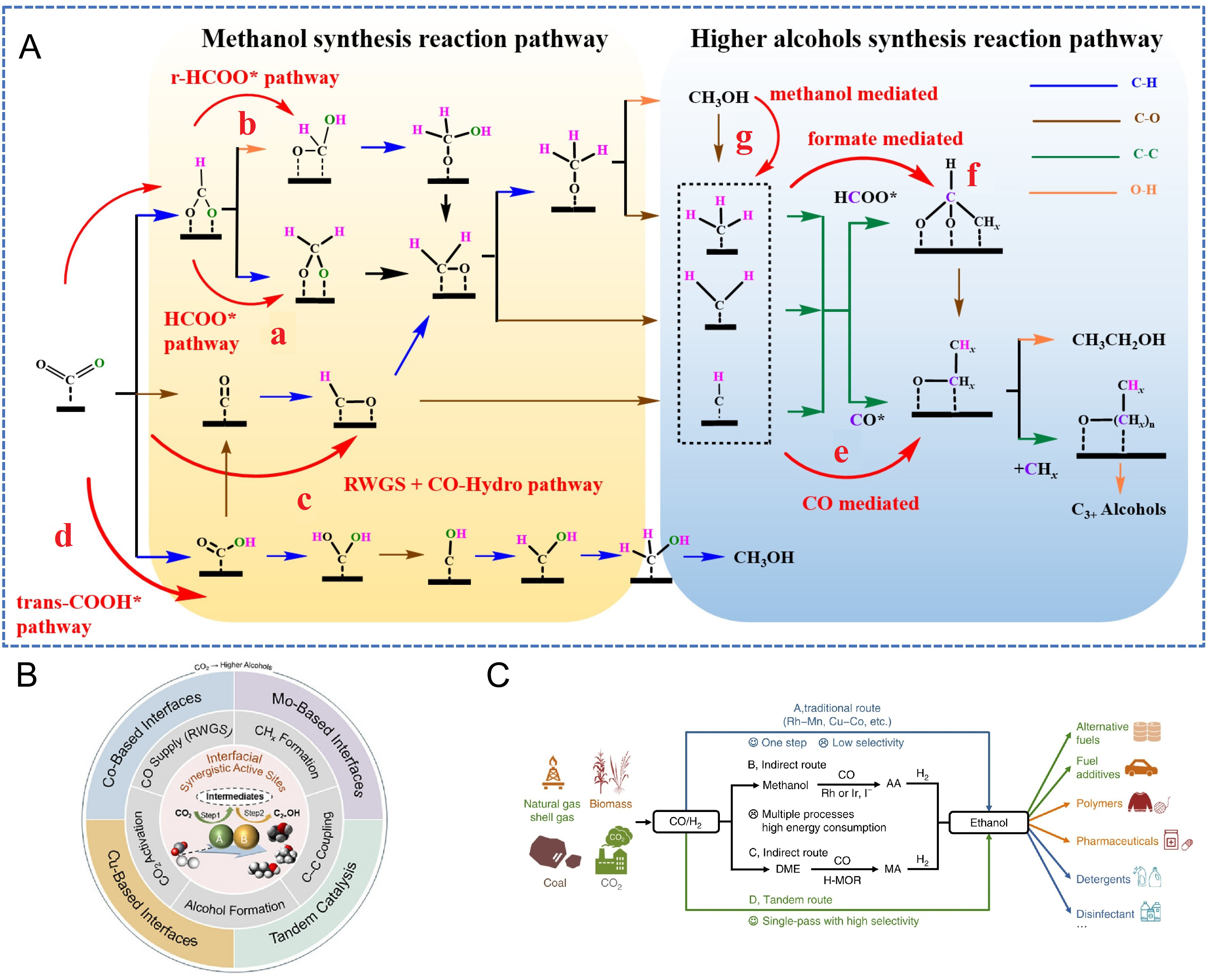
Figure 1. (A) Various reaction pathways of CO2 hydrogenation to alcohols. (a) HCOO* pathway; (b) r-HCOO* pathway; (c) RWGS + CO-Hydro pathway; (d) trans-COOH* pathway; (e) CO mediated pathway; (f) formate mediated pathway; (g) methanol mediated pathway. Blue line, C-H bond breaking or formation; brown line, C-O bond breaking or formation; green line, C-C bond coupling; orange line, O-H bond breaking or formation. (A) is reprinted with permission from Ref.[12], Copyright © 2024 MDPI; (B) Interfacial active sites play a central role in CO2 hydrogenation to higher alcohols by promoting CO2 activation, C-C coupling, and oxygenate stabilization. (B) is reprinted with permission from Ref.[33], Copyright © 2026 John Wiley and Sons; (C) Direct and indirect routes for STE conversion. (C) is reprinted with permission from Ref.[36], Copyright © 2020 Springer Nature. RWGS: Reverse water-gas shift; STE: syngas-to-ethanol; H-MOR: hydrogen-form mordenite.