


Molecular engineering of coffee grounds via exogenous precursor-guided hydrothermal carbonization and activation for high-performance supercapacitor electrodes
 0
0 Abstract
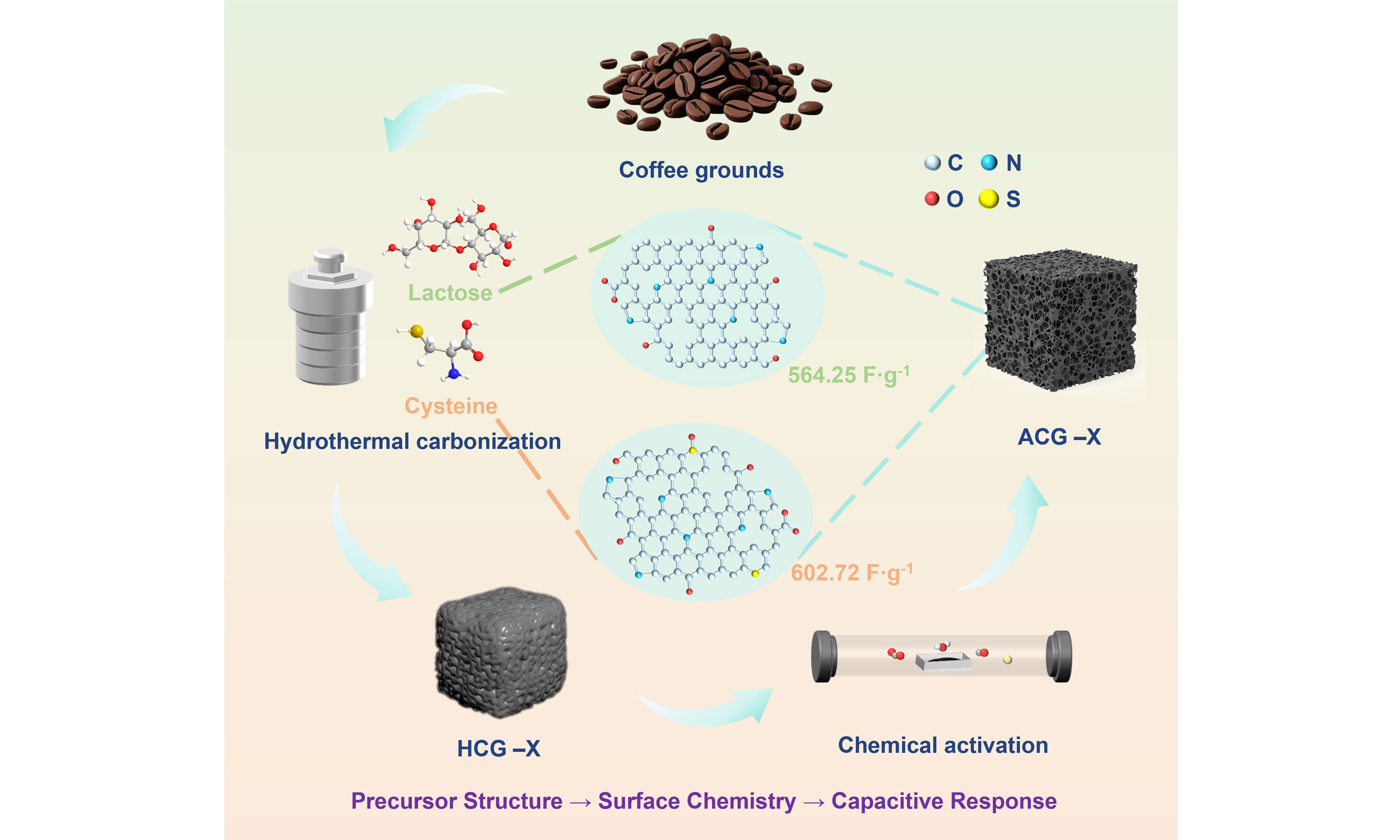
Biomass-derived porous carbons are promising electrode materials, but their surface chemistry is often limited by the inherent heteroatoms of the feedstock, restricting their tunability and high-level performance. This study introduces a precursor-guided chemical engineering strategy to actively regulate the surface chemistry and pore structure of ground-derived porous carbon. By incorporating various exogenous sugar (glucose, fructose, xylose, lactose, and sucrose) and amino acid (lysine, glycine, cysteine, glutamic acid, and proline) precursors during hydrothermal precarbonization, followed by KOH activation, we systematically investigated the relationship between the precursor molecular structure and the final carbon properties. A trade-off between “chemical gain” from heteroatom doping and “physical loss” in porosity was identified and discussed. Among the sugar precursors, lactose demonstrated the optimal balance, retaining moderate porosity while achieving a high N/O content (7.64 at%) for a capacitance of 564.25 F·g-1. Notably, a cysteine-an amino acid precursor enabled superior “chemical gain” via N/O/S triple-doping (N + O + S = 7.68 at%), with a high concentration of pseudocapacitive sites (N-5: 60.20%, C=O: 2.21 at%, and sulfur) that effectively compensated for its moderate specific surface area (1,920.91 m2·g-1). This cysteine-derived carbon delivered the highest specific capacitance of 602.72 F·g-1 at 0.5 A·g-1 in a three-electrode system. A symmetric supercapacitor based on this material exhibited a competitive energy density of 17.89 Wh·kg-1. This work establishes a clear “precursor structure → surface chemistry → capacitive response” paradigm, demonstrating that strategic molecular engineering can unlock high-performance supercapacitor electrodes from lignocellulosic waste.
Keywords
INTRODUCTION
Supercapacitors are widely recognized as promising energy storage devices for renewable power systems, electric vehicles, and portable electronics because of their high power density, fast charge-discharge rates, and outstanding long-term stability[1,2]. Electrode materials are central to device performance, and biomass-derived porous carbons have emerged as among the most promising candidates because of their wide availability, low cost, environmental friendliness, and inherently rich oxygen functional groups and hierarchical pore structures[3-6]. Among the various biomass precursors, spent coffee grounds are particularly attractive because of their high carbon yield, low ash content, and naturally abundant nitrogen species[7-9]. Our previous work demonstrated that a hydrothermal-activation synergy strategy can convert coffee grounds into N/O-codoped hierarchical porous carbon, with the resulting material delivering a specific capacitance of 546.08 F·g-1 at 0.5 A·g-1. However, the heteroatom doping in this process relies primarily on the in situ pyrolytic conversion of proteins and polysaccharides inherent to the coffee grounds, meaning that the doping type, content, and configuration are constrained by the intrinsic composition of the raw material, leaving limited room for tuning the surface chemistry.
Strategies for enhancing the electrochemical performance of biomass-derived carbons can be broadly divided into pore structure engineering and surface chemistry regulation[10-12]. Pore structure engineering strategies-such as KOH etching[13], steam treatment[14], CO2 activation[15], and molten-salt-assisted synthesis[16]-have been extensively used to create hierarchical porous architectures that promote ion diffusion and charge accumulation via high specific surface areas and tailored pore size distributions. In terms of surface chemistry, heteroatom doping with N, O, S, P, and other elements has been demonstrated to improve capacitance performance through pseudocapacitive contributions, enhanced electrolyte wettability, and improved electrical conductivity[17-19]. However, existing heteroatom doping approaches still rely predominantly on the pyrolytic retention of inherent biomass components or posttreatment impregnation. The former is limited by feedstock composition, whereas the latter suffers from poor doping uniformity and low thermal stability of the introduced functional groups. Achieving deliberate design of surface chemistry while maintaining a favorable pore structure remains a central challenge in this field.
More recently, hydrothermal carbonization assisted by exogenous small-molecule precursors has attracted increasing attention as a versatile approach for surface chemistry engineering[20,21]. Unlike conventional posttreatment doping, this approach introduces small molecules bearing specific functional groups during the hydrothermal stage, enabling molecular-level control over carbon framework construction and heteroatom anchoring. Sugars and amino acids are two representative classes of exogenous precursors. The carbon chain length, degree of polymerization, and reducing character of sugars can significantly influence dehydration-polycondensation kinetics and the degree of precursor densification[22-25], whereas the side-chain functional groups of amino acids directly govern crosslinking modes, steric hindrance, and the retention efficiency and configuration of N/O/S heteroatoms[26-28]. Introducing reducing sugars into biomass hydrothermal systems promotes the chemical anchoring of nitrogenous structures through carbonyl-amine (Maillard) reactions[29,30], and sulfur-containing amino acids enable in situ sulfur doping with enhanced electrochemical performance[31]. However, existing studies have largely focused on single precursor types or individual performance metrics, and a systematic comparison of different precursor molecular structures is lacking. The complete structure-property relationship-“precursor molecular structure → polycondensation/carbonization pathway → surface chemical composition and configuration → capacitive response”-remains poorly understood. More critically, exogenous precursors that enhance surface chemistry often simultaneously promote polycondensation-induced densification, leading to reduced specific surface area and pore volume. How to balance “surface chemistry gain” against “physical charge storage loss” and the mechanisms and limits thereof have yet to be elucidated.
To address these issues, this study builds on our previously optimized hydrothermal-activation process and selects five sugars (glucose, fructose, xylose, lactose, and sucrose) and five amino acids (lysine, glycine, cysteine, glutamic acid, and proline) as exogenous precursors. We systematically investigate how their molecular structures regulate the pore evolution, carbon framework ordering, heteroatom doping configuration, and electrochemical performance of ground-derived porous carbon. This study focuses on three key questions: (1) How do the carbon chain length, degree of polymerization, and reducing characteristics of sugars synergistically govern the polycondensation behavior and carbon framework characteristics? (2) How do the steric hindrance and functional group types of amino acid side chains direct the surface chemical composition and active site distribution? (3) Under conditions of substantially reduced specific surface area, can surface chemistry optimization compensate for physical charge storage loss through enhanced pseudocapacitance-that is, what are the conditions and limits of the “chemical gain” mechanism? By elucidating the structure-property relationship linking the precursor configuration, polycondensation/carbonization pathway, surface chemistry, and capacitive response, this work aims to provide theoretical guidance and practical insights for the targeted design of surface chemistry in high-performance biomass-derived porous carbon electrodes.
EXPERIMENTAL
Materials
In this study, coffee grounds (CG) procured from Saturnbird Coffee Company (Changsha, China) were oven-dried at 105 °C for 12 h to achieve a constant weight. All sugars (glucose, fructose, xylose, lactose, and sucrose, 99%) and amino acids (glycine, L-glutamic acid, L-proline, L-cysteine, and L-lysine hydrochloride, 99%) were purchased from Shanghai Macklin Biochemical Co., Ltd. All other chemical reagents, including hydrochloric acid (HCl, 37%), potassium hydroxide (KOH, ≥ 85%), and polytetrafluoroethylene (PTFE, 60% dispersion), were analytical grade products from Sinopharm Chemical Reagent Co., Ltd., and were used as received without further purification. The raw materials were processed under ambient laboratory conditions (25 ± 2 °C, 45 ± 5% relative humidity) prior to experimental treatments.
Preparation of exogenous precursor-regulated coffee ground-derived porous carbons
Five grams of dried coffee grounds, 50 mL of deionized water, and an exogenous precursor (sugar or amino acid) were sealed in a 100 mL autoclave (Nanjing Zhengxin Instrument Co., Ltd., China) and heated to
The dried hydrochar was ground with KOH (mass ratio of 1:3) and pyrolyzed at 700 °C for 1 h under Ar flow. The product was subsequently washed with 1 M HCl, rinsed to neutral pH with deionized water and ethanol, and dried at 105 °C. The final activated carbons were named ACG-X and ACG-Y, corresponding to their hydrochar precursors. Among them, ACG represents activated coffee grounds, X represents various exogenous sugar (glucose, fructose, xylose, lactose, and sucrose), and Y represents different amino acids (lysine, glycine, cysteine, glutamic acid, and proline). A control sample, designated ACG-1-10, was prepared without any exogenous precursor under previously optimized hydrothermal-activation conditions (280 °C, 30 min)[32].
Materials characterization
Crystalline phases of the samples were identified by X-ray diffraction (XRD) using a SmartLab diffractometer (Shimadzu Corporation, Japan). The degree of graphitization and structural disorder was evaluated via Raman spectroscopy with an InVia Qontor spectrometer [AiteSi Technology (Hong Kong) Limited, China]. The pore characteristics and specific surface areas were determined from nitrogen adsorption-desorption isotherms measured at 77 K on a JW-BK 100 surface area and pore size analyzer (Beijing JWGB Sci. & Tech. Co., Ltd., China). The surface elemental composition and chemical bonding states of the materials were analyzed by X-ray photoelectron spectroscopy (XPS) utilizing an ESCALAB Xi+ spectrometer (Thermo Fisher Scientific, USA). The microstructural morphology of the samples was characterized by field-emission scanning electron microscopy (SEM) with a ZEISS Gemini SEM 500 instrument [Carl Zeiss (Shanghai) Management Co., Ltd., China]. Elemental distribution mapping was conducted by transmission electron microscopy (TEM) coupled with energy-dispersive X-ray spectroscopy (EDS) using a Talos F200X microscope [Sinopharm Scientific Equipment (Hong Kong) Co., Ltd., China]. All raw characterization data acquired from the above instruments were processed and plotted using OriginPro 2024, and all graphic combinations and layout adjustments were performed with Microsoft PowerPoint 2020.
Electrochemical characterization
Electrodes were prepared by mixing activated carbon, acetylene black, and PTFE at a mass ratio of 8:1:1. Absolute ethanol was used as the dispersing solvent, and the mixture was ultrasonically dispersed for 30 min, followed by drying at 105 °C for 6 h. Approximately 3 mg of the obtained powder was pressed into a circular pellet (diameter: 10 mm) under a pressure of 2-4 MPa, corresponding to an active material loading of approximately 3.8 mg·cm-2. The pellet was sandwiched between two nickel foams (diameter: 15 mm) to obtain the working electrode. Under the applied potential window, the electrochemical contribution of the nickel foam was negligible compared with that of the activated carbon electrode.
Electrochemical tests were carried out on a CHI 760 E workstation (Shanghai Chenhua Instrument Co., Ltd., China) in a 6 M KOH electrolyte. Cyclic voltammetry (CV) was recorded over a potential range of -1.0 V to 0 V at scan rates of 10, 20, 50, 100, and 200 mV·s-1. Galvanostatic charge-discharge (GCD) was performed at current densities of 0.5, 1, 2, 5, and 10 A·g-1. Electrochemical impedance spectroscopy (EIS) was measured from 100 kHz to 0.01 Hz with a 5 mV amplitude. All measurements were conducted at 25 ± 1 °C using N2-purged electrolyte.
A conventional three-electrode configuration was adopted, consisting of a Hg/HgO reference electrode and a platinum plate counter electrode, with 6 M KOH as the electrolyte. The specific capacitance (Cg, F·g-1) was calculated from the GCD discharge curves according to:
where I is the discharge current (A), Δt is the discharge time (s), m is the active material mass (g), and ΔV is the operating potential window (V) after IR correction.
For the symmetric supercapacitor assembled with two mass-matched electrodes, the device-specific capacitance (Cs, F·g-1) was obtained from
where I is the discharge current (A), Δt is the discharge time (s), m is the total mass of the active material on both electrodes (g), and ΔV is the cell voltage (V). The energy density (E, Wh·kg-1) and power density
respectively.
All the performance metrics were normalized to the total active material mass on both electrodes. All the electrochemical performance figures (such as the CV and GCD) were plotted using OriginPro 2024 on the basis of the raw data.
RESULTS AND DISCUSSION
Regulation of carbon structure and surface chemistry by sugar precursors
The molecular structures of the five selected sugars differ systematically in terms of carbon chain length (pentose vs. hexose), degree of polymerization (monosaccharide vs. disaccharide), and reducing character. These structural features govern their dehydration and condensation behavior during hydrothermal pretreatment, thereby dictating the crosslinking density of the hydrochar network and ultimately the pore architecture, defect density, and heteroatom doping configuration of the final carbon materials. The molecular structures of these sugar precursors are shown in Figure 1.

Figure 1. Molecular structures of the five sugar precursors.
XRD analysis [Figure 2A] revealed that all the samples displayed broad diffraction peaks near 23° and 43°, indicating a predominantly amorphous carbon structure[10-12]. The (002) peak intensity varied systematically with the sugar type, with ACG-Xyl exhibiting the highest intensity, ACG-Suc the lowest, and ACG-Lac an intermediate value. As a pentose aldose, xylose possesses a shorter molecular backbone and high dehydration reactivity, enabling rapid formation of furan-rich polycondensation intermediates that promote carbon skeleton evolution along a more ordered pathway. In contrast, the nonreducing disaccharide sucrose lacks free carbonyl groups for carbonyl-amine reactions, and its glycosidic bond restricts efficient polycondensation; thus, its subsequent framework formation relies more on pyrolytic carbonization, which introduces disordered defects[22]. Lactose, although a disaccharide, contains a reducing end group and therefore strikes a balance between ordered stacking and framework openness[23].
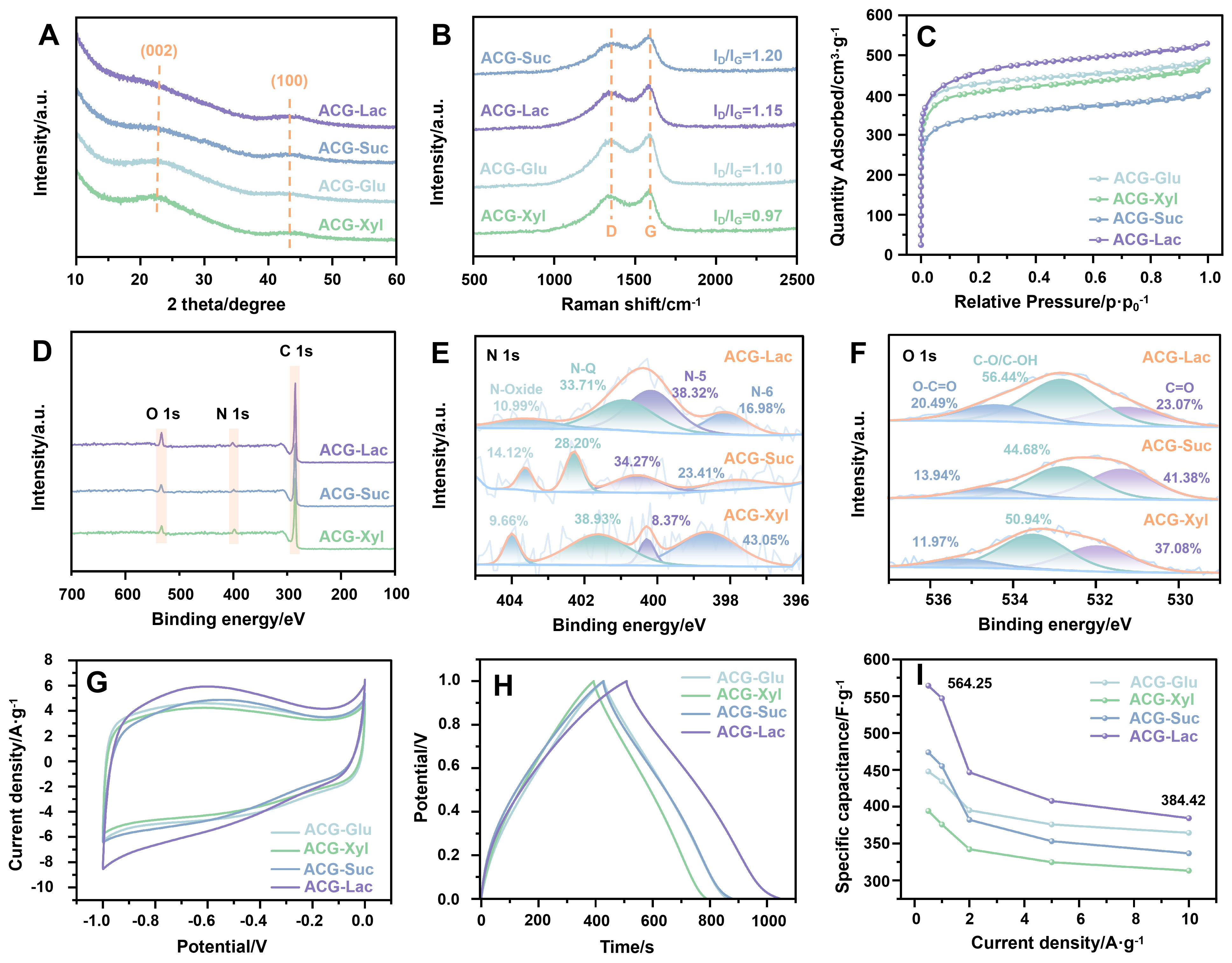
Figure 2. (A) XRD patterns, (B) Raman spectra and (C) N2 adsorption-desorption isotherms of ACG-Glu, ACG-Xyl, ACG-Suc and ACG-Lac; (D) XPS survey spectra, (E) N 1s spectra and (F) O 1s spectra of ACG- Xyl, ACG- Suc and ACG-Lac; (G) CV curves at 10 mV·s-1, (H) GCD curves at 1 A·g-1 and (I) Specific capacitances for ACG-Glu, ACG-Xyl, ACG-Suc and ACG-Lac electrodes. XRD: X-ray diffraction; XPS: X-ray photoelectron spectroscopy; ACG: activated coffee grounds; CV: cyclic voltammetry; GCD: galvanostatic charge-discharge.
Raman spectroscopy further corroborated these trends. As shown in [Figure 2B and Table 1], the ID/IG ratio increased progressively from ACG-Xyl (0.97) to ACG-Suc (1.20), with ACG-Glu (1.10), ACG-Fru (1.12), and ACG-Lac (1.15) falling in between. The lowest ratio for ACG-Xyl confirms the preservation of locally ordered stacking inherited from its relatively regular polycondensation network, whereas the highest ratio for ACG-Suc reflects the abundance of disordered structures generated under pyrolysis-dominated carbonization. Although both six-carbon monosaccharides, glucose (aldose) and fructose (ketose), differ in their carbonyl position and dehydration-rearrangement pathways, resulting in a slightly higher defect density in ACG-Fru[24]. These results reinforce that the molecular structure of the sugars governs the order of polycondensations during the hydrothermal stage, which in turn dictates the degree of graphitic microcrystallite development and surface defect distribution in the final carbon.
The ID/IG ratio of ACG-X (X = Xyl, Glu, Fru, Suc and Lac)
| Sample | ACG-Xyl | ACG-Glu | ACG-Fru | ACG-Suc | ACG-Lac |
| ID/IG | 0.97 | 1.10 | 1.12 | 1.20 | 1.15 |
The N2 adsorption-desorption isotherms and pore structure parameters of the samples are presented in Figure 2C, Supplementary Figure 1A and Table 2. All the sugar-modified samples exhibited relatively moderate specific surface areas (1,302.03-1,721.70 m2·g-1), indicating that the exogenous sugars enhanced hydrothermal polycondensations and led to a denser carbon framework that restricted subsequent KOH activation[25]. Among the sugar-modified samples, ACG-Glu and ACG-Fru presented the smallest average pore sizes (1.80-1.81 nm) and the highest micropore fractions (> 81%), which is consistent with the compact crosslinked networks formed from small, densely functionalized monosaccharides. The specific surface area of ACG-Xyl was lower (1,573.38 m2·g-1), which was attributed to its shorter five-carbon backbone and more pronounced network contraction. The specific surface area of ACG-Suc was the lowest (1,302.03 m2·g-1), whereas that of ACG-Lac was the greatest (1,721.70 m2·g-1), and the total pore volume was the greatest
Detailed pore structure parameters of ACG-X (X = Xyl, Glu, Fru, Suc and Lac)
| Sample | SBET (m2·g-1) | Smicro (m2·g-1) | Vt (cm3·g-1) | Vmicro (cm3·g-1) | Dpores (nm) |
| ACG-Xyl | 1,573.38 | 1,423.71 | 0.74 | 0.57 | 1.88 |
| ACG-Glu | 1,656.39 | 1,518.26 | 0.75 | 0.61 | 1.80 |
| ACG-Fru | 1,662.64 | 1,522.92 | 0.74 | 0.60 | 1.81 |
| ACG-Suc | 1,302.03 | 1,127.85 | 0.63 | 0.46 | 1.93 |
| ACG-Lac | 1,721.70 | 1,510.73 | 0.82 | 0.62 | 1.90 |
XPS analysis further revealed the targeted modulation of surface chemistry by the sugar precursors. All the samples displayed distinct C 1s, N 1s, and O 1s signals [Figure 2D-F and Table 3], confirming the participation of sugars in the construction of surface functional groups. Among the sugar-modified samples, ACG-Lac exhibited the highest heteroatom content (N: 1.52 at%, O: 6.12 at%), suggesting that lactose facilitates extensive carbonyl-amine reactions and achieves a high degree of N/O anchoring after carbonization. Compared with reducing sugars, ACG-Suc had the lowest nitrogen content (0.43 at%), indicating a limited nitrogen incorporation capacity[30]. N 1s fine spectra revealed distinct nitrogen configuration distributions: ACG-Xyl contained N-6 at 43.05% and N-Q at 38.93% with only 8.37% N-5, suggesting that a more ordered carbon framework favors thermally stable pyridinic N and graphitic N, which are conducive to electron transport. In contrast, ACG-Lac was dominated by N-5 (38.32%), indicating that its moderate polycondensation rate favors the preservation of edge-active nitrogen. Given that N-5 enhances pseudocapacitive activity and that N-Q improves conductivity[34], sugar precursors modulate the energy storage mechanism by regulating the nitrogen distribution. O 1s spectra revealed that ACG-Suc achieved the highest C=O proportion (41.38%, 1.77 at%) within the sugar-modified group. Although sucrose is less favorable for pore structure and nitrogen doping, its pyrolysis-driven restructuring generates abundant carbonyl groups, which enhance electrolyte wettability and contribute additional pseudocapacitance through reversible redox reactions[35]. Thus, sugar precursors establish distinct surface chemistry foundations by differentially modulating nitrogen configurations and oxygen functional groups, providing varied pseudocapacitive contributions to subsequent electrochemical processes.
Surface elemental composition and absolute content of active functional groups of ACG-X (X = Xyl, Glu, Fru, Suc and Lac)
| Sample | C (at%) | N (at%) | O (at%) | N-5 (at%) | C=O (at%) |
| ACG-Xyl | 95.49 | 0.93 | 3.59 | 0.08 | 1.33 |
| ACG-Glu | 95.56 | 0.51 | 3.93 | 0.2 | 0.61 |
| ACG-Fru | 95.47 | 0.84 | 3.69 | 0.29 | 1.23 |
| ACG-Suc | 95.29 | 0.43 | 4.29 | 0.15 | 1.77 |
| ACG-Lac | 92.36 | 1.52 | 6.12 | 0.58 | 1.41 |
The electrochemical performance of four representative sugar-derived samples is shown in [Figure 2G-I]. The CV curves at 10 mV·s-1 all exhibited quasirectangular shapes with broad redox humps, indicating that the combined electric double-layer capacitance (EDLC) and pseudocapacitive contributions[36]. The specific capacitances of all the sugar-derived activated carbons at different current densities are summarized in [Supplementary Table 1]. At 1 A·g-1, the specific capacitance followed the order ACG-Lac > ACG-Suc > ACG-Fru > ACG-Glu > ACG-Xyl. The specific capacitance of ACG-Lac was 564.25 F·g-1 at 0.5 A·g-1, which was the highest among all the sugar-modified samples. These findings demonstrate that the electrochemical performance is governed not by the surface area alone but by the synergy among the accessible pore structure, heteroatom configuration, and surface functional groups[37]. The advantage of ACG-Lac stems from three factors: the highest heteroatom content within the sugar-modified group (N + O = 7.64 at%), a higher N-5 fraction enhancing pseudocapacitance, and the highest specific surface area and total pore volume among the sugar-modified samples-together providing favorable ion transport and interfacial reaction pathways. Thus, ACG-Lac effectively compensates for pore structure loss through surface chemistry optimization. Despite having the lowest specific surface area, ACG-Suc still outperforms ACG-Xyl (473.76 vs. 394.26 F·g-1), which is attributable to its highest C=O content in the sugar group, which provides oxygen-based pseudocapacitive sites that partially offset EDLC loss[38]. In contrast, despite having higher structural ordering and lower Rct, ACG-Xyl suffers from insufficient pore structure and active site density. These findings highlight that structural ordering alone does not guarantee high capacitance; optimal performance requires synergy among an ordered conductive network, accessible porosity, and high-density active functional groups.
The rate capability at 10 A·g-1 followed the order of ACG-Glu (81.4%) > ACG-Xyl (79.4%) > ACG-Fru (79.3%) > ACG-Suc (71.1%) > ACG-Lac (68.1%). The monosaccharide-derived samples, with lower functional group contents, rely more on rapid EDLC processes and thus exhibit higher rate retention, whereas the enriched N-5 and C=O sites in ACG-Lac and ACG-Suc increase the pseudocapacitive contribution but introduce more pronounced polarization at high rates. Nonetheless, ACG-Lac maintained the highest absolute capacitance among all the sugar-modified samples across 0.5-10 A·g-1 and outperformed all the other sugar-modified samples at 0.5 and 1 A·g-1, confirming that its surface chemistry gain is most effective at low to moderate current densities. EIS analysis [Supplementary Figure 1B and Table 4] revealed comparable Rs values (0.42-0.47 Ω), whereas Rct increased in the order of ACG-Glu (0.38 Ω) < ACG-Xyl
EIS fitting equivalent circuit parameters of ACG-X (X = Xyl, Glu, Fru, Suc and Lac)
| Sample | Rs (Ω) | Rct (Ω) |
| ACG-Xyl | 0.45 | 0.64 |
| ACG-Glu | 0.47 | 0.38 |
| ACG-Fru | 0.45 | 0.66 |
| ACG-Suc | 0.46 | 1.24 |
| ACG-Lac | 0.42 | 1.11 |
In summary, the sugar precursors regulated hydrothermal polycondensations and subsequent carbonizations through three structural factors-carbon chain length, degree of polymerization, and reducing nature-enabling synergistic modulation of pore structure, structural ordering, and surface functional groups. Among them, lactose achieved the optimal “chemical gain” owing to its moderate steric hindrance, strong surface chemistry regulation capability, and favorable pore structure retention. Despite having the poorest pore structure, sucrose obtained pronounced pseudocapacitive compensation through its high density of C=O groups. Xylose exhibited the lowest capacitive performance because of premature framework densification and insufficient active sites. These comparative results demonstrate that moderate reactivity and a suitable molecular configuration are key to minimizing pore structure loss while maximizing surface chemistry gain.
Regulation of carbon structure and surface chemistry by amino acid precursors
Unlike sugar precursors, which primarily influence the carbon framework through the modulation of dehydration-polycondensation and oxygen-containing intermediate evolution, amino acid precursors exert their regulatory effects more directly through side chain functional groups that control crosslinking modes, pyrolysis behavior, and heteroatom retention. The cyclic imino group of proline, the ε-amino group of lysine, the γ-carboxyl group of glutamic acid, the thiol group of cysteine, and the minimal backbone of glycine correspond to distinct steric hindrances, reaction site types, and heteroatom incorporation pathways, thereby enabling multidimensional regulation of defect density, pore structure parameters, and surface chemical composition. The introduction of amino acid additives thus shifts the performance optimization strategy from the passive retention of inherent N/O species in the raw material to the active manipulation of nitrogen, oxygen, and sulfur active site distribution through molecular structure design-a “chemical gain” process. The molecular structures of these amino acid precursors are shown in Figure 3.

Figure 3. Molecular structures of the five amino acid precursors.
XRD patterns [Figure 4A] revealed distinct differences in (002) peak broadening among the samples, indicating that the amino acid side chain structure directly influences the ordered stacking of carbon layers. ACG-Pro exhibited the narrowest (002) peak, suggesting the most regular local carbon layer arrangement. The rigid pyrrolidine ring in proline can serve as a conformational constraint during precursor polycondensations, guiding carbon layers toward more ordered stacking and promoting graphitic microcrystallite growth. In contrast, ACG-Cys displayed the broadest (002) peak, reflecting the highest degree of disorder. During thermal treatment, cysteine not only participates in precursor crosslinking but also introduces sulfur, which significantly alters the local electronic structure and lattice continuity of the carbon framework, thereby generating more structural distortions and edge defects[40]. Lysine, glutamic acid, and glycine each exerted distinct regulatory effects on carbon layer stacking through their straight-chain multifunctional groups, dicarboxyl sites, and low-steric-hindrance highly reactive backbones, respectively.
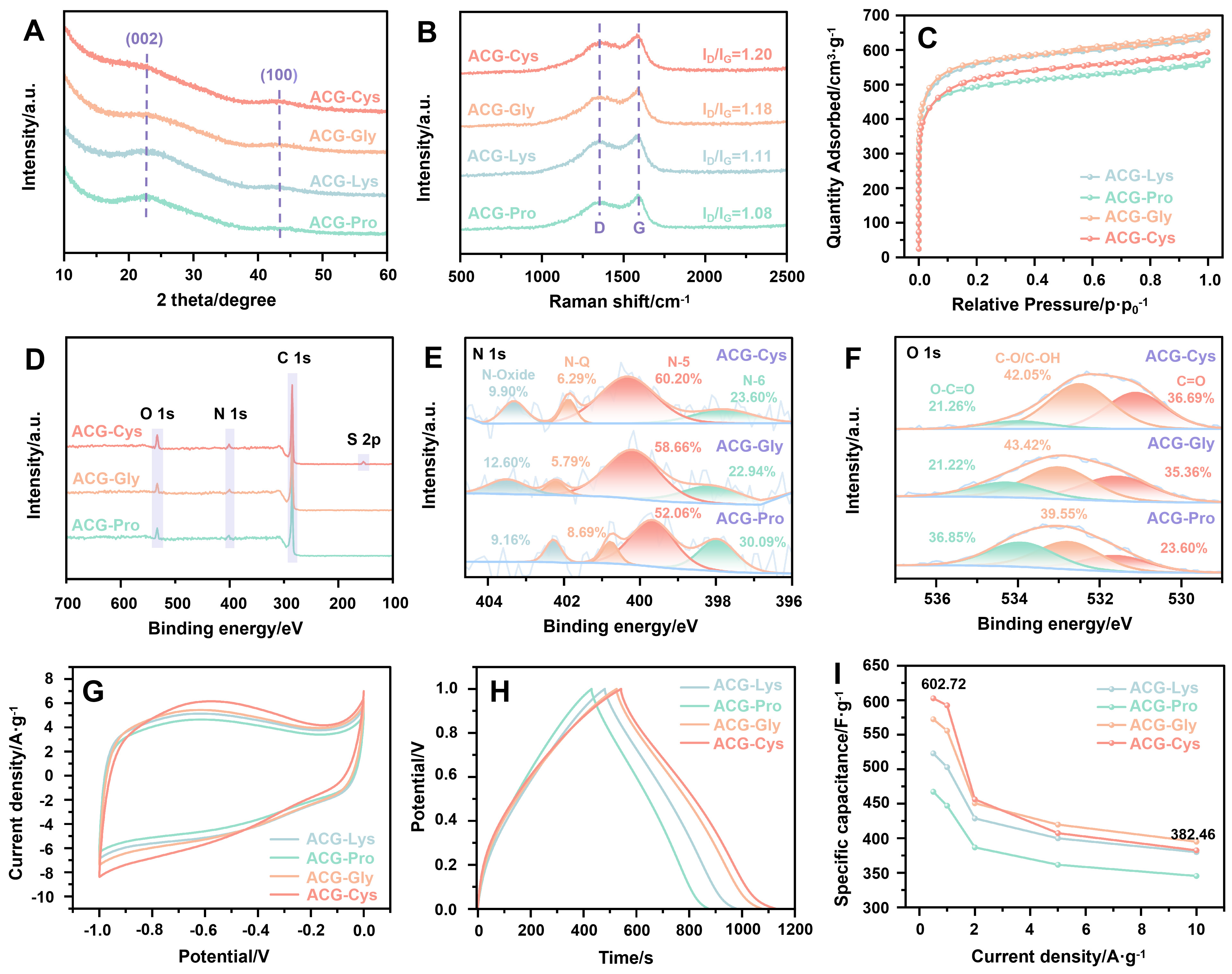
Figure 4. (A) XRD patterns, (B) Raman spectra and (C) N2 adsorption-desorption isotherms of ACG-Lys, ACG-Pro, ACG-Gly and ACG-Cys; (D) XPS survey spectra, (E) N 1s spectra and (F) O 1s spectra of ACG-Pro, ACG-Gly and ACG-Cys; (G) CV curves at 10 mV·s-1, (H) GCD curves at 1 A·g-1 and (I) Specific capacitance for ACG-Lys, ACG-Pro, ACG-Gly and ACG-Cys electrodes. XRD: X-ray diffraction; XPS: X-ray photoelectron spectroscopy; ACG: activated coffee grounds; CV: cyclic voltammetry; GCD: galvanostatic charge-discharge.
Raman spectroscopy [Figure 4B] further confirmed the modulation of defect structures by the amino acid additives. As shown in [Table 5], the ID/IG ratio increased in the order of ACG-Pro (1.08) < ACG-Lys (1.11) < ACG-GluA (1.16) < ACG-Gly (1.18) < ACG-Cys (1.20). The lowest ratio for ACG-Pro is consistent with the more ordered carbon stacking associated with its rigid pyrrolidine ring, suggesting that this precursor favors lower defect density. The highest ratio for ACG-Cys reflects the structural perturbation caused by sulfur incorporation: the larger covalent radius of sulfur relative to that of carbon can induce local bond length variations, thereby increasing the defect density[41]. The ratio of ACG-Lys was 1.11, which was close to that of ACG-Pro, suggesting that its straight-chain diamino structure enables crosslinking without substantially increasing structural disorder. Despite having the simplest molecular structure, glycine has a relatively high ID/IG of 1.18, indicating that in the absence of steric hindrance, the high reactivity of its α-amino and carboxyl groups tends to drive rapid polycondensations, generating a high density of structural defects. Overall, the amino acid side chain influences not only the type of heteroatom introduced but also the extent of framework defect formation.
The ID/IG ratio of ACG-Y (Y = Pro, Lys, GluA, Gly and Cys)
| Sample | ACG-Pro | ACG-Lys | ACG-GluA | ACG-Gly | ACG-Cys |
| ID/IG | 1.08 | 1.11 | 1.16 | 1.18 | 1.20 |
The hydrochar yields and activated carbon yields of the different precursor systems are summarized in Supplementary Table 2. Distinct yield variations were observed among sugars and amino acids, reflecting differences in precursor structure and hydrothermal conversion behavior. Among the sugar-derived systems, sucrose resulted in the highest hydrochar yield (46.76%), which can be attributed to its relatively low hydrothermal reactivity as a nonreducing sugar. Lactose also resulted in a relatively high hydrochar yield (41.12%), whereas the monosaccharide-derived systems resulted in lower hydrochar yields (35%-37%). With respect to amino acid-derived carbons, glycine and cysteine resulted in relatively low hydrochar yields (26.47% and 27.47%, respectively), indicating more extensive mass loss during hydrothermal treatment. Nevertheless, ACG-Cys retained a relatively high activated carbon yield (37.12%), exceeding those of the Gly-, Pro-, Lys-, and GluA-derived carbons. These results suggest that sulfur- and nitrogen-containing intermediates derived from cysteine contribute to enhanced structural stability during KOH activation, thereby suppressing excessive carbon consumption. Overall, the yield results indicate that the molecular structure of the exogenous precursor significantly influences both hydrothermal carbonization and activation processes. However, the final porous architecture results from the combined effects of precursor conversion, framework evolution, and activation behavior, as further evidenced by subsequent structural and surface chemistry characterization.
N2 adsorption-desorption measurements [Figure 4C, Supplementary Figure 2A and Table 6] revealed the pore structure parameters of the amino acid-derived samples. All the amino acid-modified samples exhibited specific surface areas ranging from 1,737.79 to 2,153.26 m2·g-1, indicating that exogenous amino acids generally enhanced polycondensations during the hydrothermal stage, yielding a denser carbon framework prior to activation. The specific surface area (2,153.26 m2·g-1) and total pore volume (1.00 cm3·g-1) of ACG-Gly were the greatest among the amino acid-derived samples. This can be attributed to the minimal molecular size and simple backbone of glycine, which lacks sterically bulky or multifunctional groups that would cause premature framework densification, thereby preserving more etchable sites and diffusion channels for subsequent KOH activation[42]. ACG-Lys followed closely (2,104.41 m2·g-1), suggesting that the bridging structure formed by its straight-chain diamino groups enhances framework stability while maintaining reasonable structural openness[43]. The specific surface area of ACG-GluA was lower
Detailed pore structure parameters of ACG-Y (Y = Pro, Lys, GluA, Gly and Cys)
| Sample | SBET (m2·g-1) | Smicro (m2·g-1) | Vt (cm3·g-1) | Vmicro (cm3·g-1) | Dpores (nm) |
| ACG-Pro | 1,737.79 | 1,477.89 | 0.85 | 0.62 | 1.95 |
| ACG-Lys | 2,104.41 | 1,867.25 | 0.99 | 0.77 | 1.88 |
| ACG-GluA | 1,894.75 | 1,694.12 | 0.87 | 0.68 | 1.84 |
| ACG-Gly | 2,153.26 | 1,924.78 | 1.00 | 0.78 | 1.85 |
| ACG-Cys | 1,920.91 | 1,667.17 | 0.92 | 0.69 | 1.91 |
To further understand the influence of the precursor molecular structure on pore evolution, representative SEM images of ACG-Suc, ACG-Gly, and ACG-Cys are compared in [Figure 5A-C]. Distinct morphology differences can be observed among the three samples. The ACG-Suc sample has a relatively compact carbon framework with limited pore development and several large pores, which is consistent with its relatively low specific surface area and pore volume. In contrast, ACG-Gly displays a sponge-like porous network with abundant pores generated during KOH activation. ACG-Cys has a well-developed porous texture with abundant pores distributed throughout the carbon matrix while maintaining structural integrity. These observations are consistent with the BET results, indicating that the precursor molecular structure significantly influences pore formation and structural evolution during activation, thereby affecting ion transport and electrochemical charge-storage behavior. The elemental distribution of ACG-Cys was further examined by TEM. TEM elemental mapping [Figure 5D] revealed a uniform distribution of C, N, O, and S throughout the carbon framework, verifying the successful construction of an N/O/S tridoped surface.
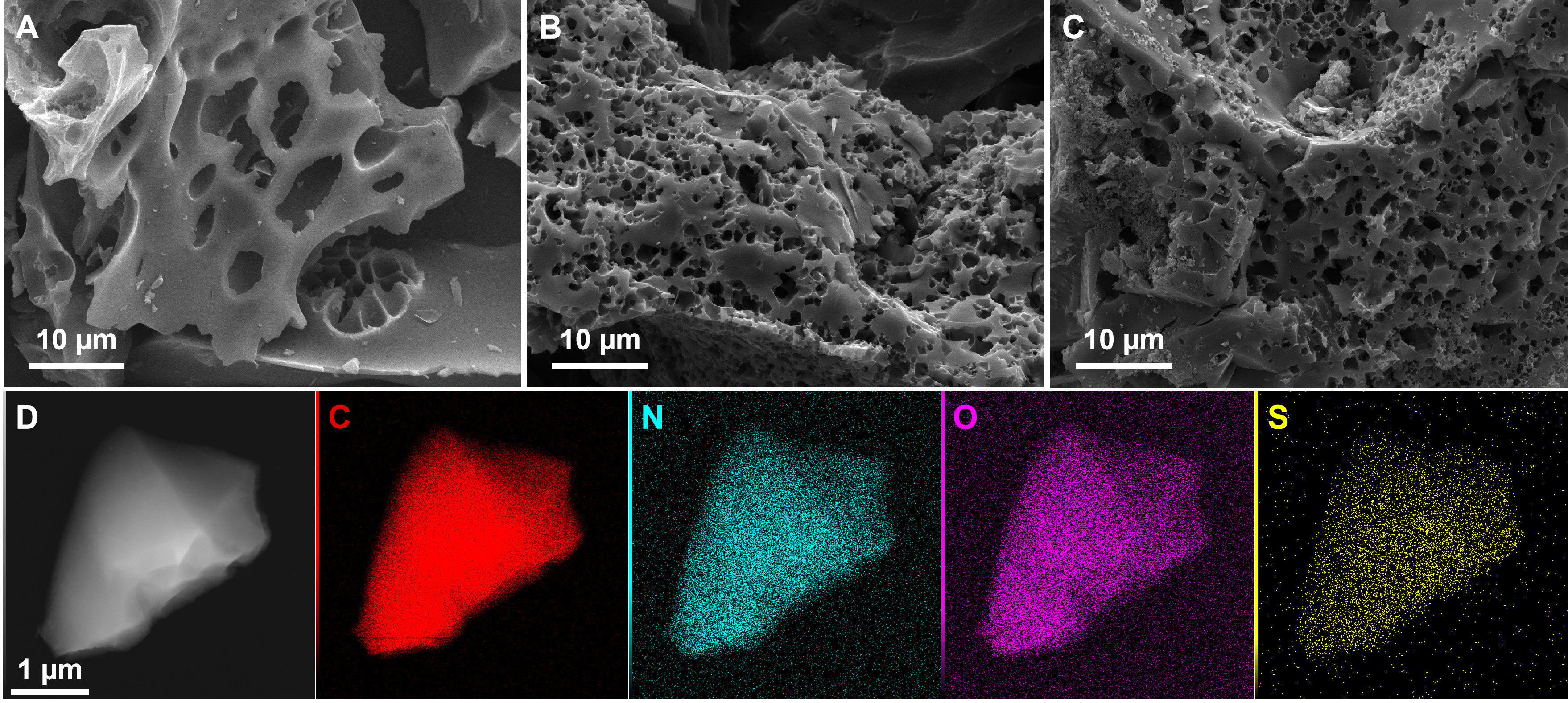
Figure 5. (A-C) SEM images of ACG-Suc, ACG-Gly, and ACG-Cys, respectively; (D) TEM image and corresponding elemental mappings of C, N, O, and S for ACG-Cys. SEM: Scanning electron microscopy; TEM: transmission electron microscopy; ACG: activated coffee grounds.
XPS analysis further demonstrated the targeted modulation of surface chemistry by the amino acid side chain functional groups. All the samples exhibited distinct C 1s, N 1s, and O 1s signals [Figure 4D and Table 7], whereas ACG-Cys additionally displayed a clear S 2p peak, confirming successful sulfur doping and the construction of a N/O/S tri-doped surface[31]. The nitrogen content of ACG-GluA was the highest (1.23 at%), followed by that of ACG-Gly (1.19 at%), suggesting that carboxyl/amino synergy and a simple molecular backbone facilitate nitrogen retention. Notably, ACG-Lys, despite containing two amino groups, had the lowest nitrogen content (0.47 at%), indicating that the degree of doping efficiency depends on the combined effects of the side chain structure, the polycondensation pathway, and pyrolytic retention rather than the precursor nitrogen content alone[26,45]. ACG-Cys possessed the lowest carbon content (92.27 at%) and the highest total heteroatom content (N + O + S = 7.68 at%). The N 1s fine spectra [Figure 4E] revealed that all the samples were dominated by N-5, with the proportion following the order of ACG-Cys (60.20%) > ACG-Gly (58.66%) > ACG-Pro (52.06%), all of which exhibit a high N-5 proportion (≥ 52.06%), indicating that precursors with minimal steric hindrance and well-exposed reactive sites favor the formation of edge-type pyrrolic nitrogen. The cyclic structure of proline, although conducive to ordered stacking, imposes steric constraints that partially limit edge nitrogen formation[27]. The absolute N-5 content of ACG-Gly was the highest (0.70 at%), followed by that of ACG-Cys (0.67 at%), both of which form important chemical bases for their high capacitive output.
Surface elemental composition and absolute content of active functional groups of ACG-Y (Y = Pro, Lys, GluA, Gly and Cys)
| Sample | C (at%) | N (at%) | O (at%) | S (at%) | N-5 (at%) | C=O (at%) |
| ACG-Pro | 95.25 | 0.66 | 4.1 | - | 0.34 | 0.97 |
| ACG-Lys | 95.85 | 0.47 | 3.68 | - | 0.24 | 1.03 |
| ACG-GluA | 93.15 | 1.23 | 5.61 | - | 0.62 | 1.85 |
| ACG-Gly | 94.55 | 1.19 | 4.26 | - | 0.7 | 1.51 |
| ACG-Cys | 92.27 | 1.11 | 6.02 | 0.55 | 0.67 | 2.21 |
The O 1s fine spectra [Figure 4F] revealed that ACG-Cys exhibited the highest C=O proportion (36.69%) and absolute content (2.21 at%), followed by ACG-Gly (35.36% and 1.51 at%, respectively), both of which significantly exceeded those of ACG-Pro. The high C=O content in ACG-Cys is attributed to thiol-promoted reconstruction of oxygen-containing surface sites during pyrolysis, whereas the simple backbone of glycine facilitates more complete functional group retention. The S 2p spectrum [Supplementary Figure 2B] further revealed that sulfur in ACG-Cys exists as thiophene-type sulfur (C-S-C, 57.53%) and oxidized sulfur (C-SOx-C, 42.47%). The former enhances electron delocalization and improves the conductive network, whereas the latter provides additional Faradaic storage through redox reactions. ACG-Cys thus exemplifies the “chemical gain” mechanism: beyond increased heteroatom content, its surface chemistry optimization lies in the synergistic enhancement of active site diversity and configuration[28].
The electrochemical behavior of four representative amino acid-derived samples is shown in [Figure 4G-I], while the specific capacitances of all samples are summarized in [Supplementary Table 3]. At 1 A·g-1, the specific capacitance followed the order ACG-Cys > ACG-Gly > ACG-GluA > ACG-Lys > ACG-Pro. ACG-Cys delivered 602.72 F·g-1 at 0.5 A·g-1, which was the highest among all the samples, despite its lower specific surface area - a clear “chemical gain” driven by enriched heteroatom configurations and active functional groups[46]. Its superior performance stems from four synergistic factors: a high N-5 fraction (60.20% and
EIS fitting equivalent circuit parameters of ACG-Y (Y = Pro, Lys, GluA, Gly and Cys)
| Sample | Rs (Ω) | Rct (Ω) |
| ACG-Pro | 0.47 | 1.41 |
| ACG-Lys | 0.46 | 0.94 |
| ACG-GluA | 0.48 | 2.12 |
| ACG-Gly | 0.46 | 1.20 |
| ACG-Cys | 0.46 | 1.38 |
CV tests at 10-200 mV·s-1 and GCD tests at 0.5-10 A·g-1 [Supplementary Figure 2D-E] demonstrated that ACG-Cys maintains a stable CV morphology and symmetric charge-discharge profiles, indicating good electrochemical reversibility. In a symmetric supercapacitor [Figure 6A-C], ACG-Cys delivered 515.27 F·g-1 at 0.5 A·g-1, with 66.7% retention at 10 A·g-1 (343.87 F·g-1), confirming that its hierarchical pore structure and multiheteroatom surface chemistry remain synergistic at the device scale. The Ragone plot [Figure 6D] revealed an energy density of 17.89 Wh·kg-1 at 125.96 W·kg-1, retaining 11.94 Wh·kg-1 at 2,438.03 W·kg-1, surpassing most reported biomass-derived porous carbons for symmetric supercapacitors in aqueous electrolytes[49-56]. A detailed comparison of the key performance metrics, including the electrolyte, voltage window, specific capacitance, energy density, and power density, is summarized in [Supplementary Table 5] [Supplementary Materials]. Long-term cycling tests [Figure 6E] revealed a capacitance retention of 76.35% after 15,000 cycles, with the Coulombic efficiency stably maintained between 99.5% and 100.5%, demonstrating acceptable cycling stability and reversible charge-storage behavior over prolonged cycling.
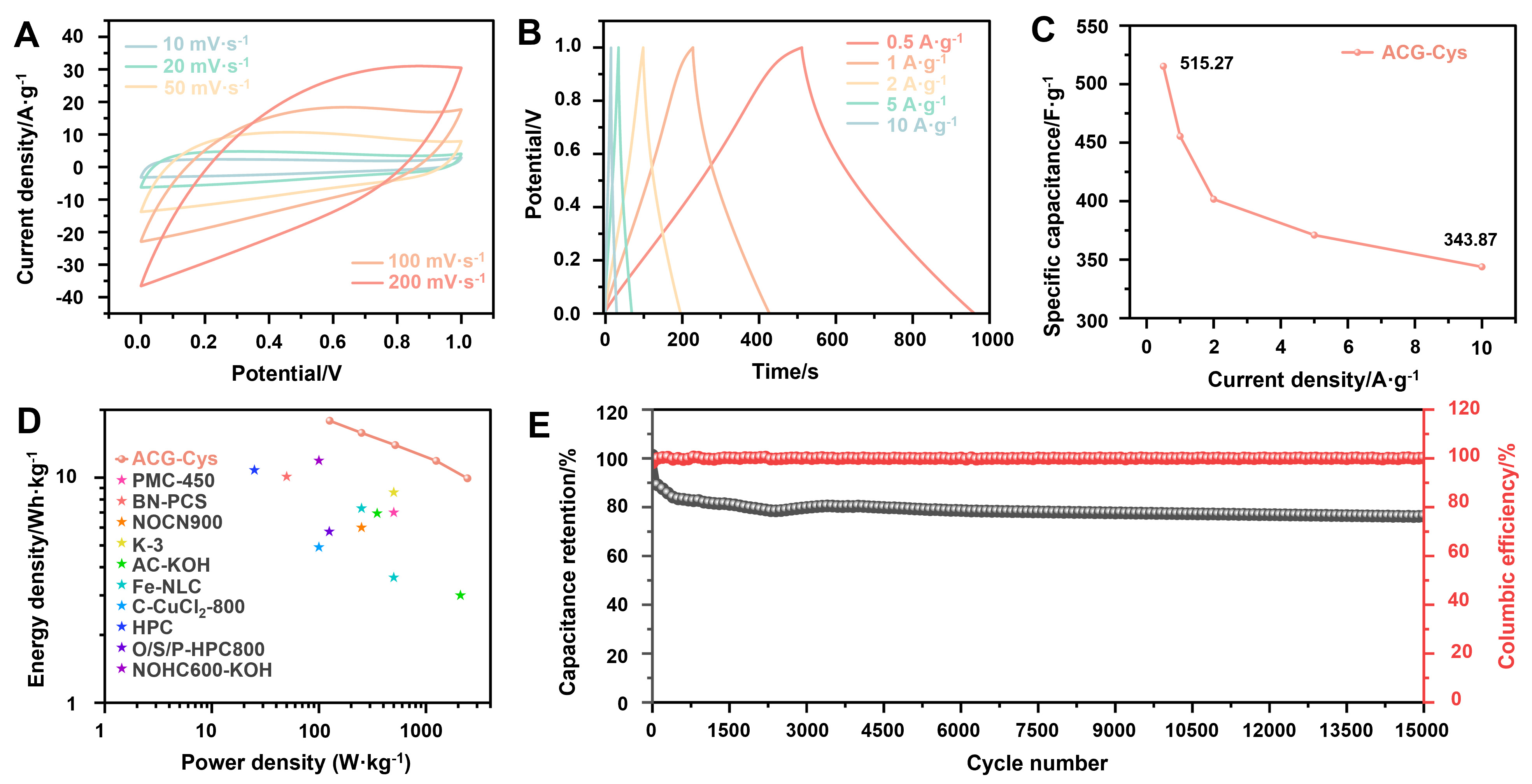
Figure 6. (A) CV curves at various scan rates, (B) GCD curves at various current densities, (C) Specific capacitance and (D) Ragone plot for ACG-Cys SSC; (E) Cycling stability performance at 10 A·g-1. CV: Cyclic voltammetry; GCD: galvanostatic charge-discharge; ACG: activated coffee grounds; SSC: symmetric supercapacitor.
CONCLUSION
This study systematically investigated the regulatory effects of sugar and amino acid precursors on the pore structure, carbon framework ordering, heteroatom configuration, and electrochemical performance of ground-derived porous carbons in coffee, elucidating the “chemical gain” mechanism by which surface chemistry optimization compensates for physical charge storage loss. Among the sugar precursors, lactose achieved the optimal balance between pore retention and heteroatom enrichment (N: 1.52 at%, O: 6.12 at%), delivering 564.25 F·g-1 at 0.5 A·g-1, while sucrose obtained pseudocapacitive compensation via high C=O content despite having the lowest surface area, and xylose experienced premature densification. Among the amino acid precursors, cysteine achieved N/O/S tri-doping with the highest N-5, C=O, and functional sulfur sites, achieving the highest capacitance (602.72 F·g-1) and an energy density of 17.89 Wh·kg-1; glycine excelled through its high surface area and N-5 content, while proline was limited by excessive framework densification despite ordered stacking. These results demonstrate that moderate precursor reactivity, a suitable molecular configuration, and efficient heteroatom anchoring are key to maximizing surface chemistry gain while minimizing pore structure loss, providing a rational design principle for high-performance biomass-derived porous carbon electrodes.
DECLARATIONS
Authors’ contributions
Writing - original draft, visualization, validation, methodology, investigation, formal analysis, data curation, conceptualization: Du, Y.
Investigation: Yang, Y.
Supervision, funding acquisition, project administration, review and editing: Duan, P.
Availability of data and materials
The original contributions presented in this study are included in the article and Supplementary Materials. Further inquiries can be directed to the corresponding authors.
AI and AI-assisted tools statement
During the preparation of this manuscript, the AI tool OpenAI (version OpenAI, released 2026-04-24) was used solely for language editing. The tool did not influence the study design, data collection, analysis, interpretation, or the scientific content of the work. All authors take full responsibility for the accuracy, integrity, and final content of the manuscript.
Financial support and sponsorship
This study was supported by the National Key Research and Development Program of China (2024YFE0101800) and the National Natural Science Foundation of China (52370150).
Conflicts of interest
All authors declared that there are no conflicts of interest.
Ethical approval and consent to participate
Not applicable.
Consent for publication
Not applicable.
Copyright
© The Author(s) 2026.
Supplementary Materials
REFERENCES
1. Yang, X.; Lv, T.; Qiu, J. High mass-loading biomass-based porous carbon electrodes for supercapacitors: review and perspectives. Small 2023, 19, e2300336.
2. Salanne, M.; Rotenberg, B.; Naoi, K.; et al. Efficient storage mechanisms for building better supercapacitors. Nat. Energy. 2016, 1, 16070.
3. Shao, Y.; El-Kady, M. F.; Sun, J.; et al. Design and mechanisms of asymmetric supercapacitors. Chem. Rev. 2018, 118, 9233-80.
4. Simon, P.; Gogotsi, Y. Perspectives for electrochemical capacitors and related devices. Nat. Mater. 2020, 19, 1151-63.
5. Guo, Z.; Han, X.; Zhang, C.; et al. Activation of biomass-derived porous carbon for supercapacitors: a review. Chin. Chem. Lett. 2024, 35, 109007.
6. Wang, Y.; Zhang, L.; Hou, H.; et al. Recent progress in carbon-based materials for supercapacitor electrodes: a review. J. Mater. Sci. 2021, 56, 173-200.
7. Adan-Mas, A.; Alcaraz, L.; Arévalo-Cid, P.; López-Gómez, F. A.; Montemor, F. Coffee-derived activated carbon from second biowaste for supercapacitor applications. Waste. Manag. 2021, 120, 280-9.
8. Ramasahayam, S. K.; Clark, A. L.; Hicks, Z.; Viswanathan, T. Spent coffee grounds derived P, N co-doped C as electrocatalyst for supercapacitor applications. Electrochim. Acta. 2015, 168, 414-22.
9. Ballesteros, L. F.; Teixeira, J. A.; Mussatto, S. I. Chemical, functional, and structural properties of spent coffee grounds and coffee silverskin. Food. Bioprocess. Technol. 2014, 7, 3493-503.
10. Cao, K. L. A.; Kitamoto, Y.; Iskandar, F.; Ogi, T. Sustainable porous hollow carbon spheres with high specific surface area derived from Kraft lignin. Adv. Powder. Technol. 2021, 32, 2064-73.
11. Chen, Y.; Wang, Z.; Mei, X.; Wang, Q.; Xie, H.; Li, Y. Nitrogen and oxygen-codoped dense porous carbon enhancing ion adsorption for high-volumetric performance supercapacitors. Energy. Mater. 2025, 5, 500146.
12. Li, W.; Zhang, W.; Xu, Y.; et al. Heteroatom-doped lignin derived carbon materials with improved electrochemical performance for advanced supercapacitors. Chem. Eng. J. 2024, 497, 154829.
13. Wang, J.; Kaskel, S. KOH activation of carbon-based materials for energy storage. J. Mater. Chem. 2012, 22, 23710.
14. Zhang, S.; Yu, Y.; Xie, M.; et al. Clean production of N, O-doped activated carbon by water vapor carbonization/activation of expired coffee for high-volumetric supercapacitor. Appl. Surf. Sci. 2022, 589, 153011.
15. Hsieh, T.; Wang, H.; Yu, G.; Huang, G.; Lin, J. Meso-pore dominant activated carbon from spent coffee grounds for high-performance electrochemical capacitors in organic electrolyte. J. Environ. Chem. Eng. 2021, 9, 106418.
16. Liu, H.; Zhu, S.; Zhang, Y.; et al. Unveiling superior capacitive behaviors of one-pot molten salt-engineered B, N Co-doped porous carbon sheets. Small 2023, 19, e2204119.
17. Wang, C.; Wu, D.; Wang, H.; Gao, Z.; Xu, F.; Jiang, K. Biomass derived nitrogen-doped hierarchical porous carbon sheets for supercapacitors with high performance. J. Colloid. Interface. Sci. 2018, 523, 133-43.
18. Qiao, J.; Wang, Z.; Gao, Y.; Zhou, W.; Han, M.; Wei, F. The influence of heteroatoms on the properties and supercapacitive performance of carbon materials: a review. J. Energy. Storage. 2025, 140, 119016.
19. Taer, E.; Apriwandi, A.; Taslim, R. Heteroatom-doped biomass-derived porous carbon for supercapacitor applications: a review. Trends. Sci. 2025, 22, 10115.
20. Djandja, O. S.; Yin, L.; Wang, Z.; Duan, P.; Xu, D.; Kapusta, K. Synthesis of N-doped carbon material via hydrothermal carbonization: Effects of reaction solvent and nitrogen source. J. Energy. Storage. 2023, 60, 106588.
21. Djandja, O. S.; Liew, R. K.; Liu, C.; et al. Catalytic hydrothermal carbonization of wet organic solid waste: a review. Sci. Total. Environ. 2023, 873, 162119.
22. Zhao, Y.; Zhao, Y.; Zheng, J.; et al. Designing spherical sucrose-derived hard carbon materials with abundant closed pores via amino-aldehyde condensation. Energy. Fuels. 2025, 39, 5974-85.
23. Myronyuk, I. F.; Mandzyuk, V. I.; Sachko, V. M.; Gun’ko, V. M. Structural features of carbons produced using glucose, lactose, and saccharose. Nanoscale. Res. Lett. 2016, 11, 508.
24. Shi, N.; Liu, Q.; He, X.; et al. Molecular structure and formation mechanism of hydrochar from hydrothermal carbonization of carbohydrates. Energy. Fuels. 2019, 33, 9904-15.
25. Inkoua, S.; Li, C.; Shao, Y.; et al. Co-hydrothermal carbonization of fruit peel with sugars or furfural impacts structural evolution of hydrochar. Ind. Crops. Prod. 2023, 193, 116221.
26. Gao, X.; Chen, Z.; Yao, Y.; et al. Direct heating amino acids with silica: a universal solvent‐free assembly approach to highly nitrogen‐doped mesoporous carbon materials. Adv. Funct. Mater. 2016, 26, 6649-61.
27. Yang, Z.; Xing, G.; Hou, P.; Han, D. Amino acid-mediated N-doped graphene aerogels and its electrochemical properties. Mater. Sci. Eng. B. 2018, 228, 198-205.
28. Hong, J.; Kim, H.; Lee, J. E.; et al. Nitrogen and sulfur dual-doped porous carbon derived from coffee waste and cysteine for electrochemical energy storage. Korean. J. Chem. Eng. 2020, 37, 1218-25.
29. Wang, Q.; Xu, Q.; Du, Z.; Zhang, W.; Wang, D.; Peng, Y. Mechanistic insights into the effects of biopolymer conversion on macroscopic physical properties of waste activated sludge during hydrothermal treatment: importance of the Maillard reaction. Sci. Total. Environ. 2021, 769, 144798.
30. Mainali, K.; Garcia-perez, M. Effect of H3PO4 and NaOH additives on the Co-carbonization of cellulose and N-containing compounds to produce N-doped chars. J. Anal. Appl. Pyrolysis. 2023, 169, 105837.
31. Kim, C. K.; Choi, I. T.; Kang, S. H.; Kim, H. K. Anchovy-derived nitrogen and sulfur co-doped porous carbon materials for high-performance supercapacitors and dye-sensitized solar cells. RSC. Adv. 2017, 7, 35565-74.
32. Du, Y.; Cao, C.; Chen, L.; Jiang, Z.; Duan, P. Engineered N/O-doped hierarchical porous carbons from coffee grounds for high-performance supercapacitors. Chem. Eng. J. 2025, 526, 170934.
33. Yu, L.; Falco, C.; Weber, J.; White, R. J.; Howe, J. Y.; Titirici, M. M. Carbohydrate-derived hydrothermal carbons: a thorough characterization study. Langmuir 2012, 28, 12373-83.
34. Zheng, Y.; Chen, K.; Jiang, K.; Zhang, F.; Zhu, G.; Xu, H. Progress of synthetic strategies and properties of heteroatoms-doped (N, P, S, O) carbon materials for supercapacitors. J. Energy. Storage. 2022, 56, 105995.
35. Cui, Z.; Liu, H.; An, X.; An, X.; Qiao, Z.; Wang, Y. Synergistic regulation of carbonyl oxygen active sites and micropores in lignite-derived porous carbon for high-performance supercapacitors. J. Electroanal. Chem. 2025, 997, 119488.
36. Borenstein, A.; Hanna, O.; Attias, R.; Luski, S.; Brousse, T.; Aurbach, D. Carbon-based composite materials for supercapacitor electrodes: a review. J. Mater. Chem. A. 2017, 5, 12653-72.
37. Wang, J.; Huo, T.; Zhao, Y.; Lu, R.; Wu, X. Recent advances in heteroatoms-doped porous carbon electrode materials for supercapacitors: a review. J. Energy. Storage. 2025, 110, 115216.
38. Zhai, Z.; Zhang, L.; Du, T.; et al. A review of carbon materials for supercapacitors. Mater. Design. 2022, 221, 111017.
39. Fleischmann, S.; Mitchell, J. B.; Wang, R.; et al. Pseudocapacitance: from fundamental understanding to high power energy storage materials. Chem. Rev. 2020, 120, 6738-82.
40. Mishra, R.; Panda, P.; Barman, S. Synthesis of sulfur‐doped porous carbon for supercapacitor and gas adsorption applications. Int. J. Energy. Res. 2022, 46, 2585-600.
41. Kiciński, W.; Szala, M.; Bystrzejewski, M. Sulfur-doped porous carbons: synthesis and applications. Carbon 2014, 68, 1-32.
42. Shao, Y.; Hu, Z.; Yao, Y.; Wei, X.; Gao, X.; Wu, Z. Glycine-derived nitrogen-doped ordered mesoporous carbons with a bimodal mesopore size distribution for supercapacitors and oxygen reduction. Carbon 2022, 192, 485-6.
43. Wan, X.; Li, Y.; Xiao, H.; Pan, Y.; Liu, J. Hydrothermal synthesis of nitrogen-doped ordered mesoporous carbon via lysine-assisted self-assembly for efficient CO2 capture. RSC. Adv. 2020, 10, 2932-41.
44. Zhang, J.; Qi, L.; Zhu, X.; et al. Proline-derived in situ synthesis of nitrogen-doped porous carbon nanosheets with encaged Fe2O3@Fe3C nanoparticles for lithium-ion battery anodes. Nano. Res. 2017, 10, 3164-77.
45. Liang, X.; Peng, S.; Lei, Y.; et al. Effect of l-glutamic acid on the positive electrolyte for all-vanadium redox flow battery. Electrochim. Acta. 2013, 95, 80-6.
46. Zhao, C.; Han, S.; Ding, Y.; Yang, Y.; Jiang, R.; Zhao, C. One-step synthesis of amino acid-derived HTC/NiO/Ni(OH)2@Ni cathode for high performance supercapacitors. Appl. Surf. Sci. 2021, 558, 149853.
47. Huang, Z. H.; Liu, T. Y.; Song, Y.; Li, Y.; Liu, X. X. Balancing the electrical double layer capacitance and pseudocapacitance of hetero-atom doped carbon. Nanoscale 2017, 9, 13119-27.
48. Hrubiak, A.; Beyene, A.; Gogitidze, Z.; Kieush, L.; Yastremska, H.; Homenuk, I. Structural arrangement, electroconductivical and electrochemical behaviours of solid amino acid-based electrodes. J. Electroanal. Chem. 2024, 970, 118526.
49. Zhang, H.; Sun, X.; Zheng, Y.; Zhou, J. Scalable synthesis of N, O co-doped hierarchical porous carbon for high energy density supercapacitors. J. Colloid. Interface. Sci. 2024, 658, 1025-34.
50. Gadipelli, S.; Howard, C. A.; Guo, J.; et al. Superior multifunctional activity of nanoporous carbons with widely tunable porosity: enhanced storage capacities for carbon‐dioxide, hydrogen, water, and electric charge. Adv. Energy. Mater. 2020, 10, 1903649.
51. Wang, Y.; Xia, Y.; Dong, X.; Qiao, P.; Wang, W.; Song, H. Enhanced electrochemical performance of K2CO3-activated porous carbons from chitosan and cellulose for supercapacitor applications. Mater. Today. Commun. 2025, 48, 113327.
52. Wang, J.; Qin, F.; Guo, Z.; Shen, W. Oxygen- and nitrogen-enriched honeycomb-like porous carbon from laminaria japonica with excellent supercapacitor performance in aqueous solution. ACS. Sustainable. Chem. Eng. 2019, 7, 11550-63.
53. Chiu, Y.; Lin, L. Effect of activating agents for producing activated carbon using a facile one-step synthesis with waste coffee grounds for symmetric supercapacitors. J. Taiwan. Inst. Chem. Eng. 2019, 101, 177-85.
54. Li, W.; Li, C.; Xu, Y.; et al. Heteroatom-doped and graphitization-enhanced lignin-derived hierarchically porous carbon via facile assembly of lignin-Fe coordination for high-voltage symmetric supercapacitors. J. Colloid. Interface. Sci. 2024, 659, 374-84.
55. Zheng, L.; Tang, B.; Dai, X.; et al. High-yield synthesis of N-rich polymer-derived porous carbon with nanorod-like structure and ultrahigh N-doped content for high-performance supercapacitors. Chem. Eng. J. 2020, 399, 125671.
Cite This Article
 Open Access
How to Cite
Download Citation
Export Citation File:
Type of Import
Tips on Downloading Citation
Citation Manager File Format
Type of Import
Direct Import: When the Direct Import option is selected (the default state), a dialogue box will give you the option to Save or Open the downloaded citation data. Choosing Open will either launch your citation manager or give you a choice of applications with which to use the metadata. The Save option saves the file locally for later use.
Indirect Import: When the Indirect Import option is selected, the metadata is displayed and may be copied and pasted as needed.
About This Article
Special Topic
Copyright

Data & Comments
Data
0









Comments
Comments must be written in English. Spam, offensive content, impersonation, and private information will not be permitted. If any comment is reported and identified as inappropriate content by OAE staff, the comment will be removed without notice. If you have any queries or need any help, please contact us at [email protected].