

Resistance to third-generation EGFR TKIs - what can be expected from the fourth-generation?
 0
0 
Graphical Abstract
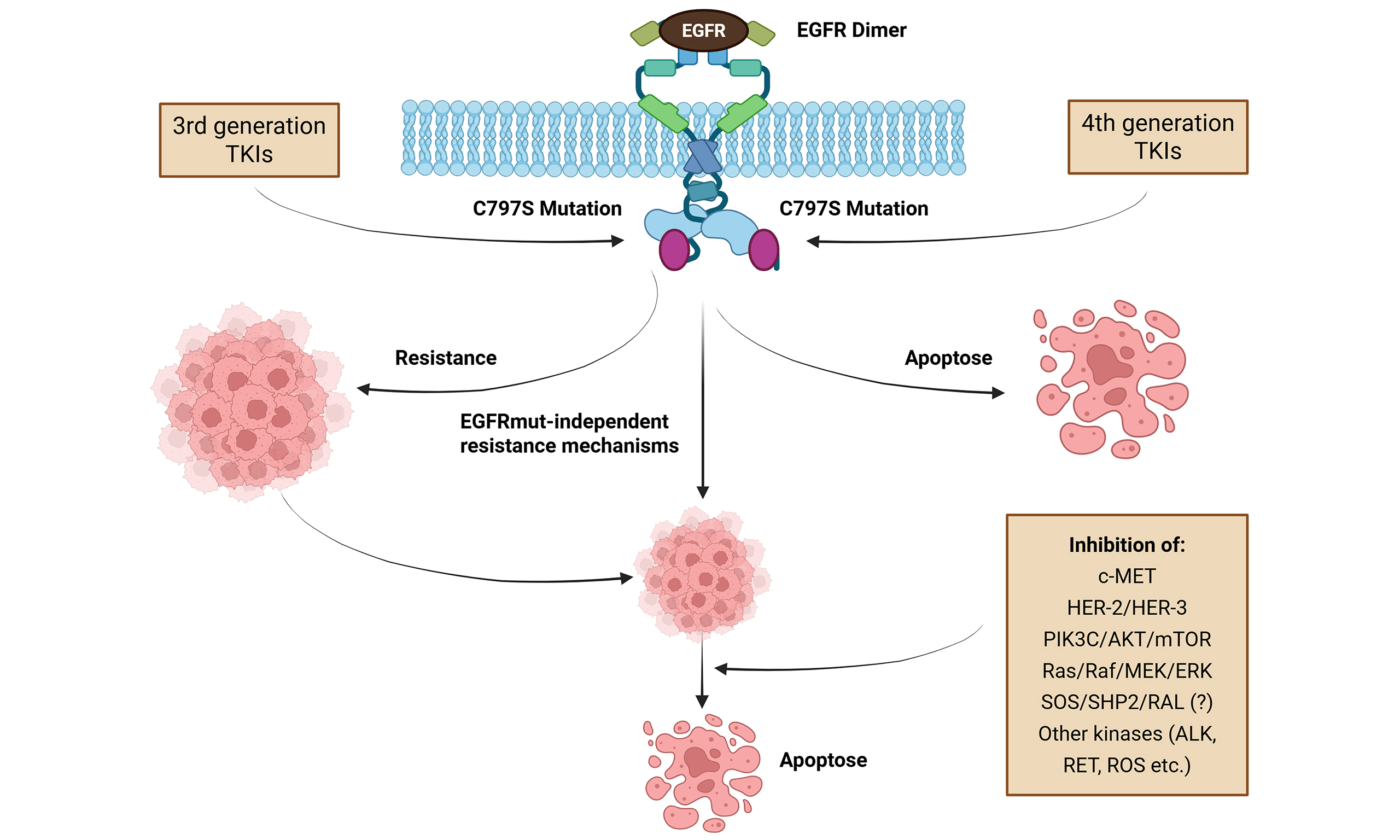
Abstract
Tyrosine kinase inhibitors (TKIs) have significantly changed the treatment of non-small cell lung cancer (NSCLC) harbouring epidermal growth factor receptor (EGFR) mutations, and osimertinib is now established as first-line therapy for NSCLCs. Combination therapies (e.g., osimertininb plus chemotherapy; lazertinib plus amivantamab) have been shown to improve median progression-free survival (mPFS) and median overall survival (mOS) relative to monotherapy. However, due to several resistance mechanisms, patients experience disease progression following EGFR TKI treatment. On-target resistance mechanisms include additional mutations (e.g., C797S/G/N, L718Q, L844V, G724X). Within the heterogeneous group of off-target resistance mechanisms, human epidermal growth factor receptor 2 (HER2) amplifications, mesenchymal-epithelial transition factor (MET) alterations, oncogenic fusions (e.g., BRAF, FGFR, RET), histological changes, epithelial-mesenchymal transitions, and alterations of the RAS/MEK/ERK and the PI3K/AKT/mTOR signal transduction pathways are critical and can confer resistance to EGFR TKIs. Several drugs have been identified to inhibit these pathways, with some of them already approved for clinical use. Most fourth-generation EGFR TKIs are orally bioavailable and are mainly allosteric thiazole amide-based reversible inhibitors. Their activity results from selective binding to an allosteric site, which can alter the EGFR protein conformation, allowing them to bypass C797X. A recommendation for the optimal treatment strategy and sequence for NSCLC patients with acquired EGFR TKI-resistant tumours still cannot be given. An improved understanding of the underlying resistance mechanisms will help to pave the way for the development of innovative and highly specific drugs for the therapy of osimertinib-resistant NSCLCs. The putative clinical relevance of fourth-generation EGFR TKIs for NSCLC patients needs to be defined, and many development hurdles need to be cleared before victory can be declared.
Keywords


 Download PDF
REFERENCES
1. Le X, Popat S, Heymach JV, West H, Zhang L. Treatment options and considerations for acquired resistance in EGFR mutation-positive non-small-cell lung cancer. ESMO Open. 2026;11:106027.
2. Dempke WCM, Fenchel K. Targeting C797S mutations and beyond in non-small cell lung cancer - a mini-review. Transl Cancer Res. 2024;13:6540-9.
3. Soria JC, Ohe Y, Vansteenkiste J, et al.; FLAURA Investigators. Osimertinib in untreated EGFR-mutated advanced non-small-cell lung cancer. N Engl J Med. 2018;378:113-25.
4. Ramalingam SS, Vansteenkiste J, Planchard D, et al.; FLAURA Investigators. Overall survival with osimertinib in untreated, EGFR-mutated advanced NSCLC. N Engl J Med. 2020;382:41-50.
5. Planchard D, Jänne PA, Cheng Y, et al.; FLAURA2 Investigators. Osimertinib with or without chemotherapy in EGFR-mutated advanced NSCLC. N Engl J Med. 2023;389:1935-48.
6. Jänne PA, Planchard D, Kobayashi K, et al.; FLAURA2 Investigators. Survival with osimertinib plus chemotherapy in EGFR-mutated advanced NSCLC. N Engl J Med. 2026;394:27-38.
7. Cho BC, Lu S, Felip E, et al.; MARIPOSA Investigators. Amivantamab plus lazertinib in previously untreated EGFR-mutated advanced NSCLC. N Engl J Med. 2024;391:1486-98.
8. Yang JC, Lu S, Hayashi H, et al.; MARIPOSA Investigators. Overall survival with amivantamab-lazertinib in EGFR-mutated advanced NSCLC. N Engl J Med. 2025;393:1681-93.
9. Chmielecki J, Gray JE, Cheng Y, et al. Candidate mechanisms of acquired resistance to first-line osimertinib in EGFR-mutated advanced non-small cell lung cancer. Nat Commun. 2023;14:1070.
10. Dempke WCM, Fenchel K. Has programmed cell death ligand-1 MET an accomplice in non-small cell lung cancer? - a narrative review. Transl Lung Cancer Res. 2021;10:2667-82.
11. Laface C, Maselli FM, Santoro AN, et al. The resistance to EGFR-TKIs in non-small cell lung cancer: from molecular mechanisms to clinical application of new therapeutic strategies. Pharmaceutics. 2023;15:1604.
12. Naim MJ, Samad A. A review on EGFR-tyrosine kinase inhibitors and their resistance mechanisms. Curr Pharm Des. 2026;32:1259-73.
13. Wang Z, Yang JJ, Huang J, et al. Lung adenocarcinoma harboring EGFR T790M and in trans C797S responds to combination therapy of first- and third-generation EGFR TKIs and shifts allelic configuration at resistance. J Thorac Oncol. 2017;12:1723-7.
14. Roper N, Brown AL, Wei JS, et al. Clonal evolution and heterogeneity of osimertinib acquired resistance mechanisms in EGFR mutant lung cancer. Cell Rep Med. 2020;1:100007.
15. Ceresa BP, Peterson JL. Cell and molecular biology of epidermal growth factor receptor. Int Rev Cell Mol Biol. 2014;313:145-78.
16. Leonetti A, Sharma S, Minari R, Perego P, Giovannetti E, Tiseo M. Resistance mechanisms to osimertinib in EGFR-mutated non-small cell lung cancer. Br J Cancer. 2019;121:725-37.
17. Meador CB, Sequist LV, Piotrowska Z. Targeting EGFR exon 20 insertions in non-small cell lung cancer: recent advances and clinical updates. Cancer Discov. 2021;11:2145-57.
18. Yun CH, Mengwasser KE, Toms AV, et al. The T790M mutation in EGFR kinase causes drug resistance by increasing the affinity for ATP. Proc Natl Acad Sci U S A. 2008;105:2070-5.
19. Laudadio E, Mobbili G, Sorci L, Galeazzi R, Minnelli C. Mechanistic insight toward EGFR activation induced by ATP: role of mutations and water in ATP binding patterns. J Biomol Struct Dyn. 2023;41:6492-501.
20. Lee HJ, Schaefer G, Heffron TP, et al. Noncovalent wild-type-sparing inhibitors of EGFR T790M. Cancer Discov. 2013;3:168-81.
21. Zhao HY, Xi XX, Xin M, Zhang SQ. Overcoming C797S mutation: the challenges and prospects of the fourth-generation EGFR-TKIs. Bioorg Chem. 2022;128:106057.
22. Zalaquett Z, Catherine Rita Hachem M, Kassis Y, et al. Acquired resistance mechanisms to osimertinib: the constant battle. Cancer Treat Rev. 2023;116:102557.
23. Grabe T, Jeyakumar K, Niggenaber J, et al. Addressing the osimertinib resistance mutation EGFR-L858R/C797S with reversible aminopyrimidines. ACS Med Chem Lett. 2023;14:591-8.
24. Ma H, Li L, Jiao C, et al. Immunotherapy after EGFR-TKI treatment in advanced non-small cell lung cancer: current status and future perspective (review). Oncol Rep. 2026;55:44.
25. Wu X, Shi Y, Wang D, et al. Immunotherapy for patients with EGFR-TKI-resistant non-small-cell lung cancer: potential mechanisms, efficacy predictors, and therapeutic integration. Chin Med J Pulm Crit Care Med. 2026;4:61-71.
26. Wang Q, Yang S, Wang K, Sun SY. MET inhibitors for targeted therapy of EGFR TKI-resistant lung cancer. J Hematol Oncol. 2019;12:63.
27. Ramalingam SS, Cheng Y, Zhou C, et al. LBA50 - Mechanisms of acquired resistance to first-line osimertinib: preliminary data from the phase III FLAURA study. Ann Oncol. 2018;29:740.
28. Papadimitrakopoulou VA, Wu YL, Han JY, et al. LBA51 - Analysis of resistance mechanisms to osimertinib in patients with EGFR T790M advanced NSCLC from the AURA3 study. Ann Oncol. 2018;29:741-8.
29. Pasquini G, Giaccone G. C-MET inhibitors for advanced non-small cell lung cancer. Expert Opin Investig Drugs. 2018;27:363-75.
30. Robichaux JP, Elamin YY, Tan Z, et al. Mechanisms and clinical activity of an EGFR and HER2 exon 20-selective kinase inhibitor in non-small cell lung cancer. Nat Med. 2018;24:638-46.
31. Xia Y, Wang K, Zhao J, et al. Receptor tyrosine kinase fusion-mediated resistance to EGFR TKI in EGFR-mutant NSCLC: a multi-center analysis and literature review. J Thorac Oncol. 2025;20:465-74.
32. Liu X, Mei W, Zhang P, Zeng C. PIK3CA mutation as an acquired resistance driver to EGFR-TKIs in non-small cell lung cancer: clinical challenges and opportunities. Pharmacol Res. 2024;202:107123.
33. Qiu X, Wang Y, Liu F, et al. Survival and prognosis analyses of concurrent PIK3CA mutations in EGFR mutant non-small cell lung cancer treated with EGFR tyrosine kinase inhibitors. Am J Cancer Res. 2021;11:3189-200.
34. Osoegawa A, Yamaguchi M, Nakamura T, et al. High incidence of C797S mutation in patients with long treatment history of EGFR tyrosine kinase inhibitors including osimertinib. JTO Clin Res Rep. 2021;2:100191.
35. Corvaja C, Passaro A, Attili I, et al. Advancements in fourth-generation EGFR TKIs in EGFR-mutant NSCLC: bridging biological insights and therapeutic development. Cancer Treat Rev. 2024;130:102824.
36. Jia Y, Yun CH, Park E, et al. Overcoming EGFR(T790M) and EGFR(C797S) resistance with mutant-selective allosteric inhibitors. Nature. 2016;534:129-32.
37. Ahmad I, Patel HM. Orthoallosteric EGFR-TKIs: a new paradigm in NSCLC treatment strategy targeting the C797S mutation. Drug Dev Res. 2025;86:e70036.
38. Ahmad I, Patel HM. From challenges to solutions: a review of fourth-generation EGFR tyrosine kinase inhibitors to overcome the C797S triple mutation in non-small cell lung cancer. Eur J Med Chem. 2025;284:117178.
39. Li Q, Zhang T, Li S, et al. Discovery of potent and noncovalent reversible EGFR kinase inhibitors of EGFRL858R/T790M/C797S. ACS Med Chem Lett. 2019;10:869-73.
40. Romagnoli E, Laudadio E, Mobbili G, et al. FL30: an epidermal growth factor kinase inhibitor overcoming T790M and C797S mutations through unique conformational modulation mechanism. Int J Biol Macromol. 2025;319:145453.
41. Kasuga H, Kataoka Y, Yamamoto F, et al. TAS3351 is a brain penetrable EGFR-TKI that overcomes T790M and C797S resistant mutations. Commun Med. 2026;6:284.
42. Huang W, Zhu L, Yan X, et al. Abstract 5461: H002: a wide spectrum, highly selective fourth-generation EGFR inhibitor overcoming resistance harboring C797S mutation in NSCLC. Cancer Res. 2022;82:5461.
43. Liu X, Zhang X, Yang L, et al. Abstract 1320: Preclinical evaluation of TQB3804, a potent EGFR C797S inhibitor. Cancer Res. 2019;79:1320.
44. Zheng S, Deng W, Zheng Q, et al. Abstract 5457: QLH11811, a selective 4th-generation EGFR inhibitor for osimertinib-resistant EGFR-mutant NSCLC. Cancer Res. 2022;82:5457.
45. Zheng J, Shen L, Jiang N, et al. First-in-human phase 1 study of ES-072, an oral mutant-selective EGFR T790M inhibitor, in non-small-cell lung cancer. Clin Lung Cancer. 2020;21:509-19.e1.
46. Wilson K, Dusek R, Gammon G. 374P NX-019, a brain penetrant, mutation selective EGFR inhibitor with broad mutant EGFR activity. Ann Oncol. 2022;33:S1588.
47. Lim SM, Fujino T, Kim C, et al. BBT-176, a novel fourth-generation tyrosine kinase inhibitor for osimertinib-resistant EGFR mutations in non-small cell lung cancer. Clin Cancer Res. 2023;29:3004-16.
48. Gawli CS, Patil CR, Patel HM. A clinical review on third and fourth generation EGFR tyrosine kinase inhibitors for the treatment of non-small cell lung cancer. Bioorg Med Chem. 2025;123:118146.
49. Xie Z, Wang Q, Wu L, et al. Abstract CT302: The safety, tolerability, and efficacy of HS-10504 in patients with EGFR mutation-positive locally advanced or metastatic NSCLC: initial results from a first-in-human phase 1 study. Cancer Res. 2026;86:CT302.
50. Lee EJ, Ko JA, Kim MJ, et al. JIN-A02, a mutant-selective fourth-generation EGFR inhibitor, overcomes C797S-mediated resistance and demonstrates intracranial activity in NSCLC. Clin Cancer Res. 2026;32:1835-45.
51. Wang Z, Song Y, Wang A, Liu B. Non-small cell lung cancer after EGFR-TKI resistance: from drug resistance mechanisms to precision interventions. Front Pharmacol. 2026;17:1795614.
52. Lim S, Choi S, Lee J, et al. 2357P TRX-221, a 4th generation, mutant-selective, and CNS-active EGFR inhibitor with robust antitumor activity in osimertinib-resistant tumor models harboring C797S mutation. Ann Oncol. 2023;34:S1198.
53. Kadam VM, Patel HM. Recent advances in synthetic strategies of fourth-generation EGFR tyrosine kinase inhibitors under clinical trials for the treatment of resistant non-small cell lung cancer (NSCLC). Bioorg Chem. 2026;181:110353.
54. Ruiter G, Johnson ML, Mazieres J, et al. P3.18.68 First-in-human trial of PFL-241/STX-241 in patients with locally advanced or metastatic NSCLC resistant to EGFR tyrosine kinase inhibitors. J Thorac Oncol. 2025;20:S575.
55. Wang J, Yuan F, Kendre M, et al. Rational design of allosteric inhibitors targeting C797S mutated EGFR in NSCLC: an integrative in silico and in-vitro study. Front Oncol. 2025;15:1590779.
56. Lucas M, Merchant M, O’Connor M, et al. 64(PB054) - BDTX-1535, a fourth generation EGFR inhibitor, targeting intrinsic and acquired resistance mutations in NSCLC. Eur J Cancer. 2022;174:S22.
57. To C, Jang J, Chen T, et al. Single and dual targeting of mutant EGFR with an allosteric inhibitor. Cancer Discov. 2019;9:926-43.
58. Li M, Qin J, Xie F, Gong L, Han N, Lu H. L718Q/V mutation in exon 18 of EGFR mediates resistance to osimertinib: clinical features and treatment. Discov Oncol. 2022;13:72.
59. Prior IA, Hood FE, Hartley JL. The frequency of ras mutations in cancer. Cancer Res. 2020;80:2969-74.
61. Skoulidis F, Li BT, Dy GK, et al. Sotorasib for lung cancers with KRAS p.G12C mutation. N Engl J Med. 2021;384:2371-81.
62. Jänne PA, Riely GJ, Gadgeel SM, et al. Adagrasib in non-small-cell lung cancer harboring a KRASG12C mutation. N Engl J Med. 2022;387:120-31.
63. Saleh K, Ibrahim R, Khoury R, Tikriti Z, Khalife N. KRAS and EGFR inhibitors: a new step in the management of colorectal cancer. Transl Gastroenterol Hepatol. 2024;9:56.
64. Wei G, Tang J, Wang H, Zhang D. Dual EGFR L858R and KRAS G12A mutations in lung adenocarcinoma: a rare case report and literature review. Pharmgenomics Pers Med. 2025;18:189-96.
65. Gregorc V, Majem M, Lo Russo G, et al. Fulzerasib plus cetuximab in first-line KRASG12C-mutated non-small-cell lung cancer (KROCUS): a single-arm, multicentre, phase 1b/2 trial. Lancet Oncol. 2026;27:432-41.
66. Negrao MV, Cassier PA, Solomon B, et al. MA06.03 KontRASt-01: preliminary safety and efficacy of JDQ443 + TNO155 in patients with advanced KRAS G12C-mutated solid tumors. J Thorac Oncol. 2023;18:S117-8.
67. Cregg J, Edwards AV, Chang S, et al. Discovery of daraxonrasib (RMC-6236), a potent and orally bioavailable RAS(ON) multi-selective, noncovalent tri-complex inhibitor for the treatment of patients with multiple RAS-addicted cancers. J Med Chem. 2025;68:6064-83.
68. Wolpin BM, Park W, Garrido-Laguna I, et al.; RMC-6236-001 Investigators. Daraxonrasib in previously treated advanced RAS-mutated pancreatic cancer. N Engl J Med. 2026;394:1790-802.
69. Wolpin BM, Musher BL, Manji GA, et al. Abstract LB407: Daraxonrasib plus chemotherapy (CT) as first line (1L) treatment for patients (Pts) with metastatic pancreatic adenocarcinoma (mPDAC). Cancer Res. 2026;86:LB407.
70. Riess J, Haura EB, Yaeger R, et al. Abstract CT021: Preliminary safety and clinical activity of zoldonrasib (RMC-9805), an oral, RAS(ON) G12D-selective, tri-complex inhibitor in patients with previously treated KRAS G12D non-small cell lung cancer (NSCLC). Cancer Res. 2026;86:CT021.
71. Riess J, Haura EB, Yaeger R, et al. Zoldonrasib deemed safe, effective in KRASG12D-mutant NSCLC. Cancer Discov. 2026;16:OF1.
72. Park J, Cho YH, Shin WJ, et al. A ras destabilizer KYA1797K overcomes the resistance of EGFR tyrosine kinase inhibitor in KRAS-mutated non-small cell lung cancer. Sci Rep. 2019;9:648.
73. Zhang C, Spevak W, Zhang Y, et al. RAF inhibitors that evade paradoxical MAPK pathway activation. Nature. 2015;526:583-6.
74. Saltos AN, Creelan BC, Tanvetyanon T, et al. A phase I/IB trial of binimetinib in combination with erlotinib in NSCLC harboring activating KRAS or EGFR mutations. Lung Cancer. 2023;183:107313.
75. Chung V, Vu P, Ma VT, et al. Results from a phase 2a study of atebimetinib in combination with mGnP in advanced or metastatic pancreatic cancer. J Clin Oncol. 2026;44:4013.
76. Shuai W, Xiao H, Yang P, et al. Structure-guided discovery and preclinical assessment of novel (thiophen-3-yl)aminopyrimidine derivatives as potent ERK1/2 inhibitors. J Med Chem. 2024;67:6425-55.
77. Xiao H, Wang A, Shuai W, et al. A first-in-class selective inhibitor of ERK1/2 and ERK5 overcomes drug resistance with a single-molecule strategy. Signal Transduct Target Ther. 2025;10:70.
78. Zhang YC, Luo WC, Li JT, Wu L, Chen ZH, Zhou Q. The emerging role of antibody-drug conjugates in EGFR-mutant non-small cell lung cancers with acquired resistance to third-generation EGFR tyrosine kinase inhibitors. J Control Release. 2026;393:114747.
79. Su C, Sun SY. Fourth-generation epidermal growth factor receptor-tyrosine kinases inhibitors: hope and challenges. Transl Cancer Res. 2024;13:3929-34.
80. Jänne PA, Johnson ML, Li J, et al. The SOS1 inhibitor BI 1701963 as monotherapy or in combination with trametinib in patients with KRAS mutation-positive solid tumors. Clin Cancer Res. 2026;32:3135-45.
81. Koczywas M, Haura E, Janne PA, et al. Abstract LB001: Anti-tumor activity and tolerability of the SHP2 inhibitor RMC-4630 as a single agent in patients with RAS-addicted solid cancers. Cancer Res. 2021;81:LB001.
Cite This Article
 Open Access
How to Cite
Download Citation
If you have the appropriate software installed, you can download article citation data to the citation manager of your choice. Simply select your manager software from the list below and click on download.
Export Citation File
Type of Import
Tips on Downloading Citation
Citation Manager File Format
Type of Import
Direct Import: When the Direct Import option is selected (the default state), a dialogue box will give you the option to Save or Open the downloaded citation data. Choosing Open will either launch your citation manager or give you a choice of applications with which to use the metadata. The Save option saves the file locally for later use.
Indirect Import: When the Indirect Import option is selected, the metadata is displayed and may be copied and pasted as needed.
About This Article
Special Topic
Copyright

Data & Comments
Data
0












Comments
Comments must be written in English. Spam, offensive content, impersonation, and private information will not be permitted. If any comment is reported and identified as inappropriate content by OAE staff, the comment will be removed without notice. If you have any queries or need any help, please contact us at [email protected].