

fig5
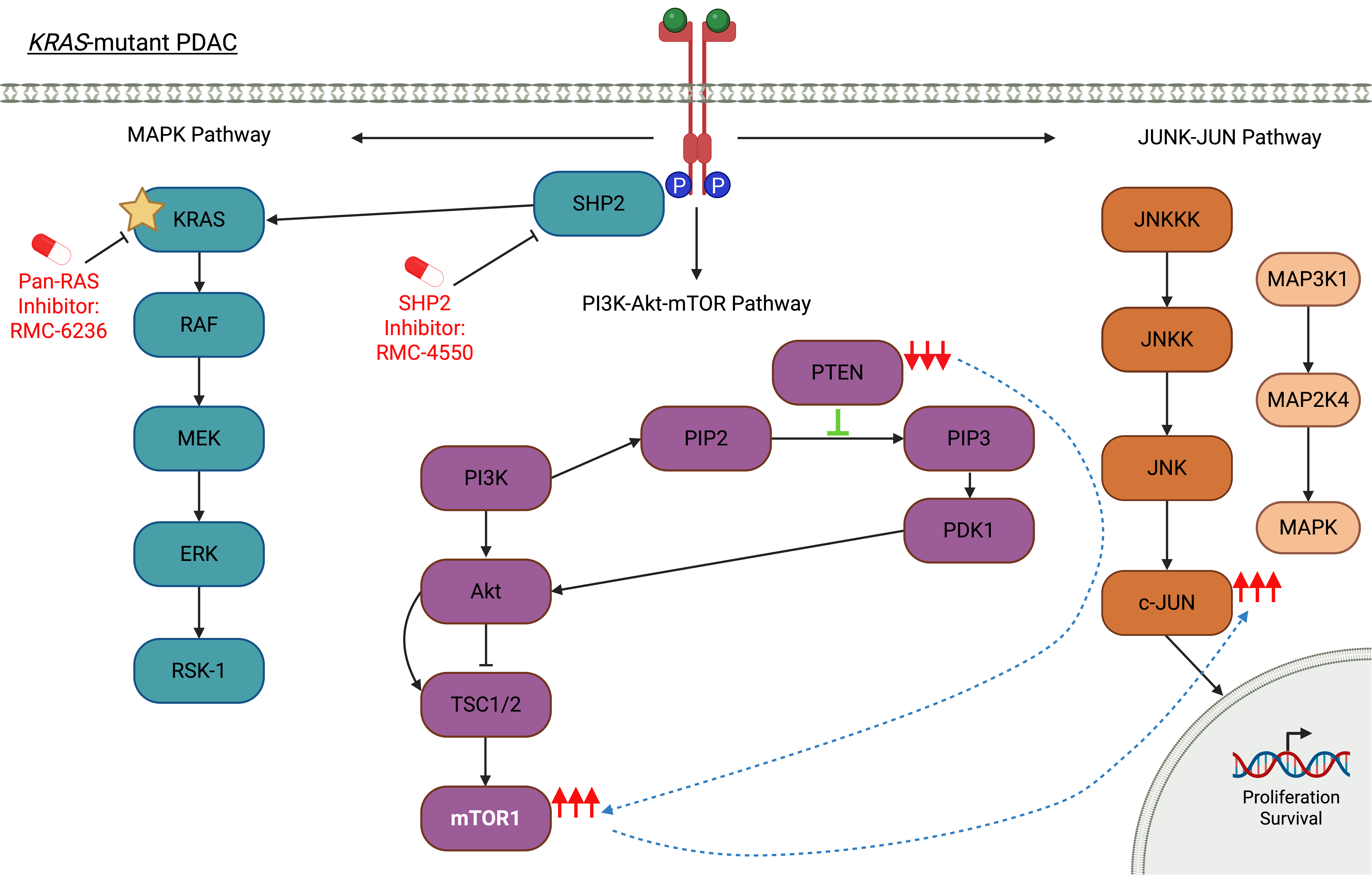
Figure 5. Graphical overview illustrating how KRAS-mutant PDAC cells switch dependency to parallel survival pathways when exposed to combination strategies targeting both KRAS and upstream regulators within the MAPK pathway. For this specific dual-inhibitor combination targeting SHP2 and RAS, resistance emerges through loss of PTEN, a negative regulator of the PI3K–AKT–mTOR axis. This results in overactivation of the PI3K–AKT–mTOR signaling pathway, causing elevated mTOR levels that ultimately drive c-JUN upregulation. Subsequently, overactivation of c-JUN promotes proliferation and survival of resistant cells under sustained inhibition of RAS signaling[104]. Created in BioRender. Giovannetti, E. (2026) https://BioRender.com/xn2tx7r. PDAC: Pancreatic ductal adenocarcinoma; MAPK: mitogen-activated protein kinase; SHP2: Src homology 2 domain-containing protein tyrosine phosphatase 2; RAS: RAS family of small GTPases; PTEN: phosphatase and tensin homolog; PI3K: phosphoinositide 3-kinase; AKT: AKT serine/threonine kinase; mTOR: mechanistic target of rapamycin; JUN: Jun proto-oncogene; RAF: rapidly accelerated fibrosarcoma; MEK: mitogen-activated protein kinase kinase; ERK: extracellular signal-regulated kinase; RSK-1: ribosomal protein S6 kinase 1; PIP: phosphatidylinositol phosphate; PDK1: 3-phosphoinositide-dependent protein kinase 1; TSC1/2: tuberous sclerosis complex 1/2; JUNK: Jun N-terminal kinase; JNK: c-Jun N-terminal kinase; JNKK: JNK kinase; JNKKK: JNK kinase kinase; MAP3K1: mitogen-activated protein kinase kinase kinase 1; MAP2K4: mitogen-activated protein kinase kinase 4.