
fig1
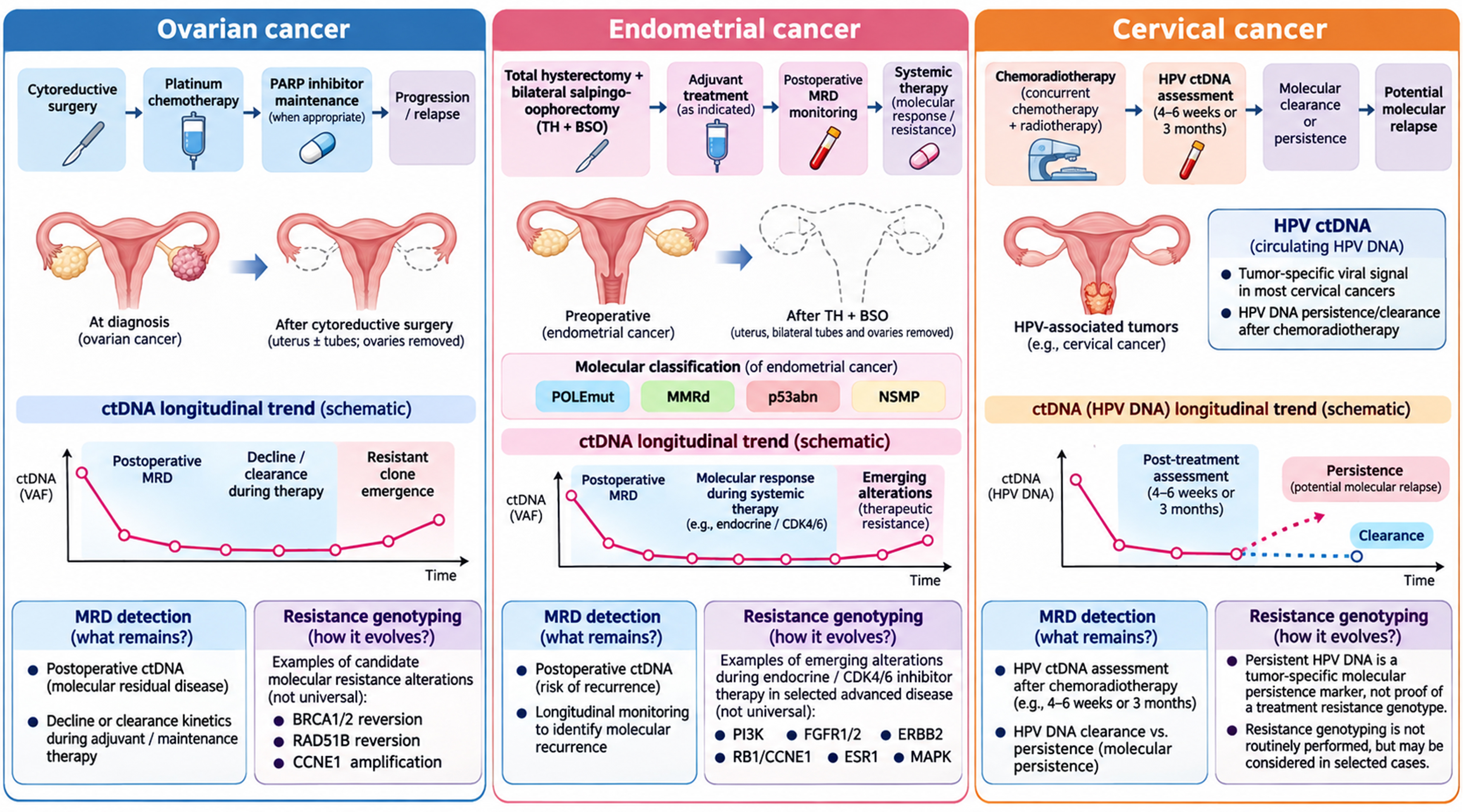
Figure 1. Disease-specific longitudinal ctDNA monitoring of molecular residual disease and therapy resistance in gynecologic cancers. In ovarian cancer, postoperative ctDNA dynamics are distinguished from candidate resistance alterations, including BRCA1/2 and RAD51B reversions and CCNE1 amplification. In endometrial cancer, the standard surgical pathway is shown as total hysterectomy with bilateral salpingo-oophorectomy, followed by postoperative MRD assessment; examples of molecular alterations emerging during endocrine/CDK4/6-targeted treatment include PI3K, FGFR1/2, ERBB2, RB1/CCNE1, ESR1, and MAPK pathway changes. In cervical cancer, circulating HPV DNA clearance or persistence after chemoradiotherapy reflects a tumor-specific molecular signal; HPV DNA persistence alone does not identify a genomic resistance mechanism. Trajectories and molecular examples are schematic, not individual patient data. This revised schematic was prepared with assistance from ChatGPT (OpenAI; GPT-6 used for the present revision) for content organization and an OpenAI image-generation tool (exact image-model version not retained) for illustration. The authors reviewed and corrected the scientific content; all depictions are conceptual and are not derived from individual patient data. HPV: Human papillomavirus; ctDNA: circulating tumor DNA; MRD: molecular residual disease; PARP: poly(ADP-ribose) polymerase; BSO: bilateral salpingo-oophorectomy; VAF: variant allele fraction; TH: total hysterectomy; POLEmut: POLE-mutated; MMRd: mismatch repair deficient; p53abn: p53-abnormal; NSMP: no specific molecular profile; CDK4/6: cyclin-dependent kinases 4 and 6; PI3K: phosphoinositide 3-kinase; FGFR1/2: fibroblast growth factor receptor 1/2; ERBB2: Erb-B2 receptor tyrosine kinase 2; RB1: RB transcriptional corepressor 1; ESR1: estrogen receptor 1; MAPK: mitogen-activated protein kinase.