

fig3
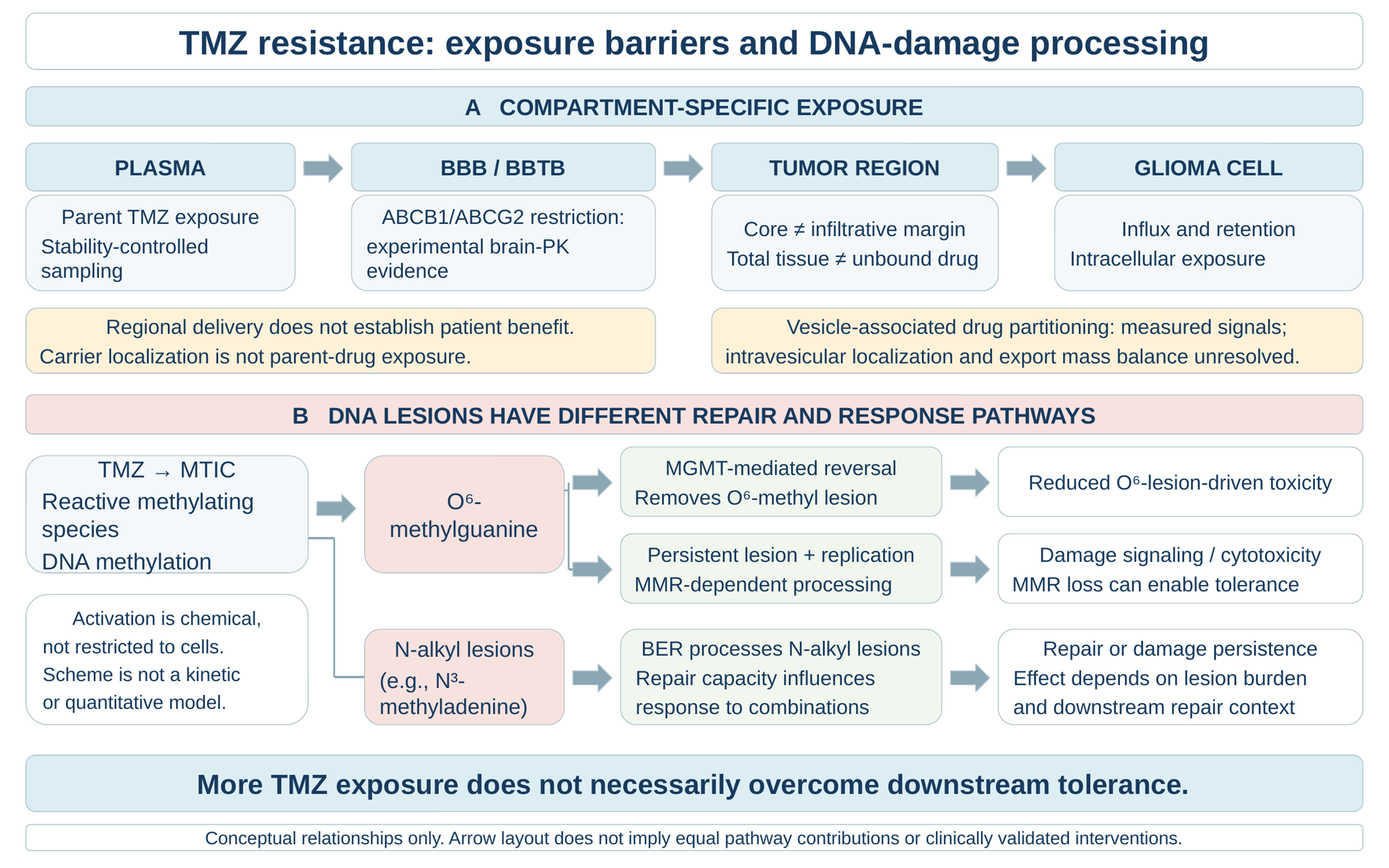
Figure 3. Exposure barriers and DNA-damage processing jointly shape the response to TMZ. (A) Compartment-specific exposure must be distinguished from carrier localization and clinical efficacy; vesicle-associated drug signals alone do not establish intravesicular localization or export mass balance; (B) Chemical activation generates methylating species and distinct DNA lesions. MGMT-mediated removal of O6-methylguanine and MMR-dependent processing of persistent lesions have different implications for response, whereas BER processes N-alkyl lesions. The diagram summarizes the mechanisms discussed in “DNA-repair context determines whether increased exposure is useful”, “Endothelial transport at the blood–brain and blood–brain tumor barriers”, “Tumor-cell transport: direct efflux, uptake, and nontransport functions”, and “Vesicles, membrane remodeling, and intracellular redistribution”, as well as in Table 3[2,23,60]; it is neither a quantitative kinetic model nor a validated treatment algorithm. This figure was created by the authors using Python/python-pptx and LibreOffice. No AI-based image-generation tools or third-party graphical elements were used. TMZ: Temozolomide; MGMT: O6-methylguanine-DNA methyltransferase; MMR: mismatch-repair; BER: base-excision repair; BBB: blood–brain barrier; BBTB: blood–brain tumor barrier; ABCB1: ATP-binding cassette subfamily B member 1; ABCG2: ATP-binding cassette subfamily G member 2; PK: pharmacokinetics; MTIC: 5-(3-methyltriazen-1-yl)imidazole-4-carboxamide.