

Temozolomide exposure and delivery barriers in glioma: cross-compartment pharmacokinetics and implications for resistance
 0
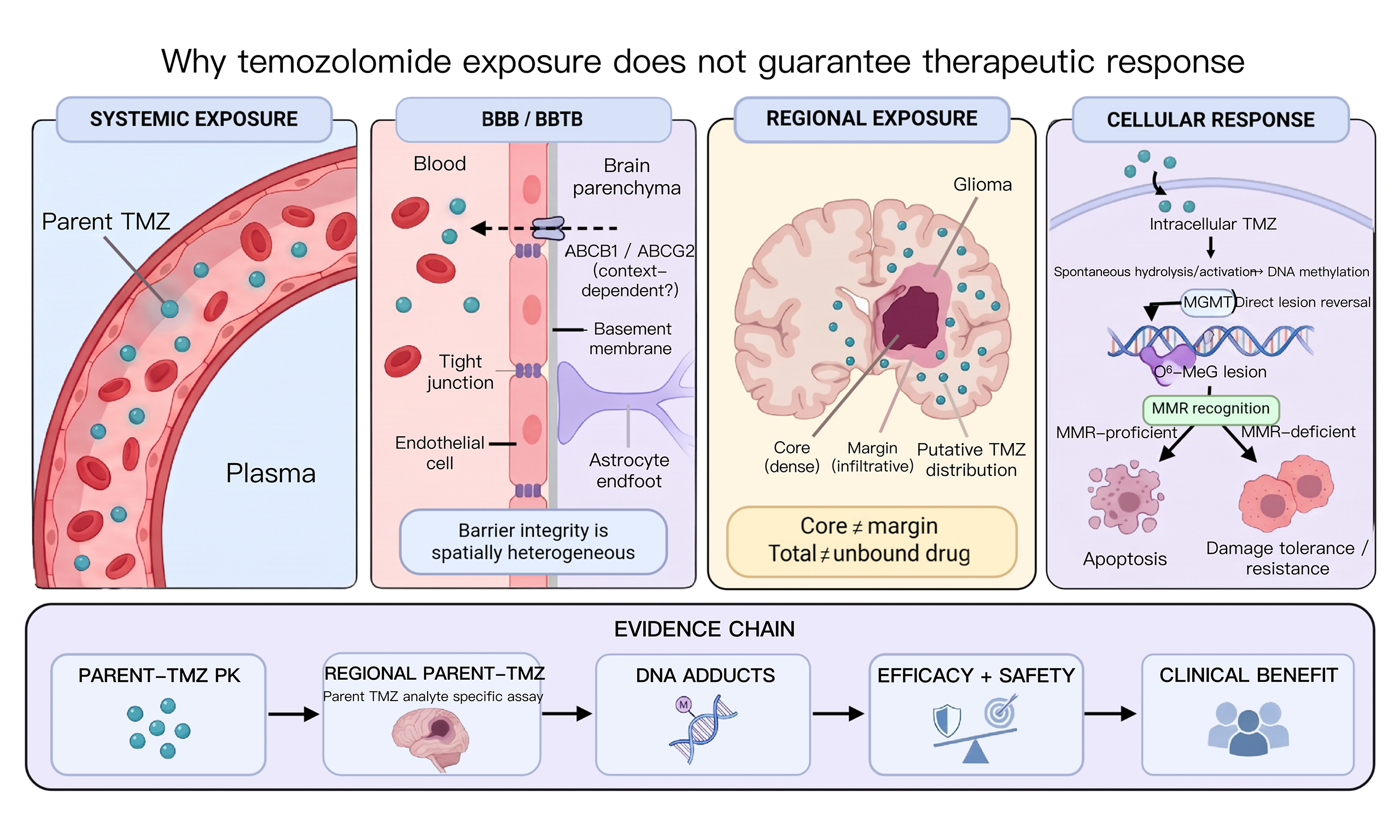
Graphical Abstract
Abstract
Temozolomide (TMZ) remains central to glioblastoma therapy, yet treatment failure reflects both pharmacodynamic resistance and incomplete exposure across relevant intracranial compartments. In this evidence-audited narrative review, we trace TMZ from the systemic circulation across the blood–brain and blood–brain tumor barriers to regional distribution, cellular uptake or export, intracellular retention, chemical activation, and DNA damage. Combined adenosine triphosphate (ATP)-binding cassette subfamily B member 1 (ABCB1)/ATP-binding cassette subfamily G member 2 (ABCG2) deficiency increases brain penetration in mice without changing systemic exposure, supporting a contribution from endothelial transport; however, evidence that individual tumor-cell transporters directly export TMZ is heterogeneous and includes negative findings. Transporter-mediated influx and vesicular partitioning further indicate that inadequate uptake or intracellular removal can be mistaken for classical efflux. Human cerebrospinal fluid and brain-interstitial studies demonstrate partial, compartment-dependent penetration, whereas focused-ultrasound studies support the feasibility of barrier opening. Survival outcomes from single-arm studies cannot be attributed to ultrasound without a randomized comparison. A focused full-text audit of 15 TMZ-containing delivery-platform studies identified extensive formulation and efficacy reporting but only three studies with direct analyte-specific measurements targeting parent TMZ in biological samples. These measurements were limited to plasma or whole blood and single-time-point total-tissue extracts of whole brain or brain tumor; none established regional unbound parent-TMZ pharmacokinetics. We propose a claim–evidence framework that separates direct transport and pharmacokinetic evidence from functional sensitization, association, delivery-concept, and negative evidence. Linking parent-drug exposure, regional distribution, pharmacodynamic competence, safety, and clinical feasibility can help determine when inadequate exposure is a modifiable component of glioma resistance.
Keywords


 Download PDF
INTRODUCTION
Glioblastoma treatment remains constrained by infiltrative growth, molecular heterogeneity, recurrence, and incomplete delivery of therapeutically active drugs to relevant intracranial compartments. Temozolomide (TMZ) resistance is often discussed in relation to O6-methylguanine-DNA methyltransferase (MGMT), mismatch repair, glioma stem-like states, and adaptive signaling. Although these mechanisms are important, they do not, by themselves, establish whether an effective amount of TMZ reaches invasive tumor cells or whether a combination partner achieves complementary exposure in the same region.
A recurring problem is the use of “efflux” as an umbrella term for mechanistically different observations. Increased transporter expression, reduced fluorescent-probe retention, altered cholesterol export, improved nanoparticle uptake, and prolonged survival in a xenograft are not interchangeable demonstrations that a specific transporter directly exports TMZ. The distinction matters because an intervention can improve TMZ sensitivity through cell-cycle regulation, membrane remodeling, ferroptosis, or cellular uptake without increasing TMZ efflux or changing intracranial TMZ concentrations.
This narrative review focuses on exposure- and delivery-related contributors to TMZ treatment failure rather than providing an exhaustive account of all resistance mechanisms. Accordingly, the synthesis follows the pharmaceutical disposition pathway from circulation to tumor-cell DNA instead of grouping studies solely by transporter family or nanomaterial class. The organizing questions are as follows: Which anatomical barrier is involved? Which chemical entity was measured? Was transport demonstrated directly? Were systemic and regional brain exposures distinguished? Does the intervention alter a surrogate endpoint, parent-drug exposure, pharmacodynamic competence, or an authentic clinical endpoint? This analyte- and compartment-resolved approach distinguishes the present synthesis from broad reviews of DNA-repair pathways or nanocarrier classes. Figure 1 summarizes the claim–evidence classes used to interpret findings across compartments.
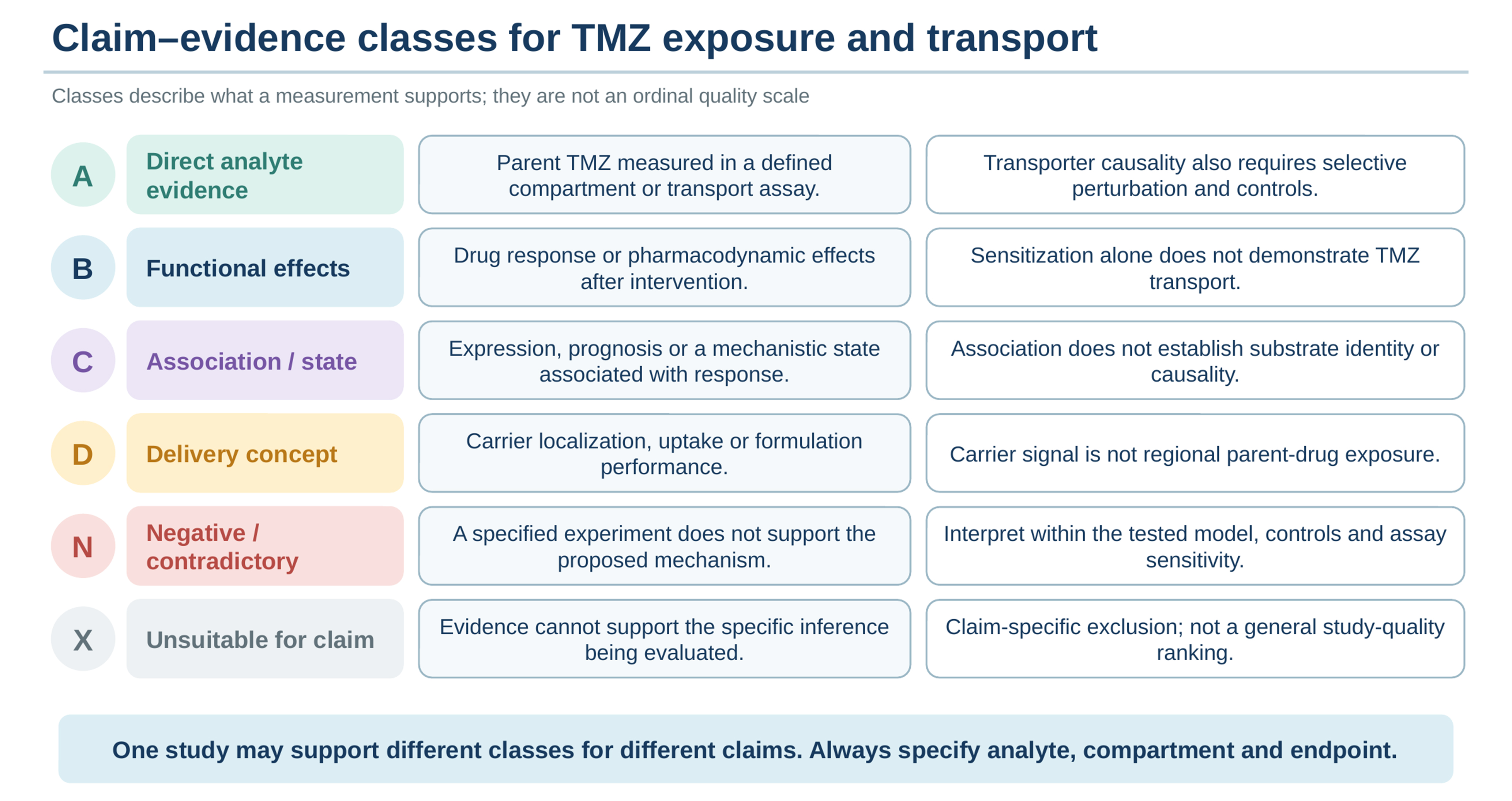
Figure 1. Claim–evidence classes for TMZ exposure and transport. Classes A, B, C, D, N and X describe the relationship between a specified claim and the available measurements, not an ordinal ranking of study quality. Direct parent-TMZ measurement does not by itself establish transporter causality. A study may support multiple classes for different claims. This figure was created by the authors using Python/python-pptx and LibreOffice. No AI-based image-generation tools or third-party graphical elements were used. TMZ: Temozolomide.
LITERATURE IDENTIFICATION AND EVIDENCE-AUDIT METHODS
Review design and scope
This work was designed as an evidence-audited narrative review with a structured literature-identification and evidence-assessment workflow. It was not prospectively registered and should not be interpreted as a formal systematic review or meta-analysis. The scope addressed four linked questions: whether TMZ itself undergoes measurable transport; where the relevant anatomical or cellular barrier is located; whether an intervention changes regional or intracellular exposure; and whether the evidence has progressed from experimental models to human pharmacokinetics (PK) or clinical feasibility. Studies of DNA repair, stemness, metabolism, ferroptosis, autophagy, and microenvironmental signaling were included when they helped distinguish altered drug response from altered drug delivery[1-4].
Search concepts, library consolidation, and full-text retrieval
PubMed- and Web of Science-derived records were consolidated in the prespecified Zotero collection “Literature Library for the Review of TMZ Efflux and Delivery in Glioma” and audited through 25 August 2026. Search concepts combined glioma or glioblastoma with TMZ and terms related to efflux, transporters, adenosine triphosphate (ATP)-binding cassette (ABC) proteins, blood–brain or blood–tumor barriers, PK, extracellular vesicles, nanoparticles, liposomes, intranasal administration, local delivery, and focused ultrasound. The searches were intentionally broad because identical terminology can describe different substrates. For example, cholesterol efflux, fluorescent-probe efflux, and TMZ efflux were retained for later mechanistic adjudication rather than excluded at the keyword stage.
The prespecified classification mapping contained 500 records, whereas the live Zotero collection snapshot contained 513 items. Of the mapped records, 475 matched uniquely to Zotero entries. Thirty-five valid PDFs were already present, leaving 440 uniquely matched records without a local PDF. DOI and open-access metadata were checked using OpenAlex, Europe PMC, publisher pages, and institutional repositories. Among the 440 initially missing records, 433 had a DOI and 246 were marked as open access. Automated retrieval produced 124 complete PDFs after seven truncated or structurally invalid downloads were excluded using PDF-header, terminal-EOF, and parser checks. This process yielded 159 library-linked full texts, of which 157 were text-extractable. Targeted recovery and lawful retrieval from authoritative web or publisher sources subsequently expanded the evidence-access set to 168 records. Because these routes included records that overlapped with earlier workflow states, the counts are not additive to the library-linked total.
Eligibility, evidence selection, and classification
Records were prioritized when they addressed at least one prespecified compartment: systemic-to-cerebrospinal fluid (CSF) or systemic-to-brain PK; blood–brain barrier (BBB)/blood–brain tumor barrier (BBTB) transport; tumor-cell influx or efflux; vesicular or intracellular drug redistribution; mechanism-informed delivery; or clinical translation. Corrigenda were linked to their parent studies rather than treated as independent evidence. Studies of another drug were retained only when they demonstrated combination-partner exposure mismatch or validated a barrier model; they were not used to infer TMZ substrate status. Two structurally invalid PDFs were excluded from full-text inference.
Claims were classified according to the measured analyte, anatomical compartment, intervention specificity, and endpoint. This claim–evidence framework evaluates what each study can support; it is neither a validated risk-of-bias instrument nor a clinical certainty-of-evidence system. Class A denotes direct measurement targeting unlabeled parent TMZ in a defined biological compartment; transporter-specific claims additionally require causal perturbation and appropriate controls. Class B denotes functional, pharmacodynamic, or efficacy evidence, including cellular and animal endpoints, but does not by itself establish drug concentration or spatial distribution. Class C denotes expression, prognosis, or mechanistic association. Class D denotes formulation, carrier-localization, or other delivery-concept evidence without validated free-TMZ exposure in the target compartment. Class N captures negative or contradictory findings, and Class X identifies evidence unsuitable for independent mechanistic inference. One hundred and two references were selected for the journal-oriented synthesis using stratified coverage of pharmacology, BBB/BBTB biology, cellular transport, vesicles, the microenvironment, sensitization, nanodelivery, local or physical delivery, clinical translation, and methodology. Selection favored original studies, direct measurements, negative results, and human evidence; reviews were used to define context and identify convergent themes[5-8]. For the 15-study delivery-platform audit, the four co-first authors (Tianxiang Jiang, Zhaoxing Jia, Xiaokai Cen, and Yuhui Zhao) independently assigned claim–evidence classes. Classification differences were jointly adjudicated by consensus of both corresponding authors (Weiping Zhang and Xianming Lin). The final adjudicated classification comprised three A+B studies (R0002, R0173, and R0179) and twelve D+B studies. These classes describe the relationship between a particular claim and the supporting measurements; they do not provide an ordinal ranking of study quality. A study may support more than one class for different claims, and a negative finding is not inherently lower-quality evidence.
Structured evidence-audit flow and limitations
The verified workflow states described above provide a structured account of literature identification and evidence access. We do not present them as a Preferred Reporting Items for Systematic Reviews and Meta-Analyses (PRISMA) flow diagram because they describe library acquisition and evidence availability rather than a complete, reproducible sequence of systematic screening and exclusion decisions. Moreover, lack of prospective registration alone does not distinguish a narrative review from a systematic review. The counts therefore represent verified workflow states rather than reconstructed or estimated screening events. This terminology preserves auditability without implying compliance with formal systematic-review requirements.
FROM SYSTEMIC EXPOSURE TO TUMOR-CELL DNA DAMAGE
TMZ activity depends on systemic and regional exposure, cellular drug handling, chemical activation, and DNA-damage processing. The parent drug must reach the relevant tumor compartment, whereas chemical activation is not restricted to the intracellular space. The resulting DNA lesions and their processing by repair and stress-response pathways then influence cell fate. Interpretations of resistance should therefore identify the specific step and compartment measured.
Anatomical compartments are not interchangeable
Plasma, total brain, CSF, tumor core, invasive margin, and intracellular concentrations answer different pharmacological questions. Favorable plasma exposure does not establish adequate exposure within infiltrative tumor margins. Conversely, a higher total-tissue concentration does not necessarily indicate a larger pharmacologically available intracellular fraction.
The OPARATIC phase I study illustrates the value of direct regional sampling in recurrent glioblastoma. Olaparib was detectable in all 71 tumor-core specimens from 27 patients and in all 21 tumor-margin specimens from 9 patients; reported median concentrations were 496 nM in the tumor core and 512.3 nM at the margin. However, the combination exacerbated TMZ-associated hematological toxicity and required intermittent scheduling[9]. These data support clinically meaningful evaluation of combination-partner penetration and tolerability. They do not constitute direct measurement of regional TMZ concentration and must not be described as such.
Human PK show partial and compartment-dependent penetration
Table 1 summarizes the human pharmacokinetic and barrier-opening evidence. Direct human measurements challenge the shorthand claim that TMZ simply “crosses the BBB well”. In 35 patients with malignant glioma, population pharmacokinetic analysis showed that CSF exposure was approximately 20% of plasma exposure; after adjustment for dose effects, neither plasma nor CSF area under the concentration–time curve (AUC) predicted toxicity, survival, or progression-free survival better than cumulative dose[10]. CSF is a useful marker of central nervous system (CNS) access, but it is not equivalent to extracellular drug exposure in infiltrative tumor tissue.
Human pharmacokinetic and barrier-opening evidence relevant to TMZ delivery
| Evidence | Population/design | Compartment or intervention | Direct TMZ measurement | Main result | Interpretation and limitation |
| Ostermann et al., 2004[10] | 35 patients with newly diagnosed or recurrent malignant glioma | Plasma and CSF population PK | Yes, HPLC | CSF/plasma AUC approximately 20% | Demonstrates partial CNS penetration; CSF is not tumor tissue and exposure did not outperform cumulative dose as an outcome predictor |
| Portnow et al., 2009[11] | 9 enrolled; 7 evaluable paired profiles | Plasma and non-enhancing peritumoral brain interstitium | Yes, ICMD and LC–MS/MS | Brain-interstitium/plasma AUC 17.8%; brain Tmax approximately 2 h | Direct regional PK, but small diagnostically heterogeneous postoperative cohort |
| Jackson et al., 2018[12] | Pilot study in recurrent high-grade glioma | Regadenoson plus paired plasma/brain microdialysis | Yes | Brain/plasma AUC remained approximately 18%-19%; no significant improvement | Clinically important negative barrier-opening result; dose and sample size limit generalization |
| Büsker et al., 2022[13] | 11 children receiving metronomic TMZ | Plasma and CSF population PK | Yes, HPLC | Model-estimated median CSF/plasma AUC 37% | Pediatric schedule-specific finding; prior radiotherapy, intraventricular treatment, sparse sampling, and no external validation |
| Mainprize et al., 2019[14] | Presurgical phase I feasibility study; 5 patients, 4 receiving TMZ | MRgFUS; paired sonicated/unsonicated tissue | Yes, LC–MS | Only one TMZ-treated patient yielded a quantifiable paired tissue comparison, favoring sonicated tissue | Direct human tissue signal but no reproducible effect estimate or efficacy inference |
| Park et al., 2020[15] | Six-patient uncontrolled one-year follow-up | Repeated MRgFUS during adjuvant TMZ | No regional TMZ PK | Repeated opening appeared feasible without procedure-related delayed complications | Supports feasibility only; cannot establish concentration increase or survival benefit |
| Woodworth et al., 2025 (BT008NA)[16] | Multicenter open-label single-arm phase I/II; 34 patients | Periresectional MB-FUS during monthly adjuvant TMZ | No spatial TMZ PK endpoint | Opening visualized in all treatments; median OS 31.3 months and PFS 13.5 months | Promising signal; nonrandomized design and non-protocol-prespecified external control preclude causal survival claims |
Intracerebral microdialysis provides a more local measure of exposure. In a postoperative pilot study, paired samples from seven evaluable patients yielded mean plasma and brain-interstitial TMZ AUC values of 17.1 and 2.7 µg·h/mL, respectively. The mean brain-interstitium/plasma ratio was 17.8%, and the peak brain concentration occurred at approximately 2 h[11]. The small and diagnostically heterogeneous cohort limits outcome inference, but the study directly demonstrates that systemic exposure substantially exceeds extracellular exposure in non-enhancing peritumoral brain.
An attempted pharmacological opening of the barrier also produced informative negative evidence. In patients with recurrent high-grade glioma, standard-dose regadenoson did not significantly increase TMZ peak concentration, AUC, or the brain/plasma AUC ratio measured by microdialysis; ratios remained approximately 18%-19% with and without the intervention[12]. This contrasts with earlier rodent findings and illustrates why barrier-opening strategies require human regional pharmacokinetic confirmation rather than extrapolation from preclinical permeability data.
Age, schedule, and sampling compartment further affect interpretation. In 11 children receiving metronomic TMZ for malignant CNS tumors, the model-estimated median CSF/plasma AUC ratio was 37%[13]. All had prior cranial radiotherapy and concomitant intraventricular therapy; the sample was small, and CSF exposure cannot be equated with brain or tumor exposure. Collectively, these studies support partial CNS penetration with substantial contextual uncertainty, not uniform delivery to all glioma compartments.
Pharmacokinetic mismatch in combination therapy
Targeted agents considered for use with TMZ may face transport limitations different from those of TMZ itself. The cited studies characterize the brain distribution and CNS PK of the ATR inhibitors berzosertib and elimusertib[17,18]. They illustrate the need to evaluate a potential combination partner’s CNS exposure separately; they do not establish TMZ transport, simultaneous target-site exposure during TMZ coadministration, or clinical efficacy of a TMZ-based combination.
The OPARATIC study similarly showed that olaparib reached both tumor core and margin, while clinically important hematological toxicity constrained scheduling[9]. Co-delivery platforms, brain-penetrant analogs, and schedule optimization should therefore be evaluated using paired exposure-response data for each agent. Future studies should establish whether both compounds reach the same tumor compartment at biologically meaningful concentrations rather than infer synchronization from administered dose or carrier colocalization[19-21].
Chemical instability, sampling design, and the meaning of exposure
TMZ is orally absorbed and undergoes spontaneous, pH-dependent conversion to 5-(3-methyltriazen-1-yl)imidazole-4-carboxamide (MTIC) and subsequent methylating species[22]. This chemistry makes sample stabilization, collection timing, and analytical specificity central to interpretation. A single tissue concentration may reflect vascular content, extracellular drug, intracellular drug, or degradation during handling. CSF can support population modeling but is separated from tumor extracellular fluid by distinct interfaces; total-brain homogenate averages vascular, extracellular, and intracellular pools; and contrast-enhancing core samples may overrepresent regions with barrier disruption. For this reason, brain/plasma or CSF/plasma AUC ratios, paired regional sampling, and microdialysis provide complementary rather than interchangeable evidence[10-13].
The human studies reviewed here converge on partial CNS penetration but do not establish a universal exposure threshold. Adult CSF and non-enhancing brain-interstitial AUC values were approximately one-fifth of plasma exposure, whereas a small pediatric metronomic cohort yielded a higher model-estimated CSF fraction[10-13]. Differences in age, dose schedule, prior irradiation, intraventricular therapy, sampling intensity, and model assumptions can plausibly explain part of this variation. The key translational question is therefore not whether TMZ “crosses the BBB”, but whether sufficient unbound drug reaches infiltrative tumor cells with a molecular context permissive for TMZ-induced cytotoxicity for a sufficient duration.
DNA-repair context determines whether increased exposure is useful
TMZ exposure and DNA-damage processing are distinct determinants of response. MGMT directly removes O6-methylguanine lesions, reducing the substrate available for subsequent cytotoxic processing. When these lesions persist, replication generates mismatches that can engage the mismatch-repair (MMR) machinery; loss of MMR can therefore promote TMZ tolerance despite adequate drug delivery. Base-excision repair (BER) processes other TMZ-associated methylated bases and influences responses to combinations targeting DNA-damage repair. Readers seeking broader coverage of these pathways are referred to the resistance review in Ref.[2].
Consequently, repair proficiency should not be treated as a single binary marker: MGMT-mediated lesion removal and MMR-dependent damage processing can have different implications for TMZ sensitivity. A delivery intervention should be assessed alongside MGMT and MMR status and lesion-linked pharmacodynamic endpoints. Higher parent-drug exposure without the expected DNA-damage response warrants investigation of downstream tolerance; a stronger damage response without higher exposure may indicate sensitization rather than improved delivery. Increased delivery alone should not be assumed to overcome every molecular form of resistance. Combination studies must also assess normal-tissue toxicity, as illustrated by the hematological constraints in the olaparib–TMZ study[9].
ENDOTHELIAL TRANSPORT AT THE BLOOD–BRAIN AND BLOOD–BRAIN TUMOR BARRIERS
ABCB1 and ABCG2 provide the strongest compartment-specific anchor
The most relevant mechanistic anchor is the investigation of TMZ penetration in wild-type and transporter-deficient mice. Combined deletion of Abcb1a/b and Abcg2 increased brain penetration of TMZ by approximately 1.5-fold without changing systemic exposure, indicating that endothelial transporter activity can restrict intracranial TMZ access[23]. The study incorporated in vitro transport experiments, in vivo pharmacokinetic comparisons, and antitumor evaluation, making it substantially stronger than an expression-only association.
The magnitude of the reported change also deserves careful interpretation. A measurable increase in brain exposure supports a transport contribution, but it does not imply complete exclusion of TMZ from the brain or demonstrate that transporter blockade alone will reverse clinical resistance. Genetic deletion in mice, pharmacological inhibition in patients, and delivery across heterogeneous human tumor margins involve different assumptions and risks.
Barrier heterogeneity complicates extrapolation
The BBTB is spatially heterogeneous. Contrast enhancement, disrupted vasculature, perivascular abnormalities, and infiltrative margins do not necessarily represent a single pharmacological compartment. Delivery strategies should therefore be evaluated against region-specific questions: Does the treatment cross relatively intact endothelial barriers? Does it accumulate only in a permeable core? Does it reach disseminated cells beyond radiographic enhancement?
Existing nanoparticle and liposomal studies provide multiple candidate approaches, but their reported endpoints vary widely[24-26]. Carrier signal within the brain is not equivalent to free TMZ concentration at the malignant-cell target. Where available, direct quantification of TMZ and its relevant pharmacological products should take precedence over imaging of the carrier alone.
Models of the BBB/BBTB determine what can be concluded
Monolayer permeability assays, transporter-overexpressing cells, multicellular BBB models, orthotopic xenografts, genetically engineered animals, and surgically obtained human samples address different questions. A human in vitro BBTB model can reveal endothelial–tumor interactions and screen relative permeability, but it cannot reproduce regional perfusion, immune-cell effects, intracranial pressure, or drug clearance[27]. Orthotopic models improve anatomical relevance but still vary in vascular phenotype and transporter expression. Tumor control in a subcutaneous model is particularly weak evidence of brain delivery because the model omits the barrier that the formulation is intended to overcome.
Barrier permeability is also not uniformly undesirable. Excessive or nonspecific opening may increase edema, hemorrhage, inflammatory signaling, or normal-brain exposure. Strategies targeting tumor endothelium or adhesion molecules may improve regional delivery, but therapeutic interpretation requires matched measurement of vascular effects and drug exposure[28]. The effects of adenosine-A2A activation were species- and model-dependent. In glioma-bearing mice, regadenoson did not significantly change plasma TMZ or brain:plasma and tumor:plasma concentration ratios. In GSC827-bearing rats, it increased the tumor:plasma TMZ concentration ratio by 25.1% without changing the brain:plasma ratio or improving survival with repeated TMZ treatment[29]. In patients with recurrent high-grade glioma, standard-dose regadenoson did not significantly increase TMZ peak concentration, AUC, or the brain:plasma AUC ratio in non-enhancing peritumoral tissue[12]. These discordant findings support species-aware preclinical interpretation and early human regional pharmacokinetic endpoints.
Efflux inhibition vs. barrier bypass
Direct ATP-binding cassette subfamily B member 1 (ABCB1)/ATP-binding cassette subfamily G member 2 (ABCG2) inhibition is conceptually different from packaging TMZ in a carrier, using a prodrug, opening the barrier physically, or delivering drug locally. Inhibition attempts to change transporter-mediated flux but can also alter systemic disposition and protective transport in healthy organs. Barrier bypass may avoid a specific transporter yet introduce reticuloendothelial clearance, incomplete drug release, or regional deposition. The approximately 1.5-fold increase produced by combined ABCB1/ABCG2 disruption in mice defines a measurable contribution, not a guarantee that systemic transporter inhibition will provide an adequate therapeutic index[23]. Mechanism-informed selection should ask whether the observed exposure deficit is large enough, spatially relevant, and safely modifiable.
TUMOR-CELL TRANSPORT: DIRECT EFFLUX, UPTAKE, AND NONTRANSPORT FUNCTIONS
Direct transport requires direct measurement
A transporter should be implicated in TMZ efflux only when the experimental design establishes that transport, accumulation, or exposure of TMZ itself changes after a transporter-specific intervention. Bidirectional transport assays, transporter-knockout or knockdown systems, appropriately controlled inhibitors, intracellular TMZ measurements, and brain-to-plasma comparisons provide stronger evidence than changes in mRNA abundance or fluorescence-probe efflux alone.
Studies using rhodamine 123, Hoechst dyes, calcein, or related substrates can establish transporter activity but do not automatically identify TMZ as the transported substrate. Similarly, reduced viability after combining a transporter inhibitor with TMZ may reflect pathway crosstalk or altered apoptosis rather than direct changes in TMZ transport.
Negative evidence challenges a uniform P-glycoprotein narrative
One glioblastoma cell-line investigation evaluated MGMT, MMR factors, P-glycoprotein, and CD133 under TMZ exposure and concluded that P-glycoprotein did not appear to participate in TMZ resistance in the models studied[30]. This does not negate endothelial ABCB1/ABCG2 effects in genetically modified mice. Instead, it illustrates that endothelial transport at the BBB and tumor-cell resistance in a particular culture system cannot be assumed to share the same mechanism.
TMZ can also alter endothelial P-glycoprotein expression and fluorescent-probe transport through Wnt-related signaling[31]. This is evidence that TMZ regulates a transporter-associated state; it is not, by itself, proof that the same transporter directly exports TMZ. Distinguishing modulation of transporter expression from direct substrate transport avoids circular reasoning.
The same distinction applies to glioblastoma stem-like cells. TMZ exposure reduced Wnt3a signaling, ABCB1 transcription, P-glycoprotein abundance, and transport activity in these cells[32]. The resulting chemosensitization was demonstrated with established P-glycoprotein substrates such as doxorubicin, vinblastine, and etoposide. The study therefore supports TMZ-mediated remodeling of a multidrug-resistance phenotype, but does not directly demonstrate P-glycoprotein transport of TMZ.
MRP1/ABCC1 effects depend on the substrate and biological context
Multidrug resistance protein 1 (MRP1) is frequently discussed as a multidrug-resistance transporter, but the available glioblastoma evidence is not uniformly supportive of direct TMZ transport. In a study of primary and recurrent glioblastoma models, pharmacological inhibition with MK571 or specific MRP1 knockdown did not alter TMZ drug response[33]. This negative observation must be reported alongside studies suggesting ATP-binding cassette subfamily C member 1 (ABCC1)-associated resistance or redox adaptation.
ABCC1-related ferroptosis studies introduce a different mechanism: nuclear factor erythroid 2-related factor 2 (NRF2)-associated ABCC1 activity can contribute to glutathione handling and susceptibility to ferroptotic stress[34]. Such evidence may be important for designing combination therapy, but glutathione export is not synonymous with TMZ export. The transported molecule, downstream death pathway, and relevant experimental endpoint must be specified.
Negative findings should be interpreted at the level of the tested model and endpoint. Failure to alter TMZ cytotoxicity after MRP1 perturbation[33] does not directly measure TMZ flux, while the cell-line P-glycoprotein result[30] addresses a different compartment from endothelial ABCB1/ABCG2 disruption[23]. Possible explanations for discordance include differences in transporter abundance or membrane localization, incomplete inhibition, alternative transport routes, TMZ instability, and a cytotoxicity endpoint dominated by DNA-repair status. These are testable explanations, not established causes of the reported null results. Paired parent-TMZ measurements, confirmation of target perturbation, positive-control substrates, and genetic rescue would distinguish a true lack of transport contribution from an insensitive or confounded readout.
ABCB5 and ABCA1 may influence resistance without establishing direct TMZ efflux
Targeting ATP-binding cassette subfamily B member 5 (ABCB5) sensitized glioblastoma to TMZ-associated apoptosis and reduced tumor growth in xenograft models, with a proposed contribution from cell-cycle-checkpoint regulation[35]. These data support a functional therapeutic relationship, but they do not alone establish direct ABCB5-mediated TMZ transport.
ATP-binding cassette subfamily A member 1 (ABCA1)-associated work links resistance to glioma stem-like enrichment, immune-state changes, cholesterol regulation, and altered treatment sensitivity[36,37]. These mechanisms are biologically plausible but should not be collapsed into a single claim of direct TMZ export. An additional methodological hazard is that “AUC” in some ABCA1 papers refers to a diagnostic receiver-operating-characteristic curve rather than pharmacokinetic area under a drug-concentration curve[37].
GLUT3 reveals the importance of TMZ influx
Recent work identified glucose transporter 3 (GLUT3)-associated uptake of TMZ using uptake assays, transporter perturbation, binding-related analysis, site-directed mutagenesis, and xenograft experiments[38]. Increased GLUT3 expression was associated with increased TMZ uptake and chemosensitivity. This evidence concerns influx, not efflux.
The finding has conceptual implications: effective intracellular exposure reflects the balance between entry and removal. A strategy that enhances influx may improve TMZ activity even when it does not inhibit an efflux transporter. Future studies should evaluate bidirectional flux and avoid treating every transporter-associated phenotype as drug export. An L-type amino acid transporter 1 (LAT1)-utilizing TMZ amino-acid prodrug further illustrates that increasing transporter-mediated accumulation does not necessarily overcome DNA repair-mediated chemoresistance[39].
Adaptive resistance networks can mimic transport phenotypes
TMZ-resistant cells frequently acquire migration, side-population, stem-like, metabolic, and stress-tolerance phenotypes. These states can coincide with transporter expression without being caused by direct TMZ export. Rat C6 resistance selection increased migration and side-population features, while lysine demethylase 5A (KDM5A), protein neddylation, carbonic anhydrase XII, transient receptor potential cation channel subfamily C member 5 (TRPC5)-nuclear factor of activated T cells 3 (NFATc3)-P-glycoprotein signaling, and Rho-associated coiled-coil containing protein kinase 2 (ROCK2)/ABCG2 have each been linked to TMZ response in specific models[40-45]. Such studies identify intervention points, but the causal chain must be decomposed into transporter abundance, measured substrate, intracellular TMZ, DNA damage, repair, and survival.
Membrane composition further changes apparent drug response. Polyunsaturated fatty acids, lipid rafts, and cholesterol handling can alter oxidative stress, receptor organization, apoptosis, and membrane protein function[46,47]. These mechanisms may change net TMZ efficacy even when they do not directly change TMZ flux. Similarly, ATP-binding cassette subfamily C member 3 (ABCC3)-mediated protection of immune cells from chemotherapy concerns immune-cell substrate handling and cannot be transferred automatically to glioma-cell TMZ export[48]. A compartment-aware review should preserve these biologically useful findings while refusing substrate substitution.
Uptake, intracellular retention, and DNA-damage competence form a net-exposure system
GLUT3-mediated uptake provides the clearest counterexample to an efflux-only model: increased entry can enhance chemosensitivity even if outward transport is unchanged. After entry, intracellular retention may be affected by vesicular partitioning, while lesion persistence depends on MGMT, mismatch repair, BER, homologous-recombination-associated responses, autophagy, and cell-cycle checkpoints. Ibudilast, metastasis-associated lung adenocarcinoma transcript 1 (MALAT1)-directed small interfering RNA (siRNA), the connexin 43 mimetic peptide (alphaCT1), bone morphogenetic protein 7 (BMP7), and radiosensitizer strategies improve response through different points in this network[49-53]. Their therapeutic value does not require relabeling them as efflux inhibitors.
Autophagy is especially context-dependent. Phosphoinositide 3-kinase (PI3K) inhibition and direct autophagy inhibition have increased TMZ-associated apoptosis or ferroptosis in experimental systems, while other adaptive programs may use autophagy for survival[54-56]. Ferroptosis-oriented approaches similarly interact with NRF2, glutathione export, lipid peroxidation, and stemness[57]. The practical implication is that intracellular TMZ concentration and downstream lesion competence should be measured together whenever a sensitizer is proposed to restore delivery.
VESICLES, MEMBRANE REMODELING, AND INTRACELLULAR REDISTRIBUTION
Extracellular vesicles and microvesicles can transfer resistance-associated proteins, nucleic acids, and signaling states between glioma and stromal cells. Studies involving exosome-directed delivery and ADP-ribosylation factor-like protein 13B (ARL13B)-associated microvesicles support a role for vesicular biology in TMZ-related resistance networks[58,59]. However, a vesicle-associated resistance phenotype does not establish that vesicles physically export pharmacologically meaningful amounts of TMZ.
In TMZ-resistant TBD-0220 cells, Hong et al. reported that EPIC-1042 co-treatment approximately doubled intracellular TMZ and reduced the TMZ signal in the isolated small-extracellular-vesicle fraction[60]. Supplementary Figure 3A and B in the original publication by Hong et al.[60] display the multiple-reaction monitoring (MRM) transition 195.1 to 138.0, supporting an analyte-directed measurement rather than a vesicle-count proxy. These observations support altered drug partitioning associated with the intervention, but do not alone establish intravesicular localization or the fraction of total TMZ exported. Concurrent effects on poly(ADP-ribose) polymerase 1 (PARP1) degradation, BER, MGMT recruitment, and autophagy also preclude attributing sensitization exclusively to inhibited vesicular export.
Membrane cholesterol and lipid rafts offer another important example. Ginsenoside-associated studies report altered cholesterol efflux, lipid-raft distribution, and TMZ sensitivity[47]. Here, “efflux” refers primarily to cholesterol handling. The appropriate interpretation is membrane-state modulation of treatment response unless intracellular or vesicular TMZ measurements establish otherwise.
Therefore, vesicular mechanisms should be separated into at least three categories: transfer of resistance-associated information, redistribution or sequestration of cellular material, and quantitatively demonstrated removal of TMZ itself. Only the third category supports a direct drug-export claim.
Vesicles as carriers of resistance information
Glioblastoma-derived extracellular vesicles transfer proteins, microRNAs, long RNAs, and metabolic signals between tumor subclones and the microenvironment. Reviews and experimental studies support roles in therapy adaptation, immune modulation, angiogenesis, and stem-like-state maintenance[61-63]. Engineered exosomes can also be used in the opposite direction - as delivery vehicles for siRNA, gene-editing components, or drug combinations[58,64,65]. These two functions should not be conflated: natural vesicle-mediated resistance communication does not prove removal of TMZ, and engineered-vesicle uptake does not establish inhibition of endogenous export.
Direct drug partitioning is a higher evidentiary bar
The supplementary methods for the EPIC-1042 study describe methanol extraction of cell and small extracellular vesicle (sEV) pellets, followed by liquid chromatography–mass spectrometry (LC–MS) analysis of TMZ[60]. The sEV preparation included a phosphate-buffered saline (PBS) wash and repeated ultracentrifugation; cell counting and cell-number-normalized vesicle protein and particle measurements were also reported. These procedures should not be confused with a demonstrated normalization scheme for the TMZ assay itself. The supplied supplement does not explicitly document TMZ-specific calibration, internal-standard correction, extraction recovery, stability validation, or free-drug carryover controls. Its acidified extraction and internal-standard procedure concerns tissue EPIC-1042, not pellet TMZ. Thus, the reported drug measurements support a transport-related hypothesis, while quantitative vesicular mass balance and analytical specificity against degradation products remain insufficiently documented. ARL13B-associated resistance transfer should likewise be distinguished from direct measurement of drug cargo.
MECHANISM-INFORMED DELIVERY STRATEGIES
Match the intervention to the limiting barrier
The existing corpus contains substantial nanoparticle and liposomal literature, but a mechanism-informed review should organize these studies by the barrier they claim to address rather than listing carrier compositions. The central distinction is whether a platform improves endothelial passage, regional tumor distribution, tumor-cell uptake, intracellular retention, combination-drug synchronization, or local exposure.
Nanoparticle co-delivery of TMZ and ligustilide, for example, is relevant because the combination was designed around brain targeting and transporter-associated barrier modulation[25]. Magnet-guided TMZ-containing nanoparticles address an alternative delivery concept[26]. These approaches remain preclinical and should be compared using matched controls, direct TMZ measurements, appropriate orthotopic models, and safety endpoints.
Distinguish sensitization from restored drug delivery
Sensitization can result from altered DNA repair, ferroptosis, peptide signaling, microRNA regulation, autophagy, or cell-cycle adaptation[50-52]. These interventions may be therapeutically important even when they do not improve brain delivery or reduce TMZ export. Their value should be categorized according to the demonstrated mechanism, not forced into an efflux framework.
Local, intranasal, and physical delivery approaches
Intranasal TMZ-containing formulations and ultrasound-activated treatment platforms offer potential ways to bypass or modify conventional anatomical barriers[66,67]. However, evidence remains dependent on model design. A strong translational assessment should specify the administered dose, anatomical distribution, direct TMZ concentration, reproducibility, local toxicity, and whether treatment reaches infiltrative regions.
Early clinical focused-ultrasound studies provide a useful hierarchy of endpoints. In a five-patient presurgical feasibility study, four patients received oral TMZ before magnetic resonance (MR)-guided focused-ultrasound barrier opening; LC–MS was planned for paired sonicated and unsonicated tissue[14]. The barrier opened radiographically and the procedure was tolerated, but limited resectable tissue allowed quantitative TMZ comparison in only one patient. In that patient, TMZ was higher in sonicated than unsonicated peritumoral tissue. This is direct human tissue evidence, but a single quantifiable pair cannot establish the magnitude, reproducibility, or clinical benefit of enhanced delivery.
A subsequent six-patient study applied repeated barrier opening during adjuvant TMZ and reported no immediate or delayed procedure-related complications at one year[15]. Five patients completed six cycles, but the uncontrolled sample was too small to estimate efficacy, and the study did not demonstrate that higher TMZ concentration mediated the observed outcomes. Its appropriate evidentiary role is repeated-procedure feasibility rather than proof of survival benefit.
The multicenter BT008NA phase 1/2 study substantially strengthened the safety and implementation evidence[16]. Thirty-four participants received periresectional microbubble-enhanced focused ultrasound during monthly adjuvant TMZ; barrier opening was visualized in all treatments, median overall survival was 31.3 months, and median progression-free survival was 13.5 months. However, the trial was open-label and single-arm, and its external control analysis was not protocol-prespecified. It therefore supports feasibility and a promising efficacy signal, not causal proof that focused ultrasound improves survival. A randomized comparison and spatial TMZ pharmacokinetic substudy remain necessary.
Thus, physical barrier opening is further along clinically than most TMZ nanocarriers, but the evidence chain remains incomplete: radiographic opening is established, repeated treatment appears feasible, and one highly limited tissue comparison suggests increased TMZ delivery; reproducible regional PK and randomized clinical benefit have not yet been demonstrated[14-16]. Table 2 summarizes representative TMZ-containing delivery platforms and distinguishes formulation and efficacy endpoints from direct parent-drug exposure measurements.
Representative TMZ-containing delivery platforms and the endpoints used to infer delivery
| Platform (reference) | Formulation anchor | Model/intervention | Efficacy or exposure anchor | Measured analyte | Evidence-supported interpretation | Principal limitation |
| PLGA-mPEG TMZ/ligustilide nanoparticles[25] | 117.6 ± 0.7 nm; ζ -26.5 ± 0.4 mV | SD rats; intravenous TMZ-equivalent dose 5 mg/kg | Plasma TMZ AUC0-∞ 44.953 vs. 10.061 µg·h/mL and t1/2 2.853 vs. 1.758 h vs. free TMZ; total-brain measurement at 3 h | Parent TMZ by LC–MS | Direct systemic parent-TMZ PK with a single-point total-brain delivery signal | Single total-brain time point; no unbound, tumor-margin or intracellular PK |
| Transferrin-functionalized PEG liposomes containing TMZ/JQ1[68] | 137 nm; PDI 0.17; ζ -12.1 mV; TMZ EE 48.3%, DL 2.9 wt% | Orthotopic U87MG and GL261; n = 8/arm | Marked suppression of day-7 tumor bioluminescence with targeted dual-loaded particles | Carrier imaging and efficacy endpoints | Receptor-targeted carrier transport and combination efficacy | No regional free parent-TMZ PK; efficacy cannot be assigned solely to TMZ delivery |
| Anti-PD-L1-scFv TMZ lipid nanocarrier[69] | 24.8 ± 1.1 nm; PDI 0.408 ± 0.068; ζ +1.2 ± 0.4 mV; TMZ loading 7% | Orthotopic syngeneic GL261; n = 5/arm | Survival was prolonged relative to controls after three low-dose administrations; the exact median was not retained because the reported 47-day value conflicts with termination of the experiment on day 45 while one animal remained alive | Carrier/formulation and efficacy endpoints | Targeted nanocarrier feasibility and functional efficacy | Long-term safety and systemic biodistribution not assessed; no regional parent-TMZ PK |
| ApoE-RBC-membrane biomimetic TMZ/OTX015 nanomedicine[19] | TMZ loading 6.7%; OTX015 loading 7.6% | Orthotopic immunocompetent primary/recurrent GL261 | Whole-blood TMZ profile and 8-h total-tissue extraction by HPLC; tumor value 7.22% injected dose/g for the targeted combination; recurrent-model median survival 58.5 days vs. 28 days TMZ-carrier and 20 days PBS | Parent-TMZ-targeted HPLC in whole blood and total tissue extracts; carrier signal and efficacy | Limited direct total-tissue exposure evidence plus strong orthotopic combination efficacy | Single 8-h total-tissue sampling; no unbound or regional parent-TMZ PK; OTX pharmacodynamics confound efficacy attribution |
| Liposomal TMZ plus ultrasound-mediated BBB opening[70] | 148.13 ± 2.66 nm; PDI 0.23 ± 0.05; ζ -23.14 ± 0.50 mV; EE 52% | Orthotopic GBM plus ultrasound BBB opening | Plasma TMZ measurements and a 2-h total brain-tumor extract measurement by HPLC–UV; tumor suppression and survival benefit were also reported | Parent-TMZ-targeted HPLC–UV in plasma and total brain-tumor extract; efficacy endpoints | Limited direct total-tissue exposure evidence supporting liposomal TMZ with physical BBB opening | Single 2-h total-tissue measurement; no unbound or spatially resolved comparison between opened and unopened regions |
| Transferrin/pH-responsive TMZ-siEGFR carrier[71] | 80.29 ± 3.14 nm; intravenous TMZ 3 mg/kg plus siEGFR 1 mg/kg | Orthotopic U87; n = 10/arm | Median survival 64.5 days targeted vs. 48 days nontargeted, 36.5 days free TMZ and 25.5 days PBS | Cy5-labeled TMZ signal and efficacy | Targeted co-delivery efficacy and preliminary tolerability | Label signal is not validated free parent-TMZ PK |
| Intranasal anti-EphA3 TMZ16e-prodrug PLGA nanoparticles[66] | 135.1 ± 2.4 nm; PDI 0.085 ± 0.037; ζ -28.65 ± 1.20 mV; EE 93.58% ± 1.39%; DL 16.81% ± 1.17% | Orthotopic T98G; intranasal dosing | Median survival 41 days targeted vs. 32 days untargeted and 24 days saline | TMZ16e prodrug formulation, coumarin uptake and efficacy | Intranasal targeted prodrug feasibility and survival benefit | Prodrug and fluorescent-marker results cannot be reported as parent-TMZ PK |
Nanocarriers should be compared by pharmacological function, not material novelty
The corpus contains liposomes, polymeric particles, lipid-polymer hybrids, magnetic particles, self-microemulsifying drug delivery systems (SMEDDS), exosome-based systems, and surface-engineered dual-drug carriers. Across these platforms, the clinically meaningful functions are limited and comparable: protection from premature degradation, altered systemic disposition, endothelial passage, receptor-mediated uptake, regional guidance, controlled release, and synchronized delivery of a sensitizer. Liposomal and nanoparticle reviews show broad design flexibility, but also recurring gaps in free-drug measurement, infiltrative-margin exposure, manufacturing reproducibility, and long-term toxicity[24,72-75].
Several examples illustrate why matched controls are essential. TMZ/ligustilide and TMZ/ferucarbotran formulations combine carrier effects with a pharmacological partner or magnetic guidance[25,26]. PEGylated TMZ/O6-benzylguanine systems and p53-gene nanoparticles combine delivery with DNA-repair or tumor-suppressor modulation[76,77]. Surface-engineered dual-drug liposomes and SMEDDS formulations add targeting or metabolic modification[78,79]. Without free-TMZ PK, empty-carrier controls, non-targeted carrier controls, and free-combination controls, improved survival cannot be attributed to barrier crossing rather than altered dose, partner activity, or nonspecific retention.
A targeted full-text audit of 15 representative TMZ-containing delivery studies exposed a consistent endpoint hierarchy [Table 2 and Supplementary Table 1]. These studies were purposively selected to span major platform classes, administration routes, model levels, and exposure endpoints, and each had an accessible source sufficient for study-level verification. The set was designed for comparative evidence auditing rather than exhaustive enumeration and should not be interpreted as including all eligible TMZ-delivery studies. Formulation reporting was often detailed: representative systems ranged from approximately 25 nm lipid nanocarriers to approximately 210 nm polymeric or inorganic constructs, with reported TMZ encapsulation efficiencies spanning about 20% to 98%. A transferrin-functionalized liposome contained 2.9 wt% TMZ with 48.3% encapsulation efficiency[68], while an intranasal anti-EphA3 formulation contained a TMZ hexadecyl-ester prodrug at 16.81 wt% with 93.58% encapsulation efficiency[66]. Such values establish formulation feasibility, but they are not interchangeable with target-compartment exposure.
Three of the 15 audited platform studies reported direct analyte-specific measurements targeting parent TMZ in biological samples, although each had important limitations[19,25,70]. The TMZ/ligustilide PLGA-mPEG study used LC–MS to measure plasma TMZ PK and a single total-brain concentration at 3 h. After intravenous administration of a TMZ-equivalent dose of 5 mg/kg in rats, plasma AUC0-∞ increased from 10.061 to 44.953 µg·h/mL, and half-life increased from 1.758 to 2.853 h[25]. The biomimetic TMZ/OTX015 study reported high-performance liquid chromatography (HPLC)-based TMZ measurements in whole blood and total-tissue extracts at 8 h, including 7.22% of the injected dose per gram of tumor for the targeted combination nanomedicine[19]. The ultrasound/liposomal study used HPLC–ultraviolet (UV) detection for plasma measurements and a measurement in a total brain-tumor extract at 2 h[70]. These studies support limited systemic or total-tissue exposure claims, but none determined unbound concentration–time profiles, spatial distribution across enhancing and infiltrative regions, or intracellular parent-TMZ availability.
Orthotopic studies frequently yielded substantial efficacy signals without analyte-resolved PK[19,69-71]. Targeted co-delivery platforms prolonged survival or suppressed bioluminescence, and an intranasal anti-EphA3 TMZ-ester formulation extended median survival from 24 days with saline to 41 days[66]. However, these outcomes combined carrier targeting, altered chemistry, sensitizing cargo, or physical barrier manipulation. Fluorescent carrier signals, coumarin uptake, Cy5-labeled drug signals, and magnetic contrast should therefore be reported as distinct endpoints rather than collectively described as increased TMZ delivery. The audit supports a two-tier presentation: direct parent-TMZ PK and rigorously controlled orthotopic studies in the main evidence table, with in vitro formulation-only studies in the Supplementary Materials.
Intranasal, local, and ultrasound-assisted approaches address different spatial failures
Intranasal delivery aims to reduce dependence on systemic BBB passage through olfactory and trigeminal routes. TMZ ester nanoparticles and thermosensitive nanoemulsion gels show preclinical feasibility, while broader intranasal reviews emphasize deposition, mucociliary clearance, enzymatic degradation, and device-dependent dosing[66,80,81]. Human translation requires absolute bioavailability, regional brain distribution, nasal toxicity, and comparisons with standard oral TMZ - not merely a higher brain/plasma ratio after unequal doses.
Local depots and resection-cavity systems can generate high concentrations near the surgical bed, but diffusion through brain extracellular space is limited and recurrence often arises beyond the cavity. Their evaluation should include release kinetics under physiological conditions, active drug stability, penetration distance, wound healing, neurotoxicity, and distant infiltrative disease. Ultrasound-activated TiO2 systems and focused-ultrasound-assisted nanoparticle or gene delivery add spatial control but involve distinct mechanisms: acoustic activation of a material is not the same as microbubble-mediated BBB opening[67,82].
A minimum evidence package for delivery claims
For a preclinical delivery platform to support a strong claim, five elements should be present: physicochemical and release characterization; matched free-drug and non-targeted controls; plasma and regional brain/tumor PK of TMZ itself; efficacy in an orthotopic and preferably heterogeneous model; and systemic plus neurological safety. Carrier fluorescence may document localization but cannot replace active-drug quantification. Total-tissue TMZ should be complemented by unbound or extracellular measurements when possible. Studies of nitrosylcobalamin, beta-elemene combinations, natural-product adjuvants, and platinum nanoformulations demonstrate the diversity of potential partners, but also the need to distinguish partner PK from TMZ PK[83-86].
A translationally credible platform must also address scale-up, batch variability, sterilization, storage, route-specific devices, and whether the proposed targeting ligand remains accessible in protein-rich biological fluids. These considerations are often peripheral in efficacy-focused animal studies but central to Q1-level assessment of drug-delivery readiness.
Natural products and multi-component interventions require unusually strong controls
Curcumin, beta-elemene, ginsenosides, polyunsaturated fatty acids, and other natural-product-derived interventions are frequently paired with TMZ because they can influence oxidative stress, membrane organization, apoptosis, autophagy, inflammatory signaling, or drug metabolism. Nanocurcumin and traditional-medicine delivery reviews illustrate how formulation can improve solubility or apparent brain availability while simultaneously introducing multiple active constituents[87-89]. These studies can generate useful hypotheses, but they are especially vulnerable to mechanism inflation: a reduction in viability may reflect intrinsic cytotoxicity, altered TMZ chemistry, general membrane injury, or a genuine sensitizing interaction.
At minimum, these experiments should include concentration-matched monotherapy arms, formal interaction analysis, stability testing, vehicle controls, and measurement of intracellular TMZ or DNA adducts when a delivery mechanism is claimed. Botanical extracts require chemical standardization and batch documentation. If the intervention is incorporated into a carrier, the design must additionally separate the effects of carrier, natural product, TMZ, free combination, and loaded combination. Without this factorial structure, claims of transporter inhibition or restored BBB delivery remain speculative even when tumor suppression is statistically significant.
Delivery of non-TMZ partners can still inform the platform - within limits
Proteasome inhibitors, platinum agents, gene therapies, and radiosensitizers face many of the same anatomical barriers as TMZ and can inform platform engineering[90-92]. Their studies are valuable for evaluating particle size, surface chemistry, protein corona, endothelial transcytosis, release behavior, and regional toxicity. They cannot, however, be counted as TMZ PK evidence. A platform validated with a highly lipophilic or transporter-sensitive partner may behave differently when loaded with TMZ, whose small size, spontaneous activation, and dosing schedule impose distinct formulation constraints.
This distinction is particularly important for co-delivery. If only the partner is retained by the carrier while TMZ releases rapidly, nominal co-encapsulation does not guarantee synchronized tumor exposure. Conversely, a carrier optimized to stabilize TMZ could delay activation or reduce the free fraction available for tumor-cell uptake. Future formulations should report drug-specific loading, release, degradation, and regional PK for every cargo rather than a single carrier-level biodistribution curve.
CLINICAL TRANSLATION: FROM DISTRIBUTION SIGNALS TO PATIENT BENEFIT
Human regional PK should precede efficacy claims
The adult CSF, postoperative microdialysis, regadenoson, pediatric CSF, and presurgical focused-ultrasound studies demonstrate that informative TMZ PK can be embedded in small clinical protocols[10-14]. Their combined lesson is methodological: collect paired plasma and regional samples, stabilize TMZ immediately, record the anatomical sampling location, and separate feasibility endpoints from therapeutic outcomes. Contrast enhancement confirms permeability change but not drug concentration; tissue detection confirms access but not unbound intracellular exposure; and a favorable ratio does not identify the concentration required for tumor-cell killing.
Sampling the non-enhancing margin is particularly important because this compartment contains infiltrative cells protected by a relatively intact barrier. Liquid-biopsy and sono-liquid-biopsy approaches may provide serial biomarkers, but they do not replace regional drug PK[93]. Biomarker release after focused ultrasound can support monitoring and biological sampling, yet must be validated against tumor burden, treatment effect, and tissue molecular state.
Focused ultrasound is promising but remains an evolving intervention
The clinical focused-ultrasound sequence has progressed from single-session feasibility to repeated treatment and a multicenter phase I/II experience[14-16]. The 2019 presurgical study provided the only direct paired human-tissue TMZ evidence, but only one treated patient yielded quantifiable paired TMZ samples. The six-patient repeated-opening study supported short-term feasibility without a concentration endpoint. BT008NA then demonstrated implementation across sites and reported encouraging survival, but its open-label single-arm design, technology evolution, and non-protocol-prespecified external control prevent a randomized causal conclusion.
The next decisive study should combine a randomized design with an embedded PK cohort. Key variables include timing between oral TMZ and sonication, microbubble dose, acoustic emissions, opening volume, location relative to the resection cavity and infiltrative pathways, plasma exposure, paired tissue or microdialysis TMZ, hemorrhage-sensitive magnetic resonance imaging (MRI), steroid use, MGMT status, and subsequent treatment. Clinical benefit should be evaluated alongside - not instead of - evidence that the intervention increases TMZ exposure in the intended compartment.
Patient selection and safety may determine net benefit
MGMT status, prior therapy, tumor location, vascular phenotype, extent of resection, steroid exposure, and hematological reserve can modify both expected benefit and risk. Barrier opening or transporter inhibition may be most rational when inadequate exposure is a dominant limitation and tumor cells remain capable of responding to TMZ-induced lesions. Conversely, increasing exposure may add toxicity without benefit in repair-proficient or profoundly resistant disease. Combination-partner studies and radiosensitizer development reinforce the need to align delivery with molecular susceptibility[94-97].
A clinically useful framework should therefore guide patient selection using both delivery and response biomarkers. Imaging permeability, regional PK, circulating or CSF biomarkers, and tumor repair-state markers can be combined prospectively. The goal is not maximal brain exposure in every patient, but a favorable therapeutic index in the subgroup for whom delivery is limiting and downstream TMZ response remains recoverable.
A FRAMEWORK FOR CLAIM–EVIDENCE CLASSIFICATION
For transporter and delivery claims, we propose six categories:
1. Class A: direct analyte-resolved evidence. Parent TMZ is quantified in a defined compartment or transport assay. Evidence for a specific transporter additionally requires transporter-specific perturbation and appropriate controls; direct drug measurement alone does not establish transporter causality.
2. Class B: functional exposure or pharmacodynamic evidence. An intervention changes brain exposure, intracellular drug-associated responses, or efficacy in animals, but the direct substrate mechanism remains incompletely resolved.
3. Class C: expression, prognosis, or clinical association. Transporter abundance correlates with resistance, subtype, or outcome without direct transport measurement.
4. Class D: delivery-concept evidence. A carrier or treatment improves a surrogate endpoint without proving increased target-compartment TMZ exposure.
5. Class N: negative or contradictory evidence. Inhibition, knockdown, or expression analysis fails to support the proposed transport mechanism.
6. Class X: evidence unsuitable for independent mechanistic inference. Examples include corrigenda treated as original papers, unrelated drug substrates, nonpharmacokinetic AUC metrics, and unreadable full-text files.
The distinction between Class A and Class B is especially important. An improvement in survival or chemosensitivity can justify further investigation but should not be translated automatically into a claim that TMZ is a direct substrate of a particular transporter. Table 3 applies these classes to the principal transporter, uptake, vesicle, and membrane-remodeling mechanisms discussed in this review.
Claim–evidence classification for transporter- and vesicle-associated TMZ mechanisms
| Candidate mechanism | Anatomical/cellular compartment | TMZ itself measured? | Principal evidence | Class | Calibrated interpretation | Main limitation |
| ABCB1/ABCG2[23] | BBB endothelium | Yes | Combined Abcb1a/b-Abcg2 deletion increased mouse brain penetration approximately 1.5-fold without changing systemic exposure; elacridar produced a similar effect | A | Strongest direct evidence that endothelial transport restricts TMZ brain exposure | Mouse genetics/pharmacological inhibition; modest effect size; clinical blockade not established |
| P-glycoprotein in glioblastoma cell lines[30] | Tumor cells | No | P-glycoprotein expression did not appear to explain TMZ resistance in the tested models | N | Negative, model-specific evidence against a uniform tumor-cell P-glycoprotein mechanism | Does not exclude endothelial transport or effects in other tumor states |
| TMZ-Wnt3-ABCB1 regulation[31,32] | BBB cells and glioblastoma stem-like cells | No; transporter activity assessed with other substrates | TMZ reduced Wnt signaling, ABCB1/P-glycoprotein abundance, and probe or known-substrate transport | B/C | TMZ remodels a multidrug-resistance state | Does not show P-glycoprotein-mediated TMZ transport |
| MRP1/ABCC1[33] | Primary and recurrent glioblastoma models | No direct TMZ flux | MK571 or MRP1 knockdown failed to alter TMZ response | N | Important negative evidence for direct MRP1-dependent TMZ resistance in these systems | Substrate-, model-, and intervention-specific |
| NRF2-ABCC1 axis[34] | TMZ-resistant glioblastoma cells | No; glutathione/redox endpoints | High NRF2/ABCC1 state altered glutathione handling and ferroptosis susceptibility | B/C | Relevant combination vulnerability, not direct TMZ efflux | Transported substrate is mainly glutathione-related material |
| ABCB5[35] | Glioblastoma cells and xenografts | No | ABCB5 targeting enhanced TMZ-associated apoptosis and reduced tumor growth, with cell-cycle-checkpoint involvement | B | Functional sensitization with plausible nontransport mechanisms | Direct TMZ transport not demonstrated |
| ABCA1[36,37] | Glioma stem-like, cholesterol, and immune-state models | No | ABCA1-associated expression and perturbation correlated with resistance phenotypes | C | Cholesterol/state regulation associated with TMZ response | Expression and diagnostic ROC AUC must not be mistaken for TMZ PK |
| GLUT3[38] | Glioblastoma cells and xenografts | Yes, uptake-focused | Transporter perturbation and uptake experiments supported increased TMZ entry and chemosensitivity | A for influx | Direct uptake evidence; demonstrates that net exposure depends on influx as well as removal | Does not address efflux or endothelial delivery |
| sEVs/PTRF-Cavin1[60] | TMZ-resistant glioblastoma cells | Yes; reported TMZ LC–MS/MRM | EPIC-1042 approximately doubled intracellular TMZ and reduced TMZ in the small-EV fraction | A/B (claim-specific) | Drug-partitioning evidence; intravesicular localization not established | TMZ assay validation and normalization incompletely specified; multiple mechanisms |
| Cholesterol efflux/lipid rafts[47] | TMZ-resistant glioblastoma cells | No | Ginsenosides altered cholesterol efflux, raft distribution, and TMZ sensitivity | C | Membrane-state sensitization | “Efflux” refers to cholesterol, not demonstrated TMZ export |
TRANSLATIONAL PRIORITIES
First, studies should quantify TMZ itself using validated analytical methods in plasma, relevant brain regions, tumor core, infiltrative margins, and, where feasible, tumor cells. Second, transporter interventions require appropriate genetic controls and separation of endothelial from tumor-cell effects. Third, combination studies must quantify both TMZ and its partner to identify intracranial exposure mismatch. Fourth, delivery systems should be evaluated in orthotopic, heterogeneous, and clinically relevant models. Carrier fluorescence, total brain concentration, and subcutaneous xenograft suppression are insufficient substitutes for active drug exposure in infiltrative glioma. Fifth, clinical studies should incorporate safety and scheduling considerations. The OPARATIC experience shows that promising intratumoral penetration can coexist with clinically important hematological toxicity[9].
Finally, contradictory findings should be integrated rather than excluded. A balanced synthesis can accommodate transporter-mediated BBB effects, absent MRP1-dependent TMZ sensitization in selected cell systems, nontransport roles of ABCB5, and increased GLUT3-mediated TMZ uptake[23,33,35,38]. Together, these observations support a net-flux and compartment-specific model rather than a single universal efflux mechanism.
Standardization priorities for transport experiments
Transporter studies should report the exact cell background, transporter abundance and localization, barrier integrity, direction of flux, recovery or mass balance, TMZ stability, and whether the analytical method distinguishes parent TMZ from degradation products. Genetic loss and rescue are preferable to inhibitor-only inference because many inhibitors have off-target effects and can change membrane or metabolic states. Known transporter substrates remain useful positive controls, but their movement cannot substitute for direct TMZ quantification. When a transporter intervention changes cytotoxicity without changing intracellular TMZ, downstream signaling should be investigated before a transport mechanism is proposed.
The same rigor applies to vesicles. Investigators should distinguish total extracellular TMZ, vesicle-associated TMZ, protein-bound or precipitated drug, and contamination introduced during isolation. Reporting particle number without drug mass cannot establish pharmacologically meaningful export. MicroRNA and stem-cell studies show that resistance can spread through regulatory information and cell-state transitions independently of drug removal [98,99]. Gene-directed combinations such as TMZ with siHOXB9 likewise require separation of gene-silencing effects from altered drug exposure[100].
Standardization priorities for animal delivery studies
Orthotopic models should be favored over subcutaneous tumors, with explicit reporting of tumor location, volume, vascular phenotype, MGMT status, immune context, sex, and randomization. Pharmacokinetic sampling should include plasma, contralateral brain, enhancing tumor, and infiltrative margin when technically feasible. A single terminal concentration cannot define exposure; serial AUC, unbound fraction, or microdialysis data are more informative. Efficacy studies should use clinically interpretable schedules and report neurological toxicity, hematology, body weight, organ pathology, and survival with prespecified humane endpoints.
For nanosystems, batch-level properties should be measured in the dosing medium, not only in water. Protein-corona formation, aggregation, sterilization, storage stability, and drug leakage can alter in vivo behavior. Studies should disclose whether an apparent brain signal derives from the intact carrier, released fluorophore, vascular retention, or parenchymal drug. Syntheses of ferroptosis-based nanotherapeutics emphasize the appeal of combining delivery with redox vulnerability but also reveal heterogeneity in models and endpoints that limits cross-study comparison[101].
Clinical trial priorities and decision gates
Early clinical studies should define a mechanistic success threshold before examining efficacy. For focused ultrasound, this could combine a prespecified increase in regional TMZ exposure with acceptable hemorrhage and edema rates. For transporter inhibition, it could require a brain/plasma change without clinically meaningful systemic PK alteration. For intranasal or local delivery, it should include absolute dose recovery and evidence that drug reaches disease beyond the administration site. If the mechanistic threshold is not met, a survival signal in a small uncontrolled study should trigger reassessment rather than escalation.
Later trials should stratify or adjust for MGMT promoter methylation, isocitrate dehydrogenase (IDH) status, extent of resection, corticosteroid use, performance status, and subsequent therapies. Imaging, tissue PK, and liquid biomarkers should be scheduled to distinguish true progression, pseudoprogression, and treatment-induced permeability changes. Reviews of future TMZ strategies consistently emphasize combination therapy, but clinical development will improve only when each combination has a falsifiable delivery hypothesis and a biomarker showing that the intended barrier was altered[102].
What would change clinical practice?
A practice-changing result would link four levels of evidence in the same program: validated regional TMZ measurement; demonstration that the intervention changes that exposure; confirmation that tumors retain downstream TMZ susceptibility; and randomized improvement in a patient-centered endpoint with acceptable toxicity. No current approach fully satisfies all four levels. The evidence is strongest for the existence of partial human CNS penetration, experimental ABCB1/ABCG2 restriction, and technical feasibility of focused-ultrasound opening. It is weaker for routine systemic transporter inhibition, clinically effective vesicle-export blockade, and most nanocarrier claims at infiltrative margins.
This staged interpretation avoids two opposite errors: dismissing delivery because oral TMZ reaches CSF, and attributing all resistance to poor delivery despite dominant DNA-repair or cell-state mechanisms. The appropriate clinical question is patient- and compartment-specific: is inadequate exposure a modifiable bottleneck in a tumor that can still respond when exposure is increased?
A testable roadmap from exposure deficit to clinical benefit
We propose a sequence of linked research decisions rather than a universal delivery platform. First, establish whether inadequate parent-TMZ exposure is present in the compartment of interest using a stability-controlled assay and paired systemic sampling. Second, test the implicated barrier with a selective intervention and matched controls. Third, determine whether any exposure gain produces the expected DNA-damage response in the relevant MGMT/MMR context. Fourth, establish reproducibility, manufacturing or device feasibility, regional safety, and combination scheduling before controlled clinical evaluation. Failure at an earlier step should prompt reassessment of the mechanism rather than attribution of a later efficacy signal to improved delivery. Figure 2 summarizes this proposed roadmap; it is a research framework, not a validated clinical decision algorithm.
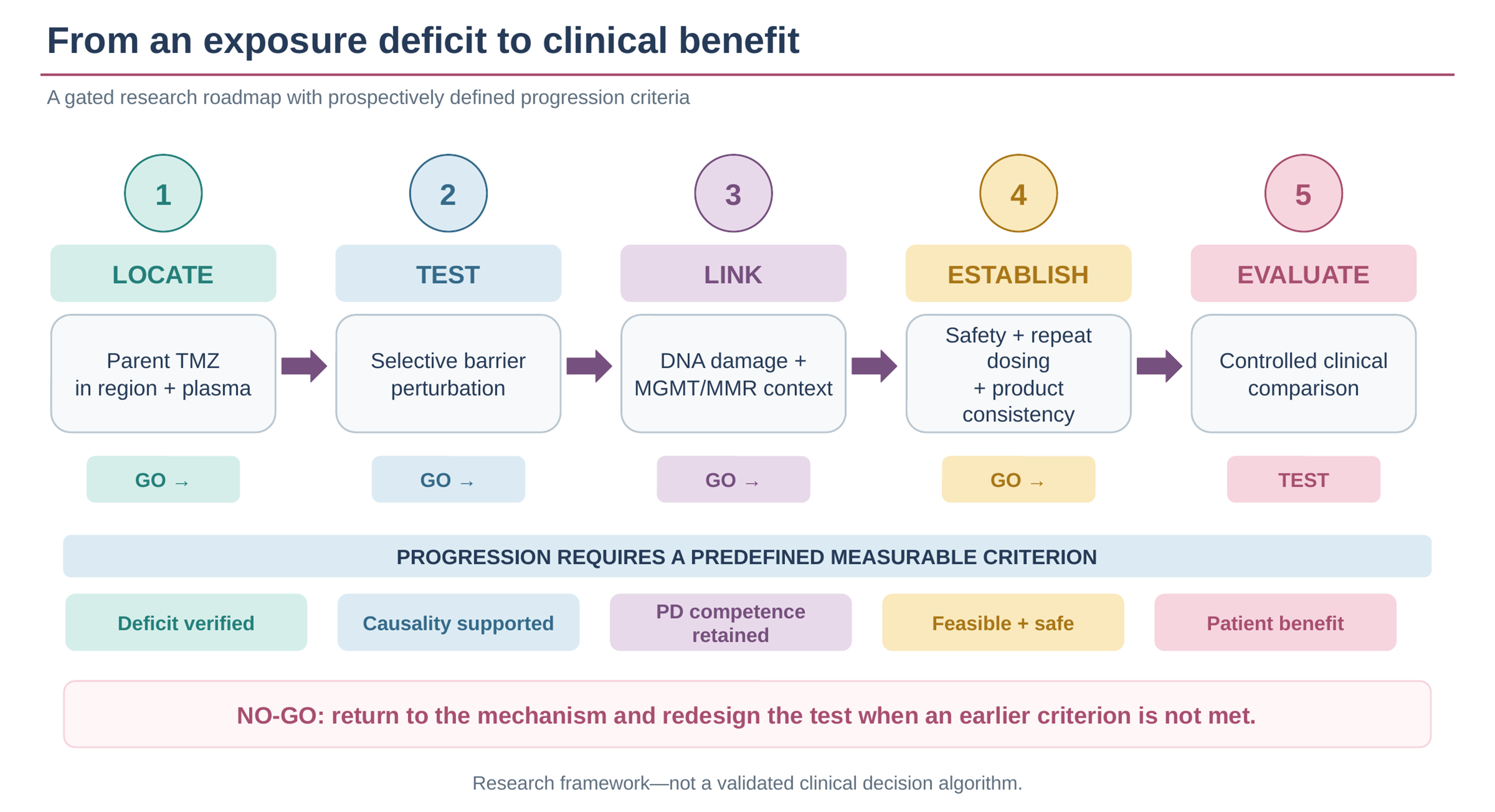
Figure 2. Proposed research roadmap from an exposure deficit to clinical benefit. Each step links a mechanistic question to a measurable endpoint. MGMT and MMR are considered separately. Progression criteria require prospective definition and validation; this framework does not prescribe patient treatment. This figure was created by the authors using Python/python-pptx and LibreOffice. No AI-based image-generation tools or third-party graphical elements were used. MGMT: O6-Methylguanine-DNA methyltransferase; MMR: mismatch-repair; TMZ: temozolomide.
Figure 3 integrates these translational priorities with the underlying exposure barriers and DNA-damage pathways, emphasizing why improved delivery and reversal of cellular resistance are not interchangeable outcomes.
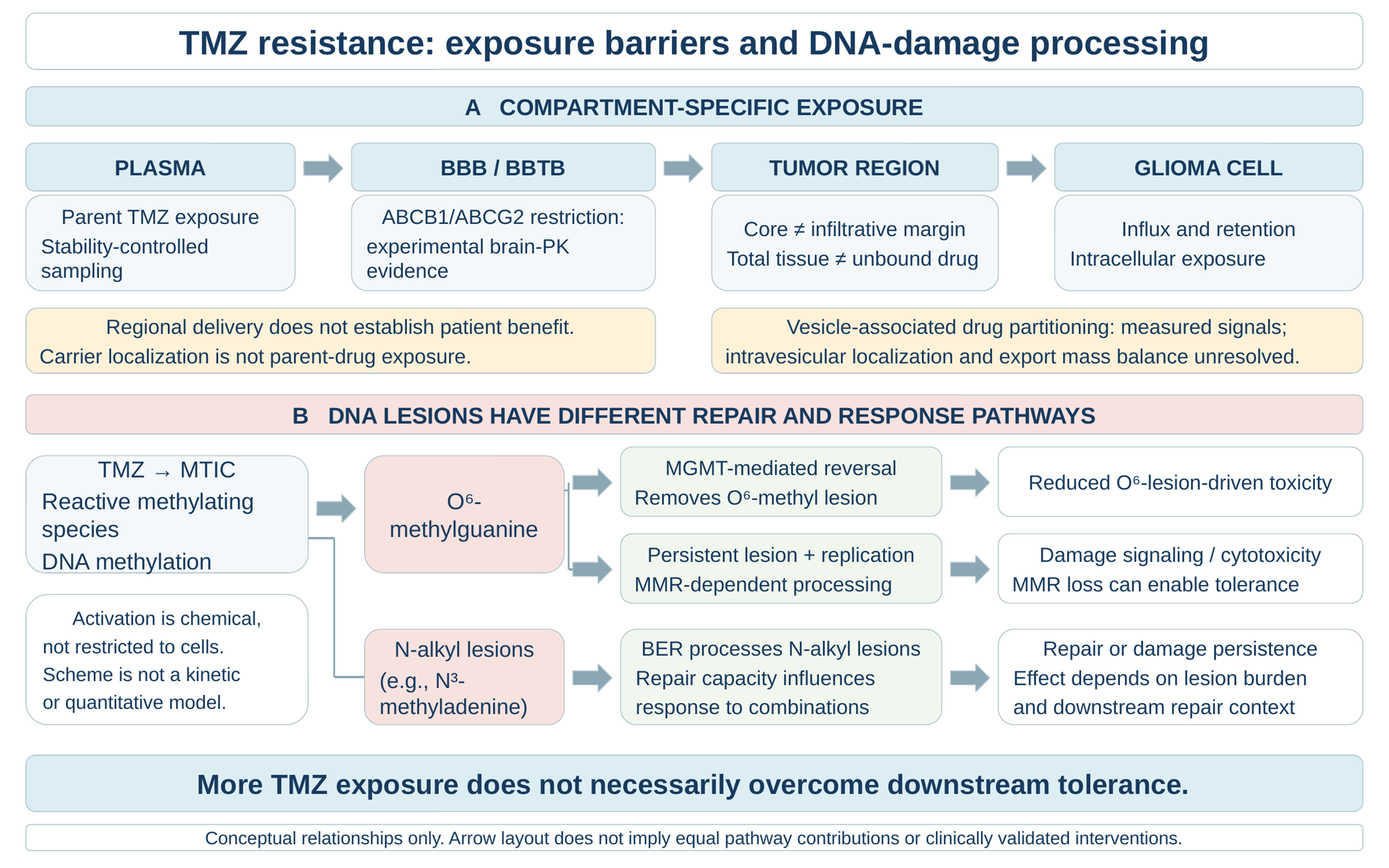
Figure 3. Exposure barriers and DNA-damage processing jointly shape the response to TMZ. (A) Compartment-specific exposure must be distinguished from carrier localization and clinical efficacy; vesicle-associated drug signals alone do not establish intravesicular localization or export mass balance; (B) Chemical activation generates methylating species and distinct DNA lesions. MGMT-mediated removal of O6-methylguanine and MMR-dependent processing of persistent lesions have different implications for response, whereas BER processes N-alkyl lesions. The diagram summarizes the mechanisms discussed in “DNA-repair context determines whether increased exposure is useful”, “Endothelial transport at the blood–brain and blood–brain tumor barriers”, “Tumor-cell transport: direct efflux, uptake, and nontransport functions”, and “Vesicles, membrane remodeling, and intracellular redistribution”, as well as in Table 3[2,23,60]; it is neither a quantitative kinetic model nor a validated treatment algorithm. This figure was created by the authors using Python/python-pptx and LibreOffice. No AI-based image-generation tools or third-party graphical elements were used. TMZ: Temozolomide; MGMT: O6-methylguanine-DNA methyltransferase; MMR: mismatch-repair; BER: base-excision repair; BBB: blood–brain barrier; BBTB: blood–brain tumor barrier; ABCB1: ATP-binding cassette subfamily B member 1; ABCG2: ATP-binding cassette subfamily G member 2; PK: pharmacokinetics; MTIC: 5-(3-methyltriazen-1-yl)imidazole-4-carboxamide.
CONCLUSIONS
TMZ disposition and treatment response are constrained across multiple anatomical and cellular compartments, but transporter-associated phenotypes should not be equated with direct TMZ export. The strongest evidence supports an experimental contribution of endothelial ABCB1/ABCG2 to brain exposure; evidence from tumor cells is more heterogeneous and includes negative findings, alternative substrates, nontransport signaling, and uptake-dependent sensitivity. Across the audited delivery studies, formulation innovation has outpaced analyte-resolved pharmacology: carrier characterization, localization, uptake, and efficacy are common, whereas direct parent-TMZ exposure measurements in the relevant intracranial compartment remain exceptional. In particular, survival outcomes in single-arm focused-ultrasound studies cannot establish an ultrasound-attributable benefit without a randomized comparator.
The principal translational gap is therefore an endpoint mismatch between what is engineered and what is measured. Future programs should link anatomical compartment, analyte identity, parent or unbound drug exposure, pharmacodynamic response, safety, and clinical feasibility within a single evidence chain. This standard would prevent carrier signals from being mistaken for TMZ delivery and prioritize platforms that measurably improve exposure at infiltrative, pharmacologically responsive tumor sites.
DECLARATIONS
Acknowledgments
The graphical abstract was created using BioRender. Created in BioRender. Jiang, T. (2026) https://BioRender.com/7ki8g2z.
Authors’ contributions
Conceptualization: Jiang T, Zhang W, Lin X
Methodology: Jiang T, Jia Z
Investigation: Jiang T, Jia Z, Cen X, Zhao Y, Qian K, Li T, Chen W, Gan L, Ma C
Data curation: Jiang T, Jia Z, Cen X, Zhao Y, Qian K, Li T, Ma C
Formal analysis: Jiang T, Jia Z
Validation: Cen X, Zhao Y, Qian K, Li T, Chen W, Gan L
Visualization: Zhao Y, Gan L
Writing - original draft: Jiang T, Jia Z, Cen X, Zhao Y
Writing - review and editing: Jiang T, Jia Z, Cen X, Zhao Y, Qian K, Li T, Chen W, Gan L, Ma C, Zhang W, Lin X
Supervision, project administration and funding acquisition: Zhang W, Lin X
All authors approved the submitted version and agree to be accountable for the accuracy and integrity of the work.
Availability of data and materials
Supplementary Table 1 provides the structured study-level audit of 15 representative TMZ-containing delivery-platform studies. No new patient-level dataset was generated.
AI and AI-assisted tools statement
During preparation of this manuscript, the authors used OpenAI (version GPT-5.6, released July 9, 2026). for English grammar checking, formatting assistance, and consistency checks. The authors reviewed and revised all AI-assisted text, independently verified the cited sources and scientific interpretations, and take full responsibility for the final manuscript and figures.
Financial support and sponsorship
This work was supported by the 2025 National TCM Comprehensive Reform Demonstration Zone Science and Technology Joint Construction Major Project (No. GZY-KJS-ZJ-2025-012); the Zhejiang Chinese Medical University University-level Research Project (No. 2023FSYYZY17); the Clinical Collaboration Project of Chinese and Western Medicine for Major Difficult Diseases (ZDYN-2024-A-141); “Mechanistic study on the controlled opening of the blood–brain barrier by specific-mode electroacupuncture stimulation through astrocytic Cebpd-mediated oxidative stress responses” (No. 82474626); and “Mechanistic Study on the Controlled Opening of the Blood–Brain Barrier by Specific-Mode Electroacupuncture via Regulation of LC–NE System-Mediated Microglial Dynamics” (No. 82505733). The funders had no role in study design, data collection, analysis, interpretation, manuscript preparation or the decision to submit.
Conflicts of interest
All authors declared that there are no conflicts of interest.
Ethical approval and consent to participate
Not applicable.
Consent for publication
Not applicable.
Copyright
©The Author(s) 2026.
Supplementary Materials
REFERENCES
1. Durga YK, Pusapati RV. Drug resistance in glioblastoma: challenges, mechanisms and therapeutic strategies (Review). Mol Clin Oncol. 2026;24:4.
2. Smerdi D, Moutafi M, Kotsantis I, Stavrinou LC, Psyrri A. Overcoming resistance to temozolomide in glioblastoma: a scoping review of preclinical and clinical data. Life. 2024;14:673.
3. Wu H, Gao W, Chen P, Wei Y, Zhao H, Wang F. Research progress of drug resistance mechanism of temozolomide in the treatment of glioblastoma. Heliyon. 2024;10:e39984.
4. Bouzinab K, Summers H, Zhang J, et al. In search of effective therapies to overcome resistance to temozolomide in brain tumours. Cancer Drug Resist. 2019;2:1018-31.
5. Lin F, de Gooijer MC, Hanekamp D, Brandsma D, Beijnen JH, van Tellingen O. Targeting core (mutated) pathways of high-grade gliomas: challenges of intrinsic resistance and drug efflux. CNS Oncol. 2013;2:271-88.
6. Cruz JVR, Batista C, Afonso BH, et al. Obstacles to glioblastoma treatment two decades after temozolomide. Cancers. 2022;14:3203.
7. Ortiz R, Perazzoli G, Cabeza L, et al. Temozolomide: an updated overview of resistance mechanisms, nanotechnology advances and clinical applications. Curr Neuropharmacol. 2021;19:513-37.
8. Harder BG, Blomquist MR, Wang J, et al. Developments in blood-brain barrier penetrance and drug repurposing for improved treatment of glioblastoma. Front Oncol. 2018;8:462.
9. Hanna C, Kurian KM, Williams K, et al. Pharmacokinetics, safety, and tolerability of olaparib and temozolomide for recurrent glioblastoma: results of the phase I OPARATIC trial. Neuro Oncol. 2020;22:1840-50.
10. Ostermann S, Csajka C, Buclin T, et al. Plasma and cerebrospinal fluid population pharmacokinetics of temozolomide in malignant glioma patients. Clin Cancer Res. 2004;10:3728-36.
11. Portnow J, Badie B, Chen M, Liu A, Blanchard S, Synold TW. The neuropharmacokinetics of temozolomide in patients with resectable brain tumors: potential implications for the current approach to chemoradiation. Clin Cancer Res. 2009;15:7092-8.
12. Jackson S, Weingart J, Nduom EK, et al. The effect of an adenosine A2A agonist on intra-tumoral concentrations of temozolomide in patients with recurrent glioblastoma. Fluids Barriers CNS. 2018;15:2.
13. Büsker S, Jäger W, Poschner S, et al. Pharmacokinetics of metronomic temozolomide in cerebrospinal fluid of children with malignant central nervous system tumors. Cancer Chemother Pharmacol. 2022;89:617-27.
14. Mainprize T, Lipsman N, Huang Y, et al. Blood-brain barrier opening in primary brain tumors with non-invasive MR-guided focused ultrasound: a clinical safety and feasibility study. Sci Rep. 2019;9:321.
15. Park SH, Kim MJ, Jung HH, et al. One-year outcome of multiple blood-brain barrier disruptions with temozolomide for the treatment of glioblastoma. Front Oncol. 2020;10:1663.
16. Woodworth GF, Anastasiadis P, Ozair A, et al. Microbubble-enhanced transcranial focused ultrasound with temozolomide for patients with high-grade glioma (BT008NA): a multicentre, open-label, phase 1/2 trial. Lancet Oncol. 2025;26:1651-64.
17. Talele S, Zhang W, Burgenske DM, et al. Brain distribution of berzosertib: an ataxia telangiectasia and Rad3-related protein inhibitor for the treatment of glioblastoma. J Pharmacol Exp Ther. 2021;379:343-57.
18. Rathi S, Mladek AC, Oh JH, et al. Factors influencing the central nervous system (CNS) distribution of the ataxia telangiectasia mutated and Rad3-related inhibitor elimusertib (BAY1895344): implications for the treatment of CNS tumors. J Pharmacol Exp Ther. 2024;391:346-60.
19. Liu Y, Wang W, Zhang D, et al. Brain co-delivery of first-line chemotherapy drug and epigenetic bromodomain inhibitor for multidimensional enhanced synergistic glioblastoma therapy. Exploration. 2022;2:20210274.
20. Dhungel L, Rowsey ME, Harris C, Raucher D. Synergistic effects of temozolomide and doxorubicin in the treatment of glioblastoma multiforme: enhancing efficacy through combination therapy. Molecules. 2024;29:840.
21. Da Ros M, Iorio AL, De Gregorio V, et al. Aldoxorubicin and temozolomide combination in a xenograft mice model of human glioblastoma. Oncotarget. 2018;9:34935-44.
22. Ribeiro Morais G, Nwokolo GC, Lamptey Mills HNL, Wheelhouse RT, Falconer RA. Exploiting methyl triazenes as attractive alternatives to temozolomide and dacarbazine for cancer therapy. Molecules. 2026;31:1103.
23. de Gooijer MC, de Vries NA, Buckle T, et al. Improved brain penetration and antitumor efficacy of temozolomide by inhibition of ABCB1 and ABCG2. Neoplasia. 2018;20:710-20.
24. Amarandi RM, Ibanescu A, Carasevici E, Marin L, Dragoi B. Liposomal-based formulations: a path from basic research to temozolomide delivery inside glioblastoma tissue. Pharmaceutics. 2022;14:308.
25. Ke G, Zhang M, Hu P, et al. Exploratory study on nanoparticle co-delivery of temozolomide and ligustilide for enhanced brain tumor therapy. Pharmaceutics. 2025;17:191.
26. Thomas RG, Kim S, Tran TA, et al. Magnet-guided temozolomide and ferucarbotran loaded nanoparticles to enhance therapeutic efficacy in glioma model. Nanomaterials. 2024;14:939.
27. Deligne C, Hachani J, Duban-Deweer S, et al. Development of a human in vitro blood-brain tumor barrier model of diffuse intrinsic pontine glioma to better understand the chemoresistance. Fluids Barriers CNS. 2020;17:37.
28. Ferber S, Tiram G, Sousa-Herves A, et al. Co-targeting the tumor endothelium and P-selectin-expressing glioblastoma cells leads to a remarkable therapeutic outcome. Elife. 2017;6:e25281.
29. Vézina A, Manglani M, Morris D, et al. Adenosine A2A receptor activation enhances blood-tumor barrier permeability in a rodent glioma model. Mol Cancer Res. 2021;19:2081-95.
30. Perazzoli G, Prados J, Ortiz R, et al. Temozolomide resistance in glioblastoma cell lines: implication of MGMT, MMR, P-glycoprotein and CD133 expression. PLoS One. 2015;10:e0140131.
31. Riganti C, Salaroglio IC, Pinzòn-Daza ML, et al. Temozolomide down-regulates P-glycoprotein in human blood-brain barrier cells by disrupting Wnt3 signaling. Cell Mol Life Sci. 2014;71:499-516.
32. Riganti C, Salaroglio IC, Caldera V, et al. Temozolomide downregulates P-glycoprotein expression in glioblastoma stem cells by interfering with the Wnt3a/glycogen synthase-3 kinase/β-catenin pathway. Neuro Oncol. 2013;15:1502-17.
33. Tivnan A, Zakaria Z, O’Leary C, et al. Inhibition of multidrug resistance protein 1 (MRP1) improves chemotherapy drug response in primary and recurrent glioblastoma multiforme. Front Neurosci. 2015;9:218.
34. de Souza I, Monteiro LKS, Guedes CB, et al. High levels of NRF2 sensitize temozolomide-resistant glioblastoma cells to ferroptosis via ABCC1/MRP1 upregulation. Cell Death Dis. 2022;13:591.
35. Lee CAA, Banerjee P, Wilson BJ, et al. Targeting the ABC transporter ABCB5 sensitizes glioblastoma to temozolomide-induced apoptosis through a cell-cycle checkpoint regulation mechanism. J Biol Chem. 2020;295:7774-88.
36. Wang SM, Lin WC, Lin HY, Chen YL, Ko CY, Wang JM. CCAAT/Enhancer-binding protein delta mediates glioma stem-like cell enrichment and ATP-binding cassette transporter ABCA1 activation for temozolomide resistance in glioblastoma. Cell Death Discov. 2021;7:8.
37. Yan Y, Liu Y, Liang Q, Xu Z. Drug metabolism-related gene ABCA1 augments temozolomide chemoresistance and immune infiltration abundance of M2 macrophages in glioma. Eur J Med Res. 2023;28:373.
38. Diao H, Sun Y, Zhou X, et al. GLUT3 enhances chemosensitivity in glioblastoma by transporting temozolomide and capecitabine. Cell Death Discov. 2025;11:382.
39. Bahrami K, Kärkkäinen J, Bibi S, et al. Specific transport of temozolomide does not override DNA repair-mediated chemoresistance. Eur J Pharm Sci. 2024;195:106661.
40. Xu Y, Yang X, Mei S, Sun Y, Li J. Acquisition of temozolomide resistance by the rat C6 glioma cell line increases cell migration and side population phenotype. Oncol Rep. 2019;42:2355-62.
41. Banelli B, Carra E, Barbieri F, et al. The histone demethylase KDM5A is a key factor for the resistance to temozolomide in glioblastoma. Cell Cycle. 2015;14:3418-29.
42. Brandt B, Németh M, Berta G, et al. A promising way to overcome temozolomide resistance through inhibition of protein neddylation in glioblastoma cell lines. Int J Mol Sci. 2023;24:7929.
43. Mujumdar P, Kopecka J, Bua S, Supuran CT, Riganti C, Poulsen SA. Carbonic anhydrase XII inhibitors overcome temozolomide resistance in glioblastoma. J Med Chem. 2019;62:4174-92.
44. Zou Y, Liu Z, Zhou Y, et al. TRPC5 mediates TMZ resistance in TMZ-resistant glioblastoma cells via NFATc3-P-gp pathway. Transl Oncol. 2021;14:101214.
45. Zhang X, Liu X, Zhou W, et al. Fasudil increases temozolomide sensitivity and suppresses temozolomide-resistant glioma growth via inhibiting ROCK2/ABCG2. Cell Death Dis. 2018;9:190.
46. Silva JA, Colquhoun A. Effect of polyunsaturated fatty acids on temozolomide drug-sensitive and drug-resistant glioblastoma cells. Biomedicines. 2023;11:779.
47. Qiu R, Zhang J, Ge C, et al. Ginsenosides Rg1 and CK control temozolomide resistance in glioblastoma cells by modulating cholesterol efflux and lipid raft distribution. Evid Based Complement Alternat Med. 2022;2022:1897508.
48. Pessina S, Cantini G, Kapetis D, et al. The multidrug-resistance transporter Abcc3 protects NK cells from chemotherapy in a murine model of malignant glioma. Oncoimmunology. 2016;5:e1108513.
49. Ha W, Sevim-Nalkiran H, Zaman AM, et al. Ibudilast sensitizes glioblastoma to temozolomide by targeting macrophage migration inhibitory factor (MIF). Sci Rep. 2019;9:2905.
50. Kim SS, Harford JB, Moghe M, Rait A, Pirollo KF, Chang EH. Targeted nanocomplex carrying siRNA against MALAT1 sensitizes glioblastoma to temozolomide. Nucleic Acids Res. 2018;46:1424-40.
51. Che J, DePalma TJ, Sivakumar H, et al. αCT1 peptide sensitizes glioma cells to temozolomide in a glioblastoma organoid platform. Biotechnol Bioeng. 2023;120:1108-19.
52. Tso JL, Yang S, Menjivar JC, et al. Bone morphogenetic protein 7 sensitizes O6-methylguanine methyltransferase expressing-glioblastoma stem cells to clinically relevant dose of temozolomide. Mol Cancer. 2015;14:189.
53. Minea RO, Duc TC, Swenson SD, et al. Developing a clinically relevant radiosensitizer for temozolomide-resistant gliomas. PLoS One. 2020;15:e0238238.
54. Harder BG, Peng S, Sereduk CP, et al. Inhibition of phosphatidylinositol 3-kinase by PX-866 suppresses temozolomide-induced autophagy and promotes apoptosis in glioblastoma cells. Mol Med. 2019;25:49.
55. Buccarelli M, Marconi M, Pacioni S, et al. Inhibition of autophagy increases susceptibility of glioblastoma stem cells to temozolomide by igniting ferroptosis. Cell Death Dis. 2018;9:841.
56. Zhao Z, Liu M, Long W, et al. Knockdown lncRNA CRNDE enhances temozolomide chemosensitivity by regulating autophagy in glioblastoma. Cancer Cell Int. 2021;21:456.
57. Karło W, Długoń M, Gutowska I, Wszołek A, Żwierełło W. Targeting ferroptosis in glioblastoma: molecular mechanisms, tumor microenvironment, and therapeutic opportunities. Cancers. 2026;18:2018.
58. Zhao J, Cui X, Zhan Q, et al. CRISPR-Cas9 library screening combined with an exosome-targeted delivery system addresses tumorigenesis/TMZ resistance in the mesenchymal subtype of glioblastoma. Theranostics. 2024;14:2835-55.
59. Xing H, Chen Y, Li H, Wang M, Cao Y, Liu X. ARL13B is regulated by the ERK/P90 pathway and mediates TMZ resistance in glioblastoma via microvesicles. Sci Rep. 2026;16:28405.
60. Hong B, Yang E, Su D, et al. EPIC-1042 as a potent PTRF/Cavin1-caveolin-1 interaction inhibitor to induce PARP1 autophagic degradation and suppress temozolomide efflux for glioblastoma. Neuro Oncol. 2024;26:100-14.
61. Araujo-Abad S, Manresa-Manresa A, Rodríguez-Cañas E, et al. Glioblastoma-derived small extracellular vesicles: nanoparticles for glioma treatment. Int J Mol Sci. 2023;24:5910.
62. Yekula A, Taylor A, Beecroft A, et al. The role of extracellular vesicles in acquisition of resistance to therapy in glioblastomas. Cancer Drug Resist. 2021;4:1-16.
63. Kosgodage US, Uysal-Onganer P, MacLatchy A, et al. Cannabidiol affects extracellular vesicle release, miR21 and miR126, and reduces prohibitin protein in glioblastoma multiforme cells. Transl Oncol. 2019;12:513-22.
64. Pourmasoumi P, Abdouss M, Farhadi M, Jameie SB, Khonakdar HA. Co-delivery of temozolomide and quercetin with folic acid-conjugated exosomes in glioblastoma treatment. Nanomedicine. 2024;19:2271-87.
65. Liu X, Cao Z, Liu N, et al. Kill two birds with one stone: engineered exosome-mediated delivery of cholesterol modified YY1-siRNA enhances chemoradiotherapy sensitivity of glioblastoma. Front Pharmacol. 2022;13:975291.
66. Wang S, Yu Y, Wang A, et al. Temozolomide hexadecyl ester targeted plga nanoparticles for drug-resistant glioblastoma therapy via intranasal administration. Front Pharmacol. 2022;13:965789.
67. Rehman FU, Rauf MA, Ullah S, et al. Ultrasound-activated nano-TiO2 loaded with temozolomide paves the way for resection of chemoresistant glioblastoma multiforme. Cancer Nano. 2021;12:17.
68. Lam FC, Morton SW, Wyckoff J, et al. Enhanced efficacy of combined temozolomide and bromodomain inhibitor therapy for gliomas using targeted nanoparticles. Nat Commun. 2018;9:1991.
69. Aytekin E, Maksoud S, Tannous BA, Pehlivan SB, Badr CE. Dual-action nanotherapy: temozolomide-loaded, anti-PD-L1 scFv-functionalized lipid nanocarriers for targeted glioblastoma therapy. Eur J Pharm Sci. 2025;213:107255.
70. Song Z, Huang X, Wang J, Cai F, Zhao P, Yan F. Targeted delivery of liposomal temozolomide enhanced anti-glioblastoma efficacy through ultrasound-mediated blood-brain barrier opening. Pharmaceutics. 2021;13:1270.
71. Wang Z, Liu Y, Xiao Y, et al. Intelligent nanoparticles with pH-sensitive co-delivery of temozolomide and siEGFR to ameliorate glioma therapy. Front Genet. 2022;13:921051.
72. Haseeb M, Khan I, Kartal Z, Mahfooz S, Hatiboglu MA. Status quo in the liposome-based therapeutic strategies against glioblastoma: “targeting the tumor and tumor microenvironment”. Int J Mol Sci. 2024;25:11271.
73. Zarneshan SN, Aghaz F. Engineered nanoparticles as a promising drug delivery system for glioblastoma multiforme treatment. Ther Deliv. 2025;16:593-606.
74. Mishra P, Gupta P, Markowska A, Ghavami S, Markowski J, Łos MJ. Advancements in drug delivery systems in glioblastoma therapy. Int J Mol Sci. 2026;27:2298.
75. Sousa DM, Loureiro JA, Pereira MC, Ramalho MJ. Surface-modified polymeric nanoparticles for glioblastoma therapy: a review on targeting strategies and delivery of repurposed drugs and off-label non-alkylating agents. Pharmaceutics. 2026;18:435.
76. Hegde MM, Palkar P, Mutalik SP, Mutalik S, Goda JS, Rao BSS. Enhancing glioblastoma cytotoxicity through encapsulating O6-benzylguanine and temozolomide in PEGylated liposomal nanocarrier: an in vitro study. 3 Biotech. 2024;14:275.
77. Kim SS, Rait A, Kim E, et al. A nanoparticle carrying the p53 gene targets tumors including cancer stem cells, sensitizes glioblastoma to chemotherapy and improves survival. ACS Nano. 2014;8:5494-514.
78. Angom RS, Rachamala HK, Nakka NMR, et al. Surface-engineered dual drug-loaded tumor-targeted liposomal nanoparticles to overcome the therapeutic resistance in glioblastoma multiforme. Commun Med. 2026;6:152.
79. Wang H, Li L, Ye J, et al. Improved safety and anti-glioblastoma efficacy of CAT3-encapsulated SMEDDS through metabolism modification. Molecules. 2021;26:484.
80. Bayanati M, Khosroshahi AG, Alvandi M, Mahboobian MM, Sun F. Fabrication of a thermosensitive in situ gel nanoemulsion for nose to brain delivery of temozolomide. J Nanomater. 2021.
81. Morales DE, Mousa S. Intranasal delivery in glioblastoma treatment: prospective molecular treatment modalities. Heliyon. 2022;8:e09517.
82. Yang Q, Zhou Y, Chen J, Huang N, Wang Z, Cheng Y. Gene therapy for drug-resistant glioblastoma via lipid-polymer hybrid nanoparticles combined with focused ultrasound. Int J Nanomedicine. 2021;16:185-99.
83. Bauer JA, Sysel AM, Dunphy MJ. Selective blood-brain barrier penetration and tumor targeting of nitrosylcobalamin in glioblastoma: pharmacokinetics, tissue distribution, and synergistic activity with trail and temozolomide. Oncoscience. 2026;13:120-9.
84. Zhang X, Chen Y, Yao J, et al. β-elemene combined with temozolomide in treatment of brain glioma. Biochem Biophys Rep. 2021;28:101144.
85. Persano F, Gigli G, Leporatti S. Natural compounds as promising adjuvant agents in the treatment of gliomas. Int J Mol Sci. 2022;23:3360.
86. Alfonso-Triguero P, Lorenzo J, Candiota AP, Arús C, Ruiz-Molina D, Novio F. Platinum-based nanoformulations for glioblastoma treatment: the resurgence of platinum drugs? Nanomaterials. 2023;13:1619.
87. Rahman MA, Yadab MK, Ali MM. Therapeutic advances of curcumin and nanocurcumin in glioblastoma: molecular targets, bioavailability, and drug delivery. Nutrients. 2026;18:194.
88. Shen X, Wang Y, Lin Y, et al. Traditional Chinese medicine-derived active ingredient and formulation therapy for glioma: multi-target mechanisms, drug delivery systems, and advances in clinical translational research. Pharmaceuticals. 2026;19:782.
89. Behl T, Sharma A, Sharma L, et al. Current perspective on the natural compounds and drug delivery techniques in glioblastoma multiforme. Cancers. 2021;13:2765.
90. Rahman MA, Yadab MK, Apu EH, Ali MM. Nanoparticle-based delivery of proteasome inhibitors for glioblastoma therapy: strategies to overcome blood-brain barrier and therapeutic resistance. Biochem Pharmacol. 2026;251:118058.
91. Elati AH, Davies EW, Mishra MV, Winkles JA, Woodworth GF, Kim AJ. Platinum-based therapeutics as emerging multi-modal radiosensitizers in glioblastoma treatment. Adv Drug Deliv Rev. 2026;232:115811.
92. Smiley SB, Zarrinmayeh H, Das SK, Pollok KE, Vannier MW, Veronesi MC. Novel therapeutics and drug-delivery approaches in the modulation of glioblastoma stem cell resistance. Ther Deliv. 2022;13:249-73.
93. Sareen H, Garrett C, Lynch D, et al. The role of liquid biopsies in detecting molecular tumor biomarkers in brain cancer patients. Cancers. 2020;12:1831.
94. Jensen KV, Cseh O, Aman A, Weiss S, Luchman HA. The JAK2/STAT3 inhibitor pacritinib effectively inhibits patient-derived GBM brain tumor initiating cells in vitro and when used in combination with temozolomide increases survival in an orthotopic xenograft model. PLoS One. 2017;12:e0189670.
95. Feng Y, Xu Q, Fang M, Hu C. Anlotinib combined with temozolomide for the treatment of patients with diffuse midline glioma: a case report and literature review. Transl Cancer Res. 2022;11:3876-82.
96. Iorio AL, da Ros M, Genitori L, et al. Tumor response of temozolomide in combination with morphine in a xenograft model of human glioblastoma. Oncotarget. 2017;8:89595-606.
97. Yazici E, Gezen A, Kalay M, et al. Donafenib suppresses glioblastoma progression: potential enhancement of therapeutic response in TMZ-resistant models. Naunyn Schmiedebergs Arch Pharmacol. 2026;399:20505-20.
98. Palizkaran Yazdi M, Barjasteh A, Moghbeli M. MicroRNAs as the pivotal regulators of temozolomide resistance in glioblastoma. Mol Brain. 2024;17:42.
100. Liu X, Liu Y, Li W, et al. The toxic effect and mechanism of TMZ combined with siHOXB9 on glioblastoma cells. Int J Mol Sci. 2025;27:79.
101. Sharma Y, Parihar A, Arya N, et al. Ferroptosis-based nanotherapeutic strategies to overcome temozolomide resistance in glioblastoma: a systematic review and meta-analysis. Curr Oncol. 2026;33:194.
Cite This Article
 Open Access
How to Cite
Jiang T, Jia Z, Cen X, Zhao Y, Qian K, Li T, Chen W, Gan L, Ma C, Zhang W, Lin X. Temozolomide exposure and delivery barriers in glioma: cross-compartment pharmacokinetics and implications for resistance. Cancer Drug Resist. 2026;9:40. https://dx.doi.org/10.20517/cdr.2026.129
Download Citation
If you have the appropriate software installed, you can download article citation data to the citation manager of your choice. Simply select your manager software from the list below and click on download.
Export Citation File
Type of Import
Tips on Downloading Citation
Citation Manager File Format
Type of Import
Direct Import: When the Direct Import option is selected (the default state), a dialogue box will give you the option to Save or Open the downloaded citation data. Choosing Open will either launch your citation manager or give you a choice of applications with which to use the metadata. The Save option saves the file locally for later use.
Indirect Import: When the Indirect Import option is selected, the metadata is displayed and may be copied and pasted as needed.
About This Article
Copyright

Data & Comments
Data
0











Comments
Comments must be written in English. Spam, offensive content, impersonation, and private information will not be permitted. If any comment is reported and identified as inappropriate content by OAE staff, the comment will be removed without notice. If you have any queries or need any help, please contact us at [email protected].