

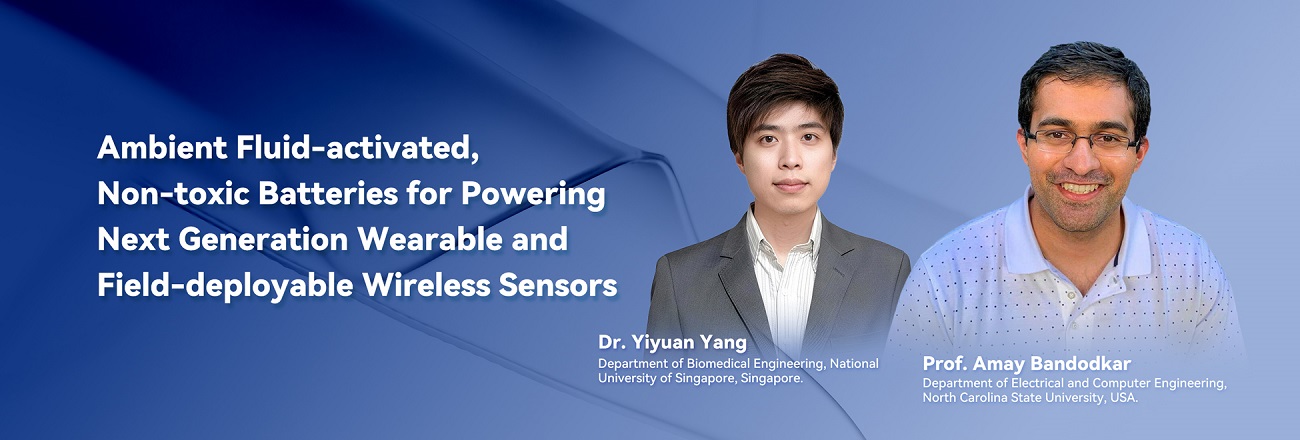
Ambient fluid-activated, non-toxic batteries for powering next generation wearable and field-deployable wireless sensors
Time
July 3, 2026
9:00 PM (Beijing Time, UTC+8)
9:00 AM (Raleigh Time, UTC−4)
9:00 PM (Beijing Time, UTC+8)
9:00 AM (Raleigh Time, UTC−4)
Join the Webinar

Join Zoom:
https://us06web.zoom.us/j/88373190186?pwd=NzgdTclX3jqqbRQWxrAEf6dn994XNI.1
Meeting ID: 883 7319 0186
Passcode: 260703
Share
Contents
Guest

Amay Bandodkar
North Carolina State University
Amay J. Bandodkar is an assistant professor and Goodnight Early Career Innovator Fellow in thedepartment of Electrical and Computer Engineering at North Carolina State University with additionalaffiliations to the Center for Advanced Self-Powered Systems of Integrated Sensors and Technologies(ASSIST) and Lampe Joint Department of Biomedical Engineering, North Carolina State University andUniversity of North Carolina at Chapel Hill. He received his Integrated Master’s in Technology(M.TECH.) in Applied Chemistry from Indian Institute of Technology – Banaras Hindu University, India,in 2011 and Ph.D. in Nano-engineering from University of California San Diego, USA, in 2016.Thereafter, he was a postdoctoral fellow in the department of Materials Science and Engineering atNorthwestern University (2016-2020).He has authored more than 50 papers in journals including Nature Electronics, NatureCommunications, and Science Advances, in the fields of soft electronics, wearable biochemicalsensors, self-powered systems, energy harvesters, and unconventional hybrid manufacturing. Inrecognition of his multi-disciplinary research, academic excellence, and demonstrated leadership, he has received the 2022 IEEE Sensors Early Career Award, 2021 MIT Technology Review 35 Innovatorsunder 35, 2021 Biosensors Young Investigator Award, 2016 Metrohm Young Chemist Award, 2016MRS Graduate Student Award, 2016 Siebel Scholars Award, 2015 Interdisciplinary Research Award,and 2011 Undergraduate Research Publication Award.
Moderator

Yiyuan Yang
National University of Singapore
Dr. Yang joined the Department of Biomedical Engineering and N.1 Institute for Health at NUS in August 2024 as an Assistant Professor. He was awarded for the Presidential Young Professorship. He earned his Ph.D. in Mechanical Engineering from Northwestern University in 2021 and completed his postdoctoral research at the Massachusetts Institute of Technology in 2024. His research focuses on developing wireless optogenetic devices for exploring neural dynamics and biorobotics. Additionally, he is working on ingestible devices designed for long-term continuous monitoring of activity and pathology in the gastrointestinal tract, as well as closed-loop medication delivery. His contributions have resulted in world-class publications, garnering international recognition; his work was ranked #1 among similarly aged articles in Nature Neuroscience according to Altmetric and featured in over 50 news outlets, including "The Times," "New York Times," and "Science News." In 2024, he received the “Outstanding Young Scientist” award from Microsystems & Nanoengineering.