


2D-to-3D assembly methods for flexible electronic devices

Contents
Guest

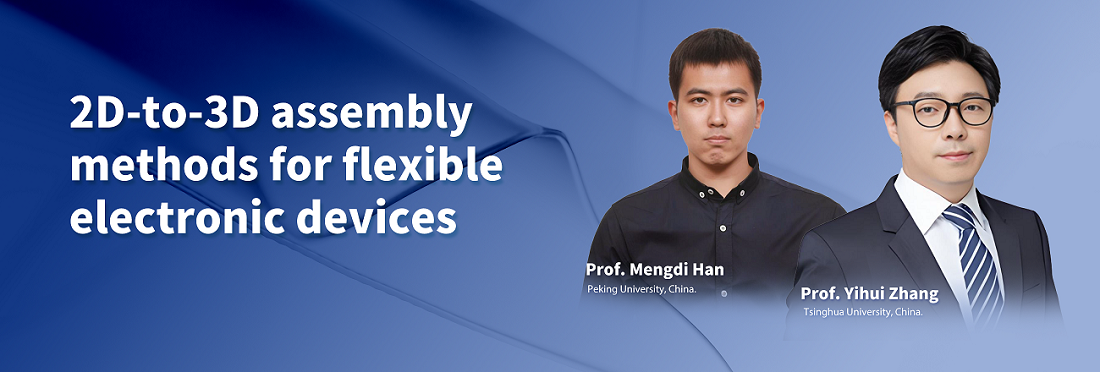
Yihui Zhang
Yihui Zhang is a tenured professor in the Department of Engineering Mechanics at the School of Aerospace Engineering, Tsinghua University, and a recipient of the National Science Fund for Distinguished Young Scholars. His research focuses on solid mechanics, 3D micro–nano structural assembly, bioelectronics, and microrobotics. He has published more than 190 research papers and holds 11 granted Chinese invention patents and 3 U.S. invention patents. As corresponding or first author, his work has appeared in leading journals such as Science, Nature, Nature Materials, Nature Electronics, Nature Machine Intelligence, Nature Reviews Materials, Science Robotics, NSR, Science Advances, Nature Communications, and JMPS.
He has received numerous honors, including the Distinguished Young Scholars Award (NSFC), the XPLORER Prize, the Young Scientist Award of the Chinese Society of Theoretical and Applied Mechanics, the Hong Kong Qiushi Outstanding Young Scholar Award, the Rice Award from SES, the Larson Award from ASME, and MIT Technology Review’s TR35. He has also been recognized for many consecutive years as a Clarivate Highly Cited Researcher. Professor Zhang currently serves as Deputy Editor of Science Advances and as Editor for Mechanics of Materials and Soft Science, among other editorial roles.
He has received numerous honors, including the Distinguished Young Scholars Award (NSFC), the XPLORER Prize, the Young Scientist Award of the Chinese Society of Theoretical and Applied Mechanics, the Hong Kong Qiushi Outstanding Young Scholar Award, the Rice Award from SES, the Larson Award from ASME, and MIT Technology Review’s TR35. He has also been recognized for many consecutive years as a Clarivate Highly Cited Researcher. Professor Zhang currently serves as Deputy Editor of Science Advances and as Editor for Mechanics of Materials and Soft Science, among other editorial roles.
Moderator

Mengdi Han
Mengdi Han is an assistant professor, researcher, and Ph.D. advisor in the Department of Biomedical Engineering at the Institute for Future Technology, Peking University. She is a recipient of the national Young Overseas High-Level Talent Program. As first or corresponding author, her papers have been published in Nature Biomedical Engineering, Nature Electronics, Science Translational Medicine, Science Robotics, Science Advances, PNAS, Advanced Materials, and other leading journals. She has received multiple honors and awards, including the Microsystems & Nanoengineering Young Scientist Award, MIT Technology Review Asia Pacific 35 Innovators Under 35, and the Asian Young Scientist Fellowship.
Dr. Han’s research group focuses on the development of miniaturized biomechanical monitoring systems. Their main scientific contributions include:
(1) Designing high-density, multimodal electronic skin with spatial resolution exceeding that of human fingertips. The fabrication process is fully compatible with MEMS and printed circuit technologies, enabling integration with minimally invasive medical instruments, robotic hands, and other systems. This technology has already been used in in vivo monitoring experiments involving hundreds of patients.
(2) Proposing a magnetic-field-based principle for wireless biosensing and developing wireless, passive, zero-power miniature implantable sensors capable of continuous in vivo monitoring of parameters such as pressure and viscosity. This approach addresses key limitations of traditional implantable sensing systems, including large device size and wired connections, and supports at-home patient monitoring for intelligent healthcare applications.
Dr. Han’s research group focuses on the development of miniaturized biomechanical monitoring systems. Their main scientific contributions include:
(1) Designing high-density, multimodal electronic skin with spatial resolution exceeding that of human fingertips. The fabrication process is fully compatible with MEMS and printed circuit technologies, enabling integration with minimally invasive medical instruments, robotic hands, and other systems. This technology has already been used in in vivo monitoring experiments involving hundreds of patients.
(2) Proposing a magnetic-field-based principle for wireless biosensing and developing wireless, passive, zero-power miniature implantable sensors capable of continuous in vivo monitoring of parameters such as pressure and viscosity. This approach addresses key limitations of traditional implantable sensing systems, including large device size and wired connections, and supports at-home patient monitoring for intelligent healthcare applications.
Abstract
Three-dimensional (3D) micro–nano structures have important and wide-ranging applications across various technological fields, including biomedicine and microelectromechanical systems (MEMS). Due to the challenges of 3D microfabrication, methods for forming complex 3D micro–nano architectures using high-performance electronic materials such as inorganic semiconductors have long been lacking. This talk will introduce a 2D-to-3D assembly strategy for micro–nano electronic devices, discussing the mechanical principles underlying the assembly process and the approaches for applying assembly loads. Furthermore, based on the concepts of discrete approximation and bioinspired micro-lattice designs, an inverse design method for 3D micro–nano structural assembly has been developed. Leveraging this assembly approach, new types of flexible electronic devices - such as electronic skins with bioinspired 3D architectures and curved electronic cell scaffolds - have been demonstrated. This presentation will highlight some of the latest research progress in this area.