



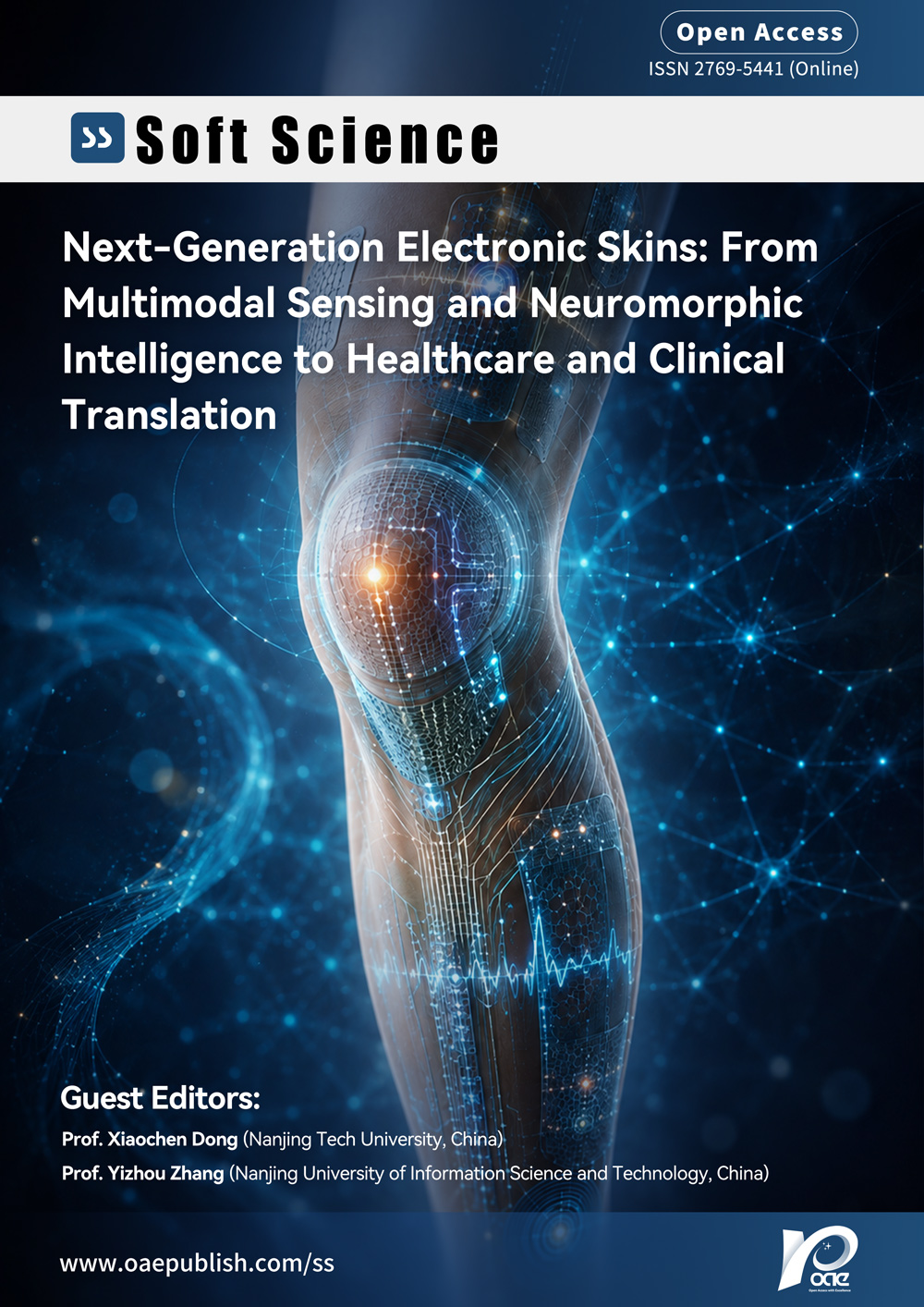
Topic: Next-Generation Electronic Skin: Multimodal Sensing, Neuromorphic Intelligence, and Clinical Translation
Guest Editors
Special Topic Introduction
Electronic skins (e-skins) are rapidly evolving from flexible sensing platforms into intelligent, adaptive interfaces capable of mimicking and extending human sensory functions. By integrating advanced soft materials, bioinspired structures, stretchable electronics, micro/nanofabrication, and intelligent information processing, next-generation intelligent e-skins are moving beyond conventional single-mode sensing devices toward multifunctional and intelligent systems capable of perceiving, processing, and interpreting complex mechanical, thermal, environmental, and biochemical signals.
Recent advances in multimodal sensing, neuromorphic intelligence, artificial intelligence, and edge computing have enabled e-skins to not only acquire sensory information but also perform local processing, adaptive decision-making, and intelligent responses in real time. The integration of self-healing materials, hydrogel-based electronics, energy-autonomous components, wireless communication technologies, and adaptive feedback mechanisms is accelerating the development of integrated electronic skin systems that seamlessly combine perception, computation, communication, and actuation. These emerging capabilities are transforming e-skins into intelligent platforms for embodied intelligence, human–machine integration, and next-generation healthcare technologies.
At the application level, intelligent electronic skins are creating new opportunities in wearable healthcare, precision medicine, prosthetics, rehabilitation, soft robotics, assistive technologies, and intelligent human–machine interfaces. However, several challenges remain before widespread practical deployment, including accurate multimodal signal decoupling and fusion, robust operation under repeated deformation and complex biological environments, energy-efficient intelligent processing, scalable manufacturing, long-term biocompatibility, and clinical validation. Addressing these challenges requires interdisciplinary advances in materials science, device engineering, artificial intelligence, robotics, and biomedical engineering, together with stronger connections between fundamental discoveries and clinical translation.
This Special Issue aims to showcase recent advances in next-generation intelligent electronic skins, with particular emphasis on multimodal sensing, neuromorphic intelligence, AI-enabled perception, bioinspired materials and architectures, sensing–computing–actuation integration, healthcare applications, and clinical translation. We welcome original research articles, reviews, perspectives, and communications addressing fundamental mechanisms, innovative materials, intelligent device architectures, system-level integration, performance evaluation, and real-world deployment of electronic skin technologies. Contributions related to intelligent healthcare, prosthetics, rehabilitation, embodied intelligence, human–machine integration, and clinically relevant e-skin systems are particularly encouraged.
Key areas of interest include, but are not limited to:
● Advanced soft materials and bioinspired architectures for intelligent electronic skins, including self-healing polymers, hydrogels, elastomers, biomaterials, and skin-conformal interfaces.
● Multimodal sensing technologies for intelligent perception, including integrated detection of mechanical, thermal, tactile, environmental, physiological, and biochemical signals, as well as advanced signal decoupling, fusion, and interpretation strategies.
● Neuromorphic electronic skins and AI-driven intelligent sensing systems, including artificial synapses, neuromorphic devices, brain-inspired computing, AI-enabled perception, edge intelligence, adaptive learning, and autonomous decision-making.
● Energy-autonomous and self-powered electronic skins, including triboelectric, piezoelectric, pyroelectric, bioenergy harvesting, and hybrid energy technologies for long-term and sustainable operation of intelligent systems.
● Integrated electronic skin systems combining sensing, communication, computation, and actuation, enabling closed-loop control, embodied intelligence, and advanced human–machine interaction.
● Wireless, implantable, and biointegrated electronic skins for healthcare applications, including continuous physiological monitoring, rehabilitation assistance, personalized medicine, and clinical-oriented biomedical systems.
● Scalable manufacturing and practical translation of electronic skins, including advanced fabrication, printing technologies, system packaging, reliability enhancement, durability testing, biocompatibility assessment, and standardized performance evaluation.
● Emerging applications of intelligent electronic skins, including wearable healthcare, precision medicine, prosthetics, rehabilitation technologies, soft robotics, assistive devices, virtual and augmented reality, human–machine integration, embodied intelligence, and clinical translation.
Keywords
Intelligent electronic skins, multimodal sensing, neuromorphic intelligence, embodied intelligence, wearable healthcare
Submission Deadline
Submission Information
For Author Instructions, please refer to https://www.oaepublish.com/ss/author_instructions
For Online Submission, please login at https://www.oaecenter.com/login?JournalId=ss&IssueId=ss26081110573
Submission Deadline: 31 Dec 2026
Contacts: Mirra Du, In-house Editor, [email protected]