




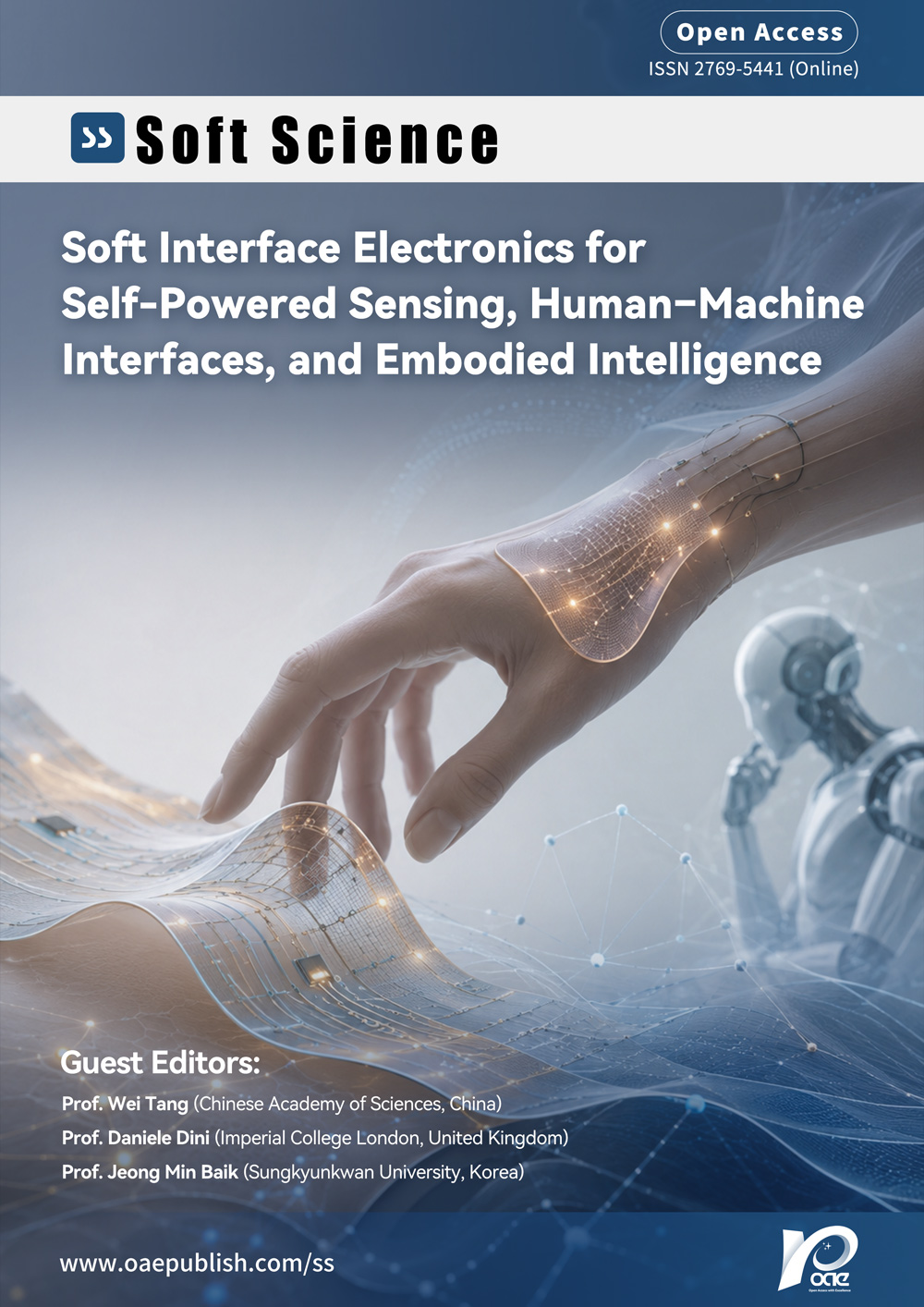
Topic: Soft Interface Electronics for Self-Powered Sensing, Human–Machine Interfaces, and Embodied Intelligence
Guest Editors
Special Topic Introduction
Soft interface electronics are reshaping the way intelligent systems interact with the human body and the surrounding environment. By combining mechanically compliant materials with multifunctional electronic architectures, these systems enable seamless signal acquisition, adaptive actuation, and intuitive bidirectional communication while maintaining high comfort and biocompatibility. Recent advances in triboelectric, piezoelectric, pyroelectric, and biofuel-based energy harvesting have further accelerated the development of self-powered platforms capable of continuous operation without conventional batteries, opening new opportunities for wearable healthcare, soft robotics, prosthetics, digital medicine, and immersive human–machine interaction.
Meanwhile, the emergence of embodied intelligence is driving a paradigm shift from passive sensing to autonomous perception, decision-making, and interaction. Integrating soft interface electronics with multimodal sensing, neuromorphic devices, artificial intelligence, and adaptive materials enables intelligent systems that can perceive complex environments, learn from dynamic stimuli, and execute context-aware responses. Such capabilities are expected to transform next-generation electronic skins, intelligent prostheses, robotic systems, and personalized healthcare technologies.
This Special Issue aims to bring together cutting-edge research and comprehensive reviews covering materials, device engineering, system integration, and practical applications of soft interface electronics. We particularly welcome interdisciplinary contributions that bridge materials science, flexible electronics, energy harvesting, bioelectronics, artificial intelligence, and robotics, providing new insights into the design of self-powered, adaptive, and intelligent electronic interfaces for future human-centered technologies.
Key areas of interest include but are not limited to:
● Self-powered sensing systems and energy harvesting technologies;
● Triboelectric, piezoelectric, pyroelectric, and biofuel-powered electronics;
● Soft electronic skins (e-skins) and wearable bioelectronics;
● Flexible and stretchable sensors for physiological and motion monitoring;
● Human–machine interfaces and multimodal interaction;
● Embodied intelligence and intelligent perception systems;
● Neuromorphic devices and edge intelligence for soft electronics;
● AI-assisted signal processing and adaptive sensing;
● Soft robotics, intelligent actuators, and tactile interfaces;
● Flexible bioelectronic interfaces for healthcare and rehabilitation;
● Materials and manufacturing for soft interface electronics;
● Integrated systems for digital health, virtual/augmented reality, and intelligent robotics.
Keywords
Soft interface electronics, self-powered sensing, human–machine interfaces, embodied intelligence, flexible bioelectronics, energy harvesting
Submission Deadline
Submission Information
For Author Instructions, please refer to https://www.oaepublish.com/ss/author_instructions
For Online Submission, please login at https://www.oaecenter.com/login?JournalId=ss&IssueId=ss26071410541
Submission Deadline: 31 Dec 2026
Contacts: Mirra Du, In-house Editor, [email protected];