


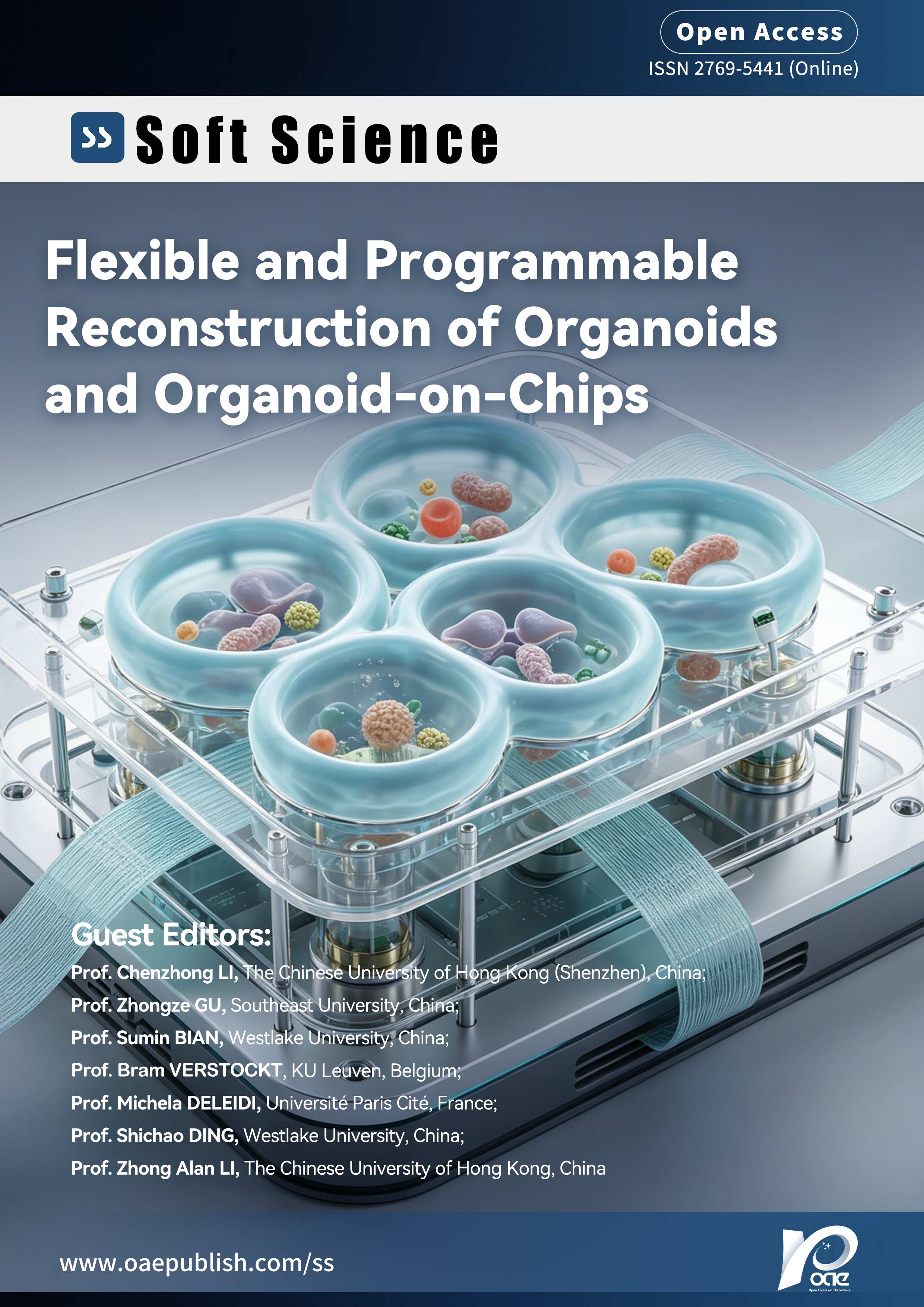
Topic: Flexible and Programmable Reconstruction of Organoids and Organoid-on-Chips
Guest Editors
Special Topic Introduction
Organoids and organoids-on-chip technologies have rapidly evolved into powerful platforms for modeling human biology, offering new opportunities to study development, disease mechanisms, and therapeutic responses. The field is now transitioning from isolated technological innovations toward system-level and clinical translation. However, key challenges remain in achieving physiologically relevant, scalable, and dynamically controllable systems.
Currently, advances in flexible materials, soft electronics, and biointegrated devices are enabling the construction of highly biomimetic and adaptive microenvironments. These technologies allow real-time sensing, precise modulation, and continuous monitoring of cellular behavior, providing critical tools to bridge the gap between in vitro models and in vivo physiology. Their integration with organoids and organoids-on-chip systems represents a promising pathway toward more functional and translationally relevant platforms.
This Special Issue, “Flexible Bio-Driven Reconstruction of Organoids and Organoids-on-Chip Systems,” aims to bring together interdisciplinary contributions spanning organoid engineering, microphysiological systems, flexible electronics and devices, disease modeling, drug delivery, and clinical applications. Particular emphasis is placed on strategies that enable system-level integration, enhance functional fidelity, and support real-world implementation.
By integrating perspectives from engineering, biology, and medicine, this issue seeks to highlight emerging concepts, define key scientific challenges, and accelerate the development of next-generation human-relevant models for precision medicine and translational research.
Key areas of interest include, but are not limited to:
● Engineering and advanced fabrication of organoids;
● Development of organoids-on-chip and microphysiological systems;
● Integration of organoids with microphysiological systems;
● Flexible and stretchable bioelectronics for biological interfacing;
● Soft materials and devices for biomimetic system design;
● Real-time (bio)sensing and monitoring in organoidsand chip-based systems;
● Dynamic microenvironment control and bioactuation technologies;
● Disease modeling using organoids and organoids-on-chip systems;
● Translational applications and clinical integration of bioengineered systems.
Keywords
Organoids, organoids-on-chip, flexible bioelectronics, microphysiological systems, disease modeling, drug screening, biomimetic systems, soft materials, translational medicine, system-level integration
Submission Deadline
Submission Information
For Author Instructions, please refer to https://www.oaepublish.com/ss/author_instructions
For Online Submission, please login at https://www.oaecenter.com/login?JournalId=ss&IssueId=ss26042810447
Submission Deadline: 31 Dec 2026
Contacts: Jiaxin Li, In-house Editor, [email protected]