
Aim
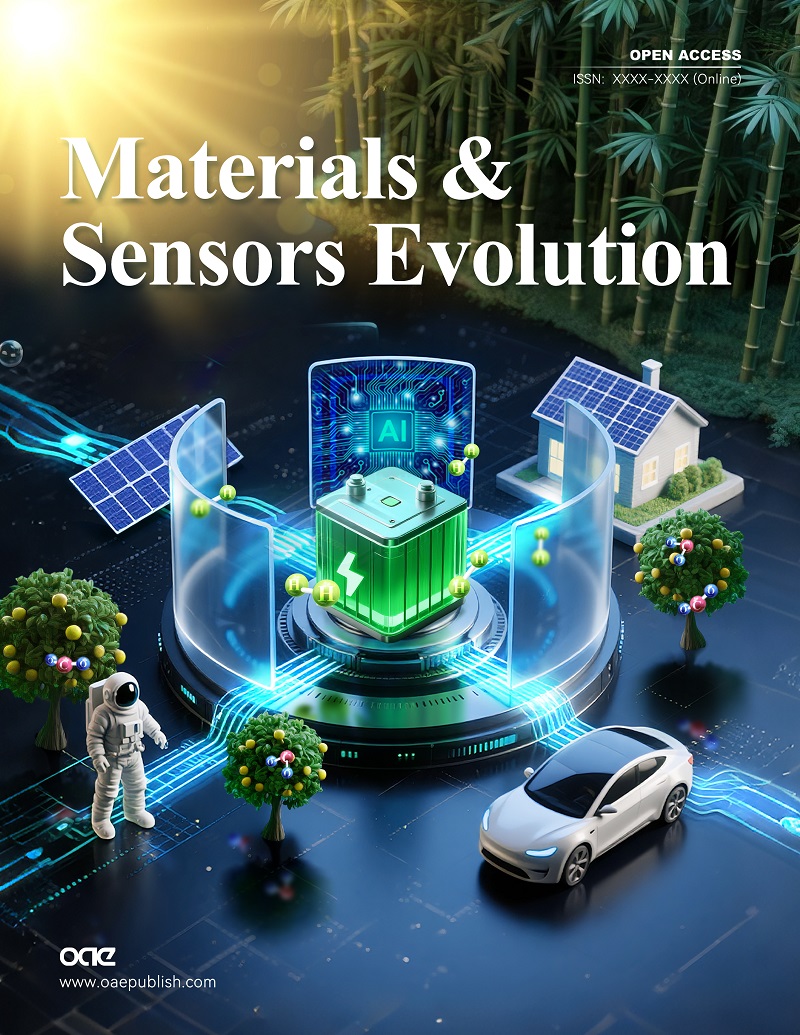
Materials & Sensors Evolution aims to serve as a forward-looking platform that advances the science and technology in the multidisciplinary domains of advanced energy materials and smart sensing devices. The journal focuses on the dynamic evolution from fundamental materials design and experiment to system-level applications, emphasizing how innovative materials drive the development of next-generation performance, reliability and sustainability.
It welcomes original research, reviews, and perspectives focusing on AI-guided materials discovery, energy storage and conversion, hydrogen sensing and safety, photovoltaic and photothermal self-powered sensors, phase-change thermal regulation, building energy conservation, and environmental, biological as well as agricultural monitoring, including the detection of VOCs, heavy metals, blood glucose, microorganism, and greenhouse gases. Contributions on bio-based and sustainable materials, flexible and transparent electronics, and sensing technologies and devices for extreme environments are also encouraged.
By integrating expertise from materials science, engineering, physics, chemistry, theoretical computation, machine learning and data science, Materials & Sensors Evolution promotes interdisciplinary collaboration and drives the development of innovative solutions for energy, environment, health-related, and advanced technological challenge within a rapidly advancing field.
Scope & Topics
Materials & Sensors Evolution is dedicated to the synergistic development of functional materials and sensing technologies, publishing original research articles, comprehensive reviews, and forward-looking perspectives covering the following areas:
- Materials design and structure-property relationship study guided by AI for sensing and energy applications
- Electrochemistry (such as metal-ion batteries, liquid battery, supercapacitors, and bio/fuel cells) and electrocatalytic processes
- Hydrogen energy: technologies for production, purification/separation, storage, sensing and safety, and fuel cells.
- Solar energy conversion and photocatalysis
- Photovoltaic, photothermal, and self-powered sensors
- Phase-change materials for thermal storage and temperature regulation
- Flexible and transparent electronics enabling next-generation sensing platforms
- Wearable and health-monitoring sensors, including smart textiles and personal diagnostic devices
- Environmental sensing technologies for the detection of VOCs, greenhouse gases, humidity, and air quality
- Agricultural and food monitoring, encompassing crop health assessment, soil analysis, and food safety detection
- Bio-derived and sustainable materials, environmentally friendly fabrication methods, and life-cycle evaluation
- Intelligent living environments: monitoring of indoor air quality, thermal comfort, and smart building materials
- Sensing technologies for transportation and mobility, including applications in electric vehicles, hydrogen-powered transport, and aerospace system
- Reliability, standardization, and security in sensing systems to ensure long-term performance
Ownership
The journal is owned by OAE Publishing Inc.
Publishing Model
Gold Open Access. All articles published by Materials & Sensors Evolution are made freely and permanently accessible online immediately from the date of publication. For further information, please refer to Open Access.
Copyright and License to Publish
Articles in Materials & Sensors Evolution are published under a Creative Commons Attribution 4.0 International (CC BY 4.0). The CC BY 4.0 allows for maximum dissemination and re-use of open access materials and is preferred by many research funding bodies. Under this license users are free to share (copy, distribute and transmit) and remix (adapt) the contribution for any purposes, even commercially, provided that the users appropriately acknowledge the original authors and the source.
Copyright is retained by authors. Authors are required to sign a License to Publish (which can be downloaded from the journal's Author Instructions), granting Materials & Sensors Evolution, which identifies itself as the original publisher, exclusive rights to publish their articles, and granting any third party the right to use the articles freely as long as the integrity is maintained and the original authors, citation details and publisher are identified.
Editorial Board
For more information about the editorial team, please refer to Editorial Board.
Editorial Policies
All manuscripts submitted to Materials & Sensors Evolution should adhere to journal's Editorial Policies.
Peer Review
The journal adheres to rigorous peer review and undergoes single-blind peer review. For more details, please refer to Editorial Process and Peer Review Guidelines.
Publication Ethics Statement
Materials & Sensors Evolution fully adheres to the Code of Conduct and the Best Practice Guidelines of Committee on Publication Ethics (COPE).
The Editors of this journal enforce a rigorous peer-review process together with strict ethical policies and standards to guarantee to add high quality scientific works to the field of scholarly publication. Unfortunately, cases of plagiarism, data falsification, image manipulation, inappropriate authorship credit, and the like, do arise. The Editors of Materials & Sensors Evolution take such publishing ethics issues very seriously and are trained to proceed in such cases with a zero tolerance policy. To verify the originality of content submitted to our journals, we use CrossCheck (powered by iThenticate) to check submissions against previous publications.
Journal Information and Statistics
- Publication model: Gold Open Access
- Frequency: Quarterly
- DOI: 10.20517/mse
- Digital archive: Portico
Contact
Please visit Contact Us for details about different queries.

