

Beyond flexibility: intrinsically elastic materials for wearable thermoelectrics
 0
0 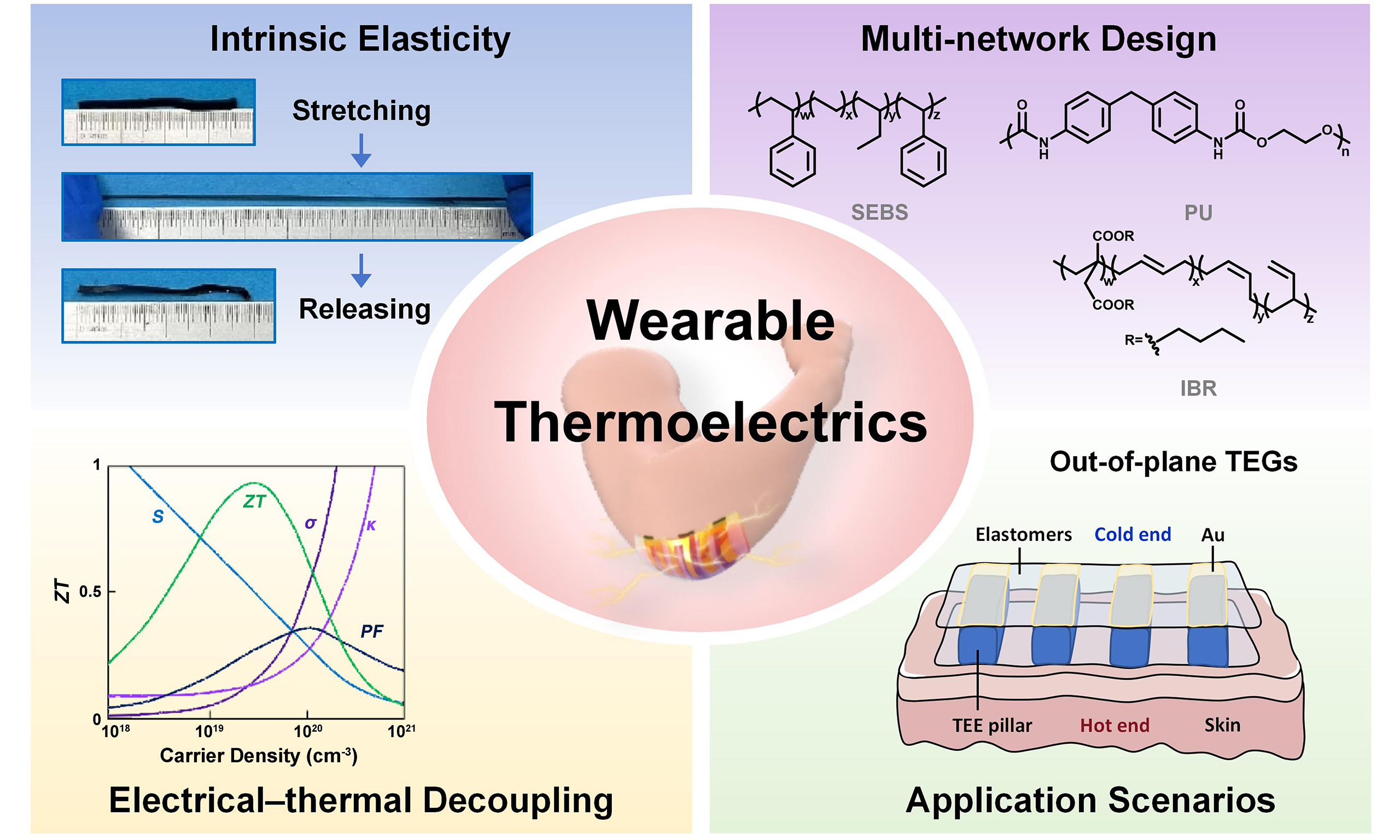


 Download PDF
INTRODUCTION
Wearable devices are rapidly advancing toward applications in healthcare monitoring, human-machine interfaces, and personalized medicine. However, their widespread deployment remains constrained by challenges in balancing the requirements for miniaturization, mechanical compliance, and sustainable power supply[1,2]. Thermoelectric (TE) devices, which can directly convert temperature gradients between human skin and the surrounding environment into electricity[3,4], have emerged as an attractive solution for self-powered wearable systems[5,6]. Unlike conventional TE applications, wearable TEs operate at room temperature and under continuous mechanical deformation. Human motions routinely withstand dynamic strains of 5%-50% on skin-mounted electronics[7] [Figure 1A], while efficient heat harvesting requires intimate and conformal skin contact[8]. Consequently, TE materials for wearable applications need to possess sufficient mechanical compliance to maintain stable thermal and electrical coupling under repeated deformation.
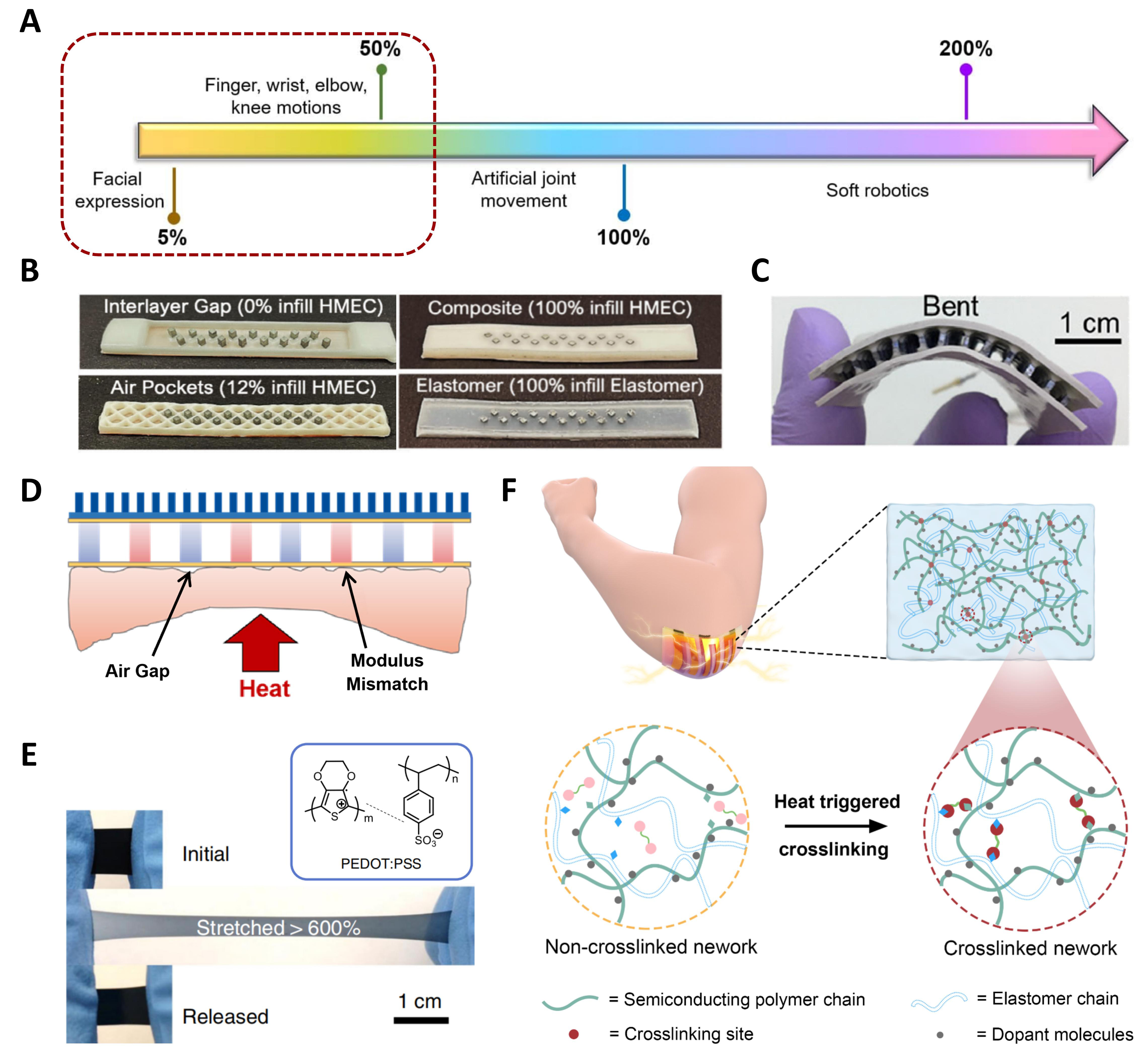
Figure 1. (A) Representative deformation strains experienced by different regions of the human body during daily activities. Reprinted with permission from[7]. Copyright 2018, The Authors, the CC-BY license; (B) Photographs of the representative inorganic TE devices based on an “island-bridge” architecture. Reprinted with permission from[22]. Copyright 2024, WILEY-VCH; (C) Photographs showing inorganic TE devices with good bending flexibility but limited stretchability and elastic recovery due to the inherently high modulus of the active materials. Reprinted with permission from[6]. Copyright 2019, The Authors, the CC-BY license; (D) Schematic illustration of an air gap and modulus mismatch between inorganic flexible TEG and human skin. Reprinted with permission from[24]. Copyright 2021, WILEY-VCH; (E) A free-standing organic TE material exhibiting over 600% tensile strain with minimal mechanical hysteresis. Reprinted with permission from[27]. Copyright 2020, The Authors, the CC-BY license; (F) Schematic diagram of intrinsically elastic TE elastomers through nanoscale phase separation, thermally activated cross-linking, and targeted doping. TE: Thermoelectric; TEG: thermoelectric generator; HMEC: hollow microsphere elastomer composite; PEDOT:PSS: poly(3,4-ethylenedioxythiophene):poly(styrenesulfonate).
The TE performance of a material is commonly evaluated using the figure of merit, zT = S2σT/κ, where S, σ, κ, and T represent the Seebeck coefficient, electrical conductivity, thermal conductivity, and absolute temperature, respectively[9]. For decades, inorganic TE materials, such as Bi2Te3 and SnSe, have dominated the performance frontier, with zT values over 1.0[10,11]. To adapt these materials to wearable systems, extensive efforts have focused on structural engineering strategies, including thin-film geometries, serpentine interconnections, and island-bridge architectures[12,13]. Although these strategies achieve functional flexibility and even stretchability, the TE materials themselves generally remain rigid or plastically deformable[14,15]. As a result, repeated deformation can induce crack formation, interfacial delamination, and degradation of thermal and electrical pathways. Moreover, the spatial separation of TE components and deformable supporting structures often results in low fill factors and increased interfacial thermal resistance, ultimately limiting device efficiency and long-term reliability[16].
The rise of organic TE materials, particularly conjugated polymers, provides new opportunities for achieving intrinsic elasticity[17,18]. Owing to their inherently low thermal conductivity (0.1-0.6 W·m-1·K-1), lightweight nature, solution processability, and tunable molecular structures, organic TE materials are inherently attractive for wearable applications[19]. Using elastomer blending, nanophase separation, thermally activated crosslinking, and targeted doping, intrinsically elastic TE materials that combine high stretchability, excellent elastic recovery, and competitive TE performance have been realized[20]. Recent studies further reveal that elastomer embedding not only enhances mechanical compliance but also reshapes nanoscale transport pathways, enabling reduced heat transport while preserving or even enhancing charge transport[20,21], thereby providing new opportunities to decouple electrical and thermal properties.
In this perspective, we provide a conceptual framework, critically assess challenges and opportunities for the design of intrinsically elastic TE materials, and outline a roadmap toward practical wearable devices. We first discuss why intrinsic elasticity is important for wearable TE devices and how it fundamentally differs from conventional structural flexibility. We then summarize the journey toward achieving intrinsic elasticity in organic TEs and highlight the unexpected benefits beyond elasticity. Finally, we discuss the remaining challenges and future opportunities toward efficient, durable, and body-conformable TE systems.
WHY INTRINSIC ELASTICITY MATTERS IN WEARABLE DEVICES
To clarify the concept of intrinsic elasticity, we define intrinsically elastic TE materials based on three criteria. First, the material itself exhibits rubber-like elasticity (high elongation at break, excellent elastic recovery, and low hysteresis) without relying on auxiliary substrates or structural engineering. Second, efficient charge transport is maintained through continuous, interconnected semiconducting networks within the material. Third, the mechanical and electrical functions are intrinsically integrated at the molecular and nanoscale level within a unified material.
When transferring thermoelectric generators (TEGs) from rigid platforms to the body surface, the core challenge lies in efficiently utilizing the temperature difference of just 5-15 K between the skin and the environment, and maintaining long-term stable thermal contact on dynamic curved surfaces along with repeated deformation. In particular, human joints such as fingers, wrists, and elbows routinely experience tensile strains of 30%-50%, accompanied by complex bending and shear deformation during daily activities [Figure 1A]. These deformations are cyclic, multiaxial, and spatially non-uniform, placing stringent requirements on both the structural integrity and functional stability of skin-mounted TE systems. Under such conditions, structural compliance alone is insufficient, as devices that deform without full recovery inevitably accumulate residual strain, leading to progressive loss of conformal contact and degradation of TE performance.
Conventional wearable TE systems are predominantly based on inorganic materials, in which mechanical compliance is introduced through structural engineering such as “island-bridge” architectures [Figure 1B and C]. In this system, mechanically rigid TE components, such as Bi2Te3, are fabricated into millimeter-scale columns to form active “islands”, interconnected via serpentine-shaped metal or liquid-metal interconnects that serve as stretchable “bridges”, and encapsulated within an elastomer matrix[22,23]. Mechanical compliance is thus achieved primarily through geometric deformation of interconnects, while the TE components themselves remain essentially rigid and undeformed.
However, this separation between mechanical compliance and functional material inevitably introduces fundamental limitations. First, the need to spatially decouple rigid islands reduces the fill factor, as a significant portion of the device area is occupied by interconnects and encapsulation layers rather than active material. This translates directly into low power density, which is critical for space-constrained wearable systems. Second, the intrinsic rigidity of TE islands prevents full conformal contact with the skin, resulting in microscopic air gaps at the bio–device interface [Figure 1D]. Given the extremely low thermal conductivity of air (~0.026 W·m-1·K-1), these interfacial voids introduce substantial parasitic thermal resistance and significantly diminish the effective temperature difference available for power output[24]. Third, the large mismatch in elastic modulus between the rigid TE components and elastic substrates always causes interfacial stress concentration, resulting in interfacial delamination[6,22] and progressive degradation of electrical and thermal transport pathways[25] after repeated deformations. These limitations underscore that introducing an elastic substrate alone is insufficient to achieve long-term and reliable wearable TE systems.
In contrast, organic TE materials could address these challenges by integrating charge-transport networks into soft molecular frameworks, thereby enabling mechanical compliance at the material level. Beyond mechanical adaptability, organic systems inherently benefit from low lattice thermal conductivity, chemical versatility, and solution processability, which together provide a unique design space for independently tuning electrical, thermal, and mechanical properties at the molecular level. These features establish organic TE materials as a promising platform for intrinsically elastical TE systems in wearable applications.
A JOURNEY TO INTRINSICALLY ELASTIC TES
Early efforts focused on blending conductive polymers with elastic matrices to impart mechanical compliance. Poly(3,4-ethylenedioxythiophene):poly(styrenesulfonate) (PEDOT:PSS) emerged as a representative platform due to its high electrical conductivity, aqueous processability, and good stability in air[26]. For example, blending with polyurethane and ionic liquids successfully produced stretchable composites with elongation exceeding 600% [Figure 1E][27]. However, this strategy relies on phase-separated architectures with poorly controlled morphology, leading to unstable transport pathways and reduced TE performance [S ~ 15-40 μV·K-1; power factor (PF) ~ 101-102 μW·m-1·K-2]. Consequently, electrical transport, TE performance, and mechanical resilience could not be simultaneously optimized, highlighting the inherent limitations of simple blending strategies.
To move beyond simple blending strategies, subsequent efforts explored hierarchical structuring of conductive networks within elastic matrices. Representative examples include nanowire-embedded elastomers, in which poly(3-butylthiophene-2,5-diyl) (P3BT) nanowires were embedded in a polystyrene-block-polyisoprene-block-polystyrene (SIS) elastomer[28]. Compared with conventional blends[28], these architectures partially preserved long-range transport pathways while improving mechanical resilience. Nevertheless, charge transport still relied on discontinuous transport pathways within insulating matrices, resulting in limited TE performance (PF ≈ 1.16 μW·m-1·K-2). These persistent limitations underscore a fundamental trade-off between mechanical design and electronic transport.
A critical breakthrough was achieved with the emergence of intrinsically elastic TE elastomers[20]. Instead of embedding conductive domains into elastomers, these materials integrate semiconducting polymers, dopants, crosslinkers, and elastic matrices into a unified nanophase-separated network that simultaneously supports efficient charge transport and reversible mechanical deformation [Figure 1F]. This architecture was enabled by the synergistic combination of uniform bulk nanophase separation, thermally activated crosslinking, and targeted doping. Specifically, careful matching of the polymer and elastomer using the Hansen solubility parameter (HSP) promotes the formation of uniformly distributed, elastomer-wrapped semiconducting nanofibrils, establishing continuous charge-transport pathways. Targeted doping ensures that N-DMBI is preferentially enriched in the conjugated polymer phase and suppresses dopant dilution by the elastomer matrix. Meanwhile, thermally activated crosslinking stabilizes the nanostructure without disrupting the conjugated backbone, thereby conferring excellent resilience to the material. As a result, the TE elastomer simultaneously achieved a PF of 514 μW·m-1·K-2, a zT of 0.49, an elongation at break exceeding 850%, and elastic recovery above 90% at 150% strain[20,29]. This work demonstrated that high TE performance and rubber-like elasticity are not fundamentally incompatible, but can instead be realized simultaneously through integrated molecular and mesoscale structural engineering.
Beyond elongation at break and elastic recovery, a comprehensive assessment of mechanical parameters is essential for understanding the deformation tolerance and operational reliability of intrinsically elastic TE materials. Young’s modulus, elongation, tensile strength, and toughness collectively define the mechanical landscape governing the balance among conformability, deformability, and mechanical robustness. A low Young’s modulus combined with high elongation ensures conformal skin contact and accommodates large strains without fracture. Tensile strength and toughness together reflect the ability of materials to withstand mechanical stress and dissipate energy prior to failure. Cyclic durability under repeated stretch-release deformation further serves as a critical indicator of reversibility, fatigue resistance, and long-term stability. One representative system, poly(benzodifurandione) (PBFDO)-based elastomers[30], has successfully achieved high electrical conductivity with over 1,000 cyclic tensile tests, highlighting the versatility and generality of the multi-network design strategy. We believe that this materials platform will inspire the future development of intrinsically elastic TEs and accelerate their practical implementation in wearable energy harvesting.
ELASTICITY RESHAPES TRANSPORT PHYSICS
Conventional wisdom suggests that incorporating insulating materials into active TE materials would inevitably compromise electrical transport by diluting the active components[27]. Surprisingly, the emergence of TE elastomers has challenged this long-held assumption, introducing a fundamentally different framework for understanding transport in soft TEs. Rather than simply introducing mechanical compliance, elastomers provide a structural degree of freedom that enables the decoupling and cooperative regulation of mechanical, electrical, and thermal properties. The essence of this transition is that transport is no longer governed by a single homogeneous conductive network but by structurally differentiated networks that regulate mechanical properties and electrical and thermal transport in a coordinated manner.
Within the multi-network architecture of TE elastomers[20], different structural motifs assume distinct transport functions. The elastic framework primarily accommodates mechanical deformation through reversible stress recovery, whereas the semiconducting nanofibrillar network preserves charge carrier percolation. Importantly, mechanical deformation does not disrupt connectivity. Instead, it induces reversible reconfiguration of percolation pathways while preserving global transport continuity. This behavior originates from elastomer-induced nanoconfinement, which promotes the formation of highly ordered and interconnected semiconducting nanofibrils with enhanced molecular packing and carrier transport[31]. The thermally activated crosslinking further locks this architecture into a dynamically reconfigurable, non-dissociative network that accommodates strain through reversible chain rearrangement, avoiding fracture or interfacial slippage [Figure 1F]. Consequently, mechanical deformation energy is preferentially recovered by the elastic network, while charge transport remains confined to the electronically percolated networks, establishing the physical basis for mechanical–electrical decoupling.
Beyond structural regulation, spatial control of dopant distribution is equally important for maintaining charge transport under deformation. By preferentially confining dopants within the semiconductor phase, the electronic landscape remains largely insensitive to morphological evolution during stretching, thereby stabilizing carrier concentration without compromising electronic connectivity. As a result, the Seebeck coefficient remains largely invariant while conductivity can be maintained or improved. Mechanical strain primarily reorganizes the elastic framework without substantially perturbing the charge-transport landscape, thereby providing an additional mechanism for mechanical–electrical decoupling. While preferential confinement of N-DMBI within the semiconducting polymer phase helps stabilize the doping profile under static conditions, the long-term stability under cyclic mechanical stress and exposure to ambient conditions (e.g., oxygen and moisture) remains an open question. Future work should therefore explore polymeric dopants or covalently linked dopants to ensure operational robustness in real-world wearable conditions.
The multi-network architecture also reshapes heat transport. The intrinsically low thermal conductivity of the elastomers [e.g., styrene-ethylene-butylene-styrene (SEBS), ~0.14 W·m-1·K-1[20]] directly reduces the composite’s overall thermal conductivity. More importantly, the nanophase-separated architecture introduces a large number of interfaces between the semiconductor and elastomer phases, providing a large number of scattering centers for phonons[32] and propagons[33,34]. These interfaces are not static but are structurally integrated within a deformable matrix, thereby disrupting heat transport pathways and leading to substantially lower thermal conductivity.
Similar transport-regulation strategies have also been demonstrated in multilevel pores or multilevel phase architectures, where increased interface density and multiscale confinement broaden the phonon mean-free-path distribution, thereby enhancing phonon scattering while preserving efficient charge transport[34,35]. Typically, irregular hierarchical porous thermoelectric polymers (IHP-TEP) employ multiscale porous architectures to spatially separate electronic and thermal transport[36]. Nanoconfinement simultaneously promotes molecular ordering and carrier delocalization, while hierarchical pores and curved interfaces selectively scatter phonons over a broad spectrum, thereby achieving electron–phonon decoupling and a record zT of 1.64 in p-type organic TE materials. Although the IHP-TEP strategies have not yet achieved intrinsic elasticity, they provide a valuable mechanistic foundation for transport decoupling through hierarchical structural engineering[37]. Integrating these transport-regulation strategies with elastic multi-network architectures may offer an effective route toward wearable TEs with simultaneously optimized mechanical compliance and TE performance.
CONCLUSION AND OUTLOOK
The development of intrinsically elastic organic TEs represents a conceptual transition from engineering mechanical compliance to engineering transport physics. Rather than serving merely as soft supporting matrices, elastomers have emerged as functional and structural components that actively regulate charge transport, heat transport, and mechanical deformation through hierarchical multi-network architectures. This shift fundamentally changes the design philosophy of wearable TEs - from balancing inevitable trade-offs toward realizing cooperative optimization through multilevel structural engineering.
Despite the rapid progress made in recent years, intrinsically elastic TEs remain in their early stages of development. Several critical challenges remain before intrinsically elastic TE materials can be used in practical applications. High elastomer content risks disrupting the semiconducting percolation network, yet the optimal composition to balance mechanical and electronic performance is unclear. Cyclic deformation may cause dopant migration between phases, compromising doping stability over time. Ambient oxygen, moisture, and operational heat raise unresolved concerns about long-term durability. The nanophase-separated morphology is sensitive to processing variables such as solvent, drying rate, and annealing temperature, which complicates batch reproducibility. High-density module integration also demands solutions for stable and low-resistance contacts, module design, and encapsulation.
Although intrinsically elastic TE materials are solution-processable and compatible with scalable manufacturing approaches such as roll-to-roll coating and inkjet printing, these techniques have primarily been demonstrated for thin-film fabrication. Direct translation from planar elastic films to three-dimensional pillar-based TE modules remains challenging. In particular, conventional microfabrication processes for forming TE pillars can hardly build up out-of-plane polymer alignment, resulting in degraded charge transport and reduced TE performance. Therefore, realizing scalable, elastic TE modules will require developing new material formulations, printable inks, and fabrication strategies that preserve the optimized microstructure during patterning and device assembly.
Addressing these challenges will require close collaboration among multidisciplinary researchers, combining theoretical modeling, molecular design, multiscale structural engineering, advanced in situ characterization, and device-level engineering to establish a comprehensive framework for next-generation intrinsically elastic TE technologies.
Looking forward, we envision that intrinsic elasticity will evolve from a mechanical feature to a useful performance-enhancement strategy for wearable TEs. By integrating elastic multi-polymer network architectures with emerging strategies such as hierarchical transport regulation, dynamic covalent chemistry, and AI-assisted materials design, future organic TEs may achieve unprecedented combinations of efficiency, durability, and deformability. Such advances will not only enable practical self-powered wearable electronics but also provide a framework for designing multifunctional soft electronic materials in which mechanical, electrical, and thermal properties are cooperatively engineered rather than independently optimized.
DECLARATIONS
Authors’ contributions
Wrote the original draft: Li, S.
Supervised, reviewed, and revised the manuscript: Zhang, Z.; Lei, T.
Availability of data and materials
Not applicable.
AI and AI-assisted tools statement
Not applicable.
Financial support and sponsorship
We acknowledge the financial support from the National Natural Science Foundation of China (T2521001, Lei, T.), the Beijing Natural Science Foundation (2262050, Zhang, Z.), and the Peking University Third Hospital Young Eagle Project (BYSYCY2024022, Zhang, Z.).
Conflicts of interest
All authors declared that there are no conflicts of interest.
Ethical approval and consent to participate
Not applicable.
Consent for publication
Not applicable.
Copyright
© The Author(s) 2026.
REFERENCES
1. Gao, W.; Emaminejad, S.; Nyein, H. Y. Y.; et al. Fully integrated wearable sensor arrays for multiplexed in situ perspiration analysis. Nature 2016, 529, 509-14.
2. Zhao, C.; Park, J.; Root, S. E.; Bao, Z. Skin-inspired soft bioelectronic materials, devices and systems. Nat. Rev. Bioeng. 2024, 2, 671-90.
3. Shi, X. L.; Zou, J.; Chen, Z. G. Advanced thermoelectric design: from materials and structures to devices. Chem. Rev. 2020, 120, 7399-515.
4. Tan, G.; Zhao, L. D.; Kanatzidis, M. G. Rationally designing high-performance bulk thermoelectric materials. Chem. Rev. 2016, 116, 12123-49.
5. Kishore, R. A.; Nozariasbmarz, A.; Poudel, B.; Sanghadasa, M.; Priya, S. Ultra-high performance wearable thermoelectric coolers with less materials. Nat. Commun. 2019, 10, 1765.
6. Hong, S.; Gu, Y.; Seo, J. K.; et al. Wearable thermoelectrics for personalized thermoregulation. Sci. Adv. 2019, 5, eaaw0536.
7. Han, S.; Liu, C.; Xu, H.; et al. Multiscale nanowire-microfluidic hybrid strain sensors with high sensitivity and stretchability. npj. Flex. Electron. 2018, 2, 29.
8. Wang, Y.; Zhu, W.; Deng, Y.; et al. Self-powered wearable pressure sensing system for continuous healthcare monitoring enabled by flexible thin-film thermoelectric generator. Nano. Energy. 2020, 73, 104773.
10. Gao, T.; Wen, Y.; Bai, S.; et al. Extending the temperature range of the Cmcm phase of SnSe for high thermoelectric performance. Science 2025, 390, 1266-71.
11. Qin, B.; Kanatzidis, M. G.; Zhao, L. D. The development and impact of tin selenide on thermoelectrics. Science 2024, 386, eadp2444.
12. Yang, Q.; Yang, S.; Qiu, P.; et al. Flexible thermoelectrics based on ductile semiconductors. Science 2022, 377, 854-8.
13. Lu, Y.; Zhou, Y.; Wang, W.; et al. Staggered-layer-boosted flexible Bi2Te3 films with high thermoelectric performance. Nat. Nanotechnol. 2023, 18, 1281-8.
14. Liu, Y.; Wang, X.; Hou, S.; et al. Scalable-produced 3D elastic thermoelectric network for body heat harvesting. Nat. Commun. 2023, 14, 3058.
15. Deng, T.; Gao, Z.; Li, Z.; et al. Room-temperature exceptional plasticity in defective Bi2Te3-based bulk thermoelectric crystals. Science 2024, 386, 1112-7.
16. Liu, Q.; Shi, X.; Cao, T.; Chen, W.; Li, L.; Chen, Z. Advances and challenges in inorganic bulk-based flexible thermoelectric devices. Prog. Mater. Sci. 2025, 150, 101420.
17. Russ, B.; Glaudell, A.; Urban, J. J.; Chabinyc, M. L.; Segalman, R. A. Organic thermoelectric materials for energy harvesting and temperature control. Nat. Rev. Mater. 2016, 1, 16050.
18. Ma, Y.; Di, C.; Zhu, D. Advances in organic thermoelectric devices for multiple applications. Adv. Phys. Res. 2023, 2, 2300027.
19. Wang, S.; Zuo, G.; Kim, J.; Sirringhaus, H. Progress of conjugated polymers as emerging thermoelectric materials. Prog. Polym. Sci. 2022, 129, 101548.
21. Peña-Alcántara, A. E.; Ghasemi, M.; Cheng, C.; et al. Solution-state nanoconfined aggregation and microstructure evolution in blends of conjugated polymers and elastomers. Proc. Natl. Acad. Sci. U. S. A. 2026, 123, e2516186123.
22. Han, Y.; Tetik, H.; Malakooti, M. H. 3D soft architectures for stretchable thermoelectric wearables with electrical self-healing and damage tolerance. Adv. Mater. 2024, 36, e2407073.
23. Han, Y.; Simonsen, L.; Malakooti, M. H. Printing liquid metal elastomer composites for high‐performance stretchable thermoelectric generators. Adv. Energy. Mater. 2022, 12, 2201413.
24. Jia, Y.; Jiang, Q.; Sun, H.; et al. Wearable thermoelectric materials and devices for self-powered electronic systems. Adv. Mater. 2021, 33, e2102990.
25. Rösch, A. G.; Franke, L.; Mallick, M. M.; Lemmer, U. Optimizing printed thermoelectric generators with geometry and processibility limitations. Energy. Convers. Manag. 2023, 279, 116776.
26. Fan, X.; Stott, N. E.; Zeng, J.; et al. PEDOT:PSS materials for optoelectronics, thermoelectrics, and flexible and stretchable electronics. J. Mater. Chem. A. 2023, 11, 18561-91.
27. Kim, N.; Lienemann, S.; Petsagkourakis, I.; et al. Elastic conducting polymer composites in thermoelectric modules. Nat. Commun. 2020, 11, 1424.
28. Jeong, Y. J.; Jung, J.; Suh, E. H.; Yun, D.; Oh, J. G.; Jang, J. Self‐healable and stretchable organic thermoelectric materials: electrically percolated polymer nanowires embedded in thermoplastic elastomer matrix. Adv. Funct. Mater. 2020, 30, 1905809.
29. Sun, N.; Chen, W.; Li, M.; Lin, J.; Huang, W. Organic thermoelectric elastomers for flexible energy electronics. Aggregate 2025, 6, e70233.
30. Zhao, Y.; Li, Y.; Yang, R.; et al. Environmentally stable N-type conducting polymer with high intrinsic stretchability. Adv. Mater. 2026, 38, e18190.
31. Gumyusenge, A.; Tran, D. T.; Luo, X.; et al. Semiconducting polymer blends that exhibit stable charge transport at high temperatures. Science 2018, 362, 1131-4.
32. Qian, X.; Zhou, J.; Chen, G. Phonon-engineered extreme thermal conductivity materials. Nat. Mater. 2021, 20, 1188-202.
33. Allen, P. B.; Feldman, J. L.; Fabian, J.; Wooten, F. Diffusons, locons and propagons: character of atomic vibrations in amorphous Si. Philos. Mag. B. 1999, 79, 1715-31.
34. Wang, D.; Ding, J.; Ma, Y.; et al. Multi-heterojunctioned plastics with high thermoelectric figure of merit. Nature 2024, 632, 528-35.
35. Niu, L.; Zhao, Y.; Wang, D.; et al. Confined assembly of polymer nanowires for high-performance organic thermoelectrics. Adv. Mater. 2026, e73071.
36. Zhang, X.; Wang, D.; Liu, L.; et al. Irregular hierarchical-porous polymer for high-performance soft thermoelectrics. Science 2026, 391, 1063-9.
Cite This Article
 Open Access
How to Cite
Li, S.; Zhang, Z.; Lei, T. Beyond flexibility: intrinsically elastic materials for wearable thermoelectrics. Soft Sci. 2026, 6, 87. https://dx.doi.org/10.20517/ss.2026.186
Download Citation
If you have the appropriate software installed, you can download article citation data to the citation manager of your choice. Simply select your manager software from the list below and click on download.
Export Citation File
Type of Import
Tips on Downloading Citation
Citation Manager File Format
Type of Import
Direct Import: When the Direct Import option is selected (the default state), a dialogue box will give you the option to Save or Open the downloaded citation data. Choosing Open will either launch your citation manager or give you a choice of applications with which to use the metadata. The Save option saves the file locally for later use.
Indirect Import: When the Indirect Import option is selected, the metadata is displayed and may be copied and pasted as needed.
About This Article
Special Topic
Copyright

Data & Comments
Data
0











Comments
Comments must be written in English. Spam, offensive content, impersonation, and private information will not be permitted. If any comment is reported and identified as inappropriate content by OAE staff, the comment will be removed without notice. If you have any queries or need any help, please contact us at [email protected].