




Dynamic readout enables long-range biodegradable wireless sensing
 0
0 
INTRODUCTION
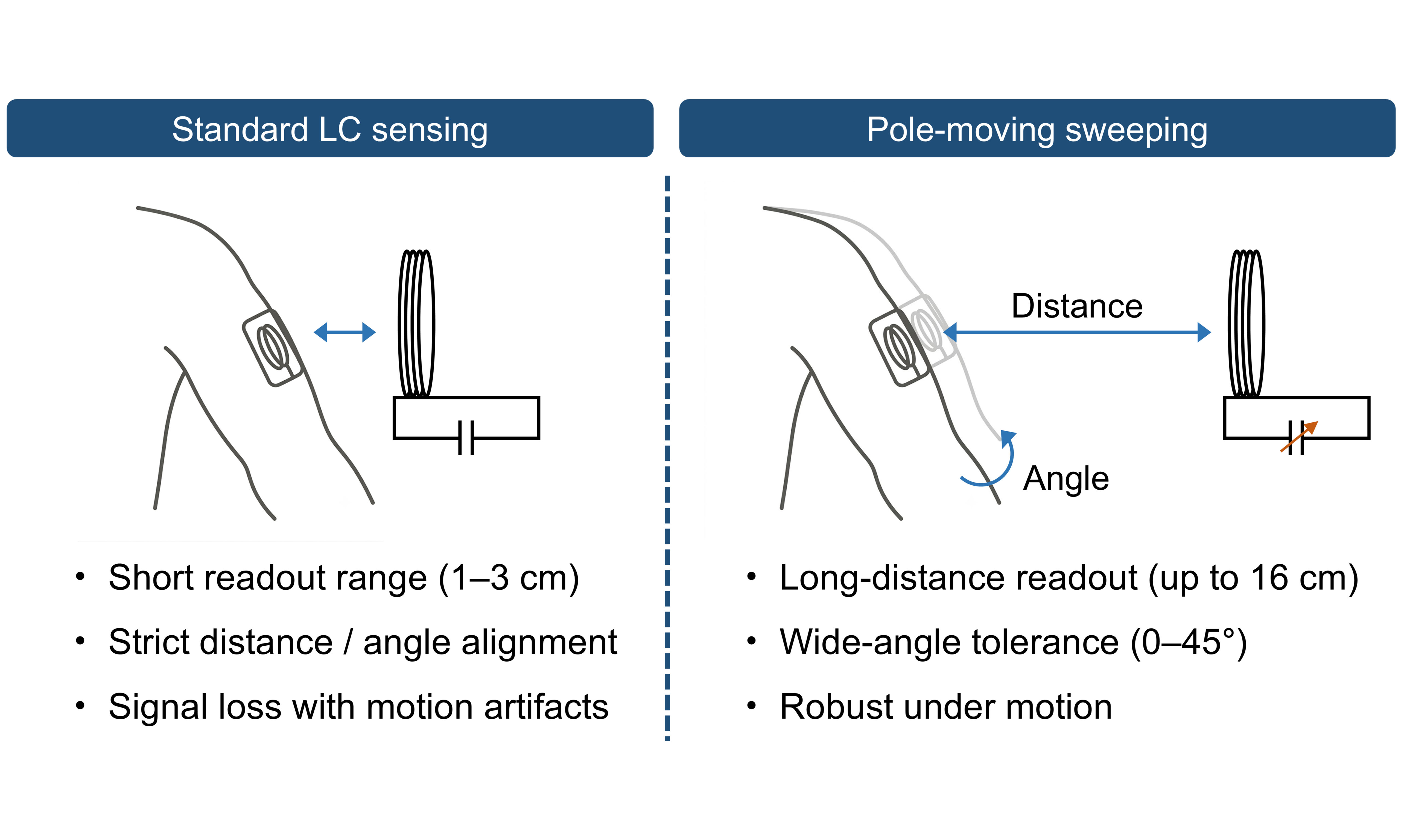
Monitoring physiological signals from within the body remains a significant challenge in biomedical engineering. While external wearable devices and medical imaging systems have seen remarkable advances over the past decade, they fundamentally cannot offer the continuous and site-specific data that only implantable sensors can provide. The emergence of biodegradable implantable electronics has made this approach increasingly attractive. These devices can reside transiently within the body, perform their diagnostic function, and then dissolve without requiring surgical removal. Among these, passive inductor-capacitor (LC) resonant sensors have emerged as a particularly promising approach, as they require no battery or active components[1]. Recent studies have broadened biodegradable wireless LC sensing from physiological monitoring, including vascular blood-flow[2] and regional temperature monitoring[3], to multifunctional implantable platforms that couple sensing with feedback-guided therapy[4]. However, a critical limitation has confined their practical utility: reliable readout has been restricted to distances of roughly 1-3 cm, and signal quality degrades rapidly when even minor misalignment occurs between the implanted sensor and the external reader. In a study recently published in Nature, Lan et al.[5] report a soft biodegradable wireless sensing platform that substantially extends this range, achieving reliable readout up to 16 cm and across a wide range of angles. This advance carries meaningful implications for clinical monitoring of deep-tissue physiology, where precise positional control of an implanted sensor is rarely feasible.
SCIENTIFIC SIGNIFICANCE
The scientific contribution of this paper lies in the invention of the ‘pole-moving sweeping’ readout system, where the key innovation is not in the sensing principle itself, but in how the resonant frequency is interrogated. Conventional passive inductor-capacitor (LC) wireless sensor readout relies on inductive coupling between a stationary external reader and an implanted resonator, detecting the sensor's resonant frequency by tracking the phase-frequency response. The coupling coefficient k decays rapidly with distance, rendering signals undetectable beyond a few centimeters. Previous attempts to address this limitation, including parity-time (PT)-symmetric circuits[6,7] and exceptional point (EP)-locked systems[8], achieved enhanced signal strength at longer distances. However, these approaches require precisely controlled distance and angular orientation between the reader and sensor. This requirement is fundamentally incompatible with the realities of an implanted device in a living, moving body.
The ‘pole-moving sweeping’ approach described by Lan et al.[5] achieves a qualitatively different outcome by dynamically shifting the coupled-system pole location in the complex-frequency plane during frequency sweeping. Unlike conventional frequency tracking, which primarily adjusts the reader’s resonant frequency without altering the transfer-function poles, this strategy modifies the pole dynamics of the coupled reader–sensor system, thereby maintaining high readout sensitivity over a broad range of distances and angular misalignments [Figure 1A][5]. This pole-moving sweeping strategy, grounded in coupled-mode theory, dramatically amplifies the phase response near the sensor’s resonant frequency by more than an order of magnitude [Figure 1B]. This insight clearly differentiates ‘pole-moving sweeping’ from prior approaches by shifting the focus from enhancing coupling strength to reconfiguring the readout dynamics themselves. The authors quantify this: the readout frequency varies by only 0.3% as the distance changes from 10 to 30 cm, a stability that would be essentially impossible with previous fixed-pole approaches. The theoretical framework, derived from Kirchhoff's law and coupled-mode theory, is rigorously developed and gives the work significant analytical depth.
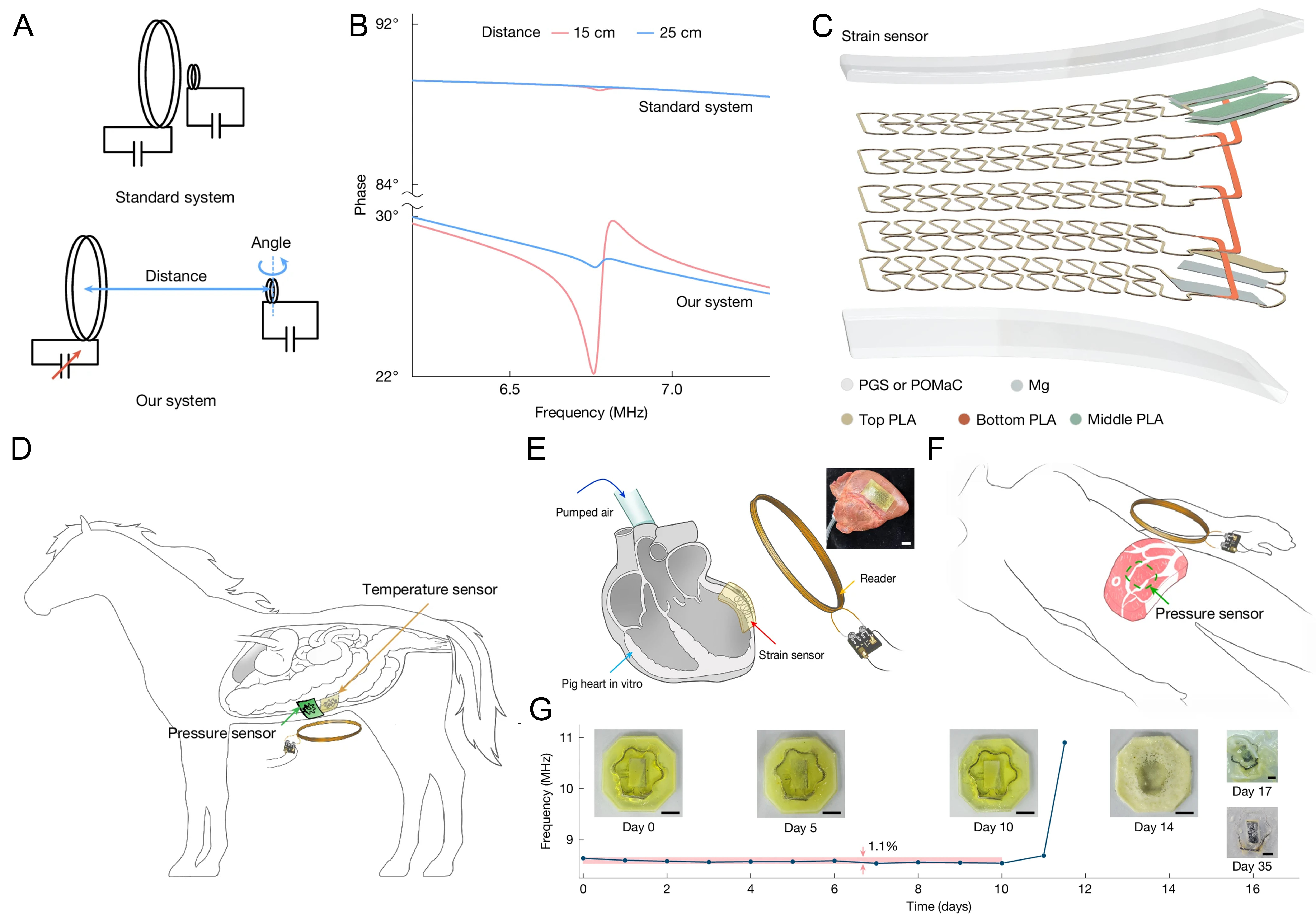
Figure 1. Soft biodegradable wireless sensing platform for long-distance and wide-angle physiological monitoring. (A) Schematic comparison of a standard LC readout system and the pole-moving sweeping readout system; (B) Phase-frequency response curves at readout distances of 15 cm and 25 cm; (C) Exploded-view schematic of the folded multilayer strain sensor structure; (D) Schematic of in vivo implantation of temperature and pressure sensors in the abdominal cavity of a horse. (E) Schematic and photograph of ex vivo strain sensing on a pig heart; (F) Schematic of a pressure sensor placed between human abdominal surface and fresh pork to simulate deep-tissue sensing; (G) Sequential optical images (Day 0-35) and resonant frequency stability over time. (A-G) reproduced with permission[5]. Copyright 2026, Springer Nature. PLA: Polylactic acid; PGS: poly(glycerol sebacate); POMaC: poly[octamethylene maleate (anhydride) citrate].
Equally important is the integrated folded structure that enables the sensor itself to be simultaneously soft, biodegradable, and electromagnetically effective [Figure 1C]. The challenge lies in achieving sufficient inductance for long-distance wireless sensing using biodegradable conductors such as magnesium and substrates such as polylactic acid (PLA)[2], materials that have resistivity values orders of magnitude higher than copper (Cu), or correspondingly lower conductivity. The authors address this through a multilayer serpentine structure created by a 180° twist-and-fold fabrication process. By splitting the serpentine trace into multiple strands, they reduce tensile stiffness and minimize resistance due to the skin and proximity effects of high-frequency currents, with the multilayer folded structure further increasing the overall inductance. Importantly, this folding strategy enables multilayer inductors without the need for interlayer soldering or vias, which are incompatible with biodegradable materials. The finite element analysis confirms that the maximum principal strain during the 180° twist remains well below the failure strain of the magnesium (Mg)-PLA composite, and this structure maintains stable mechanical and electrical performance under cyclic loading[5].
The paper demonstrates three sensor types: pressure, temperature, and strain, each leveraging different transduction mechanisms while sharing a common LC resonance readout mechanism. The pressure sensor (0-6.4 kPa range) exploits air-gap capacitance modulation under load; the temperature sensor uses poly(ethylene glycol) as a thermally responsive dielectric; and the strain sensor detects inductance changes arising from geometric reconfiguration of the serpentine coil under stretching. This modularity is a notable strength of the overall design, enabling a single structural and electromagnetic platform to support multiple sensing types. Beyond improving electromagnetic performance, the folded multilayer architecture also provides mechanical compliance, allowing the device to conform to soft biological tissues while reducing interfacial mechanical mismatch. This feature is important for stable implantation and biological integration. The authors also briefly demonstrate pH sensing capability using a poly[2-(diisopropylamino)ethyl methacrylate] and poly(ethylene glycol) diacrylate (PDPAEMA-PEGDA) dielectric, suggesting the broader chemical sensing potential of this platform.
IN VIVO PERFORMANCE AND TRANSLATIONAL IMPACT
The translational credibility of this work is substantially strengthened by the in vivo and ex vivo demonstrations [Figure 1D-F], particularly the intra-abdominal monitoring in a horse [Figure 1D], a large animal model whose physiological scale is far more relevant to human clinical translation than the rodent models that dominate the implantable sensor literature. The ability to continuously and wirelessly monitor intra-abdominal pressure and core abdominal temperature through the abdominal wall of a 465 kg horse, with sensors located 6-8 cm from the external reader, represents a remarkable demonstration of clinical-scale readout capability. The measured intra-abdominal pressures of 3.5 kPa in the supine position and 5.7 kPa in the standing position, as well as the 1.8 °C temperature recovery following anesthesia, are physiologically plausible values that lend credibility to the sensor measurements.
The ex vivo pig heart strain measurement is also noteworthy in the context of post-cardiac surgery monitoring [Figure 1E]. The demonstrated ability to capture continuous strain signals at various loading frequencies (0.4 Hz, 0.1 Hz, 0.05 Hz) with the sensor attached directly to the heart surface provides a meaningful proof-of-concept. The hybrid human-pork tissue model used to simulate deep-tissue sensing conditions [Figure 1F] is a well-conceived experimental design that captures both motion artifacts from respiration and signal attenuation through biological tissue. Under these conditions, the standard LC readout system completely failed, while the ‘pole-moving sweeping’ system succeeded.
The biocompatibility and degradation data presented are adequate for proof-of-concept purposes [Figure 1G]. Cytotoxicity, histological, and blood chemistry analyses in rodents provide a reassuring baseline safety profile for the constituent materials. Notably, the in vivo rat abdominal implantation demonstrates stable sensor operation for 12 days with only 2.2% frequency drift, a functional lifetime sufficient for acute postoperative monitoring. Tunable degradation through encapsulation choice - poly(glycerol sebacate) (PGS) for shorter-term use and poly[octamethylene maleate (anhydride) citrate] (POMaC) for extended operation - offers practical flexibility for matching device lifetime to clinical need.
Although the demonstrated operational lifetime is sufficient for acute postoperative monitoring, it remains limited for applications requiring long-term physiological surveillance. Further advances in biodegradable encapsulation materials and degradation engineering will therefore be necessary to extend device longevity while maintaining stable sensing performance throughout the intended implantation period.
FUTURE RESEARCH DIRECTIONS
For this platform to advance toward clinical deployment, challenges in scalable and standardized fabrication must be addressed. The current device architecture relies on multi-step patterning and manual folding processes, which, while effective at the laboratory scale, may limit reproducibility and throughput in larger-scale manufacturing. Specifically, scalable manufacturing will require precise control over multilayer alignment, folding strain, and variations in biodegradable conductors and substrates, because small structural deviations can directly affect inductance, resistance, and readout stability. These constraints are particularly relevant for biodegradable materials, where mechanical integrity and electrical performance must be tightly controlled across batches[9]. Developing fabrication strategies that preserve the folded multilayer structure while enabling higher-throughput production will be essential. Approaches such as automated assembly or continuous manufacturing methods could provide a pathway toward consistent and scalable device fabrication without compromising structural complexity.
As the sensing range and robustness of LC-based systems improve, new system-level challenges emerge that were previously less critical. The extended readout distance enabled by the pole-moving sweeping approach increases the likelihood of interference from multiple sensors or external electromagnetic sources, particularly in realistic clinical environments. This is especially relevant when multiple devices operate within overlapping frequency ranges, where spectral separation becomes increasingly constrained. In multi-sensor environments, such spectral overlap may lead to frequency congestion, where closely spaced resonant peaks become difficult to distinguish during wireless interrogation. In addition, although the pole-moving sweeping strategy substantially improves long-distance and angle-tolerant readout, it may introduce trade-offs among sweep speed, spectral resolution, calibration requirements, and signal-processing complexity. Ensuring reliable signal discrimination in such scenarios will require careful coordination between sensor design and interrogation strategies. Beyond spectral interference, tissue-induced parasitic capacitance may also cause resonant-frequency drift during long-term implantation, particularly as tissue moisture and physiological conditions change. Optimized coil layouts, insulating encapsulation layers, and circuit-level compensation algorithms may help minimize parasitic interference and maintain long-term readout stability. In addition, the ability to read signals over longer distances raises new considerations regarding unintended signal accessibility beyond the immediate vicinity of the patient. Although passive LC systems inherently lack onboard computation for encryption, these emerging use conditions suggest that data integrity and controlled readout will become increasingly important in future implementations.
Beyond these considerations, expanding the functional scope of this platform represents an important direction for future research. While the current system focuses on physical sensing, integrating additional functionalities such as biochemical detection[10] could significantly broaden its clinical relevance. However, such expansion will require biodegradable recognition or dielectric materials with sufficient analyte selectivity, stability in physiological fluids, and minimal cross-sensitivity to unrelated environmental changes. The demonstrated compatibility of the folded LC architecture with different transduction mechanisms suggests that such extensions may be feasible. In addition, coupling sensing capabilities with therapeutic responses within the same transient system could enable closed-loop interventions that operate over defined time windows[11]. Realizing this vision will require coordinated advances in materials design, device integration, and system-level optimization. Ultimately, such developments could position biodegradable wireless sensors as versatile platforms for time-limited, patient-specific medical applications.
CONCLUSION
The work by Lan et al.[10] provides an important step forward in biodegradable implantable bioelectronics. By addressing the long-standing limitation of short-range and alignment-sensitive readout through the physics of pole-moving sweeping, the authors move passive LC-based sensing closer to practical use in clinically relevant settings. The integrated folded structure further shows that mechanical compliance and electromagnetic functionality can be achieved within a fully biodegradable platform. The demonstration of deep-tissue monitoring in a large animal model highlights the feasibility of this approach beyond controlled laboratory conditions. At the same time, translating this platform into clinical practice will require advances in scalable fabrication, system-level robustness, and integration with broader sensing or therapeutic functionalities. Together, these developments point toward a new generation of transient implantable systems designed for reliable, time-limited physiological monitoring.
DECLARATIONS
Authors’ contributions
Writing - original draft: Lim, J.; Han, S.
Writing - review and editing: Lim, J.; Han, S.; Kim, J.; Won, S. M.; Hwang, S. W.
Supervision: Won, S. M.; Hwang, S. W.
Availability of data and materials
Not applicable.
AI and AI-assisted Tools Statement
Not applicable.
Financial support and sponsorship
This work was supported by the National Research Foundation of Korea (NRF) grant funded by the Korean government (the Ministry of Science, ICT, MSIT) (RS-2022-00165524).
Conflicts of interest
All authors declared that there are no conflicts of interest.
Ethical approval and consent to participate
Not applicable.
Consent for publication
Not applicable.
Copyright
© The Author(s) 2026.
REFERENCES
1. Kim, D.; Joo, J.; Kim, B.; Park, Y.; Won, S. M.; Yoo, J. From materials to systems: resonant inductive coupling for wireless bioelectronics. npj. Flex. Electron. 2026, 10, 72.
2. Boutry, C. M.; Beker, L.; Kaizawa, Y.; et al. Biodegradable and flexible arterial-pulse sensor for the wireless monitoring of blood flow. Nat. Biomed. Eng. 2019, 3, 47-57.
3. Lu, D.; Yan, Y.; Avila, R.; et al. Bioresorbable, wireless, passive sensors as temporary implants for monitoring regional body temperature. Adv. Healthcare. Mater. 2020, 9, 2000942.
4. Bi, H.; Sheng, H.; Wang, Z.; et al. A wireless, bioresorbable postoperative treatment system with temperature feedback, photothermal, and drug combination therapy. Adv. Mater. 2026, 38, e22601.
5. Lan, Y.; Li, S.; Guo, H.; et al. Soft biodegradable implants for long-distance and wide-angle sensing. Nature 2026, 649, 366-74.
6. Assawaworrarit, S.; Yu, X.; Fan, S. Robust wireless power transfer using a nonlinear parity-time-symmetric circuit. Nature 2017, 546, 387-90.
7. Chen, P.; Sakhdari, M.; Hajizadegan, M.; et al. Generalized parity-time symmetry condition for enhanced sensor telemetry. Nat. Electron. 2018, 1, 297-304.
8. Dong, Z.; Li, Z.; Yang, F.; Qiu, C.; Ho, J. S. Sensitive readout of implantable microsensors using a wireless system locked to an exceptional point. Nat. Electron. 2019, 2, 335-42.
9. Choi, Y. S.; Hsueh, Y.; Koo, J.; et al. Stretchable, dynamic covalent polymers for soft, long-lived bioresorbable electronic stimulators designed to facilitate neuromuscular regeneration. Nat. Commun. 2020, 11, 5990.
10. Li, S.; Lu, D.; Li, S.; et al. Bioresorbable, wireless, passive sensors for continuous pH measurements and early detection of gastric leakage. Sci. Adv. 2024, 10, eadj0268.
Cite This Article
 Open Access
How to Cite
Download Citation
Export Citation File:
Type of Import
Tips on Downloading Citation
Citation Manager File Format
Type of Import
Direct Import: When the Direct Import option is selected (the default state), a dialogue box will give you the option to Save or Open the downloaded citation data. Choosing Open will either launch your citation manager or give you a choice of applications with which to use the metadata. The Save option saves the file locally for later use.
Indirect Import: When the Indirect Import option is selected, the metadata is displayed and may be copied and pasted as needed.
About This Article
Copyright

Data & Comments
Data
0











Comments
Comments must be written in English. Spam, offensive content, impersonation, and private information will not be permitted. If any comment is reported and identified as inappropriate content by OAE staff, the comment will be removed without notice. If you have any queries or need any help, please contact us at [email protected].