



Intelligent wearable technologies enabled by triboelectric nanogenerators
 0
0 Abstract
Intelligent wearable technologies are advancing toward higher portability, multifunctionality, and autonomy, yet their widespread deployment is constrained by the limited endurance of conventional power sources and the growing energy demands of distributed sensor networks. The human body provides a continuous source of low-frequency biomechanical energy, offering a sustainable basis for self-powered wearables. Triboelectric nanogenerators (TENGs), leveraging the coupling of contact electrification and electrostatic induction, have therefore emerged as an enabling platform capable of harvesting biomechanical energy while simultaneously performing self-powered sensing, effectively addressing bottlenecks in energy supply and signal acquisition. In this perspective, we systematically review TENG-based intelligent wearable technologies, highlighting technical advances and application examples in physiological signal monitoring, biomedical applications, and human-machine interaction. Finally, we outline future directions in enhancing energy output, operational stability, and intelligent multifunctional integration, providing guidance for practical deployment and scalable development of TENG-based wearable technologies.
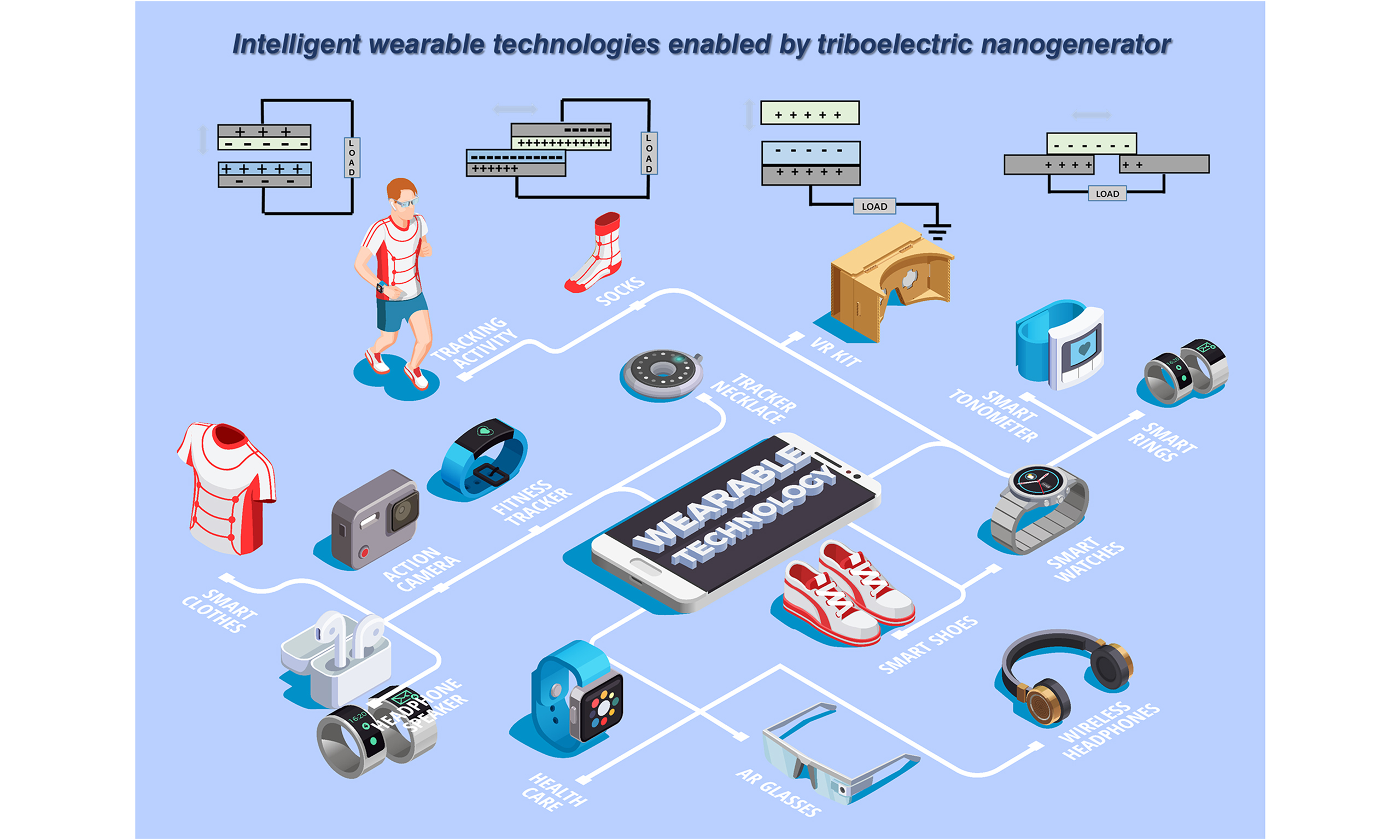
Keywords
INTRODUCTION
Driven by the converging advances in artificial intelligence (AI) and the Internet of Things (IoT), intelligent wearable devices have rapidly evolved from single-function motion trackers into multifunctional “human-extension terminals” that serve healthcare, human-machine interaction, and everyday entertainment[1,2]. From smart earphones and fitness trackers to smart clothing and watches, these systems establish a seamless interface between the human body and the digital world by continuously acquiring physiological and behavioral data[3,4]. However, most current wearables still rely on lithium batteries, whose limited energy density and frequent recharging fundamentally restrict long-term portability, system autonomy, and user experience. At the same time, the large-scale deployment of distributed sensor networks urgently demands ultra-low-power, self-sustained sensing technologies, making self-powered operation a critical enabling condition for the next generation of intelligent wearables.
The human body itself represents an always-on “mobile energy source”, as daily activities continuously generate abundant low-frequency mechanical energy. Common actions such as clapping, joint flexion and extension, walking, running, and thoracic breathing predominantly produce mechanical vibrations below
In this Perspective, we systematically review recent advances and representative applications of TENG-based intelligent wearable technologies across key scenarios. For physiological signal monitoring, TENG-enabled wearables realize highly sensitive detection of tactile, auditory, and human motion stimuli, supporting real-time tracking of behavioral patterns and environmental interactions. In biomedical monitoring, TENG devices can operate in a fully self-powered mode to capture critical physiological signals and, when integrated with miniaturized electronics and wireless communication modules, enable long-term continuous monitoring and remote transmission of cardiovascular, respiratory, and joint movement data, substantially improving both functionality and user comfort. In human-machine interaction, subtle mechanical motions are directly converted into electrical signals to enable motion recognition, gesture control, and immersive virtual reality interfaces, providing self-powered, high-sensitivity, and highly customizable interaction solutions. Finally, we outline future development strategies centered on enhancing energy output, long-term operational stability, and multifunctional intelligent integration, offering theoretical guidance and practical reference for engineering implementation, large-scale deployment, and iterative evolution of TENG-based wearable technologies, while also clarifying key opportunities for future research and application expansion.
INTELLIGENT WEARABLE TECHNOLOGIES
As key carriers of embodied intelligence, intelligent wearable devices extend and augment human capabilities by continuously sensing physiological states and environmental cues. They have demonstrated substantial utility across diverse domains, including health monitoring, daily interaction, professional sports, and medical rehabilitation [Figure 1]. In personal health management, TENG-based wearables enable self-powered monitoring of physical activity, heart rate, and sleep patterns, supporting exercise planning and early risk assessment. In smart watches[11] and belts[12], TENGs function as motion and pressure sensors for cardiovascular tracking and posture monitoring. In everyday interaction, TENG-equipped earphones[13] and rings[14] capture voice and gesture signals for real-time translation, control, and identity verification. In professional sports, TENG sensors in shoes[15] and clothes[16] transduce mechanical energy while recording gait, plantar pressure, and muscle activity to support performance feedback. In medical rehabilitation, TENG-based upper-limb devices[17] systems convert joint motion and arterial pulsations into electrical signals for precise feedback and continuous, cuffless monitoring. These self-powered, high-sensitivity capabilities provide a robust foundation for practical deployment of intelligent wearable systems.
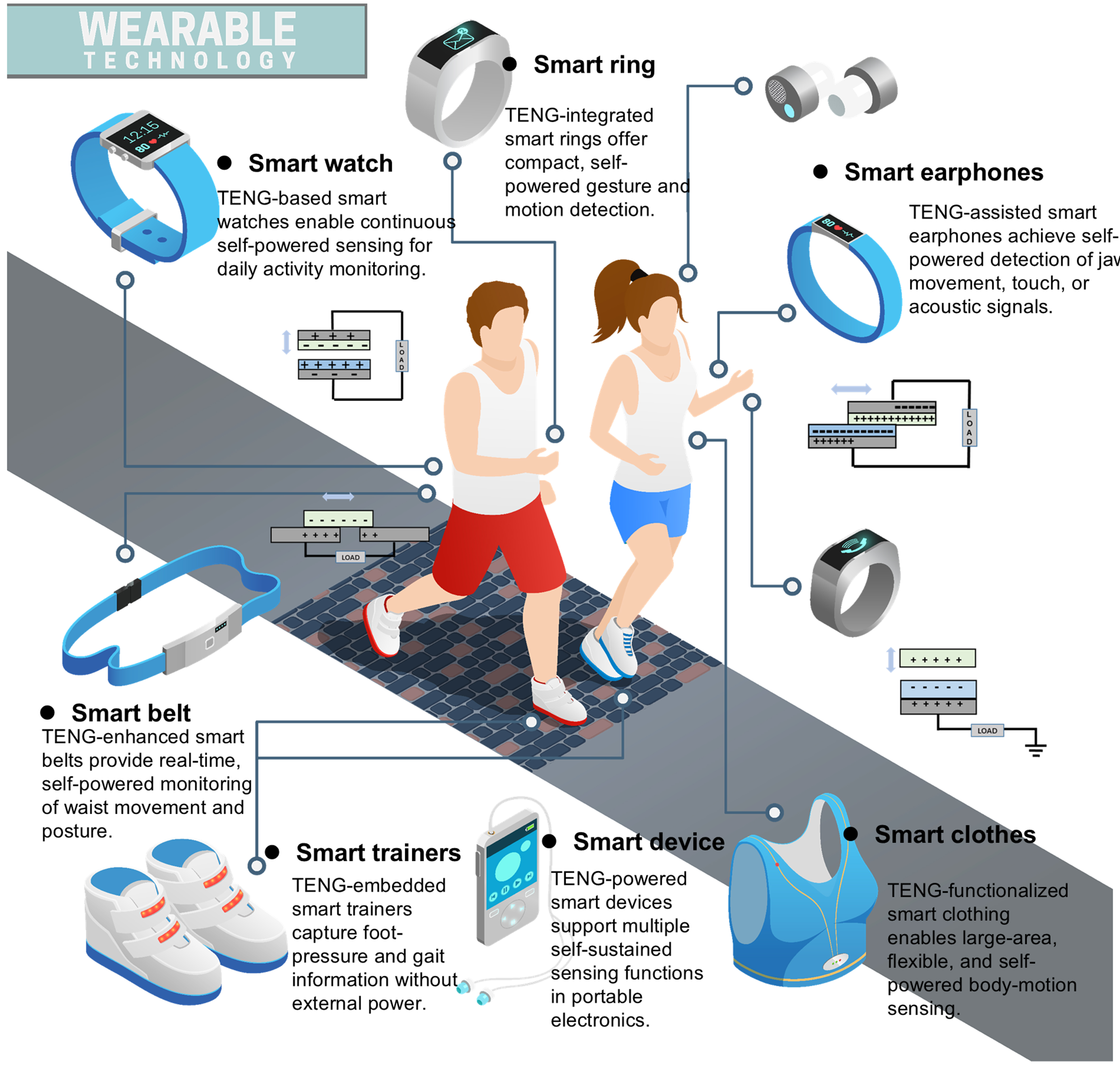
Figure 1. Representative application scenarios of intelligent wearable technologies. TENG: Triboelectric nanogenerator.
For energy harvesting, TENGs maximize charge transfer and electrostatic potential through periodic contact, separation, or sliding motions to achieve efficient biomechanical energy conversion. For sensing, the same mechanisms are utilized to encode mechanical stimuli into distinct electrical signal features, such as amplitude and frequency, which directly reflect motion characteristics. Different operational modes, including contact-separation (CS), sliding, single-electrode, and freestanding triboelectric-layer modes, can be tailored to balance energy output and sensing sensitivity, highlighting the intrinsic dual-function capability of TENGs in intelligent wearable systems.
In practical wearable scenarios, the selection of energy-harvesting strategies and material systems should be jointly optimized based on the biomechanical characteristics of specific human activities. Human activities exhibit distinct motion amplitudes and frequencies, leading to different energy conversion efficiencies in TENGs. Large-amplitude, high-frequency motions, such as walking and joint movement, generate higher output and are suitable as primary energy sources. In contrast, low-frequency motions, such as respiration, provide stable but low power for long-term sensing. This distinction guides application-specific energy harvesting strategies. Owing to broad material compatibility, TENGs can be fabricated from low-cost, wearable, safe materials such as polydimethylsiloxane (PDMS), polytetrafluoroethylene (PTFE), and common textiles, enabling seamless integration into practical wearable systems.
TENG-BASED WEARABLE SENSORS
TENGs can directly convert human mechanical motions into electrical signals, enabling self-powered sensing without external power sources. Their operation relies on the coupled effects of contact electrification and electrostatic induction, which transform mechanical stimuli into detectable electrical signals. This unique attribute renders TENGs particularly advantageous for self-powered wearable sensing, enabling broad applications in physiological signal acquisition, biomedical monitoring, and human-machine interaction[18,19]. The representative performance of TENGs[20-37] as wearable power sources is presented in Table 1.
Representative performance metrics of TENGs as wearable power sources
| Device type | Output performance | Energy-storage unit | Application demonstration | Ref. |
| Flexible all-printed CS-mode TENG | VOC = 106 V, ISC = 2.4 μA, 34 mW/m2 | Capacitor (2 μF, 0-10.2 V in 60 s) | Driving an electronic watch and thermometer | [20] |
| Flexible CS-mode TENG | VOC = 30 V, ISC = 0.4 μA, 32 mW/m2 | None | Lighting up 234 green LEDs | [21] |
| Textile-based TENG | VOC = 232 V, ISC = 6.3 μA, 66.13 mW/m2 | Capacitor (15 mF, 0-0.12 V in 300 s) | Driving a pedometer | [22] |
| Textile-based TENG | VOC = 25 V, ISC = 150 nA, 1.008 mW/m2 | None | Lighting 116 LEDs, pressure sensing | [23] |
| Textile-based TENG | VOC = 150 V, ISC = 4 μA, 393.7 mW/m2 | Flexible LIB belt (0.4-1.9 V in 4 h) | Powering the heartbeat meter strap | [24] |
| Soft tubular TENG | VOC = 200 V, ISC = 106 μA, 112.5 mW/m2 | Capacitor (27 μF, 1.2-4.2 V in 126 s) | Driving portable electronics | [25] |
| Multi-layer TENG | VOC = 700 V, QSC = 2.2 μC, 7.34 W/m2 | Capacitor (1 mF, 3.3-3.7 V in 300 s) | Human-activity sensors, portable electronics | [26] |
| Stretchable TENG | VOC = 104 V, ISC = 8 μA, 2.3 W/m2 | Capacitor (1 μF, 0-8 V in 60 s) | Intelligent lamp control | [27] |
| Breathable TENG | VOC = 168 V, ISC = 8.3 μA, 1.03 W/m2 | Capacitor (0.47 μF, 0-5 V in 5 s) | Lighting 6 LEDs | [28] |
| Stretchable and transparent TENG | VOC = 255.3 V, ISC = 22.6 μA, 4.06 mW/m2 | Capacitor (22 μF, 0-2 V in ≈211 s) | Powering electronic watch | [29] |
| Flexible TENG | VOC = 70 V, ISC= 30.2 mA/m2, 2.79 W/m2 | Capacitor (2.2 μF, 0-0.5 V in 50 s) | Lighting 80 blue LEDs | [30] |
| Textile-based DC TENG | VOC = 90 V, ISC = 0.45 μA | Supercapacitor (0-1.8 V in 80 s) | Driving calculator and hygrothermograph | [31] |
| Textile-based TENG | VOC = 80 V, ISC = 13 μA, 824 mW/m2 | Capacitor (22 μF, 0-880 μC in 700 s) | Lighting 750 LEDs | [32] |
| Textile-based TENG | VOC = 1,600 V, ISC = 12 μA, 203 mW/m2 | Capacitor (47 μF, 0-880 μC in 200 s) | Driving a smart watch | [33] |
| Textile-based TENG | VOC = 50 V, ISC = 0.35 μA, 263.36 mW/m2 | Capacitor (0.68 μF, 0-2.5 V in 7 s) | Driving smart watch | [34] |
| Textile-based TENG | VOC = 19 V, ISC = 0.4 μA, 11/0.88 W/m2 (compression/stretching) | Capacitor (1 μF, 0-3.5 V in 7 s) | Active sensors, lighting 24 LEDs | [35] |
| Direct-current fabrics TENG | VOC = 1,200 V, ISC = 2 μA, 0.75 mW/m2 | Capacitor (100 μF, 0-4 V in 300 s) | Lighting 99 bulbs and 1,053 LEDs | [36] |
| Textile-based TENG | VOC = 880 V, JSC = 1.1 μA/cm2, 0.14 W/m2 | Capacitor (16 μF, 0-2 V in 20 s) | Lighting 150 LEDs | [37] |
TENGs can effectively capture mechanical vibrations and morphological deformations arising from diverse physiological activities, enabling high-precision sensing across auditory, tactile, and body-motion modalities. In auditory perception, flexible TENG-based acoustic sensors operate predominantly through a CS triboelectric mechanism driven by sound-induced mechanical vibrations. In this incident, acoustic waves induce periodic deformation and separation of the triboelectric layers, generating corresponding electrical signals. Owing to their high mechanical compliance and fast dynamic response, these sensors can effectively respond to acoustic stimuli within the sound pressure level (SPL) range of approximately 50-110 dB and cover the primary frequency range of human speech, thereby supporting auditory-related applications such as speech recognition, voice authentication, and hearing assistance[38]. For tactile perception, TENG devices detect pressure, temperature, and material properties through contact-induced charge transfer[4]. Their high stretchability and ultrathin architectures enable conformal skin integration, allowing sensitive detection of subtle tactile stimuli. In body-motion sensing, TENGs transduce frictional displacement and structural deformation generated by joint flexion, muscle contraction, and limb movement into electrical signals, enabling multisite, comprehensive motion monitoring[39]. These systems can accurately quantify joint angles and motion frequencies, providing reliable data for exercise assessment and rehabilitation training [Figure 2A]. Notably, the intrinsic self-powered operation and low-maintenance characteristics of TENG-based sensors render them particularly suitable for long-term health management, home-based healthcare, and continuous behavioral monitoring, in which sustained functionality, reliability, and minimal user intervention are critical requirements.

Figure 2. Application domains of TENG-based intelligent wearable technologies. (A) Physiological signal sensing: A1: A highly sensitive and wide-frequency-range self-powered auditory sensor for both robotics and human hearing aids. Reprinted with permission[38]. Copyright 2018, American Association for the Advancement of Science; A2: Components and schematic diagram of the haptic glove[4]. Reprinted with permission. Copyright 2025, American Association for the Advancement of Science; A3: A breathable ionic mechanoreceptor for body motion sensing[39]. Reprinted with permission. Copyright 2022, Springer Nature; (B) Biomedical monitoring: B1: A woven self-powered pulse and blood pressure sensor[40]. Reprinted with permission. Copyright 2018, WILEY-VCH; B2: The sleep respiratory state judgment based on the voltage signals. Reprinted with permission[41]. Copyright 2021, Wiley-VCH; B3: Monitoring of the human shoulder joint[42]. Reprinted with permission. Copyright 2024, WILEY-VCH; (C) Human–machine interaction: C1: A self-powered facial lip-language decoding system[43]. Reprinted with permission. Copyright 2022, Springer Nature; C2: An eye-triggered self-powered sensor that could control multiple electronics. Reprinted with permission[44]. Copyright 2017, American Association for the Advancement of Science; C3: Schematic diagram of an intelligent perception system based on the multi-receptor skin and deep learning[45]. Reprinted with permission. Copyright 2024, American Association for the Advancement of Science. TENG: Triboelectric nanogenerator.
In biomedical applications, TENG-based wearable sensors exploit their non-invasive, real-time, and fully self-powered characteristics to enable continuous monitoring of critical physiological signals, thereby supporting early disease screening and objective rehabilitation assessment. Representative applications include cardiovascular monitoring, respiratory surveillance, and joint function evaluation. TENGs can sensitively detect arterial pulsations to acquire pulse waveforms, providing rich cardiovascular information under both physiological and pathological conditions. By combining multisite pulse signal acquisition with pulse transit time (PTT) analysis, TENG-based sensors can achieve cuffless, continuous blood pressure estimation, enabling real-time cardiovascular monitoring without the need for conventional inflatable cuffs[40]. By conformally adhering to the thoracoabdominal region or integrating into respiratory masks, TENG devices can resolve respiratory motion and airflow fluctuations, allowing accurate measurement of respiratory rate, depth, and even specific gas components[41]. For joint function assessment, stretchable and self-healable TENG sensors applied to joints and periarticular muscles transduce joint motion and muscle exertion into electrical signals, enabling quantitative evaluation of joint angles and muscular activity[42]. These capabilities provide precise and reliable data for rehabilitation monitoring, particularly in upper-limb functional recovery [Figure 2B]. These characteristics enable TENG-based wearables to support quantitative postoperative rehabilitation evaluation and continuous remote monitoring of chronic conditions such as cardiovascular and respiratory diseases. Their self-powered operation reduces maintenance requirements, making them suitable for long-term clinical-grade wearable systems in home-based and telemedicine settings.
TENGs further establish highly efficient human-machine interaction channels by converting subtle human motions into well-resolved electrical signals. Representative applications include AI-enabled gesture interaction, IoT control, and tele-perception. By deploying TENG sensor arrays on the hands or facial regions, minute electrophysical signals induced by gestures or lip movements can be precisely captured. When coupled with AI algorithms, these systems enable real-time sign-language translation, immersive virtual reality interaction, and lip-reading recognition, thereby facilitating barrier-free communication for special populations[43]. Integrated into daily wearable platforms, TENGs can detect actions such as blinking or hand gestures to control smart home systems, consumer electronics, and industrial robotic grippers, supporting seamless operation in smart living and digital manufacturing environments[44]. Moreover, by exploiting electrostatic induction, TENG-based tele-perception systems can function as electronic skins or bioinspired tactile sensors capable of resolving object proximity, motion trajectories, and three-dimensional surface topographies, providing essential technological support for advanced robotics and intelligent interactive systems[45-47] [Figure 2C].
Beyond signal generation, the intelligence of TENG-based wearable systems arises from algorithm-driven transformation of raw electrical signals into actionable information. By integrating time-domain, frequency-domain, and time-frequency analysis with machine learning and deep learning models, these systems enable automatic feature extraction, noise suppression, and spatiotemporal pattern recognition from complex sensor data. In particular, deep learning architectures such as convolutional neural networks (CNNs), recurrent neural networks (RNNs), and graph neural networks (GNNs) support end-to-end processing for motion recognition, gesture interpretation, and human-machine interaction. Through the tight coupling of native TENG signals and adaptive algorithms, self-powered wearables evolve from passive sensors into intelligent perception and decision-making platforms.
CHALLENGE AND PERSPECTIVES
Despite rapid progress, the practical deployment of TENG-based intelligent wearable technologies remains constrained by technology-specific bottlenecks, including limited power output and stability, environmental sensitivity, fabrication scalability, and insufficient system-level intelligence. Overcoming these issues requires coordinated advances across the material, device, system, and data-processing levels.
Improving energy harvesting performance is a primary challenge. This relies on precise regulation of surface charge through micro- and nanoscale design, functional group and dielectric optimization, and charge-trapping enhancement, while simultaneously maintaining mechanical compliance. In addition, hydrophobic triboelectric materials and robust encapsulation are necessary to suppress moisture-induced charge decay and ensure long-term stability in wearable conditions. System-level integration with miniaturized power management circuits is also essential for realizing fully self-powered wearable platforms.
For sensing applications, key performance metrics - including detection limit, linearity, response time, and signal stability - must be further optimized to meet the requirements for medical-grade monitoring and high-fidelity human-machine interaction. At the manufacturing level, scalable fabrication with high repeatability and standardized quality control is critical to address device variability and enable industrial translation.
Looking ahead, the integration of TENG-based sensing systems with machine learning and AI will enable the transition from passive sensing to closed-loop intelligent wearables, supporting health risk assessment, rehabilitation monitoring, and intention-aware human-machine interaction.
DECLARATIONS
Authors’ contributions
Wrote the original draft: Du, Y.
Supervised, reviewed, and revised the manuscript: Wang, Z. L.; Wei, D.
Availability of data and materials
Not applicable.
Financial support and sponsorship
This work was supported by the National Natural Science Foundation (Grant No. 22479016).
Conflicts of interest
All authors declared that there are no conflicts of interest.
Ethical approval and consent to participate
Not applicable.
Consent for publication
Not applicable.
Copyright
© The Author(s) 2026.
REFERENCES
1. Moin, A.; Zhou, A.; Rahimi, A.; et al. A wearable biosensing system with in-sensor adaptive machine learning for hand gesture recognition. Nat. Electron. 2021, 4, 54-63.
2. Wang, J.; Li, S.; Yi, F.; et al. Sustainably powering wearable electronics solely by biomechanical energy. Nat. Commun. 2016, 7, 12744.
3. Liu, Y.; Yiu, C.; Song, Z.; et al. Electronic skin as wireless human-machine interfaces for robotic VR. Sci. Adv. 2022, 8, eabl6700.
4. Xu, G.; Wang, H.; Zhao, G.; et al. Self-powered electrotactile textile haptic glove for enhanced human-machine interface. Sci. Adv. 2025, 11, eadt0318.
5. Fan, F.; Tian, Z.; Lin, Wang. Z. Flexible triboelectric generator. Nano. Energy. 2012, 1, 328-34.
6. Zhu, G.; Chen, J.; Liu, Y.; et al. Linear-grating triboelectric generator based on sliding electrification. Nano. Lett. 2013, 13, 2282-9.
7. Du, Y.; Wang, Z. L.; Wei, D. Emerging sensing systems based on triboelectric nanogenerator. Nano. Energy. 2025, 143, 111292.
8. Du, Y.; Tang, Q.; He, W.; et al. Harvesting ambient mechanical energy by multiple mode triboelectric nanogenerator with charge excitation for self-powered freight train monitoring. Nano. Energy. 2021, 90, 106543.
9. Zhao, H.; Xu, M.; Shu, M.; et al. Underwater wireless communication via TENG-generated Maxwell’s displacement current. Nat. Commun. 2022, 13, 3325.
10. Du, Y.; Fu, S.; Shan, C.; et al. A novel design based on mechanical time-delay switch and charge space accumulation for high output performance direct-current triboelectric nanogenerator. Adv. Funct. Mater. 2022, 32, 2208783.
11. Byun, K.; Lee, M.; Cho, Y.; Nam, S.; Shin, H.; Park, S. Potential role of motion for enhancing maximum output energy of triboelectric nanogenerator. APL. Mater. 2017, 5, 074107.
12. Gai, L.; Wang, F.; Zhou, F. A stretchable triboelectric nanogenerator integrated ion coagulation electrode for cheerleading monitoring. J. Electron. Mater. 2022, 51, 7182-9.
13. Zong, R.; Gao, Y.; Feng, J.; Li, Y.; Qi, L. A self-powered and self-sensing human kinetic energy harvesting system for application in wireless smart headphones. Sustain. Mater. Technol. 2025, 43, e01272.
14. Faruk, O.; Islam, M. R.; Pradhan, G. B.; et al. A wearable triboelectric-iontronic hybrid smart finger ring with self-powered static-dynamic tactile sensing for advanced human-machine interactions. Adv. Funct. Mater. 2025, e27394.
15. Yang, P.; Shi, Y.; Li, S.; et al. Monitoring the degree of comfort of shoes in-motion using triboelectric pressure sensors with an ultrawide detection range. ACS. Nano. 2022, 16, 4654-65.
16. Yu, A.; Pu, X.; Wen, R.; et al. Core-shell-yarn-based triboelectric nanogenerator textiles as power cloths. ACS. Nano. 2017, 11, 12764-71.
17. Fan, F. R.; Tang, W.; Wang, Z. L. Flexible nanogenerators for energy harvesting and self-powered electronics. Adv. Mater. 2016, 28, 4283-305.
18. Du, Y.; Song, J.; Liu, H.; et al. Self-powered triboelectric sensor for real-time, intelligent occlusal force monitoring. Adv. Funct. Mater. 2025, e19646.
19. Pu, X.; Zhang, C.; Wang, Z. L. Triboelectric nanogenerators as wearable power sources and self-powered sensors. Natl. Sci. Rev. 2023, 10, nwac170.
20. Liu, G.; Gao, Y.; Xu, S.; et al. One-stop fabrication of triboelectric nanogenerator based on 3D printing. EcoMat 2021, 3, e12130.
21. Sheng, F.; Yi, J.; Shen, S.; et al. Self-powered smart arm training band sensor based on extremely stretchable hydrogel conductors. ACS. Appl. Mater. Interfaces. 2021, 13, 44868-77.
22. Xu, F.; Dong, S.; Liu, G.; et al. Scalable fabrication of stretchable and washable textile triboelectric nanogenerators as constant power sources for wearable electronics. Nano. Energy. 2021, 88, 106247.
23. Li, Y.; Zhang, Y.; Yi, J.; et al. Large-scale fabrication of core-shell triboelectric braided fibers and power textiles for energy harvesting and plantar pressure monitoring. EcoMat 2022, 4, e12191.
24. Pu, X.; Li, L.; Song, H.; et al. A self-charging power unit by integration of a textile triboelectric nanogenerator and a flexible lithium-ion battery for wearable electronics. Adv. Mater. 2015, 27, 2472-8.
25. Liu, G. X.; Li, W. J.; Liu, W. B.; et al. Soft tubular triboelectric nanogenerator for biomechanical energy harvesting. Adv. Sustain. Syst. 2018, 2, 1800081.
26. Niu, S.; Wang, X.; Yi, F.; Zhou, Y. S.; Wang, Z. L. A universal self-charging system driven by random biomechanical energy for sustainable operation of mobile electronics. Nat. Commun. 2015, 6, 8975.
27. Bai, Z.; Xu, Y.; Lee, C.; Guo, J. Autonomously adhesive, stretchable, and transparent solid-state polyionic triboelectric patch for wearable power source and tactile sensor. Adv. Funct. Mater. 2021, 31, 2104365.
28. Yuan, W.; Zhang, C.; Zhang, B.; et al. Wearable, breathable and waterproof triboelectric nanogenerators for harvesting human motion and raindrop energy. Adv. Mater. Technol. 2022, 7, 2101139.
29. Wen, Z.; Yang, Y.; Sun, N.; et al. A wrinkled PEDOT:PSS film based stretchable and transparent triboelectric nanogenerator for wearable energy harvesters and active motion sensors. Adv. Funct. Mater. 2018, 28, 1803684.
30. Wang, L.; Daoud, W. A. Highly flexible and transparent polyionic-skin triboelectric nanogenerator for biomechanical motion harvesting. Adv. Energy. Mater. 2019, 9, 1803183.
31. Chen, C.; Guo, H.; Chen, L.; et al. Direct current fabric triboelectric nanogenerator for biomotion energy harvesting. ACS. Nano. 2020, 14, 4585-94.
32. Lee, H.; Lee, H. E.; Wang, H. S.; et al. Hierarchically surface-textured ultrastable hybrid film for large-scale triboelectric nanogenerators. Adv. Funct. Mater. 2020, 30, 2005610.
33. Huang, T.; Zhang, J.; Yu, B.; et al. Fabric texture design for boosting the performance of a knitted washable textile triboelectric nanogenerator as wearable power. Nano. Energy. 2019, 58, 375-83.
34. Li, Z.; Huang, H.; Shen, J.; et al. 3-D woven triboelectric nanogenerators with integrated friction, spacer, and electrode layers for wearable energy harvesting and mechanical sensing. Nano. Energy. 2025, 135, 110622.
35. Dong, K.; Deng, J.; Ding, W.; et al. Versatile core–sheath yarn for sustainable biomechanical energy harvesting and real-time human-interactive sensing. Adv. Energy. Mater. 2018, 8, 1801114.
36. Cheng, R.; Dong, K.; Chen, P.; et al. High output direct-current power fabrics based on the air breakdown effect. Energy. Environ. Sci. 2021, 14, 2460-71.
37. Xiong, J.; Cui, P.; Chen, X.; et al. Skin-touch-actuated textile-based triboelectric nanogenerator with black phosphorus for durable biomechanical energy harvesting. Nat. Commun. 2018, 9, 4280.
38. Guo, H.; Pu, X.; Chen, J.; et al. A highly sensitive, self-powered triboelectric auditory sensor for social robotics and hearing aids. Sci. Robot. 2018, 3, eaat2516.
39. Wang, H. L.; Guo, Z. H.; Pu, X.; Wang, Z. L. Ultralight iontronic triboelectric mechanoreceptor with high specific outputs for epidermal electronics. Nanomicro. Lett. 2022, 14, 86.
40. Meng, K.; Chen, J.; Li, X.; et al. Flexible weaving constructed self-powered pressure sensor enabling continuous diagnosis of cardiovascular disease and measurement of cuffless blood pressure. Adv. Funct. Mater. 2019, 29, 1806388.
41. Peng, X.; Dong, K.; Ning, C.; et al. All-nanofiber self-powered skin-interfaced real-time respiratory monitoring system for obstructive sleep apnea-hypopnea syndrome diagnosing. Adv. Funct. Mater. 2021, 31, 2103559.
42. Du, Y.; Shen, P.; Liu, H.; et al. Conformal self-powered inertial displacement sensor with geometric optimization for in situ noninvasive data acquisition. Adv. Funct. Mater. 2024, 34, 2409602.
43. Lu, Y.; Tian, H.; Cheng, J.; et al. Decoding lip language using triboelectric sensors with deep learning. Nat. Commun. 2022, 13, 1401.
44. Pu, X.; Guo, H.; Chen, J.; et al. Eye motion triggered self-powered mechnosensational communication system using triboelectric nanogenerator. Sci. Adv. 2017, 3, e1700694.
45. Du, Y.; Shen, P.; Liu, H.; et al. Multi-receptor skin with highly sensitive tele-perception somatosensory. Sci. Adv. 2024, 10, eadp8681.
46. Du, Y.; Shen, P.; Liu, H.; et al. Meta-structured electret heterointerface for resilient and adaptive tele-perception in embodied intelligence. Matter 2025, 8, 102363.
Cite This Article
 Open Access
How to Cite
Download Citation
Export Citation File:
Type of Import
Tips on Downloading Citation
Citation Manager File Format
Type of Import
Direct Import: When the Direct Import option is selected (the default state), a dialogue box will give you the option to Save or Open the downloaded citation data. Choosing Open will either launch your citation manager or give you a choice of applications with which to use the metadata. The Save option saves the file locally for later use.
Indirect Import: When the Indirect Import option is selected, the metadata is displayed and may be copied and pasted as needed.
About This Article
Copyright

Data & Comments
Data
0











Comments
Comments must be written in English. Spam, offensive content, impersonation, and private information will not be permitted. If any comment is reported and identified as inappropriate content by OAE staff, the comment will be removed without notice. If you have any queries or need any help, please contact us at [email protected].