


High-dielectric-constant polymer-based elastomeric dielectrics for soft electronic devices
 0
0  ,
, Abstract
Polymer-based elastomeric dielectrics have demonstrated significant application prospects in flexible electronic skins, dielectric actuators, and energy harvesting and storage due to their light weight, tunable structures, and mechanical flexibility. A key focus in developing polymer-based dielectric elastomers is the simultaneous enhancement of dielectric constant and breakdown strength, along with the reduction of dielectric loss, without compromising mechanical flexibility. This review summarizes recent advances in the design and preparation of high-dielectric-constant (high-k) polymer-based elastomeric dielectrics, with special emphasis on strategies for balancing and improving both dielectric and mechanical properties. Finally, we summarize and provide an outlook on the application fields of polymer-based elastic dielectric materials.
Keywords
INTRODUCTION
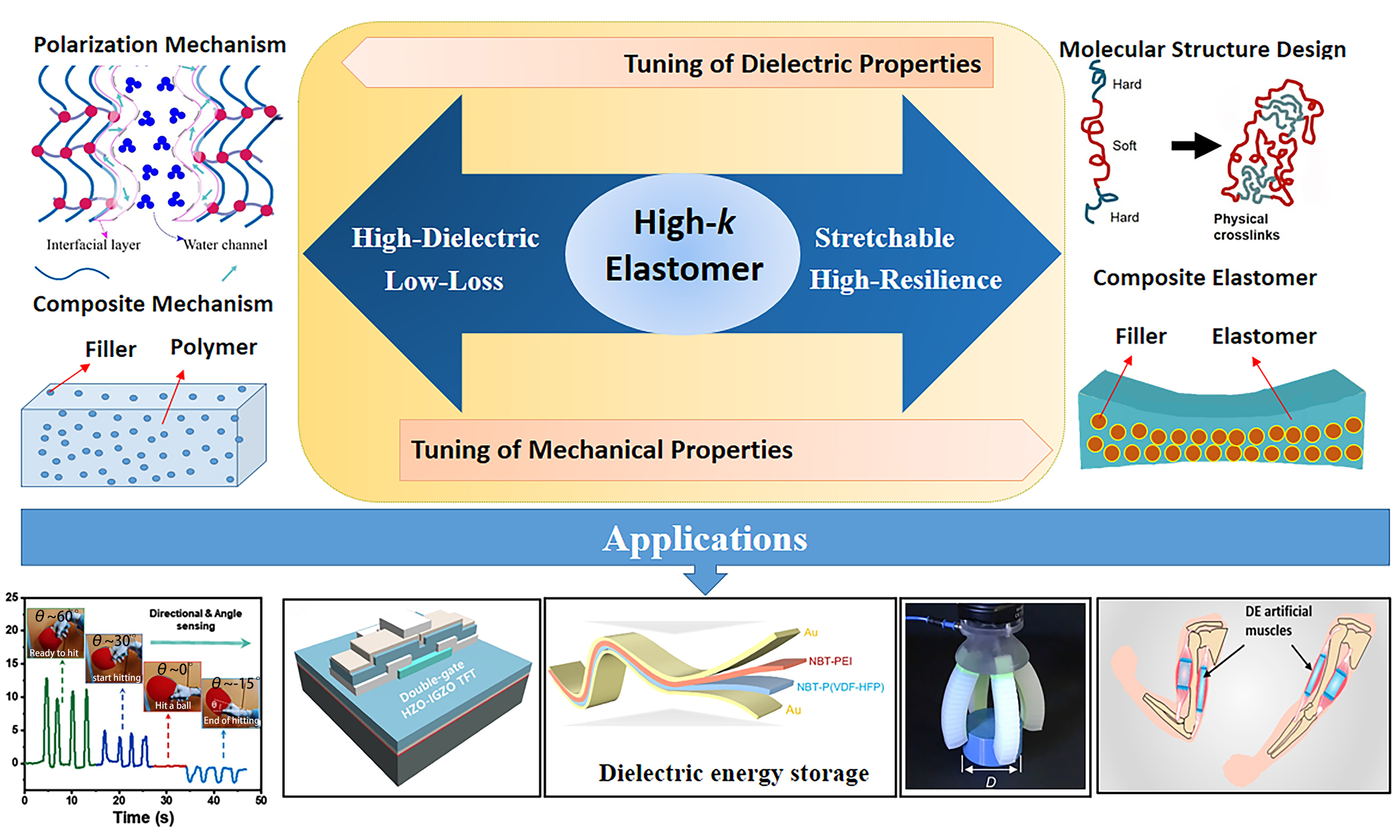
With the rapid advancement of wearable devices, soft robotics, and bio-inspired artificial intelligence (AI), critical materials for next-generation electronic devices are required to not only exhibit excellent electrical properties but also possess biomimetic characteristics such as softness, stretchability, and mechanical robustness[1-12]. Among various material systems, high-dielectric-constant (high-k) polymer-based materials have become a preferred choice for advanced applications such as high-energy-density capacitors, field-effect transistors, actuators, and capacitive sensors due to their superior electrical insulation, elastic tunability, and efficient electromechanical energy conversion[13-25], as illustrated in Figure 1.
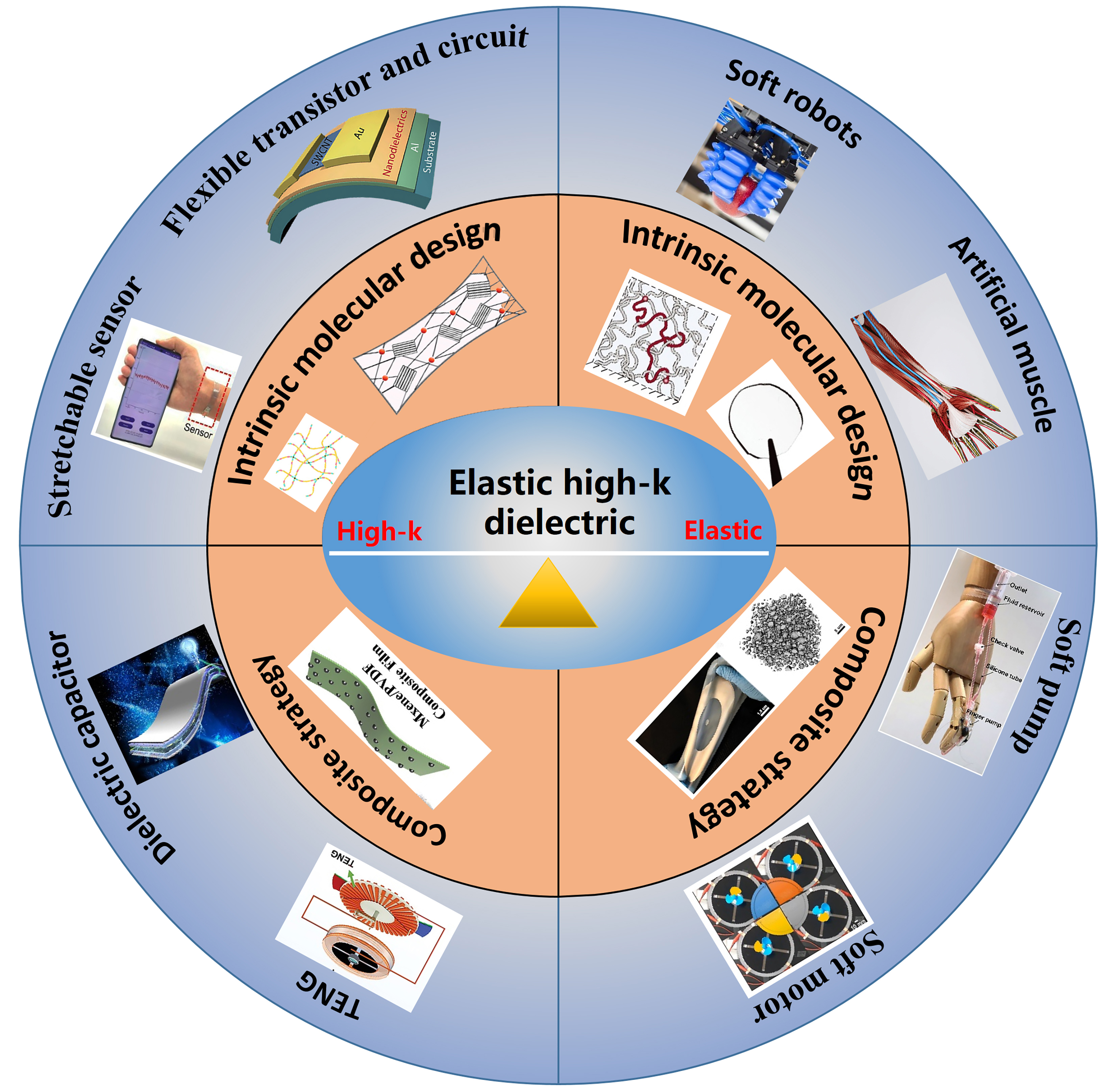
Figure 1. Schematic illustration of balancing dielectric and mechanical properties, and application fields of high-k polymer-based elastomers (Reproduced with permission[3]: Copyright © 2025, SPE-Inspiring Plastics[4]; Copyright © 2024, American Chemical Society[5]; Copyright © 2021, Wiley-VCH GmbH[18]; Copyright © 2024, Wiley-VCH GmbH[19]; Copyright © 2023, The American Association for the Advancement of Science[20]; Copyright © 2021, The American Association for the Advancement of Science[21]; Copyright © 2019, WILEY-VCH Verlag GmbH & Co. KGaA, Weinheim[22]; Copyright 2021, Liu et al.[23]; Copyright © 2023, Wiley-VCH GmbH). PVDF: Polyvinylidene fluoride; SWCNT: single-wall carbon nanotubes; TENG: triboelectric nanogenerator.
A high-k fundamentally reflects the material’s strong polarization capability under an applied electric field[26]. The key performance metrics for high-k polymer-based materials encompass a high k to enhance electrical response, coupled with high breakdown strength (Eb) to ensure operational reliability and low dielectric loss (tan δ) to improve energy conversion efficiency[27]. Meanwhile, a low elastic modulus and high fracture elongation are necessary to accommodate large deformations[28]. However, these essential properties often exhibit inherent trade-offs at the molecular level. The high polarization capability in polymer dielectrics typically arises from strongly polar groups (e.g., -CN, -F) grafted onto the polymer chains[29]. These groups, along with hydrogen-bonding interactions, significantly restrict molecular chain mobility, leading to increased stiffness and embrittlement[30]. In contrast, conventional elastomers such as polydimethylsiloxane (PDMS) offer excellent stretchability, but their low intrinsic k (k ≈ 2-3) severely limits energy density in electronic devices[31]. Furthermore, under mechanical strain, changes in molecular chain orientation, crystalline domain alignment, interfacial adhesion, and material dimensions can alter critical properties such as k, tanδ, and Eb, ultimately compromising device reliability. This fundamental conflict between dielectric performance and stretchability poses a major challenge for the development of high-performance flexible electronics[32].
This review provides a systematic overview of recent progress in addressing the balance between the dielectric and mechanical properties of polymer-based elastomers. First, we elucidate the molecular origins of polarization and stretchability, emphasizing the intrinsic conflict between these fundamental characteristics. Next, we present an in-depth discussion of design strategies and enhancement methods, focusing on their underlying mechanisms, representative material systems, and performance outcomes. Finally, we identify key challenges and highlight future research directions, offering guidance for the rational design of next-generation high-performance flexible electronic devices.
POLARIZATION AND STRETCHABILITY OF DIELECTRIC MATERIALS
Polarization of dielectric materials
The dielectric properties of a material originate from its polarization. When exposed to an electric field, the positive and negative charge centers within a dielectric material undergo separation or reorientation, generating a macroscopic electric dipole moment. This phenomenon results in bound charges on the material’s surface, which is known as polarization[33]. Polarization is quantified by the polarization vector (P), as given in[34]:
where ε0 is the electric permittivity of a vacuum (8.854 × 10⁻¹² Fm-1), and E is electric field. k is directly influenced by P.
As illustrated in Figure 2A-E, dielectric materials typically exhibit five polarization mechanisms, including interfacial polarization (Pint), ionic polarization (Pion), dipolar polarization (Pdip), atomic polarization (Pat), and electronic polarization (Pe)[34]. Among these, electronic polarization, arising from the distortion of electron clouds, is universally present in all dielectric materials. Atomic/ionic polarization results from the relative displacement of positive and negative ions/atoms. Ionic polarization primarily occurs in ionic compounds such as mica and ceramic materials. Dipolar polarization is caused by the reorientation of permanent dipoles under an electric field, with typical material systems including polyvinylidene fluoride (PVDF) and its binary and ternary polymers. Interfacial polarization, induced by the accumulation of charges at interfaces or defects, is predominantly found in composite material systems, such as polymer composites filled with conductive materials such as carbon-based materials or liquid metals (LMs)[35]. Each mechanism contributes differently to the overall dielectric behavior across various frequencies[36] [Figure 2F]. Under certain conditions, these mechanisms can superimpose, leading to pronounced frequency-dependent dielectric properties.
A delay in the polarization response to a changing electric field, known as polarization relaxation, results in energy dissipation [Figure 2G]. This dissipation is characterized by the dielectric loss tanδ, which is defined as[37]:
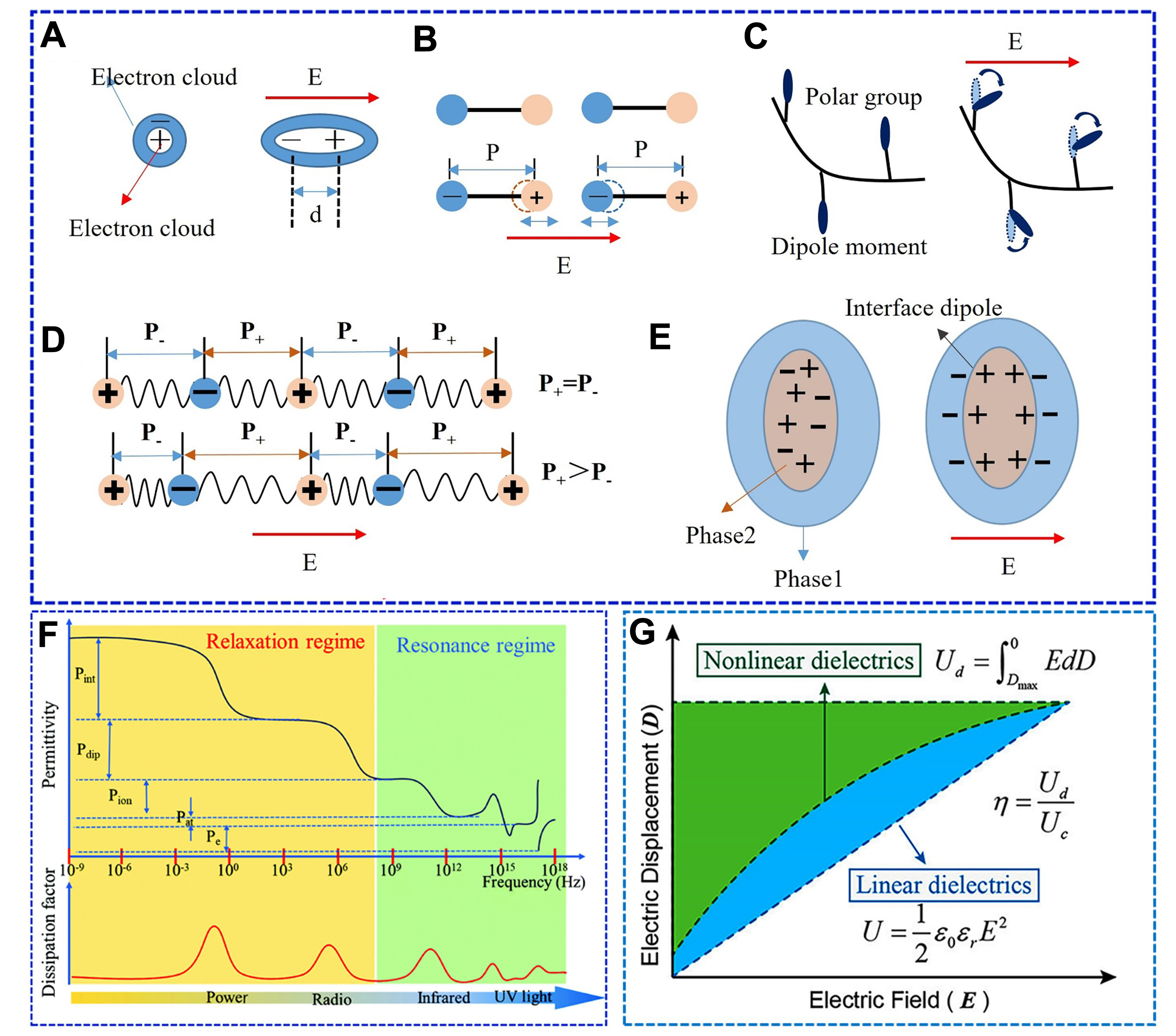
Figure 2. Principles of Dielectric Material Polarization and Energy Dissipation. (A) Electronic polarization; (B) Atomic polarization; (C) Ionic polarization; (D) Dipolar polarization and (E) interfacial polarization; (F) k and tanδ versus frequency[36] (Reproduced with permission. Copyright © 2016 American Chemical Society); (G) Schematic D-E hysteresis loop indicating energy dissipation[31]. (Reproduced with permission. Copyright © 2021 American Chemical Society).
where k” and k’ are the imaginary and real parts of the complex dielectric constant, respectively. According to free electric theory, at very low frequencies (e.g., f < 103 Hz), tanδ is related to the electrical conductivity (σ) and the real part of the k through[38]:
The mechanism of high-k dielectric plays a critical role in determining material performance. However, the properties of a material often involve complex trade-offs. For example, electronic and atomic polarizations exhibit fast response times, low tanδ, and high Eb, yet their contribution to k remains limited[39]. In contrast, other types of polarization mechanisms can significantly increase the k-value; however, each comes with specific limitations. Dipolar polarization significantly increases k but involves energy dissipation due to internal friction during dipole reorientation, leading to high tanδ[40]. It is also highly frequency-dependent; at elevated frequencies, dipoles cannot reorient quickly enough, causing k to decrease. Furthermore, since molecular chain mobility is temperature-sensitive, the k based on this mechanism often shows poor thermal stability. Interfacial polarization, common in composite materials, occurs predominantly near interfaces where defects tend to accumulate. These regions promote charge injection and partial discharge, substantially reducing the Eb[41]. The slow migration and relaxation of interfacial charges also contribute to high tanδ[42].
Determinants of dielectric materials’s stretchability
Polymers are long-chain molecules consisting of multiple repeating chemical units, with their molecular structure serving as the fundamental determinant of their properties[43]. The backbone structure plays a critical role in governing the flexibility of polymer materials. A high proportion of single bonds within the backbone promotes molecular chain flexibility due to the free rotation of these bonds. For instance, polybutylene succinate (PBS), which contains an abundance of single bonds in its backbone, facilitates relatively unconstrained motion and extension of molecular chains, thereby imparting favorable flexibility to the material[44] [Figure 3A].
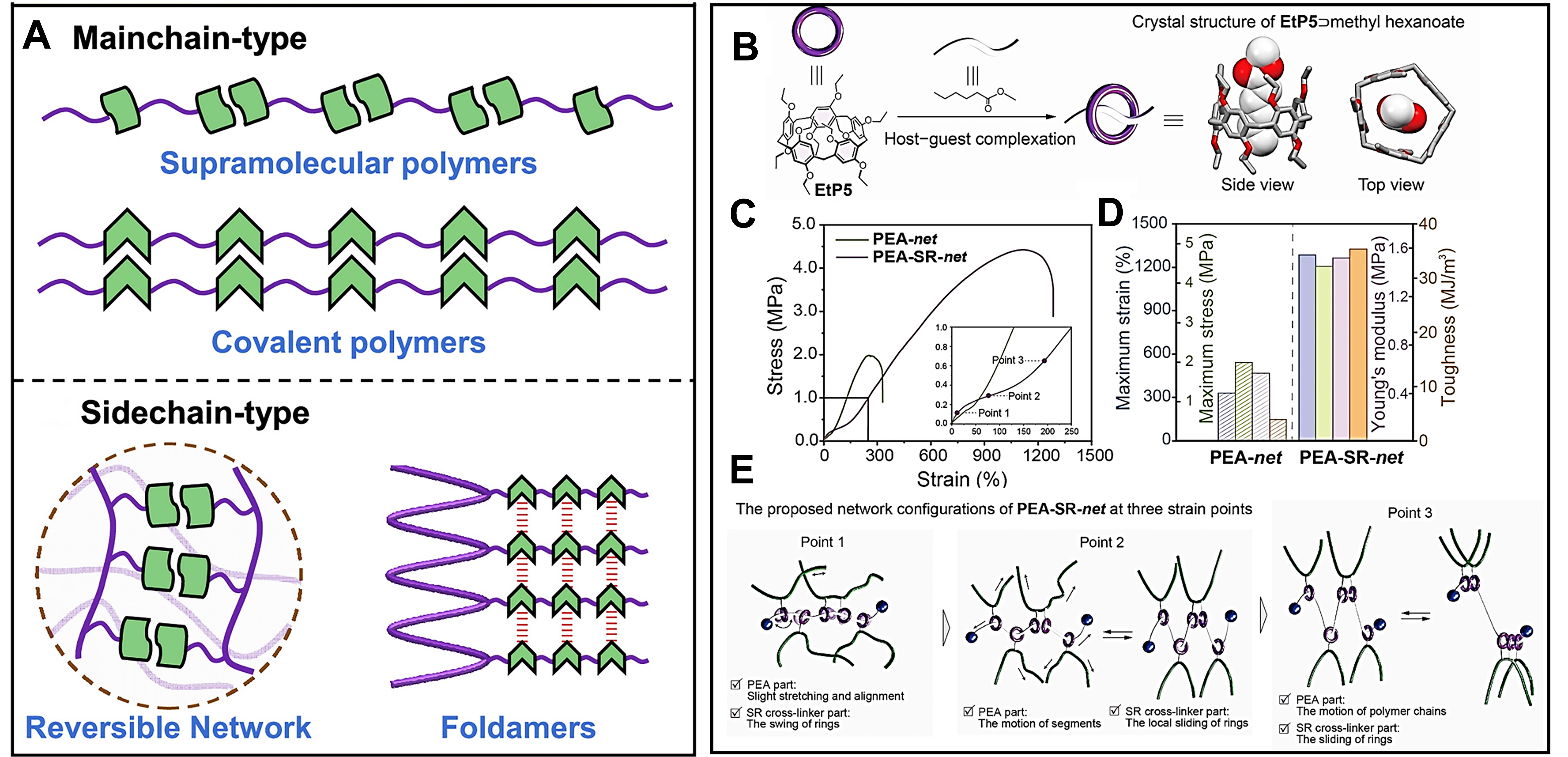
Figure 3. Schematic illustration of polymer elastification. (A) Polymer backbone and side chain design strategies (Reproduced with permission[44]. Copyright 2023, American Chemical Society); (B) Construction of slide-ring polymers based on pillar[5]arene/alkyl chain interactions; (C) Improvement of elongation at break via slide-ring structure; (D) Enhancement of tensile strength through slide-ring architecture; (E) Schematic representation of tensile network structures in poly(vinyl alcohol) (PVA) nanofiber net and PVA-reinforced nanofiber net (The figures B, C, D, and E are reproduced with permission[45]. Copyright 2024, Wiley-VCH GmbH). PEA-SR-net: A novel class of slide-ring polymers networks, comprising covalent poly(ethyl acrylate) (PEA) cross-linked with polyrotaxanes formed by pillar[5]arene macrocycles as the rings and lipophilic poly(caprolactone) (PCL) as the axle.
The local chemical environment and functional groups along the molecular chain also profoundly influence material stiffness and softness. The size, polarity, and number of side chains have a great influence on the properties. Bulky side groups impede molecular chain motion, reducing flexibility and increasing rigidity. For example, in bio-based polymers featuring long alkyl side chains, rigidity escalates with side chain length. Polar side groups induce strong intermolecular interactions, further restricting chain mobility and enhancing rigidity, as observed in bio-based cellulose derivatives containing hydroxyl or carboxyl groups. By modulating the number and spatial distribution of these functional groups, the stiffness and flexibility of the material can be systematically tailored[45]. Figure 3B illustrates the construction of a slide-ring polymer based on pillar[5]arene/alkyl chain host-guest interactions. The polymer exhibits low elastic modulus (~0.6 MPa), low fracture strength (2 MPa), and limited fracture elongation (~300%), as shown in Figure 3C and D. Under tensile stress, the pillar[5]arene rings, which serve as side-chain groups of poly(ethyl acrylate) (PEA), can undergo slight swinging by overcoming non-covalent interactions with the poly(caprolactone) (PCL) axle. This mechanism helps improve the material’s elastic modulus (~1.2 MPa) and reduces energy dissipation (from 4.5 to 0.3 MJ·M-3 under 600% and 200% strain), as schematically depicted in Figure 3E.
The intensity of intermolecular interactions directly dictates the rigidity and flexibility of polymer materials[44]. Strong intermolecular interactions, such as hydrogen bonding and van der Waals forces, impose significant constraints between molecular chains, inhibiting their relative sliding and motion, and consequently increasing material rigidity. For example, chitosan exhibits extensive hydrogen bonding between molecules, promoting the formation of crystalline regions leading to high crystallinity. This structural arrangement lends the material considerable rigidity and strength, rendering it suitable for biomedical applications such as wound dressings. Conversely, weak intermolecular interactions permit greater chain mobility, resulting in enhanced material flexibility.
Molecular chain length exerts a dual influence on material rigidity and flexibility. Generally, longer molecular chains increase interchain entanglement, which restricts chain mobility and enhances rigidity. However, longer chains also provide greater conformational freedom, which enhances flexibility through increased molecular motion. This is exemplified in bio-based polyhydroxyalkanoates (PHA), where increased chain length due to a higher degree of polymerization imparts greater tensile strength (from
Cross-linking represents another essential factor influencing the flexibility of polymeric materials. It involves the formation of a three-dimensional network structure via chemical bonds connecting molecular chains[46]. Under light cross-linking conditions, molecular chains between cross-linking points retain significant freedom to move, allowing the material to maintain considerable flexibility. Simultaneously, the cross-linked structure enhances both rigidity and strength[47,48]. For example, lightly cross-linked sodium alginate hydrogel possesses sufficient flexibility (294% elongation and 0.098 MPa modulus) to adapt comfortably to the skin while offering adequate mechanical strength (0.35 MPa) for wound care applications. In contrast, high cross-linking density severely restricts molecular chain movement, yielding a rigid, brittle material with significantly increased stiffness and markedly reduced flexibility (85% elongation and 0.114 MPa modulus)[49].
MATERIAL DESIGN AND OPTIMIZATION STRATEGIES
Molecular structure design
Molecular structure design serves as the core approach to enhancing the performance of intrinsic high-k polymers. The key lies in the systematic and rational construction at the molecular level, which enables the synergistic optimization and balancing of multiple performance indicators, ultimately leading to a significant improvement in the overall material performance. Through precise molecular engineering, not only can the dielectric constant of the polymer be effectively increased, but other critical parameters, such as breakdown strength, dielectric loss, mechanical properties, and thermal stability, can also be maintained, thereby avoiding the deterioration of other properties caused by optimizing a single parameter[50]. Within this framework, common molecular design strategies mainly include backbone structure design, side-chain engineering, and the construction of specific topological structures and conjugated systems.
(1) Backbone engineering
Backbone engineering involves modifying the chemical structure, flexibility and stereo regularity of the polymer backbone to tailor dielectric properties[51]. Rigid backbones [e.g., polyimides, poly(aryl ether ketones)] restrict chain mobility and reduce dipole loss[52,53], often leading to a lower dielectric constant. In contrast, flexible backbones [e.g., polyurethanes (PUs), silicones] promote orientational polarization of polar groups, enhancing the dielectric constant, though often at the cost of increased loss[54]. Recently, rigid-flexible block copolymers have been designed to combine the dimensional stability of rigid segments with the high polarizability of flexible segments[55,56]. de Sousa Jr.[57] et al. enhanced the electromechanical response by modifying the copolymer composition and molecular weight, as well as incorporating other compounds and nanoparticles to improve thermal stability and dielectric properties. This approach achieved a tensile strength of 1000 and an elongation at break of 1300% [Figure 4A].
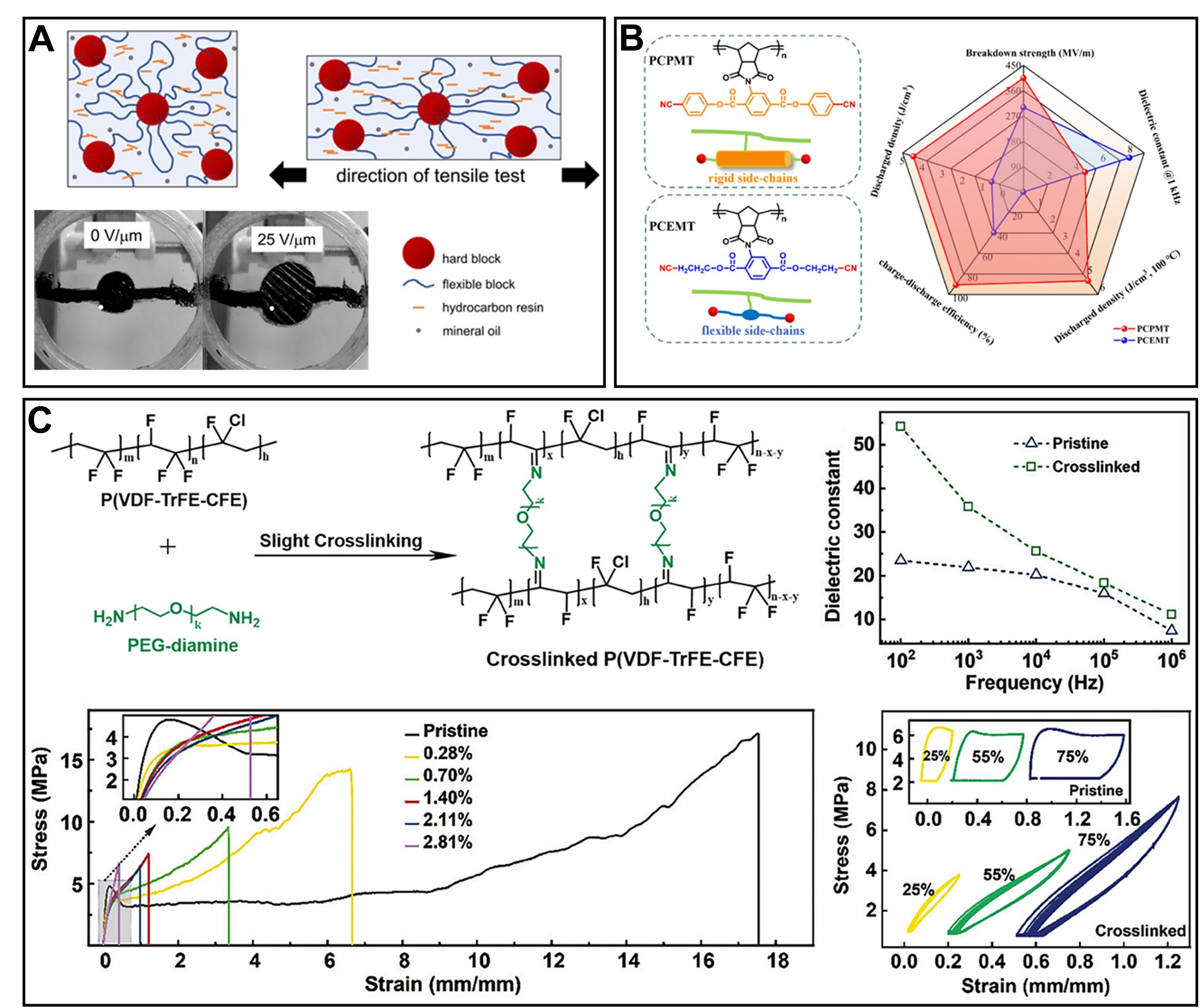
Figure 4. (A) Enhanced mechanical properties of dielectric elastomers through backbone design strategies (Reproduced with permission[57]. Copyright 2024, Wiley-VCH GmbH); (B) Construction of novel flexible dielectric materials using polar rigid/flexible side chains (Reproduced with permission[60]. Copyright 2023, American Chemical Society); (C) Intrinsically stretchable high-dielectric elastomers achieved via a slight cross-linking strategy (Reproduced with permission[62]. Copyright 2024, Wiley-VCH GmbH). PCEMT: Poly(bis(2-cyanoethyl) 2-(1,3-dioxo-1,3,3a,4,7,7a-hexahydro-2H-4,7-methanoisoindol-2-yl)terephthalateand; PCPMT: poly(bis(4-cyanophenyl) 2-(1,3-dioxo-1,3,3a,4,7,7a-hexahydro-2H-4,7-methanoisoindol-2-yl)terephthalate); PEG: polyethylene glycol; P(VDF-TrFE): poly (vinylidene fluoride-ran-trifluoroethylene).
(2) Side-chain design
Side-chain design involves grafting specific functional groups onto the polymer backbone to regulate dielectric behavior[45]. Polar side groups with high dipole moments (e.g., cyano, nitro, and fluoro groups) can markedly enhance orientational polarization, thereby increasing the dielectric constant[58]. The length, density, and chemical nature of these side chains are critical factors influencing dielectric performance. Research has shown that by carefully controlling steric hindrance and mobility of side chains can increase the dielectric constant while simultaneously suppressing dielectric loss[59]. Luo[60] et al. introduced polar cyano groups into
(3) Crosslinked structure design
Slight crosslinking technology is one of the key strategies for preparing high-performance elastomeric ferroelectric dielectrics. This technique involves introducing sparse and controllable chemical crosslinking points into the ferroelectric polymer base to construct a lightly crosslinked three-dimensional network structure. This approach skillfully balances multiple material properties[61]. Typically, long, flexible crosslinking segments provide sufficient local segmental mobility for the polymer backbone and polar groups, which is crucial for maintaining a high dielectric constant and reversible ferroelectric polarization response. Meanwhile, the moderate crosslinked network effectively disperses mechanical stress, transforming the material from a thermoplastic into an elastomer, thereby significantly enhancing its stretchability, resilience, and mechanical durability. The crosslinked structure also suppresses irreversible chain slippage and reorganization of crystalline phases, ensuring stable ferroelectric and dielectric performance under high strain, cyclic loading, and temperature variations. However, excessive cross-linking may restrict the orientational polarization of polar groups, ultimately lowering the dielectric constant. Xu[62] et al. obtained a relaxor ferroelectric elastomer with enhanced dielectric constant (54.2 at 100 Hz) by micro-crosslinking the relaxor ferroelectric polymer poly(vinylidene fluoride-trifluoroethylene-trichlorofluoroethylene) using a long soft-chain crosslinker. Moreover, the ferroelectric properties of this elastomer remained stable even under 80% strain [Figure 4C].
(4) Topological structure design
Topological structure design aims to optimize dielectric properties by constructing star-shaped, hyperbranched, or dendritic polymer architectures, which enable precise control over chain packing and mobility[63]. These unconventional polymer topologies often exhibit unique phase behavior and molecular dynamics, allowing access to property profiles unattainable with conventional linear polymers[64,65]. For instance, dendritically branched polymers, with their abundant modifiable chain ends, enable the integration of various functional groups to enhance dielectric performance and stretchability[66].
Interface engineering and surface modification
Interfacial engineering and surface modification techniques are widely employed to enhance the dielectric constant of composite material systems[67]. The primary objective is to establish a robust and functionalized transition layer between the filler and the polymer matrix. This interfacial layer suppresses the agglomeration of nanofillers caused by their high surface energy, ensures homogeneous dispersion within the matrix, and strengthens both chemical and physical bonding between the filler and polymer. Consequently, it mitigates phase separation, facilitates uniform stress transfer, and improves the dielectric constant without compromising mechanical properties. Furthermore, the interfacial layer inhibits charge carrier migration and accumulation, reduces leakage current and energy loss, minimizes interfacial defects, and alleviates electric field concentration, thereby enabling the material to withstand higher electric fields[68]. Common strategies include:
(1) Surface modification
Surface modification involves applying modifier molecules or polymer layers onto the filler surface through chemical or physical methods to improve compatibility with the matrix[69]. Han et al. synthesized dual-component core-shell structured BaTiO(C2O4)2@urea/CDs (BTRU/CDs) particles by chemically grafting functionalized carbon nanotubes (CDs) onto BTRU particles. This approach contributed to the good dispersion and interfacial compatibility of the BTRU/CDs particles within the polymer matrix. Subsequently, these particles were incorporated as the filler phase into plasticized silicone rubber (SR) (with silicone oil added), resulting in a composite with desirable modulus (approximately 0.193 MPa), high toughness (elongation at break ~849.5%), high dielectricity (εr = 6.91 at 1 Hz), and a vertical actuation displacement 683% higher than that of the pure matrix [Figure 5A][70].
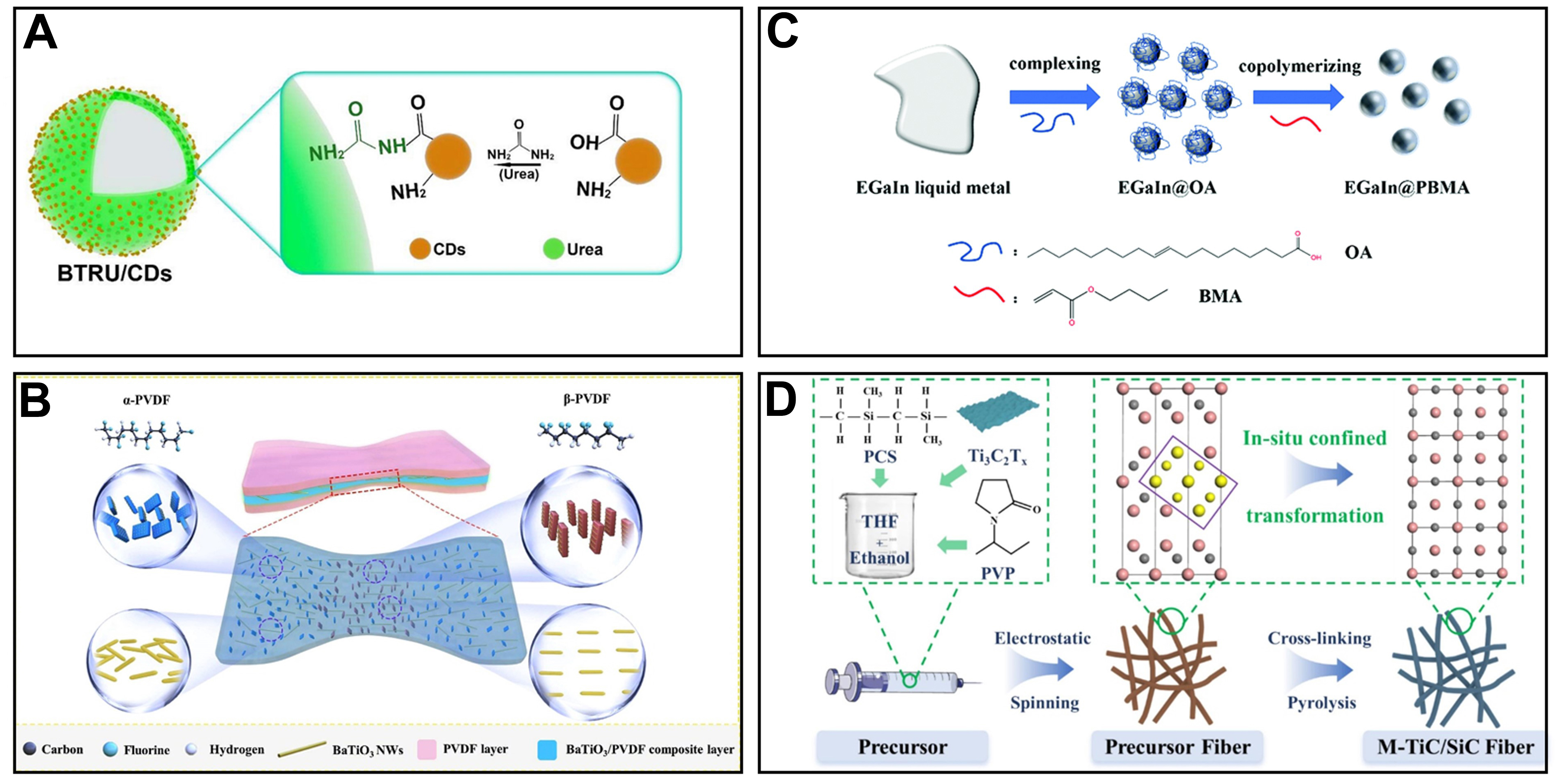
Figure 5. High-k polymer elastomer design strategies. (A) Enhanced mechanical and dielectric properties via carbon dot surface modification of BaTiO(C2O4)2@urea core-shell nanoparticles[70]. (Reproduced with permission. Copyright 2024, American Chemical Society), (B) High energy storage density achieved by stress field-regulated crystallinity of PVDF matrix and in-plane aligned BaTiO3 nanowires[79]. (Reproduced with permission. Copyright © 2024 Central South University); (C) Reduced dielectric loss in elastic dielectrics achieved by in-situ polymerization-fabricated poly(n-butyl methacrylate)-coated liquid metal nanodroplets (EGaIn@PBMA) core-shell structures[84]. (Reproduced with permission. Copyright 2020, Royal Society of Chemistry), (D) Reduced dielectric loss achieved by in-situ polymerization-fabricated MXene-derived TiC/SiC (M-TiC/SiC) composite fibers[85]. (Reproduced with permission. Copyright © 2025 Elsevier B.V.). BTRU/CDs: BaTiO(C2O4)2@urea/carbon dots; BMA: n-butyl methacrylate; OA: oleic acid; PVDF: polyvinylidene fluoride; PCS: polycarbosilane; THF: tetrahydrofuran; PVP: polyvinylpyrrolidone; NWs: nanowires.
(2) Core-shell structure design
Core-shell structure design involves fabricating a functional shell layer on the filler surface to precisely tailor interfacial characteristics[71]. The shell material - which can be either inorganic (e.g., SiO2, Al2O3)[72,73] or organic - primarily acts primarily as an electronic barrier to suppress leakage current while modulating interfacial polarization. In conductive polymer composites, polarization occurs via a domain-type mechanism governed by electron transport among adjacent conductive fillers. Essentially, the core-shell architecture modifies the dielectric properties by controlling the size and distribution of filler clusters[74]. For example, Hussain et al. proposed a core-shell structured filler consisting of a Barium Strontium Titanate (BST) core and a ZnO shell embedded in a Poly (vinylidene fluoride-ran-trifluoroethylene) [P(VDF-TrFE)] matrix, functionalized with (3-aminopropyl)triethoxysilane (APTES). By leveraging the synergistic effect of the high dielectric constant of BST and the inherent nonlinearity of zinc oxide, they achieved a reduction in the dielectric loss (tanδ) from 0.123 to 0.038 (a 3.24-fold decrease) at a frequency of 100 Hz[75].
(3) Gradient interface design
Gradient interface design relies on creating a transition layer with gradually varying composition or structure to eliminate abrupt interfaces, thereby reducing internal stress and electric field concentration. This design effectively distributes electric field stress, enhancing the breakdown strength and long-term reliability of the material[76]. Wang et al. sequentially coated the surface of amorphous carbon (C) with TiO2 (TO) and Al2O3 (AO) shells. This novel design of progressively varied multilayer hierarchical interfaces enables a graded reduction in carrier concentration from the C core to the TO and AO layers. The TO layer, with its moderate dielectric constant, acts as a transition layer to hinder carrier transport and reduce electric field distortion between the C and AO layers. The AO layer, characterized by a wide bandgap and high electron affinity, serves as a buffer layer that further traps carriers and achieves good dielectric compatibility with the PVDF matrix, thereby significantly mitigating electric field distortion. As a result, the dielectric constant of the composite is remarkably enhanced, reaching up to 59.5 with a low dielectric loss of 0.095 at 100 kHz[77].
Others
Advanced fabrication processes are crucial for the development of high-performance polymer materials with elevated dielectric constants. Conventional methods, including blending, solution casting, and hot pressing, are often insufficient for producing next-generation material systems. In recent years, several innovative strategies have been proposed:
(1) Field-assisted assembly
Field-assisted assembly employs external electric, magnetic, or ultrasonic fields to control the spatial distribution and orientation of fillers within a polymer matrix. For example, alternating electric fields can guide graphite and BaTiO3 particles to form organized, chain-like structures; this approach achieves an optimal balance between high dielectric constant (73.5) and low loss (0.19)[78]. The in situ uniaxial stretching process simultaneously enables the construction of in-plane aligned BaTiO3 nanowires and the controlled crystallization of the PVDF matrix. The polarization phase transition and enhanced Young’s modulus synergistically improve both the polarization capability and voltage withstand capacity of the PVDF matrix, achieving a high energy density of 40.9 J/cm3[79] [Figure 5B]. Magnetic field-assisted alignment is particularly effective for magnetically responsive fillers such as Fe3O4-coated ceramic particles, enabling the fabrication of materials with anisotropic dielectric properties[80].
Moreover, the shear and tensile forces generated during solution shearing and stretch-orientation processes can induce orderly alignment of polymer chains, resulting in anisotropic structures and properties. Ultra-high molecular weight polyethylene films produced via solution shearing, for instance, exhibit a highly oriented crystalline structure, yielding exceptional in-plane thermal conductivity (10.74 W·m-1·K-1) and an improved dielectric constant (4.1)[81]. This method is especially suitable for fabricating high-performance polymer films.
(2) Multilayer structure design
Multilayer structure design utilizes alternating polymer films as dielectric layers, with each layer tailored to exhibit distinct dielectric, conductive, or thermal properties. Wang et al. designed an all-organic PVDF-P(VDF-TrFE-CTFE)-PVDF composite film using PVDF with high breakdown strength as the outer layers and poly(vinylidene fluoride-trifluoroethylene-chlorotrifluoroethylene) [P(VDF-TrFE-CTFE)] with high dielectric constant as the intermediate layer. In this structure, P(VDF-TrFE-CTFE) possesses high polarization capability, with a dielectric constant as high as 50, and serves as the polarization layer in the sandwich configuration. In contrast, PVDF exhibits relatively low loss and is used to reduce charge injection from the electrodes while maintaining high breakdown strength. When the P(VDF-TrFE-CTFE) content is 45 vol%, the composite achieves a dielectric constant of 18.61[82]. Through precise structural engineering, synergistic enhancements in performance can be achieved. This approach allows accurate control of layer thickness and interfacial characteristics, enabling property combinations that are difficult to attain with conventional blended materials[83]. However, attention must be paid to factors such as the strict compatibility of interfaces and the proportions of each layer material.
(3) In-situ polymerization
In-situ polymerization involves dispersing fillers within monomer precursors before initiating polymerization directly at the filler surfaces[84] [Figure 5C]. This technique promotes molecular-level integration between filler and matrix, enhancing interfacial adhesion and dispersion homogeneity. It is especially advantageous for composites incorporating nano-sheet fillers [e.g., graphene, Boron nitride nanoplates (BNNS)] and conductive fillers[85], as it effectively prevents filler agglomeration and suppresses excessive percolation [Figure 5D].
APPLICATIONS
High-k polymer-based elastomers combine excellent flexibility with superior dielectric performance, demonstrating significant application potential in numerous cutting-edge fields due to their unique electromechanical coupling properties. Their practical utility primarily relies on two core characteristics: mechanical flexibility and a high dielectric constant[86-93]. Table 1 summarizes their main application areas and corresponding key performance parameters.
Main application areas and parameters of high-k polymer-based elastomers
| Materials | Strategy | Applications | k | tanδ | ε | E b | Ref. |
| MXene/TPU | Solution casting | Pressure sensor | 817@1 kHz | 0.64@1 kHz | -- | -- | [86] |
| Microstructured fluorinated elastomer | Photopolymerization | Pressure sensor | 5.8@1 kHz | -- | 300% | -- | [87] |
| BT NPs/p(BA-GMA) | ATRP | Strain sensor | 13.13@10 kHz | -- | 87.2% | -- | [88] |
| PHDE | Solution processing | Actuators | 5.16@1 kHz | 0.03@1 kHz | 80% | -- | [89] |
| CEC/PVC | Solution casting | Actuators | 18.9@1 kHz | 0.04@1 Hz | 136.09% | 19.53 V/μm | [90] |
| Dielectric gel | Crosslinking | Actuators | 52@1 kHz | 0.8@1 kHz | 1000% | -- | [91] |
| BZT/BT | Foaming and compositing | Capacitor | 110@1 kHz | 0.02@1 kHz | 80% | -- | [92] |
| Poly carbonate | Side chain | Capacitor | 4.5@50 Hz | 0.0048@50 Hz | -- | > 500 MV/m | [93] |
Electronic skin
Dielectric materials are primarily used in transistors and sensors within electronic skin applications[94-96]. In organic field-effect transistors (OFETs), materials with high dielectric constants can induce more charge carriers in the channel, reducing the threshold voltage (Vth) and operating voltage, which facilitates low-power operation and large-scale integration of OFETs. Sun[97] et al. synthesized functional PUs containing nitro and sulfobetaine zwitterionic groups, increasing the dielectric constant of the PU to 6.5. When used as the gate dielectric in OFETs, this material resulted in a Vth as low as -0.02 V and a mobility two orders of magnitude higher than that of nitro-free PU-based devices [Figure 6A]. Employing polymer-based high-k materials as the dielectric layer in capacitive pressure sensors can significantly enhance sensitivity. Li[98] et al. developed a hybrid elastomer composed of chain-extended PU and LM, which effectively reduced the elastic modulus and increased the dielectric constant to 8.17 at 1 kHz. This elastomer was applied in capacitive pressure sensors capable of effectively detecting hand and throat muscle movements [Figure 6B].
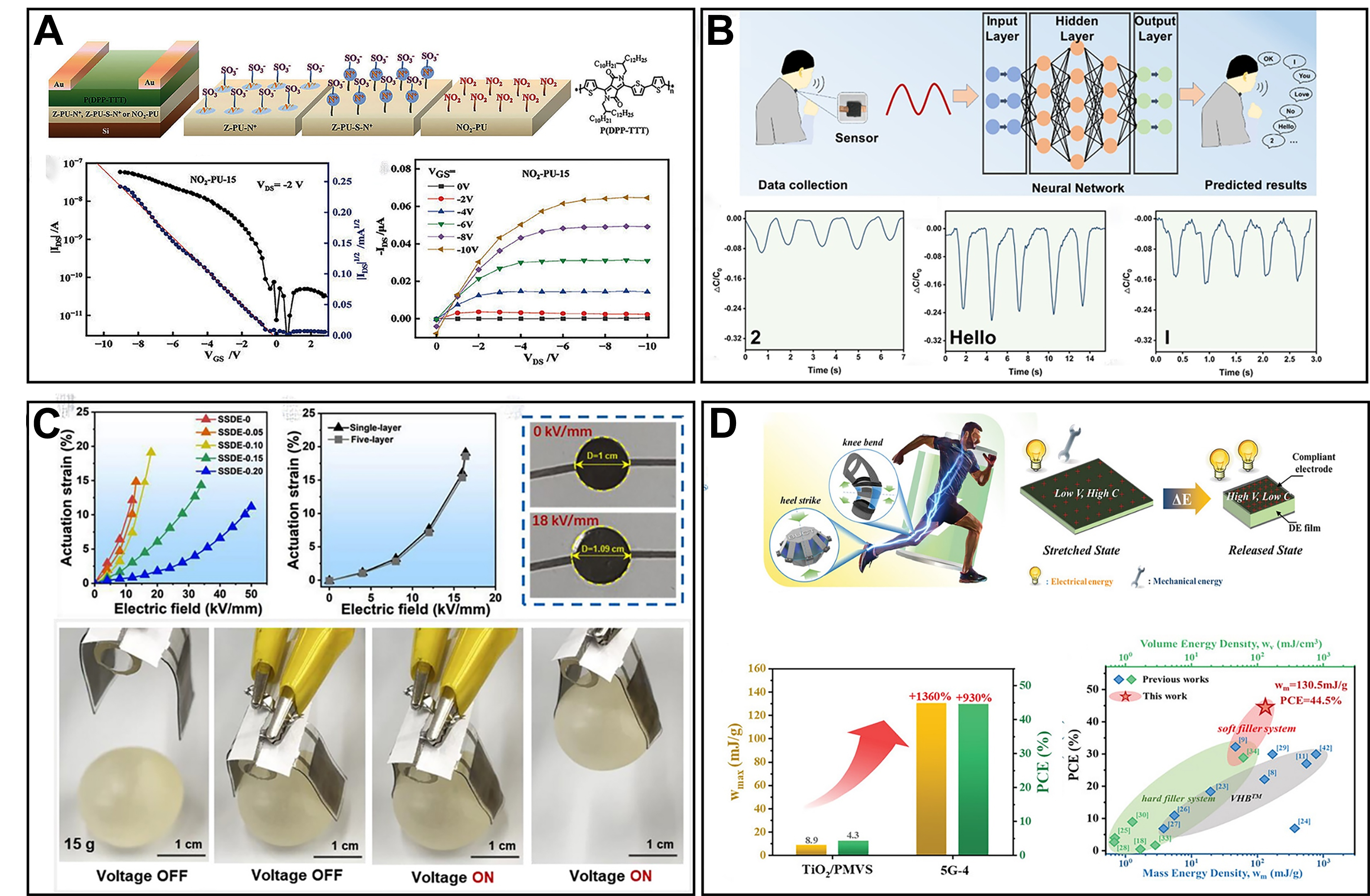
Figure 6. Applications of high-k polymer-based elastomers in (A) Organic field-effect transistors (OFETs)[97] (Copyright © 2024, American Chemical Society), (B) Capacitive pressure sensors (Reproduced with permission[98]. Copyright © 2024, American Chemical Society), (C) Dielectric actuators[101] (Copyright © 2024, American Chemical Society), and (D) Energy harvesters (Reproduced with permission[106]. (Copyright © 2023 Wiley-VCH GmbH).
Dielectric elastomer actuator
The use of high-k polymer-based dielectric materials in dielectric actuation represents a core technology in soft robotics, bionic devices, artificial muscle and adaptive optics[99,100]. Unlike sensors, which convert physical signals into electrical signals, actuators transform electrical energy into mechanical motion (or force). High-dielectric materials play an essential role in this process. Increasing the dielectric constant significantly enhances output force and stress, reduces driving voltage, and improves energy density. Wang[101] et al. optimized the dielectric properties, breakdown strength, and actuation performance of a silicone-based polymer by precisely adjusting the ratio of short- and long-chain components. The material exhibited a remarkable actuation strain of 19.09% at 18 kV·mm-1 without pre-stretching. When applied in a flexible gripper, it was capable of lifting objects up to 500 times its own weight [Figure 6C]. Zhang[102] et al. covalently grafted an ionic liquid (IL) containing reactive carbon double bonds into a well-designed interpenetrating polyacrylate network (IPN), achieving a high dielectric constant (εᵣ = 10.37 at 10 Hz), low modulus (0.097 MPa), and low mechanical loss (tanδm = 0.28 at 1 Hz). Dielectric elastomer actuators (DEAs) made from this material demonstrated extremely high actuation strain (196%) under a low driving electric field (17 V·μm-1). Soft grippers assembled from these bending actuators functioned as flexible arms capable of successfully grasping objects of various shapes and fragile items.
Energy harvesting and storage
The application of high-k polymer-based elastomers in dielectric energy storage is critical for the development of next-generation high-performance flexible electronics and electrical systems. Their primary objectives include the fabrication of thin-film capacitors with high energy density and energy-harvesting devices[103-105]. Jiang[106] et al. synthesized a dielectric material based on polar rubber (GNBR) and used it as a “soft filler” in a silicone rubber elastomer. This approach effectively avoided the formation of weak interfaces under large strains and reduced the local field strength in the interfacial regions. Under a 200% equiaxial strain, its Eb was 2.8 times that of the traditional hard filler [TiO2/Poly Methyr Vinyl Siloxane (PMVS)] composite. The energy storage density reached 130.5 mJ/g, with a maximum power conversion efficiency of 44.5% [Figure 6D]. Wang[107] et al., inspired by the elastic energy storage and recovery mechanisms observed in biological tendons and muscles, proposed an approach to enhance the energy conversion efficiency of dielectric elastomer generators (DEGs). They systematically investigated the principles of DEG energy harvesting under various conditions and the role of elastic energy storage and recovery in improving efficiency.
Self-healing functional elastomer
High-k elastomers with self-healing capabilities are gradually being applied in the field of novel electronic devices[108,109]. These materials integrate high dielectric properties with intrinsic elasticity and self-healing functions, providing an ideal functional matrix for a new generation of flexible and stretchable electronic systems. In applications, their high dielectric constant can effectively reduce driving voltages, enhance the sensitivity of capacitive sensors, or improve energy harvesting efficiency. Meanwhile, the dynamic reversible bonds (such as hydrogen bonds, ionic interactions, etc.) within the elastic network enable the material to self-heal under thermal, light, or ambient conditions after mechanical damage or electrical breakdown, restoring both mechanical integrity and electrical performance[110-112]. This dual functionality allows capacitors, transistors, sensors, and energy storage devices based on such materials not only to withstand repeated deformation and stretching but also to autonomously repair after long-term use or accidental damage[113]. This significantly enhances the reliability, durability, and service life of devices in wearable electronics, soft robotics, and bio-integrated systems. Table 2 presents the application scope and performance parameters of some self-healing high-dielectric elastomers.
Performance of self-healing dielectric elastomers
| Dielectric elastomer | Applied device | Self-healing groups | Healing temperature | Healing time | Mechanical damage self-healing efficiency (%) | ε/Recovery | Ref. |
| PDMS-PANI | Actuator | Hydrogen bond | Room temperature | 48 h | ~20 | -- | [108] |
| Spiroglycol-structured lipoic acid derivative | Capacitive sensor | Hydrogen bond | 80 °C | 4 h | 80% | -- | [109] |
| Silicone | Actuator | Ionic bonds | 120 °C | 12 h | 77 | -- | [110] |
| Styrene-butadiene-styrene | Actuator | Electrostatic interaction | Room temperature | 4 h | 39% | 11.4/67% | [111] |
| Silicone rubber-based DEs | -- | Ionically and hydrogen bonds | Room temperature | -- | 90% | 14.38/-- | [112] |
| Polyurethane | Actuator | Hydrogen bonds | Room temperature | 12 h | 31.4% | 9/-- | [113] |
CONCLUSION AND OUTLOOK
As a class of materials combining excellent dielectric properties with good mechanical flexibility, high-k polymer-based elastomers show significant application potential in fields such as flexible electronics, soft robotics, and energy storage and conversion. This review has summarized strategies for the synergistic optimization of high-k, low tanδ, high Eb, and excellent stretchability. These strategies encompass molecular design, interface/surface engineering, and novel preparation processes. These methods have effectively enhanced the overall performance of the materials and promoted their preliminary applications in sensors, actuators, and energy storage devices.
However, balancing dielectric properties and mechanical flexibility remains a long-term core challenge in this field. Furthermore, there is still considerable room for improvement in both the dielectric and mechanical properties themselves. The understanding of the precise mechanisms linking microscopic structure to macroscopic performance is still insufficient, long-term stability and reliability need further enhancement, and challenges persist in achieving green and scalable fabrication. Future research in this area should focus on the following directions:
1. Deepening the study of structure-property relationships and mechanisms: combining multi-scale simulations, AI-assisted techniques, and advanced in-situ characterization methods to reveal the influence of molecular structure, interfacial behavior, and domain structure on dielectric/mechanical properties and stability[114]. By predicting the impact of polar group combinations, crosslinking network topology, and filler distribution on performance, the goal is to achieve target-oriented precise design of molecules and composite systems, establish “structure-property-process” mapping relationships, and accelerate the screening and optimization of new high-k elastomers.
2. Innovative material design to overcome performance trade-offs: Developing novel strategies such as bio-inspired hierarchical structure design, dynamic bond cross-linked networks, multi-mechanism polarization synergy (electron/ion/dipole synergy), and utilizing machine learning to aid in designing new material systems. This aims to break the constraints between traditional properties, synergistically enhancing the dielectric constant, breakdown strength, and flexibility while reducing loss.
3. Enhancing long-term stability and reliability: Systematically studying failure mechanisms such as material aging, fatigue, and electrical degradation. Through interface engineering, defect control, and self-healing structure design, the operational lifespan and environmental adaptability of devices can be significantly improved, ensuring material durability under complex working conditions (e.g., cyclic loading, high/low temperatures, humid environments).
In summary, the development of elastomers based on high-k polymers is shifting from an “empirical exploration” model to a “design-driven” paradigm. By leveraging machine learning and AI to integrate high-throughput design, biomimetic principles, and advanced fabrication techniques, it is expected to break through existing performance bottlenecks, achieve synergistic innovation from materials to devices and further to integrated systems, and ultimately provide robust support for next-generation flexible electronics and soft intelligent systems.
DECLARATIONS
Authors’ contributions
Writing - original draft, methodology, investigation, formal analysis: Zhao, D.; Li, F.
Writing - review & editing: Yu, Y.; Tang, M.; Wei, K.
Writing - review & editing, methodology: Wu, Y.
Methodology: Liu, Y.; Guo, Y.; Wang, P.; Li, R. W.
Supervision, methodology: Wang, H.
Availability of data and materials
Not applicable.
AI and AI-assisted tools statement
Not applicable.
Financial support and sponsorship
This work was supported by the National Key Research and Development Program of China (Grant Nos. 2024YFB3814100, 2024YFB3816200), the National Natural Science Foundation of China (Grant Nos. U24A6001, 52127803, 52301256, 62174165, U24A20228, 62204246), the Scientific Research Project of the Zhejiang Health Informatics Society (Grant No. 2023XHJC-Y02), the Ningbo Key Research and Development Program (Grant Nos. 2024Z143, 2024H008), the Ningbo Science and Technology Program for Agricultural and Social Development (Grant No. 2023AS057), and the Ningbo Public Welfare Project (Grant No. 2024S036).
Conflicts of interest
All authors declared that there are no conflicts of interest.
Ethical approval and consent to participate
Not applicable.
Consent for publication
Not applicable.
Copyright
© The Author(s) 2026.
REFERENCES
1. Park, S.; Heo, S. W.; Lee, W.; et al. Self-powered ultra-flexible electronics via nano-grating-patterned organic photovoltaics. Nature 2018, 561, 516-21.
2. Jing, Z.; Sun, A.; He, Z.; et al. Highly robust and conductive polymer electrodes for droplet energy harvesting and printable on-skin electronics. Adv. Mater. 2025, 37, 2506511.
3. Meng, S.; Zhao, T.; Wang, X.; Wang, X.; Zhang, Y. High-dielectric PVDF/MXene composite dielectric materials for energy storage preparation and performance study. Polym. Compos. 2023, 45, 3460-73.
4. Li, Z.; Zhao, K.; Wang, J.; et al. Sensitive, robust, wide-range, and high-consistency capacitive tactile sensors with ordered porous dielectric microstructures. ACS. Appl. Mater. Interfaces. 2024, 16, 7384-98.
5. Zhao, S.; Liu, H. Y.; Cui, L.; et al. Elastomeric nanodielectrics for soft and hysteresis-free electronics. Adv. Mater. 2021, 33, 2104761.
6. Li, Y.; Zhai, W.; Liu, B.; et al. Remarkable interfacial dielectric relaxation of physically cross-linked ice-hydrogel. Soft. Sci. 2021, 1, 11.
7. Xing, J.; Yi, X.; Qu, Y.; et al. Helical ionotropic gel-fiber sensor with omnidirectional strain perception for multidimensional motion correction in adolescent activity assessment. Soft. Sci. 2025, 5, 37.
8. Crawford, K. E.; Sita, L. R. De novo design of a new class of “hard-soft” amorphous, microphase-separated, polyolefin block copolymer thermoplastic elastomers. ACS. Macro. Lett. 2015, 4, 921-5.
9. Munzenrieder, N.; Voser, P.; Petti, L.; et al. Flexible self-aligned double-gate IGZO TFT. IEEE. Electron. Device. Lett. 2014, 35, 69-71.
10. Zou, S.; Picella, S.; de Vries, J.; Kortman, V. G.; Sakes, A.; Overvelde, J. T. B. A retrofit sensing strategy for soft fluidic robots. Nat. Commun. 2024, 15, 539.
11. Fan, Z.; Dai, J.; Huang, Y.; et al. Superior energy storage capacity of polymer-based bilayer composites by introducing 2D ferroelectric micro-sheets. Nat. Commun. 2025, 16, 1180.
12. Qiu, Y.; Zhang, E.; Plamthottam, R.; Pei, Q. Dielectric elastomer artificial muscle: materials innovations and device explorations. Acc. Chem. Res. 2019, 52, 316-25.
13. Benouhiba, A.; Holzer, S.; Konstantinidi, S.; Civet, Y.; Perriard, Y. The elastic frontier: dielectric elastomer actuators in healthcare technology. Smart. Mater. Struct. 2025, 34, 033001.
14. Cheng, N.; Liu, C.; Gao, Y.; et al. Ultra-elastic, durable, bio-degradable, and recyclable pulp foam as an air dielectric substitute for sustainable capacitive pressure sensing. Adv. Funct. Mater. 2025, 35, 2423122.
15. Shu, L.; Liang, R.; Yu, Y.; Tian, T.; Rao, Z.; Wang, Y. Unique elastic, dielectric and piezoelectric properties of micro-architected metamaterials. J. Mater. Chem. C. 2019, 7, 2758-65.
16. Zeng, T.; Meng, L.; Li, Q.; et al. Enhancing energetic disorder in all-organic composite dielectrics for high-temperature capacitive energy storage. Nat. Commun. 2025, 16, 5620.
17. Qian, X.; Chen, X.; Zhu, L.; Zhang, Q. M. Fluoropolymer ferroelectrics: multifunctional platform for polar-structured energy conversion. Science 2023, 380, eadg0902.
18. Wang, L.; Zhuo, J.; Peng, J.; Dong, H.; Jiang, S.; Shi, Y. A stretchable soft pump driven by a heterogeneous dielectric elastomer actuator. Adv. Funct. Mater. 2024, 34, 2411160.
19. Gao, L.; Hu, B. L.; Wang, L.; et al. Intrinsically elastic polymer ferroelectric by precise slight cross-linking. Science 2023, 381, 540-4.
20. Kim, J.; Zhang, G.; Shi, M.; Suo, Z. Fracture, fatigue, and friction of polymers in which entanglements greatly outnumber cross-links. Science 2021, 374, 212-6.
21. Pan, C.; Markvicka, E. J.; Malakooti, M. H.; et al. A liquid-metal-elastomer nanocomposite for stretchable dielectric materials. Adv. Mater. 2019, 31, 1900663.
22. Yin, L. J.; Zhao, Y.; Zhu, J.; et al. Soft, tough, and fast polyacrylate dielectric elastomer for non-magnetic motor. Nat. Commun. 2021, 12, 4517.
23. Liu, Y.; Yue, S.; Tian, Z.; et al. Self-powered and self-healable extraocular-muscle-like actuator based on dielectric elastomer actuator and triboelectric nanogenerator. Adv. Mater. 2024, 36, 2309893.
24. Wang, Y.; Cui, J.; Yuan, Q.; Niu, Y.; Bai, Y.; Wang, H. Significantly enhanced breakdown strength and energy density in sandwich-structured barium titanate/poly(vinylidene fluoride) nanocomposites. Adv. Mater. 2015, 27, 6658-63.
25. Lang, C.; Lloyd, E. C.; Matuszewski, K. E.; et al. Nanostructured block copolymer muscles. Nat. Nanotechnol. 2022, 17, 752-8.
26. Wang, S.; Yang, C.; Li, X.; et al. Polymer-based dielectrics with high permittivity and low dielectric loss for flexible electronics. J. Mater. Chem. C. 2022, 10, 6196-221.
27. Yue, D.; Yin, J. H.; Zhang, W. C.; et al. Computational simulation for breakdown and energy storage performances with optimization in polymer dielectrics. Adv. Funct. Mater. 2023, 33, 2300658.
28. Yin, G.; Yang, Y.; Song, F.; et al. Dielectric elastomer generator with improved energy density and conversion efficiency based on polyurethane composites. ACS. Appl. Mater. Interfaces. 2017, 9, 5237-43.
29. Bonardd, S.; Moreno-Serna, V.; Kortaberria, G.; Díaz, Díaz. D.; Leiva, A.; Saldías, C. Dipolar glass polymers containing polarizable groups as dielectric materials for energy storage applications. A minireview. Polymers 2019, 11, 317.
30. Li, F.; Gao, L.; Wang, L.; Hu, B. Unlocking the elasticity in ferroelectrics by slight crosslinking. Chin. J. Struct. Chem. 2025, 44, 100443.
31. Feng, Q. K.; Zhong, S. L.; Pei, J. Y.; et al. Recent progress and future prospects on all-organic polymer dielectrics for energy storage capacitors. Chem. Rev. 2022, 122, 3820-78.
32. Hu, Q.; Wang, L.; Pan, L.; Hu, B. L. Slight-crosslinking: opening a new journey for the intrinsic elastification of ferroelectric polymers. Chemistry 2025, 31, e202500247.
33. Alhasadi, M. F.; Sun, Q.; Federico, S. Theory of uniformity applied to elastic dielectric materials and piezoelectricity. Eur. J. Mech. A. Solids. 2022, 91, 104391.
34. Liu, L.; Qu, J.; Gu, A.; Wang, B. Percolative polymer composites for dielectric capacitors: a brief history, materials, and multilayer interface design. J. Mater. Chem. A. 2020, 8, 18515-37.
35. Dakin, T. Conduction and polarization mechanisms and trends in dielectric. IEEE. Electr. Insul. Mag. 2006, 22, 11-28.
36. Prateek, Thakur, V.K.; Gupta, R.K. Recent progress on ferroelectric polymer-based nanocomposites for high energy density capacitors: synthesis, dielectric properties, and future aspects. Chem. Rev. 2016, 116, 4260-317.
37. Yadegari, A.; Ebel, T. Exploring modification strategies to enhance energy storage performance of BOPP dielectric films. J. Mater. Chem. A. 2025, 13, 30768-95.
38. Wang, B.; Liang, G.; Jiao, Y.; et al. Two-layer materials of polyethylene and a carbon nanotube/cyanate ester composite with high dielectric constant and extremely low dielectric loss. Carbon 2013, 54, 224-33.
39. Yang, M.; Ren, W.; Guo, M.; Shen, Y. High-energy-density and high efficiency polymer dielectrics for high temperature electrostatic energy storage: a review. Small 2022, 18, 2205247.
40. Qin, M.; Zhang, L.; Wu, H. Dielectric loss mechanism in electromagnetic wave absorbing materials. Adv. Sci. 2022, 9, 2105553.
41. Tian, G.; Deng, W.; Yang, T.; et al. Insight into interfacial polarization for enhancing piezoelectricity in ferroelectric nanocomposites. Small 2023, 19, 2207947.
42. Wei, J.; Zhu, L. Intrinsic polymer dielectrics for high energy density and low loss electric energy storage. Prog. Polym. Sci. 2020, 106, 101254.
43. Rui, G.; Bernholc, J. J.; Zhang, S.; Zhang, Q. Dilute nanocomposites: tuning polymer chain local nanostructures to enhance dielectric responses. Adv. Mater. 2024, 36, 2311739.
44. Deng, Y.; Zhang, Q.; Qu, D. Emerging hydrogen-bond design for high-performance dynamic polymeric materials. ACS. Mater. Lett. 2023, 5, 480-90.
45. Chen, L.; Liu, Y.; You, W.; et al. Construction of slide-ring polymers based on pillar[5]arene/alkyl chain host-guest interactions. Angew. Chem. Int. Ed. 2025, 64, e202417713.
46. Kim, M.; Park, H.; Kim, E.; Chung, M.; Oh, J. H. Photo-crosslinkable organic materials for flexible and stretchable electronics. Mater. Horiz. 2025, 12, 4573-607.
47. Kong, V. A.; Staunton, T. A.; Laaser, J. E. Effect of cross-link homogeneity on the high-strain behavior of elastic polymer networks. Macromolecules 2024, 57, 4670-9.
48. Deng, J.; Bai, R.; Zhao, J.; et al. Insights into the correlation of cross-linking modes with mechanical properties for dynamic polymeric networks. Angew. Chem. Int. Ed. 2023, 62, e202309058.
49. Zhao, S.; Zhang, Z.; Yin, L.; et al. CPBA/PVDF dielectric elastomer composites with high actuation performance under low electric field by optimizing the internal structure. Polymer 2025, 336, 128867.
50. Park, C.; Lee, K.; Koo, M.; Park, C. Soft ferroelectrics enabling high-performance intelligent photo electronics. Adv. Mater. 2021, 33, e2004999.
51. Raji, I. O.; Dodo, O. J.; Saha, N. K.; et al. Network polymer properties engineered through polymer backbone dispersity and structure. Angew. Chem. Int. Ed. 2024, 63, e202315200.
52. Zhang, W.; Xiong, T.; Bai, Z.; Liu, H.; Qiu, X. Solid-state electrolytes based on polyimides for lithium batteries: structures, key properties, synthesis methods and applications. Electrochem. Energy. Rev. 2025, 8, 33.
53. Chen, P.; Wang, H.; Su, J.; et al. Recent advances on high-performance polyaryletherketone materials for additive manufacturing. Adv. Mater. 2022, 34, 2270360.
54. Wu, C.; Deshmukh, A. A.; Li, Z.; et al. Molecular engineering: flexible temperature-invariant polymer dielectrics with large bandgap. Adv. Mater. 2020, 32, 2070165.
55. Xiao, Y.; Chen, Z.; Mao, J.; et al. Self-strengthening dielectric elastomer of triblock copolymer with significantly improved electromechanical performance under low voltage. Macromol. Mater. Eng. 2021, 306, 2000732.
56. He, G.; Liu, Z.; Wang, C.; Chen, S.; Luo, H.; Zhang, D. Achieving superior energy storage properties of all-organic dielectric polystyrene-based composites by blending rod-coil block copolymers. ACS. Sustainable. Chem. Eng. 2021, 9, 8156-69.
57. de Sousa Jr, R. R.; Sacramento, J. B.; Da Silva, L. C. E.; Becker, D.; Vidotti, S. E.; Carastan, D. J. High-performance block-copolymer-based dielectric elastomers with enhanced mechanical properties. ACS. Appl. Polym. Mater. 2023, 5, 9505-14.
58. Liu, Y.; Chen, J.; Jiang, X.; Jiang, P.; Huang, X. All-organic cross-linked polysiloxane-aromatic thiourea dielectric films for electrical energy storage application. ACS. Appl. Energy. Mater. 2020, 3, 5198-207.
59. Yang, D.; Tian, M.; Kang, H.; et al. New polyester dielectric elastomer with large actuated strain at low electric field. Mater. Lett. 2012, 76, 229-32.
60. Luo, H.; Yan, C.; Liu, X.; Luo, H.; Chen, S. Constructing novel high-performance dipolar glass polymer dielectrics by polar rigid/flexible side chains. ACS. Appl. Mater. Interfaces. 2023, 15, 24470-82.
61. Gao, L.; Zhang, J.; Wang, L.; et al. Highly elastic relaxor ferroelectrics for wearable energy storage. Mater. Horiz. 2024, 11, 6150-7.
62. Xu, T.; Wang, L.; Gao, L.; et al. Intrinsic elastomer with remarkable dielectric constant via elastification of relaxor ferroelectric polymer. Adv. Mater. 2024, 36, 2404001.
63. Panyukov, S. Theory of flexible polymer networks: elasticity and heterogeneities. Polymers 2020, 12, 767.
65. Fan, Y.; Shen, Z.; Zhou, X.; et al. Highly sensitive strain sensor from topological-structure modulated dielectric elastic nanocomposites. Adv. Mater. Technol. 2021, 7, 2101190.
66. Sun, H.; Kabb, C. P.; Sims, M. B.; Sumerlin, B. S. Architecture-transformable polymers: reshaping the future of stimuli-responsive polymers. Prog. Polym. Sci. 2019, 89, 61-75.
67. Li, L.; Xu, W.; Rui, G.; Zhang, S.; Zhang, Q. M.; Wang, Q. Dilute nanocomposites for capacitive energy storage: progress, challenges and prospects. Chem. Sci. 2024, 15, 19651-68.
68. Xie, Z.; Liu, D.; Xiao, Y.; et al. The effect of filler permittivity on the dielectric properties of polymer-based composites. Compos. Sci. Technol. 2022, 222, 109342.
69. Huang, X.; Sun, B.; Zhu, Y.; Li, S.; Jiang, P. High-k polymer nanocomposites with 1D filler for dielectric and energy storage applications. Prog. Mater. Sci. 2019, 100, 187-225.
70. Han, Y.; Zhang, Y.; Huang, P.; et al. A dielectric elastomer containing bicomponent core-shell nanoparticles with enhanced electromechanical properties for flexible crawling Robots. ACS. Appl. Polym. Mater. 2024, 6, 6667-78.
71. Zhang, J.; Zhao, F.; Zuo, Y.; et al. Improving actuation strain and breakdown strength of dielectric elastomers using core-shell structured CNT-Al2O3. Compos. Sci. Technol. 2020, 200, 108393.
72. Huang, B.; Yu, Y.; Zhao, Y.; et al. Al@SiO2 core-shell fillers enhance dielectric properties of silicone composites. ACS. Omega. 2023, 8, 35275-82.
73. Sun, H.; Zhang, T.; Sun, H.; et al. Improved the high-temperature energy storage performance of PEI films via loading core-shell structured Al2O3@BaSrTiO3 nanofillers. Ceram. Int. 2024, 50, 43811-8.
74. Zhou, W.; Cao, G.; Yuan, M.; et al. Core-shell engineering of conductive fillers toward enhanced dielectric properties: a universal polarization mechanism in polymer conductor composites. Adv. Mater. 2023, 35, 2207829.
75. Hussain, A.; Luo, S.; Jawaid, J.; et al. Interface-engineered core-shell nanoparticle embedded polymer nanocomposite demonstrating low voltage and temperature dependent tunable dielectric response. J. Mater. Chem. A. 2025, 13, 30587-98.
76. Guo, Y.; Liu, S.; Wu, S.; et al. Enhanced tunable dielectric properties of Ba0.6Sr0.4TiO3/PVDF composites through dual-gradient structural engineering. J. Alloys. Compd. 2022, 920, 166034.
77. Wang, P.; Guo, Z.; Sun, Z.; Li, G.; Bi, J.; Qian, L. Carrier gradient core-double shell structure with heterojunction transition layer for significantly enhancing dielectric properties. Chem. Eng. J. 2024, 496, 153968.
78. Wu, W.; Liu, X.; Qiang, Z.; et al. Inserting insulating barriers into conductive particle channels: a new paradigm for fabricating polymer composites with high dielectric permittivity and low dielectric loss. Compos. Sci. Technol. 2021, 216, 109070.
79. Guo, R.; Luo, H.; Zhai, D.; et al. Ultrahigh energy density in dielectric nanocomposites by modulating nanofiller orientation and polymer crystallization behavior. Adv. Powder. Mater. 2024, 3, 100212.
80. Pabba, D. P.; Rao, B. B.; Thiam, A.; et al. Magnetic field assisted high performance triboelectric nanogenerators based on P(VDF-HFP)/NiFe2O4 nanofiber composite. Ceram. Int. 2024, 50, 4178-89.
81. Li, Z.; An, L.; Khuje, S.; et al. Solution-shearing of dielectric polymer with high thermal conductivity and electric insulation. Sci. Adv. 2021, 7, eabi7410.
82. Wang, L.; Luo, H.; Zhou, X.; Yuan, X.; Zhou, K.; Zhang, D. Sandwich-structured all-organic composites with high breakdown strength and high dielectric constant for film capacitor. Compos. Part. A. Appl. Sci. Manuf. 2019, 117, 369-76.
83. Shi, Y.; Askounis, E.; Plamthottam, R.; et al. A processable, high-performance dielectric elastomer and multilayering process. Science 2022, 377, 228-32.
84. Su, Y.; Sui, G.; Lan, J.; Yang, X. A highly stretchable dielectric elastomer based on core-shell structured soft polymer-coated liquid-metal nanofillers. Chem. Commun. 2020, 56, 11625-8.
85. Tang, C.; Han, B.; Dong, L.; et al. In-situ confined transformation of Ti3C2Tx in electrospun SiC fiber matrix for optimized conductive loss and polarization loss. Chem. Eng. J. 2025, 521, 166507.
86. Zhang, L.; Zhang, S.; Wang, C.; Zhou, Q.; Zhang, H.; Pan, G. B. Highly sensitive capacitive flexible pressure sensor based on a high-permittivity MXene nanocomposite and 3D network electrode for wearable electronics. ACS. Sens. 2021, 6, 2630-41.
87. Chen, Y.; Huang, Z.; Hu, F.; et al. Microstructured polyfluoroacrylate elastomeric dielectric layer for highly stretchable wide-range capacitive pressure sensors. ACS. Appl. Mater. Interfaces. 2023, 15, 58700-10.
88. Feng, Z. P.; Hao, Y. N.; Qin, J.; et al. Ultrasmall barium titanate nanoparticles modulated stretchable dielectric elastomer sensors with large deformability and high sensitivity. InfoMat 2023, 5, e12413.
89. Peng, J.; Zhuo, J.; Dong, H.; et al. Dielectric elastomer actuators with low driving voltages and high mechanical outputs enabled by a scalable ultra-thin film multilayering process. Adv. Funct. Mater. 2024, 34, 2411801.
90. Huang, J.; Zhang, X.; Liu, R.; Ding, Y.; Guo, D. Polyvinyl chloride-based dielectric elastomer with high permittivity and low viscoelasticity for actuation and sensing. Nat. Commun. 2023, 14, 1483.
91. Shi, L.; Yang, R.; Lu, S.; et al. Dielectric gels with ultra-high dielectric constant, low elastic modulus, and excellent transparency. NPG. Asia. Mater. 2018, 10, 821-6.
92. Tang, T.; Yang, W.; Shen, Z.; et al. Compressible polymer composites with enhanced dielectric temperature stability. Adv. Mater. 2023, 35, 2209958.
93. Li, T.; Yi, S.; Sun, W.; et al. Constructing fluorinated triphenyl in carbonate copolymers toward flexible high energy-storable dielectric films with enhanced thermal resistance. Nano. Energy. 2024, 130, 110105.
94. Kim, S. H.; Basir, A.; Avila, R.; et al. Strain-invariant stretchable radio-frequency electronics. Nature 2024, 629, 1047-54.
95. Hu, W.; Ren, Z.; Li, J.; Askounis, E.; Xie, Z.; Pei, Q. New dielectric elastomers with variable moduli. Adv. Funct. Mater. 2015, 25, 4827-36.
96. Hu, J.; Sun, M.; Wei, T.; Chen, C.; Wan, X.; Mu, Y. Low-voltage organic field-effect transistors using a phosphocholine-based polyampholyte dielectric. Macromolecules 2025, 58, 5618-26.
97. Sun, Q.; Hu, J.; Chen, C.; Wan, X.; Mu, Y. Functional zwitterionic polyurethanes as gate dielectrics for organic field-effect transistors. Adv. Elect. Mater. 2024, 11, 2400578.
98. Li, W.; Wu, S.; Zhou, Q.; Gong, C.; Liu, Z.; Yan, Y. Harmonizing elastic modulus and dielectric constant of elastomers for improved pressure sensing performance. ACS. Appl. Mater. Interfaces. 2024, 16, 32727-38.
99. He, J.; Chen, Z.; Xiao, Y.; et al. Intrinsically anisotropic dielectric elastomer fiber actuators. ACS. Materials. Lett. 2022, 4, 472-9.
100. Yang, L.; Wang, H. High-performance electrically responsive artificial muscle materials for soft robot actuation. Acta. Biomater. 2024, 185, 24-40.
101. Wang, R.; Liang, Y.; Xiao, J.; et al. Multilayer assembly of dielectric actuators based on a reversibly crosslinkable silicone elastomer. Adv. Funct. Mater. 2025, 36, e09974.
102. Zhang, Y.; Song, Z.; Yu, W.; et al. Dielectric elastomer with covalently charged interpenetrated polyacrylate network for large actuation strain under low driving electric field. Chem. Eng. J. 2025, 520, 165877.
103. Shu, L.; Shi, X.; Zhang, X.; et al. Partitioning polar-slush strategy in relaxors leads to large energy-storage capability. Science 2024, 385, 204-9.
104. Zhang, T.; Sun, H.; Yin, C.; et al. Recent progress in polymer dielectric energy storage: from film fabrication and modification to capacitor performance and application. Prog. Mater. Sci. 2023, 140, 101207.
105. Cao, Z.; Xu, X.; Sun, F.; et al. Depolymerizable thermosetting dielectric elastomers toughened by sacrificial hydrogen bonds for sustainable capacitive strain-sensor. Adv. Funct. Mater. 2025, 35, 2505979.
106. Jiang, Y.; Liu, X.; Wang, Y.; et al. High energy harvesting performances silicone elastomer via filling soft dielectric with stretching deformability. Adv. Mater. 2023, 35, 2300246.
107. Wang, Z.; Tang, C.; Wang, Y.; et al. Enhancing the energy conversion efficiency of dielectric elastomer generators via elastic energy storage and recovery. Appl. Energy. 2025, 379, 124854.
108. Duan, L.; Lai, J. C.; Li, C. H.; Zuo, J. L. A dielectric elastomer actuator that can self-heal integrally. ACS. Appl. Mater. Interfaces. 2020, 12, 44137-46.
109. Yang, D.; Zhao, K.; Yang, R.; et al. A rational design of bio-derived disulfide CANs for wearable capacitive pressure sensor. Adv. Mater. 2024, 36, 2403880.
110. Madsen, F. B.; Yu, L.; Skov, A. L. Self-healing, high-permittivity silicone dielectric elastomer. ACS. Macro. Lett. 2016, 5, 1196-200.
111. Zhang, Y.; Ellingford, C.; Zhang, R.; et al. Electrical and mechanical self-healing in high-performance dielectric elastomer actuator materials. Adv. Funct. Mater. 2019, 29, 1808431.
112. Huang, B.; Yu, Y.; Zhao, Y.; et al. Efficient self-repairing high permittivity cyanosilicone dielectric elastomers. Polymer 2023, 280, 126047.
113. Tan, M. W. M.; Thangavel, G.; Lee, P. S. Rugged soft robots using tough, stretchable, and self-healable adhesive elastomers. Adv. Funct. Mater. 2021, 31, 2103097.
Cite This Article
 Open Access
How to Cite
Download Citation
Export Citation File:
Type of Import
Tips on Downloading Citation
Citation Manager File Format
Type of Import
Direct Import: When the Direct Import option is selected (the default state), a dialogue box will give you the option to Save or Open the downloaded citation data. Choosing Open will either launch your citation manager or give you a choice of applications with which to use the metadata. The Save option saves the file locally for later use.
Indirect Import: When the Indirect Import option is selected, the metadata is displayed and may be copied and pasted as needed.
About This Article
Special Topic
Copyright

Data & Comments
Data
0











Comments
Comments must be written in English. Spam, offensive content, impersonation, and private information will not be permitted. If any comment is reported and identified as inappropriate content by OAE staff, the comment will be removed without notice. If you have any queries or need any help, please contact us at [email protected].