

fig7
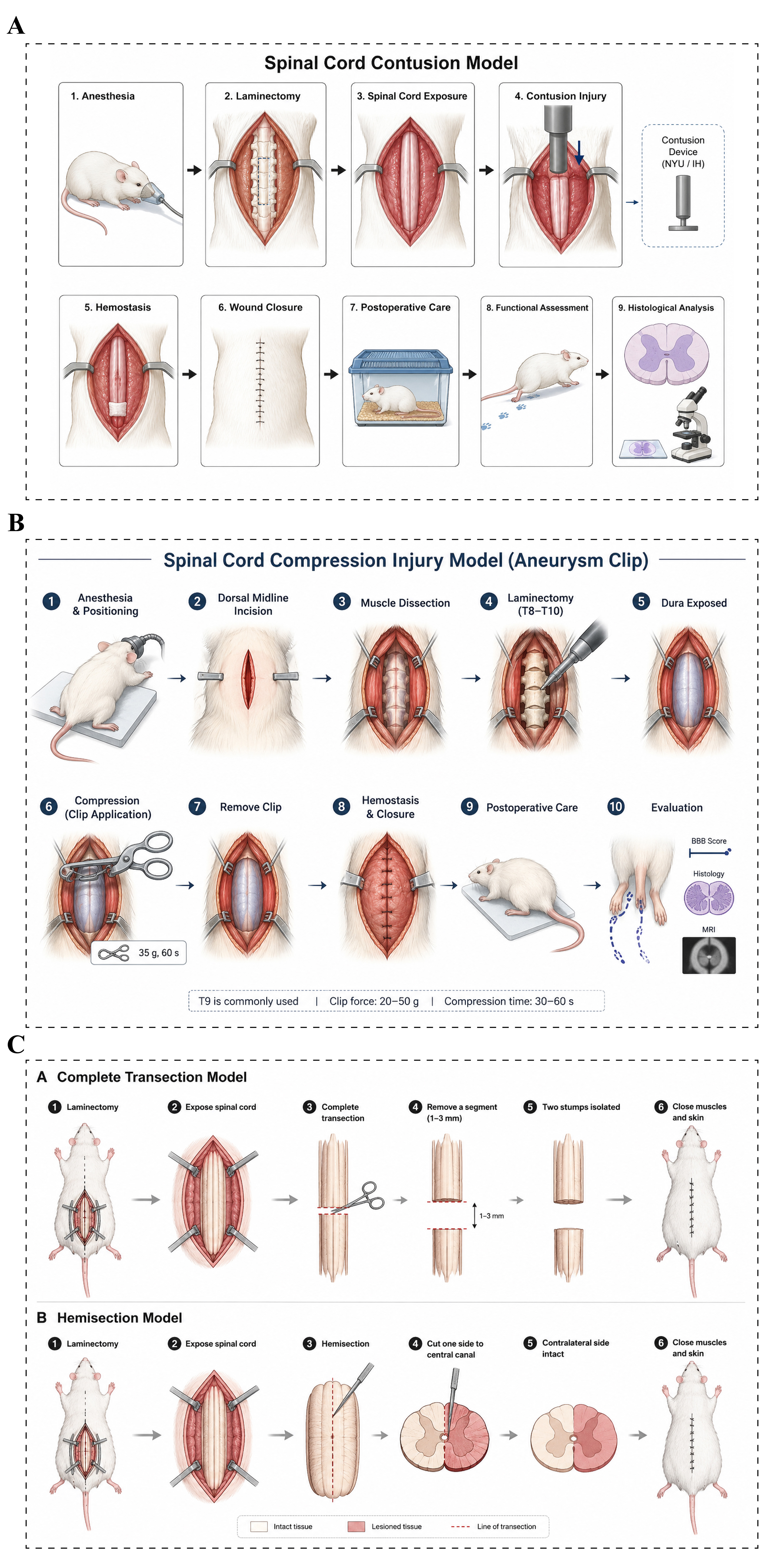
Figure 7. Animal models of SCI. (A) Contusion injury models: After anesthesia, the animal is placed in the prone position, and laminectomy is performed at the target thoracic level, typically T9-T10, to expose the spinal cord while preserving the dura. A standardized impactor, such as the NYU or Infinite Horizon Impactor, is then used to deliver a controlled contusion injury. After surgery, animals receive routine postoperative care, and injury severity and recovery are assessed using locomotor tests, histological analysis, and immunological evaluation; (B) Compression injury models: After laminectomy and spinal cord exposure under anesthesia, a calibrated aneurysm clip is applied to the target segment for 30-60 s to induce compression injury. Neurological impairment and recovery are subsequently evaluated using the BBB locomotor score, histological analysis, and imaging examinations; (C) Complete transection and hemisection models: In the complete transection model, the exposed spinal cord is completely severed at the target level, with a small segment of tissue removed when necessary to prevent reconnection. This model is widely used to study axonal regeneration, neural tissue engineering, and cell-based therapies. In the hemisection model, only one half of the spinal cord is transected while the contralateral side remains intact, making it particularly suitable for investigating neural plasticity, axonal regeneration, neural circuit reconstruction, and functional recovery. NYU: New York University impactor; IH: Infinite Horizon impactor; BBB: Basso, Beattie, and Bresnahan; MRI: magnetic resonance imaging; SCI: spinal cord injury.