



Estimation of liver fibrosis and cirrhosis risk using non-invasive biomarkers in people living with HIV and prediabetes in Tanzania
 0
0 Abstract
Aim: Metabolic dysfunction-associated steatotic liver disease (MASLD) and liver fibrosis are increasingly prevalent among people living with HIV (PLHIV), particularly as metabolic comorbidities such as prediabetes rise. Yet, liver fibrosis risk in PLHIV with prediabetes remains poorly characterised, particularly in sub-Saharan Africa. Non-invasive tests (NITs), including the Fibrosis-4 (FIB-4) Index, are recommended for first-line fibrosis risk stratification. Most lack validation in sub-Saharan African PLHIV. We aimed to estimate liver fibrosis risk and ten-year cirrhosis risk using blood-based NITs in a Tanzanian cohort of PLHIV with prediabetes.
Methods: We conducted a cross-sectional analysis of baseline data from 1,691 PLHIV with prediabetes enrolled in the Metformin Trial (META) Trial in Tanzania. Fibrosis risk was assessed using FIB-4, Metabolic Dysfunction-Associated Fibrosis 5 (MAF-5), NAFLD Fibrosis Score (NFS), and LiverRisk with validated age-adjusted cut-offs. Ten-year cirrhosis risk was estimated using the Cirrhosis Outcome Risk Estimator (CORE).
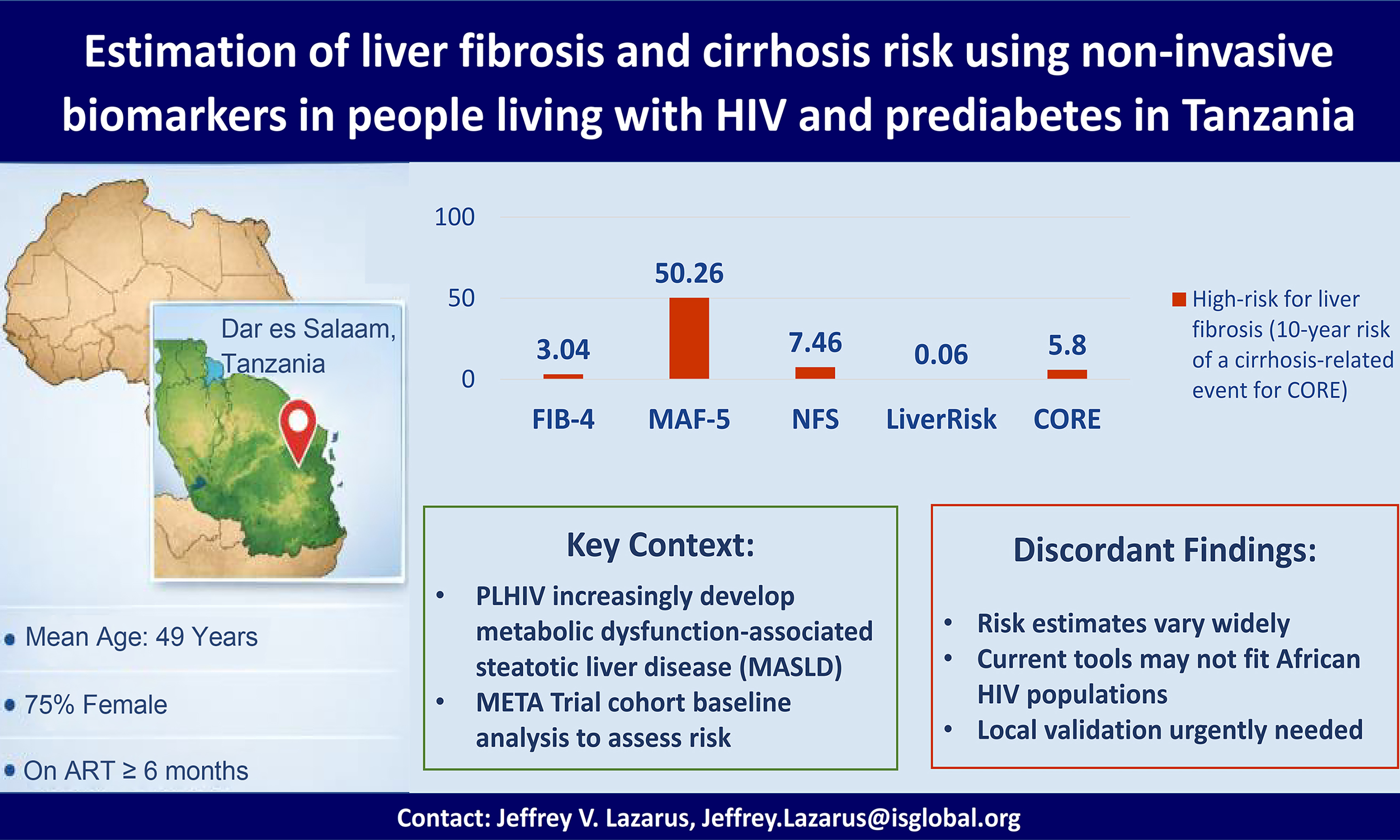
Results: Participants had a mean age of 49.4 years (SD 9.4); 75.0% were female and 99.2% were Black. FIB-4 classified 65.0% as low risk and 3.04% as high risk. MAF-5 identified 50.26% as high risk, while NFS classified 7.46% as high risk. Less than 1% were medium- to high-risk by LiverRisk. Using CORE, 5.8% had > 1% predicted 10-year cirrhosis risk. Substantial discrepancies were observed.
Conclusion: Multiple NITs identified measurable fibrosis or cirrhosis risk, yet risk classification varied markedly. These findings highlight both the potential utility and major limitations of existing NITs in African HIV and prediabetes settings and underscore the urgent need for locally validated, context-appropriate fibrosis screening tools.
Keywords
INTRODUCTION
Liver disease and metabolic dysfunction are increasingly recognised as contributors to morbidity and mortality among people living with HIV (PLHIV)[1], even in the context of effective viral suppression with antiretroviral therapy (ART). In sub-Saharan Africa, where the burden of HIV remains high, liver fibrosis has emerged as a substantial, though under-researched, health threat[2-4]. Metabolic dysfunction-associated steatotic liver disease (MASLD), a leading cause of cirrhosis and liver cancer, and bidirectionally related to type 2 diabetes and cardiovascular disease, is estimated to have a 34% (95%CI: 28%-41%) prevalence among PLHIV in lower- and middle-income countries[2]. Meanwhile, the prevalence among the adult population living with overweight or obesity, which are strongly linked to MASLD, in Tanzania is 30%[5]. Diabetes type 2 prevalence estimates in Tanzania range from 2% to 13% of the adult population, and it is estimated that PLHIV are nearly twice as likely to have diabetes compared with HIV-negative counterparts[6-8]. Despite growing awareness, critical data gaps persist in the region, limiting our understanding of the extent and drivers of hepatic complications in PLHIV.
Non-invasive tests (NIT) such as the Fibrosis-4 (FIB-4) Index, originally developed to estimate liver fibrosis in people co-infected with HIV and hepatitis C virus (HCV), are simple tools for assessing fibrosis risk[9]. More recently, FIB-4 has gained utility as a first-line test to evaluate risk for advanced liver fibrosis, defined as those with fibrosis ≥ 3 on histology using Metavir staging, in diverse clinical populations, including those living with HIV[10]. Its simplicity, very low cost, and reliance on routinely collected clinical data make it particularly attractive in resource-limited settings.
Importantly, PLHIV may remain at risk for liver complications even in the absence of HCV co-infection or in those with sustained ART adherence[11]. This ongoing risk may stem from various factors, including chronic inflammation associated with longstanding HIV infection, metabolic changes induced by HIV or ART, medication-related hepatotoxicity, and endemic co-infections such as hepatitis B virus (HBV) infection. These multifactorial risks underscore the importance of ongoing liver health surveillance in this population.
Beyond FIB-4, several other non-invasive scores have been developed to assess liver fibrosis risk, and by extension risk for development of cirrhosis due to MASLD. This is important since fibrosis is the principal determinant of liver-related events (LREs)[12]. The Metabolic Dysfunction-Associated Fibrosis 5 (MAF-5), the NAFLD Fibrosis Score (NFS), and the LiverRisk score incorporate metabolic and demographic variables to stratify fibrosis risk and were validated against liver stiffness measurements as surrogates for liver biopsy[13-15]. CORE (cirrhosis outcome risk estimator) is a novel risk prediction tool that estimates the ten-year probability of cirrhosis or complications thereof, and outperforms FIB-4 in this aspect[16]. Table 1 describes the components, intended outcomes, and use of these scores to date in sub-Saharan African populations living with HIV. Despite the utility of these tools, there are limited data on the prevalence of liver fibrosis risk among PLHIV in high-burden, resource-limited settings, and their applicability in sub-Saharan African populations remains untested. Age-adjusted FIB-4 thresholds, along with other scoring systems like MAF-5 and NFS, may offer more accurate risk stratification, yet have not been widely applied or evaluated in routine care across such contexts. LiverRisk and CORE have so far not been studied in sub-Saharan African populations.
NIT score components, endpoints, cut-offs, and limitations in the study population
| Score | Original development population | Variables required | Intended endpoint | Cut-offs used in this study | Major limitations in PLHIV in sub-Saharan Africa |
| FIB-4 index | HIV/HCV coinfected adults hepatology | Age, AST, ALT, platelets | Advanced fibrosis risk | < 1.3 low risk; 1.3-2.67 intermediate; > 2.67 high risk (< 65 years); age-adjusted ≥ 65 years thresholds | Platelet suppression from HIV infection may affect score; limited sub-Saharan African validation; lower accuracy in younger adults |
| MAF-5 | General population with metabolic dysfunction | Age, presence of diabetes (in this study n = 0 have diabetes), or HbA1c ≥ 5.7% (39 mmol/mol) or FBG ≥ 5.6 mmol/L (100 mg/dL), BMI, WC, AST | Fibrosis risk | < 0 low risk; ≥ 1 high risk | Metabolic phenotypes may differ in PLHIV; low positive predictive value; no African HIV validation |
| NFS | NAFLD populations from tertiary care cohorts | Age, BMI, presence of diabetes (in this study n = 0 have diabetes), or HbA1c ≥ 5.7% (39 mmol/mol) or FBG ≥ 7.0 mmol/L (126 mg/dL), AST/ALT ratio, platelets, albumin | Advanced fibrosis risk | < -1.455 low risk; -1.455-0.676 indeterminate; > 0.676 high risk | Developed before MASLD terminology; may overestimate risk in older or metabolically distinct populations; limited HIV-specific validation, and none in sub-Saharan Africa |
| LiverRisk | General population cohorts with metabolic dysfunction | Age, sex, cholesterol, GGT, AST, ALT, platelets, albumin | Liver-related and diabetes-related mortality and fibrosis risk | < 6 minimal; 6- < 10 low; 10- < 15 medium; ≥ 15 high | No validation in sub-Saharan Africa; proprietary/complex derivation background; uncertain transportability to PLHIV |
| CORE | General population cohort in Finland/Sweden | Age, sex, GGT, AST, ALT | 10-year cirrhosis or liver-related event risk | ≥ 1% considered elevated risk | Developed in European populations with low cirrhosis incidence; no validated threshold for African HIV populations |
This study evaluates how different non-invasive fibrosis tools classify liver disease risk among PLHIV with prediabetes in Tanzania, with the goal of informing how HIV programs might pragmatically integrate liver risk stratification into routine care[17].
METHODS
Study design and setting
The Metformin Trial (META) is a phase III randomised double-blind placebo-controlled trial aimed at determining the effectiveness of metformin in preventing diabetes among PLHIV who have prediabetes. The five study sites for this trial are located in the Dar es Salaam area, and include three public regional referral hospitals (Mwananyamala, Temeke, Amana), a public district hospital (Mnazi Moja) and a private not-for-profit hospital (Shree Hindu Mandal). This is a cross-sectional study using baseline data from the META Phase III Trial cohort to evaluate liver fibrosis risk using FIB-4, MAF-5, NFS, and LiverRisk scores and to estimate the risk of incident cirrhosis within ten years using CORE. Clinical trial registration: This process evaluation is listed on the ClinicalTrials.gov registry (registration number: NCT06743698). The META trial is listed on the International Standard Randomised Controlled Trial Number (ISRCTN) registry (registration number: ISRCTN77382043).
Participant recruitment
Inclusion criteria for the patients recruited into this study were: to be an adult, living with HIV, having been on ART for at least six months and considered stable with a viral load test in the previous 12 months that was below 1,000 copies/ml, have impaired fasting glucose according to the Oral Glucose Tolerance Test (OGTT) prediabetes criteria (≥ 7.8-11.1 mmol/L; where fasting blood glucose was ≥ 7.0 and < 11.0 mmol/L), and planning to remain in the area for more than 12 months. Patients were excluded if they were pregnant, had participated in the META Phase II study or had a known hypersensitivity to metformin or any excipients associated with the preparation, were known to have renal disease, had clinical evidence of liver disease or congestive heart failure requiring pharmacological treatment, had evidence of alcoholism or acute alcohol intoxication, had any form of acute metabolic acidosis including lactic acidosis or diabetic ketoacidosis or other acute conditions with the potential to alter renal function or to cause tissue hypoxia, or had any other acute conditions requiring hospital admission or emergency clinical intervention, including blood pressure > 180/110 mmHg, haemoglobin < 6.5 g/dL for women or haemoglobin < 7.0 g/dL for men (grade 3); white cell count < 1.5 × 10⁹ cells/mm3 (grade 3) and any baseline liver function derangements at grade 4 according to Division of AIDS (DAIDS) table for grading the severity of adult and pediatric adverse events criteria[18]. Researchers provided the individuals invited to participate with information about the study and asked each to give their consent in writing before participation.
Data collection
Participants who consented to be screened for the trial were asked to return to the clinic having fasted, i.e., not eaten or drunk anything except water for at least 8 h before their appointment. At screening, a morning venepuncture sample was collected on arrival at the clinic and used for measurement of fasting blood glucose, HbA1c point-of-care test, and rapid malaria point-of-care antigen test (CareStart-Malaria pf/PAN[HRP2/plDH] Ag Combo RDT, USA). Participants were given a 75 g anhydrous glucose solution dissolved in 300 mL non-carbonated water (Rapilose oral glucose tolerance test solution, Penlan Healthcare, UK), and a 2-h post-glucose-load capillary blood glucose measurement was taken via finger prick. To determine blood glucose levels, a point-of-care test (Hemocue Glucose 201 RT-Hemocue AB, Sweden) was performed immediately following venepuncture and finger prick. Baseline blood biochemistry and haematology testing was conducted on the morning venepuncture sample from those enrolled in the trial following screening.
Data analysis
We calculated the FIB-4, MAF-5, NFS, LiverRisk, and CORE scores according to published or derived formulas[9,13-16]. Age was measured in years, aspartate aminotransferase (AST), alanine aminotransferase (ALT), and Gamma-glutamyl Transferase (GGT) were measured in IU/L, and platelet count was measured in 109/L. For MAF-5 and NFS calculations, which use the presence of diagnosed diabetes, HbA1c, or fasting blood glucose thresholds, we used fasting blood glucose ≥ 5.6 mmol/L for MAF-5 and ≥ 7.0 mmol/L for NFS or HbA1c ≥ 5.7% (39 mmol/mol) for both scores[13,14]. Waist circumference (WC) was measured in centimeters and body mass index (BMI) was calculated as the ratio of weight in kilograms and height in meters squared. Ten participants (0.6%) did not have requisite data to calculate the FIB-4 score, nor 326 (19.3%) for MAF-5, nor 15 (0.9%) for NFS, nor 14 (0.8%) for LiverRisk, nor 2 (0.1%) for CORE.
Following current international clinical guidelines, we categorized FIB-4 scores into risk strata based on age-specific thresholds[10]. For participants aged younger than 65 years, scores were classified as low risk (< 1.30), intermediate risk (1.30-2.67), and high risk (> 2.67). For participants aged 65 years and older, the corresponding cut-offs were low risk (< 2.00), intermediate risk (2.00-2.67), and high risk (> 2.67). These categorical variables were then labelled as “low risk”, “intermediate risk”, and “high risk” for descriptive and inferential analyses. MAF-5 score categories are based on the published cut-offs of low fibrosis risk (MAF-5 < 0) and high fibrosis risk (MAF-5 ≥ 1), with an indeterminate risk profile being assigned to scores between these values. NFS categories follow validated cut-offs: < -1.455 = low risk, -1.455 to 0.676 = indeterminate risk, and > 0.676 = high risk of advanced fibrosis. Cutoffs for LiverRisk (N = 1,677) are: minimal-risk group (< 6), low-risk group (6 to < 10), medium-risk group (10 to < 15), and high-risk group (≥ 15)[15,19,20]. No published cut-off exists for CORE; we used a 1% cut-off, which would likely be an approach with a high sensitivity to detect persons that will develop cirrhosis while maintaining a high specificity[21]. Likelihood ratio chi-squared test and Fisher’s exact test were used to test significance between scores and sex, which can only be interpreted as exploratory, given the female-to-male imbalance among participants. Data processing and analyses for FIB-4, MAF-5, NFS, and LiverRisk were conducted using Stata (version 16.1); CORE analyses were performed in R (version 2022.12.0) using the “rms” package (version 8.1-1).
Ethical considerations
Ethical approvals for the study were obtained from the Liverpool School of Tropical Medicine Research Ethics Committee (20-089) and the National Institute for Medical Research Ethics committee in Tanzania (NIMR/HQ/R.8a/Vol. IX/3613), and subsequently from the UCL Research Ethics Committee. The study is compliant with the Declaration of Helsinki. Written informed consent for participation in the trial was obtained prior to any data collection. During the consent process, all participants were provided with written information about the study; which was also explained verbally, and they were informed that their participation was voluntary and that they may withdraw from participation at any time without penalty.
RESULTS
Participant characteristics
Assessment of liver fibrosis risk varied substantially across non-invasive tools, suggesting that the choice of scoring method alone could materially alter how many patients are flagged for further evaluation within HIV care programs. Among the 1,691 participants enrolled in the META Trial, the majority were female (75.0%) and nearly all identified as black (99.2%, Table 2). The mean age of participants was 49.4 years (SD: 9.4), and on average, individuals had been living with HIV for 12.8 years, accounting for approximately 26.4% of their lifetime. Metabolic indicators showed evidence of elevated risk: the median BMI was 26.3 kg/m2 and the median WC was 91 cm, both consistent with overweight and central adiposity. N = 316 were missing data for WC. Glycaemic markers were generally within normal ranges, with HbA1c (N = 20 missing) and fasting blood glucose (N = 0 missing) reporting medians of 5.7% and 6.1 mmol/L, respectively. Liver enzymes [i.e., ALT (N = 1 missing), AST (N = 2 missing), and GGT (N = 1 missing)] were also mostly within normal limits (medians: 18, 24, and 24 IU/L, respectively) but showed wide ranges [interquartile range (IQR): 14-23, 20-29, and 17-34 IU/L, respectively] [Table 2], indicating that a subset may have underlying hepatic or metabolic dysfunction. Additionally, there were N = 6 and N = 9 missing values for albumin and platelet count, respectively.
Participant characteristics
| Characteristic | N (%) | ||
| Total | 1,691 (100.0) | ||
| Sex | |||
| Male | 423 (25.0) | ||
| Female | 1,268 (75.0) | ||
| Ethnicity | |||
| Black | 1,678 (99.2) | ||
| Other | 13 (0.8) | ||
| ARV regimen at enrolment | |||
| TDF + 3TC + DTG | 1,503 (88.9) | ||
| TDF + FTC + ATV/r | 72 (4.3) | ||
| ABC + 3TC + ATV/r | 29 (1.7) | ||
| AZT + 3TC + ATV/r | 16 (1.0) | ||
| TDF + 3TC + EFV | 14 (0.8) | ||
| TDF + 3TC + ATV/r | 7 (0.4) | ||
| TDF + FTC + LPV/r | 5 (0.3) | ||
| TDF + FTC + EFV | 2 (0.1) | ||
| TDF + 3TC + LPV/r | 2 (0.1) | ||
| Other | 41 (2.4) | ||
| Other characteristics | Mean (SD) | Median | Range (IQR) |
| Age (n = 1,691) | 49.4 (9.4) | 49.0 | 18-85 (43-56) |
| BMI (n = 1,691) | 26.9 (6.0) | 26.3 | 14.6-53.8 (22.3-30.6) |
| WC (n = 1,375) | 91.7 (14.2) | 91.0 | 55-150 (82-102) |
| HbA1c (n = 1,671) | 5.8 (0.7) | 5.7 | 4.1-14 (5.4-6.1) |
| ALT (n = 1,690) | 20.6 (17.8) | 18.0 | 6-586 (14-23) |
| AST (n = 1,689) | 26.3 (12.3) | 24.0 | 3-220 (20-29) |
| GGT (n = 1,690) | 31.0 (30.3) | 24.0 | 4-651 (17-34) |
| FBG (n = 1,691) | 6.4 (0.7) | 6.4 | 3.4-10.7 (6.1-6.8) |
| Albumin (n = 1,685) | 40.2 (5.9) | 40 | 12-145.3 (38-42) |
| Platelets (n = 1,682) | 263.4 (88.7) | 251 | 40-1140 (207-306) |
| Years Diagnosed with HIV (n = 1,688) | 12.8 (4.8) | 13 | 2-33 (9-17) |
| Percent of Life Living with HIV (n = 1,688) | 26.4 (10.5) | 26.1 | 4.4-88.9 (18.6-33.6) |
Distribution of NIT scores
Table 3 summarizes the distribution of NIT scores in the study population, reporting the mean (SD), median, and range, along with the IQR, for each score. Assessment of liver fibrosis risk using non-invasive scores revealed substantial variation in risk classification across tools [Table 4]. The MAF-5 score identified a much higher proportion of participants (50.26%) as high risk than any other scale: 3.0% for FIB-4, 8.3% for NFS, and 0.1% for LiverRisk. CORE estimated that 5.8% of the sample had a 1% risk or greater to develop cirrhosis or have a cirrhosis-related event within ten years. The agreement among the four liver risk scores was generally poor, with only a fair level of concordance observed between FIB-4 and NFS (κ = 0.29), while all other interrater comparisons showed slight to no agreement [Table 5 and Supplementary Table 1].
FIB-4, MAF-5, NFS, LiverRisk, CORE statistical summary
| NIT score | Mean (SD) | Median | Range (IQR) |
| FIB-4 (n = 1,681; 99.4% of n = 1,691) | 1.26 (0.66) | 1.13 | 0.18-7.16 (0.83-1.53) |
| MAF-5 (n = 1,365; 80.7% of n = 1,691) | 1.05 (1.56) | 1.01 | -4.83-8.20 (0.88-1.98) |
| NFS (n = 1,676; 99.1% of n = 1,691) | -1.25 (1.50) | -1.16 | -11.90-5.90 (-2.08- -0.34) |
| LiverRisk (n = 1,677; 99.2% of n = 1,691) | 5.80 (0.99) | 5.72 | 1.48-17.93 (5.22-6.23) |
| CORE (n = 1,689; 99.9% of n = 1,691) | 0.04 (0.11) | 0.0018 | 0.0001-0.24 (0.00095-0.0035) |
FIB-4, MAF-5, NFS, LiverRisk, CORE cut-off calculations
| FIB-4 | MAF-5 | NFS | LiverRisk | CORE | ||||||
| N | % | n | % | N | % | N | % | N | % | |
| Minimal risk | N/A | N/A | N/A | N/A | N/A | N/A | 1,083 | 64.58 | N/A | N/A |
| Low risk | 1,092 | 65 | 321 | 23.52 | 690 | 41.17 | 585 | 34.88 | 1,591 | 94.09 |
| Indeterminate/Medium risk | 537 | 31.96 | 358 | 26.23 | 861 | 51.37 | 8 | 0.48 | N/A | N/A |
| High risk | 51 | 3.04 | 686 | 50.26 | 125 | 7.46 | 1 | 0.06 | 98 | 5.80 |
Kappa statistics between scores
| FIB-4 | NFS | LiverRisk | MAF-5 | |
| FIB-4 | 1 | 0.29 | 0.0106 | 0.0792 |
| NFS | 0.29 | 1 | 0.0015 | 0.1047 |
| LiverRisk | 0.0106 | 0.0015 | 1 | -0.0002 |
| MAF-5 | 0.0792 | 0.1047 | -0.0002 | 1 |
Sex-stratified differences
Sex-stratified analyses showed significant differences between females and males for the FIB-4, LiverRisk, and CORE scores, whereas MAF-5 and NFS did not vary by sex [Supplementary Table 2]. For FIB-4, females were more frequently classified as low risk compared with males (70% vs. 50%, P < 0.001). High-risk classifications were uncommon in both groups (3% in females; 4% in males). For MAF-5, there was no statistical difference by sex; 54.1% of males were categorized as high risk compared with 49.1% of females. LiverRisk demonstrated marked sex differences, with females more frequently classified as minimal risk compared with males (76% vs. 29%, P < 0.001). Comparatively, 11.8% of males and 3.8% of females had a 1% risk or higher of cirrhosis or related event incidence within ten years.
DISCUSSION
In this study of PLHIV with prediabetes in Tanzania, we observed considerable variability in liver fibrosis risk classification depending on the non-invasive score used, which has practical implications for HIV and metabolic programs, as the use of different fibrosis scores could lead to markedly different referral volumes, diagnostic cascades, and demands on already constrained specialist services. While the majority of participants were classified as low risk using the FIB-4 index, NFS and LiverRisk, over half were categorised as high risk by the MAF-5 score. This cohort of people with prediabetes exhibited high WC, modest AST elevations, and HIV-related differences in platelet profiles, all components of the MAF-5 formula, which potentially resulted in substantially higher MAF-5 risk classification. This divergence underscores the importance of context and population-specific considerations in selecting appropriate fibrosis risk assessment tools. For example, MAF-5 is designed to positively identify those at high risk, but has a low positive predictive value[13]. While CORE estimated that the risk of developing cirrhosis within ten years was around five percent in this sample, a study in Sweden with data collected in 1985-96 found an extremely low risk of 0.27%[16]. It should be noted that it often takes more than 20 years from the point of MASLD diagnosis for cirrhosis to develop, and that given cirrhosis is a rare outcome, risk estimations will likely always be in the single-digit range[22]. The contrast with much lower estimates of cirrhosis risk in high-income settings highlights how background population risk and care context shape the predictive value of fibrosis tools, reinforcing the need for setting-specific implementation strategies rather than direct score transfer.
In the current study and in a recent comparison of FIB-4 and LiverRisk, estimates of advanced fibrosis vary widely by test, across care settings and across patient populations[23]. In particular, the FIB-4 score may perform well with a high negative predictive value in low-prevalence settings[24], while LiverPRO, which was not assessed here since this requires a proprietary formula, and LiverRisk may improve diagnostic precision by balancing sensitivity and specificity, suggesting that similar performance limitations may exist in our Tanzanian sample. Further, standard thresholds may lead to an overestimation of fibrosis risk in older PLHIV populations[25,26]. With increasing life expectancy among PLHIV on ART, accurate fibrosis risk stratification becomes essential to provide appropriate care and avoid unnecessary referrals or invasive diagnostics. Moreover, the high percentage of indeterminate or high-risk scores across tools highlights the need for further investigation into contributing risk factors such as viral hepatitis coinfection, alcohol use, metabolic comorbidities, and ART-associated hepatotoxicity[1]. A clearer understanding of these factors can inform targeted screening and management strategies tailored to the specific needs of PLHIV in sub-Saharan Africa. Further investigation into associated risk factors is warranted to guide targeted interventions and adapt non-invasive fibrosis algorithms for HIV populations with distinct metabolic and epidemiologic profiles, ensuring accurate risk stratification and efficient referral.
This study has some limitations. Most importantly, we did not have access to a gold standard to compare the examined NITs against due to missing data, such as the prevalence of advanced chronic liver disease (ACLD) or incidence. Therefore, we cannot definitively know which of the examined tests performs best in this population. The cohort was known not to have type 2 diabetes or be on treatment for type 2 diabetes; however, they all had prediabetes and HIV, which suggests rudimentary insulin resistance. This limits generalisability to the larger Tanzanian population more broadly. During screening, people with liver disease, including cirrhosis, were excluded, but data on HBV/HCV were not captured, limiting our ability to account for underlying viral hepatitis as a contributor to liver-related outcomes in a setting with a high burden of HBV. Sample sizes varied slightly across fibrosis scores due to missing data required for score calculation. Each NIT requires a specific combination of laboratory and clinical variables (e.g., platelet count, AST, ALT, albumin, WC, GGT). Participants missing one or more required variables were excluded from that specific score calculation but remained eligible for other analyses. Approximately 20% (n = 316) of the sample did not have WC data, which is an important measurement to consider along with BMI when assessing overweight and obesity[27] and could have skewed MAF-5 calculation results and may be indicative of an implementation issue with this data collection method. FIB-4 calculations for those younger than 35 used the same cut-offs as those between the ages of 35 and 65, even as the likelihood of those under 35 having advanced fibrosis is low[28]. It would also be useful in future studies to evaluate NIT performance by duration of HIV infection.
The type of ART used in African settings may also influence fibrosis risk. Widespread use of tenofovir disoproxil fumarate (TDF) and dolutegravir (DTG)-based regimens, first-line treatments that the majority of patients in this study are prescribed, is generally associated with lower rates of hepatotoxicity compared with earlier regimens[29]. Yet, emerging evidence suggests that contemporary ART regimens may contribute indirectly to liver disease through metabolic pathways, namely the repression of adipogenesis, reduction of adiponectin and leptin release, and the increased secretion of proinflammatory cytokines in adipocytes, thereby enhancing inflammation, cellular stress, and fibrotic processes[30,31]. Further, ART-related metabolic effects, particularly weight gain, adipose tissue inflammation, and fibrosis, are most pronounced in women and in people of African origin[30], raising particular concern for our cohort, where the majority were female and almost all were Black African. Importantly, sexual dimorphism plays a role in metabolic and fibrotic risk such that women are generally protected until menopause, after which the risk of liver fibrosis increases[32]. This demographic profile suggests that the observed discrepancies in fibrosis risk scores may in part reflect heightened vulnerability to ART-induced metabolic changes, compounding the existing burden of prediabetes.
Conclusion
This study highlights the potential utility and limitations of non-invasive fibrosis scores for assessing liver disease risk among PLHIV with prediabetes in a high-burden, resource-limited setting in sub-Saharan Africa. While FIB-4 identified a majority of participants as low risk, scores such as MAF-5 and NFS revealed a larger proportion with suggested underlying advanced fibrosis, underscoring the importance of tool selection and interpretation. Better availability of modern fibrosis estimation methods such as vibration-controlled transient elastography is needed in similar low-resource settings. Age-adjusted thresholds, particularly for FIB-4, should be examined in aging HIV populations, and further validation is needed for African populations to avoid misclassification bias. For HIV programs in resource-limited settings, these findings suggest that careful selection of non-invasive fibrosis tools, and explicit decisions about acceptable trade-offs between sensitivity and specificity, may be as important as expanding access to advanced diagnostics. Moving forward, integrating liver health screening into HIV and metabolic healthcare alongside investigation of underlying risk factors and NIT utility in predicting LREs can help strengthen efforts to identify and manage MASLD/metabolic dysfunction-associated steatohepatitis (MASH) and other liver and metabolic complications in sub-Saharan Africa.
DECLARATIONS
Acknowledgments
Lazarus JV, White TM and Picchio CA acknowledge institutional support to ISGlobal from MCIN/AEI/10.13039/501100011033 (grant No. CEX2023-0001290-S) and the Generalitat de Catalunya through the CERCA Programme. Hagström H was supported by grants from The Swedish Research Council, The Swedish Cancer Society, Region Stockholm (CIMED and Clinical Researcher Award), The Swedish Heart and Lung Foundation, and others.
Authors’ contributions
Conceptualised the study: Lazarus JV
Contributed to the study design: Lazarus JV, White TM, Ramaiya K, Kivuyo S, Mfinanga S, van Widenfelt E, Brennan PN, Picchio CA, Hagström H, Strandberg R, Garrib A
Led the drafting of the manuscript and analysis: White TM
Contributed to the interpretation of the data, critically revised the manuscript for important intellectual content, and approved the final version for publication: Lazarus JV, White TM, Ramaiya K, Kivuyo S, Mfinanga S, van Widenfelt E, Brennan PN, Picchio CA, Hagström H, Strandberg R, Garrib A
Availability of data and materials
All data used in this study are available for download at: https://zenodo.org/records/20701212.
AI and AI-assisted tools statement
During the preparation of this manuscript, the AI tool ChatGPT (version 4.5, released 2025-02-27) was used solely for design the map in the Graphical Abstract. The tool did not influence the study design, data collection, analysis, interpretation, or the scientific content of the work. All authors take full responsibility for the accuracy, integrity, and final content of the manuscript.
Financial support and sponsorship
The project is supported by Global Health EDCTP3 and its members. Funded by the European Union under Global Health EDCTP3. Views and opinions expressed are, however, those of the author(s) only and do not necessarily reflect those of Global Health EDCTP3 nor its members. Neither of the parties can be held responsible for them. The project is part of the EDCTP2 programme (grant No. RIA2018CO-2513 META-TRIAL) supported by the European Union; the National Institute for Health and Care Research (NIHR) in the United Kingdom, where NIHR is funded by the Department of Health and Social Care. The views and opinions of authors expressed herein do not necessarily state or reflect those of EDCTP. The META Trial has received financial and drug support from Merck Healthcare KGaA (CrossRef Funder ID: 10.13039/100009945). The funders of the study had no role in study design, data collection, data analysis, data interpretation, or writing of the report. The authors take full responsibility for these functions.
Conflicts of interest
Lazarus JV received grants to his institutions from AbbVie, Boehringer Ingelheim, Echosens, Gilead Sciences, Madrigal Pharmaceuticals, Moderna, MSD, Novo Nordisk, Pfizer, and Roche Diagnostics, consulting fees from Echosens, GSK, Madrigal Pharmaceuticals, Novo Nordisk, Pfizer, and Takeda, a paid leadership role at the Global NASH Council (ended), and honoraria for lectures from AbbVie, Echosens, Gilead Sciences, GSK, Janssen, MSD, Novo Nordisk, Pfizer, and Prosciento outside of the submitted work. He is also the director of the Global Think-tank on Steatotic Liver Disease. Brennan PN acknowledges consultancy fees from Novo Nordisk, Resolution Therapeutics, and Madrigal. Additionally, he has received educational honoraria or support to attend meetings from Takeda and Novo Nordisk outside of this work. Hagström H’s institutions have received research funding from Astra Zeneca, Echosens, Gilead Sciences, Intercept, MSD, Novo Nordisk, Takeda, and Pfizer. He has served as a consultant, speaker, or on advisory boards for Astra Zeneca, Boehringer Ingelheim, Bristol Myers Squibb, GSK, Echosens, Ipsen, MSD, and Novo Nordisk and has been part of hepatic events adjudication committees for Arrowhead, Boehringer Ingelheim, KOWA, and GW Pharma. The other authors declared that there are no conflicts of interest.
Ethical approval and consent to participate
Ethical approvals for the study were obtained from the Liverpool School of Tropical Medicine Research Ethics Committee (20-089) and the National Institute for Medical Research Ethics committee in Tanzania (NIMR/HQ/R.8a/Vol. IX/3613), and subsequently from the UCL Research Ethics Committee. The study is compliant with the Declaration of Helsinki. Written informed consent for participation in the trial was obtained prior to any data collection. During the consent process, all participants were provided with written information about the study; which was also explained verbally, and they were informed that their participation was voluntary and that they may withdraw from participation at any time without penalty.
Consent for publication
Not applicable.
Copyright
© The Author(s) 2026.
Supplementary Materials
REFERENCES
2. Manzano-Nunez R, Rivera-Esteban J, Navarro J, et al. Uncovering the NAFLD burden in people living with HIV from high- and middle-income nations: a meta-analysis with a data gap from Subsaharan Africa. J Int AIDS Soc. 2023;26:e26072.
3. Spearman CW, Abdo A, Ambali A, et al. ; Gastroenterology and Hepatology Association of sub-Saharan Africa (GHASSA). Health-care provision and policy for non-alcoholic fatty liver disease in sub-Saharan Africa. Lancet Gastroenterol Hepatol. 2021;6:1047-56.
4. Liu C, Zhu S, Zhang J, et al. Global, regional, and national burden of liver cancer due to non-alcoholic steatohepatitis, 1990-2019: a decomposition and age-period-cohort analysis. J Gastroenterol. 2023;58:1222-36.
5. Kilonzo SB, Kamala E, Jaka H, Ngoya P. Non-alcoholic fatty liver disease in Tanzania: prevalence, determinants, and diagnostic performance of triglycerides-glucose index and triglycerides-glucose index -body mass index compared to the hepatic ultrasound in overweight and obese individuals. BMC Gastroenterol. 2024;24:96.
6. Jeremiah K, Filteau S, Faurholt-Jepsen D, et al. Diabetes prevalence by HbA1c and oral glucose tolerance test among HIV-infected and uninfected Tanzanian adults. PLoS One. 2020;15:e0230723.
7. International Diabetes Federation. Tanzania country profile 2024. Available from: https://idf.org/our-network/regions-and-members/africa/members/tanzania/. [Last accessed on 10 Jul 2026].
8. Institute for Health Metrics and Evaluation. GBD compare 2017. Available from: https://vizhub.healthdata.org/gbd-compare/. [Last accessed on 10 Jul 2026].
9. Sterling RK, Lissen E, Clumeck N, et al. ; APRICOT Clinical Investigators. Development of a simple noninvasive index to predict significant fibrosis in patients with HIV/HCV coinfection. Hepatology. 2006;43:1317-25.
10. European Association for the Study of the Liver (EASL), European Association for the Study of Diabetes (EASD), European Association for the Study of Obesity (EASO). EASL-EASD-EASO Clinical Practice Guidelines on the management of metabolic dysfunction-associated steatotic liver disease (MASLD). J Hepatol. 2024;81:492-542.
11. Gattu AK, Fourman LT. Metabolic dysfunction-associated steatotic liver disease in people with HIV. Curr Opin HIV AIDS. 2025;20:350-8.
12. Angulo P, Kleiner DE, Dam-Larsen S, et al. Liver fibrosis, but no other histologic features, is associated with long-term outcomes of patients with nonalcoholic fatty liver disease. Gastroenterology. 2015;149:389-97.e10.
13. van Kleef LA, Francque SM, Prieto-Ortiz JE, et al. Metabolic dysfunction-associated fibrosis 5 (MAF-5) score predicts liver fibrosis risk and outcome in the general population with metabolic dysfunction. Gastroenterology. 2024;167:357-67.e9.
14. Angulo P, Hui JM, Marchesini G, et al. The NAFLD fibrosis score: a noninvasive system that identifies liver fibrosis in patients with NAFLD. Hepatology. 2007;45:846-54.
15. Liu S, Chen X, Jiang X, et al. LiverRisk score: an accurate, cost-effective tool to predict fibrosis, liver-related, and diabetes-related mortality in the general population. Med. 2024;5:570-82.e4.
16. Strandberg R, Åberg F, Asteljoki JV, et al. Use of new CORE risk score to predict 10 year risk of liver cirrhosis in general population: population based cohort study. BMJ. 2025;390:e083182.
17. Ravichandran N, Broughan J, Mccombe G, et al. Process evaluation of a metformin RCT for people living with HIV with pre-diabetes in tanzania (META Trial): a study protocol. HRB Open Res. 2025;8:109.
18. US. Department of Health and Human Services, National Institute of Allergy and Infectious Diseases. DAIDS table for grading the severity of adult and pediatric adverse events, corrected version 2.1 2017. Available from: https://rsc.niaid.nih.gov/clinical-research-sites/daids-adverse-event-grading-tables. [Last accessed on 10 Jul 2026].
19. Strandberg R, Shang Y, Ekstedt M, Vessby J, Hagström H. Validating non-invasive tests for diagnostic prediction of fibrosis in patients with biopsy-proven MASLD: CORE, LiverRisk, and FIB-4. EASL Congress, Amsterdam: 2025. Available from: https://www.postersessiononline.eu/173580348_eu/congresos/EASL2025/aula/-WED_477_EASL2025.pdf. [Last accessed on 10 Jul 2026].
20. Serra-Burriel M, Juanola A, Serra-Burriel F, et al. ; LiverScreen Consortium Investigators. Development, validation, and prognostic evaluation of a risk score for long-term liver-related outcomes in the general population: a multicohort study. Lancet. 2023;402:988-96.
21. GitHub - rickstra/. CORE: The Cirrhosis Outcome Risk Estimator for the 10 year risk of cirrhosis in primary care n.d. Available from: https://github.com/rickstra/CORE. [Last accessed on 10 Jul 2026].
22. Lekakis V, Papatheodoridis GV. Natural history of metabolic dysfunction-associated steatotic liver disease. Eur J Intern Med. 2024;122:3-10.
23. Semmler G, Thöne P, Embacher J, et al. Prevalence of fibrosis and applicability of lab-based noninvasive tests from primary to tertiary care. Clin Gastroenterol Hepatol. 2025;Epub ahead of print.
24. Han JW, Kim HY, Yu JH, et al. Diagnostic accuracy of the Fibrosis-4 index for advanced liver fibrosis in nonalcoholic fatty liver disease with type 2 diabetes: a systematic review and meta-analysis. Clin Mol Hepatol. 2024;30:S147-58.
25. Kjaergaard M, Lindvig KP, Thorhauge KH, et al. Using the ELF test, FIB-4 and NAFLD fibrosis score to screen the population for liver disease. J Hepatol. 2023;79:277-86.
26. Yendewa GA, Khazan A, Jacobson JM. Risk stratification of advanced fibrosis in patients with human immunodeficiency virus and hepatic steatosis using the fibrosis-4, nonalcoholic fatty liver disease fibrosis, and BARD scores. Open Forum Infect Dis. 2024;11:ofae014.
27. Rubino F, Cummings DE, Eckel RH, et al. Definition and diagnostic criteria of clinical obesity. Lancet Diabetes Endocrinol. 2025;13:221-62.
28. Abeysekera KWM, Fernandes GS, Hammerton G, et al. Prevalence of steatosis and fibrosis in young adults in the UK: a population-based study. Lancet Gastroenterol Hepatol. 2020;5:295-305.
29. Otto AO, Rivera CG, Zeuli JD, Temesgen Z. Hepatotoxicity of contemporary antiretroviral drugs: a review and evaluation of published clinical data. Cells. 2021;10:1263.
30. Capeau J, Lagathu C, Béréziat V. Recent data on the role of antiretroviral therapy in weight gain and obesity in persons living with HIV. Curr Opin HIV AIDS. 2024;19:14-20.
31. Quesada-López T, Cereijo R, Blasco-Roset A, et al. Divergent effects of the antiretroviral drugs, dolutegravir, tenofovir alafenamide, and tenofovir disoproxil fumarate, on human adipocyte function. Biochem Pharmacol. 2024;220:116010.
Cite This Article
 Open Access
How to Cite
Download Citation
Export Citation File:
Type of Import
Tips on Downloading Citation
Citation Manager File Format
Type of Import
Direct Import: When the Direct Import option is selected (the default state), a dialogue box will give you the option to Save or Open the downloaded citation data. Choosing Open will either launch your citation manager or give you a choice of applications with which to use the metadata. The Save option saves the file locally for later use.
Indirect Import: When the Indirect Import option is selected, the metadata is displayed and may be copied and pasted as needed.
About This Article
Copyright

Data & Comments
Data
0










Comments
Comments must be written in English. Spam, offensive content, impersonation, and private information will not be permitted. If any comment is reported and identified as inappropriate content by OAE staff, the comment will be removed without notice. If you have any queries or need any help, please contact us at [email protected].