

Steatotic liver disease in cardiovascular-kidney-metabolic syndrome
 0
Graphical Abstract
Abstract
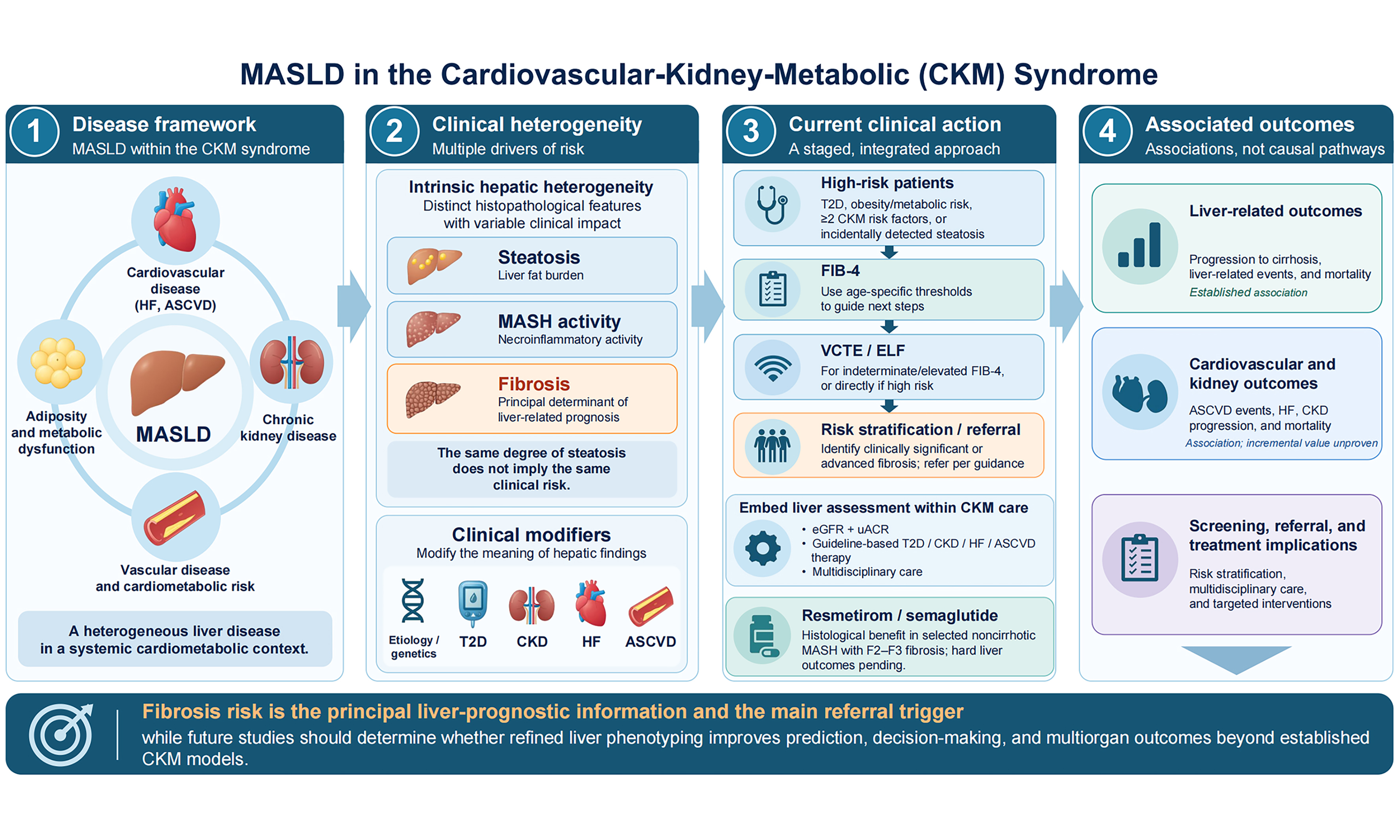
The cardiovascular-kidney-metabolic (CKM) syndrome has reoriented chronic metabolic disease management from organ-specific care toward integrated multisystem risk assessment. Metabolic dysfunction-associated steatotic liver disease (MASLD) commonly coexists with obesity, type 2 diabetes (T2D), chronic kidney disease (CKD), heart failure (HF), and atherosclerotic cardiovascular disease (ASCVD); however, a binary classification based solely on the presence or absence of steatosis fails to capture its clinical significance. This review distinguishes intrinsic hepatic heterogeneity from two categories of clinical modifiers. Steatosis, metabolic dysfunction-associated steatohepatitis (MASH) activity, and fibrosis define the pathological state of the liver, whereas etiological and genetic factors and the surrounding CKM comorbidity burden modify the interpretation and prognosis of these findings. Fibrosis burden shows the most robust association with liver-related events and mortality and serves as the primary indication for hepatology referral. Etiology and genetics may partly dissociate hepatic from cardiovascular risk, although polygenic risk scores have not demonstrated consistent incremental clinical value. T2D, CKD, and HF substantially alter the overall risk associated with MASLD, while HF-related venous congestion can confound liver stiffness measurements. The 2026 CKM guideline, the 2026 European guideline on cardiovascular disease and CKD, and contemporary hepatology pathways collectively support staged fibrosis assessment and bidirectional cardiovascular and kidney evaluation. Resmetirom and semaglutide improve histological surrogate endpoints in MASH, whereas their effects on hepatic decompensation, liver transplantation, and mortality await confirmation in ongoing long-term outcome trials. Future cohorts and trials should jointly capture hepatic, cardiovascular, and kidney phenotypes and determine whether refined liver phenotyping improves prediction, decision-making, and multiorgan clinical outcomes beyond established CKM models.
Keywords


 Download PDF
INTRODUCTION
The cardiovascular-kidney-metabolic (CKM) framework conceptualizes obesity, diabetes, chronic kidney disease (CKD), and cardiovascular disease as a continuous, mutually reinforcing risk spectrum. The 2026 American Heart Association/American College of Cardiology/American Diabetes Association/American Society of Nephrology (AHA/ACC/ADA/ASN) clinical practice guideline translated this paradigm into clinical pathways through staging, risk quantification, and stratified intervention; notably, it was the first major cardiovascular guideline to incorporate metabolic dysfunction-associated steatotic liver disease (MASLD) fibrosis assessment into routine care for selected patients at high CKM risk[1,2]. In parallel, the 2023 multisociety consensus replaced nonalcoholic fatty liver disease (NAFLD) and nonalcoholic steatohepatitis (NASH) with MASLD and metabolic dysfunction-associated steatohepatitis (MASH), shifting the disease definition from an exclusion-based label to affirmative diagnostic criteria centered on metabolic dysfunction[3].
MASLD frequently coexists with disorders across the CKM spectrum, yet epidemiological overlap alone is insufficient to guide clinical decision-making. A longitudinal meta-analysis of 129 studies linked MASLD to incident cardiovascular events, CKD, diabetes, malignancy, and liver-related outcomes[4]. This risk, however, is heterogeneous. Hepatic steatosis, MASH activity, and fibrosis do not invariably progress in tandem, and fibrosis severity rather than steatosis burden predicts long-term outcomes[5,6]; moreover, underlying etiology and genetics may uncouple hepatic from atherosclerotic risk[7,8], whereas comorbid type 2 diabetes (T2D), CKD, heart failure (HF), and established atherosclerotic cardiovascular disease (ASCVD) alter the prognostic weight of a given hepatic phenotype[9-12]. The field must therefore advance beyond documenting broad associations between MASLD and cardiovascular risk to delineating quantifiable hepatic phenotypes, their prognostic trajectories, and their therapeutic implications within specific etiological and CKM contexts.
Several recent publications have addressed facets of this question. The 2026 AHA/ACC/ADA/ASN CKM guideline specifies candidates and intervals for fibrosis assessment based on the Fibrosis-4 index (FIB-4)[2]; the 2026 American Gastroenterological Association (AGA) clinical care pathway provides hepatology-oriented thresholds and referral criteria targeting clinically significant fibrosis[13]; the modified Delphi recommendations by Chew et al. outline the screening and management of MASLD in patients with cardiovascular disease[14]; and a recent state-of-the-art review proposes a roadmap for multiorgan trial design across MASLD, MASH, and the CKM spectrum[15]. Nevertheless, existing guidance remains largely siloed by organ system or clinical specialty. A critical clinical question therefore persists: for a patient already receiving CKM care, which hepatic findings actively alter management decisions - such as specialist hepatology referral, eligibility for MASH-directed pharmacotherapy, selection of cardiorenal therapy, or cardiovascular risk reclassification - and which represent epidemiological associations without established incremental utility? Table 1 summarizes these hepatic phenotypes and clinical modifiers, while Table 2 maps their supporting evidence to actionable clinical decisions within an integrative, guideline-informed framework.
Clinical heterogeneity of MASLD: intrinsic hepatic phenotypes, clinical modifiers, outcomes supported, and current role
| Category | Domain | Operational measures | Key limitations | Principal clinical implications | Outcome supported (evidence type) and current role | Refs. |
| Intrinsic hepatic heterogeneity | Steatosis | Ultrasonography, CAP, MRI-PDFF, histological grading | Limited sensitivity for mild disease; CAP affected by obesity and technical quality; MRI-PDFF limited by cost and availability | Reflects hepatic fat burden and metabolic context; may be associated with treatment response, but does not independently define overall CKM risk | Metabolic risk context (observational imaging cohorts); does not alone determine referral, MASH treatment, or cardiovascular risk reclassification | [16-18] |
| Intrinsic hepatic heterogeneity | MASH activity | Histology (reference standard); aminotransferases and candidate circulating or imaging biomarkers provide indirect information only | Biopsy sampling variability; liver enzymes are nonspecific and may be influenced by alcohol, medications, cholestasis, viral hepatitis, or heart failure-related liver injury | Indicates inflammatory activity and risk of liver disease progression; currently serves as an indicator of hepatic inflammatory burden rather than a determinant of cardiovascular therapy | Liver disease progression (biopsy cohorts; histological endpoints in RCTs); relevant to MASH treatment eligibility in specialist settings | [18,19] |
| Intrinsic hepatic heterogeneity | Fibrosis | FIB-4, ELF test, VCTE, MRE | Influenced by age, platelet count, inflammation, and congestion; indeterminate zones require second-line interpretation | Most consistent predictor of liver-related events and all-cause mortality; associated with selected cardiovascular and kidney outcomes | Liver-related events and mortality (prospective biopsy cohorts, meta-analyses); principal trigger for referral and treatment triage; cardiovascular associations observational, without consistent reclassification | [20,21] |
| Clinical modifiers | Etiology and genetics | MASLD/MetALD classification, assessment of alternative etiologies, individual genetic variants, PRSs | Exposure misclassification; ancestry dependence; limited and inconsistent incremental predictive value of PRSs | May explain discordance between liver phenotype and cardiovascular risk; may modify liver-related risk without proportionally modifying ASCVD risk | Liver-related events (retrospective cohorts; genetic association and Mendelian randomization studies); primarily explanatory; no routine genetic testing | [3,22,23] |
| Clinical modifiers | CKM context | T2D, eGFR, uACR, HF, ASCVD, obesity/adiposity phenotype | Confounding, bidirectionality, and reverse causation; some liver markers may reflect systemic disease severity rather than independent hepatic risk | Substantially modifies prognosis and the interpretation of hepatic findings; determines cardiorenal treatment priority and overall multisystem risk | Cardiovascular, HF, kidney, and mortality outcomes (RCTs for treatment; observational data for interaction with MASLD); determines cardiorenal therapy through established pathways | [9,24,25] |
Evidence-to-action matrix: decisions changed by hepatic features and clinical modifiers
| Feature | Liver referral | MASH pharmacotherapy eligibility | Established cardiorenal therapy | Cardiovascular risk prediction | Principal evidence base | Refs. |
| Steatosis (imaging) | No, not alone; prompts metabolic and fibrosis-risk assessment | No | No; prompts cardiometabolic risk-factor assessment | No; association confounded by metabolic risk factors | Imaging and claims-based cohorts; diagnostic-accuracy studies | [7,19] |
| MASH activity | Supportive (e.g., persistent aminotransferase elevation) | Yes, as part of histological or integrated noninvasive assessment of MASH with F2-F3 fibrosis (US labels) | No | No | Biopsy cohorts; histological endpoints in RCTs | [18,26,27] |
| Fibrosis (NITs or histology) | Yes; principal trigger | Yes, noncirrhotic F2-F3 (US labels); not on the basis of a single NIT value | No; determined by CKM indications | Not established; associations without consistent reclassification | Prospective biopsy cohorts and meta-analyses (liver outcomes); IPD diagnostic-accuracy meta-analyses; observational CV cohorts | [13,20,21] |
| Etiology and genetics | Selected (MetALD, alternative etiologies, discordant findings) | No; genotype is not an eligibility criterion | No | No; PRSs lack consistent incremental value | Retrospective cohorts; GWAS and Mendelian randomization; PRS prediction studies | [22,23] |
| CKM comorbidity | Indirect; defines who enters the fibrosis pathway | May inform agent choice (e.g., semaglutide with obesity or T2D) | Yes; per T2D, CKD, HF, ASCVD, and obesity indications | Yes, through established tools (e.g., PREVENT, SCORE2, KFRE) | RCTs (e.g., DAPA-CKD, EMPA-KIDNEY, FIDELIO-DKD, FIGARO-DKD, FLOW, SELECT) and guidelines | [2,28-34] |
This narrative review conceptualizes steatosis, MASH activity, and fibrosis as axes of intrinsic hepatic heterogeneity, and etiology, genetics, and CKM comorbidities as clinical modifiers [Figure 1]. We sequentially examine clinical phenotypes, prognostic implications, contemporary management pathways, and priority evidence gaps.
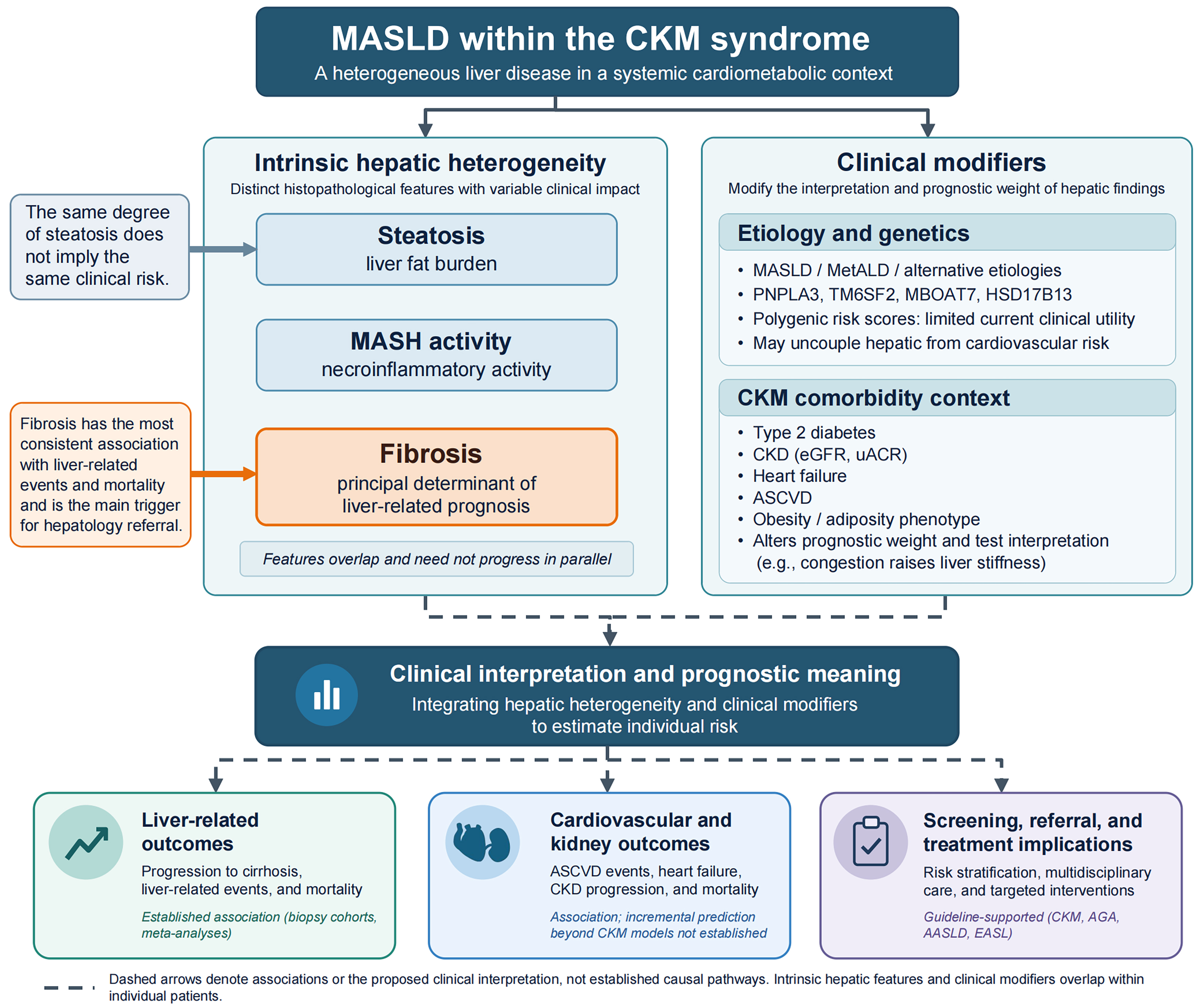
Figure 1. Conceptual framework of MASLD heterogeneity within the cardiovascular-kidney-metabolic syndrome. Clinical heterogeneity in MASLD reflects the combined effects of intrinsic hepatic pathology and the clinical context in which these findings occur. Steatosis, MASH (necroinflammatory) activity, and fibrosis represent intrinsic hepatic heterogeneity, whereas etiology, genetic background, and CKM comorbidities modify the interpretation and prognostic significance of these hepatic phenotypes. Among hepatic features, fibrosis has the most consistent association with liver-related events and mortality and is the principal trigger for hepatology referral. Etiological and genetic factors may partly dissociate hepatic from cardiovascular risk, while T2D, CKD, HF, ASCVD, and adiposity phenotype substantially modify overall risk and may alter the interpretation of noninvasive tests (for example, venous congestion in HF increases liver stiffness). Accordingly, the same degree of steatosis does not necessarily imply the same clinical prognosis or management priority. Integrated interpretation of hepatic phenotype and clinical modifiers informs liver-related risk assessment, referral, and treatment decisions, alongside established cardiovascular and kidney risk assessment. Labels in the outcome boxes indicate the strength of supporting evidence: an established association for liver-related outcomes; an association for cardiovascular and kidney outcomes, without established incremental prediction beyond existing CKM risk models; and guideline support for screening, referral, and treatment. Intrinsic hepatic features and clinical modifiers overlap within individual patients and need not progress in parallel, and dashed arrows denote observational associations or the proposed clinical interpretation. AASLD: American Association for the Study of Liver Diseases; AGA: American Gastroenterological Association; ASCVD: atherosclerotic cardiovascular disease; CKD: chronic kidney disease; CKM: cardiovascular-kidney-metabolic; EASL: European Association for the Study of the Liver; HF: heart failure; MASLD: metabolic dysfunction-associated steatotic liver disease; MASH: metabolic dysfunction-associated steatohepatitis; MetALD: metabolic dysfunction and alcohol-associated liver disease; T2D: type 2 diabetes; eGFR: estimated glomerular filtration rate; uACR: urinary albumin-to-creatinine ratio; PNPLA3: patatin-like phospholipase domain-containing 3; TM6SF2: transmembrane 6 superfamily member 2; MBOAT7: membrane-bound O-acyltransferase domain-containing 7; HSD17B13: hydroxysteroid 17-beta dehydrogenase 13.
Literature search strategy
Literature searches were conducted across PubMed/MEDLINE, Embase, Web of Science, and the Cochrane Library for English-language articles published between January 2000 and October 2026. Search terms combined disease terms (“metabolic dysfunction-associated steatotic liver disease”, “MASLD”, “metabolic dysfunction-associated steatohepatitis”, “MetALD”, “nonalcoholic fatty liver disease”, “metabolic dysfunction-associated fatty liver disease”, “steatotic liver disease”, and “liver fibrosis”) with terms related to the CKM syndrome (“cardiovascular-kidney-metabolic syndrome”, “cardiovascular disease”, “atherosclerosis”, “heart failure”, “chronic kidney disease”, “albuminuria”, “type 2 diabetes”, and “obesity”) and with terms for genetics, sex differences, noninvasive tests (“Fibrosis-4 index”, “enhanced liver fibrosis test”, “transient elastography”, and “magnetic resonance elastography”), risk prediction, and treatment (“resmetirom”, “semaglutide”, “sodium-glucose cotransporter 2 inhibitors”, “glucagon-like peptide-1 receptor agonists”, “finerenone”, and “lifestyle intervention”). Current guidelines and consensus statements from hepatology, cardiology, nephrology, and diabetes societies, together with US prescribing information, were identified from society and regulatory websites, and the reference lists of key articles were hand-searched. Eligible publications comprised clinical practice guidelines, consensus statements, randomized controlled trials, prospective and retrospective cohort studies, genetic association and Mendelian randomization analyses, diagnostic-accuracy studies, and systematic reviews and meta-analyses in adult populations. Case reports, conference abstracts lacking full-text publication, non-English articles, pediatric studies, investigations restricted to alternative etiologies of chronic liver disease, and preclinical studies without direct mechanistic relevance were excluded.
CLINICAL CHARACTERIZATION OF MASLD
This section first delineates measurable pathological variations within the liver and then examines the etiological, genetic, and CKM contexts that modify their clinical interpretation. Histopathological features characterize the intrinsic hepatic lesion; etiological factors and genetic architecture account for interindividual variability in disease susceptibility and progression; and CKM comorbidities modify prognostic weight and therapeutic prioritization. Below, we examine diagnostic modalities, methodological constraints, and clinical outcome associations [Table 1], whereas actionable screening and treatment strategies are addressed in the following section.
Intrinsic hepatic heterogeneity: steatosis, MASH activity, and fibrosis
Steatosis burden can be characterized via conventional ultrasonography, controlled attenuation parameter (CAP), magnetic resonance imaging-proton density fat fraction (MRI-PDFF), or histological grading. Ultrasonography is widely available but exhibits limited sensitivity for mild steatosis; CAP is confounded by adiposity and technical variability; and MRI-PDFF provides continuous, reproducible quantification of hepatic fat, rendering it well suited to pharmacological trials and longitudinal monitoring, despite cost and accessibility constraints in routine practice[16,17]. Discrepancies across imaging modalities and diagnostic definitions also contribute to substantial heterogeneity in epidemiological estimates[35-38]. Hepatic steatosis commonly coexists with visceral adiposity, insulin resistance, hypertriglyceridemia, and an elevated apolipoprotein B particle burden; consequently, its association with ASCVD is heavily confounded by conventional metabolic risk factors. Critically, reduced hepatic fat content does not necessarily signify lower risk, as steatosis frequently regresses during progression to advanced fibrosis or cirrhosis. Ultrasonographic steatosis or an elevated MRI-PDFF should therefore neither supplant established ASCVD risk stratification tools nor serve as the sole indication for specialist referral.
MASH is histologically characterized by hepatic steatosis, hepatocellular ballooning, and lobular inflammation. Serum alanine aminotransferase (ALT) and aspartate aminotransferase (AST) levels, along with circulating or imaging biomarkers, provide only indirect information on necroinflammatory activity[39]. Normal aminotransferase levels do not exclude MASH or advanced liver fibrosis, whereas elevated levels may reflect alcohol intake, hepatotoxic medications, viral hepatitis, cholestasis, or HF-related liver injury[18,19]. Although MASH activity may be mechanistically linked to multisystem risk via oxidative stress, proinflammatory signaling, and endothelial dysfunction, it currently serves as an indicator of hepatic disease progression and systemic metabolic-inflammatory burden rather than an independent determinant of cardiovascular therapy.
Liver fibrosis is the primary determinant of hepatic prognosis and the principal indication for specialist hepatology referral; however, coexisting metabolic and cardiovascular conditions remain independently actionable even when the risk of liver fibrosis is low. Prospective and retrospective biopsy cohorts and meta-analyses consistently identify histologic fibrosis stage, rather than steatosis or activity score alone, as the primary determinant of hepatic decompensation, hepatocellular carcinoma (HCC), liver-related mortality, and all-cause mortality[5,6,20,40-43]. In the meta-analysis by Dulai et al., the all-cause mortality rate ratios for stage F3 and F4 disease compared with stage F0 were 3.48 [95% confidence interval (CI): 2.51-4.83] and 6.40 (95%CI: 4.11-9.95), respectively[20]. In a prospective NASH Clinical Research Network cohort of 1,773 adults with biopsy-confirmed NAFLD followed for a median of 4.0 years, all-cause mortality rates were 0.32, 0.89, and 1.76 per 100 person-years for baseline fibrosis stages F0-F2, F3, and F4, respectively, with ascites, variceal hemorrhage, and hepatic encephalopathy occurring more frequently in stage F4 disease. Across this cohort, incident hepatic decompensation was associated with higher all-cause mortality after adjustment for demographic, metabolic, and baseline histologic factors [adjusted hazard ratio (aHR): 6.8; 95%CI: 2.2-21.3][42]. In the same cohort, the incidence of a decline of more than 40% in the estimated glomerular filtration rate (eGFR) was 2.98 per 100 person-years in stage F4 disease compared with 0.97 per 100 person-years in stage F0-F2 disease, whereas rates of cardiac events did not differ significantly across fibrosis stages[42]. Thus, whereas liver fibrosis exhibits a robust, graded association with liver-related outcomes and all-cause mortality, its incremental predictive utility for cardiovascular events beyond established risk factors awaits prospective validation.
Noninvasive tests (NITs) interrogate distinct aspects of liver fibrosis. The FIB-4 index, derived from age, serum AST and ALT levels, and platelet count, serves as a low-cost first-line triage tool; the Enhanced Liver Fibrosis (ELF) test reflects extracellular matrix remodeling; and vibration-controlled transient elastography (VCTE) and magnetic resonance elastography (MRE) measure liver stiffness. The performance of these tests and composite strategies, such as FibroScan-AST (FAST), age, presence of diabetes, PRO-C3 (N-terminal type III collagen propeptide), and platelet count (ADAPT), and MRE combined with FIB-4 (MEFIB), has been evaluated in multicenter studies and individual-participant-data meta-analyses. Collectively, the evidence supports a sequential approach that rules out low-risk disease and escalates assessment in patients with indeterminate or elevated scores, while accounting for the context-dependent performance of each modality[21,44-50]. These diagnostic-accuracy data derive largely from hepatology and referral populations, and both liver stiffness and FIB-4 components (serum aminotransferase levels and platelet count) may be altered by venous congestion and acute illness[51,52]. The risk of liver fibrosis is also associated with cardiovascular outcomes, although this evidence derives mainly from observational imaging, registry, and claims-based cohorts[53]. UK Biobank analyses linked liver disease and higher fibrosis risk scores to cardiovascular outcomes[54], and Chew et al. reported that FIB-4 predicted major adverse cardiovascular events (MACE) in patients with NAFLD[55]. However, observational association does not establish incremental prognostic utility, as consistent net reclassification improvement beyond validated ASCVD or HF risk models has yet to be demonstrated[54-57].
Etiological and genetic modifiers
The new steatotic liver disease nomenclature distinguishes MASLD, metabolic dysfunction and alcohol-associated liver disease (MetALD), and other specific etiologies[3]. This taxonomy reflects substantive pathophysiological differences, as comparable degrees of hepatic steatosis can arise from distinct exposure profiles. In the presence of cardiometabolic risk factors, alcohol intake of less than 20 g per day in women and 30 g per day in men is classified as MASLD; intake of 20 to 50 g per day in women and 30 to 60 g per day in men is classified as MetALD; and higher intake is classified as alcohol-related liver disease[3]. A large retrospective Veterans Health Administration cohort study of patients with imaging-defined steatosis showed that, compared with MASLD, MetALD was associated with a higher risk of adverse liver-related outcomes [hazard ratio (HR): 1.56; 95%CI: 1.50-1.62] but a comparable incidence of MACE, suggesting that etiological exposures can differentially modulate hepatic vs. cardiovascular risk[58]. Alternative etiologies - including viral hepatitis, hepatotoxic pharmacotherapy, endocrine disorders, and inherited metabolic diseases - warrant exclusion when clinical presentations are atypical or diagnostic findings are discordant.
Since the discovery of PNPLA3 and TM6SF2[59,60], genetic association studies have demonstrated that steatosis, lobular inflammation, and fibrosis do not invariably progress in tandem. Genetic variants in PNPLA3, TM6SF2, and MBOAT7 are associated with longitudinal fibrosis progression and adverse liver-related events[61-63], whereas HSD17B13, MARC1, and GCKR illustrate how distinct biologic pathways may produce similar imaging-defined steatosis[22,64-68]. TM6SF2 variants may increase the risk of liver-related events while not increasing, and in some settings reducing, atherosclerotic outcomes through their effects on very-low-density lipoprotein secretion. Mendelian randomization analyses using PNPLA3 likewise did not show a parallel increase in ischemic heart disease with genetically determined susceptibility to liver-fat accumulation; exome-wide and combined polygenic studies further indicate that genetically determined liver-fat content and coronary risk do not necessarily align[7,8,69-71]. These genetic observations, reflecting lifelong endogenous exposure rather than pharmacological intervention, argue against a uniform linear relationship between hepatic fat accumulation and ASCVD risk across the MASLD spectrum. A review by Chew et al. on genetic interactions between NAFLD and cardiovascular disease provides additional context for this dissociation of risk[72].
Polygenic risk scores (PRSs) aggregate multiple risk alleles into a composite genetic predisposition metric, yet their clinical utility remains to be established. Some analyses have shown statistically significant improvements in the area under the receiver operating characteristic curve when a PRS was added to the FIB-4 index or clinical variables, but these gains were modest and have not been consistently replicated across populations[23,73]. Although PRS models for HCC or severe liver disease may improve selected statistical indices, they still lack robust cross-ancestry calibration, consistent net reclassification improvement, net benefit on decision-curve analysis, and direct validation in clinical trials of genetically guided therapy[23,73,74]. Etiological and genetic profiling can thus help explain early-onset disease, familial aggregation, lean MASLD, and discordance between hepatic severity and systemic metabolic burden, although routine genotyping is not currently indicated in standard clinical practice.
CKM comorbidity as the systemic context for interpreting MASLD
Coexisting CKM conditions constitute the systemic milieu that modifies the prognostic weight and clinical interpretation of hepatic phenotypes, an effect most evident in T2D. In a propensity score-matched TriNetX cohort analysis, concomitant T2D was associated with 39%, 45%, and 42% higher 5-year risks of ischemic heart disease, ischemic stroke, and HF, respectively, compared with MASLD alone; the risk of HCC was nearly doubled (HR: 1.96; 95%CI: 1.69-2.27)[24]. Formal interaction analyses remain necessary to determine whether T2D acts as an effect modifier of MASLD-related hepatic progression beyond shared cardiometabolic risk and potential confounding by diabetes duration, glycemic control, and background pharmacotherapy.
CKD further identifies a high-risk multiorgan phenotype[75]. A 2026 meta-analysis of 36 observational studies showed an estimated CKD prevalence of 15.22% (95%CI: 9.69%-23.12%) and an incidence of 22.17 per 1,000 person-years (95%CI: 11.44-32.89) among patients with MASLD. Mortality was 18.28 per 1,000 person-years among patients with coexisting CKD compared with 7.26 per 1,000 person-years among those without CKD[9]. In a National Health and Nutrition Examination Survey (NHANES) analysis, the coexistence of MASLD and CKD was associated with an aHR for all-cause mortality of 3.28 (95%CI: 1.89-5.70) compared with the absence of both conditions, together with higher risks of coronary heart disease and HF; coexisting liver fibrosis and CKD conferred the poorest prognosis[11]. Consequently, a binary CKD classification inadequately captures cardiorenal risk. The eGFR and urinary albumin-to-creatinine ratio (uACR) reflect glomerular filtration and kidney damage, respectively, and their joint classification provides a more informative assessment of cardiorenal risk[76]. These epidemiological associations may reflect shared upstream cardiometabolic drivers and potential alterations in circulating biomarkers secondary to impaired renal clearance.
The relationship between MASLD and HF is bidirectional. In a Taiwanese study, MASLD was associated with new-onset HF, HF hospitalization, and HF with preserved ejection fraction (HFpEF), with subdistribution HRs of 2.59, 2.30, and 1.91, respectively; approximately three-quarters of incident HF cases were HFpEF[25]. A larger Korean cohort study likewise linked MASLD and an increasing number of cardiometabolic risk factors to incident HF[77]. In the TOPCAT HFpEF trial population, however, associations of the FIB-4 index and the NAFLD fibrosis score with the composite cardiovascular outcome were markedly attenuated after adjustment for established HF risk factors, and only high-risk FIB-4 remained statistically associated with HF hospitalization[57]. Elevated noninvasive fibrosis indices in HF may therefore partly reflect systemic hemodynamic severity, and their incremental prognostic value beyond standard HF risk models remains uncertain. Specifically, HF-induced venous congestion can elevate liver stiffness and alter FIB-4 components, so elastography should be repeated after euvolemia is achieved[51,52].
Complementary lines of evidence further substantiate this multisystem interplay. Meta-analyses have linked MASLD to incident CKD[78,79], new-onset HF[80], atrial fibrillation[81], and fatal and nonfatal cardiovascular events[82], whereas biopsy-confirmed cohorts, nationwide registries, and pooled analyses indicate that risk varies according to histologic severity[83,84], the number of coexisting metabolic risk factors[85-87], and body-weight or adiposity phenotype[88]. The resulting distinctions among hepatic features, the outcomes they predict, and their current role in clinical decision-making are summarized in Table 2.
Sex differences in MASLD within the CKM syndrome
Sex is a cross-cutting modifier of MASLD prevalence, progression, and extrahepatic risk[89,90]. In population studies, women have a lower risk of MASLD than men; however, once MASLD is established, women have a similar risk of MASH and a higher risk of advanced fibrosis. In a meta-analysis, the risk of advanced fibrosis was 37% higher in women than in men (relative risk, 1.37; 95%CI: 1.12-1.68), and this excess was most evident in populations with a mean age of 50 years or older[91]. This age dependence is consistent with a protective effect of estrogen before menopause: among adults with NASH, premenopausal women had less severe fibrosis than men, whereas postmenopausal women had fibrosis severity similar to that of men[92]. Sex hormones also interact with genetic susceptibility; the PNPLA3 p.I148M variant confers a greater risk of liver disease in women, in part through estrogen receptor-α-dependent regulation of PNPLA3 expression[93]. Other sex-specific determinants include body-fat distribution, menopause, polycystic ovary syndrome, and a history of gestational diabetes, as well as sex differences in alcohol consumption that affect classification as MASLD or MetALD[89,90]. Regarding extrahepatic outcomes, MASLD appears to attenuate the relative cardiovascular protection typically observed in women; in a longitudinal community cohort, women with NAFLD lost this cardiovascular advantage, with risk approaching that of men[94]. Sex-specific data on CKD outcomes and on the performance of FIB-4 and elastography thresholds remain limited, and most cohorts and trials have not reported sex-stratified results[89,90]. Consequently, the lower prevalence of MASLD in premenopausal women does not imply low risk in postmenopausal women with CKM comorbidities, underscoring the need for sex- and menopause-stratified reporting of clinical outcomes and diagnostic thresholds.
ACTIONABLE HEPATIC PHENOTYPING IN CLINICAL MANAGEMENT
Identifying patients who require liver fibrosis assessment
Contemporary guidelines generally support case finding for clinically significant (stage ≥ F2) or advanced (stage ≥ F3) liver fibrosis, depending on the guideline, in high-risk groups rather than population-wide screening. T2D is the most consistently endorsed entry criterion. Targeted evaluation is likewise indicated in individuals with central adiposity, overweight or obesity accompanied by metabolic risk factors, at least two CKM risk factors, incidentally detected hepatic steatosis, persistently elevated serum aminotransferase levels, or clinical suspicion of advanced liver disease[2,13,18,19]. The 2026 CKM guideline further specifies FIB-4 assessment every 1-2 years in patients with T2D or at least two CKM risk factors, and every 2-3 years in those classified as having CKM stage 1 disease solely owing to prediabetes[2]. High-risk patients may enter the FIB-4 pathway without prior ultrasonographic confirmation of steatosis, and normal aminotransferase levels do not exclude advanced liver fibrosis. In patients with T2D and multiple metabolic risk factors, a low FIB-4 score does not necessarily preclude further evaluation when clinical suspicion persists[95], and the 2026 AGA pathway allows selected high-risk patients to proceed directly to VCTE[13]. Patients with a low-risk result should undergo repeat FIB-4 assessment at these risk-stratified intervals [Table 3 and Figure 2][2].
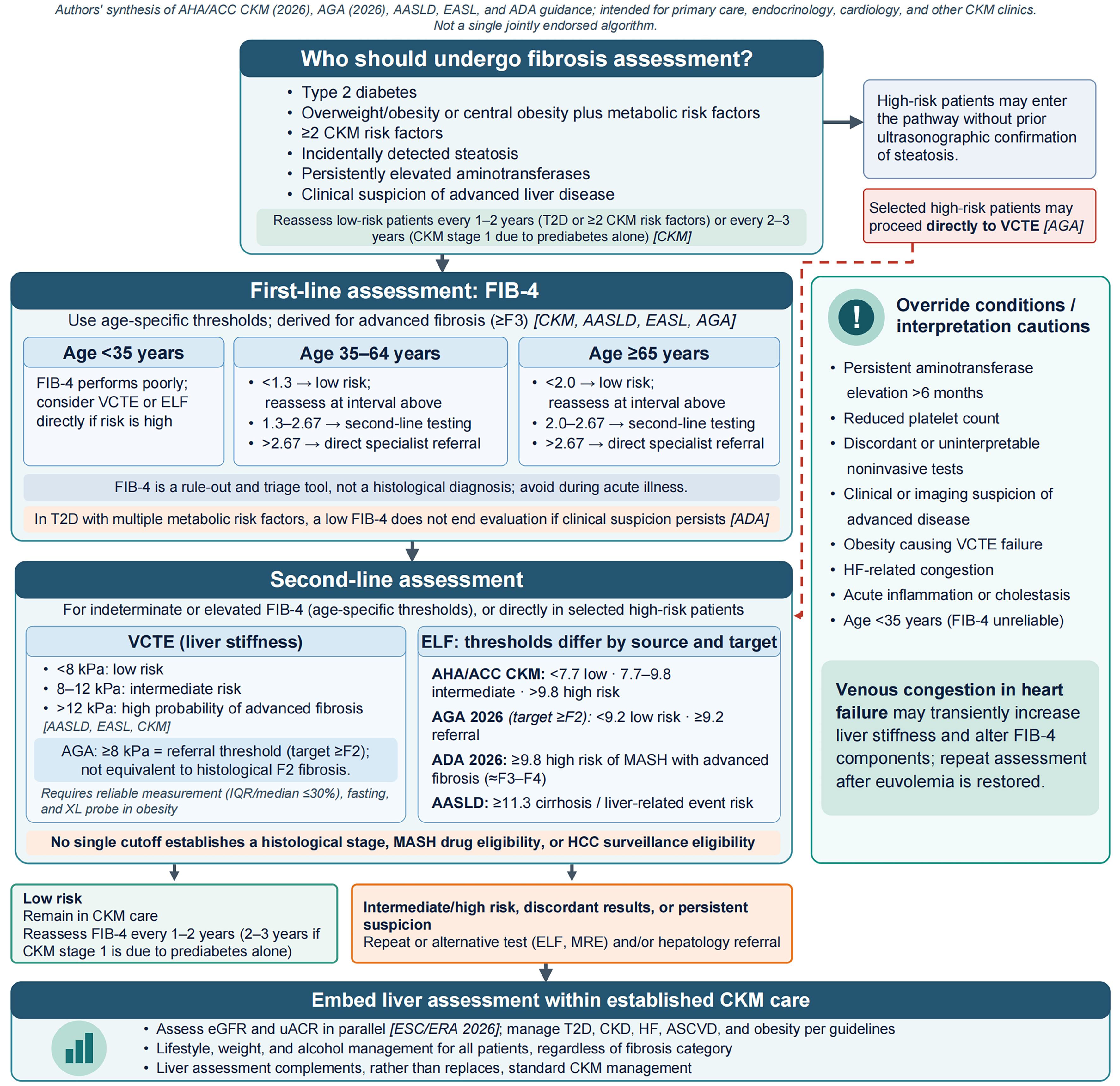
Figure 2. Guideline-synthesized pathway for liver fibrosis assessment within integrated CKM care. Patients at increased risk of clinically significant (≥ F2) or advanced (≥ F3) liver fibrosis, including those with T2D, obesity or central adiposity with additional metabolic risk factors, multiple CKM risk factors, incidentally detected steatosis, persistently elevated aminotransferases, or clinical suspicion of advanced liver disease, may undergo staged fibrosis assessment. FIB-4 is used primarily as a first-line rule-out and triage test rather than as a diagnostic test and should be avoided during acute illness. In adults aged 35-64 years, FIB-4 values < 1.3 generally support low-risk follow-up, values of 1.3-2.67 prompt second-line assessment, and values > 2.67 support specialist referral. In adults aged 65 years or older, the corresponding lower threshold for second-line assessment is 2.0, whereas the high-risk threshold remains 2.67. Low-risk patients should be reassessed every 1-2 years, or every 2-3 years when CKM stage 1 is attributable to prediabetes alone (AHA/ACC CKM). In T2D with multiple metabolic risk factors, a low FIB-4 does not end evaluation if clinical suspicion persists (ADA). FIB-4 performs poorly below age 35 years, and selected high-risk patients may proceed directly to VCTE (AGA; dashed red line). Second-line testing may include VCTE or ELF, with thresholds interpreted according to their source and target condition: for VCTE, < 8, 8-12, and > 12 kPa indicate low, intermediate, and high probability of advanced fibrosis (AASLD, EASL, AHA/ACC CKM), with ≥ 8 kPa as the AGA referral threshold for ≥ F2 and with reliable measurement required (IQR/median ≤ 30%, fasting, and an XL probe in obesity); for ELF, < 7.7, 7.7-9.8, and > 9.8 (AHA/ACC CKM), ≥ 9.8 as high risk of advanced fibrosis (ADA), < 9.2 and ≥ 9.2 as the AGA low-risk and referral boundary, and ≥ 11.3 for cirrhosis and liver-related event risk (AASLD). No single threshold establishes a histological stage, eligibility for MASH pharmacotherapy, or eligibility for HCC surveillance. Low-risk patients remain in CKM care with risk-factor management, whereas intermediate- or high-risk, discordant, or persistently suspicious results warrant repeat or alternative testing (ELF or MRE) and/or hepatology referral. Persistent aminotransferase elevation, thrombocytopenia, discordant or uninterpretable noninvasive tests, clinical suspicion of advanced disease, obesity causing VCTE failure, or age < 35 years may override nominally low-risk results or limit test interpretation. Heart failure-related venous congestion, acute inflammation, and cholestasis may transiently increase liver stiffness and should be considered when interpreting elastography; in congestion, assessment should be repeated after euvolemia is restored. Liver fibrosis assessment should be embedded within, rather than replace, established CKM evaluation and treatment, including parallel assessment of kidney function and albuminuria (ESC/ERA), guideline-directed management of T2D, CKD, HF, ASCVD, and obesity, and lifestyle, weight, and alcohol management for all patients regardless of fibrosis category. This pathway integrates contemporary society recommendations for implementation across primary care, endocrinology, cardiology, and multidisciplinary CKM clinics. AASLD: American Association for the Study of Liver Diseases; ACC: American College of Cardiology; ADA: American Diabetes Association; AGA: American Gastroenterological Association; AHA: American Heart Association; ASCVD: atherosclerotic cardiovascular disease; CKD: chronic kidney disease; CKM: cardiovascular-kidney-metabolic; EASL: European Association for the Study of the Liver; eGFR: estimated glomerular filtration rate; ELF: enhanced liver fibrosis; ERA: European Renal Association; ESC: European Society of Cardiology; FIB-4: Fibrosis-4 index; HF: heart failure; HCC: hepatocellular carcinoma; IQR: interquartile range; MASH: metabolic dysfunction-associated steatohepatitis; MRE: magnetic resonance elastography; T2D: type 2 diabetes; uACR: urinary albumin-to-creatinine ratio; VCTE: vibration-controlled transient elastography.
Guideline-synthesized liver fibrosis risk stratification pathway across society recommendations
| Step | Measure, threshold, and source (target condition) | Recommended action | Important boundary | Refs. |
| Identify target population | T2D; obesity plus risk factors; ≥ 2 CKM risk factors; abnormal liver enzymes or imaging-defined steatosis; reassess FIB-4 every 1-2 years (T2D or ≥ 2 CKM risk factors) or every 2-3 years (CKM stage 1 due to prediabetes alone) (CKM) | Calculate FIB-4 and evaluate alternative etiologies | Ultrasonographic confirmation of steatosis is not required in high-risk patients; selected high-risk patients may proceed directly to VCTE (AGA); a low FIB-4 does not end evaluation in T2D with multiple risk factors if suspicion persists (ADA) | [2,13,95] |
| FIB-4, age 35-64 years | < 1.3; 1.3-2.67; > 2.67 (CKM, AASLD, EASL, AGA; derived for advanced fibrosis) | Risk-based reassessment; second-line NIT; direct referral | Not a histological diagnosis; poor accuracy below 35 years; avoid during acute illness | [2,18,19,96] |
| FIB-4 age ≥ 65 years | < 2.0; 2.0-2.67; > 2.67 (same sources) | Risk-based reassessment; second-line NIT; direct referral | Age adjustment does not change the high-risk threshold | [97] |
| VCTE | < 8; 8-12; > 12 kPa (AASLD, EASL, CKM; > 12 kPa: advanced fibrosis, ≥ F3); ≥ 8 kPa referral (AGA; target ≥ F2) | Follow-up; specialist assessment or further stratification; high-risk pathway | ≥ 8 kPa is a referral threshold, not confirmation of F2 fibrosis; requires reliable measurement (IQR/median ≤ 30%), fasting, and XL probe in obesity; overestimated in congestion | [2,13,18,19,98] |
| ELF | < 7.7/7.7-9.8/> 9.8: low/intermediate/high risk (AHA/ACC CKM); ≥ 9.8: high risk of MASH with advanced fibrosis, approximately F3-F4 (ADA); < 9.2 low risk and ≥ 9.2 referral (AGA; target ≥ F2); ≥ 11.3: cirrhosis and liver-related event risk (AASLD) | Apply each threshold according to its intended purpose for follow-up, referral, or prognostic assessment | Thresholds differ by source, target condition, and setting; no single cutoff establishes a histological stage or eligibility for MASH pharmacotherapy | [2,13,18,95] |
| Override conditions | Persistent enzyme elevation, discordant NITs, or clinical suspicion of advanced disease; persistent clinical suspicion despite a low-risk result | Specialist assessment regardless of nominal risk category; repeat testing or use an alternative test (ELF, MRE, VCTE) | Repeat liver stiffness after euvolemia is restored in HF-related congestion | [13,19,99] |
A guideline-synthesized staged fibrosis pathway
The FIB-4 index functions primarily as a first-line rule-out and triage tool rather than a definitive diagnostic test for liver fibrosis; its cutoff scores were derived for advanced fibrosis and validated mainly in adults aged 35-64 years[97]. In adults younger than 65 years, FIB-4 < 1.3 generally supports low-risk management, values ≥ 1.3 prompt second-line VCTE or ELF testing, and values > 2.67 support direct hepatology referral. In adults aged 65 years or older, the threshold for second-line testing is adjusted to 2.0, while the high-risk threshold remains 2.67. These cutoffs align with the 2026 CKM guideline and consensus guidance from the American Association for the Study of Liver Diseases (AASLD), the European Association for the Study of the Liver (EASL), and the AGA[2,13,18,19]. Because the FIB-4 index performs poorly in adults younger than 35 years of age, a low score should not preclude further assessment in younger patients with high clinical risk or elevated serum liver-enzyme levels. It should also not be used for long-term risk stratification during acute illness[2,13,18,19].
Second-line cutoff values must be interpreted according to their source, target condition, and care setting [Table 3]. For VCTE, values < 8 kPa generally support low risk, 8-12 kPa indicate intermediate risk, and >
Referral to a hepatologist should not be precluded by a nominally low-risk score when serum aminotransferase elevations persist for more than 6 months, the platelet count is reduced, clinical or imaging features suggest advanced liver disease, or NIT results are discordant or uninterpretable. If obesity leads to VCTE measurement failure, an XL probe, the ELF test, or MRE may be used. Decompensated HF, acute inflammation, and cholestasis can transiently increase liver stiffness; in the absence of urgent evidence of intrinsic liver disease, testing should be repeated after stabilization of volume status or resolution of the acute process. When noninvasive results are discordant or clinical suspicion persists despite low-risk scores, clinicians should repeat testing, use an alternative modality (ELF, MRE, or VCTE), or refer the patient to hepatology[13,18,19]. Conversely, an isolated abnormality on noninvasive testing requires integrative clinical confirmation before establishing a diagnosis of cirrhosis or initiating HCC surveillance or MASH-specific pharmacotherapy.
This pathway synthesizes EASL, AASLD, AGA, and noninvasive testing guidance[13,99-103] and incorporates validation studies of FIB-4[96] and VCTE[98,104] to define practical boundaries related to age[97], obesity, and technical failure[98,104]. By integrating society recommendations that differ in target populations, reassessment intervals, and biomarker thresholds, this integrative pathway provides a structured clinical framework for primary care, endocrinology, cardiology, and multidisciplinary CKM clinics [Table 3 and Figure 2].
Embedding liver assessment within established cardiovascular and kidney care
The first joint 2026 European Society of Cardiology/European Renal Association (ESC/ERA) guideline on cardiovascular disease and CKD introduced the STAMP on CKD framework: Screen, Triage, Address CKD risk, Modify cardiovascular management according to CKD, and Plan multidisciplinary care[28]. It recommends screening all patients with cardiovascular disease using creatinine-based eGFR and uACR; two abnormal measurements separated by at least 3 months are used to confirm chronicity, and patients with diabetes or a high risk of kidney function decline should be reassessed at least annually. The Kidney Failure Risk Equation (KFRE) may be used in CKD stages G3-G5. In patients without established symptomatic ASCVD, SCORE2 or SCORE2-OP with a CKD risk modifier, or SCORE2-Diabetes, may be selected according to diabetes status; SMART2 may be used in those with established ASCVD. By contrast, evidence does not yet support routine incorporation of FIB-4, VCTE, ELF, or MRI-PDFF into cardiovascular risk equations. Thus, whereas the ESC/ERA framework establishes standardized cardiorenal evaluation, hepatic fibrosis stratification relies on complementary hepatology and CKM society guidance.
Liver assessment should complement, rather than replace, established CKM therapy. Angiotensin-converting enzyme inhibitors or angiotensin receptor blockers, sodium-glucose cotransporter 2 (SGLT2) inhibitors, finerenone, glucagon-like peptide-1 receptor agonists (GLP-1 RAs), statins, and antihypertensive therapy should be selected according to established indications for T2D, CKD, HF, ASCVD, or obesity[2,28]. For example, the ESC/ERA guideline recommends an SGLT2 inhibitor in patients with CKD, T2D, and an eGFR ≥ 20 mL/min/1.73 m2, irrespective of current glucose-lowering requirements, and finerenone in patients with CKD, T2D, an eGFR ≥ 25 mL/min/1.73 m2, and a uACR ≥ 30 mg/g. Semaglutide may be used in selected high-risk patients with T2D and CKD to reduce kidney disease progression and cardiovascular events[28]. Collectively, these recommendations underscore that coexisting cardiorenal comorbidities - rather than MASLD alone - drive the selection of established organ-protective pharmacotherapies; similarly, current evidence does not support altering low-density lipoprotein cholesterol targets, antiplatelet regimens, or cardiovascular imaging protocols solely on the basis of hepatic phenotype. The modified Delphi recommendations by Chew et al. on cardiovascular-liver-metabolic screening and management provide practical guidance on cross-specialty workflows and implementation[14].
Clinical outcome evidence underpinning this therapeutic hierarchy derives primarily from landmark cardiorenal trials, including DAPA-CKD[29], EMPA-KIDNEY[30], FIDELIO-DKD[31], FIGARO-DKD[32], FLOW[33], and SELECT[34], together with earlier cardiovascular outcome trials of GLP-1 RAs[105] and SGLT2 inhibitors[106,107], rather than from MASLD-only cohorts. Although diabetes and obesity trials and network meta-analyses indicate that GLP-1 RAs, SGLT2 inhibitors, and pioglitazone improve selected hepatic and metabolic parameters, improvements in hepatic surrogate markers do not establish that liver-specific pathways mediate the observed cardiorenal risk reductions[108-110].
Lifestyle, weight management, and coordinated longitudinal care
Lifestyle intervention is the foundation of management at every disease stage, regardless of fibrosis category. Weight loss of approximately 5% or more reduces hepatic steatosis, a loss of 7%-10% is associated with MASH resolution, and a loss of 10% or more is associated with fibrosis regression[19,111]. A Mediterranean-style dietary pattern, limited intake of ultra-processed foods and sugar-sweetened beverages, and regular physical activity (at least 150 min per week of moderate-intensity or 75 min of vigorous-intensity activity) are recommended irrespective of weight change[18,19]. Alcohol intake should be assessed with structured questionnaires at baseline and during follow-up, because it determines classification as MASLD, MetALD, or alcohol-related liver disease and modifies hepatic risk[3,19,112]. Weight- and diabetes-directed pharmacotherapy and metabolic and bariatric surgery should be considered according to obesity and T2D indications[2,13,19].
Multidisciplinary care allocation should be stratified by fibrosis risk and systemic comorbidity burden. Patients at low fibrosis risk can be managed longitudinally in primary care, endocrinology, or cardiology, with periodic FIB-4 reassessment and management of cardiometabolic risk factors through established pathways[2,13]. Patients at intermediate or high risk, those with discordant tests, and those being considered for MASH pharmacotherapy should be referred to hepatology for staging, exclusion of alternative etiologies, assessment of treatment eligibility, and surveillance once cirrhosis is confirmed[18,19]. Cardiology, endocrinology, and nephrology remain responsible for ASCVD, HF, diabetes, and CKD care, including eGFR and uACR monitoring, irrespective of liver findings[2,28]. A designated coordinating clinician, as recommended by the 2026 CKM guideline, can reconcile these parallel plans[2].
For most patients, cardiorenal pharmacotherapy is determined by established T2D, CKD, HF, ASCVD, and obesity indications, whereas fibrosis staging identifies parallel hepatology priorities - specifically specialist referral, MASH-directed pharmacotherapy, or cirrhosis surveillance. An exception arises with dual-indicated agents such as semaglutide in patients with obesity or T2D and concomitant F2-F3 MASH, where the hepatic phenotype can guide the choice among already indicated options.
MASH-targeted therapy: histological benefits and clinical boundaries
By 2026, resmetirom and semaglutide 2.4 mg had received accelerated approval in the United States for adults with noncirrhotic MASH and F2-F3 fibrosis, for use in conjunction with diet and exercise[113,114]; regulatory status and availability differ in other jurisdictions. Both approvals were based on histological surrogate endpoints rather than on demonstrated reductions in hepatic decompensation, transplantation, or mortality[26,27]. Treatment eligibility therefore requires integration of fibrosis evidence, clinical context, and labeling requirements and should not be determined by FIB-4 or a single VCTE measurement alone.
The primary MAESTRO-NASH analysis population included 966 patients with biopsy-confirmed F1B-F3 MASH (322, 323, and 321 patients in the resmetirom 80-mg, resmetirom 100-mg, and placebo groups), whereas the efficacy analysis supporting the US Food and Drug Administration (FDA) indication was restricted to 888 patients with F2-F3 fibrosis. In the primary analysis population at week 52, MASH resolution without worsening of fibrosis occurred in 25.9%, 29.9%, and 9.7% of patients receiving resmetirom 80 mg, resmetirom 100 mg, and placebo, respectively; adjusted absolute differences were 16.4 percentage points (95%CI: 11.0-21.8) and 20.7 percentage points (95%CI: 15.3-26.2). Improvement in fibrosis by at least one stage without worsening of MASH occurred in 24.2%, 25.9%, and 14.2%, respectively, corresponding to differences of 10.2 percentage points (95%CI: 4.8-15.7) and 11.8 percentage points (95%CI: 6.4-17.2)[27]. Serious adverse events were broadly similar across groups, although diarrhea and nausea were more frequent with resmetirom. Discontinuation because of adverse events occurred in 6.8% of the 100-mg group vs. 2.2% of the placebo group. Hepatotoxicity, gallbladder-related events, and drug interactions with statins warrant clinical monitoring. Whether resmetirom-induced reductions in atherogenic lipids translate into lower rates of MACE remains to be established in dedicated outcome trials.
ESSENCE randomized 1,197 patients with F2-F3 MASH; the prespecified week-72 histological interim analysis included the first 800 randomized participants (534 receiving semaglutide and 266 receiving placebo), which formed the basis for the primary efficacy evaluation. MASH resolution without worsening of fibrosis occurred in 62.9% of patients with semaglutide and 34.3% with placebo, an absolute difference of 28.7 percentage points (95%CI: 21.1-36.2). Improvement in fibrosis without worsening of MASH occurred in 36.8% and 22.4%, respectively, an absolute difference of 14.4 percentage points (95%CI: 7.5-21.3)[26] [Table 4]. The mean percentage change in body weight was 8.5 percentage points greater with semaglutide than with placebo. Gastrointestinal events, mainly nausea, diarrhea, constipation, and vomiting, were the most common adverse events, and serious adverse events occurred in 13.4% of patients in both groups. Although SELECT and FLOW established the cardiovascular and kidney benefits of semaglutide in their respective indicated populations, these benefits cannot be attributed specifically to MASH resolution[33,34].
Core evidence from MAESTRO-NASH and ESSENCE
| Trial | Analysis population | MASH resolution without worsening of fibrosis | Fibrosis improvement without worsening of MASH | Key safety findings and clinical outcomes | Refs. |
| MAESTRO-NASH 80 mg | Primary analysis population, n = 966 (322/323/321); percentages and differences from this population. FDA F2-F3 efficacy subset, n = 888 | 25.9% vs. 9.7%; difference +16.4 pp (95%CI: 11.0-21.8) | 24.2% vs. 14.2%; difference +10.2 pp (95%CI: 4.8-15.7) | Diarrhea and nausea; clinical outcomes pending 54-month follow-up | [27] |
| MAESTRO-NASH 100 mg | As above | 29.9% vs. 9.7%; difference +20.7 pp (95%CI: 15.3-26.2) | 25.9% vs. 14.2%; difference +11.8 pp (95%CI: 6.4-17.2) | Discontinuation 6.8%; hepatotoxicity, gallbladder events, and statin interactions | [27] |
| ESSENCE 2.4 mg | Randomized, n = 1,197; week-72 interim histology set, n = 800 (534 vs. 266); percentages from this set | 62.9% vs. 34.3%; difference +28.7 pp (95%CI: 21.1-36.2) | 36.8% vs. 22.4%; difference +14.4 pp (95%CI: 7.5-21.3) | Gastrointestinal events; clinical outcomes pending 240-week follow-up | [26] |
Neither trial has yet demonstrated a benefit on liver-related clinical outcomes. Follow-up in MAESTRO-NASH continues to 54 months, and Part 2 of ESSENCE continues to 240 weeks with assessment of cirrhosis-free survival. Pending completion of these long-term phases, both agents have been shown to improve histological surrogate endpoints, whereas their efficacy in preventing hepatic decompensation, HCC, liver transplantation, and mortality awaits definitive confirmation. Furthermore, differences in trial design and study populations preclude indirect comparisons of response rates across these studies.
The broader MASH drug-development landscape includes PIVENS[108], FLINT[115], LEAN[116], the phase 2 semaglutide trial[110], and studies of lanifibranor[117], obeticholic acid[118], tirzepatide[119], pegozafermin[120], and the phase 2 resmetirom trial[121]. Collectively, these studies demonstrate that histological endpoints are modifiable through diverse pharmacological mechanisms, while underscoring how placebo response rates, histopathological inter-reader variability, baseline fibrosis distribution, and missing-data handling influence observed treatment effects[122,123]. Future studies should evaluate head-to-head, combination, and sequential strategies and prespecify long-term clinical outcomes.
UNRESOLVED QUESTIONS AND RESEARCH AGENDA
Overcoming evidence fragmentation from single-organ trials
Clinical trials across cardiovascular disease, HF, CKD, and MASH remain predominantly structured around single-organ paradigms. Zannad et al. noted that hepatic phenotypes are inadequately captured in cardiovascular and kidney trials and that liver trials continue to emphasize histological surrogate endpoints[124]. Khan et al. further showed that HF trials frequently exclude patients with liver disease and rarely include liver-specific endpoints[125]. Future cohorts and trials should systematically capture hepatic measures (FIB-4, VCTE or ELF, and MRI-PDFF or MRE), kidney measures (eGFR and uACR), and cardiovascular and liver outcomes (ASCVD events, HF hospitalization, cardiovascular death, cirrhosis, hepatic decompensation, HCC, and liver transplantation), as well as all-cause mortality, with organ-specific outcomes prespecified rather than subsumed within a broad composite endpoint.
A recent roadmap for multiorgan clinical trial design and a systematic review of CKD representation in cardiovascular randomized controlled trials provide direct methodological support for this approach[15,126]. The priority is to embed liver phenotyping in established cardiovascular and kidney trials and reduce fragmentation across organ-specific cohorts.
Demonstrating the incremental predictive value of liver phenotypes
Consistent epidemiological association alone does not establish incremental clinical utility. Future prognostic studies should evaluate hepatic biomarkers alongside established predictors that include age, sex, blood pressure, diabetes, lipids, eGFR, uACR, and established cardiovascular disease, and should report the absolute change in discrimination, together with calibration, net reclassification improvement, integrated discrimination improvement, and net benefit on decision-curve analysis. External validation across ancestries is required, as is assessment of whether additional testing changes referral, treatment selection, or clinical outcomes. Previous studies on FIB-4 and MACE, hepatic steatosis and advanced fibrosis in acute myocardial infarction, and the PREVENT equations in relation to visceral adiposity provide a foundation for these questions[55,127-129], but do not replace prospective studies of incremental prediction and decision impact.
Linking surrogate endpoints to multiorgan clinical outcomes
Whether reductions in MRI-PDFF, aminotransferases, liver stiffness, or histological activity consistently translate into fewer hepatic decompensation events or lower mortality remains a central gap in drug development. Future trials should distinguish direct hepatic effects from effects mediated through body weight, glycemia, blood pressure, or kidney function, rather than combining benefits observed across disparate trial populations into a single causal pathway. Multiorgan composite endpoints should account for competing risks and event severity, and their components (ASCVD, HF, kidney, and liver outcomes) should be reported separately.
Establishing implementable cross-specialty pathways
Primary care, endocrinology, and cardiology services should be able to initiate low-cost liver fibrosis assessment, while hepatology should manage high-risk cases, discordant results, and treatment-eligibility decisions. In parallel, patients with cardiovascular disease or HF should undergo routine assessment of eGFR and uACR and be referred to nephrology when indicated. Implementation studies should compare the cost-effectiveness of alternative testing sequences, reassessment intervals, and referral thresholds and identify which patients truly require advanced imaging, biopsy, or genetic testing. Ultimately, multidisciplinary pathways should not subject every patient to exhaustive testing, but rather deploy targeted diagnostics precisely where results alter clinical management.
LIMITATIONS
Several methodological and evidentiary considerations frame the interpretation of this review. First, as an integrative narrative synthesis rather than a quantitative meta-analysis, this review prioritized clinical practice guidelines, landmark trials, and large longitudinal cohorts without formal risk-of-bias scoring or quantitative pooling. Second, current evidence linking hepatic phenotypes to extrahepatic outcomes derives predominantly from observational imaging, registry, and administrative cohorts subject to residual confounding and reverse causation and often based on earlier NAFLD or metabolic dysfunction-associated fatty liver disease definitions[3]. Third, because the synthesized clinical pathway [Table 3 and Figure 2] integrates society recommendations developed across distinct clinical settings and target fibrosis stages, its diagnostic thresholds warrant prospective validation across diverse age strata, adiposity phenotypes, HF-related congestion, and ancestral groups. Fourth, sex- and ancestry-stratified data regarding NIT calibration and longitudinal outcomes remain sparse. Finally, ongoing phase 3 MASH outcome trials and evolving regulatory guidance will continue to refine therapeutic boundaries, underscoring the need for prospective multiorgan cohorts and trials incorporating harmonized hepatic, cardiovascular, and kidney endpoints.
KEY CLINICAL MESSAGES
Actionable now
(1) In adults with T2D or at least two CKM risk factors, assess fibrosis risk with FIB-4 at guideline-defined intervals and escalate to VCTE or ELF when results are not low risk; (2) Base hepatology referral on fibrosis risk, persistent abnormalities, or discordant tests, recognizing that thresholds differ by guideline and target condition; (3) Address weight, diet, physical activity, alcohol, and cardiometabolic risk factors in all patients, irrespective of fibrosis category; (4) Select cardiorenal therapies according to T2D, CKD, HF, ASCVD, and obesity indications, with parallel eGFR and uACR assessment; (5) In the United States, consider resmetirom or semaglutide for noncirrhotic MASH with F2-F3 fibrosis after specialist assessment, in conjunction with lifestyle therapy.
Investigational
(1) Whether hepatic phenotypes improve cardiovascular, HF, or kidney risk prediction beyond established CKM models; (2) Whether MASH-directed therapy reduces hepatic decompensation, HCC, transplantation, death, or cardiorenal events; (3) Whether liver phenotype should modify lipid targets, antiplatelet therapy, or cardiovascular imaging; (4) The clinical utility of PRSs and routine genetic testing.
CONCLUSIONS
Clinical heterogeneity in MASLD reflects both intrinsic hepatic pathology and the factors that modify its interpretation. Steatosis, MASH activity, and fibrosis define the intrinsic hepatic lesion, whereas etiological exposures, genetic architecture, and CKM comorbidities modify the prognostic weight and therapeutic prioritization of these findings. Fibrosis risk remains the principal determinant of liver-related prognosis and the main trigger for hepatology referral, and it is appropriately assessed through a staged pathway that usually begins with FIB-4 and escalates to VCTE or ELF. T2D, CKD, HF, and ASCVD already alter cardiorenal treatment under established guidelines, but MASLD and its refined hepatic phenotypes do not yet independently justify modification of cardiovascular risk equations, antiplatelet indications, or lipid-lowering targets. The research priority is no longer merely to catalog cross-organ associations, but to establish whether refined hepatic phenotyping improves risk stratification and therapeutic decision-making beyond established CKM models and ultimately reduces multiorgan clinical events.
DECLARATIONS
Authors’ contributions
Conceptualization: Zhao L, Chew NWS
Literature search and writing - original draft: Zhao L
Interpretation of evidence, writing - review and editing, and supervision: Chew NWS
Both authors read and approved the final manuscript and agreed to be accountable for all aspects of the work.
Availability of data and materials
Not applicable.
AI and AI-assisted tools statement
Not applicable.
Financial support and sponsorship
This work was supported by the National University Health System Seed Fund (NUHSRO/2022/RO5+6/Seed-Mar/03); the National Medical Research Council Research Training Fellowship (MH 095:003/008-303); the National University of Singapore Yong Loo Lin School of Medicine Academic Fellowship Scheme; the National University Health System Clinician Scientist Program (NCSP2.0/2024/NUHS/NCWS); the Clinician Scientist Development Unit Clinician-Scientist Grant; the National Medical Research Council Research Transition Award (TA24jul-0008).
Conflicts of interest
All authors declared that there are no conflicts of interest.
Ethical approval and consent to participate
Not applicable.
Consent for publication
Not applicable.
Copyright
© The Author(s) 2026.
REFERENCES
1. Ndumele CE, Rangaswami J, Chow SL, et al. ; American Heart Association. Cardiovascular-Kidney-Metabolic Health: a presidential advisory from the American Heart Association. Circulation. 2023;148:1606-35.
2. Ndumele CE, Rodriguez F, Dixon DL, et al. 2026 AHA/ACC/ADA/ASN Guideline for the Prevention, Detection, Evaluation, and Management of Cardiovascular-Kidney-Metabolic Syndrome: A Report of the American College of Cardiology/American Heart Association Joint Committee on Clinical Practice Guidelines. J Am Coll Cardiol. 2026;87:e1889-2007.
3. Rinella ME, Lazarus JV, Ratziu V, et al. ; NAFLD Nomenclature consensus group. A multisociety Delphi consensus statement on new fatty liver disease nomenclature. Hepatology. 2023;78:1966-86.
4. Chan KE, Ong EYH, Chung CH, et al. Longitudinal outcomes associated with metabolic dysfunction-associated steatotic liver disease: a meta-analysis of 129 studies. Clin Gastroenterol Hepatol. 2024;22:488-98.e14.
5. Ekstedt M, Hagström H, Nasr P, et al. Fibrosis stage is the strongest predictor for disease-specific mortality in NAFLD after up to 33 years of follow-up. Hepatology. 2015;61:1547-54.
6. Angulo P, Kleiner DE, Dam-Larsen S, et al. Liver fibrosis, but no other histologic features, is associated with long-term outcomes of patients with nonalcoholic fatty liver disease. Gastroenterology. 2015;149:389-97.e10.
7. Lauridsen BK, Stender S, Kristensen TS, et al. Liver fat content, non-alcoholic fatty liver disease, and ischaemic heart disease: Mendelian randomization and meta-analysis of 279 013 individuals. Eur Heart J. 2018;39:385-93.
8. Dongiovanni P, Petta S, Maglio C, et al. Transmembrane 6 superfamily member 2 gene variant disentangles nonalcoholic steatohepatitis from cardiovascular disease. Hepatology. 2015;61:506-14.
9. Kueh MTW, Yeo JKW, Chen Y, et al. Global prevalence, incidence, and outcomes of coexisting MASLD and chronic kidney disease: a meta-analysis. Liver Int. 2026;46:e70747.
10. Chew NWS, Mehta A, Goh R, et al. The global cardiovascular-liver-metabolic syndemic: epidemiology, trends and challenges. Nat Rev Cardiol. 2026;23:219-38.
11. Goh RSJ, Koh J, Utami Intaran MA, et al. Population-based study on the coexistence of metabolic dysfunction-associated steatotic liver disease and chronic kidney disease. J Am Heart Assoc. 2025;14:e041834.
12. Zhang A, Kong G, Cao G, et al. Long-term prognosis of coexistent metabolic dysfunction-associated steatotic liver disease and chronic kidney disease following acute myocardial infarction. Clin Res Cardiol. 2026;Epub ahead of print.
13. Kanwal F, Bril F, Wong VW, et al. Clinical care pathway for the risk stratification and management of patients with metabolic dysfunction-associated steatotic liver disease. Gastroenterology. 2026;171:164-83.
14. Chew NWS, Mehta A, Goh RSJ, et al. Cardiovascular-liver-metabolic health: recommendations in screening, diagnosis, and management of metabolic dysfunction-associated steatotic liver disease in cardiovascular disease via modified Delphi approach. Circulation. 2025;151:98-119.
15. Zannad F, Khan MS, Bansal N, et al. MASLD, MASH, and the CKM spectrum: a roadmap for multiorgan clinical trial design. J Am Coll Cardiol. 2026;87:2006-33.
16. Caussy C, Reeder SB, Sirlin CB, Loomba R. Noninvasive, quantitative assessment of liver fat by MRI-PDFF as an endpoint in NASH trials. Hepatology. 2018;68:763-72.
17. Ferraioli G, Barr RG, Berzigotti A, et al. WFUMB Guideline/Guidance on Liver Multiparametric Ultrasound: Part 1. Update to 2018 Guidelines on Liver Ultrasound Elastography. Ultrasound Med Biol. 2024;50:1071-87.
18. Rinella ME, Neuschwander-Tetri BA, Siddiqui MS, et al. AASLD Practice Guidance on the clinical assessment and management of nonalcoholic fatty liver disease. Hepatology. 2023;77:1797-835.
19. European Association for the Study of the Liver (EASL), European Association for the Study of Diabetes (EASD), European Association for the Study of Obesity (EASO). EASL-EASD-EASO Clinical Practice Guidelines on the management of metabolic dysfunction-associated steatotic liver disease (MASLD). J Hepatol. 2024;81:492-542.
20. Dulai PS, Singh S, Patel J, et al. Increased risk of mortality by fibrosis stage in nonalcoholic fatty liver disease: Systematic review and meta-analysis. Hepatology. 2017;65:1557-65.
21. Mózes FE, Lee JA, Selvaraj EA, et al. ; LITMUS Investigators. Diagnostic accuracy of non-invasive tests for advanced fibrosis in patients with NAFLD: an individual patient data meta-analysis. Gut. 2022;71:1006-19.
22. Jamialahmadi O, De Vincentis A, Tavaglione F, et al. Partitioned polygenic risk scores identify distinct types of metabolic dysfunction-associated steatotic liver disease. Nat Med. 2024;30:3614-23.
23. De Vincentis A, Tavaglione F, Jamialahmadi O, et al. A polygenic risk score to refine risk stratification and prediction for severe liver disease by clinical fibrosis scores. Clin Gastroenterol Hepatol. 2022;20:658-73.
24. Riley DR, Hydes T, Hernadez G, Zhao SS, Alam U, Cuthbertson DJ. The synergistic impact of type 2 diabetes and MASLD on cardiovascular, liver, diabetes-related and cancer outcomes. Liver Int. 2024;44:2538-50.
25. Chang KC, Su TH, Wu CK, et al. Metabolic dysfunction-associated steatotic liver disease is associated with increased risks of heart failure. Eur J Heart Fail. 2025;27:512-20.
26. Sanyal AJ, Newsome PN, Kliers I, et al. ; ESSENCE Study Group. Phase 3 trial of semaglutide in metabolic dysfunction-associated steatohepatitis. N Engl J Med. 2025;392:2089-99.
27. Harrison SA, Bedossa P, Guy CD, et al. ; MAESTRO-NASH Investigators. A phase 3, randomized, controlled trial of resmetirom in NASH with liver fibrosis. N Engl J Med. 2024;390:497-509.
28. Damman K, Ter Maaten JM, Mayne KJ, et al. ; ESC Guidelines Advisory Group. 2026 ESC Guidelines for the management of cardiovascular disease and chronic kidney disease, in collaboration with the European Renal Association (ERA). Eur Heart J. 2026;Epub ahead of print.
29. Heerspink HJL, Stefánsson BV, Correa-Rotter R, et al. ; DAPA-CKD Trial Committees and Investigators. Dapagliflozin in patients with chronic kidney disease. N Engl J Med. 2020;383:1436-46.
30. Herrington WG, Staplin N, Wanner C, et al. ; The EMPA-KIDNEY Collaborative Group. Empagliflozin in patients with chronic kidney disease. N Engl J Med. 2023;388:117-27.
31. Bakris GL, Agarwal R, Anker SD, et al. ; FIDELIO-DKD Investigators. Effect of finerenone on chronic kidney disease outcomes in type 2 diabetes. N Engl J Med. 2020;383:2219-29.
32. Pitt B, Filippatos G, Agarwal R, et al. ; FIGARO-DKD Investigators. Cardiovascular events with finerenone in kidney disease and type 2 diabetes. N Engl J Med. 2021;385:2252-63.
33. Perkovic V, Tuttle KR, Rossing P, et al. ; FLOW Trial Committees and Investigators. Effects of semaglutide on chronic kidney disease in patients with type 2 diabetes. N Engl J Med. 2024;391:109-21.
34. Lincoff AM, Brown-Frandsen K, Colhoun HM, et al. ; SELECT Trial Investigators. Semaglutide and cardiovascular outcomes in obesity without diabetes. N Engl J Med. 2023;389:2221-32.
35. Le MH, Yeo YH, Li X, et al. 2019 global NAFLD prevalence: a systematic review and meta-analysis. Clin Gastroenterol Hepatol. 2022;20:2809-17.e28.
36. Younossi ZM, Golabi P, de Avila L, et al. The global epidemiology of NAFLD and NASH in patients with type 2 diabetes: a systematic review and meta-analysis. J Hepatol. 2019;71:793-801.
37. Younossi ZM, Koenig AB, Abdelatif D, Fazel Y, Henry L, Wymer M. Global epidemiology of nonalcoholic fatty liver disease-Meta-analytic assessment of prevalence, incidence, and outcomes. Hepatology. 2016;64:73-84.
38. Riazi K, Azhari H, Charette JH, et al. The prevalence and incidence of NAFLD worldwide: a systematic review and meta-analysis. Lancet Gastroenterol Hepatol. 2022;7:851-61.
39. Marks LM, Jensen T, Degrado TR. Noninvasive testing in the diagnosis of metabolic dysfunction-associated steatohepatitis. Metab Target Organ Damage. 2024;4:28.
40. Hagström H, Nasr P, Ekstedt M, et al. Fibrosis stage but not NASH predicts mortality and time to development of severe liver disease in biopsy-proven NAFLD. J Hepatol. 2017;67:1265-73.
41. Vilar-Gomez E, Calzadilla-Bertot L, Wai-Sun Wong V, et al. Fibrosis severity as a determinant of cause-specific mortality in patients with advanced nonalcoholic fatty liver disease: a multi-national cohort study. Gastroenterology. 2018;155:443-57.e17.
42. Sanyal AJ, Van Natta ML, Clark J, et al. ; NASH Clinical Research Network (CRN). Prospective study of outcomes in adults with nonalcoholic fatty liver disease. N Engl J Med. 2021;385:1559-69.
43. Fu CE, Ng CH, Yong JN, et al. A meta-analysis on associated risk of mortality in nonalcoholic fatty liver disease. Endocr Pract. 2023;29:33-9.
44. Vali Y, Lee J, Boursier J, et al. ; LITMUS systematic review team†. Enhanced liver fibrosis test for the non-invasive diagnosis of fibrosis in patients with NAFLD: a systematic review and meta-analysis. J Hepatol. 2020;73:252-62.
45. Castera L, Friedrich-Rust M, Loomba R. Noninvasive assessment of liver disease in patients with nonalcoholic fatty liver disease. Gastroenterology. 2019;156:1264-81.e4.
46. Eddowes PJ, Sasso M, Allison M, et al. Accuracy of FibroScan controlled attenuation parameter and liver stiffness measurement in assessing steatosis and fibrosis in patients with nonalcoholic fatty liver disease. Gastroenterology. 2019;156:1717-30.
47. Hsu C, Caussy C, Imajo K, et al. Magnetic resonance vs transient elastography analysis of patients with nonalcoholic fatty liver disease: a systematic review and pooled analysis of individual participants. Clin Gastroenterol Hepatol. 2019;17:630-7.e8.
48. Newsome PN, Sasso M, Deeks JJ, et al. FibroScan-AST (FAST) score for the non-invasive identification of patients with non-alcoholic steatohepatitis with significant activity and fibrosis: a prospective derivation and global validation study. Lancet Gastroenterol Hepatol. 2020;5:362-73.
49. Daniels SJ, Leeming DJ, Eslam M, et al. ADAPT: an algorithm incorporating PRO-C3 accurately identifies patients with NAFLD and advanced fibrosis. Hepatology. 2019;69:1075-86.
50. Jung J, Loomba RR, Imajo K, et al. MRE combined with FIB-4 (MEFIB) index in detection of candidates for pharmacological treatment of NASH-related fibrosis. Gut. 2021;70:1946-53.
51. Xanthopoulos A, Starling RC, Kitai T, Triposkiadis F. Heart failure and liver disease: cardiohepatic interactions. JACC Heart Fail. 2019;7:87-97.
52. Hopper I, Kemp W, Porapakkham P, et al. Impact of heart failure and changes to volume status on liver stiffness: non-invasive assessment using transient elastography. Eur J Heart Fail. 2012;14:621-7.
53. Lonardo A, Ballestri S, Baffy G, Weiskirchen R. Liver fibrosis as a barometer of systemic health by gauging the risk of extrahepatic disease. Metab Target Organ Damage. 2024;4:41.
54. Roca-Fernandez A, Banerjee R, Thomaides-Brears H, et al. Liver disease is a significant risk factor for cardiovascular outcomes - a UK Biobank study. J Hepatol. 2023;79:1085-95.
55. Chew NWS, Ng CH, Chan KE, et al. FIB-4 predicts MACE and cardiovascular mortality in patients with nonalcoholic fatty liver disease. Can J Cardiol. 2022;38:1779-80.
56. Jamalinia M, Lonardo A. Perspective article: determinants and assessment of cardiovascular risk in steatotic liver disease owing to metabolic dysfunction-addressing the challenge. Metab Target Organ Damage. 2024;4:23.
57. Peters AE, Pandey A, Ayers C, et al. Association of liver fibrosis risk scores with clinical outcomes in patients with heart failure with preserved ejection fraction: findings from TOPCAT. ESC Heart Fail. 2021;8:842-8.
58. Ochoa-Allemant P, Hubbard RA, Kaplan DE, Serper M. Adverse liver outcomes, cardiovascular events, and mortality in steatotic liver disease. JAMA Intern Med. 2025;185:986-95.
59. Romeo S, Kozlitina J, Xing C, et al. Genetic variation in PNPLA3 confers susceptibility to nonalcoholic fatty liver disease. Nat Genet. 2008;40:1461-5.
60. Kozlitina J, Smagris E, Stender S, et al. Exome-wide association study identifies a TM6SF2 variant that confers susceptibility to nonalcoholic fatty liver disease. Nat Genet. 2014;46:352-6.
61. Gellert-Kristensen H, Richardson TG, Davey Smith G, Nordestgaard BG, Tybjaerg-Hansen A, Stender S. Combined effect of PNPLA3, TM6SF2, and HSD17B13 variants on risk of cirrhosis and hepatocellular carcinoma in the general population. Hepatology. 2020;72:845-56.
62. Mancina RM, Dongiovanni P, Petta S, et al. The MBOAT7-TMC4 variant rs641738 increases risk of nonalcoholic fatty liver disease in individuals of European descent. Gastroenterology. 2016;150:1219-30.e6.
63. Liu YL, Patman GL, Leathart JB, et al. Carriage of the PNPLA3 rs738409 C >G polymorphism confers an increased risk of non-alcoholic fatty liver disease associated hepatocellular carcinoma. J Hepatol. 2014;61:75-81.
64. Emdin CA, Haas ME, Khera AV, et al. ; Million Veteran Program. A missense variant in Mitochondrial Amidoxime Reducing Component 1 gene and protection against liver disease. PLoS Genet. 2020;16:e1008629.
65. Chen VL, Kuppa A, Oliveri A, et al. Human genetics of metabolic dysfunction-associated steatotic liver disease: from variants to cause to precision treatment. J Clin Invest. 2025;135:e186424.
66. Speliotes EK, Yerges-Armstrong LM, Wu J, et al. ; NASH CRN, GIANT Consortium, MAGIC Investigators, GOLD Consortium. Genome-wide association analysis identifies variants associated with nonalcoholic fatty liver disease that have distinct effects on metabolic traits. PLoS Genet. 2011;7:e1001324.
67. Abul-Husn NS, Cheng X, Li AH, et al. A protein-truncating HSD17B13 variant and protection from chronic liver disease. N Engl J Med. 2018;378:1096-106.
68. Pirola CJ, Garaycoechea M, Flichman D, et al. Splice variant rs72613567 prevents worst histologic outcomes in patients with nonalcoholic fatty liver disease. J Lipid Res. 2019;60:176-85.
69. Wang X, Lyu Q, Zhang Y, et al. Shared genetic architecture between metabolic dysfunction-associated steatotic liver disease and cardiometabolic traits comorbidities: a genome-wide pleiotropic and multi-omics study. Metab Target Organ Damage 2025;5:23.
70. Liu DJ, Peloso GM, Yu H, et al. ; Charge Diabetes Working Group, EPIC-InterAct Consortium, EPIC-CVD Consortium, GOLD Consortium, VA Million Veteran Program. Exome-wide association study of plasma lipids in >300,000 individuals. Nat Genet. 2017;49:1758-66.
71. Ahmed A, Cule M, Bell JD, Sattar N, Yaghootkar H. Differing genetic variants associated with liver fat and their contrasting relationships with cardiovascular diseases and cancer. J Hepatol. 2024;81:921-9.
72. Chew NWS, Chong B, Ng CH, et al. The genetic interactions between non-alcoholic fatty liver disease and cardiovascular diseases. Front Genet. 2022;13:971484.
73. Liu Z, Yuan H, Suo C, Jin L, Zhang T, Chen X. Population stratification using MASLD polygenic risk score improves severe liver disease prediction by clinical fibrosis scores. Dig Liver Dis. 2025;57:1819-25.
74. Bianco C, Jamialahmadi O, Pelusi S, et al. Non-invasive stratification of hepatocellular carcinoma risk in non-alcoholic fatty liver using polygenic risk scores. J Hepatol. 2021;74:775-82.
75. Lonardo A. Association of NAFLD/NASH, and MAFLD/MASLD with chronic kidney disease: an updated narrative review. Metab Target Organ Damage. 2024;4:16.
76. Levin A, Ahmed SB, Carrero JJ, et al. Executive summary of the KDIGO 2024 Clinical Practice Guideline for the Evaluation and Management of Chronic Kidney Disease: known knowns and known unknowns. Kidney Int. 2024;105:684-701.
77. Kim CK, Jo S, Ha K, et al. Metabolic dysfunction-associated steatotic liver disease and risk of heart failure: a nationwide cohort study. Heart. 2026;112:1313-9.
78. Musso G, Gambino R, Tabibian JH, et al. Association of non-alcoholic fatty liver disease with chronic kidney disease: a systematic review and meta-analysis. PLoS Med. 2014;11:e1001680.
79. Mantovani A, Zaza G, Byrne CD, et al. Nonalcoholic fatty liver disease increases risk of incident chronic kidney disease: a systematic review and meta-analysis. Metabolism. 2018;79:64-76.
80. Mantovani A, Petracca G, Csermely A, et al. Non-alcoholic fatty liver disease and risk of new-onset heart failure: an updated meta-analysis of about 11 million individuals. Gut. 2023;72:372-80.
81. Mantovani A, Morandin R, Sani E, et al. MASLD is associated with an increased long-term risk of atrial fibrillation: an updated systematic review and meta-analysis. Liver Int. 2025;45:e16128.
82. Mantovani A, Csermely A, Petracca G, et al. Non-alcoholic fatty liver disease and risk of fatal and non-fatal cardiovascular events: an updated systematic review and meta-analysis. Lancet Gastroenterol Hepatol. 2021;6:903-13.
83. Simon TG, Roelstraete B, Hagström H, Sundström J, Ludvigsson JF. Non-alcoholic fatty liver disease and incident major adverse cardiovascular events: results from a nationwide histology cohort. Gut. 2022;71:1867-75.
84. Simon TG, Roelstraete B, Khalili H, Hagström H, Ludvigsson JF. Mortality in biopsy-confirmed nonalcoholic fatty liver disease: results from a nationwide cohort. Gut. 2021;70:1375-82.
85. Liang Y, Chen H, Liu Y, et al. Association of MAFLD with diabetes, chronic kidney disease, and cardiovascular disease: a 4.6-year cohort study in China. J Clin Endocrinol Metab. 2022;107:88-97.
86. Oh R, Kim G, Lee KN, et al. Metabolic dysfunction-associated steatotic liver disease in patients with type 2 diabetes: risk of heart failure. Cardiovasc Diabetol. 2024;23:391.
87. Moon JH, Jeong S, Jang H, Koo BK, Kim W. Metabolic dysfunction-associated steatotic liver disease increases the risk of incident cardiovascular disease: a nationwide cohort study. EClinicalMedicine. 2023;65:102292.
88. Ye Q, Zou B, Yeo YH, et al. Global prevalence, incidence, and outcomes of non-obese or lean non-alcoholic fatty liver disease: a systematic review and meta-analysis. Lancet Gastroenterol Hepatol. 2020;5:739-52.
89. Burra P, Bizzaro D, Gonta A, et al. ; Special Interest Group Gender in Hepatology of the Italian Association for the Study of the Liver (AISF). Clinical impact of sexual dimorphism in non-alcoholic fatty liver disease (NAFLD) and non-alcoholic steatohepatitis (NASH). Liver Int. 2021;41:1713-33.
90. Lonardo A, Nascimbeni F, Ballestri S, et al. Sex differences in nonalcoholic fatty liver disease: state of the art and identification of research gaps. Hepatology. 2019;70:1457-69.
91. Balakrishnan M, Patel P, Dunn-Valadez S, et al. Women have a lower risk of nonalcoholic fatty liver disease but a higher risk of progression vs men: a systematic review and meta-analysis. Clin Gastroenterol Hepatol. 2021;19:61-71.e15.
92. Yang JD, Abdelmalek MF, Pang H, et al. Gender and menopause impact severity of fibrosis among patients with nonalcoholic steatohepatitis. Hepatology. 2014;59:1406-14.
93. Cherubini A, Ostadreza M, Jamialahmadi O, et al. ; EPIDEMIC Study Investigators. Interaction between estrogen receptor-α and PNPLA3 p.I148M variant drives fatty liver disease susceptibility in women. Nat Med. 2023;29:2643-55.
94. Allen AM, Therneau TM, Mara KC, et al. Women with nonalcoholic fatty liver disease lose protection against cardiovascular disease: a longitudinal cohort study. Am J Gastroenterol. 2019;114:1764-71.
95. American Diabetes Association Professional Practice Committee for Diabetes*. 4. Comprehensive medical evaluation and assessment of comorbidities: standards of care in diabetes-2026. Diabetes Care. 2026;49:S61-88.
96. Shah AG, Lydecker A, Murray K, Tetri BN, Contos MJ, Sanyal AJ; Nash Clinical Research Network. Comparison of noninvasive markers of fibrosis in patients with nonalcoholic fatty liver disease. Clin Gastroenterol Hepatol. 2009;7:1104-12.
97. McPherson S, Hardy T, Dufour JF, et al. Age as a confounding factor for the accurate non-invasive diagnosis of advanced NAFLD fibrosis. Am J Gastroenterol. 2017;112:740-51.
98. Boursier J, Zarski JP, de Ledinghen V, et al. ; Multicentric Group from ANRS/HC/EP23 FIBROSTAR Studies. Determination of reliability criteria for liver stiffness evaluation by transient elastography. Hepatology. 2013;57:1182-91.
99. European Association for the Study of the Liver. EASL Clinical Practice Guidelines on non-invasive tests for evaluation of liver disease severity and prognosis - 2021 update. J Hepatol. 2021;75:659-89.
100. Newsome PN, Cramb R, Davison SM, et al. Guidelines on the management of abnormal liver blood tests. Gut. 2018;67:6-19.
101. Kanwal F, Shubrook JH, Adams LA, et al. Clinical care pathway for the risk stratification and management of patients with nonalcoholic fatty liver disease. Gastroenterology. 2021;161:1657-69.
102. Sterling RK, Patel K, Duarte-Rojo A, et al. AASLD Practice Guideline on blood-based noninvasive liver disease assessment of hepatic fibrosis and steatosis. Hepatology. 2025;81:321-57.
103. Sterling RK, Duarte-Rojo A, Patel K, et al. AASLD Practice Guideline on imaging-based noninvasive liver disease assessment of hepatic fibrosis and steatosis. Hepatology. 2025;81:672-724.
104. Tapper EB, Challies T, Nasser I, Afdhal NH, Lai M. The performance of vibration controlled transient elastography in a US cohort of patients with nonalcoholic fatty liver disease. Am J Gastroenterol. 2016;111:677-84.
105. Marso SP, Bain SC, Consoli A, et al. ; SUSTAIN-6 Investigators. Semaglutide and cardiovascular outcomes in patients with type 2 diabetes. N Engl J Med. 2016;375:1834-44.
106. Neal B, Perkovic V, Mahaffey KW, et al. ; CANVAS Program Collaborative Group. Canagliflozin and cardiovascular and renal events in type 2 diabetes. N Engl J Med. 2017;377:644-57.
107. Zinman B, Wanner C, Lachin JM, et al. ; EMPA-REG OUTCOME Investigators. Empagliflozin, cardiovascular outcomes, and mortality in type 2 diabetes. N Engl J Med. 2015;373:2117-28.
108. Sanyal AJ, Chalasani N, Kowdley KV, et al. ; NASH CRN. Pioglitazone, vitamin E, or placebo for nonalcoholic steatohepatitis. N Engl J Med. 2010;362:1675-85.
109. Ng CH, Lin SY, Chin YH, et al. Antidiabetic medications for type 2 diabetics with nonalcoholic fatty liver disease: evidence from a network meta-analysis of randomized controlled trials. Endocr Pract. 2022;28:223-30.
110. Newsome PN, Buchholtz K, Cusi K, et al. ; NN9931-4296 Investigators. A placebo-controlled trial of subcutaneous semaglutide in nonalcoholic steatohepatitis. N Engl J Med. 2021;384:1113-24.
111. Vilar-Gomez E, Martinez-Perez Y, Calzadilla-Bertot L, et al. Weight loss through lifestyle modification significantly reduces features of nonalcoholic steatohepatitis. Gastroenterology. 2015;149:367-78.e5.
112. Singal AK. Monitoring and treatment of alcohol use disorder: an integrated multidisciplinary model. Metab Target Organ Damage. 2025;5:17.
113. Novo Nordisk. WEGOVY (semaglutide) injection, for subcutaneous use: prescribing information. Silver Spring, MD: U.S. Food and Drug Administration; 2025. Available from: https://www.accessdata.fda.gov/drugsatfda_docs/label/2025/215256s023lbl.pdf. [accessed 25 November 2026].
114. Madrigal Pharmaceuticals. REZDIFFRA (resmetirom) tablets, for oral use: prescribing information. Silver Spring, MD: U.S. Food and Drug Administration; 2024. Available from: https://www.accessdata.fda.gov/drugsatfda_docs/label/2024/217785s000lbl.pdf. [accessed 25 November 2026].
115. Neuschwander-Tetri BA, Loomba R, Sanyal AJ, et al. ; NASH Clinical Research Network. Farnesoid X nuclear receptor ligand obeticholic acid for non-cirrhotic, non-alcoholic steatohepatitis (FLINT): a multicentre, randomised, placebo-controlled trial. Lancet. 2015;385:956-65.
116. Armstrong MJ, Gaunt P, Aithal GP, et al. ; LEAN trial team. Liraglutide safety and efficacy in patients with non-alcoholic steatohepatitis (LEAN): a multicentre, double-blind, randomised, placebo-controlled phase 2 study. Lancet. 2016;387:679-90.
117. Francque SM, Bedossa P, Ratziu V, et al. ; NATIVE Study Group. A randomized, controlled trial of the Pan-PPAR agonist lanifibranor in NASH. N Engl J Med. 2021;385:1547-58.
118. Younossi ZM, Ratziu V, Loomba R, et al. ; REGENERATE Study Investigators. Obeticholic acid for the treatment of non-alcoholic steatohepatitis: interim analysis from a multicentre, randomised, placebo-controlled phase 3 trial. Lancet. 2019;394:2184-96.
119. Loomba R, Hartman ML, Lawitz EJ, et al. ; SYNERGY-NASH Investigators. Tirzepatide for metabolic dysfunction-associated steatohepatitis with liver fibrosis. N Engl J Med. 2024;391:299-310.
120. Loomba R, Sanyal AJ, Kowdley KV, et al. Randomized, controlled trial of the FGF21 analogue pegozafermin in NASH. N Engl J Med. 2023;389:998-1008.
121. Harrison SA, Bashir MR, Guy CD, et al. Resmetirom (MGL-3196) for the treatment of non-alcoholic steatohepatitis: a multicentre, randomised, double-blind, placebo-controlled, phase 2 trial. Lancet. 2019;394:2012-24.
122. Davison BA, Harrison SA, Cotter G, et al. Suboptimal reliability of liver biopsy evaluation has implications for randomized clinical trials. J Hepatol. 2020;73:1322-32.
123. Han MAT, Altayar O, Hamdeh S, et al. Rates of and factors associated with placebo response in trials of pharmacotherapies for nonalcoholic steatohepatitis: systematic review and meta-analysis. Clin Gastroenterol Hepatol. 2019;17:616-29.e26.
124. Zannad F, Sanyal AJ, Butler J, Miller V, Harrison SA. Integrating liver endpoints in clinical trials of cardiovascular and kidney disease. Nat Med. 2024;30:2423-31.
125. Khan MS, Rashid AM, Van Spall HGC, et al. Exclusion of liver disease and underutilization of liver-specific endpoints in heart failure trials. JACC Heart Fail. 2025;13:102490.
126. Colombijn JMT, Idema DL, van Beem S, et al. Representation of patients with chronic kidney disease in clinical trials of cardiovascular disease medications: a systematic review. JAMA Netw Open. 2024;7:e240427.
127. Chew NW, Figtree GA, Kong G, et al. Hepatic steatosis and advanced fibrosis are independent predictors of mortality in acute myocardial infarction without standard modifiable risk factors. Diabetes Obes Metab. 2022;24:2454-8.
128. Alebna PL, Ambrosio M, Dod R, et al. Evaluation of the PREVENT risk assessment tool and visceral adiposity: Insights from the UK Biobank. Prog Cardiovasc Dis. 2026;94:56-62.
Cite This Article
 Open Access
How to Cite
Zhao L, Chew NWS. Steatotic liver disease in cardiovascular-kidney-metabolic syndrome. Metab Target Organ Damage. 2026;6:72. https://dx.doi.org/10.20517/mtod.2026.201
Download Citation
If you have the appropriate software installed, you can download article citation data to the citation manager of your choice. Simply select your manager software from the list below and click on download.
Export Citation File
Type of Import
Tips on Downloading Citation
Citation Manager File Format
Type of Import
Direct Import: When the Direct Import option is selected (the default state), a dialogue box will give you the option to Save or Open the downloaded citation data. Choosing Open will either launch your citation manager or give you a choice of applications with which to use the metadata. The Save option saves the file locally for later use.
Indirect Import: When the Indirect Import option is selected, the metadata is displayed and may be copied and pasted as needed.
About This Article
Special Topic
Copyright

Data & Comments
Data
0











Comments
Comments must be written in English. Spam, offensive content, impersonation, and private information will not be permitted. If any comment is reported and identified as inappropriate content by OAE staff, the comment will be removed without notice. If you have any queries or need any help, please contact us at [email protected].