
Beyond glycemic control: the cardiorenal positioning of tirzepatide in the wake of SURPASS-CVOT
 0


 Download PDF
Cardiovascular disease, chronic kidney disease (CKD), type 2 diabetes mellitus (T2DM), and obesity share common risk factors and pathophysiological mechanisms, collectively encompassed within cardiovascular-kidney-metabolic (CKM) syndrome[1]. Advanced stages of CKM syndrome are associated with substantially increased risks of cardiovascular events and mortality, underscoring the importance of integrated cardiovascular, kidney, and metabolic risk management[2,3]. Previous cardiovascular outcomes trials, including REWIND[4], demonstrated that glucagon-like peptide-1 (GLP-1) receptor agonists (GLP-1 RAs) reduce major adverse cardiovascular events compared with placebo. Building on this evidence, SURPASS-CVOT enrolled patients with T2DM and established atherosclerotic cardiovascular disease and compared once-weekly tirzepatide (up to 15 mg) with dulaglutide (1.5 mg), an established cardioprotective GLP-1 RA, using a conservative noninferiority margin of 1.05. Tirzepatide demonstrated noninferiority, but not superiority, for cardiovascular death, nonfatal myocardial infarction, or nonfatal stroke [hazard ratio: 0.92; 95.3% confidence interval (CI): 0.83-1.01; P = 0.09 for superiority][5]. These findings support the cardiovascular positioning of tirzepatide within the broader CKM framework, while raising further questions regarding its potential kidney benefits.
The therapeutic landscape of diabetic kidney disease (DKD) is moving from glucose-centered management toward integrated cardiorenal-metabolic protection. Renin-Angiotensin-Aldosterone System (RAAS) blockade, Sodium-glucose cotransporter 2 (SGLT2) inhibitors, and nonsteroidal mineralocorticoid receptor antagonists have established kidney protection as a primary therapeutic objective rather than a downstream consequence of glycemic improvement. In parallel, incretin-based therapies initially developed for glycemic control have demonstrated potential kidney benefits in cardiovascular outcomes trials and subsequent exploratory analyses. The FLOW trial further strengthened this evidence by demonstrating a 24% reduction in the composite risk of kidney failure, substantial estimated glomerular filtration rate (eGFR) decline, or kidney-related or cardiovascular death with semaglutide vs. placebo in patients with T2DM and CKD at high risk of progression[6]. Building on these findings, prespecified exploratory kidney analyses of SURPASS-CVOT reported a lower incidence of the composite kidney outcome with tirzepatide than with dulaglutide [hazard ratio (HR): 0.77; 95%CI: 0.68-0.88], primarily driven by reduced new-onset macroalbuminuria[7]. These findings do not simply add another renal signal to the incretin literature[8]; they raise a broader clinical question about where tirzepatide should be positioned inside the modern cardiorenal treatment framework.
The significance of these findings lies directly in the trial’s active-comparator design. By comparing tirzepatide with dulaglutide rather than placebo, SURPASS-CVOT provides an opportunity to examine their relative kidney effects. However, the kidney findings were derived from prespecified exploratory analyses without adjustment for multiple testing. The four-component composite kidney outcome included persistent macroalbuminuria, a sustained ≥ 50% reduction in eGFR, kidney failure, or kidney-related death. Over a median follow-up of 4.0 years, the composite outcome favored tirzepatide (6.0% vs. 7.6%). However, the alternative composite kidney outcome excluding macroalbuminuria and incorporating a sustained ≥ 40% reduction in eGFR was not significantly reduced in the overall population (5.6% vs. 6.1%; HR 0.90, 95%CI: 0.79-1.04). Nevertheless, tirzepatide was associated with a slower annual eGFR decline than dulaglutide, with between-group differences of 0.29 mL/min/1.73 m2 per year (95%CI: 0.17-0.41) in the overall population and 0.93 mL/min/1.73 m2 per year (95%CI: 0.65-1.22) in the high-risk CKD subgroup[7]. Importantly, analyses in the low-to-moderate CKD-risk subgroup were post hoc, and differences in endpoint composition across risk categories do not establish treatment-effect heterogeneity. Participants with macroalbuminuria at baseline could not contribute incident macroalbuminuria events, potentially influencing the relative contribution of individual components in different CKD-risk categories. Therefore, these exploratory findings should be interpreted cautiously and require confirmation in dedicated kidney outcome trials[7].
The mechanisms underlying the potential kidney benefits of tirzepatide remain incompletely understood. Improvements in glycemic control, body weight, and blood pressure may contribute to its observed effects on kidney outcomes. In a pooled analysis of the SURPASS-1, SURPASS-3, SURPASS-4, and SURPASS-5 trials, changes in glycated hemoglobin (HbA1c) and body weight were estimated to mediate 45.9% (95%CI: 20.7%-71.0%) of the reduction in albuminuria associated with tirzepatide[9]. However, mediation analyses are susceptible to residual confounding and cannot establish direct kidney-specific effects. Beyond metabolic improvements, experimental evidence suggests that GLP-1 and glucose-dependent insulinotropic polypeptide (GIP) signaling may modulate inflammation, oxidative stress, and adipose tissue function[1]. Nevertheless, the specific contribution of GIP receptor agonism to kidney protection remains uncertain, particularly as GIP receptor expression has not been established in the kidney. Further mechanistic studies and dedicated clinical trials are needed to clarify whether dual incretin agonism provides kidney benefits beyond those attributable to metabolic improvements or GLP-1 receptor activation.
The clinical implication is not that tirzepatide should displace established kidney-protective therapies, but that it may offer an additional therapeutic option within the contemporary cardiorenal framework. Current management of DKD is already built on risk-factor control, RAAS blockade, SGLT2 inhibitors, and nonsteroidal mineralocorticoid receptor antagonism, alongside GLP-1 RAs for appropriate patients[10,11]. Tirzepatide may be particularly relevant for patients with coexisting obesity, hyperglycemia, CKD, and cardiovascular risk. However, SURPASS-CVOT did not specifically evaluate tirzepatide as an add-on to universally optimized cardiorenal therapy. Only 30.6% of participants received SGLT2 inhibitors at baseline, with greater use in the dulaglutide group than in the tirzepatide group at 36 months (41.1% vs. 33.8%), potentially complicating the interpretation of kidney outcomes[5]. Clinical implementation must also consider tolerability and treatment persistence (i.e., continuation of therapy over time), as gastrointestinal adverse events were more frequent with tirzepatide, while real-world GLP-1 RA use may be limited by adverse effects, cost, and treatment discontinuation[12]. Thus, although patients with overlapping metabolic and cardiorenal risk factors represent a clinically relevant population for consideration, the optimal positioning of tirzepatide and its incremental benefits alongside guideline-directed kidney-protective therapies require further investigation. The cardiovascular noninferiority of tirzepatide to dulaglutide, together with its encouraging exploratory kidney findings, supports further investigation of its potential cardiorenal benefits. Nevertheless, cardiovascular superiority remains unproven, and the available kidney evidence is insufficient to establish a reduction in kidney failure or additional benefits beyond optimized guideline-directed therapy.
SURPASS-CVOT and its prespecified exploratory analyses of kidney outcomes provide important evidence for evaluating the cardiorenal positioning of tirzepatide [Figure 1]. Although the exploratory kidney findings are encouraging, they do not establish additional protection against kidney failure or superiority over the GLP-1 RA class. Rather than redefining current kidney treatment algorithms, SURPASS-CVOT identifies a pivotal question for the next generation of cardiorenal trials: can dual incretin agonism provide measurable kidney protection beyond established multidrug therapy? Future dedicated kidney outcome trials should determine whether tirzepatide provides incremental benefits beyond contemporary guideline-directed therapy, particularly in patients with overlapping metabolic and cardiorenal risk factors. Such evidence will be essential to establish its optimal clinical positioning within an integrated CKM treatment framework.
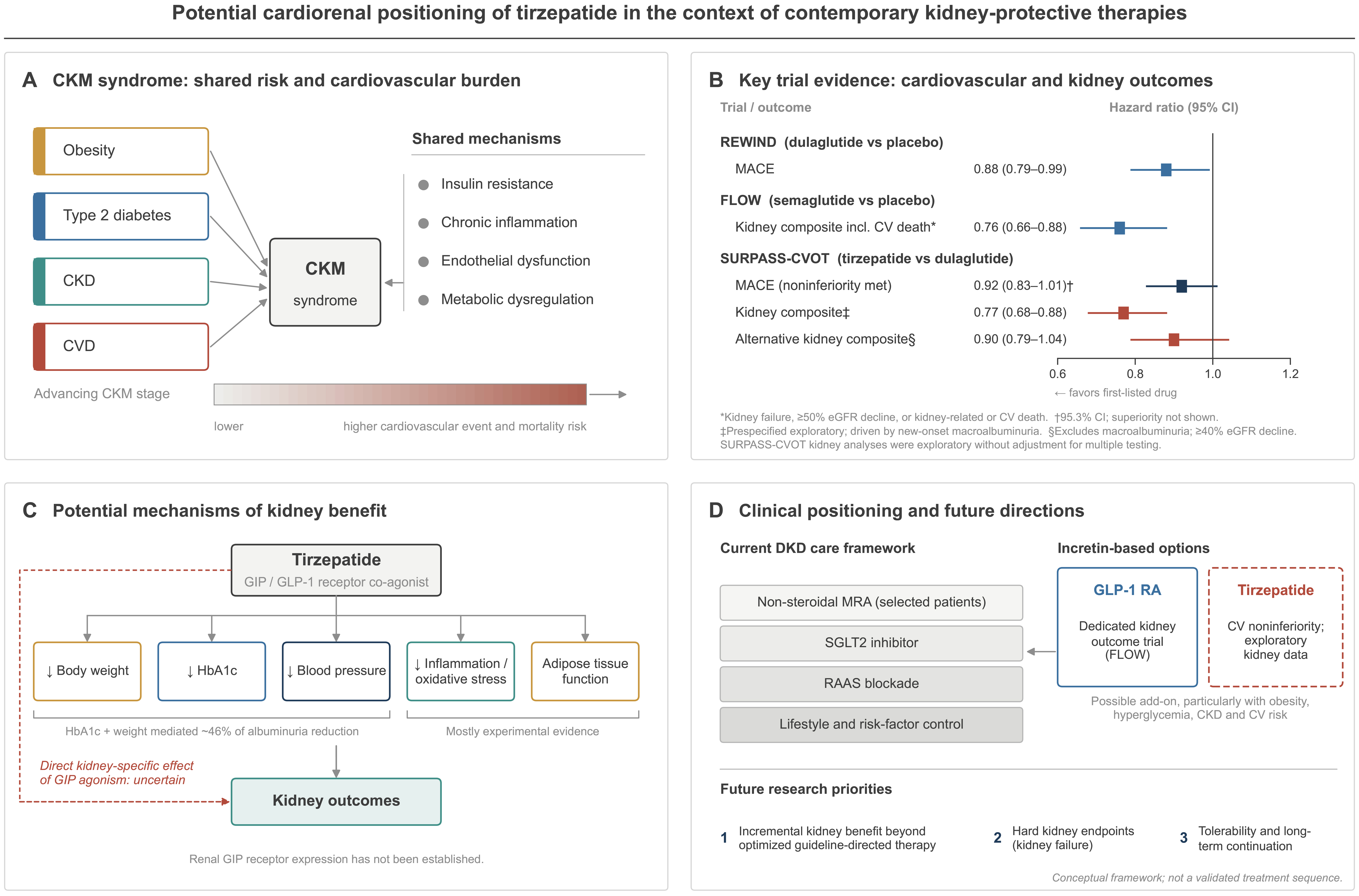
Figure 1. Potential cardiorenal positioning of tirzepatide in the context of contemporary kidney-protective therapies. Panels A-D are labeled as follows: (A) CKM syndrome: shared risk and cardiovascular burden; (B) key trial evidence: cardiovascular and kidney outcomes; (C) potential mechanisms of kidney benefit; and (D) clinical positioning and future directions. SURPASS-CVOT demonstrated cardiovascular noninferiority of tirzepatide to dulaglutide, while its kidney findings were derived from prespecified exploratory analyses without multiplicity adjustment. In contrast, the FLOW trial provided dedicated kidney outcome evidence for semaglutide based on a composite endpoint that included cardiovascular death. Panel B summarizes published hazard ratios (95%CIs) from REWIND, FLOW, and SURPASS-CVOT; comparisons are trial-specific (placebo-controlled for REWIND and FLOW, active-controlled for SURPASS-CVOT) and are not directly comparable across trials. The proposed framework is conceptual and does not represent a validated treatment sequence or establish incremental kidney protection from tirzepatide when combined with optimized guideline-directed therapy. *Kidney failure, ≥ 50% eGFR decline, or kidney-related or CV death. †95.3%CI; superiority not shown. ‡Prespecified exploratory; driven by new-onset macroalbuminuria. §Excludes macroalbuminuria; ≥ 40% eGFR decline. CKD: Chronic kidney disease; CKM: cardiovascular-kidney-metabolic syndrome; CI: confidence interval; CV: cardiovascular; CVD: cardiovascular disease; DKD: diabetic kidney disease; eGFR: estimated glomerular filtration rate; GIP: glucose-dependent insulinotropic polypeptide; GLP-1: glucagon-like peptide-1; GLP-1 RA: glucagon-like peptide-1 receptor agonist; HbA1c: glycated hemoglobin; MACE: major adverse cardiovascular events; MRA: mineralocorticoid receptor antagonist; RAAS: renin-angiotensin-aldosterone system; SGLT2: sodium-glucose cotransporter 2.
DECLARATIONS
Authors’ contributions
Manuscript drafting and conceptual discussions: Huang YT
Conceptualization, intellectual guidance, and literature review: Wu VC
Critical review and revision of the manuscript: Huang YT, Wu VC
Both authors read and approved the final version of the manuscript.
Availability of data and materials
Not applicable.
AI and AI-assisted tools statement
During the preparation of this manuscript, ChatGPT (OpenAI; GPT-6, medium thinking effort, released 2026-10-07) was used for English translation, grammatical correction, and language refinement. Claude (Anthropic; Claude Opus 5.5) was used solely to assist in drafting Python code for redrawing Figure 1. The figure itself was generated programmatically using Python (version 3.14) and the matplotlib library (version 3.11.2), rather than by an AI image-generation tool. All scientific content, numerical values, labels, and figure structure were determined and verified by the authors. The authors reviewed and take full responsibility for the final figure. The scientific concepts, interpretations, and conclusions were developed by the authors. All AI-assisted output, including text and code, was reviewed and edited by the authors. These tools did not influence the study design, data collection, analysis, interpretation, or scientific content of the work. All authors take full responsibility for the accuracy, integrity, and final content of the manuscript.
Financial support and sponsorship
None.
Conflicts of interest
Both authors declared that there are no conflicts of interest.
Ethical approval and consent to participate
Not applicable.
Consent for publication
Not applicable.
Copyright
© The Author(s) 2026.
REFERENCES
1. Alicic RZ, Neumiller JJ, Tuttle KR. GLP-1 receptor agonists and next-generation metabolic hormone therapies in chronic kidney disease. Nat Rev Nephrol. 2026;22:265-82.
2. Ndumele CE, Rangaswami J, Chow SL, et al. ; American Heart Association. Cardiovascular-Kidney-Metabolic health: a presidential advisory from the American Heart Association. Circulation. 2023;148:1606-35.
3. Li J, Wei X. Association of cardiovascular-kidney-metabolic syndrome with all-cause and cardiovascular mortality: a prospective cohort study. Am J Prev Cardiol. 2025;22:100985.
4. Gerstein HC, Colhoun HM, Dagenais GR, et al. ; REWIND Investigators. Dulaglutide and cardiovascular outcomes in type 2 diabetes (REWIND): a double-blind, randomised placebo-controlled trial. Lancet. 2019;394:121-30.
5. Nicholls SJ, Pavo I, Bhatt DL, et al. ; SURPASS-CVOT Investigators. Cardiovascular outcomes with tirzepatide versus dulaglutide in type 2 diabetes. N Engl J Med. 2025;393:2409-20.
6. Perkovic V, Tuttle KR, Rossing P, et al. ; FLOW Trial Committees and Investigators. Effects of semaglutide on chronic kidney disease in patients with type 2 diabetes. N Engl J Med. 2024;391:109-21.
7. Zoungas S, D'Alessio D, Pavo I, et al. A comparison of the effects of tirzepatide and dulaglutide on major kidney events in people with type 2 diabetes: pre-specified exploratory analyses of the SURPASS-CVOT trial. Lancet Diabetes Endocrinol. 2026;14:544-57.
8. Chuang MH, Chen JY, Wang HY, Jiang ZH, Wu VC. Clinical outcomes of tirzepatide or GLP-1 receptor agonists in individuals with type 2 diabetes. JAMA Netw Open. 2024;7:e2427258.
9. Apperloo EM, Tuttle KR, Pavo I, et al. Tirzepatide associated with reduced albuminuria in participants with type 2 diabetes: pooled post hoc analysis from the randomized active- and placebo-controlled SURPASS-1-5 clinical trials. Diabetes Care. 2025;48:430-6.
10. Kidney Disease: Improving Global Outcomes (KDIGO) CKD Work Group. KDIGO 2024 Clinical Practice Guideline for the evaluation and management of chronic kidney disease. Kidney Int. 2024;105:S117-314.
11. American Diabetes Association Professional Practice Committee for Diabetes*. 11. Chronic kidney disease and risk management: standards of care in diabetes-2026. Diabetes Care. 2026;49:S246-60.
Cite This Article
 Open Access
How to Cite
Huang YT, Wu VC. Beyond glycemic control: the cardiorenal positioning of tirzepatide in the wake of SURPASS-CVOT. Metab Target Organ Damage. 2026;6:71. https://dx.doi.org/10.20517/mtod.2026.139
Download Citation
If you have the appropriate software installed, you can download article citation data to the citation manager of your choice. Simply select your manager software from the list below and click on download.
Export Citation File
Type of Import
Tips on Downloading Citation
Citation Manager File Format
Type of Import
Direct Import: When the Direct Import option is selected (the default state), a dialogue box will give you the option to Save or Open the downloaded citation data. Choosing Open will either launch your citation manager or give you a choice of applications with which to use the metadata. The Save option saves the file locally for later use.
Indirect Import: When the Indirect Import option is selected, the metadata is displayed and may be copied and pasted as needed.
About This Article
Copyright

Data & Comments
Data
0









Comments
Comments must be written in English. Spam, offensive content, impersonation, and private information will not be permitted. If any comment is reported and identified as inappropriate content by OAE staff, the comment will be removed without notice. If you have any queries or need any help, please contact us at [email protected].