
fig5
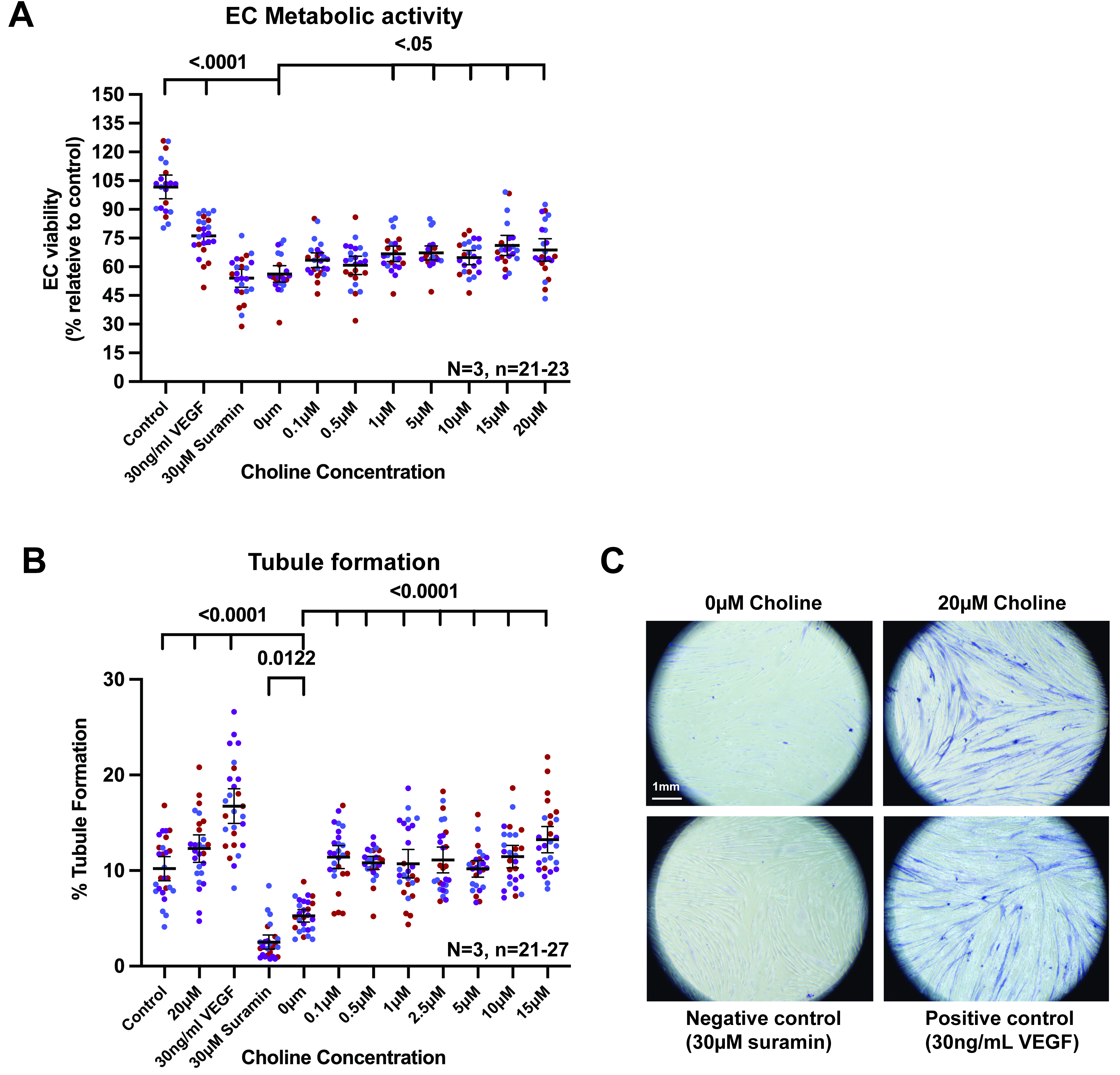
Figure 5. Choline modulates endothelial metabolic activity and promotes angiogenic tubule formation in vitro. (A) Endothelial metabolic activity following treatment with increasing concentrations of choline. HUVECs were treated with 0, 0.1, 0.5, 1, 2.5, 5, 10, 15, or 20 µM choline, with untreated control cells, 30 ng/mL VEGF, and 30 µM suramin included as assay controls. Metabolic activity was measured using the CellTiter 96 AQueous One Solution MTS assay and expressed relative to untreated control. Each colour represents an independent biological repeat and each point represents an individual analysed well; black horizontal lines indicate the mean ± 95% CI; n = 21-23 wells from N = 3 independent biological repeats; (B) Quantification of endothelial tubule formation following choline treatment using an HDF/HUVEC co-culture assay. Cells were treated with the indicated choline concentration range, with untreated control, 30 ng/mL VEGF as a positive control, and 30 µM suramin as a negative control. Tubule formation is expressed as percentage tubule formation across the well. Each colour represents an independent biological repeat and each point represents an individual analysed well; black horizontal lines indicate the mean ± 95% CI; n = 21-27 wells from N = 3 independent biological repeats. VEGF increased tubule formation whereas suramin reduced network formation. Choline increased tubule formation relative to 0 µM choline; (C) Representative images from the HDF/HUVEC tubule formation assay showing 0 µM choline, 20 µM choline, 30 µM suramin, and 30 ng/mL VEGF conditions. More extensive tubule-like endothelial networks are visible in the 20 µM choline and VEGF-treated conditions, whereas network formation is reduced in the 0 µM choline and suramin-treated conditions. Scale bar, 1 mm. Statistically significant P values are indicated on the graphs. Comparisons for which no P value is shown were not statistically significant. VEGF: Vascular endothelial growth factor; CI: confidence interval; HDF: human dermal fibroblast; HUVEC: human umbilical vein endothelial cell; MTS: 3-(4,5-dimethylthiazol-2-yl)-5-(3-carboxymethoxyphenyl)-2-(4-sulfophenyl)-2H-tetrazolium.