
fig4
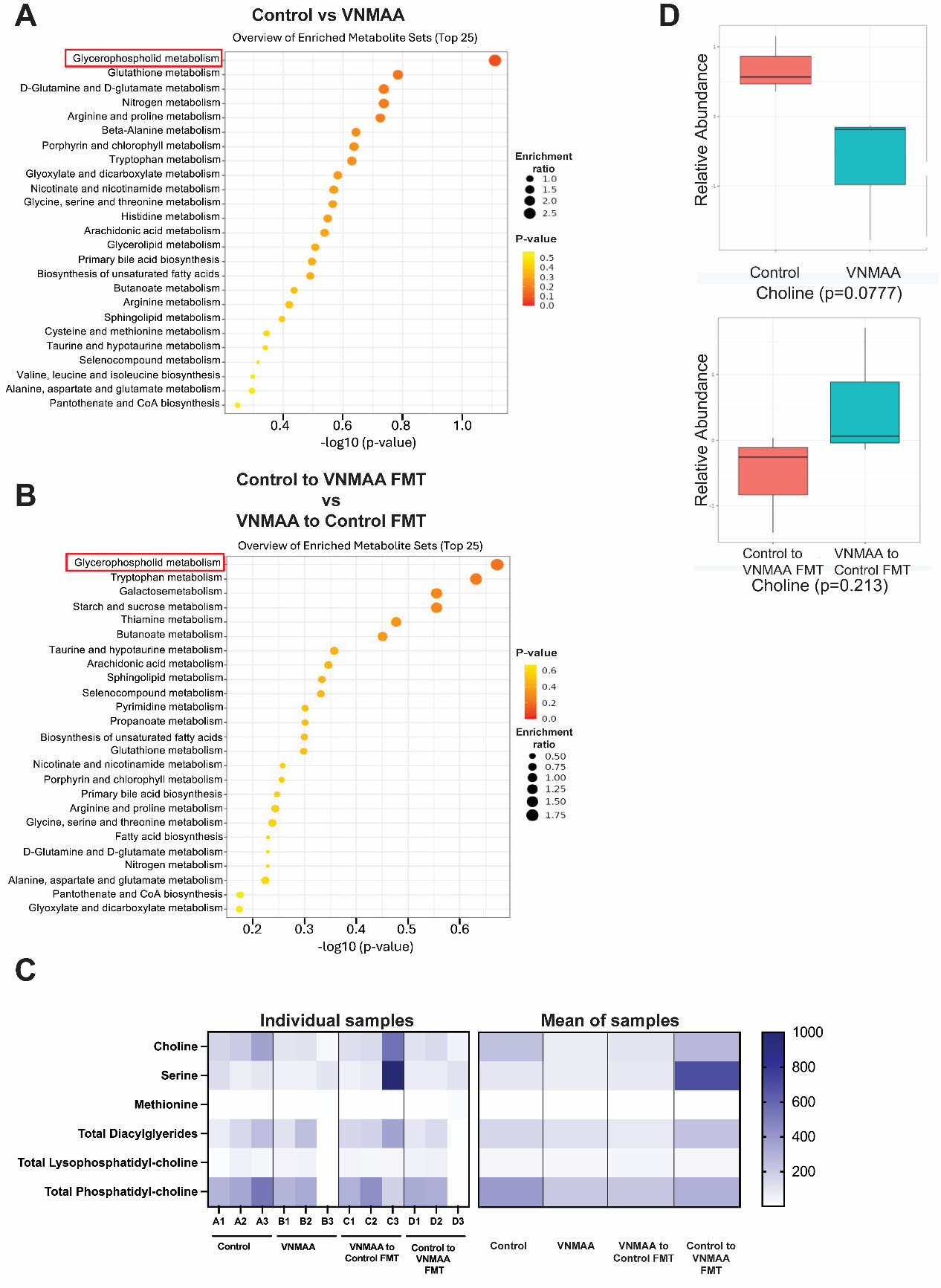
Figure 4. Maternal milk metabolomic profiling identifies recurrent glycerophospholipid-associated metabolic signatures and choline as an exploratory candidate. (A) Pathway enrichment analysis of maternal milk metabolomic data comparing control and VNMAA-treated dams. Milk samples collected at P12 were analysed using the Biocrates MxP® Quant 500 targeted metabolomics platform, incorporating flow injection analysis-tandem mass spectrometry and liquid chromatography-tandem mass spectrometry. The top 25 enriched metabolite sets are shown; dot position indicates -log10(P value), dot size indicates enrichment ratio, and dot colour indicates P value. Glycerophospholipid metabolism was among the most prominent metabolic signatures identified in this comparison; (B) Pathway enrichment analysis comparing the reciprocal FMT groups, control-to-VNMAA FMT and VNMAA-to-control FMT. Glycerophospholipid metabolism was again represented among the enriched metabolite sets, supporting its prioritisation for further examination as a candidate pathway associated with maternal microbial state; (C) Heatmaps showing individual sample-level abundance (left) and mean (right) of selected metabolites associated with glycerophospholipid metabolism in maternal milk, including choline, serine, methionine, total diacylglycerides, total lysophosphatidylcholine, and total phosphatidylcholine. For the individual samples, each column represents an individual milk sample, with samples grouped according to experimental condition; colour intensity represents metabolite abundance according to the scale shown; (D) Choline abundance in maternal milk for the control versus VNMAA comparison (top) and reciprocal FMT comparison (bottom). Box plots show the distribution of individual samples in each comparison. Choline abundance was lower in VNMAA-treated dams than controls, although this difference did not reach statistical significance (P = 0.0777). Choline abundance also did not differ significantly between the reciprocal FMT groups (P = 0.2131). Choline was therefore considered an exploratory candidate metabolite within the broader glycerophospholipid-associated metabolic signature rather than a demonstrated differentially abundant or causal metabolite. VNMAA: Vancomycin, neomycin, metronidazole, amphotericin B and ampicillin; FMT: faecal microbiota transplantation.