
fig3
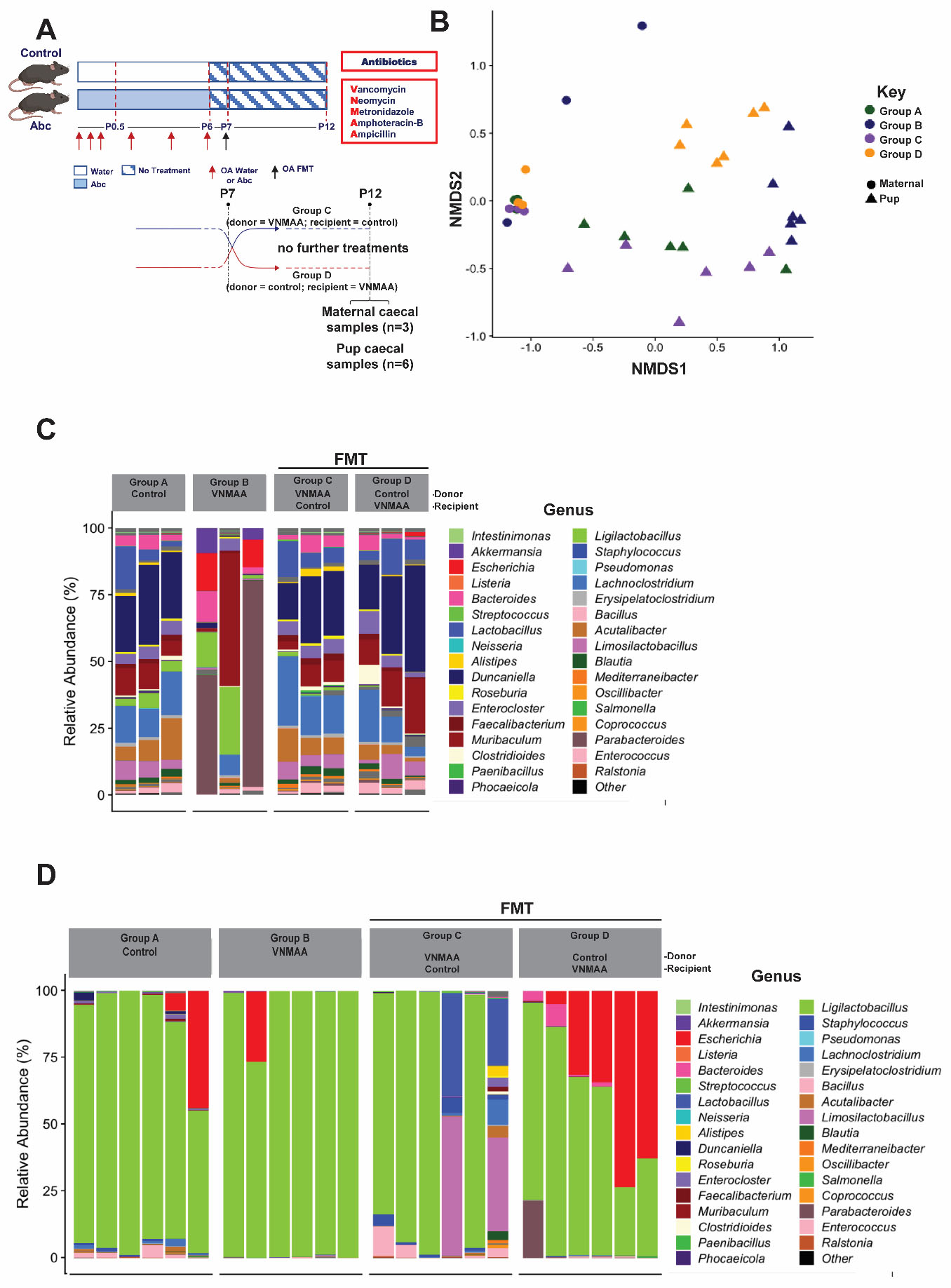
Figure 3. Maternal and pup caecal microbiome profiles following microbiome perturbation and reciprocal FMT. (A) Experimental design and sampling strategy. Dams were orally gavaged with water or VNMAA at the indicated time points during pregnancy (red arrows). Dams and pups were orally administered water or VNMAA from P0.5 to P6 at the indicated time points (red arrows). VNMAA consisted of vancomycin, neomycin, metronidazole, amphotericin B, and ampicillin. At P7, reciprocal FMT was performed (black arrow), with VNMAA microbiota (donor) transferred to control (recipient) dams and control microbiota (donor) transferred to VNMAA-treated (recipient) dams. No further treatments were administered after FMT. Maternal and pup caecal samples were collected at P12 for whole-genome shotgun sequencing. Created in BioRender. Robinson, S. (2026) https://BioRender.com/sl9ns64; (B) NMDS ordination of genus-level microbial community profiles from maternal and pup caecal samples. Samples are coloured according to experimental group and symbols distinguish maternal from pup samples; (C) Genus-level relative abundance profiles of maternal caecal microbiota across control, VNMAA-treated, and reciprocal FMT groups. A total of three maternal caecal samples per treatment group were analysed; (D) Genus-level relative abundance profiles of P12 pup caecal microbiota across the corresponding experimental groups. A total of six pup caecal samples per treatment group were analysed. The genus-level profiles (C and D) showed visually distinct microbial compositions among the maternal treatment groups; however, PERMANOVA analyses did not identify a statistically significant overall difference in community composition across the four groups (P = 0.186). The limited number of maternal samples (n = 3 per group) may have reduced the power to detect treatment-associated differences. In contrast, maternal and P12 pup caecal communities differed significantly at the community level (PERMANOVA, P < 0.001), with pup profiles generally showing more limited and variable community composition. Given the limited sample size, these microbiome data are therefore presented as descriptive and hypothesis-generating, rather than as evidence for treatment-specific community restructuring, individual causal taxa, or definitive FMT engraftment. NMDS: Non-metric multidimensional scaling; FMT: faecal microbiota transplantation; PERMANOVA: permutational multivariate analysis of variance.