
fig1

Growth redox conditions and interface effects govern polarization switching speed, retention and reliability in epitaxial Hf<sub>0.5</sub>Zr<sub>0.5</sub>O<sub>2</sub> thin films

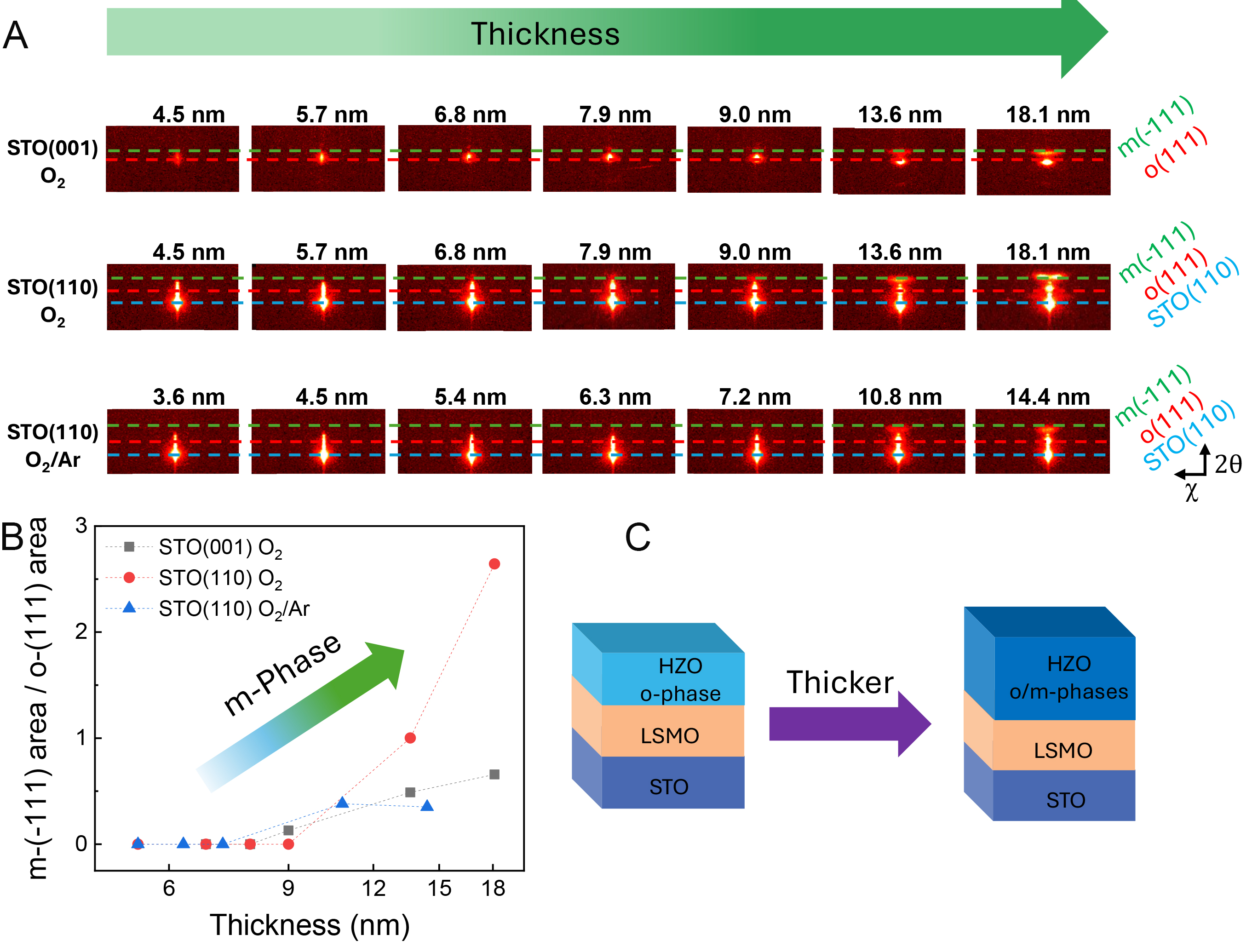
Figure 1. (A) χ-2θ diffraction images around the o-(111) reflection for HZO films of the indicated thickness for the three series: STO(001) O2, STO(110) O2, and STO(110) O2/Ar. The orthorhombic (o) and monoclinic (m) reflections are indicated. (B) Area ratio of the m-(-111) diffraction peak with respect to the o-(111) peak, extracted from the χ-integrated 2θ patterns, as a function of film thickness for the three series of samples. (C) Schematic illustration of the thickness-dependent phase evolution of epitaxial HZO films, showing the stabilization of the orthorhombic phase in the ultrathin regime and the progressive appearance of the monoclinic phase with increasing thickness.

Microstructures
ISSN 2770-2995 (Online)

Portico

All published articles are preserved here permanently:

https://www.portico.org/publishers/oae/

Portico

All published articles are preserved here permanently:

https://www.portico.org/publishers/oae/