




Perpendicular compensated ferrimagnetic tunnel junctions
 0
0 
Abstract
Combining the advantages of ferromagnetic and antiferromagnetic tunnel junctions, ferrimagnetic tunnel junctions are highly desirable for spintronic applications. Here, we design and experimentally demonstrate a novel type of perpendicular compensated ferrimagnetic tunnel junction composed of the ferrimagnetic oxide NiCo2O4 and the compensated ferrimagnetic alloy Co100-xGdx separated by an MgAl2O4 insulating barrier. The tunneling magnetoresistance undergoes a sign transition from positive to negative (from +72% to -22%) as the temperature increases across the magnetization compensation point of Co100-xGdx, which is attributed to the reversible magnetic dominance between the Co and Gd sublattices. Furthermore, we employ this ferrimagnetic tunnel junction to realize temperature-dependent non-volatile multilevel states. Our findings on the perpendicular compensated ferrimagnetic tunnel junctions can provide an attractive avenue for developing ferrimagnet-based devices.
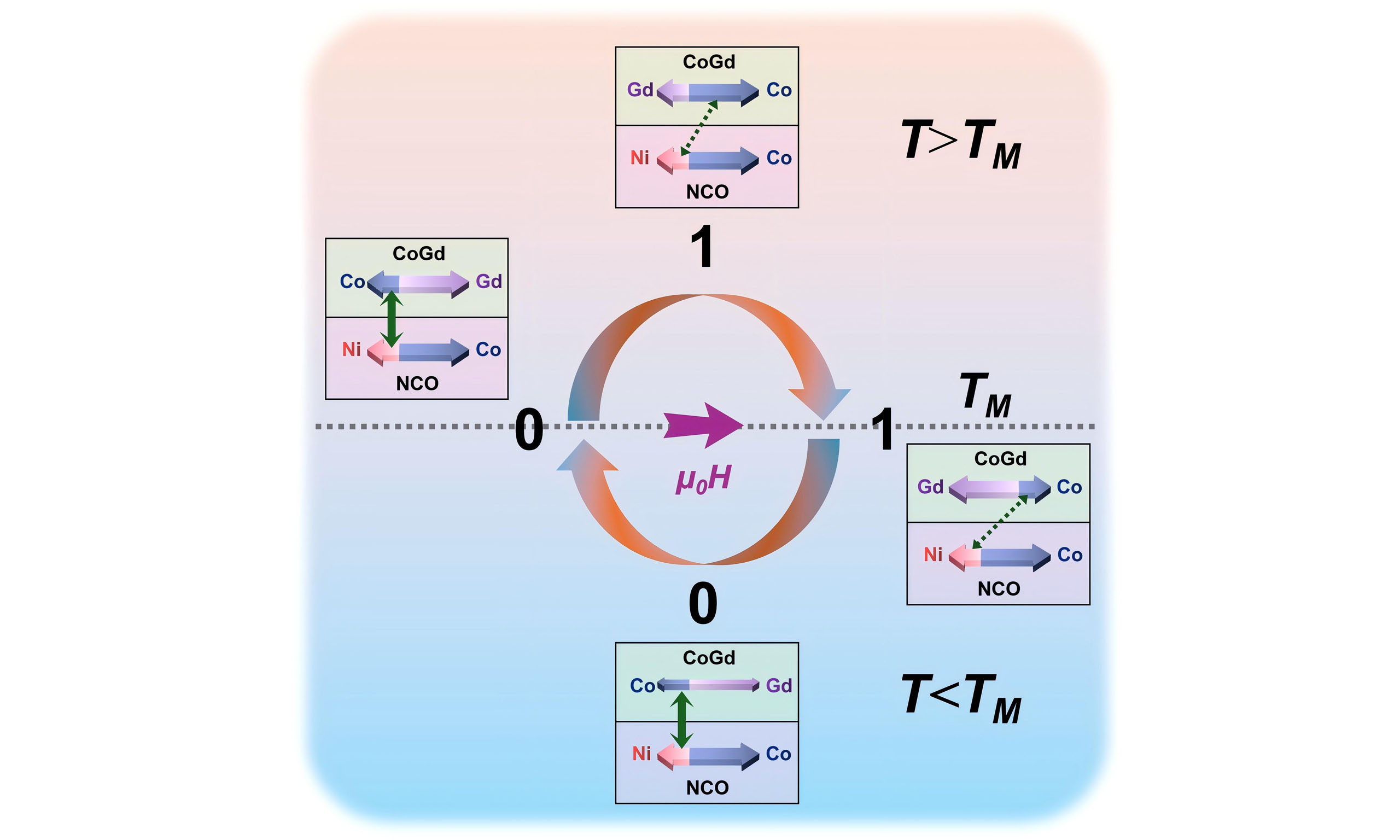
Keywords
INTRODUCTION
Magnetic tunnel junctions (MTJs), which comprise two ferromagnetic (FM) layers separated by a thin insulating layer, serve as the core building blocks for magnetic random access memory (MRAM), spin logic devices, and brain-inspired computing systems[1-6]. Electron tunneling between two FM electrodes can be effectively controlled by switching the relative magnetization orientation between parallel (P) and antiparallel (AP) states. This effect is known as tunneling magnetoresistance (TMR) [Figure 1A][7-9]. However, the miniaturization of MTJ devices remains a critical challenge in spintronics, owing to stray fields generated within ferromagnetic layers [Figure 1B][10,11]. Moreover, the intrinsic slow spin dynamics of ferromagnets limit the operational speed of arithmetic devices[12]. Antiferromagnets (AFM) have become potential candidates for spintronic applications owing to their strong magnetic stability, zero stray fields and ultrafast dynamic responses [Figure 1B][13,14]. An antiferromagnetic tunnel junction (AFMTJ) consists of two AFM electrodes, and the P or AP alignment of their Néel vectors gives rise to the TMR effect [Figure 1A][7,8]. Antiferromagnets exhibit zero net magnetization, which greatly complicates the achievement of TMR in AFMTJs. To overcome these bottlenecks, ferrimagnets stand out as a promising candidate that combines the merits of ferromagnets and antiferromagnets simultaneously. Consisting of two sublattices with antiparallel but unequal magnetic moments, ferrimagnets produce tunable and detectable net magnetization and ultrafast spin dynamics. Owing to the limited net magnetization, ferrimagnets feature drastically suppressed stray fields relative to conventional ferromagnets, effectively mitigating edge-induced perturbations in scaled-down spintronic devices [Figure 1B][15-18]. As a result, perpendicular ferrimagnetic tunnel junctions possess great potential to boost the integration density of MTJ units and promote arithmetic frequency and operating speed.
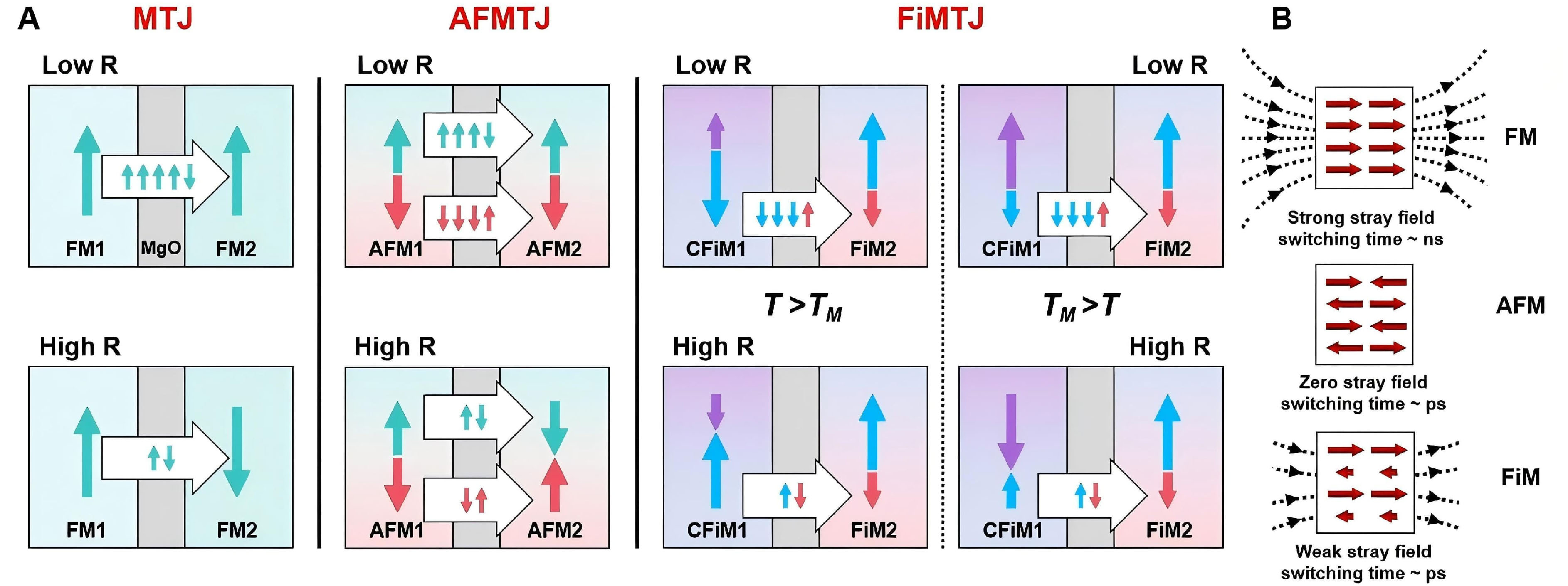
Figure 1. Schematics of different types of tunnel junctions. (A) Schematics of a conventional MTJ where two ferromagnetic (FM) electrodes are separated by a tunnel barrier. Conduction (indicated by block arrows) between the left and right FM electrodes for parallel and antiparallel magnetization (indicated by different colored arrows). Schematics of an antiferromagnetic tunnel junction (AFMTJ) with two AFM electrodes. Schematics of our ferrimagnetic tunnel junction (FiMTJ) with a compensated ferrimagnetic electrode (CFiM1) and another ferrimagnetic electrode (FiM2). Tunneling behavior at temperatures below and above TM is illustrated; (B) Schematic comparison of magnetic configuration, stray fields, and spin dynamics of FM, AFM, and FiM. MTJ: Magnetic tunnel junction.
Research studies on ferrimagnetic tunnel junctions have primarily focused on compensated ferrimagnets, composing Rare-earth (RE) and transition metals (RE-TM)[19-21]. Such materials exhibit a unique antiferromagnetic coupling between the non-equivalent magnetic moments of the RE and TM sublattices[22-24]. At a specific magnetization compensation temperature (TM), the magnetic moments of the two sublattices become equivalent and opposite. Below and above TM, the net magnetization is dominated by the RE and TM sublattices, respectively. By changing the temperature, the dominant sublattice responsible for the net magnetic moment can be switched[25,26]. Significant progress has been made in realizing TMR (~33% to 58%) and giant magnetoresistance (GMR) (~0.5%), particularly in CoFe/MgO/CoGd or CoFeB/MgO/CoFeB/CoTb tunnel junctions and CoFe/Cu/CoGd spin valves[27-29]. Despite these achievements, the presence of in-plane magnetic anisotropy and the ferromagnetic layer (CoFe) in the devices restrict further performance optimization. As a result, the development of perpendicular
In this work, we demonstrate a novel type of perpendicular compensated ferrimagnetic tunnel junctions, in which the compensated ferrimagnet Co100-xGdx and the ferrimagnetic metal oxide NiCo2O4 (NCO) are separated by an MgAl2O4 (MAO) insulating barrier. As a ferrimagnet, NCO exhibits robust perpendicular magnetic anisotropy (PMA) together with an extremely high spin polarization (theoretically up to 100%), rendering it an ideal candidate for our ferrimagnetic tunnel junctions[30]. Intriguingly, we observe a sign transition of TMR (from +72% to -22%) as the temperature increases across the TM point. This sign transition arises from the reversible switching of magnetic dominance between Co and Gd sublattices in the CoGd layer. Furthermore, the proposed ferrimagnetic devices can realize temperature-dependent non-volatile multilevel resistance states.
MATERIALS AND METHODS
Sample growth and device fabrication
The bilayers NCO (16 nm)/MAO (3 nm) were epitaxially deposited on (100)-oriented MAO substrates using a KrF excimer laser (λ = 248 nm) via a pulsed laser deposition (PLD) system. The ceramic targets NCO and MAO were prepared through solid-state reaction (supplied by ZhongNuo Advanced Material Technology Co., Ltd, Beijing). The deposition parameters were fixed at a substrate temperature of 350 °C, a laser energy density of 1.2 J/cm2, and a pulse repetition rate of 7 Hz. The oxygen pressure during the deposition process was set as 200 mTorr for NCO and 50 mTorr for MAO, respectively. After the deposition, the multilayers were in situ annealed for 15 minutes under the oxygen pressure of 50 mTorr and then cooled down to room temperature under the oxygen pressure of 1,000 mTorr to suppress oxygen vacancy formation.
After deposition of the heterostructures, tunnel junction devices with varied dimensions were fabricated. All devices adopt uniform bottom electrode strips (NCO, 300 μm in width) and vertically interleaved top electrode strips (Co82Gd18/Pt, 100 μm in width) measuring around 100 μm in width. A 30 nm silicon oxide layer was deposited to electrically isolate the top and bottom electrodes. Effective junctions of different sizes are located at the intersection of the top and bottom electrodes. The detailed micro-nano fabrication process of the devices is illustrated in Supplementary Figure 1. Device patterning was performed using an Ultraviolet Maskless Lithography machine (TuoTuo Technology). The Co82Gd18 layers were deposited using a dual-target co-sputtering technique in a magnetron sputtering system with a base pressure lower than
Magnetic measurements and magnetoresistance characterizations
Temperature-dependent magnetic characterizations of the films were conducted on a superconducting quantum interference device (SQUID), where in-plane magnetic fields were applied along the substrate [100] crystallographic direction and out-of-plane fields along the [001] orientation. Magnetoresistance measurements of ferrimagnetic tunnel junctions and anomalous Hall effect (AHE) measurements were implemented with a physical property measurement system (PPMS).
Electrical analysis and fitting
The Brinkman-Dynes-Rowell (BDR) model[31-35] used for analyzing tunneling conductance is described as
where the tunneling conductance at zero bias
The density functional theory calculations
Based on density of functional theory, all first-principles calculations were performed using the Vienna ab initio simulation package (VASP) code[36]. The exchange-correlation functional adopted the meta generalized gradient approximation (meta-GGA) of the strongly constrained and appropriately normed (SCAN) semilocal density functional[37]. SCAN function can satisfies all exact constraints applicable to existing density functionals, suggesting its superiority over most conventional gradient-corrected functionals. The heterostructure unit cell was calculated using the Γ-centered K-point mesh with a resolved value of 0.03 π/Å. The energy cut-off value is 450 eV, and the structures were completely relaxed until their atomic Hellmann-Feynman forces were less than 0.005 eV/Å. The convergence criterion of energy in the self-consistency process is 10-6 eV.
RESULTS AND DISCUSSION
First, the NCO (16 nm)/MAO (3 nm) bilayers with flat surface morphology were deposited on (100)-oriented MAO single-crystal substrates using a KrF excimer laser [Figure 2A]. Subsequently,
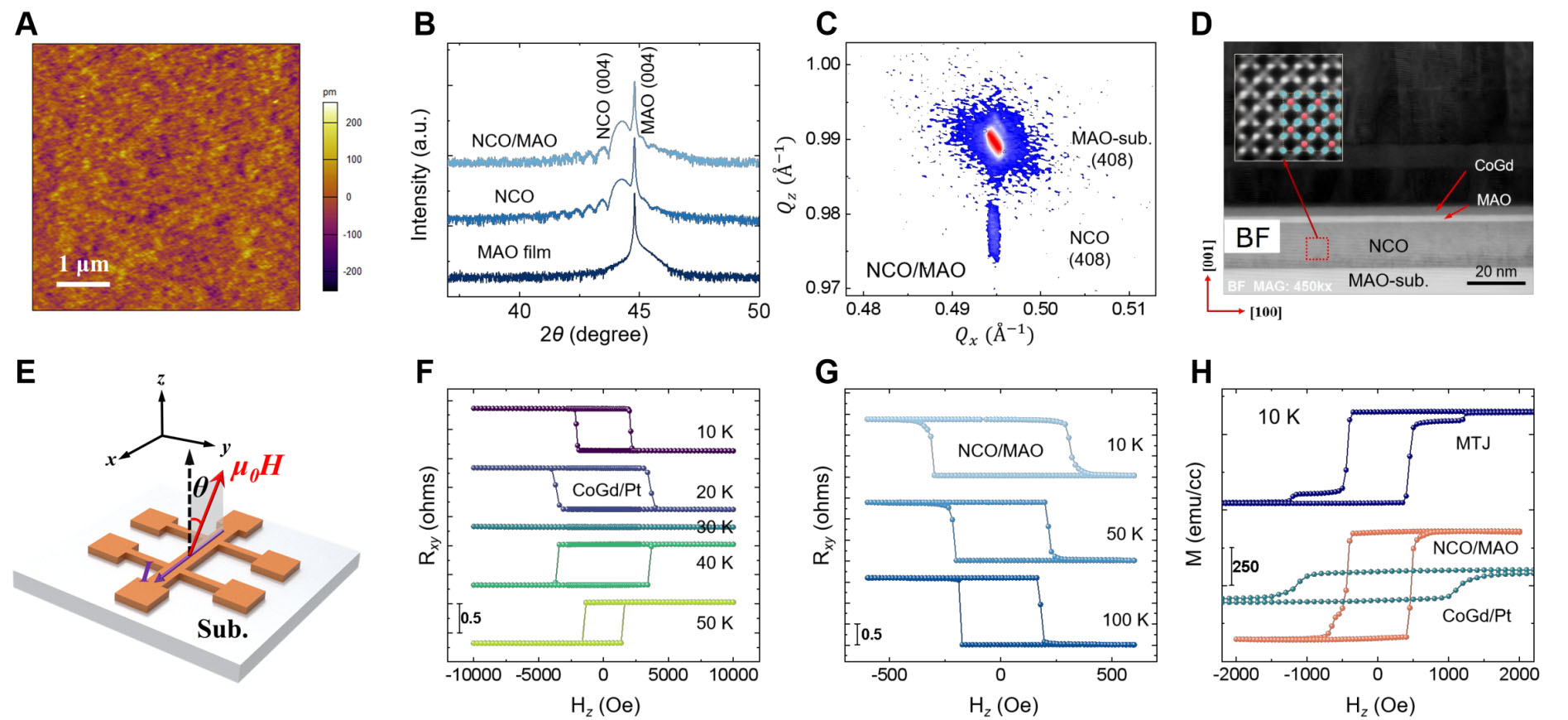
Figure 2. Structural characterization and spin-dependent performance of heterostructures. (A) Atomic force microscopy (AFM) image of the NiCo2O4/MgAl2O4 (NCO/MAO) bilayers with a root-mean-square (RMS) roughness of 0.05 nm. The length of the scale bar is 1 μm; (B) X-ray diffraction (XRD) patterns of MAO (12 nm), NCO (16 nm), and NCO (16 nm)/MAO (3 nm). The characteristic diffraction peaks at (004)-plane are indicated; (C) Reciprocal space mapping (RSM) of the (408) reflection of the NCO/MAO bilayers; (D) Annular bright-field (ABF) micrograph of the magnetic tunnel junction (MTJ) heterostructures along the [100] axis, with labels indicating different layers. The length of the scale bar is 20 nm. Inset: Atomic-resolution higher-magnification high-angle annular dark-field scanning transmission electron microscopy (HAADF-STEM) image of the region enclosed by the red dashed box, illustrating the unit cell scheme of the NCO crystal structure. Red and blue spheres represent Td and Oh sites, respectively; (E) Schematic illustration of hall-bar device for anomalous Hall effect (AHE) measurements; (F) AHE loops of the Co82Gd18 (5 nm)/Pt (50 nm) bilayers at various temperatures; (G) AHE loops of the NCO (16 nm)/MAO (3 nm) bilayers at different temperatures; (H) Out-of-plane magnetic hysteresis loops of the NCO/MAO bilayers, Co82Gd18 /Pt bilayers, and MTJ heterostructures at 10 K. BF: Bright-field.
We further investigate the spin-dependent transport properties of the ferrimagnetic layers: Co82Gd18 and NCO (see Experimental Section). Regarding the Co82Gd18 layer, the square-shaped AHE loops of the
Furthermore, we systematically investigate the TMR performance of the ferrimagnetic tunnel junction (junction size: Dia~2 μm, A ~3.1 μm2) under out-of-plane magnetic fields (see Experimental Section). Notably, the TMR undergoes a clear sign transition from positive to negative as the temperature rises across the TM of Co82Gd18 (~27 K) [Figure 3A]. In the TMR hysteresis loops, one switching occurs at a low magnetic field (around 600 Oe), corresponding to the magnetization reversal of NCO. The second switching at a higher magnetic field is tunable from 2,500 Oe to 12,000 Oe and back to 1,600 Oe with increasing temperature from 10 K to 40 K, which is consistent with the changing coercivity of the Co82Gd18 layer. The TMR value is defined as
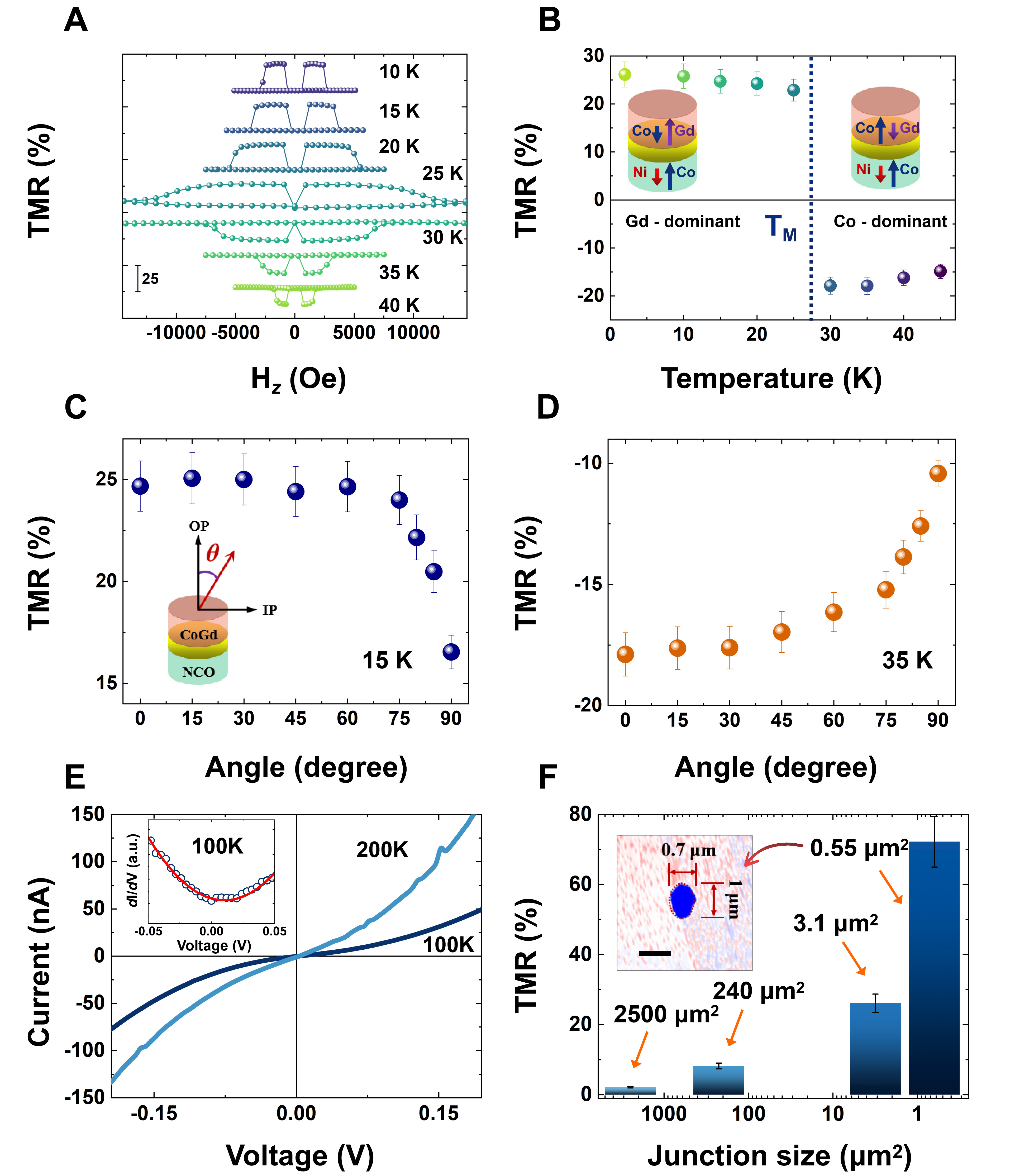
Figure 3. Tunneling characteristics of our perpendicular compensated ferrimagnetic tunnel junctions. (A) TMR loops obtained at various temperatures (using a reading bias of 1 mV); (B) Temperature dependence of the TMR values. Error bars are defined as the standard deviation (SD), the sample size is 3 and the error bars throughout this figure share the same source. Inset: A sketch illustrating the variation of antiferromagnetic coupling in Co82Gd18 when the temperature is below and above TM; The dependence of the TMR value on the angle of the sweeping magnetic field at (C) 15 K and (D) 35 K. In these Figures, 0° and 90° correspond to the out-of-plane and in-plane magnetic field directions, respectively; (E) I-V curves (Dia~56 μm, A ~2,500 μm2) at various temperatures. Inset: Corresponding dI/dV-V curves in the low-bias region at 100 K, fitted using the BDR model; (F) Size-dependent TMR values of our ferrimagnetic tunnel junctions (Circles: Dia 56 μm,
In addition, the nonlinear I-V curves of the junction were measured across a temperature range of
To elucidate the spin-dependent transport behavior in our perpendicular ferrimagnetic tunnel junctions, density functional theory (DFT) calculations of the NCO oxide and the CoGd alloy were performed (the structural models of CoGd and NCO are displayed in Figure 4A and 4B, respectively). For simplified modeling and reduced computational cost of DFT calculations, we adopted the Co75Gd25 model with an integer atomic stoichiometric ratio. In the calculated density of states (DOS), the majority of the occupied f states of Gd are located at ~4.5 eV below the Fermi energy level and contribute to the magnetic moment of Gd [Figure 4C]. For the CoGd alloy, the calculated average magnetic moments are ~+7.29 µB and ~-1.51 µB for each Gd and Co atom, respectively [Supplementary Table 1], suggesting the antiferromagnetic coupling between Gd and Co. The Hall conductance can be described as
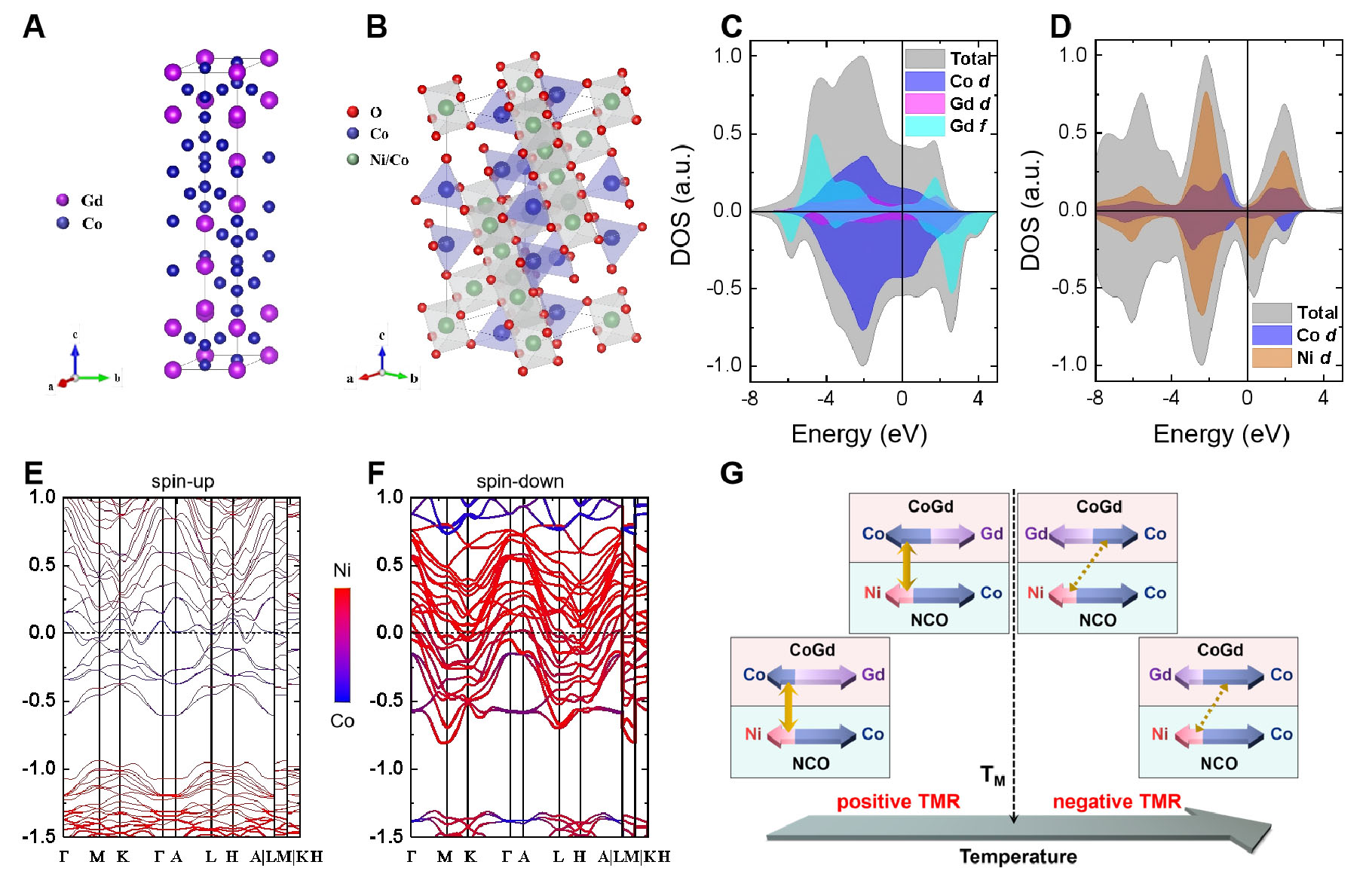
Figure 4. DFT calculations of CoGd and NCO. (A) Illustration of the Co75Gd25 structure for the DFT calculations; (B) Sketch of the inverse spinel structure of NCO for the DFT calculations; (C) Calculated total DOS, DOS of the Co d states, and DOS of the Gd d and f states in CoGd; (D) Calculated total DOS and DOS of the Co and Ni d states in NCO; The calculated band structures of (E) spin-up and
where τ is the momentum relaxation time, e is the electron charge, v is the velocity, B = (0, 0, Bz) is the magnetic field along the z-direction, ε is the energy, ħ is the Planck constant, and f0 is the Fermi distribution function[55]. According to the key term
Benefiting from the temperature-dependent behavior inherent in our ferrimagnetic tunnel junction, the tunneling magnetoresistance states exhibit tunability to temperature modulation, enabling the realization of temperature-dependent non-volatile multilevel resistance states. The tunneling resistance states “0” and “1” at 20 K can be tuned through a heating-up and cooling-down process between 20 K and 40 K, assisted by a fixed magnetic field of 0.3 T [Figure 5A]. During the thermal cycling, the magnetic dominance between Co and Gd sublattices is switched, and the magnetic field fixes the net moment direction when the temperature crosses TM. Once the resistance state is written, it remains non-volatile as the temperature returns to 20 K. Conversely, the resistance state can be reset to the “0” level through a cooling and warming cycle between
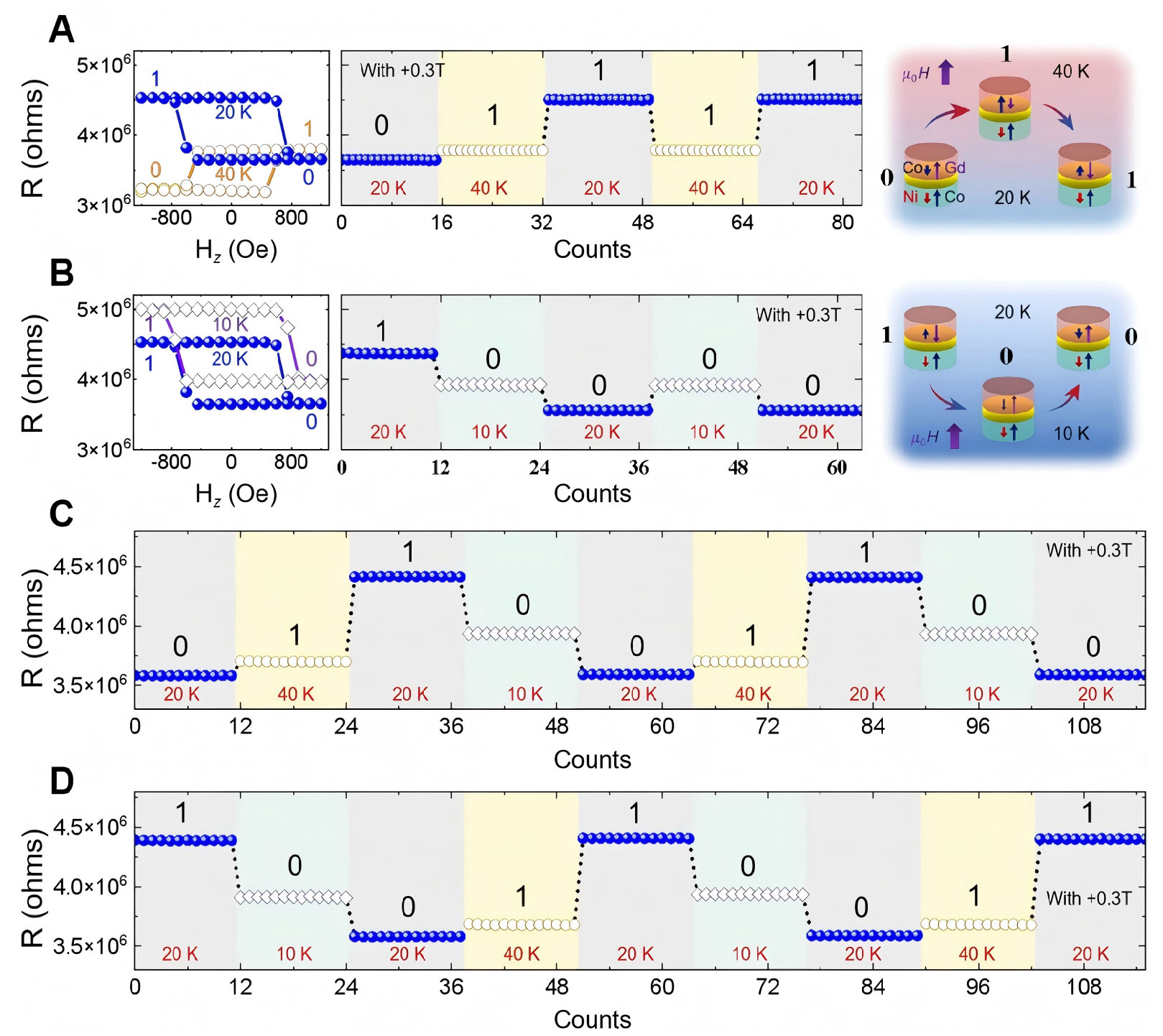
Figure 5. Temperature-dependent non-volatile multilevel states. TMR loops within a small magnetic field range, temperature-dependent non-volatile multilevel states assisted by a fixed magnetic field (+0.3 T), and mechanism illustration within (A) 20~40 K and (B) 10~20 K. “0” and “1” correspond to the low and high resistance states at the corresponding temperatures; Temperature-dependent non-volatile multilevel states within 10~40 K starting from different initial states: (C) “0” and (D) “1” assisted by a fixed magnetic field (+0.3 T). TMR: Tunneling magnetoresistance.
CONCLUSION
In summary, we have successfully demonstrated the perpendicular compensated ferrimagnetic tunnel junction based on the NCO/MAO/Co82Gd18 heterostructures, which exhibits reversible TMR sign switching (from +72% to -22%) as the temperature increases across the magnetization compensation point of Co82Gd18. The TMR sign switching is attributed to the thermally reversible magnetic compensation in Co82Gd18. Furthermore, we have applied this device to demonstrate temperature-dependent non-volatile multilevel resistance states. Unlike conventional MTJs, our ferrimagnetic tunnel junctions feature stray-field-free operation, temperature-tunable TMR polarity, and non-volatile multilevel resistance states. Utilizing our perpendicular compensated ferrimagnetic tunnel junctions, higher unit density, faster operating speed, and enhanced device controllability are foreseeable for future spintronic applications. Our findings offer a promising route for the design and development of ferrimagnet-based spintronic devices.
DECLARATIONS
Authors’ contributions
The conception and design of the work: Liu, Q.; Liu, P.; Wang, K.; Chen, L.
The acquisition and analysis of data: Liu, Q.; Liu, P.; Hu, S.; Wang, Y.
The theoretical calculations: Li, X.
The interpretation of data: Liu, Q.; Liu, P.; Chen, S.; Xu, Z.; Hu, S.; Ye, M.
The writing and revising: Liu, Q.; Liu, P.; Li, X.; Wang, K.; Chen, L.
The supervision: Wang, K.; Chen, L.
Availability of data and materials
The raw data supporting the findings of this study are available within this Article and its Supplementary Materials. Further data is available from the corresponding authors upon reasonable request.
AI and AI-assisted tools statement
Not applicable.
Financial support and sponsorship
This work was supported by the National Key R&D Program of China (Grant No. 2022YFA1402903), National Key Research and Development Program of China (Grant No. 2022YFA1405100), National Natural Science Foundation of China (Grant Nos. 12574096, 12504076, 12241405, 12304154 and 52025025), Postdoctoral Fellowship Program of CPSF (Grant No. GZC20252187), the Shenzhen Fundamental Research Program (Grant No. JCYJ20250604144519025) and SUSTech Core Research Facilities.
Conflicts of interest
All authors declared that there are no conflicts of interest.
Ethical approval and consent to participate
Not applicable.
Consent for publication
Not applicable.
Consent for publication
Not applicable.
Copyright
© The Author(s) 2026.
Supplementary Materials
REFERENCES
1. Yuasa, S.; Nagahama, T.; Fukushima, A.; Suzuki, Y.; Ando, K. Giant room-temperature magnetoresistance in single-crystal Fe/MgO/Fe magnetic tunnel junctions. Nat. Mater. 2004, 3, 868-71.
2. Yang, H.; Valenzuela, S. O.; Chshiev, M.; et al. Two-dimensional materials prospects for non-volatile spintronic memories. Nature 2022, 606, 663-73.
3. Cai, K.; Yang, M.; Ju, H.; et al. Electric field control of deterministic current-induced magnetization switching in a hybrid ferromagnetic/ferroelectric structure. Nat. Mater. 2017, 16, 712-6.
4. Cao, Y.; Sheng, Y.; Edmonds, K. W.; Ji, Y.; Zheng, H.; Wang, K. Deterministic magnetization switching using lateral spin-orbit torque. Adv. Mater. 2020, 32, e1907929.
5. Cao, Y.; Rushforth, A.; Sheng, Y.; Zheng, H.; Wang, K. Tuning a binary ferromagnet into a multistate synapse with spin-orbit-torque-induced plasticity. Adv. Funct. Mater. 2019, 29, 1808104.
6. Xue, F.; Zhang, C.; Ma, Y.; et al. Integrated memory devices based on 2D materials. Adv. Mater. 2022, 34, e2201880.
7. Gurung, G.; Elekhtiar, M.; Luo, Q. Q.; Shao, D. F.; Tsymbal, E. Y. Nearly perfect spin polarization of noncollinear antiferromagnets. Nat. Commun. 2024, 15, 10242.
8. Shao, D.; Tsymbal, E. Y. Antiferromagnetic tunnel junctions for spintronics. npj. Spintronics. 2024, 2, 14.
9. Echtenkamp, W.; Dixit, B.; Yang, Y.; et al. Prospects of electric field control in perpendicular magnetic tunnel junctions and emerging 2D spintronics for ultralow energy memory and logic devices. Adv. Funct. Mater. 2026, 36, 2505426.
11. Zhou, S.; Wang, Y.; Liu, Y. Modelling of magnetic stray fields in multilayer magnetic films with in-plane or perpendicular anisotropy. Magnetochemistry 2022, 8, 159.
12. De Ranieri, E.; Roy, P. E.; Fang, D.; et al. Piezoelectric control of the mobility of a domain wall driven by adiabatic and non-adiabatic torques. Nat. Mater. 2013, 12, 808-14.
13. Kimel, A. V.; Ivanov, B. A.; Pisarev, R. V.; Usachev, P. A.; Kirilyuk, A.; Rasing, T. Inertia-driven spin switching in antiferromagnets. Nat. Phys. 2009, 5, 727-31.
14. Han, J.; Cheng, R.; Liu, L.; Ohno, H.; Fukami, S. Coherent antiferromagnetic spintronics. Nat. Mater. 2023, 22, 684-95.
15. Kim, K. J.; Kim, S. K.; Hirata, Y.; et al. Fast domain wall motion in the vicinity of the angular momentum compensation temperature of ferrimagnets. Nat. Mater. 2017, 16, 1187-92.
16. Kim, C.; Lee, S.; Kim, H. G.; et al. Distinct handedness of spin wave across the compensation temperatures of ferrimagnets. Nat. Mater. 2020, 19, 980-5.
17. Din, A.; Amin, O. J.; Wadley, P.; Edmonds, K. W. Antiferromagnetic spintronics and beyond. npj. Spintronics. 2024, 2, 29.
18. Kim, S. K.; Beach, G. S. D.; Lee, K. J.; Ono, T.; Rasing, T.; Yang, H. Ferrimagnetic spintronics. Nat. Mater. 2022, 21, 24-34.
19. Ishibashi, M.; Yakushiji, K.; Kawaguchi, M.; Tsukamoto, A.; Nakatsuji, S.; Hayashi, M. Ferrimagnetic compensation and its thickness dependence in TbFeCo alloy thin films. Appl. Phys. Lett. 2022, 120, 022405.
20. Finley, J.; Liu, L. Spintronics with compensated ferrimagnets. Appl. Phys. Lett. 2020, 116, 110501.
21. Kiphart, D.; Chaves O'Flynn, G. D.; Stobiecki, F.; Frąckowiak, Ł.; Matczak, M.; Kuświk, P. Tailoring ferrimagnetic properties using proximity effects in Co/Tb-Co bilayers. Adv. Mater. Interfaces. 2025, 12, e00330.
22. Ueda, K.; Mann, M.; de Brouwer, P. W. P.; Bono, D.; Beach, G. S. D. Temperature dependence of spin-orbit torques across the magnetic compensation point in a ferrimagnetic TbCo alloy film. Phys. Rev. B. 2017, 96, 064410.
23. Wang, J.; Li, B.; An, Y.; Song, G.; Zhang, S. Interplay between magnetization compensation temperature and thickness in ferrimagnetic CoGd alloy films. Appl. Phys. Lett. 2025, 126, 072401.
24. Xu, T.; Cheng, Y.; Dong, Y.; et al. Evolution of compensated magnetism and spin-torque switching in ferrimagnetic Fe1-xTbx. Phys. Rev. Appl. 2023, 19.
25. Mishra, R.; Yu, J.; Qiu, X.; Motapothula, M.; Venkatesan, T.; Yang, H. Anomalous current-induced spin torques in ferrimagnets near compensation. Phys. Rev. Lett. 2017, 118, 167201.
26. Li, Y.; Huang, S.; Zhu, W.; et al. Spin-canting mediated anomalous nernst effect in ferrimagnetic CoTb films. Chinese. Phys. Lett. 2026, 43, 020708.
27. Kaiser, C.; Panchula, A. F.; Parkin, S. S. Finite tunneling spin polarization at the compensation point of rare-earth-metal-transition-metal alloys. Phys. Rev. Lett. 2005, 95, 047202.
28. Zhu, W.; Tang, M.; Pan, C.; et al. Sign-tunable magnetic tunnel junctions engineered via ferrimagnets for efficient all-electrical and thermal switching. Adv. Funct. Mater. 2026, 36, 2505415.
29. Jiang, X.; Gao, L.; Sun, J. Z.; Parkin, S. S. Temperature dependence of current-induced magnetization switching in spin valves with a ferrimagnetic CoGd free layer. Phys. Rev. Lett. 2006, 97, 217202.
30. Shen, Y.; Kan, D.; Lin, I.; Chu, M.; Suzuki, I.; Shimakawa, Y. Perpendicular magnetic tunnel junctions based on half-metallic NiCo2O4. Appl. Phys. Lett. 2020, 117, 042408.
31. Brinkman, W. F.; Dynes, R. C.; Rowell, J. M. Tunneling conductance of asymmetrical barriers. J. Appl. Phys. 1970, 41, 1915-21.
32. Miller, C. W.; Li, Z. P.; Schuller, I. K.; Dave, R. W.; Slaughter, J. M.; Akerman, J. Dynamic spin-polarized resonant tunneling in magnetic tunnel junctions. Phys. Rev. Lett. 2007, 99, 047206.
33. Santos, T. S.; Lee, J. S.; Migdal, P.; Lekshmi, I. C.; Satpati, B.; Moodera, J. S. Room-temperature tunnel magnetoresistance and spin-polarized tunneling through an organic semiconductor barrier. Phys. Rev. Lett. 2007, 98, 016601.
34. Kaiser, B.; Ramberger, J.; Norum, M.; Nandakumaran, N.; Dewey, J.; Leighton, C. Optimizing nonlocal spin valves via wide-range interfacial-resistance tuning: Toward spin-accumulation sensors. Phys. Rev. Appl. 2024, 22.
35. Oliver, B.; Nowak, J. Temperature and bias dependence of dynamic conductance-low resistive magnetic tunnel junctions. J. Appl. Phys. 2004, 95, 546-50.
36. Kresse, G.; Furthmüller, J. Efficient iterative schemes for ab initio total-energy calculations using a plane-wave basis set. Phys. Rev. B. 1996, 54, 11169-86.
37. Sun, J.; Ruzsinszky, A.; Perdew, J. P. Strongly constrained and appropriately normed semilocal density functional. Phys. Rev. Lett. 2015, 115, 036402.
38. Vasiukov, D. M.; Kareev, M.; Wen, F.; et al. Epitaxial stabilization of thin films of the frustrated Ge-based spinels. Phys. Rev. Mater. 2021, 5, 064419.
39. Liu, Q.; Li, X.; Zhu, Y.; et al. Oxygen controlled perpendicular magnetic anisotropy in LaCoO3-δ/La0.7Sr0.3MnO3/LaCoO3-δ heterostructures. Appl. Phys. Lett. 2022, 120, 242902.
40. Liu, Q.; Liu, P.; Li, X.; et al. Perpendicular manganite magnetic tunnel junctions induced by interfacial coupling. ACS. Appl. Mater. Interfaces. 2022, 14, 13883-90.
41. Chen, X.; Zhang, X.; Han, M. G.; et al. Magnetotransport anomaly in room-temperature ferrimagnetic NiCo2O4 thin films. Adv. Mater. 2019, 31, e1805260.
42. Kan, D.; Mizumaki, M.; Kitamura, M.; et al. Spin and orbital magnetic moments in perpendicularly magnetized Ni1-xCo2+yO4-z epitaxial thin films: effects of site-dependent cation valence states. Phys. Rev. B. 2020, 101, 224434.
43. Bitla, Y.; Chin, Y. Y.; Lin, J. C.; et al. Origin of metallic behavior in NiCo2O4 ferrimagnet. Sci. Rep. 2015, 5, 15201.
44. Siddiqui, S. A.; Han, J.; Finley, J. T.; Ross, C. A.; Liu, L. Current-induced domain wall motion in a compensated ferrimagnet. Phys. Rev. Lett. 2018, 121, 057701.
45. Meo, A.; Sha, C.; Darwin, E.; et al. Spin-wave eigenmodes in nanoscale magnetic tunnel junctions with perpendicular magnetic anisotropy. Phys. Rev. Appl. 2025, 23, 034086.
46. Chen, D.; Xu, Y.; Tong, S.; et al. Noncollinear spin state and unusual magnetoresistance in ferrimagnet Co-Gd. Phys. Rev. Materials. 2022, 6, 014402.
47. Park, J.; Hirata, Y.; Kang, J.; et al. Unconventional magnetoresistance induced by sperimagnetism in GdFeCo. Phys. Rev. B. 2021, 103, 014421.
48. Shen, Y.; Kan, D.; Tan, Z.; Wakabayashi, Y.; Shimakawa, Y. Tuning of ferrimagnetism and perpendicular magnetic anisotropy in NiCo2O4 epitaxial films by the cation distribution. Phys. Rev. B. 2020, 101, 094412.
49. Rivas-Murias, B.; Lucas, I.; Jiménez-Cavero, P.; Magén, C.; Morellón, L.; Rivadulla, F. Independent control of the magnetization in ferromagnetic La2/3Sr1/3MnO3/SrTiO3/LaCoO3 heterostructures achieved by epitaxial lattice mismatch. Nano. Lett. 2016, 16, 1736-40.
50. Wu, H.; Chen, A.; Zhang, P.; et al. Magnetic memory driven by topological insulators. Nat. Commun. 2021, 12, 6251.
51. Currivan-Incorvia, J. A.; Siddiqui, S.; Dutta, S.; et al. Logic circuit prototypes for three-terminal magnetic tunnel junctions with mobile domain walls. Nat. Commun. 2016, 7, 10275.
52. Bartolomé, J.; Arauzo, A.; Kazak, N. V.; et al. Uniaxial magnetic anisotropy in Co2.25Fe0.75O2BO3 compared to Co3O2BO3 and Fe3O2BO ludwigites. Phys. Rev. B. 2011, 83, 144426.
53. Kou, X.; Pan, L.; Wang, J.; et al. Metal-to-insulator switching in quantum anomalous Hall states. Nat. Commun. 2015, 6, 8474.
54. Liu, L.; Qin, Q.; Lin, W.; et al. Current-induced magnetization switching in all-oxide heterostructures. Nat. Nanotechnol. 2019, 14, 939-44.
Cite This Article
 Open Access
How to Cite
Download Citation
Export Citation File:
Type of Import
Tips on Downloading Citation
Citation Manager File Format
Type of Import
Direct Import: When the Direct Import option is selected (the default state), a dialogue box will give you the option to Save or Open the downloaded citation data. Choosing Open will either launch your citation manager or give you a choice of applications with which to use the metadata. The Save option saves the file locally for later use.
Indirect Import: When the Indirect Import option is selected, the metadata is displayed and may be copied and pasted as needed.
About This Article
Copyright

Data & Comments
Data
0










Comments
Comments must be written in English. Spam, offensive content, impersonation, and private information will not be permitted. If any comment is reported and identified as inappropriate content by OAE staff, the comment will be removed without notice. If you have any queries or need any help, please contact us at [email protected].