

Control of magnetic anisotropy in epitaxial SrRuO3 via oxygen octahedral engineering
 0

Graphical Abstract
Abstract
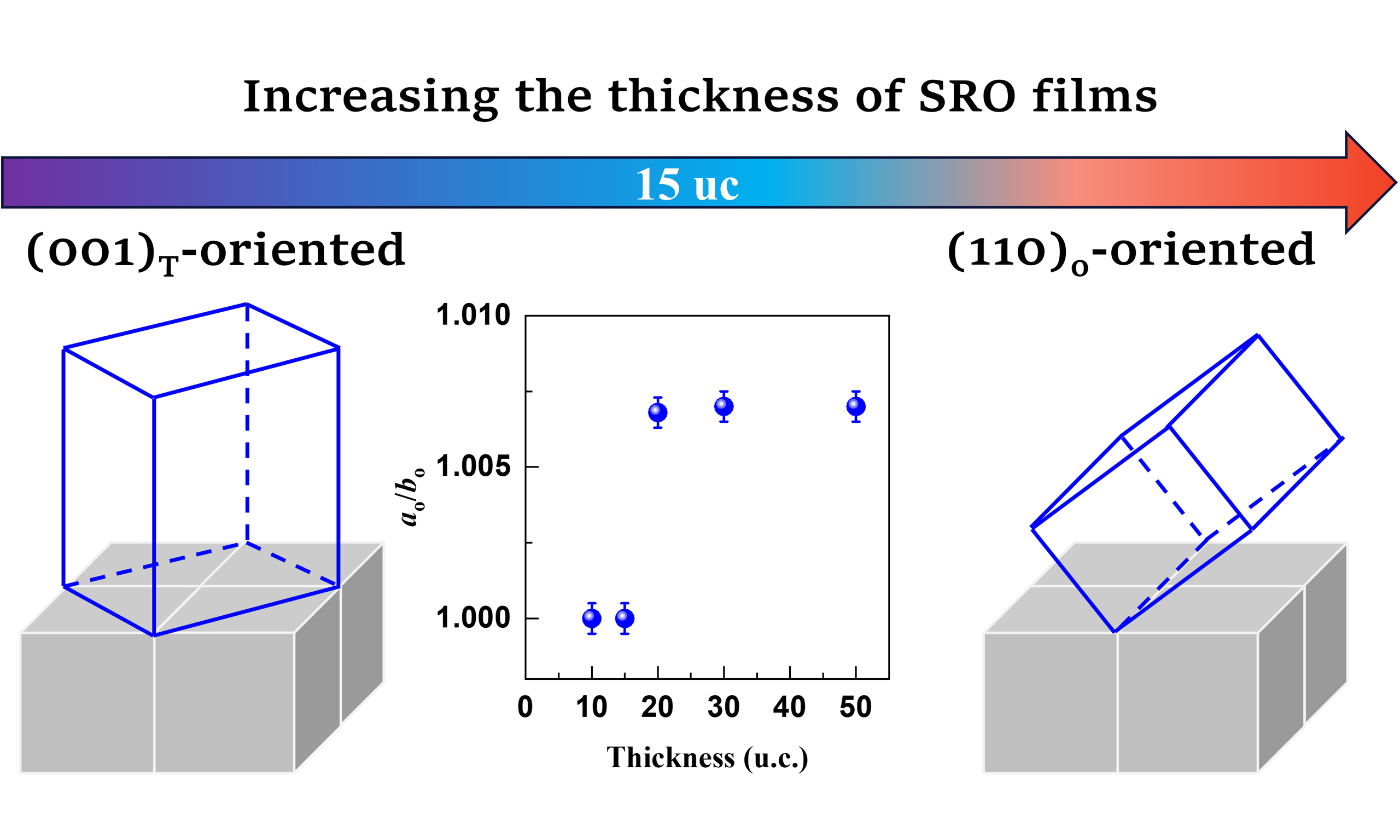
In transition metal oxides, strong electron, spin, and lattice correlations originating from d-p orbital hybridization govern their functional properties. These functional properties are highly sensitive to their lattice symmetry. Here we demonstrate the control of crystal symmetry in SrRuO3 by engineering a SrTiO3/SrRuO3 heterointerface with atomic-scale thickness variation. Proximity to the cubic SrTiO3 substrate can induce a non-tilted RuO6 configuration, stabilizing a tetragonal phase in ultrathin SrRuO3. As the thickness of SrRuO3 film increases, the structure transitions toward a monoclinic-distorted orthorhombic symmetry. High-resolution X-ray diffraction confirms this evolution. The films within the critical thickness range exhibit tetragonal symmetry, enhanced saturation magnetization, and isotropic in-plane magnetism, whereas thicker films become a monoclinic-distorted orthorhombic phase with strong in-plane magnetic anisotropy. This work establishes oxygen octahedral engineering as a powerful method for tailoring magnetic anisotropies in transition metal oxides.
Keywords


 Download PDF
INTRODUCTION
Quantum materials are a class of matter whose macroscopic properties are governed by quantum mechanical effects[1,2]. Owing to their unique quantum behaviors, these systems have attracted extensive research interest for their promising applications in quantum technologies and spintronics[3]. Among them, a family of 4d ruthenium oxides has garnered particular attention. These materials are typically excellent conductors featuring ruthenium in the Ru4+ oxidation state. For instance, RuO2 has recently been identified as a prototypical altermagnet[4,5]. Its crystal structure features opposite-spin sublattices connected via rotational symmetry, a unique spin group, zero net magnetization, and a characteristic d-wave pattern of time-reversal symmetry-breaking spin splitting on its Fermi surfaces. Sr2RuO4, with a superconducting critical temperature of 1.5 K, most likely exhibits a chiral p-wave spin-triplet state with broken time-reversal symmetry, although its precise order parameter remains under debate[6-8]. SrRuO3 (SRO) stands as a ferromagnetic Weyl semimetal that exhibits nonmonotonic temperature dependence of both anomalous Hall conductivity and spin-wave gap[9-11]. For the 4d ferromagnetic SRO, the magnetic properties are highly sensitive to its lattice symmetry[12-14]. This symmetry can be tuned via oxygen displacements from their face-center sites, which alter the transition metal-oxygen bond lengths and angles[15,16]. These structural changes manifest as tilts or rotations of the oxygen octahedra. Although epitaxial strain is a common tool for manipulating the octahedral distortions, the structural changes it produces are complex. Recently, the results demonstrate that interface engineering of the oxygen coordination environment allows one to control additional degrees of freedom in SRO films[17,18]. Interface engineering has thus been recognized as a promising route for controlling the octahedral tilts in the heterostructure. The interfacial coupling has a short impact length scale, unlike strain. This allows us to tailor the structural symmetry and magnetic properties by controlling the thickness of SRO films, rather than introducing oxygen vacancies in previous work[13,19]. Introducing defects can affect the magnetic moment for SRO film.
In this Article, we modulate the crystal symmetry of SRO by fabricating a SrTiO3 (STO)/SRO heterointerface with mismatched lattice symmetry and exerting atomic-level control over the SRO layer thickness. Near the STO/SRO interface, the RuO6 follows the non-tilted STO structure due to the cubic symmetry in STO, thereby suppressing octahedral tilting in ultrathin SRO films and stabilizing a tetragonal phase. As the film thickness increases, the octahedral tilts in thicker films approach the orthorhombic symmetry in SRO. Experimentally, high-resolution X-ray diffraction (XRD) is used to confirm such a structural symmetry transition. The corresponding critical thickness is about 15-unit cells (uc). Below 15 uc of thickness, the SRO films exhibit a tetragonal lattice symmetry, enhanced saturation magnetization, and isotropic in-plane magnetic behavior. In contrast, beyond 15 uc, the SRO lattice symmetry is monoclinic-distorted orthorhombic, similar as bulk SRO, with a strong in-plane magnetic anisotropy. As a result, we demonstrate the control of the lateral magnetic anisotropies by atomic-scale symmetry design of the oxygen coordination environment in SRO films.
MATERIALS AND METHODS
Epitaxial SRO thin films with different thicknesses were prepared on the TiO2-terminated (001) STO substrates via pulsed laser deposition (PLD). Film growth was performed using a KrF excimer laser (248 nm wavelength) with a laser fluence of 2 J cm-2 and a repetition rate of 13 Hz, under an oxygen atmosphere of 100 mTorr and a substrate temperature of 680 °C. A commercial 99.99%-purity SRO ceramic target (Kurt J. Lesker Company) was adopted for deposition, with the target-substrate distance fixed at 4.5 cm. The film thickness was monitored in situ by reflection high-energy electron diffraction (RHEED) throughout the growth process [Supplementary Figure 1]. To explore the thickness-dependent structural phase evolution and magnetic anisotropy of SRO films, samples with thicknesses of 10, 15, 20, 30, and 50 uc were prepared and systematically investigated.
The crystal structure of the epitaxial SRO films was characterized by XRD, including a 2θ-ω scan of the (002) reflection and reciprocal space mapping of the STO substrate (204) peak at φ = 0°, 90°, 180°, and 270°. Surface topography was investigated by atomic force microscopy (AFM) over a scanning area of 5 × 5 μm2. Magnetic hysteresis (M-H) loops were acquired at 10 K using a Quantum Design superconducting quantum interference device (SQUID) magnetometer (MPMS) along the (100), (010), and (001) crystallographic orientations of the STO substrate. Hall transport properties were evaluated with a physical property measurement system (PPMS).
RESULTS AND DISCUSSION
Figure 1A displays the schematic diagram of SRO thin films grown on STO substrates. Figure 1B presents the XRD 2θ-ω scan spectrum of the as-prepared SRO films. Clear Laue fringes around the SRO (002) diffraction peak are observed for our epitaxial SRO films on STO substrates. We further performed XRD rocking curve measurements on all SRO thin films, as presented in Supplementary Figure 2. Narrow full width at half-maximum (FWHM) values of 0.105°, 0.098°, 0.093°, 0.082°, and 0.076° were obtained for the SRO (002) diffraction peaks corresponding to film thicknesses of 10, 15, 20, 30, and 50 uc, respectively. The presence of pronounced Laue oscillations and sharp rocking curves demonstrates the high crystalline uniformity of the SRO films on STO substrates. With increasing SRO film thickness, the SRO (002) diffraction peaks gradually shift toward higher Bragg angles, indicating a lattice shortening along the out-of-plane c-axis. The pseudo-cubic c-axis lattice parameters extracted from the SRO (002) peak positions are plotted as a function of film thickness in Figure 1C, which reveals a monotonic decrease in the c-lattice constant with increasing film thickness. Additionally, AFM characterization reveals a uniform step-terrace morphology for the 10 uc SRO film, demonstrating an atomically smooth surface [Figure 1D]. SRO films with different thicknesses exhibit analogous step-terrace surface topography, with only minor variations in terrace width stemming from slight differences in the cutting angle of commercial STO substrates [Supplementary Figure 3]. These morphological features further verify the excellent epitaxial quality of the SRO films.
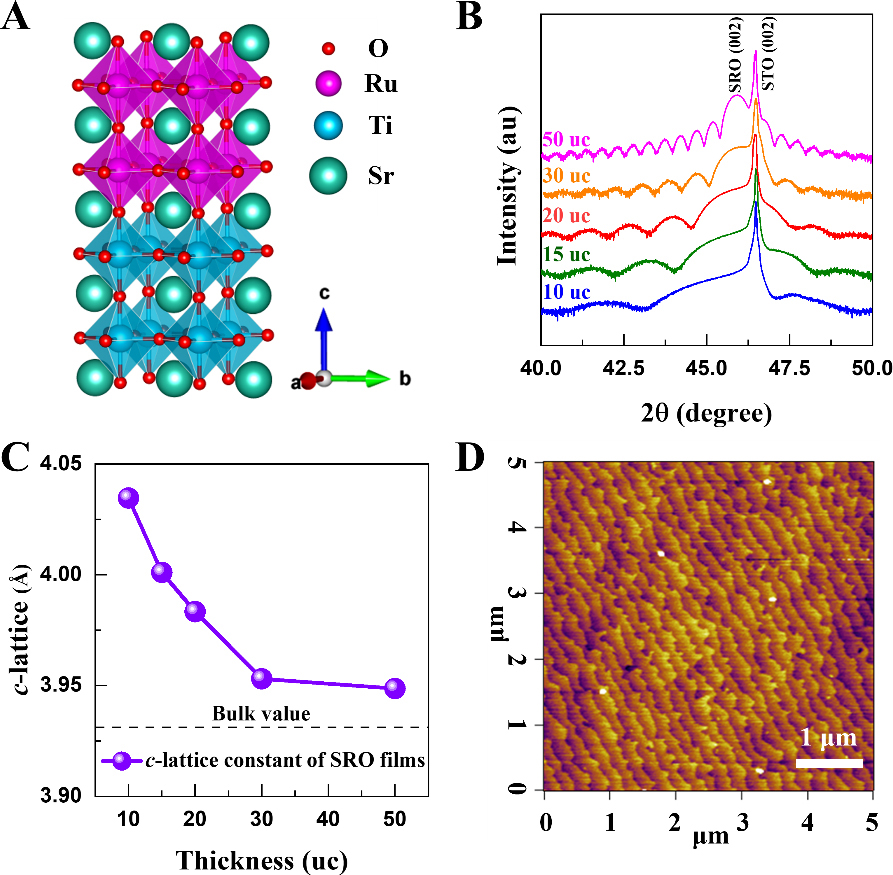
Figure 1. Structural characterization of SRO films grown on STO (001) substrates at room temperature. (A) Schematics of the SRO and STO crystal structure; (B) 2θ-ω XRD scans of the epitaxial SRO films around the STO (002) peak with variable thickness; (C) Lattice constant c vs. thickness of SRO film. The black dotted line represents the pseudo-cubic c-lattice of bulk SRO; (D) The AFM topography images of the SRO film, offering a visual representation of its surface. SRO: SrRuO3; STO: SrTiO3; XRD: X-ray diffraction; AFM: atomic force microscopy; uc: unit cells.
The crystal structure of the SRO film was further examined by reciprocal space mappings (RSMs) using high-resolution XRD (HRXRD). RSMs were acquired around the asymmetric STO (204) Bragg reflection at φ = 0°, 90°, 180°, and 270° to evaluate the epitaxial strain and structural coherence of SRO films. We observe that the structural symmetry of SRO films changes from tetragonal to monoclinic-distorted orthorhombic with increasing the thickness of SRO films. Figure 2A presents the RSM results for 15 uc SRO films. Note that the z direction corresponds to the out-of-plane direction of the sample surface plane. Both the film and substrate peaks exhibit the same QX values across the RSM patterns, demonstrating that all films are coherently strained to match that of the STO substrate and possess identical in-plane lattice parameters. For the 15 uc SRO film, the diffraction peaks occur at the same QZ value across different azimuthal φ angles, which is characteristic of a tetragonal structure[20,21]. The corresponding structural schematic of the tetragonal phase is illustrated in Figure 2B[13]. The out-of-plane orientation is along the (001)T of SRO with a notably elongated lattice constant cT. In this configuration, the Ru-O-Ru bond angle θ, which determines the octahedral tilting degree calculated as (180º-θ)/2, aligns along the out-of-plane direction. In contrast, the 30 uc SRO film shows distinct QZ variations at different azimuthal φ angles, verifying a monoclinic-distorted orthorhombic structure [Figure 2C], and the corresponding structural schematic is presented in Figure 2D. Here, the out-of-plane direction corresponds to the (110)o plane of SRO, while the co axis lies in the film plane and is fully constrained by the substrate. In this case, the Ru-O-Ru bond angle θ tilts along the in-plane direction. We determined the room-temperature lattice parameters of the 30 uc SRO film as ao = 5.58 Å, bo = 5.54 Å, co = 7.81 Å, αo = βo = 90o, and γo = 89.3o. To distinguish between orthorhombic and tetragonal phases, we define an orthorhombicity factor as the ratio ao/bo[21]. The orthorhombicity factor is 1.007 for 30 uc SRO film. In contrast, for the 15 uc film, the orthorhombicity factor is 1.000. The thickness-dependent evolution of ao/bo is summarized in Figure 3. The plotted trend reveals that lattice symmetry transition takes place at a critical thickness of 15 uc, which is in good agreement with previous studies[21]. SRO films with thicknesses above the critical value adopt a stable monoclinic-distorted orthorhombic phase, while thinner films retain the tetragonal phase.
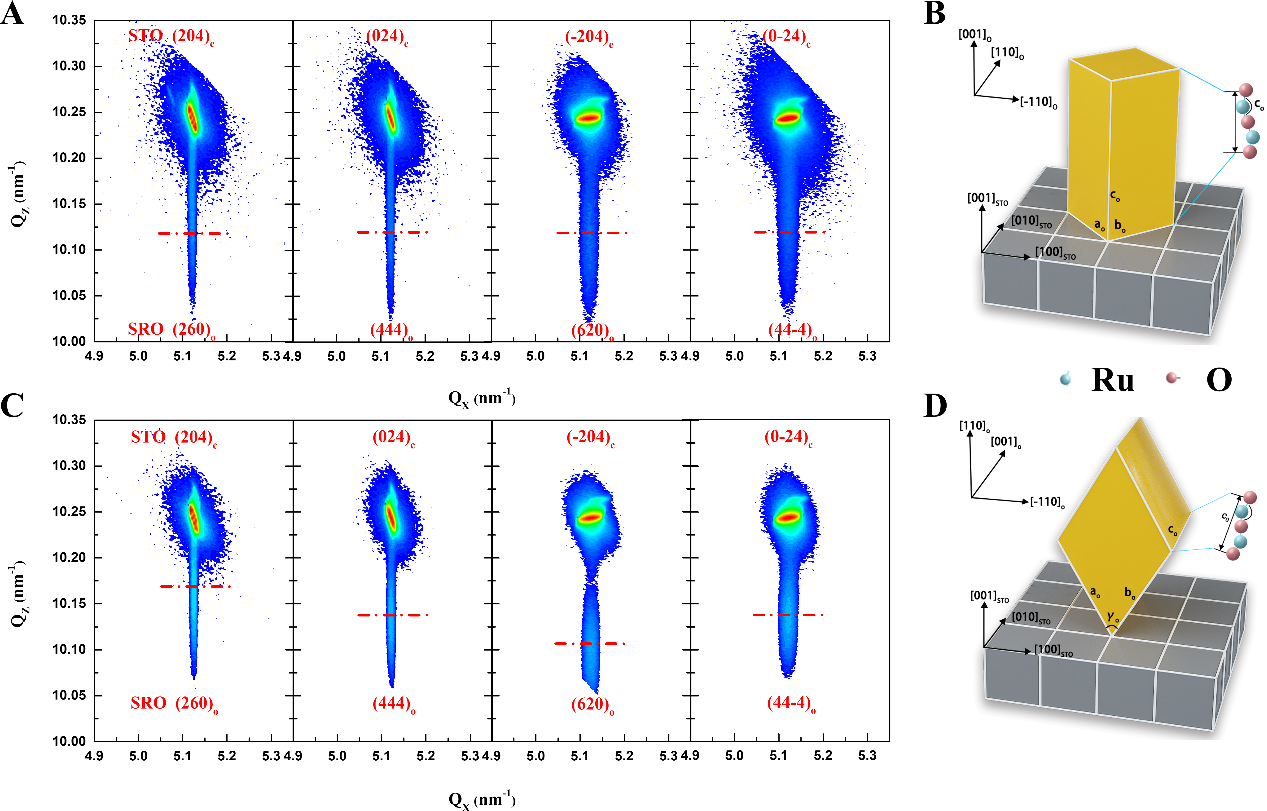
Figure 2. (A) RSMs of 15 uc SRO films grown on STO substrates measured at room temperature; (B) Corresponding schematic diagram illustrating the tetragonal structure of SRO films grown on STO substrates; (C) RSMs of 30 uc SRO films grown on STO substrates measured at room temperature; (D) Schematic diagram showing the orthorhombic structure of SRO films grown on STO substrates. The peak positions of the SRO (260)o, (444)o, (620)o, and (44-4)o reflections, corresponding to STO (204), (024), (-204), and (0-24), respectively. Figure 2B and D, adapted from[13], Copyright 2013, AIP Publishing. SRO: SrRuO3; STO: SrTiO3; RSMs: reciprocal space mappings.
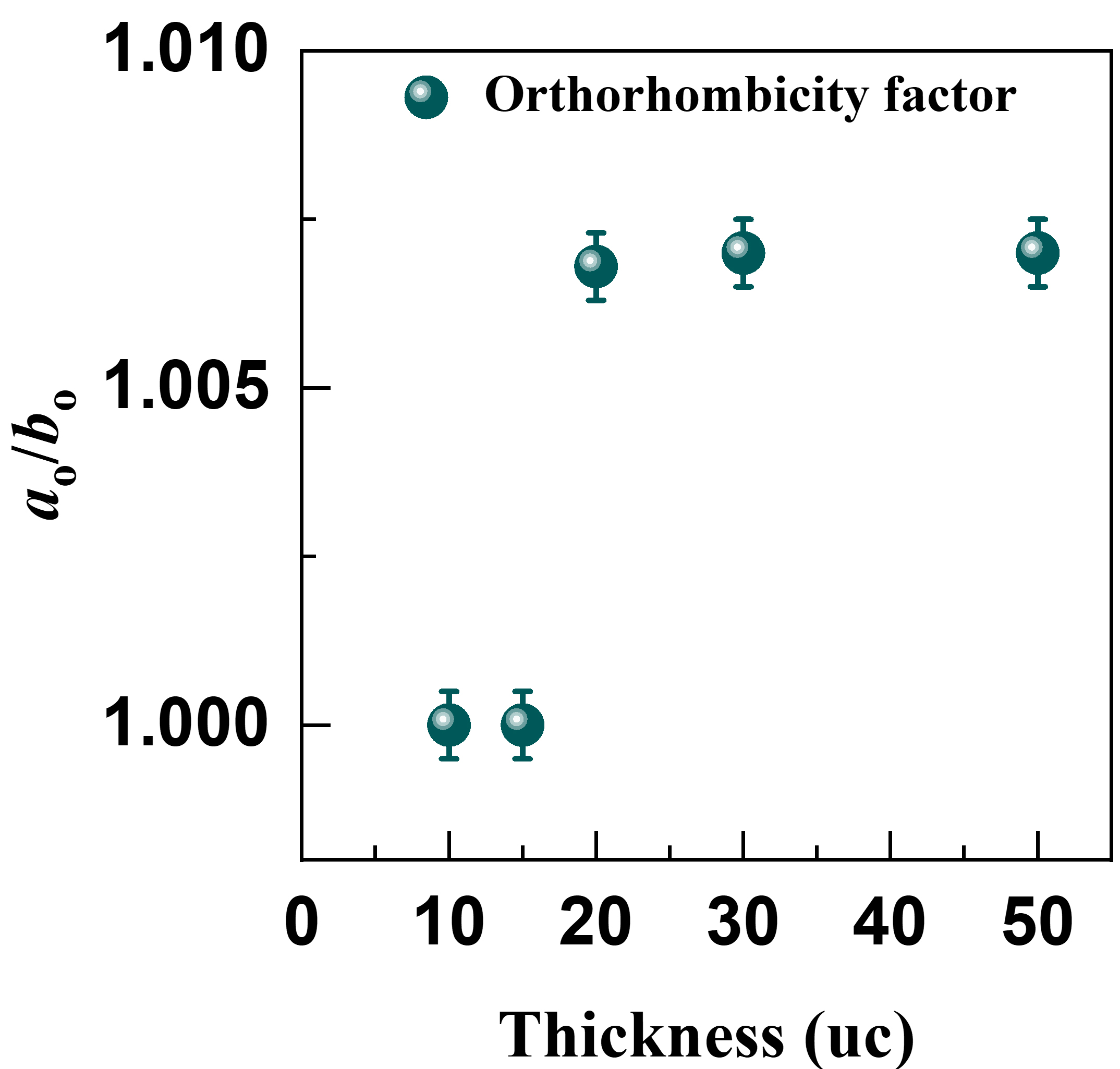
Figure 3. The orthorhombicity factor (ao/bo) at room temperature as a function of SRO film thickness. The abrupt change signifies a structural phase transition from tetragonal to monoclinic-distorted orthorhombic. The error bars represent the standard error, derived from the peak position of RSM measurements. SRO: SrRuO3; RSM: reciprocal space mapping; uc: unit cells.
The octahedral tilt angle of SRO thin films, which correlates structural symmetry with internal lattice distortion, can be quantitatively calculated from the orthorhombicity factor through the following empirical formula:
Here, the ratio boct/aoct denotes the bond length in a RuO6 octahedron. As previously reported, this value is close to 1.0, and its variation is negligible during oxygen octahedral rotation, owing to the unchanged strain state. Therefore, the octahedral tilt angle is predominantly governed by the orthorhombicity factor ao/bo. For a 30 uc SRO film, the measured orthorhombicity factor of 1.007 corresponds to an octahedral tilt angle of approximately 6.8º, which is slightly lower than the bulk SRO value of ~10º[22]. This comparison demonstrates that thicker films are capable of achieving octahedral distortion magnitudes close to those of bulk SRO. In contrast, the orthorhombicity factor is 1.000 for 15 uc SRO film, indicating a complete suppression of octahedral tilting in the tetragonal SRO films. Such a tetragonal phase differs fundamentally from the orthorhombic structure of bulk SRO, demonstrating that continuous oxygen octahedral connectivity across the interface modulates the phase stability of ultrathin SRO films. This underscores the vital role of the interface-tailored oxygen coordination environment in governing the structural evolution of the SRO layer. From the correlation between ao/bo and the SRO film thickness, the impact of the octahedral coupling can maintain about 15 uc. Given the absence of TiO6 octahedral tilting in STO substrate, the RuO6 tilting in the SRO film is suppressed to maintain oxygen octahedral continuity across the STO/SRO interface. This interfacial suppression effect gradually weakens with increasing distance from the interface and completely disappears beyond the critical thickness of 15 uc.
Given that the RuO6 octahedral tilt strongly influences hybridization between Ru 4d and O p orbitals, the magnetic anisotropy of the SRO layer in STO/SRO heterostructures can be governed by the interfacial Ru-O-Ti bond angle for ultrathin SRO films. Figure 4A and B presents the M-H curves for 15 uc and 30 uc SRO films at 10 K, respectively. The 30 uc orthorhombic SRO film exhibits an out-of-plane easy axis with a saturation magnetization of 185 emu/cm3 and anisotropic projections along the [1-10]o {[100]c} and [001]o {[010]c} directions. Here c represents the pseudo-cubic structure. In contrast, the 15 uc tetragonal SRO film also exhibits an out-of-plane easy axis, accompanied by a high saturation magnetization of 330 emu/cm3 and isotropic in-plane magnetic hysteresis loops. This distinct difference in saturation magnetization and in-plane magnetic anisotropy stems from the structural symmetry transition of SRO films. Figure 4C presents the saturation magnetization of SRO films as a function of film thickness, measured with the magnetic field applied along the STO [001]c, [100]c, and [010]c directions. When the field is aligned along the out-of-plane [001]c direction, the saturation magnetization decreases monotonically with increasing SRO film thickness [Supplementary Figure 4]. This trend exhibits a strong correlation with the variation of the c-axis lattice constant. Such a correlation originates from c-axis lattice elongation, which weakens the orbital overlap between Ru 4d and O 2p states along the out-of-plane direction[23]. The reduced orbital overlap suppresses the quenching of orbital magnetic moments, thereby boosting the saturation magnetization of ultrathin SRO films. In contrast, the saturation magnetization along both [100]c and [010]c directions follow a non-monotonic trend, increasing first to a maximum and then declining with increased film thickness. This transition occurs at a thickness of 15 uc, which aligns well with the structural transition from the tetragonal to the monoclinic-distorted orthorhombic phase. It is noteworthy that for film thicknesses exceeding 15 uc, the saturation magnetization along the in-plane [100]c and [010]c directions exhibit a clear separation, further evidencing anisotropic in-plane magnetization in monoclinic-distorted orthorhombic SRO films. Such anisotropic magnetic behavior could be attributed to the symmetry change of the unit cell. Similar anisotropic behaviors, including in-plane magnetization and resistivity anisotropy, have also been reported in manganite films grown on orthorhombic substrates such as NdGaO3 and DyScO3[24-26]. The thickness-dependent evolution of coercivity is further presented in Figure 4D. For the out-of-plane [001]c direction, the coercivity exhibits a slight increase with increasing film thickness. In contrast, for the in-plane [100]c and [010]c directions, the coercivity presents obvious difference between the tetragonal and orthorhombic phases. The result indicates that the in-plane magnetization of tetragonal SRO films is more easily switched than that of monoclinic-distorted orthorhombic SRO films.
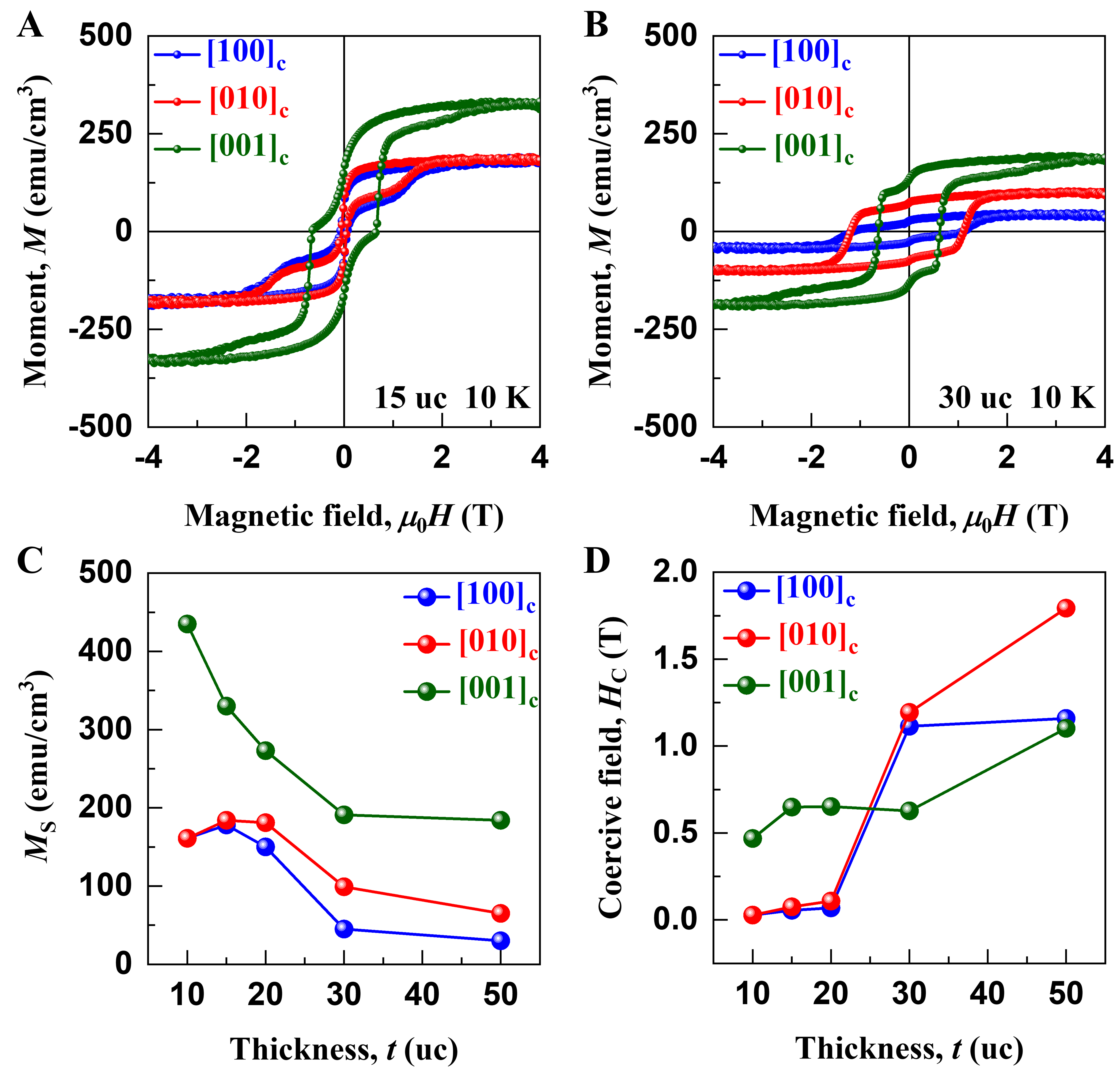
Figure 4. The curve of magnetization vs magnetic field at 10 K. (A) 15 uc and (B) 30 uc sample; (C) and (D) the saturation magnetization and coercive field as a function of the thickness of SRO film, respectively. SRO: SrRuO3; uc: unit cells.
To elucidate the in-plane magnetic anisotropy in SRO films, we investigate its correlation with octahedral rotation, a structural modulation that couples lattice distortion to magnetic characteristics. As illustrated in Figure 2B, the Ru-O-Ru bond angle θ in tetragonal SRO films aligns along the out-of-plane direction. The crystal structure remains symmetric along the in-plane [100]c and [010]c directions, leading to isotropic in-plane magnetization. In comparison, the monoclinic-distorted orthorhombic SRO films feature an in-plane-oriented Ru-O-Ru bond angle θ that breaks the structural symmetry, thereby giving rise to anisotropic in-plane magnetic behavior [Figure 2D]. This anisotropy originates from the high susceptibility of magnetic coupling in SRO systems to the orbital overlap between Ru 4d and O 2p orbitals. In orthorhombic SRO films, the anisotropic in-plane Ru-O-Ru bonding effectively modulates such orbital overlap, which ultimately induces the formation of the anisotropic in-plane magnetic moment. The anisotropic orbital overlap also causes the low-temperature resistivity anisotropy, observed in the La0.7Sr0.3MnO3 (LSMO) film on the DyScO3 (DSO) substrate[26].
Figure 5A presents the anomalous Hall effect (AHE) measurements of SRO films at 10 K. The transverse resistivity, ρxy, of SRO films can be expressed as:
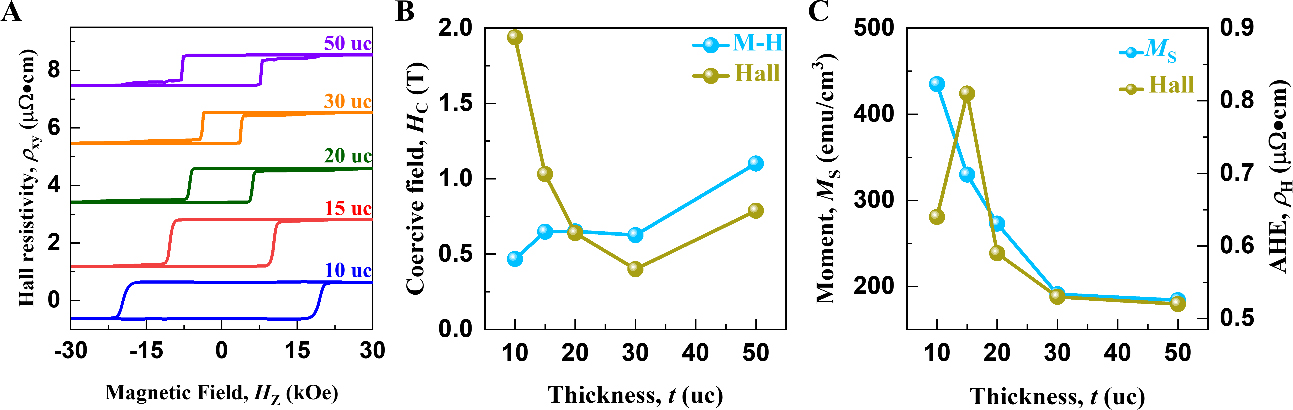
Figure 5. (A) The anomalous Hall effect (AHE) hysteresis loops for the SRO films at 10 K. Note that the OHE background and magnetoresistance contribution have already been subtracted; (B) The coercivity field of the AHE data and the out-of-plane M-H loops as a function of the film thickness; (C) Depiction of the saturation magnetization and saturation AHE resistivity as a function of the film thickness. SRO: SrRuO3; AHE: anomalous Hall effect; OHE: ordinary Hall effect; HZ: out-of-plane magnetic field; uc: unit cells.
where ρOHE = R0H corresponds to the ordinary Hall effect, with the ordinary Hall coefficient R0 and the out-of-plane magnetic field H. The linear field-dependent ρOHE component has been subtracted from the raw data. Meanwhile, ρAHE = RAM represents the AHE, where RA is the anomalous Hall coefficient and M is the out-of-plane magnetization. The anomalous component of transverse Hall resistivity ρxy as a function of HZ exhibits nearly 100% remanence and sharp magnetization reversal for all measured samples, indicative of robust perpendicular magnetic anisotropy (PMA). Notably, the tetragonal SRO film exhibits a distinct discrepancy in coercivity between the AHE measurement and the out-of-plane M-H curve [Figure 5B]. As displayed in Supplementary Figure 5, the out-of-plane M-H loop of the 10 uc SRO film can be decomposed into two superimposed hysteresis components: MI-H with low coercivity and high saturation magnetization, and MT-H with high coercivity and low saturation magnetization. The out-of-plane M-H loop was fitted using[27]:
where the first and second terms on the two M-H contributions: MI-H and MT-H loops. MS-I (MS-T) and Hc-I (Hc-T) are the saturation magnetization and coercivity, respectively, of the MI-H (MT-H) loop. HI and HT are two fitting constants. The coercivity values extracted from AHE measurements are highly consistent with those of the MT-H component. As reported in previous studies, MI-H response originates from the interfacial ferromagnetic insulating phase of the SRO layer. This phase emerges within the 3-4 uc region near the substrate interface due to abundant oxygen vacancies[28,29]. Such an interfacial phase makes no contribution to the AHE signal. Although the MI-H component exists in SRO films of all thicknesses, its relative contribution gradually declines as the film thickness increases. According to Equation 2, the saturation anomalous Hall resistivity, ρH, should be proportional to the saturation magnetization. Nevertheless, an obvious discrepancy between the trends of ρH and the saturation magnetization is observed in the tetragonal SRO film [Figure 5C]. This abnormal phenomenon can be attributed to a significant contribution from the interfacial insulating phase to the magnetic moment in ultrathin films.
CONCLUSIONS
In summary, we realize atomic-scale modulation of magnetic anisotropy in SRO thin films via thickness-engineered structural phase transition. The cubic STO substrate effectively suppresses RuO6 octahedral tilting at the heterointerface, which stabilizes the tetragonal phase in ultrathin SRO films below the critical thickness. Such tetragonal symmetry endows the films with enhanced saturation magnetization and isotropic in-plane magnetic behavior. In contrast, SRO films thicker than the critical dimension undergo a structural transition to the monoclinic-distorted orthorhombic phase, triggering the emergence of prominent in-plane magnetic anisotropy. These findings demonstrate that precise modulation of oxygen octahedral coupling at oxide heterointerfaces offers an effective strategy for artificially tailoring the functional magnetic properties of correlated oxide systems.
DECLARATIONS
Acknowledgments
The authors thank the support of SUSTech Core Research Facilities.
Authors’ contributions
Made substantial contributions to the conception and design of the study and performed data analysis and interpretation, writing-original draft: Xu, Z.
Performed data acquisition and provided administrative, technical, and material support: Chai, L.; Hu, S.; Ye, M.; Chen, S.
Funding, source, and supervisor: Jiang, Y.; Chen, L.
Availability of data and materials
The data supporting the findings of this study are available within this Article and its Supplementary Materials. Further data are available from the corresponding authors upon request.
AI and AI-assisted tools statement
Not applicable.
Financial support and sponsorship
This work is supported partially by National Key Research and Development Program of China (Nos. 2022YFA1204003, 2022YFA1402903, 2022YFA1402601), National Natural Science Foundation of China (Nos. 52271186, 52571230, U24A6002, 12574096, 12504076), Tianjin Key Laboratory of Optoelectronic Detection Technology and System (No. 2024LODTS101), Shenzhen Fundamental Research Program (Grant No. JCYJ20250604144519025).
Conflicts of interest
All authors declared that there are no conflicts of interest.
Ethical approval and consent to participate
Not applicable.
Consent for publication
Not applicable.
Copyright
© The Author(s) 2026.
Supplementary Materials
REFERENCES
2. Tokura, Y.; Kawasaki, M.; Nagaosa, N. Emergent functions of quantum materials. Nat. Phys. 2017, 13, 1056-68.
4. Šmejkal, L.; Sinova, J.; Jungwirth, T. Beyond conventional ferromagnetism and antiferromagnetism: a phase with nonrelativistic spin and crystal rotation symmetry. Phys. Rev. X. 2022, 12, 031042.
5. Song, C.; Bai, H.; Zhou, Z.; et al. Altermagnets as a new class of functional materials. Nat. Rev. Mater. 2025, 10, 473-85.
6. Maeno, Y.; Ikeda, A.; Mattoni, G. Thirty years of puzzling superconductivity in Sr2RuO4. Nat. Phys. 2024, 20, 1712-8.
7. Grinenko, V.; Das, D.; Gupta, R.; et al. Unsplit superconducting and time reversal symmetry breaking transitions in Sr2RuO4 under hydrostatic pressure and disorder. Nat. Commun. 2021, 12, 3920.
8. Grinenko, V.; Ghosh, S.; Sarkar, R.; et al. Split superconducting and time-reversal symmetry-breaking transitions in Sr2RuO4 under stress. Nat. Phys. 2021, 17, 748-54.
9. Itoh, S.; Endoh, Y.; Yokoo, T.; et al. Weyl fermions and spin dynamics of metallic ferromagnet SrRuO3. Nat. Commun. 2016, 7, 11788.
10. Lin, W.; Liu, L.; Liu, Q.; et al. Electric field control of the magnetic Weyl fermion in an epitaxial SrRuO3 (111) thin film. Adv. Mater. 2021, 33, e2101316.
11. Kar, U.; Singh, A. K.; Hsu, Y.; et al. The thickness dependence of quantum oscillations in ferromagnetic Weyl metal SrRuO3. npj. Quantum. Mater. 2023, 8, 540.
12. Lu, W.; Yang, P.; Song, W. D.; Chow, G. M.; Chen, J. S. Control of oxygen octahedral rotations and physical properties in SrRuO3 films. Phys. Rev. B. 2013, 88.
13. Lu, W.; Dong Song, W.; He, K.; et al. The role of octahedral tilting in the structural phase transition and magnetic anisotropy in SrRuO3 thin film. J. Appl. Phys. 2013, 113, 063901.
14. Koster, G.; Klein, L.; Siemons, W.; et al. Structure, physical properties, and applications of SrRuO3 thin films. Rev. Mod. Phys. 2012, 84, 253-98.
15. Singh, A. K.; Yang, S.; Kar, U.; et al. Evolution of the structural phase and orientation in ultrathin SrRuO3 film with SrTiO3 capping layer. Sci. Rep. 2025, 15, 17841.
16. Rondinelli, J. M.; Spaldin, N. A. Structure and properties of functional oxide thin films: insights from electronic-structure calculations. Adv. Mater. 2011, 23, 3363-81.
17. Kan, D.; Aso, R.; Sato, R.; Haruta, M.; Kurata, H.; Shimakawa, Y. Tuning magnetic anisotropy by interfacially engineering the oxygen coordination environment in a transition metal oxide. Nat. Mater. 2016, 15, 432-7.
18. Jeong, S. G.; Han, G.; Song, S.; et al. Propagation control of octahedral tilt in SrRuO3 via artificial heterostructuring. Adv. Sci. 2020, 7, 2001643.
19. Lee, S. A.; Oh, S.; Hwang, J.; et al. Enhanced electrocatalytic activity via phase transitions in strongly correlated SrRuO3 thin films. Energy. Environ. Sci. 2017, 10, 924-30.
20. Kan, D.; Aso, R.; Kurata, H.; Shimakawa, Y. Epitaxial strain effect in tetragonal SrRuO3 thin films. J. Appl. Phys. 2013, 113, 173912.
21. Chang, S. H.; Chang, Y. J.; Jang, S. Y.; et al. Thickness-dependent structural phase transition of strained SrRuO3 ultrathin films: the role of octahedral tilt. Phys. Rev. B. 2011, 84, 104101.
22. Zayak, A. T.; Huang, X.; Neaton, J. B.; Rabe, K. M. Structural, electronic, and magnetic properties of SrRuO3 under epitaxial strain. Phys. Rev. B. 2006, 74, 094104.
23. Grutter, A. J.; Wong, F. J.; Jenkins, C. A.; Arenholz, E.; Vailionis, A.; Suzuki, Y. Stabilization of spin-zero Ru4+ through epitaxial strain in SrRuO3 thin films. Phys. Rev. B. 2013, 88, 214410.
24. Liao, Z.; Huijben, M.; Zhong, Z.; et al. Controlled lateral anisotropy in correlated manganite heterostructures by interface-engineered oxygen octahedral coupling. Nat. Mater. 2016, 15, 425-31.
25. Zhou, G.; Ji, H.; Yan, Z.; et al. Interfacial engineering manipulation of magnetic anisotropy evolution via orbital reconstruction in low-dimensional manganite superlattices. Sci. China. Mater. 2022, 65, 1902-11.
26. Wang, B.; You, L.; Ren, P.; et al. Oxygen-driven anisotropic transport in ultra-thin manganite films. Nat. Commun. 2013, 4, 2778.
27. Li, P.; Ding, J.; Zhang, S. S.; et al. Topological hall effect in a topological insulator interfaced with a magnetic insulator. Nano. Lett. 2021, 21, 84-90.
28. Ishigami, K.; Yoshimatsu, K.; Toyota, D.; et al. Thickness-dependent magnetic properties and strain-induced orbital magnetic moment in SrRuO3 thin films. Phys. Rev. B. 2015, 92, 064402.
Cite This Article
 Open Access
How to Cite
Xu, Z.; Chai, L.; Hu, S.; Ye, M.; Chen, S.; Jiang, Y.; Chen, L. Control of magnetic anisotropy in epitaxial SrRuO3 via oxygen octahedral engineering. Microstructures 2026, 6, 20260135. https://dx.doi.org/10.20517/microstructures.2026.39
Download Citation
If you have the appropriate software installed, you can download article citation data to the citation manager of your choice. Simply select your manager software from the list below and click on download.
Export Citation File
Type of Import
Tips on Downloading Citation
Citation Manager File Format
Type of Import
Direct Import: When the Direct Import option is selected (the default state), a dialogue box will give you the option to Save or Open the downloaded citation data. Choosing Open will either launch your citation manager or give you a choice of applications with which to use the metadata. The Save option saves the file locally for later use.
Indirect Import: When the Indirect Import option is selected, the metadata is displayed and may be copied and pasted as needed.
About This Article
Copyright

Data & Comments
Data
0











Comments
Comments must be written in English. Spam, offensive content, impersonation, and private information will not be permitted. If any comment is reported and identified as inappropriate content by OAE staff, the comment will be removed without notice. If you have any queries or need any help, please contact us at [email protected].