




Synergistic regulation of barocaloric and magnetocaloric effects in Ni2MnGa: a quantitative phase field study
 0
0 Abstract
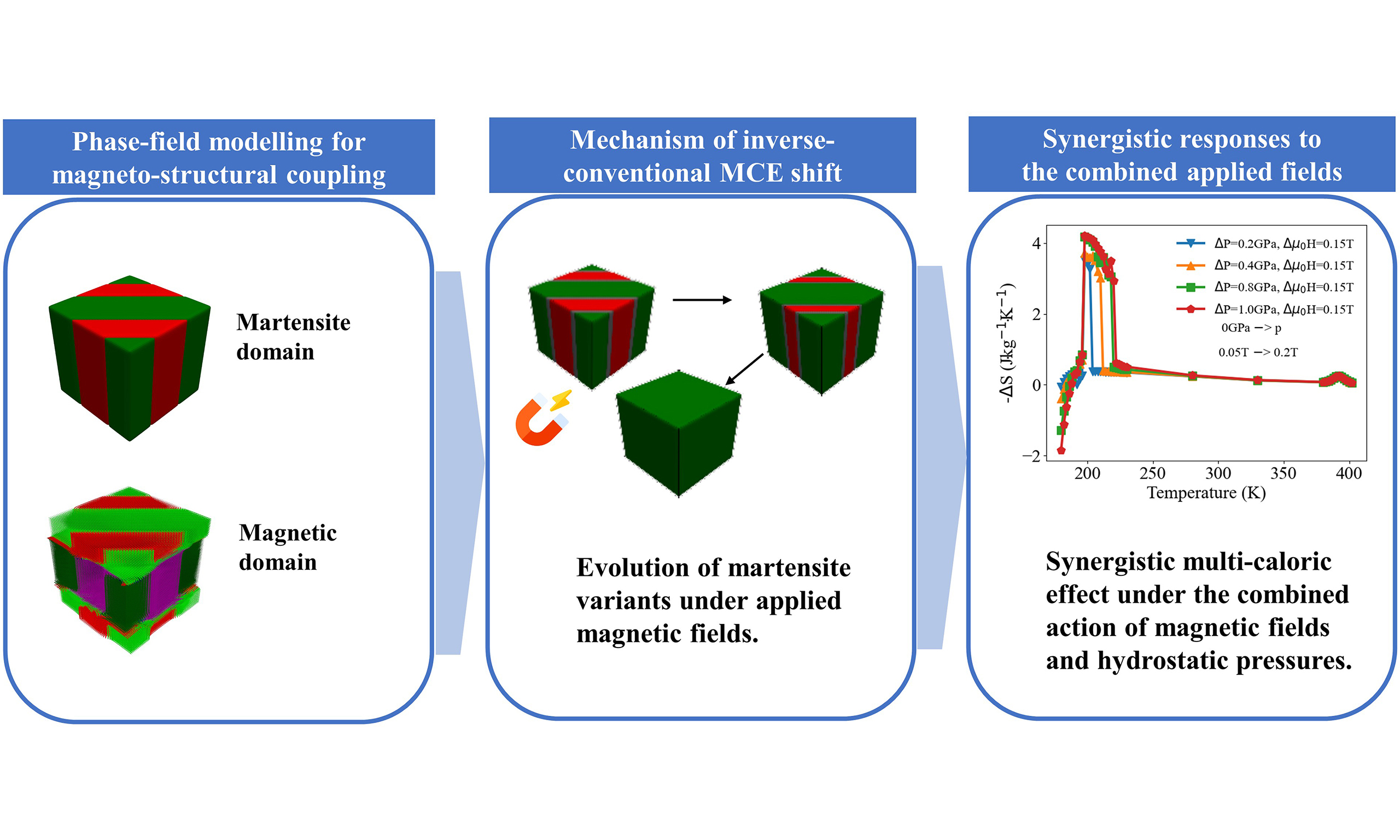
The central challenge in achieving efficient solid-state refrigeration is the harnessing of the synergistic interplay between barocaloric and magnetocaloric effects. In this study, a quantitative phase-field model is developed to elucidate the cooperative enhancement mechanism of multicaloric effects under coupled fields in the ferromagnetic shape-memory alloy Ni2MnGa. As demonstrated by simulations, the application of hydrostatic pressure results in a linear increase in the martensitic transformation temperature by approximately 24 K/GPa. Concurrently, this pressure-induced process generates a substantial barocaloric response. In the context of the magnetocaloric effect, an anomalous non-monotonic behaviour emerges in proximity to the phase transition. The application of weak magnetic fields results in an inverse magnetocaloric effect, characterised by a positive magnetocaloric coefficient (ΔS > 0), while strong fields reverse this effect, resulting in a negative magnetocaloric coefficient (ΔS < 0). Microstructural analysis corroborates the underlying cause of this effect as being attributed to magneto-structural entropy changes. It is imperative to note that hydrostatic pressure exerts a significant suppression effect on this anomalous magnetocaloric response. Furthermore, the synergistic application of 1GPa pressure and a 0.75 T magnetic field yields an entropy change |ΔS| of 4.46 J·kg-1·K-1, which exceeds the sum of the individual field effects, thereby demonstrating positive magnetoelastic coupling for synergistic enhancement. The present study offers significant theoretical and simulation-based insights into the design of high-performance multicaloric cooling materials.
Keywords
INTRODUCTION
Confronted with mounting environmental challenges, researchers across disciplines are dedicated to developing innovative technologies. In the refrigeration field, solid-state refrigeration has emerged as an environmentally friendly technology with enormous application potential, serving as a promising alternative to the currently dominant vapor compression refrigeration (VCR) technology. In fact, solid-state refrigeration has gradually garnered significant attention from the research community and industry. Solid-state refrigeration is fundamentally based on the caloric effect, which encompasses four categories: magnetocaloric effect (MCE), electrocaloric effect (ECE), elastocaloric effect (eCE), and barocaloric effect (BCE)[1]. These effects correspond to the thermal responses of ferroic materials under magnetic, electric, uniaxial stress, and hydrostatic pressure fields, respectively.
Over the past few decades, MCE and ECE have been intensively studied by researchers worldwide, resulting in numerous academic papers and experimental-stage devices[2,3]. In the last two decades, research focus has gradually shifted toward eCE, which can be further divided into the eCE (strictly defined as thermal response under cyclic uniaxial stress)[4] and the BCE (thermal response under cyclic hydrostatic pressure)[5]. Specifically, for BCE, an increase in external hydrostatic pressure typically leads to a rise in the barocaloric system’s temperature, while a decrease in external pressure results in a corresponding drop in temperature[6]. Compared with other solid-state refrigeration technologies, barocaloric refrigeration offers distinct advantages: it provides high cooling capacity and a simple structure, avoiding the drawbacks of MCE (requiring large magnets) and ECE (risk of electrical breakdown)[7].
Since Stern-Taulats[1] et al. and Kitanovski et al.[3] published pioneering studies providing solid experimental evidence for BCE, research on barocaloric materials has boomed[8,9]. Most reported BCEs originate from first-order or second-order structural phase transitions, observed in materials such as shape memory alloys (SMAs)[10], ferroelastic fluorides[11], ferroelectrics[12], and plastic crystals[13]. Notably, some materials exhibit BCE without undergoing phase transitions, including lithium nitride (LiN)[14], polydimethylsiloxane (PDMS) rubber[15], and vulcanized natural rubber[16].
Among various barocaloric materials, SMAs have attracted considerable attention due to their unique physical properties. In particular, ferromagnetic shape memory alloys (FSMAs) - a special subclass of SMAs - possess both structural and magnetic order, enabling them to undergo magnetostructural phase transitions under external stimuli such as temperature, magnetic field, and stress field[17]. During stress- or magnetic field-induced martensitic transformation and reverse transformation, FSMAs release or absorb a large amount of latent heat, thereby exhibiting significant caloric effects[18]. This implies that FSMAs can generate both mechanical caloric effects and MCE, even simultaneously. Consequently, FSMAs are classified as multiferroic materials (exhibiting two or more ferroic orders), and the coupling between ferroic orders gives rise to the multicaloric effect - where multiferroic materials respond to multiple external stimuli with entropy and temperature change[19]. SMAs are capable of producing enormous eCE; for example, Ni-Mn-Ti alloys exhibit an adiabatic temperature change (ΔT) of up to 31.5 K[20], and Ni-Fe-Ga alloys show a ΔT of 13.5 K[21]. Additionally, the magnetoelastic coupling in FSMAs can potentially enhance the caloric effect and enable the regulation of refrigeration processes[22].
Based on the above research background, this work selects Ni2MnGa - a typical FSMA - as the research object to investigate its performance under combined magnetic field and hydrostatic pressure. Although Ni2MnGa exhibits inherent brittleness, theoretical exploration and simulation of this alloy remain of great significance for elucidating its functional mechanisms and providing insights into other FSMA systems[23]. Currently, numerous experimental[24] and simulation[25] studies on Ni2MnGa have been reported. Researchers such as Wu et al. and Ohmer et al. have simulated the magnetostructural properties of Ni2MnGa using phase-field modeling, and several computational models based on different methods have been developed[26,27]. Compared with other simulation methods, phase-field modeling is particularly effective in investigating the evolution of microstructures (i.e., magnetic domains and martensitic variants) and in capturing the evolution of physical properties under different external fields, thus providing detailed insights into evolutionary processes[28]. However, the majority of the aforementioned studies grounded in micromagnetism employ the Landau-Lifshitz-Gilbert (LLG) equation, which only evolves the magnetization and is independent of temperature. This results in inaccurate calculations of thermal effects[29].
To address this limitation, this work develops a phase-field model incorporating two time-dependent Ginzburg-Landau (TDGL) equations to compute the magnetic moment and the martensitic variant transformation fraction, respectively. The TDGL equation is a theoretical framework that evolves the phase-field variables of a system via the free energy, which is inherently temperature-dependent and a function of multiple characteristic variables of the system. This makes it a more suitable tool for discussing phase transitions and multi-physics field problems. This model simulates the evolution of martensitic variants and magnetic domains in Ni2MnGa under combined external hydrostatic pressure and a magnetic field. Subsequently, the isothermal entropy change (ΔS) and adiabatic temperature change (ΔT) are calculated based on the Maxwell relations. As a FSMA, Ni2MnGa exhibits both magnetocaloric and BCE; therefore, this work focuses on investigating the factors influencing its BCE, with particular emphasis on the coupling between magnetocaloric and BCE.
The remainder of this paper is organized as follows: The section entitled “Materials and Methods” provides a comprehensive overview of the phase-field model of Ni2MnGa and the calculation of caloric effects via Maxwell relations. The section entitled “Results and Discussion” provides a detailed exposition of the simulation of the fundamental physical properties of Ni2MnGa, as well as BCE, MCE and the multicaloric effect.
MATERIALS AND METHODS
The present study aims to systematically investigate the BCE of Ni2MnGa FSMA and to clarify the regulatory role of external magnetic fields. To this end, a comprehensive theoretical framework has been established. The research process is predicated on a two-step core logic. Firstly, phase-field simulation was employed to capture the magnetostructural phase transition (MSPT) behavior of Ni2MnGa under combined hydrostatic pressure and magnetic field. Secondly, Maxwell relations were applied to quantify the key caloric performance metrics, i.e., isothermal entropy change (ΔS) and adiabatic temperature change (ΔT). The following section details the phase-field model and the calculation methods.
Phase-field model
The phase-field simulation methodology is predicated on the principle of minimizing the total Gibbs free energy of the system. This approach is inherently capable of describing the temporal and spatial evolution of microstructures (e.g., martensitic variants and magnetic domains) during phase transitions. The total Gibbs free energy E of Ni2MnGa comprises seven energy components, namely chemical energy (fch), elastic strain energy (fel), magnetocrystalline anisotropy energy (fmc), exchange energy (fexch), magnetostatic energy (fms), magnetoelastic coupling energy (fme), and Zeeman energy (fzm). The integral form of the total free energy is expressed as[30]:
where V denotes the total volume of the simulation system. The formulation of each energy component and the temporal evolution equations is derived from the intrinsic physical properties of Ni2MnGa as detailed below:
fch is responsible for the interfacial energy between distinct phases and the bulk free energy difference between martensite and austenite. It can be expressed mathematically as follows:
where the first term of the right-hand side represents the gradient energy (β is gradient energy coefficients and ∇ is referred to as the gradient operator), and the second term f0({ηp}) represents the bulk free energy that has been expanded into a Landau polynomial:
Where {ηp(p = 1,2,3)} represent structural order parameters ({ηp(p = 1,2,3) = 0)} for austenite, {ηp(p = 1,2,3 ≠ 0)} for tetragonal martensite variants). A, B and C are Landau coefficients that are expressed as A = 32ΔG*, B = 3A-12ΔGm, C = 2A-12ΔGm. ΔGm = Q (T-TM)/TM is the driving force of martensitic transformation and Q is latent heat of martensitic transformation, TM is martensitic transformation temperature, T is ambient temperature[31]. ΔG* is the energy barrier based on literature[32]:
fel originates from lattice mismatch and elastic relaxation. According to Khachaturyan (KS) microelasticity theory, this energy can be further decomposed into three distinct components: intrinsic strain energy (E0), homogeneous relaxation energy
The fel is calculated via KS microelasticity theory. k is the reciprocal lattice vector, and
where ε1 = (cM-ac)/ac, ε2 = (aM-ac)/ac. ac is the crystal lattice parameter of the cubic austenite phase and aM, cM are the crystal lattice parameters of the tetragonal-like martensite phase. The magnetic energy components are comprised of four subcomponents that describe magnetic behavior:
(1) Magneto-crystalline anisotropy energy:
where m = |M/M0| is the unit vector of the magnetisation and M0 the saturation magnetisation. a1 and a11 are exchange parameters. a12 is the first cubic anisotropic constant.
(2) fexch:
where A is an exchange stiffness constant.
(3) fms:
where μ0 is the vacuum permeability, and Hd is the demagnetization field arising from long-range interactions among magnetic moments.
(4) fme:
where γ0, γ1 are the volume and anisotropic magnetostriction constants. ei’s are functions of stress-free strains of martensitic variants that is expressed as[33]
(5) fzm:
where H is applied external magnetic fields.
Temporal evolution equations: The evolution of structural order parameters ηp and magnetic order parameters m are governed by TDGL equations for free energy minimization:
where Lη and Lm are the kinetic coefficients of the evolutions of the structural and magnetic parameters, respectively.
Simulation details: TDGL equations were solved via Gauss-Seidel projection method[34]. A 64Δx × 64Δγ × 64Δz 3D domain (Δx × Δγ × Δz: mesh size) with periodic boundary conditions (x/y/z axes) was adopted. To facilitate the calculation, we employed unified kinetic coefficients Lη = Lm =1.0 (In this case, the time in our results is relative, while other physical properties remain unaffected). The remaining parameters, such as elastic modulus, were obtained from experiments and literature sources [Table 1].
Material and simulation parameters for Ni2MnGa
| Parameters | Values | Unit | Source |
| TM | 202 | K | [35] |
| TC | 380 | K | [35] |
| Latent heat (Q) | 1.99 | kJ/kg | [35] |
| Elastic modulus (C11) | 1.6 × 10¹¹ | N/m2 | [26] |
| Elastic modulus (C12) | 1.52 × 10¹¹ | N/m2 | [26] |
| Elastic modulus (C44) | 0.43 × 10¹¹ | N/m2 | [26] |
| a 1 | J/m3 | This work | |
| a 11 | 13.475 × 10⁵ | J/m3 | This work |
| a 12 | 3.138 × 10⁵ | J/m3 | This work |
| γ 0 | 1.0 × 10⁷ | J/m3 | This work |
| γ1 | 0.4 × 10⁷ | J/m3 | This work |
| Ms | 88.1 (at 180 K) | A·m2/kg | [35] |
Calculation of caloric effects via maxwell relations
The Maxwell relations are a set of equations that quantify caloric effects by linking entropy changes to material property responses (volume, magnetization) to external fields. They were applied to calculate ΔS and ΔT for BCE, MCE, and multicaloric effect (MCE-BCE coupling).
BCE: Isothermal entropy change from pressure variation (p0 → p1) is
where V stands for volume, p for the applied hydrostatic pressure, and T for temperature. Adiabatic temperature change is
where Cp is isobaric heat capacity.
MCE Under magnetic field variation (μ0H0 → μ0H1), The isothermal entropy change and the adiabatic temperature change in the MCE are calculated by the following equations:
where μ0 is the vacuum permeability constant, M stands for magnetisation, H for the applied magnetic field, and T for temperature. CH is the heat capacity at a constant magnetic field.
MCE-BCE Coupling: The isothermal entropy changes and the adiabatic temperature changes in the multicaloric effect are calculated by the following equations:
=\int_{p_{0}}^{p_{1}}\left(\frac{\partial V}{\partial T}\right)_{p} d p+\mu_{0} \int_{H_{0}}^{H_{1}}\left(\frac{\partial M}{\partial T}\right)_{H} d H+\mu_{0} \int_{p_{0}}^{p_{1}} \int_{H_{0}}^{H_{1}} \frac{\partial \chi_{12}}{\partial T} d p d H $$
where χ12 is the cross-susceptibility.
RESULTS AND DISCUSSION
In this study, the inverse magnetocaloric, barocaloric, and multicaloric effects induced by the martensitic transformation in stoichiometric Ni2MnGa were simulated. Ni2MnGa is a prototypical FSMA that manifests both ferroelasticity and ferromagnetism. Its physical properties are modifiable by applied loads and magnetic fields. At temperatures that exceed TC, Ni2MnGa exists in the paramagnetic austenite phase which possesses a cubic crystal structure. In the event that the temperature is lower than TC but higher than TM, a paramagnetic-ferromagnetic transition occurs, resulting in the system transforming into the ferromagnetic austenite phase. In the presence of a temperature lower than TM, a transformation from the high-temperature phase to the low-temperature phase occurs, resulting in the ferromagnetic martensite phase with a tetragonal crystal structure[36]. In this phase the short crystal axis serves as the easy magnetization axis. The existence of three distinct types of martensite variants is well documented, each exhibiting an easily identifiable magnetization axis oriented along the X, Y, or Z direction.
Simulation of basic physical properties and model validation
In order to verify the reliability of the established phase-field model, the fundamental physical behaviors of Ni2MnGa, including martensitic variant reorientation, magnetic domain evolution, and magnetization-temperature (M-T) characteristics, were initially simulated. These properties have been the subject of extensive research in previous works (including our own), and the consistency between the simulation results and existing knowledge can confirm the validity of the model. This provided a foundation for the subsequent study of caloric effects.
The temperature-dependent magnetization and the magnetic hysteresis loop at 190 K in Ni2MnGa were calculated, in conjunction with the evolution of magnetic domains and martensite variants. In the absence of an external magnetic field, the system began from a random distribution of magnetic moments and martensitic nuclei. The system gradually developed a stable domain structure as it minimized free energy. As demonstrated in the subsequent microstructural evolution figures, two martensite variants, designated X (red) and Y (green), possessed magnetic moments that aligned along four distinct orientations. As illustrated in Figure 1A and B, the magnetic moments were represented by yellow (+X), orange (-X), blue (+Y), and dark blue (-Y). At this time, the magnetization intensity was contributed by the net magnetic moments of the two variants. Due to the symmetrical orientation of the variants, the net magnetization was very low. This domain configuration was the result of a balance between magnetocrystalline anisotropy, elastic energy, magnetoelastic coupling, and domain wall energy. Therefore, the microstructures, domains, and various properties of the Ni2MnGa alloy were calculated under various applied magnetic fields and pressures.
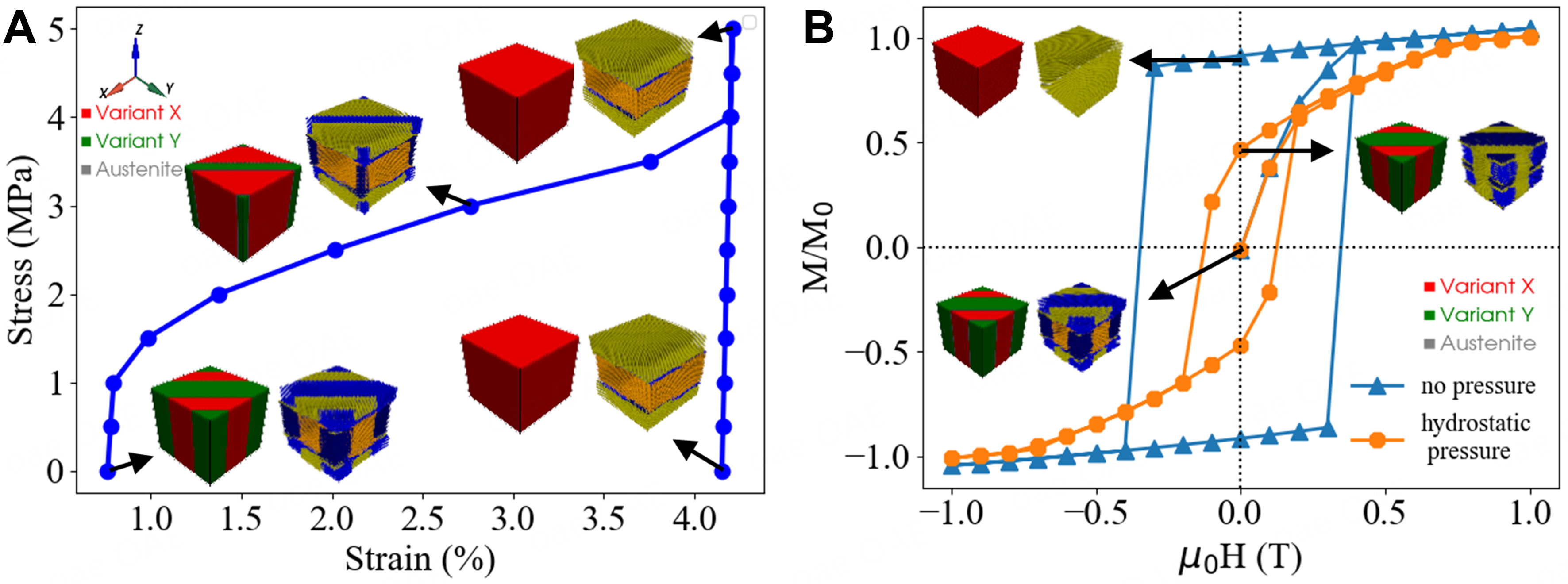
Figure 1. (A) The stress-strain curve of martensitic Ni2MnGa at temperature of 190 K; (B) Magnetic hysteresis loops of martensitic Ni2MnGa subject to different mechanical boundary conditions at temperature of 190 K.
Figure 1A presented the stress-strain curve of martensitic Ni2MnGa simulated at 190 K, where a compressive stress was applied along the X-axis, increasing from 0 MPa to 5 MPa with steps of 0.5 MPa. As evidenced by the stress-strain curve and the concomitant martensite domain evolution, it was discernible that twin boundaries commence movement and martensite variants rearrange at 1.5 MPa. The observed expansion of the red domain region and contraction of the green domain region were indicative of an increase in the volume fraction of martensite variants X and a decrease in that of martensite variants Y. Upon reaching a pressure of 4 MPa, all martensite variants Y underwent a transformation into martensite variants X. Subsequent to this, even under conditions of further increasing the pressure to 5 MPa and then reducing it to 0 MPa, the martensite domains persisted in a single-domain state. This observation suggested that the application of sufficiently large compressive stress resulted in the irreversible martensitic reorientation. This outcome aligned with the established martensitic reorientation behavior of Ni2MnGa, as documented in prior research[26].
As illustrated in Figure 1B, the magnetic hysteresis loops of Ni2MnGa are depicted under varying mechanical boundary conditions, including free boundary and 1 GPa hydrostatic pressure, at a temperature of 190 K. The initial magnetization curve demonstrated a well-defined sequence of domain structure evolution upon the application of a magnetic field along the direction +X, with a maximum value of 1 T and a step size of
Conversely, under the boundary condition of applying a hydrostatic pressure of 1 GPa, the volume fraction of martensite variants remained constant irrespective of the variation of the external magnetic field, and no magnetically induced reorientation of martensite occurs. It had been demonstrated that under the influence of hydrostatic pressure, the remanence, coercivity, and area of the magnetic hysteresis loop of the material are significantly reduced, while the saturation field was increased. This phenomenon was consistent with the regulatory effect of hydrostatic pressure on magnetic properties, as reported in the literature[26].
As illustrated in Figure 2A, the temperature-dependent volumetric strain curves of Ni2MnGa were observed under varying hydrostatic pressures, with the temperature ranging from 180 to 400 K. The applied hydrostatic pressure was systematically varied in steps from 0 to 1 GPa, with an interval of 0.2 GPa. Each volumetric strain curve displayed an abrupt mutation at a particular temperature, a hallmark of first-order phase transitions, signifying a martensitic transformation in the material. As hydrostatic pressure increases, the entire curve shifted to higher temperatures, indicating that the martensitic transformation temperature rises accordingly. As illustrated in Figure 2A, the inset displayed the linear regression relationship between the martensitic transformation temperature and hydrostatic pressures. This relationship demonstrated a monotonically increasing trend of the phase transformation temperature with increasing hydrostatic pressure, with a slope of dT/dP ≈ 24 K/GPa. This finding was basically consistent with the experimental data reported in reference[37].
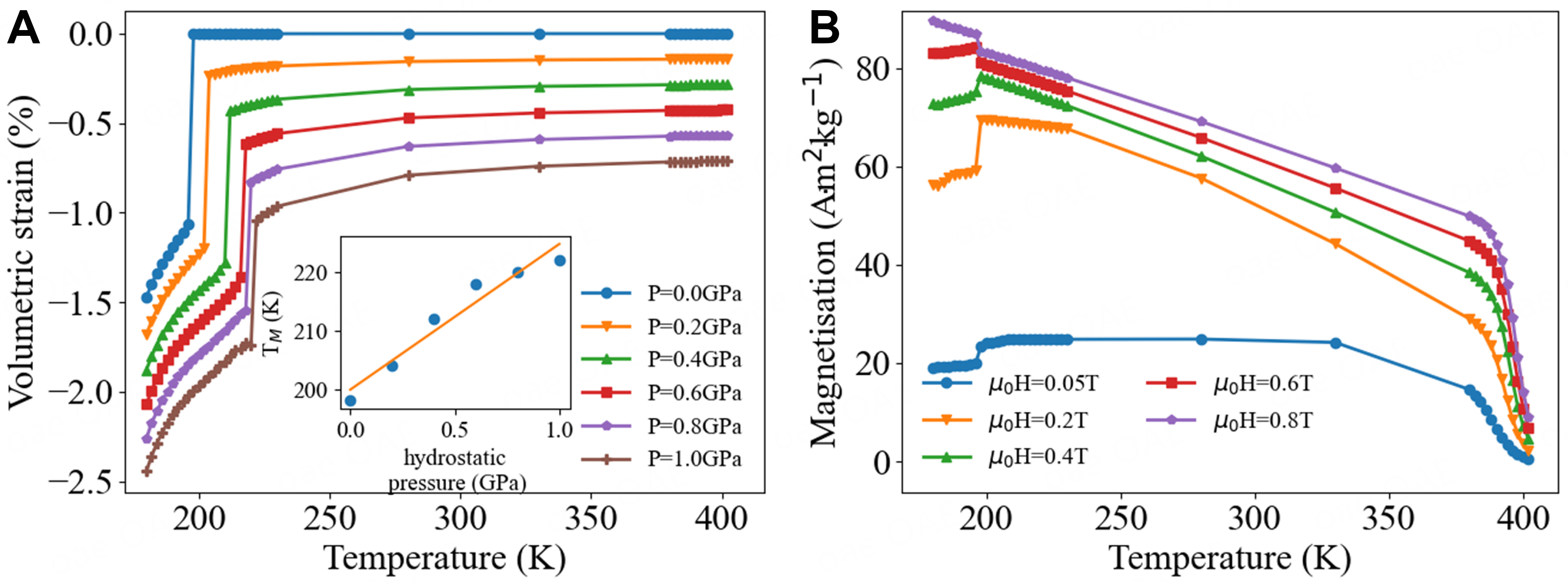
Figure 2. (A) Curves of volume strain versus temperature for Ni-Mn-Ga alloys under different hydrostatic pressures within the temperature range of 180 to 400 K. The inset shows that the martensitic transformation temperature increases with increasing applied hydrostatic pressure; (B) M (T) curves under different external magnetic fields at the range of 180 to 400 K.
As illustrated in Figure 2B, the simulated M-T curves of Ni2MnGa were depicted under varying external magnetic fields, with temperatures ranging from 180 to 400 K and magnetic fields increasing from 0.05 to
The simulation results for martensitic transformation reorientation, magnetic hysteresis, and M-T exhibited a high degree of consistency with existing experimental data. This finding served to fully verify the reliability of the phase-field model and to ensure the validity of subsequent caloric effect calculations.
BCE regulation by hydrostatic pressures
The isothermal entropy change (|ΔS|) and adiabatic temperature change (|ΔT|) of BCE in Ni2MnGa were calculated using the Maxwell relation method, as depicted in Figure 2A. The volumetric strain data from Figure 2A were utilized to determine the isothermal entropy change and adiabatic temperature change of BCE in Ni2MnGa. The calculation results were illustrated in Figure 3A and B.
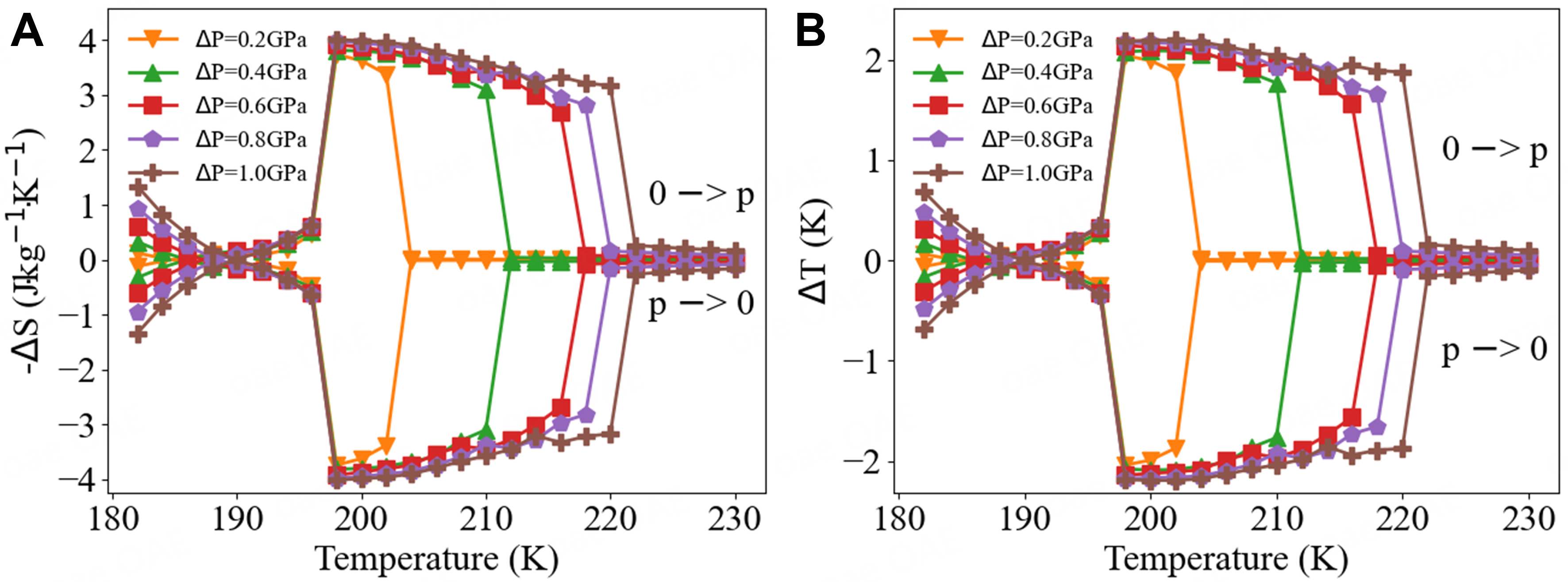
Figure 3. (A) Isothermal entropy changes of the barocaloric effect under different hydrostatic pressures; (B) adiabatic temperature changes of the barocaloric effect under different hydrostatic pressures.
In the isothermal pressurization process, characterized by an increase in hydrostatic pressure increased from 0 to p, the isothermal entropy change was represented by ΔS < 0, while the adiabatic temperature change was expressed as ∆T > 0. These phenomena signify a decline in entropy of the system and an increase in temperature. In the process of isothermal depressurization process, the decrease in hydrostatic pressure from p to 0 was accompanied by a positive increase in entropy (ΔS > 0) and a negative decrease in temperature (∆T < 0). These characteristics confirmed the occurrence of the conventional BCE in Ni2MnGa. The following section would examine the evolution characteristics of the BCE with temperature and pressure. (1) Shift of initial transformation temperature: as illustrated in Figure 2A, the initial martensitic transition temperature underwent a substantial shift toward higher temperatures within an increase in hydrostatic pressure. For instance, the initial phase transition temperature was estimated to be approximately 196 K at
MCE and its mechanism
To complement the analysis of the BCE, the MCE of Ni2MnGa under applied magnetic fields (0.05-0.8 T) was investigated. As demonstrated in Figures 4A and B, the variations of the isothermal entropy change (ΔS) and adiabatic temperature change (ΔT) with temperature are illustrated. Distinct magnetization changes occur at both the TC and the martensitic transformation temperature (TM). These transitions resulted in significant caloric responses, indicative of phase transitions in the system. In the vicinity of the TC, the second-order paramagnetic-ferromagnetic phase transition exhibited conventional MCE characteristics (ΔS < 0, ΔT > 0). It was noteworthy that in the vicinity of TM (195-197 K), the entropy change and temperature change exhibited non-monotonic variations with applied magnetic fields. A weak field induced the inverse MCE (ΔS > 0, ΔT < 0), while a high magnetic field resulted in the conventional MCE (ΔS < 0, ΔT > 0). The transition between these regimes occurs at a critical field μ0HC ≈ 0.4 T, where |ΔS| attained its maximum value of 1.10 J·kg-1·K-1. This observation is consistent with experimental findings reported in the literature[36]. In comparison, the isothermal entropy change of Ni48.7Mn27.6Ga23.7 |ΔS| is approximately 1.3 J·kg-1·K-1 under the influence of a magnetic field Δμ0H = 0.3 T[39].
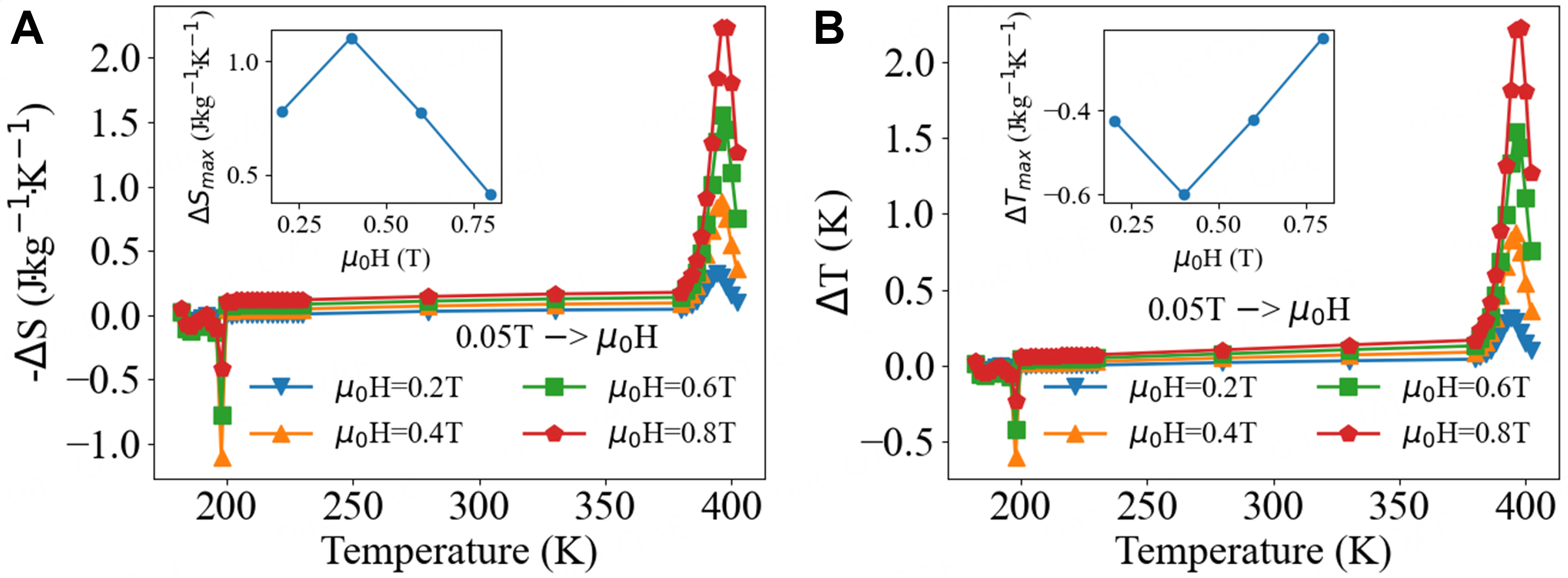
Figure 4. (A) Isothermal entropy changes of the inverse and conventional magnetocaloric effects. The inset is the maximum entropy change versus μ0H at 196 K; (B) Adiabatic temperature changes of the inverse and conventional magnetocaloric effect. The inset shows that the temperature change versus μ0H at 196 K.
As illustrated in Figure 5A, the total, structural, and magnetic entropy changes ΔS are plotted against magnetic fields at 196 Kelvin. It is noteworthy that the minor configurational entropy change was incorporated within the structural entropy change contribution. The entropy change evolution reveals two distinct magnetization regimes and clarified the microscopic origin of the inverse-to-conventional magnetocaloric crossover. In the phase-field model, the total free energy is decomposed into magnetic and structural contributions [see Eq. (1)]. Entropy is derived from the thermodynamic relation
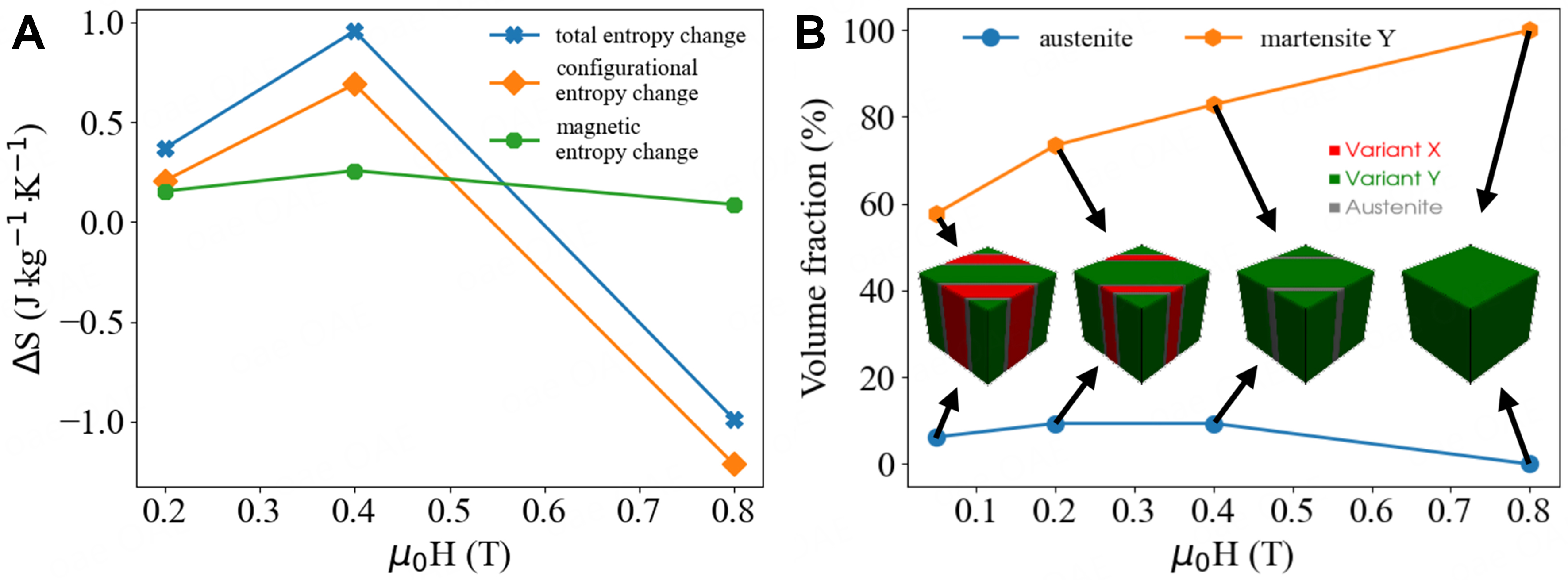
Figure 5. (A) Entropy contributions from different energy terms at 196 K as functions of magnetic fields; (B) Volume fractions of austenite and that of the martensite variant Y at 196 K as functions of magnetic fields along axis Y.
The phenomenon is further substantiated by the temperature-dependent magnetization. In the range of magnetic fields below 0.4 T, (∂M/∂T) > 0 because the phenomenon of thermal activation becomes evident, facilitating twin boundary motion and variants reorientation. It has been established that the presence of a magnetic field with a magnitude greater than 0.4 T results in a negative outcome, i.e. (∂M/∂T) < 0. According to the Eq. (20) the positive (∂M/∂T) below the field of 0.4T results in a positive entropy change, which is consistent with the inverse MCE at low fields. The negative slope above the field of 0.4T (and in the high-field single-domain state) yields a negative entropy change, consistent with the conventional MCE. This direct correlation confirms that the anomalous magnetocaloric response in Ni2MnGa arises from the strong interplay among magnetic, structural, and configurational degrees of freedom. In this system, low-field behavior is controlled by the reorientation of martensite variants, and high-field behavior is governed by spin polarization.
This discovery has an applicable implication: maximum inverse MCE is achieved at the remarkably low field μ0HC = 0.4 T, which is substantially lower than the field required for conventional magnetocaloric materials. By adjusting the composition to position the operating temperature near TM, the required critical field can be further reduced. This offers a new pathway for designing efficient low-field magnetic refrigeration devices.
Multicaloric effect and synergistic regulation by combined magnetic and pressure fields
In accordance with thermodynamic principles concerning the multicaloric effect, the aggregate isothermal entropy change caused by magnetic field and hydrostatic pressure can be expressed as the Eq. (22). As indicated in the relevant literature, cross-susceptibility under external magnetic and hydrostatic pressure fields, referred to as χ12, is defined as follows:
In the present work, this coefficient is calculated from the mixed second-order derivative of the total free energy. The first two terms in Eq. (22) represent the individual magnetocaloric and barocaloric responses that were measured in the absence of a secondary field. The third term represents the cross-susceptibility contribution, which assumes significance when χ12 is temperature-dependent. The non-vanishing cross term is indicative of a genuine multicaloric response that cannot be decomposed into two independent mono-caloric effects.
A series of simulations were conducted in which hydrostatic pressure ranging from 0 to 1 GPa was applied concurrently with a magnetic field ranging from 0.05 to 0.8 T. As illustrated in Figures 6A and B, the isothermal entropy change ΔS and adiabatic temperature change ΔT of the multicaloric effect are shown respectively. In contrast to the non-monotonic evolution of the MCE, the multicaloric entropy and temperature changes vary monotonically with field strength. This phenomenon can be attributed to the suppression of magnetically induced reorientation of martensitic variants by hydrostatic pressure, thereby eliminating the structural-entropy-driven non-monotonicity of the MCE. The mechanical constraint has been demonstrated to enhance the effective magnetoelastic coupling, thereby increasing the system’s sensitivity to magnetic fields. This phenomenon is evident in the steeper slope of the M-H curves observed under pressure.
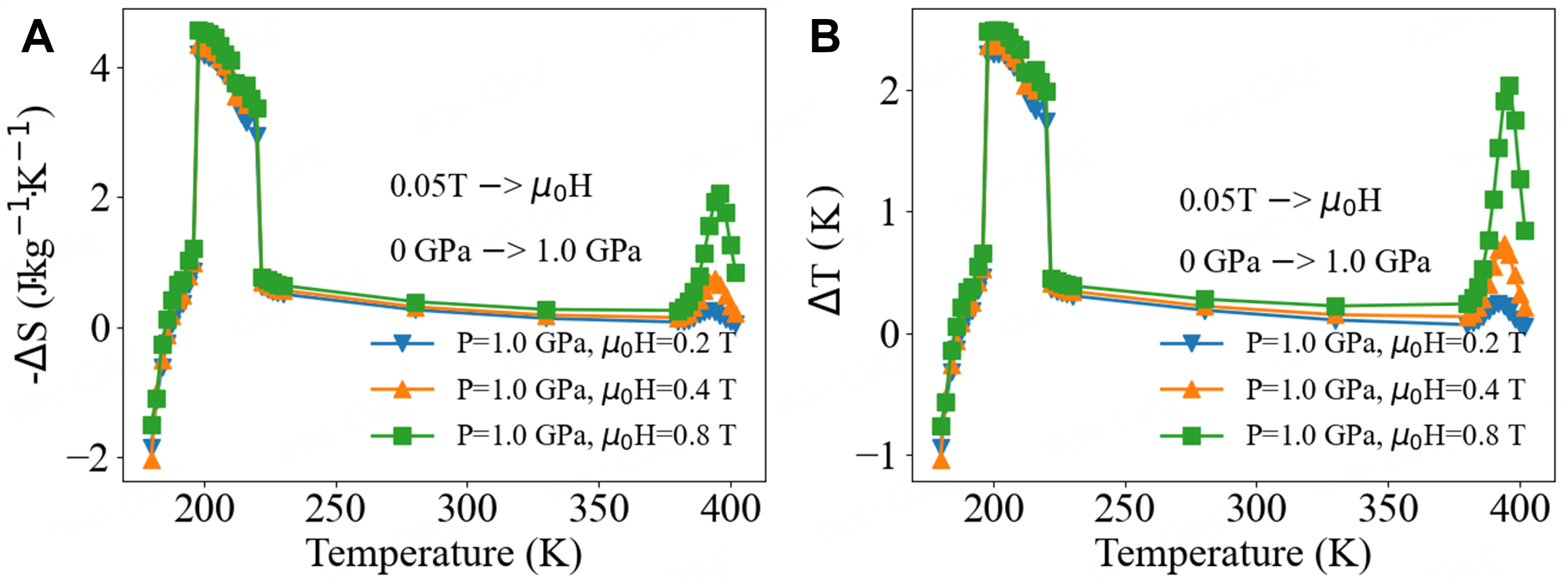
Figure 6. (A) Isothermal entropy changes and (B) adiabatic temperature changes of the multicaloric effect under different hydrostatic pressures and magnetic fields.
A quantitative analysis reveals that the maximum entropy change of the BCE under the condition of p = 0 → 1 GPa is ΔSBCE = -4.01 J·kg-1·K-1. It has been demonstrated that the maximum entropy change of the MCE, when considered under the parameter range of μ0H = 0.05 → 0.8 T, is ΔSMCE = +0.40 J·kg-1·K-1. The sum of the entropy changes of the two individual mono-caloric effects is ΔSmono = ΔSBCE + ΔSMCE = -3.61 J·kg-1·K-1. By contrast, under the condition of combined p = 0 → 1 GPa and μ0H = 0.05 → 0.8 T, the multicaloric entropy change reaches ΔSmulti = -4.56 J·kg-1·K-1. It has been determined that the absolute value of ΔSmulti is greater than that of ΔSmono. According to Eq. (22), the entropy change associated with the cross-susceptibility term is negative, indicating that pressure suppresses the motion of field-induced variants. The cross-susceptibility at 196 K and at 198 K was computed using Eq. (22). The results of this computation are shown in Figure 7A and B. As illustrated in Figure 7B, the minimum of χ12 observed at μ0H = 0.3 ~ 0.4 T corresponds to the completion of martensite variants reorientation(martensite variants Y to X). The other minimum of χ12, observed at higher magnetic fields, can be attributed to the nonlinear effect as magnetization approaches saturation. Then the entropy changes associated with the cross-susceptibility at 198 K were computed using Eq. (23). As demonstrated in Figure 7C, the entropy changes under the aforementioned conditions is negative. This finding serves to substantiate the hypothesis that Ni2MnGa manifests a synergistic enhancement of the multicaloric effect.
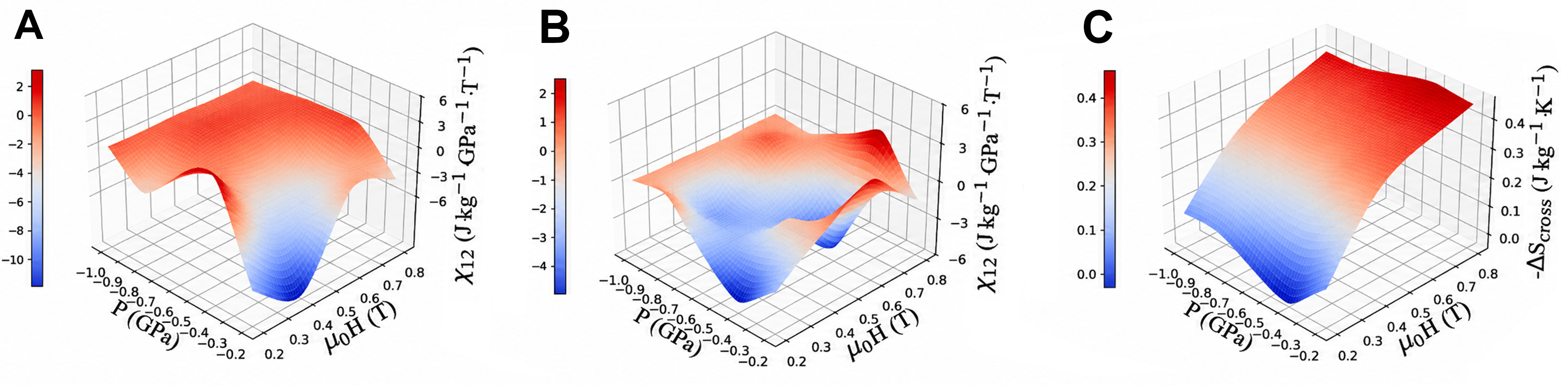
Figure 7. The cross-susceptibility χ12 and isothermal entropy change ΔS in Ni2MnGa: (A) χ12 at 196 K and (B) χ12 at 198 K; (C) the correlated isothermal entropy change ΔS as a function of magnetic field and hydrostatic pressure.
CONCLUSIONS
In summary, the present study elucidates the cooperative regulation of the martensitic transformation and caloric responses in Ni2MnGa by hydrostatic pressure and magnetic fields. Uniaxial pressure drives twin boundary migration to achieve a mono-variant state, enabling large reversible actuation . Concurrently, hydrostatic pressure simultaneously suppresses magnetically induced reorientation - tuning magnetic hysteresis - and raises the transformation temperature by ~24 K/GPa, thereby boosting the BCE. The magnetocaloric response displays a field-driven transition: at fields below 0.4 T, variant reorientation generates a positive structural entropy change (inverse MCE); above this critical field, spin polarization dominates, yielding a negative entropy change (conventional MCE). This reversal is directly tied to the completion of structural reorientation and strong magnetostructural coupling. It has been demonstrated that the non-monotonicity of the MCE is eliminated under the combined pressure and magnetic field. Consequently, the multicaloric response becomes monotonic and synergistically enhanced, with an entropy change exceeding the sum of individual contributions due to negative magnetoelastic cross-coupling. These results establish a thermodynamic pathway for engineering high-performance multicaloric materials through controlled external-field interactions.
DECLARATIONS
Authors’ contributions
Made substantial contributions to conception and design of the study and performed data analysis and interpretation: Dong, M.; Shi, X.; Ma, X.
Performed data acquisition, as well as provided administrative, technical, and material support: Liu, J.; Wang, H.; Wang, Z.; Liu, Z.; Chen, J.; Huang, H.
Availability of data and materials
The data that support the findings of this study are available from the corresponding author upon reasonable request.
AI and AI-assisted tools statement
Not applicable.
Financial support and sponsorship
This work was supported by the National Key Research and Development Program of China (No. 2017YFB0702702), the Fundamental Research Funds for the Central Universities (No. FRF-BRB-25-006, No. FRF-TP-24-041A),2023 Fund for Fostering Young Scholars of the School of Mathematics and Physics, USTB (FRF-BR-23-01B), the National Natural Science Foundation of China (No. 22235002), the Open Project Fund from Guangdong Provincial Key Laboratory of Materials and Technology for Energy Conversion, Guangdong Technion-Israel Institute of Technology (No. MATEC2024KF008).
Conflicts of interest
Chen, J. is an Executive Editor of the journal Microstructures. Huang, H. is an Associate Editor of the journal Microstructures. Chen, J. and Huang, H. were not involved in any steps of editorial processing, notably including reviewers’ selection, manuscript handling or decision making. The other authors declare that there are no conflicts of interest.
Ethical approval and consent to participate
Not applicable.
Consent for publication
Not applicable.
Copyright
© The Author(s) 2026.
REFERENCES
1. Stern-taulats, E.; Castán, T.; Mañosa, L.; Planes, A.; Mathur, N. D.; Moya, X. Multicaloric materials and effects. MRS. Bull. 2018, 43, 295-9.
2. Pal, D. A short review of magnetocaloric effect in Ni-Mn-Ga heusler alloy system. Int. J. Sci. Res. Phys. Appl. Sci. 2023, 11, 13-20. https://inis.iaea.org/records/0pmfh-5qh81. (accessed 2026-06-30).
3. Kitanovski, A. Energy applications of magnetocaloric materials. Adv. Energy. Mater. 2020, 10, 1903741.
4. Yu, C.; Chen, T.; Yin, H.; Kang, G.; Fang, D. Modeling the anisotropic elastocaloric effect of textured NiMnGa ferromagnetic shape memory alloys. Int. J. Solids. Struct. 2020, 191-2, 509-28.
5. Cirillo, L.; Greco, A.; Masselli, C. Cooling through barocaloric effect: a review of the state of the art up to 2022. Therm. Sci. Eng. Prog. 2022, 33, 101380.
6. Sun, Y.; An, S.; Gao, Y.; et al. Materials with the barocaloric effect for solid-state refrigeration. J. Mater. Chem. A. 2025, 13, 6152-75.
7. Mañosa, L.; Planes, A. Solid-state cooling by stress: a perspective. Appl. Phys. Lett. 2020, 116, 050501.
9. Greco, A.; Aprea, C.; Maiorino, A.; Masselli, C. A review of the state of the art of solid-state caloric cooling processes at room-temperature before 2019. Int. J. Refrig. 2019, 106, 66-88.
10. Stern-taulats, E.; Planes, A.; Lloveras, P.; et al. Tailoring barocaloric and magnetocaloric properties in low-hysteresis magnetic shape memory alloys. Acta. Materialia. 2015, 96, 324-32.
11. Gorev, M.; Bogdanov, E.; Flerov, I. Conventional and inverse barocaloric effects around triple points in ferroelastics (NH4)3 NbOF6 and (NH4)3 TiOF5. Scr. Mater. 2017, 139, 53-7.
12. Mikhaleva, E. A.; Flerov, I. N.; Gorev, M. V.; et al. Caloric characteristics of PbTiO3 in the temperature range of the ferroelectric phase transition. Phys. Solid. State. 2012, 54, 1832-40.
13. Lloveras, P.; Aznar, A.; Barrio, M.; et al. Colossal barocaloric effects near room temperature in plastic crystals of neopentylglycol. Nat. Commun. 2019, 10, 1803.
14. Sagotra, A. K.; Chu, D.; Cazorla, C. Room-temperature mechanocaloric effects in lithium-based superionic materials. Nat. Commun. 2018, 9, 3337.
15. Carvalho, A.; Imamura, W.; Usuda, E.; Bom, N. Giant room-temperature barocaloric effects in PDMS rubber at low pressures. Eur. Polym. J. 2018, 99, 212-21.
16. Usuda, E.; Bom, N.; Carvalho, A. Large barocaloric effects at low pressures in natural rubber. Eur. Polym. J. 2017, 92, 287-93.
17. Hu, F.; Wei, S.; Cao, Y.; et al. Magnetocaloric and barocaloric effects associated with two successive magnetostructural transformations in Ni55.5Mn17.8Ga26.7 alloy. J. Alloys. Compd. 2020, 818, 153356.
18. Pataky, G. J.; Ertekin, E.; Sehitoglu, H. Elastocaloric cooling potential of NiTi, Ni2FeGa, and CoNiAl. Acta. Materialia. 2015, 96, 420-7.
19. Eerenstein, W.; Mathur, N. D.; Scott, J. F. Multiferroic and magnetoelectric materials. Nature 2006, 442, 759-65.
20. Cong, D.; Xiong, W.; Planes, A.; et al. Colossal elastocaloric effect in ferroelastic Ni-Mn-Ti alloys. Phys. Rev. Lett. 2019, 122, 255703.
21. Imran, M.; Zhang, X. Elastocaloric effects in polycrystalline Ni-Fe-Ga foams with hierarchical pore architecture. Phys. Rev. Materials. 2020, 4, 065403.
22. Mañosa, L.; González-Alonso, D.; Planes, A.; et al. Giant solid-state barocaloric effect in the Ni-Mn-In magnetic shape-memory alloy. Nat. Mater. 2010, 9, 478-81.
23. Liu, K.; Zeng, H.; Qi, J.; et al. Microstructure and giant baro-caloric effect induced by low pressure in Heusler Co51Fe1V33Ga15 alloy undergoing martensitic transformation. J. Mater. Sci. Technol. 2021, 73, 76-82.
24. Nguyen, H. Y.; Kieu, X. H.; Nguyen, H. N.; et al. Structure and magnetic properties of Ni-Mn-Ga shape memory alloys. Adv. Nat. Sci.:. Nanosci. Nanotechnol. 2022, 13, 015014.
25. Tao, J.; Yang, X.; Liu, X.; Wu, J.; Wang, Y. Effects of hydrostatic pressure on martensitic transition, ductility, and magnetocrystalline anisotropy of Ni2MnGa. J. Appl. Phys. 2025, 137, 245902.
26. Wu, P.; Ma, X.; Zhang, J.; Chen, L. Phase-field simulations of magnetic field-induced strain in Ni2MnGa ferromagnetic shape memory alloy. Philos. Mag. 2011, 91, 2102-16.
27. Ohmer, D.; Yi, M.; Gutfleisch, O.; Xu, B. Phase-field modelling of paramagnetic austenite-ferromagnetic martensite transformation coupled with mechanics and micromagnetics. Int. J. Solids. Struct. 2022, 238, 111365.
28. Jin, Y. M. Domain microstructure evolution in magnetic shape memory alloys: phase-field model and simulation. Acta. Mater. 2009, 57, 2488-95.
29. Huang, H.; Ma, X.; Wang, J.; Liu, Z.; He, W.; Chen, L. A phase-field model of phase transitions and domain structures of NiCoMnIn metamagnetic alloys. Acta. Mater. 2015, 83, 333-40.
30. Zayak, A.; Buchelnikov, V.; Entel, P. A Ginzburg-Landau theory for Ni-Mn-Ga. Phase. Transit. 2002, 75, 243-56.
31. Yeddu, H. K.; Malik, A.; Ågren, J.; Amberg, G.; Borgenstam, A. Three-dimensional phase-field modeling of martensitic microstructure evolution in steels. Acta. Mater. 2012, 60, 1538-47.
32. Cui, S.; Wan, J.; Zuo, X.; Chen, N.; Zhang, J.; Rong, Y. Three-dimensional, non-isothermal phase-field modeling of thermally and stress-induced martensitic transformations in shape memory alloys. Int. J. Solids. Struct. 2017, 109, 1-11.
33. Vasil’ev, A.; Bozhko, A.; Khovailo, V.; et al. Structural and magnetic phase transitions in shape memory alloys Ni2 + XMn1 - XGa. J. Magn. Magn. Mater. 1999, 196-197, 837-9.
34. Wang, X.; Garcı́a-cervera, C. J.; Weinan, E. A gauss-seidel projection method for micromagnetics simulations. J. Comput. Phys. 2001, 171, 357-72.
35. Cejpek, P.; Proschek, P.; Straka, L.; Heczko, O. Dependence of martensite transformation temperature on magnetic field in Ni2MnGa and Ni2MnGa0.95In0.05 single crystals. J. Alloys. Compd. 2022, 908, 164514.
36. Vasil’ev, A. N.; Buchel’nikov, V. D.; Takagi, T.; Khovailo, V. V.; Estrin, E. I. Shape memory ferromagnets. Phys. -Usp. 2003, 46, 559-88.
37. Maeda, H.; Fukuda, T.; Kakeshita, T. Effect of hydrostatic pressure on martensitic transformation in a ferromagnetic shape memory alloy Ni2MnGa. J. Alloys. Compd. 2011, 509, 7840-3.
38. He, X. J.; Xu, K.; Wei, S. X.; Zhang, Y. L.; Li, Z.; Jing, C. Barocaloric effect associated with magneto-structural transformation studied by an effectively indirect method for the Ni58.3Mn17.1Ga24.6 Heusler alloy. J. Mater. Sci. 2017, 52, 2915-23.
Cite This Article
 Open Access
How to Cite
Download Citation
Export Citation File:
Type of Import
Tips on Downloading Citation
Citation Manager File Format
Type of Import
Direct Import: When the Direct Import option is selected (the default state), a dialogue box will give you the option to Save or Open the downloaded citation data. Choosing Open will either launch your citation manager or give you a choice of applications with which to use the metadata. The Save option saves the file locally for later use.
Indirect Import: When the Indirect Import option is selected, the metadata is displayed and may be copied and pasted as needed.
About This Article
Copyright

Data & Comments
Data
0










Comments
Comments must be written in English. Spam, offensive content, impersonation, and private information will not be permitted. If any comment is reported and identified as inappropriate content by OAE staff, the comment will be removed without notice. If you have any queries or need any help, please contact us at [email protected].