




Emerging medium-range order in deformed Zr-based bulk metallic glasses during sub-Tg relaxation
 0
0 
Abstract
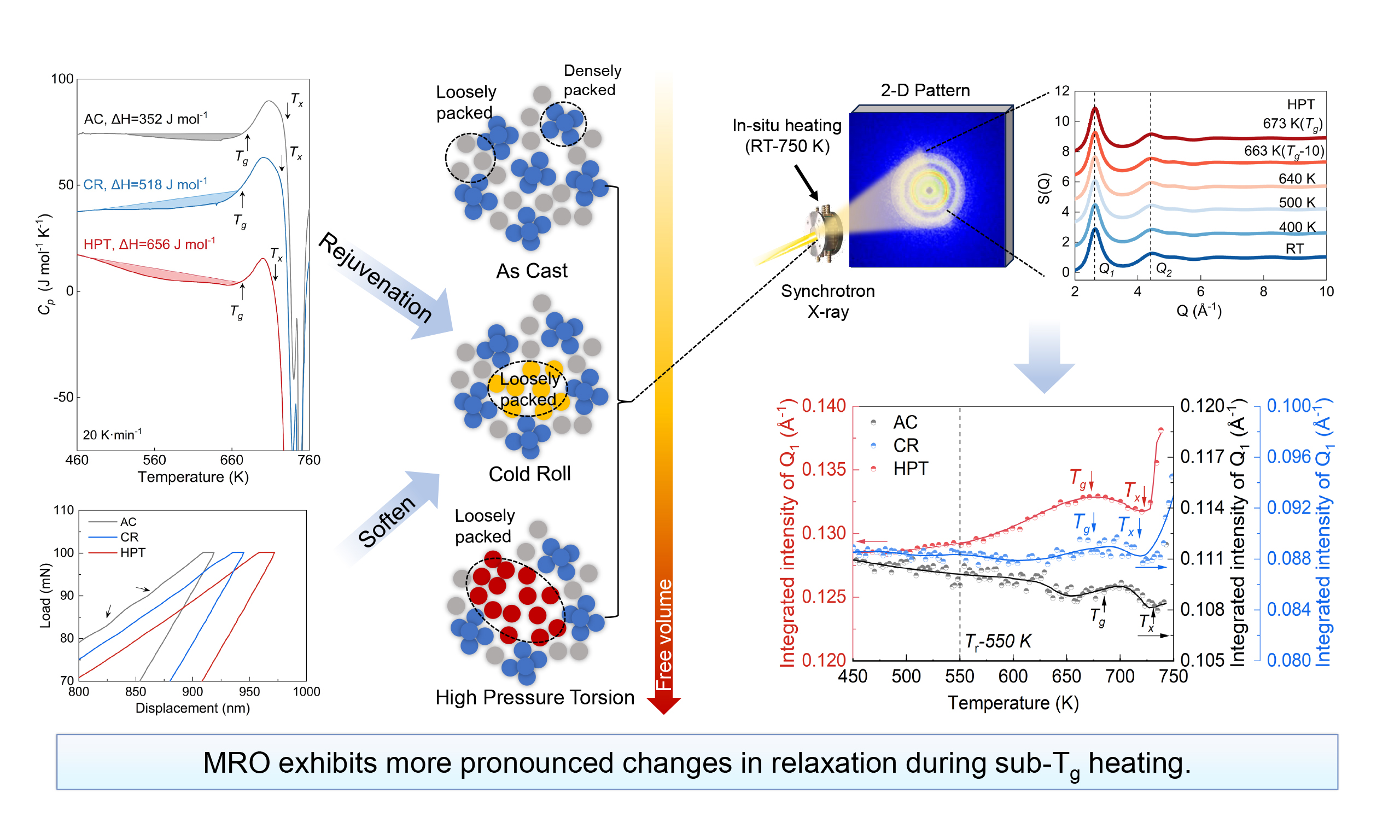
The plasticity of bulk metallic glasses (BMGs) is closely correlated with the nature of shear bands; however, the structural origin of shear bands remains elusive due to the difficulty of obtaining direct observations. In this study, we investigated the microstructural evolution of shear bands during thermal relaxation by examining the local atomic-scale response to heating. Zr52.5Cu17.9Ni14.6Al10Ti5 BMGs were subjected to two specifically designed deformation methods, namely, cold rolling and high-pressure torsion (HPT), to generate shear bands with varying volume fractions and rejuvenation states. In situ synchrotron diffraction results revealed a more pronounced growth of medium-range ordering at sub-Tg temperatures in the deformed BMGs than in the as-cast sample. The HPT-deformed BMG, with the highest volume fraction and distribution complexity of shear bands, demonstrated the most rapid increase in the ordering process. The transition of cluster connection modes possibly explained the anomalous emergence of medium-range order in the shear bands of deformed BMGs during sub-Tg relaxation or tension. Our study offers new insights into the atomic structure origins of shear bands, contributing to a deeper understanding of BMG plasticity.
Keywords
INTRODUCTION
Bulk metallic glasses (BMGs) are characterized by a lack of long-range atomic order, but with unique short-range and medium-range order (SRO and MRO), endowing them with unique mechanical properties[1-5], such as high yield strength but limited ductility[6,7]. Inhomogeneous plastic deformation in BMGs under high stress or high strain rates[8,9] can induce a highly localized softening area along with the formation of shear bands (SBs)[10-12], leading to catastrophic fracture under uniaxial loading[13,14]. Various models have been proposed to determine microstructural evolution during plastic deformation in BMGs. The free volume theory postulates that macroscopic shear deformation can be attributed to the coordinated transition of multiple atoms into adjacent voids[8,15,16]. Alternatively, the shear transformation zone (STZ) model describes the plastic deformation of BMGs as a collective process involving numerous localized shear events within atomic clusters of varying configurations[17-19]. Other models, including those based on flow units[20,21], also suggest the presence of[22,23] microscopic regions with higher energy and atomic mobility than the surrounding matrix, similar to crystal defects. However, due to the extremely short timescales within highly localized regions, direct atomic-scale observations using conventional characterization techniques remain challenging. Therefore, obtaining a clear picture of the atomic structure of shear bands remains elusive.
It has been reported that increased free volume can enhance atomic diffusion and produce loosely packed structures with multiple softened regions[24]. Numerous experiments confirmed that this increase in free volume can lead to reduced hardness and elastic modulus, though with improved ductility[25-27]. Work softening of BMGs has also been associated with the accumulating of excess free volume in SBs[28-30]. Structure relaxation is known to induce the annihilation of excess free volume, resulting in structural homogenization and transition to a lower energy state. This process decreases soft regions and overall deformability[31,32]. The reverse process, known as rejuvenation, is described as a transition to a higher energy state[33-35]. Thermal cycling has been adopted as a non-destructive pathway to rejuvenate BMGs, as demonstrated by increased enthalpy and improved plasticity. Destructive methods, involving plastic deformation, such as cold rolling (CR)[36-38], high-pressure torsion (HPT)[39-41], and the confinement method[42-44], have been applied to improve the plasticity of glassy alloys. In plastic deformation methods, SBs with structural and dynamic inhomogeneities are introduced into the glasses[45]. Subsequently, the rejuvenation effect of plastic deformation has been confirmed by the increased exothermal enthalpy of the deformed MGs when heated to sub-Tg[46-48]. This plastic deformation has been shown to induce substantial stress concentrations and multiple shear transformations within the glassy matrix, resulting in a high density of confined shear bands and increased free volume. This controlled modification of structural inhomogeneities and free volume can facilitate the observation and analysis of atomic-scale dynamics and changes associated with shear bands. As a result, by examining the evolution of short-to-medium range order during relaxation, we can effectively elucidate the structural characteristics of shear bands within deformed BMGs.
This work introduced high-density SBs in the deformed Zr-based BMG via CR and HPT, as confirmed by differential scanning calorimetry and microscopy techniques. Nanoindentation and microcolumn compression tests were conducted to investigate the softening behavior of the samples in different rejuvenated states. Subsequent in-situ synchrotron high-energy X-ray diffraction revealed that, at sub-Tg temperatures, different deviations occurred from the linear relevance at the first moment of the first sharp diffraction peak (FSDP) among MGs with different deformation modes. Pair distribution function analysis indicated that the enhancement of structural ordering was due to the transition of cluster connection modes on MRO. Our results showed that the transformation of cluster connection modes may explain the anomalous growth of MRO in the shear bands of the deformed BMGs.
MATERIALS AND METHODS
Sample preparation
Zr52.5Cu17.9Ni14.6Al10Ti5 BMG (i.e., BAM 11) plates with dimensions of 10 mm in width, 30 mm in length, and
Characterization of SBs
Specific heat capacity (Cp) experiments were carried out by differential scanning calorimetry (Mettler-Toledo, DSC-1, Switzerland) in a high-purity N2 atmosphere at a flow rate of 50 mL·min-1. The temperature range of the experiment was set to 323-773 K at a heating rate of 20 K min-1. A sapphire sample was used as a reference for Cp measurement. An FEI Quanta 250 FEG (Oregon, USA) scanning electron microscope (SEM) was used to observe the SBs on the surfaces of the CR and HPT samples and the morphology of the nanoindentation area. High-resolution transmission electron microscopy measurements were performed via transmission electron microscopy (TEM, JEM-2100F, Japan).
Mechanical testing
The nanoindentation tests were carried out using an Agilent Nano Indenter G200 (California, USA) at room temperature with a typical Berkovich diamond indenter. The load was set from 0 to 100 mN at a loading rate of 5 mN s-1, and the load was held at 100 mN for 10 s and then unloaded at the same rate as the loading process. Subsequently, eight points were measured for each sample to obtain the mean values. Micropillars with nominal diameters of ~2.5 μm and a height of around 5 μm were prepared by a focused ion beam (FIB) system (Zeiss Auriga, Germany) operated at an accelerating voltage of 30 keV using a Ga+ focused ion beam. A two-step milling method was then employed with milling currents of 0.79 nA for coarse milling and 40 pA for fine polishing. Two specimens were prepared on the same individual sample, with a distance of more than 100 μm between them to avoid stress interactions. An FT-NMT03 nanomechanical in situ testing system (China) was used in the experiments, capable of performing in situ micropillar compression tests in a Zeiss Auriga FIB/SEM dual beam system. The experiments utilized a conical flat indenter made of diamond, featuring a 10-μm flat tip at its apex, and indentation was performed at a constant loading rate of 10-3 s-1.
High-energy X-ray synchrotron diffraction
High-energy X-ray synchrotron diffraction experiments were performed at the beamline 11-ID-C of the Advanced Photon Source (APS), Argonne National Laboratory (ANL, Illinois, USA). AC-BMG with a thickness of ~1 mm, CR- and HPT-BMG with a thickness of ~0.3 mm were mounted in a Linkam THMS600 furnace (United Kingdom) for thermal scanning. Then, high-energy X-rays with a beam size of
To analyze Q1, the first moment indicated the summary of the products of the position of Q and the corresponding intensity, representing the center of the heights of Q1. The integrated intensity was calculated by the area between the profile and the baseline (y = 0 for S(Q) and y = 1 for G(r)). To analyze the MRO structure, the reduced PDF profile G(r) was transformed to g(r) by 1 + G(r)/4πrρ0 (ρ0 denotes the average number density). The second peak of g(r) characterized the connection mode of the SRO clusters on the MRO scale[50]. The connection modes between the adjacent coordination polyhedrons were divided into four types: 1-atom (vertex sharing), 2-atom (edge sharing), 3-atom (face sharing), and 4-atom (intercross-sharing). To deconvolute the contributions of these connection modes, Gaussian peak fitting was performed on the second coordination shell. First, we calculated the average cluster radius R = 2.969 Å by weighing the bond length of each atom pair of the BAM 11 system[51]. Based on this value, the center distances of the 1-atom, 2-atom, 3-atom, and 4-atom cluster connection modes were determined as 2R,
RESULTS AND DISCUSSION
Deformation-induced rejuvenation and shear bands
Figure 1A presents the specific heat capacity curves Cp of the AC, CR- and HPT-deformed BMGs measured at a heating rate of 20 K min-1. The glass transition temperature (Tg), crystallization temperature (Tx), and enthalpy release (ΔH) are summarized in Table 1. Notably, the onset of Tg for the CR- and HPT-deformed BMGs shifted -6 and -7 K, respectively, compared to the AC BMG, suggesting that the glassy states of the deformed BMGs became less stable than those of the AC BMG. Additionally, the relaxation enthalpy before Tg was calculated, indicating that the HPT-deformed BMG exhibited the highest ΔH of 0.656 kJ mol-1. A greater ΔH value implied a more pronounced rejuvenated state in the HPT-deformed BMG[52]. The surface morphology of the CR- and HPT-deformed BMGs (unpolished) was assessed by SEM, revealing a significant proliferation of SBs [Figure 1B and C]. The average spacing between the primary SBs in CR BMG was approximately 7-8 μm [Figure 1B]. By contrast, the HPT BMG exhibited a higher density of shear bands, with an average spacing of about 2 μm [Figure 1C], which was consistent with other reports[41]. Figure 1D-F shows the high-resolution transmission electron microscopy (HRTEM) images of the AC, CR, and HPT BMGs, with insets showing the corresponding selected area electron diffraction (SAED) patterns. As shown in Figure 1D, the HRTEM image of the AC-BMG revealed a lower heterogeneity amorphous structure with no discernible crystalline features, which was further confirmed by a diffuse halo in the SAED pattern. By contrast, after deformation processing, the CR [Figure 1E] and HPT [Figure 1F] BMGs exhibited pronounced contrast variations in their HRTEM images while retaining their amorphous nature, as evidenced by the diffuse halos in their respective SAED patterns. The enhancement of structural heterogeneity was most prominent in the HPT sample, where the introduction of extensive shear bands led to more distinct contrast variations in the HRTEM image.
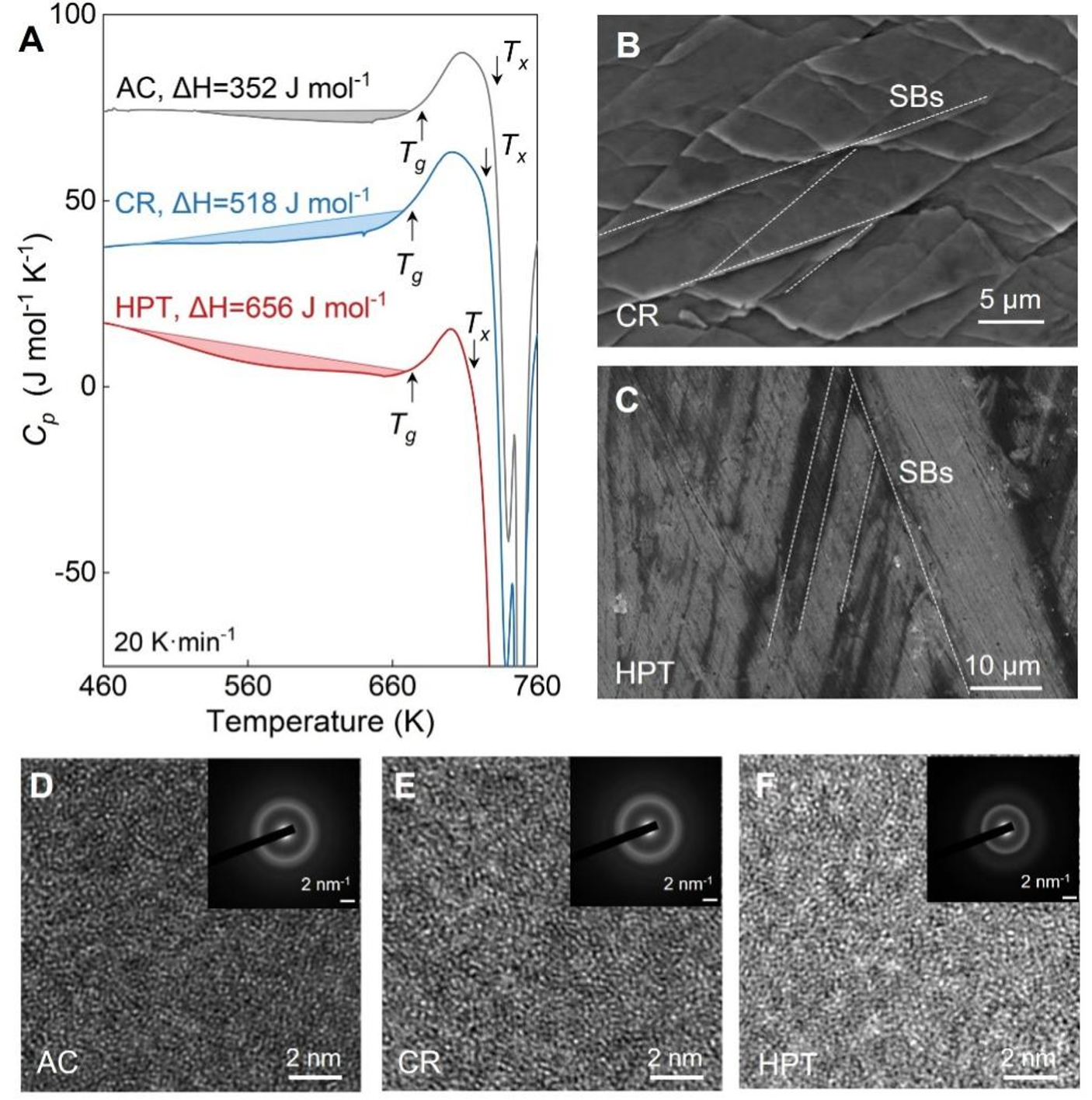
Figure 1. Rejuvenation of BAM 11 metallic glass by pre-plastic deformation. (A) Specific heat capacity Cp curves of AC, CR, and HPT BMGs. The SEM images of the surface of (B) CR and (C) HPT BMGs. Shear bands are marked by white dashed lines. HRTEM images of (D) AC, (E) CR, and (F) HPT BMGs. The insets are SAED patterns.
The thermal physical and mechanical parameters of BAM11 BMGs
| Sample | Tg (K) | Tx (K) | ΔTx (K) | ΔH (sub-Tg) (kJ mol-1) | Hardness (GPa) |
| AC | 680 | 731 | 51 | 0.352 | 6.4 |
| CR | 674 | 724 | 50 | 0.518 | 6.2 |
| HPT | 673 | 720 | 47 | 0.656 | 5.9 |
Mechanical softening induced by the shear bands
The nanoindentation results of all BMGs are shown in Figure 2A. The indentation depth under identical loads revealed a clear trend of increasing indentation size with an increasing degree of plastic deformation. For the AC BMG, the hardness and modulus were measured as 6.4 ± 0.1 and 107.8 ± 0.6 GPa, respectively. For the deformed BMGs, the hardness and modulus were as low as 6.2 ± 0.1 and 105.0 ± 0.8 GPa for the CR BMG and 5.9 ± 0.3 and 103.2 ± 2.5 GPa for the HPT BMG, indicating that both the hardness and modulus decreased with increased spatial heterogeneity [Figure 2B]. Analysis of the indentation depth revealed that under consistent load conditions, the rejuvenated BMGs exhibited larger indentation areas, indicating a macroscopic softening phenomenon in the metallic glass. Furthermore, a small step adjacent to the indentation on the surface of the AC BMG (inset of Figure 2C) was observed, showing shear band propagation. By contrast, the edges of indentation for the CR- and HPT-deformed BMGs were smooth, suggesting that plasticity was improved. A notable feature of the load-displacement response in the AC BMG was the presence of a distinct discontinuous deformation event (black arrows in Figure 2A), typically related to the activation of a single shear band. The discrete event reflected the inhomogeneous plasticity of metallic glass, indicating that discontinuous yielding occurred during plastic deformation. This inhomogeneous deformation was notably absent in both the CR- and HPT-deformed BMGs, suggesting that pre-plastic deformation processing promoted more homogeneous deformation characteristics.
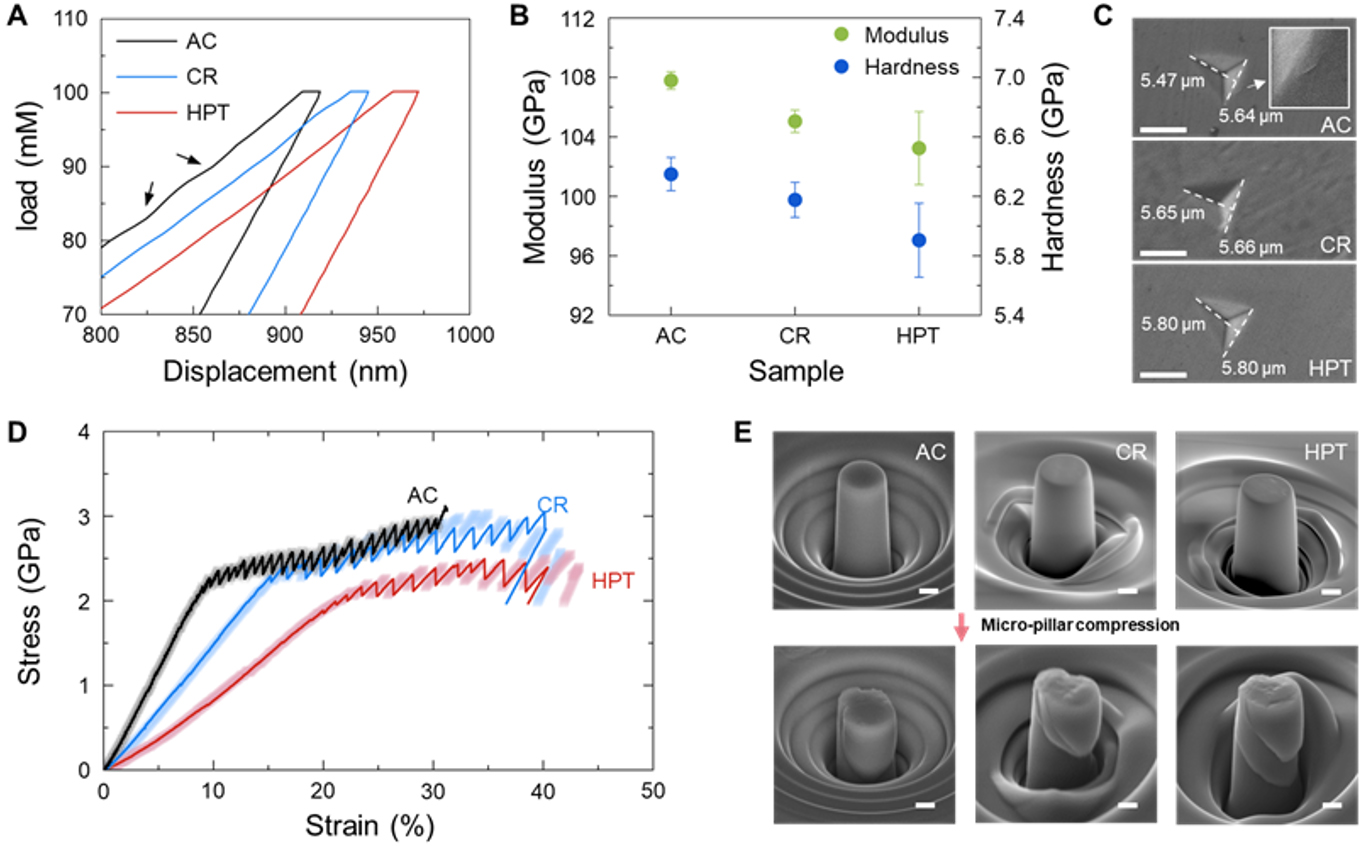
Figure 2. (A) Nanoindentation test results for AC, CR, and HPT BMGs. (B) Hardness and modulus of AC, CR and HPT BMGs from nanoindentation. The error bar indicates the standard deviation through eight tests. (C) The surface morphology of the indentation of AC, CR, and HPT BMGs. The scale bar is 5 μm. (D) The load versus displacement curves of BMG pillars. (E) The morphology of the pillars of AC, CR, and HPT BMGs before and after compression tests. The scale bar is 1 μm.
The micropillar compression results, shown in Figure 2D, present the two stress-strain curves (solid and scattered lines) for both the initial and rejuvenated BMGs. This excessive elastic limit beyond the normal level was because the stress-strain curve was not calibrated, highlighting the macro-softening induced by the high volume fraction of SBs. The yield strength of the AC BMG was approximately 2.27 GPa, while the yield strength of the rejuvenated BMGs decreased to 2.25 GPa for CR BMG and 2.11 GPa for HPT BMG. The softening trend was consistent with the hardness trends observed in the nanoindentation tests [Table 1]. Figure 2E reveals the morphologies after compression. The surface of the AC-BMG had only one primary SB, whereas the surface of the rejuvenated BMGs revealed multiple primary SBs accompanied by small secondary shear bands[53]. These findings further confirmed that the introduction of heterogeneous structures (SBs) through pre-deformation improved inhomogeneous plastic deformation.
Structure relaxation behavior of shear bands at sub-Tg temperatures
Figure 3A-C shows the structure factors, S(Q) patterns, of AC, CR, and HPT BMGs at different temperatures. It was evident that the BMGs retained a glassy feature when heated to Tg. Figure 3D-F presents the corresponding differential structure factor, ΔS(Q) curves, which were obtained by subtracting the S(Q) data at room temperature from that of the corresponding temperature. The variations in ΔS(Q) curves compared to that of 400 K indicated a sub-Tg structure evolution in the rejuvenated BMGs. As marked by the red dashed line in Figure 3D-F, for the AC BMG, the shape of the ΔS(Q) patterns developed consistently below Tg. This indicated a typical thermally driven structural change of an amorphous system approaching its glass transition state. However, the ΔS(Q) curves of the rejuvenated BMGs (CR and HPT) over 400 K exhibited a clear difference from that of the AC BMG. Specifically, they first exhibited a distinct inflection point at lower Q (~2.3 Å-1), reached a maximum, and then followed a similar decreasing trend. This unique shape of the ΔS(Q) curves in the low-Q region suggested a non-linear, localized ordering process that differed from the uniform evolution observed in the AC BMG.
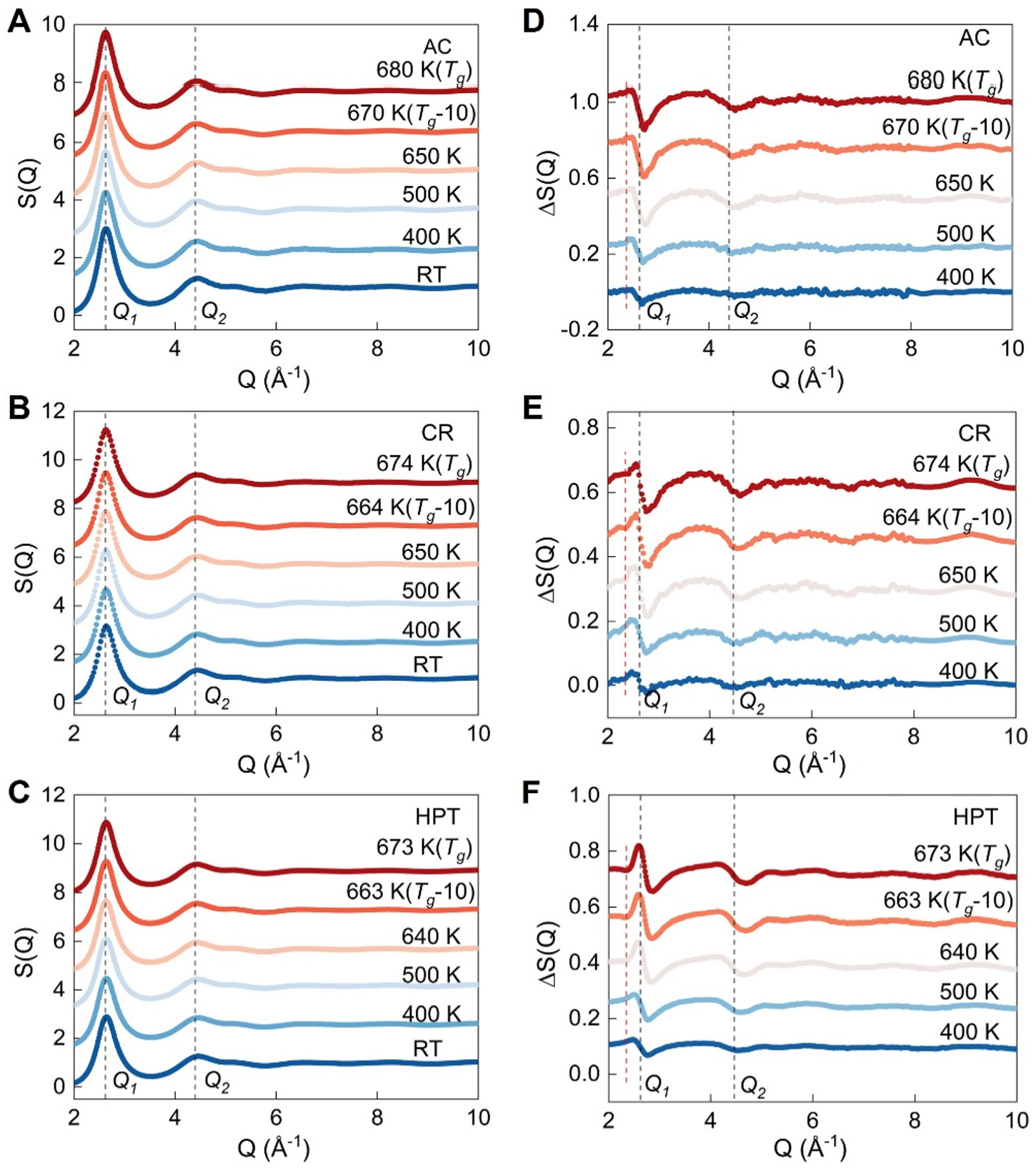
Figure 3. The in-situ synchrotron X-ray diffraction patterns at different temperatures of the (A) AC, (B) CR, and (C) HPT BMGs during heating. Difference △S(Q) profiles obtained by subtracting the diffraction pattern at RT for the (D) AC, (E) CR, and (F) HPT BMGs.
Further investigations into the in-situ heating process were conducted by analyzing the FSDP (Q1)[54,55]. The first peak position in momentum transfer (first moment of Q1) was positively correlated with the packing density of the MGs[49,50,56]. As shown in Figure 4A, with an increase in temperature, the first moment of Q1 for all BMGs initially exhibited an overall decreasing trend due to thermal expansion. The AC BMG exhibited a continuous decrease as the temperature increased to Tg, reflecting a pronounced decrease in packing density. By contrast, the decrease in packing density for the rejuvenated BMGs was suppressed at temperatures far below Tg, implying a competition event in structural evolution that resisted thermal expansion. Due to the introduction of high density of SBs, the atomic mobility was activated in the loosely packed regions, enabling a preferential transition to denser packing during heating. In HPT-BMG, this competition was even more pronounced. This was possibly attributed to the higher volume fraction of SBs in HPT-BMG.
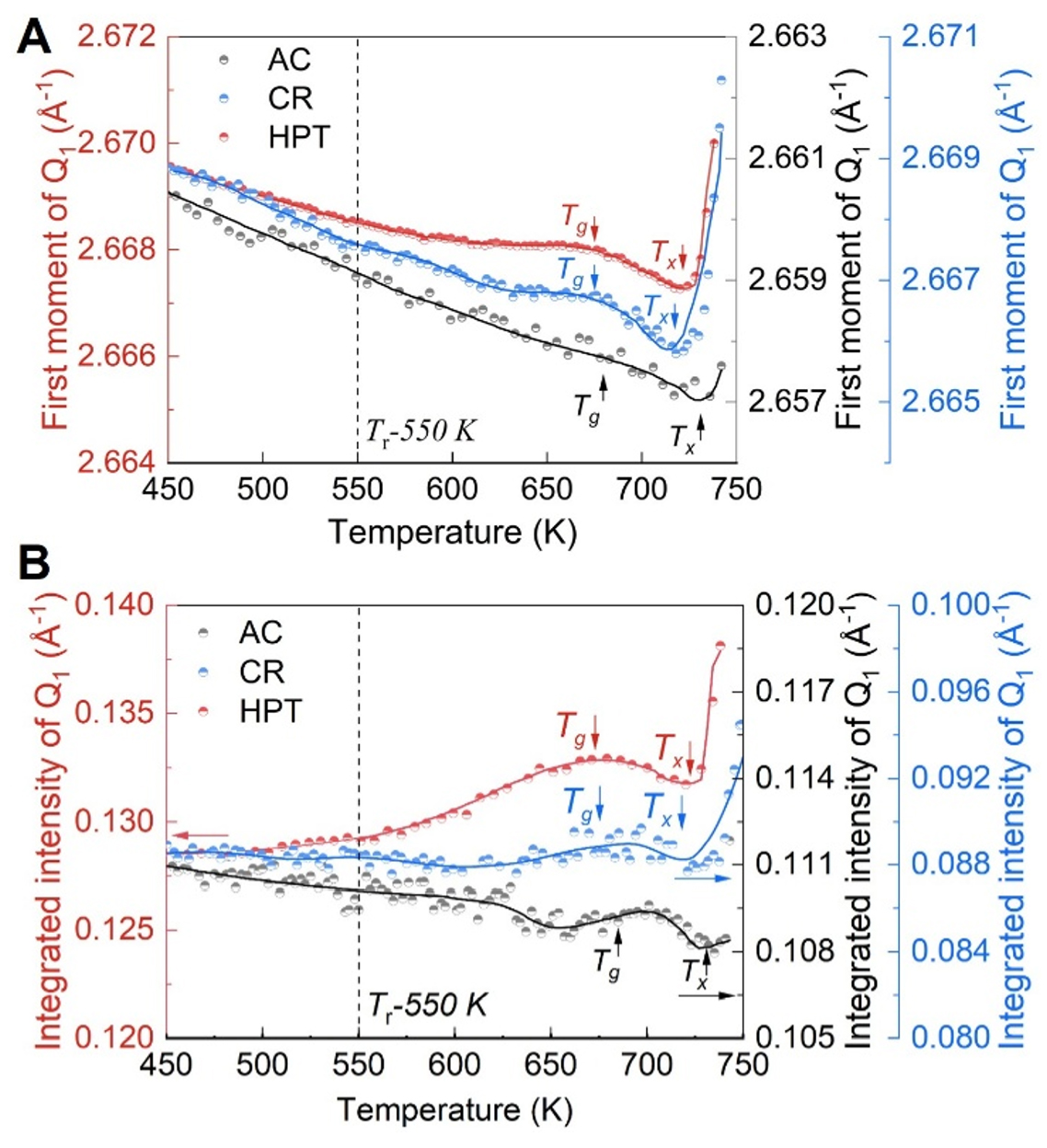
Figure 4. Emergence of medium-range ordering at sub-Tg in different BMGs. (A) First moment and (B) integrated intensity of the first sharp diffraction peak (Q1) of S(Q) profile of AC, CR and HPT BMGs as a function of temperature. The solid lines are obtained by spline fitting of the raw data. The onset temperature of relaxation (Tr) is marked by the dashed line in the figures.
Statistical analysis of the integral intensity of Q1 was conducted to illustrate the evolution of localized structural ordering in the MGs [Figure 4B]. AC-BMG exhibited a decreasing trend in integral intensity before Tg, followed by an increase after Tg. This evolution in structural ordering has been reported as associated with structural relaxation. The Q1 integral intensities of all BMGs demonstrated a uniform decreasing trend in the supercooled liquid phase region, followed by a rapid increase after reaching the Tx temperature, signifying the rapid convergence of the structure into an ordered state during crystallization. After heating, the slope of the integrated intensity initially exhibited a decreasing trend. Subsequently, enhanced atomic mobility in the shear-affected zones promoted structural ordering, leading to an opposite shift in both CR BMG and HPT BMG. This trend reversal was more intense in HPT BMG with greater plastic deformation. Also, the temperature at which these two competing mechanisms reached equilibrium was denoted as Tr.
Real space structural analysis was employed to elucidate the structural evolution mechanism in the BMGs. Reduced pair-distribution function, G(r), patterns in Figure 5A-C were derived from the Fourier transformation of the S(Q) profiles. As the temperature approached Tx, all samples exhibited peak splitting, indicating the onset of crystallization. Statistical analysis of the integral intensities, corresponding to the range of G(r) > 0 of r1 and r6, provided specific insights regarding structural evolution. A relative coordinate axis was adopted for comparison, with the Y-axis range set to the average value of each curve ±10%. A notable commonality was that as the temperature increased to Tg, the integral intensities of r1 and r6 transitioned from a gradual increase (starting at Tr) to a rapid increase, corresponding to a rapid relaxation process. For AC-BMG, the changes in the intensities of r1 and r6 were smaller than those in the rejuvenated BMGs, and the temperature at which rapid relaxation occurred was higher [Figure 5D]. Conversely, CR- and HPT-BMG, which possessed a higher volume fraction of SBs, exhibited a lower Tr, indicating that the introduction of SBs directly modulated atomic mobility, thereby influencing rapid relaxation [Figure 5E]. Although the trends of r1 and r6 during relaxation remained consistent in HPT-BMG, it was evident that the changes in the r6 peak, representing MRO, were more pronounced [Figure 5F]. This indicated that the structural relaxation prior to Tg was primarily driven by contributions from medium-range order. Based on the above analysis, we concluded that the introduction of SBs through plastic deformation facilitated the rapid activation of MRO during the relaxation process, thereby promoting structural ordering below Tg.
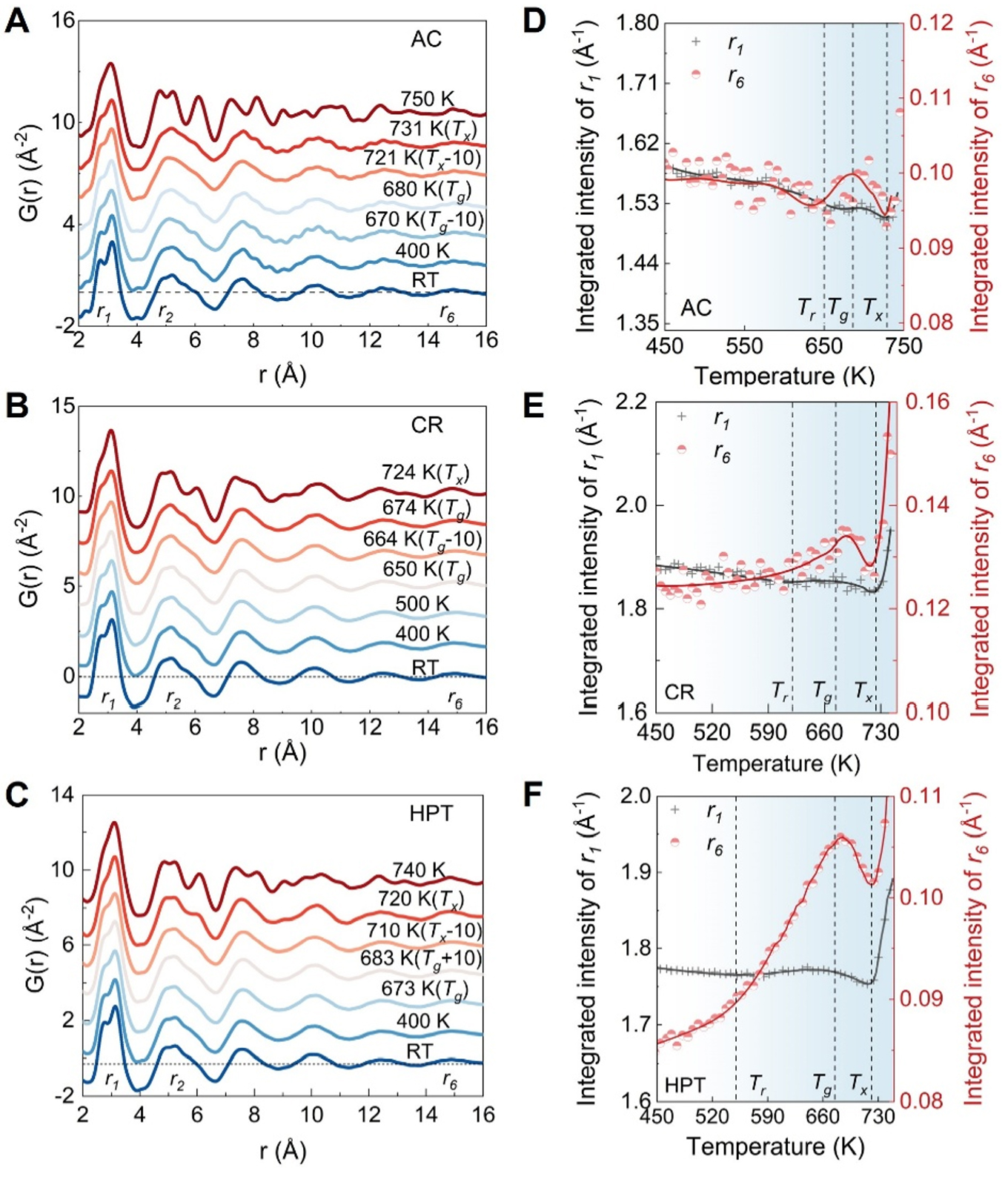
Figure 5. Pair-distribution function, G(r), of (A) AC, (B) CR, and (C) HPT BMGs during in-situ heating process. Integrated intensity of G(r) over the first (r1) and sixth (r6) shell (for regions where G(r) ≥ 0) for (D) AC, (E) CR, and (F) HPT BMGs.
Based on previous studies, the MRO structures could be reflected by correlations among atoms in the second-nearest-neighbor shell and accessed by analyzing the radial distribution of central atoms within local short-range order (SRO) units[57]. Figure 6A demonstrates the connection models between inter-polyhedra, including 1-atom, 2-atom, 3-atom, and 4-atom sharing configurations, and variations in these connection modes could alter MRO ordering. The cluster center distances for these four connection modes could be calculated geometrically as 2R,
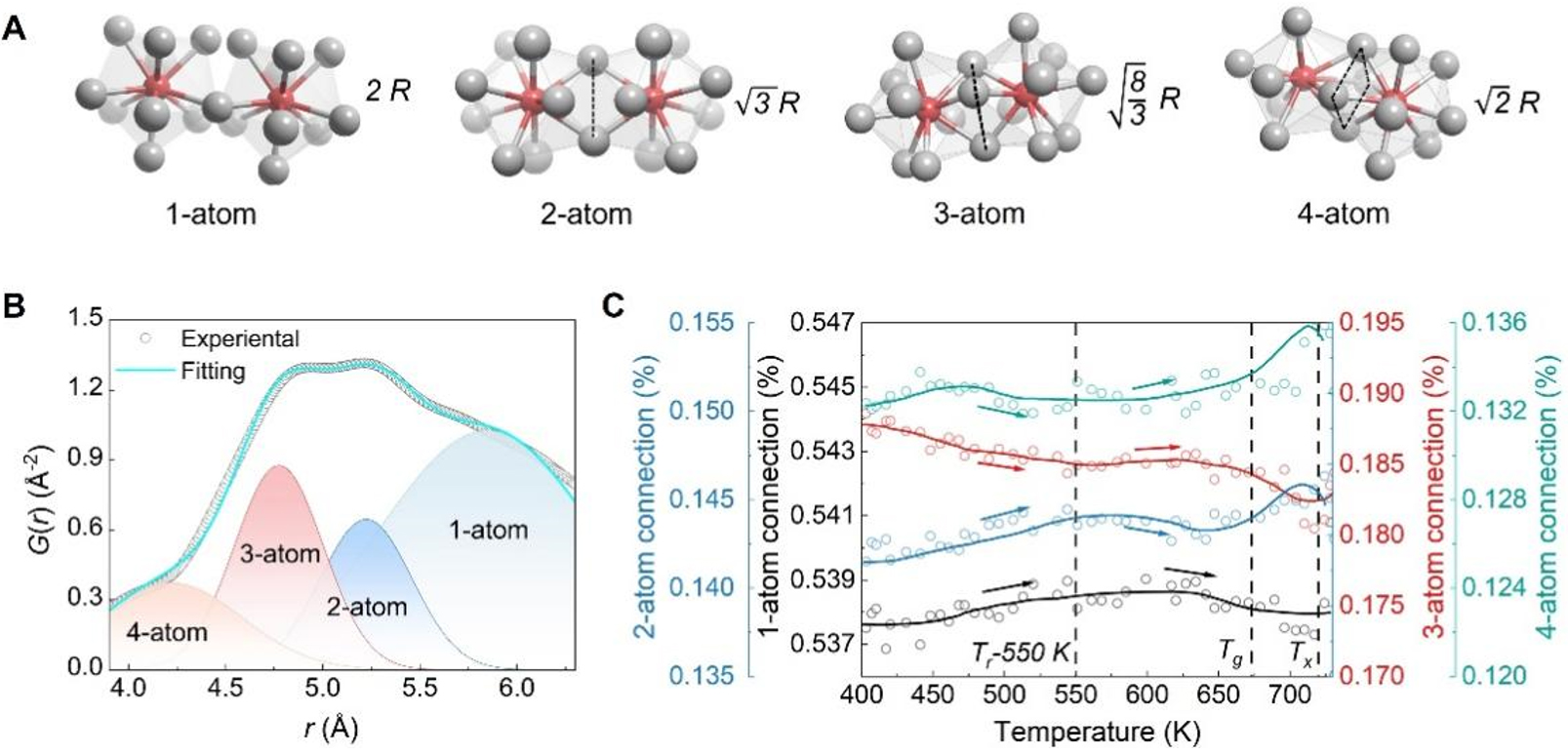
Figure 6. (A) Schemes of the four different cluster connection modes. (B) Gaussian fitting result for the 2nd shell of the g(r) pattern of HPT BMG at room temperature. (C) The contribution of each connection mode of the HPT BMG during in situ heating process.
CONCLUSIONS
In conclusion, a clear structure engineering-mechanical property correlation was revealed through state-of-the-art characterization techniques and analysis. The introduction of different volume fractions of shear bands into BAM11 BMG by mechanical deformation could alter different rejuvenation states with higher energy states. The rejuvenated BMG exhibited more significant structural relaxation at sub-Tg, which was associated dominantly with enhanced ordering at medium-range scale. Specifically, this MRO ordering process was characterized by a competitive evolution between different cluster connection modes, where the transition from 2-atom to 3-atom connections dominated. Our findings suggested that a high energy state could be obtained through severe plastic deformation, which in turn resulted in significantly enhanced sub-Tg structural ordering behavior at the medium-range scale. Our study offers novel insights into the atomic structure origins of shear bands and provides a model for the design of Zr-based metallic glasses with high plasticity.
DECLARATIONS
Acknowledgments
The authors thanked the staff of beamline BL13SSW at Shanghai Synchrotron Radiation Facility for the support of synchrotron data analyses. Thanks to Yin Z.X. for the help in sample preparation in the preliminary.
Authors’ contributions
Supervised the project: Lan, S.; Zhu, H.
Cast and processed the CR-BMG: Yao, Z.; Ying, H.; Zhang, W.
Cast and processed the HPT-BMG: Yao, Z.; Jiang, Y.; Lin, H.; Edalati, K.
Prepared micro-pillar specimens and performed the micro-pillar compression: Yao, Z.
Prepared the TEM specimens: Yao, Z.; Liu, S.; Ge, J.
Performed in-situ synchrotron X-ray diffraction experiments at 11-ID-C of APS, ANL: Lan, S.; Liu, S.; Ren, Y.
Analyzed the PDF results: Zeng, J.; Lan, S.; Wu, Z.; Liu, S.; Ren, Y.; Wang, X. L.
Performed the TEM work: Lan, S.; Yao, Z.; Liu, S.
Drafted the manuscript together: Lan, S.; Wu, Z.; Liu, S.; Yao, Z.
All authors analyzed and reviewed the results and provided input to this paper.
Availability of data and materials
The data that support the findings of this study are available from the corresponding author upon reasonable request.
AI and AI-assisted tools statement
Not applicable.
Financial support and sponsorship
This work was financially supported by the National Natural Science Foundation of China (Grant Nos. 12261160364, 52573263, 52222104, 22275089, and 52571196), funded by Basic Research Program of Jiangsu (Grant No. BK20253026), the Natural Science Foundation of Jiangsu Province (Grant No. BK20200019), the Fundamental Research Funds for the Central Universities (No. 30922010307), the Research Grants Council of the Hong Kong Special Administrative Region, Project N_CityU173/22, and the support by Guangdong-Hong Kong-Macao Joint Laboratory for Neutron Scattering Science. Wu, Z. acknowledges the financial support by Guangdong Talent Program (no. 2024TQ08C536). This research used the Advanced Photon Source, a US Department of Energy (DOE) Office of Science User Facility operated for the DOE Office of Science by Argonne National Laboratory under Contract No. DE-AC02–06CH11357, and was supported by the US DOE Office of Science, Office of Basic Energy Sciences.
Conflicts of interest
Ren, Y. is a Senior Editorial Board Member of the journal Microstructures. Lan, S. is an Editorial Board Member of the journal Microstructures. Ren, Y. and Lan, S. were not involved in any steps of editorial processing, notably including reviewers' selection, manuscript handling and decision making, while the other authors have declared that they have no conflicts of interest.
Ethical approval and consent to participate
Not applicable.
Consent for publication
Not applicable.
Copyright
© The Author(s) 2026.
REFERENCES
1. Ma, E.; Ding, J. Tailoring structural inhomogeneities in metallic glasses to enable tensile ductility at room temperature. Mater. Today. 2016, 19, 568-79.
3. Liu, Z.; Yang, Y.; Liu, C. Yielding and shear banding of metallic glasses. Acta. Mater. 2013, 61, 5928-36.
4. Yazdani, A.; Dewitt, D.; Huang, W.; et al. Mechanical properties of an ultrahard in situ amorphous steel matrix composite. Adv. Eng. Mater. 2024, 26, 2400257.
5. Di, S.; Wang, Q.; Zhou, J.; et al. Enhancement of plasticity for FeCoBSiNb bulk metallic glass with superhigh strength through cryogenic thermal cycling. Scr. Mater. 2020, 187, 13-8.
6. Qiao, J.; Wang, Y.; Pelletier, J.; Keer, L. M.; Fine, M. E.; Yao, Y. Characteristics of stress relaxation kinetics of La60Ni15Al25 bulk metallic glass. Acta. Mater. 2015, 98, 43-50.
7. Xu, N.; Huang, Y.; Cao, Y.; Li, S.; Wang, Y. D. Novel casting CoCrNiAl eutectic high entropy alloys with high strength and good ductility. Microstructures 2023, 3, 2023015.
9. Wang, Q.; Lou, H.; Xu, D.; et al. Shear straining promoted structural transition in bulk metallic glasses. Scr. Mater. 2024, 249, 116168.
10. Greer, A.; Cheng, Y.; Ma, E. Shear bands in metallic glasses. Mater. Sci. Eng. R. Rep. 2013, 74, 71-132.
11. Ketov, S. V.; Sun, Y. H.; Nachum, S.; et al. Rejuvenation of metallic glasses by non-affine thermal strain. Nature 2015, 524, 200-3.
12. Wu, G.; Liu, S.; Wang, Q.; et al. Substantially enhanced homogeneous plastic flow in hierarchically nanodomained amorphous alloys. Nat. Commun. 2023, 14, 3670.
13. Wright, W.; Saha, R.; Nix, W. Deformation mechanisms of the Zr40Ti14Ni10Cu12Be24 bulk metallic glass. Mater. Trans. 2001, 42, 642-9.
14. Wang, W. H. The elastic properties, elastic models and elastic perspectives of metallic glasses. Prog. Mater. Sci. 2012, 57, 487-656.
16. Huang, R.; Suo, Z.; Prevost, J.; Nix, W. Inhomogeneous deformation in metallic glasses. J. Mech. Phys. Solids. 2002, 50, 1011-27.
17. Falk, M. L.; Langer, J. S. Dynamics of viscoplastic deformation in amorphous solids. Phys. Rev. E. 1998, 57, 7192-205.
18. Schuh, C.; Hufnagel, T.; Ramamurty, U. Mechanical behavior of amorphous alloys. Acta. Mater. 2007, 55, 4067-109.
19. Sun, W.; Li, T.; Wang, Y.; et al. Thermally-driven structural inhomogeneity and serrated plastic flow in TaTiZr amorphous medium-entropy alloy. Acta. Mater. 2025, 286, 120764.
20. Wang, W. H. Dynamic relaxations and relaxation-property relationships in metallic glasses. Prog. Mater. Sci. 2019, 106, 100561.
21. Tao, K.; Qiao, J.; He, Q.; Song, K.; Yang, Y. Revealing the structural heterogeneity of metallic glass: mechanical spectroscopy and nanoindentation experiments. Int. J. Mech. Sci. 2021, 201, 106469.
22. Wang, Z.; Sun, B. A.; Bai, H. Y.; Wang, W. H. Evolution of hidden localized flow during glass-to-liquid transition in metallic glass. Nat. Commun. 2014, 5, 5823.
24. Lv, J.; Yin, D.; Wang, F.; Yang, Y.; Ma, M.; Zhang, X. Influence of sub-Tg annealing on microstructure and crystallization behavior of TiZr-based bulk metallic glass. J. Non. Cryst. Solids. 2021, 565, 120855.
25. Song, K.; Pauly, S.; Sun, B.; et al. Formation of Cu-Zr-Al-Er bulk metallic glass composites with enhanced deformability. Intermetallics 2012, 30, 132-8.
26. He, L.; Wu, S.; Dong, A.; et al. Selective laser melting of dense and crack-free AlCoCrFeNi2.1 eutectic high entropy alloy: synergizing strength and ductility. J. Mater. Sci. Technol. 2022, 117, 133-45.
27. Hadibeik, S.; Ghasemi-Tabasi, H.; Burn, A.; Lani, S.; Spieckermann, F.; Eckert, J. Controlling the glassy state toward structural and mechanical enhancement: additive manufacturing of bulk metallic glass using advanced laser beam shaping technology. Adv. Funct. Mater. 2023, 34, 2311118.
28. Argon, A.; Kuo, H. Plastic flow in a disordered bubble raft (an analog of a metallic glass). Mater. Sci. Eng. 1979, 39, 101-9.
29. Long, Z.; Tao, P.; Wang, G.; et al. Effect of Nb and Ta addition on mechanical properties of Zr-based bulk metallic glasses and composites. J. Alloys. Compd. 2022, 912, 165071.
30. Kong, L.; Tao, P.; Xiong, Z.; Yan, X.; Yang, Y. Effect of deep cryogenic cycle treatment on the microstructure and mechanical properties of Zr46Cu46Al4Ti4 bulk metallic glass. Intermetallics 2024, 175, 108504.
31. Wang, W. H. Correlation between relaxations and plastic deformation, and elastic model of flow in metallic glasses and glass-forming liquids. J. Appl. Phys. 2011, 110, 053521.
32. Yu, H. B.; Shen, X.; Wang, Z.; Gu, L.; Wang, W. H.; Bai, H. Y. Tensile plasticity in metallic glasses with pronounced β relaxations. Phys. Rev. Lett. 2012, 108, 015504.
33. Greer, A. L.; Sun, Y. H. Stored energy in metallic glasses due to strains within the elastic limit. Philos. Mag. 2016, 96, 1643-63.
34. Li, X.; Wang, J.; Ke, H.; Yang, C.; Wang, W. Extreme rejuvenation and superior stability in a metallic glass. Mater. Today. Phys. 2022, 27, 100782.
35. Yuan, X.; Şopu, D.; Spieckermann, F.; et al. Maximizing the degree of rejuvenation in metallic glasses. Scr. Mater. 2022, 212, 114575.
36. Lee, M.; Lee, K.; Das, J.; Thomas, J.; Kühn, U.; Eckert, J. Improved plasticity of bulk metallic glasses upon cold rolling. Scr. Mater. 2010, 62, 678-81.
37. Scudino, S.; Jerliu, B.; Surreddi, K.; Kühn, U.; Eckert, J. Effect of cold rolling on compressive and tensile mechanical properties of Zr52.5Ti5Cu18Ni14.5Al10 bulk metallic glass. J. Alloys. Compd. 2011, 509, S128-30.
38. Stolpe, M.; Kruzic, J.; Busch, R. Evolution of shear bands, free volume and hardness during cold rolling of a Zr-based bulk metallic glass. Acta. Mater. 2014, 64, 231-40.
39. Pan, J.; Ivanov, Y. P.; Zhou, W. H.; Li, Y.; Greer, A. L. Strain-hardening and suppression of shear-banding in rejuvenated bulk metallic glass. Nature 2020, 578, 559-62.
40. Dmowski, W.; Yokoyama, Y.; Chuang, A.; et al. Structural rejuvenation in a bulk metallic glass induced by severe plastic deformation. Acta. Mater. 2010, 58, 429-38.
41. Gunderov, D.; Churakova, A.; Boltynjuk, E.; et al. Observation of shear bands in the Vitreloy metallic glass subjected to HPT processing. J. Alloys. Compd. 2019, 800, 58-63.
42. Nieh, T.; Yang, Y.; Lu, J.; Liu, C. Effect of surface modifications on shear banding and plasticity in metallic glasses: an overview. Prog. Nat. Sci. Mater. Int. 2012, 22, 355-63.
43. Chen, W.; Chan, K.; Chen, S.; Guo, S.; Li, W.; Wang, G. Plasticity enhancement of a Zr-based bulk metallic glass by an electroplated Cu/Ni bilayered coating. Mater. Sci. Eng. A. 2012, 552, 199-203.
44. Qu, R.; Wu, S.; Wang, S.; Wang, X.; Zhang, Z. Shear banding stability and fracture of metallic glass: effect of external confinement. J. Mechan. Phys. Solids. 2020, 138, 103922.
45. Ding, J.; Patinet, S.; Falk, M. L.; Cheng, Y.; Ma, E. Soft spots and their structural signature in a metallic glass. Proc. Natl. Acad. Sci. USA. 2014, 111, 14052-6.
46. Hubek, R.; Seleznev, M.; Binkowski, I.; Peterlechner, M.; Divinski, S. V.; Wilde, G. The impact of micro-alloying on relaxation dynamics in Pd40Ni40P20 bulk metallic glass. J. Appl. Phys. 2018, 124, 225103.
47. Zhou, H.; Hubek, R.; Peterlechner, M.; Wilde, G. Two-stage rejuvenation and the correlation between rejuvenation behavior and the boson heat capacity peak of a bulk metallic glass. Acta. Mater. 2019, 179, 308-16.
48. Ebner, C.; Escher, B.; Gammer, C.; Eckert, J.; Pauly, S.; Rentenberger, C. Structural and mechanical characterization of heterogeneities in a CuZr-based bulk metallic glass processed by high pressure torsion. Acta. Mater. 2018, 160, 147-57.
49. Qiu, X.; Thompson, J. W.; Billinge, S. J. L. PDFgetX2: a GUI-driven program to obtain the pair distribution function from X-ray powder diffraction data. J. Appl. Crystallogr. 2004, 37, 678.
50. Lan, S.; Blodgett, M.; Kelton, K. F.; Ma, J. L.; Fan, J.; Wang, X. Structural crossover in a supercooled metallic liquid and the link to a liquid-to-liquid phase transition. Appl. Phys. Lett. 2016, 108, 211907.
51. Ding, J.; Ma, E.; Asta, M.; Ritchie, R. O. Second-nearest-neighbor correlations from connection of atomic packing motifs in metallic glasses and liquids. Sci. Rep. 2015, 5, 17429.
52. Révész, Á.; Arjmandabasi, T.; Schafler, E.; Browne, D. J.; Kovács, Z. Comprehensive thermal analysis of a high stability Cu-Zr-Al bulk metallic glass subjected to high-pressure torsion. J. Therm. Anal. Calorim. 2023, 148, 2323-34.
53. Louzguine-Luzgin, D.; Ketov, S.; Wang, Z.; Miyama, M.; Tsarkov, A.; Churyumov, A. Plastic deformation studies of Zr-based bulk metallic glassy samples with a low aspect ratio. Mater. Sci. Eng. A. 2014, 616, 288-96.
54. Ren, Z. Q.; Churakova, A.; Wang, X.; et al. Enhanced tensile strength and ductility of bulk metallic glasses Zr52.5Cu17.9Al10Ni14.6Ti5 via high-pressure torsion. Mater. Sci. Eng. A. 2021, 803, 140485.
55. Ma, D.; Stoica, A. D.; Wang, X. Power-law scaling and fractal nature of medium-range order in metallic glasses. Nat. Mater. 2008, 8, 30-4.
56. Li, F.; Wang, T.; He, Q.; et al. Micromechanical mechanism of yielding in dual nano-phase metallic glass. Scr. Mater. 2018, 154, 186-91.
57. Yao, Z.; Zhu, H.; Lou, Y.; et al. Composition engineering of short-range-ordered polyhedra in Ni-Mo-P-B metallic glass for electrochemical sensing. Mater. Today. 2026, 94, 103245.
Cite This Article
 Open Access
How to Cite
Download Citation
Export Citation File:
Type of Import
Tips on Downloading Citation
Citation Manager File Format
Type of Import
Direct Import: When the Direct Import option is selected (the default state), a dialogue box will give you the option to Save or Open the downloaded citation data. Choosing Open will either launch your citation manager or give you a choice of applications with which to use the metadata. The Save option saves the file locally for later use.
Indirect Import: When the Indirect Import option is selected, the metadata is displayed and may be copied and pasted as needed.
About This Article
Copyright

Data & Comments
Data
0










Comments
Comments must be written in English. Spam, offensive content, impersonation, and private information will not be permitted. If any comment is reported and identified as inappropriate content by OAE staff, the comment will be removed without notice. If you have any queries or need any help, please contact us at [email protected].