

fig25
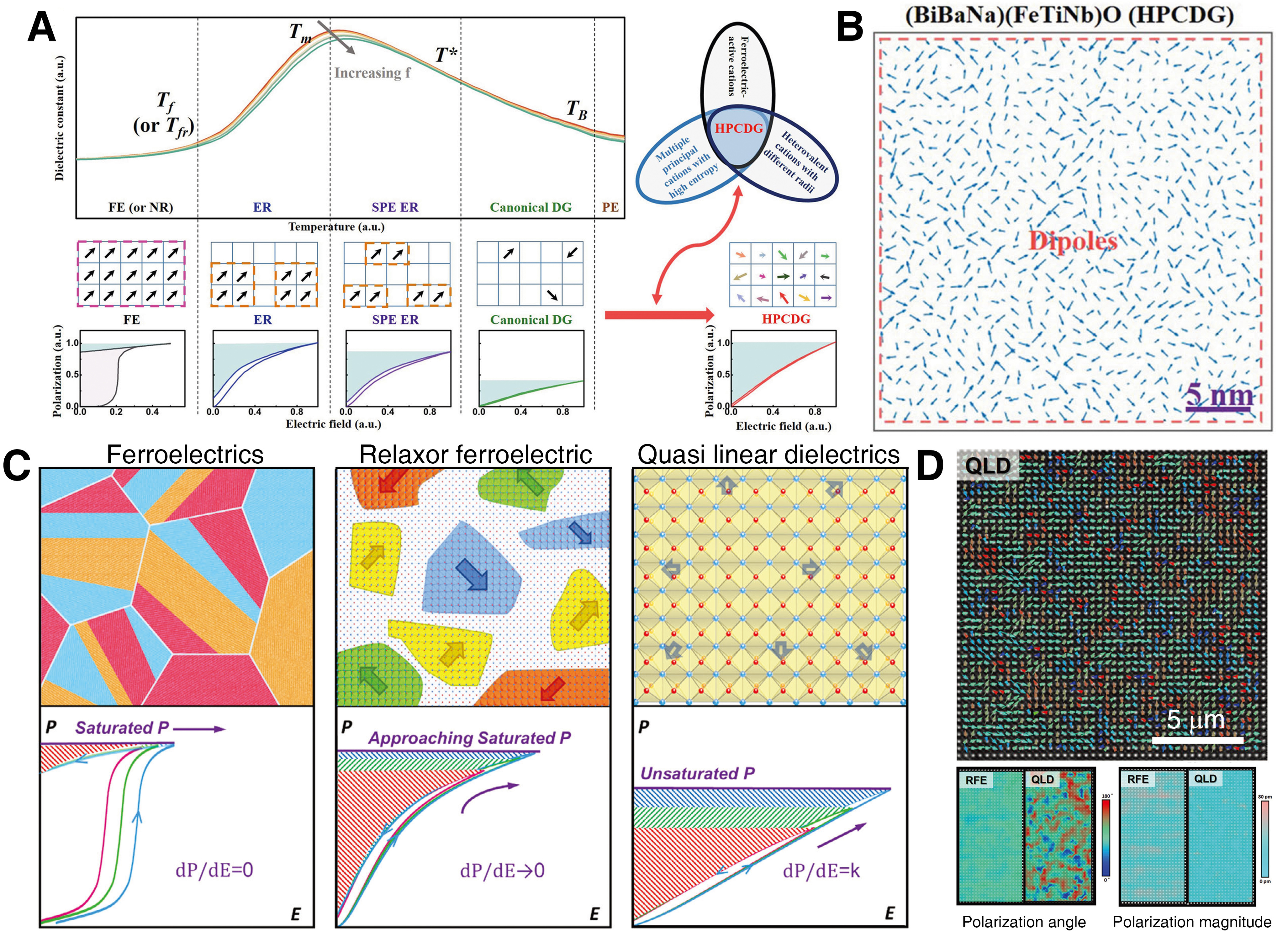
Figure 25. Design strategies for high-performance dielectric capacitors based on highly polarizable concentrated dipole glass (HPCDG) and QLD behavior. (A and B) HPCDG design: (A) Temperature-dependent dielectric response sketches of typical RFEs at various frequencies, with corresponding polar structures and polarization responses for nonergodic relaxor (NR, or FE), ergodic relaxor (ER), superparaelectric ergodic relaxor (SPE ER), canonical dipole glass (DG), paraelectric (PE) states, and HPCDG. The inset shows the schematic design strategy of HPCDG; (B) Composition strategy and structural mechanism of (BiBaNa)(FeTiNb)O HPCDG, illustrated by phase-field-simulated two-dimensional domain structures of BF-BT-2/9BNT-2/9NN. This figure is quoted with permission from Fu et al.[324]; (C and D) Novel RFEs with enhanced ESP through high-permittivity QLD behavior: (C) Schematic microstructures and unipolar P-E loops (with identical internal electric fields represented by red, green, and blue loops) comparing different dielectrics including FEs with macroscopic domains and QLD materials featuring lattice distortions; the shaded areas represent electrostatic ES capacity; (D) Advanced transmission electron microscopy of QLD-type composition 0.88NaNb0.9Ta0.1O3-0.10ST-0.02La(Mg1/2Ti1/2)O3: [001]-oriented atomic-resolution HAADF-STEM images, polar states shown by individual arrows representing B-site cation displacement vectors in each unit cell, projected polarization angle, and polarization magnitude mappings. This figure is quoted with permission from Wang et al.[325]. RFE: Relaxor ferroelectric; ESP: energy storage performance; HAADF-STEM: high-angle annular dark field- scanning transmission electron microscopy; ES: energy storage; QLD: quasi-linear dielectrics.