

fig5
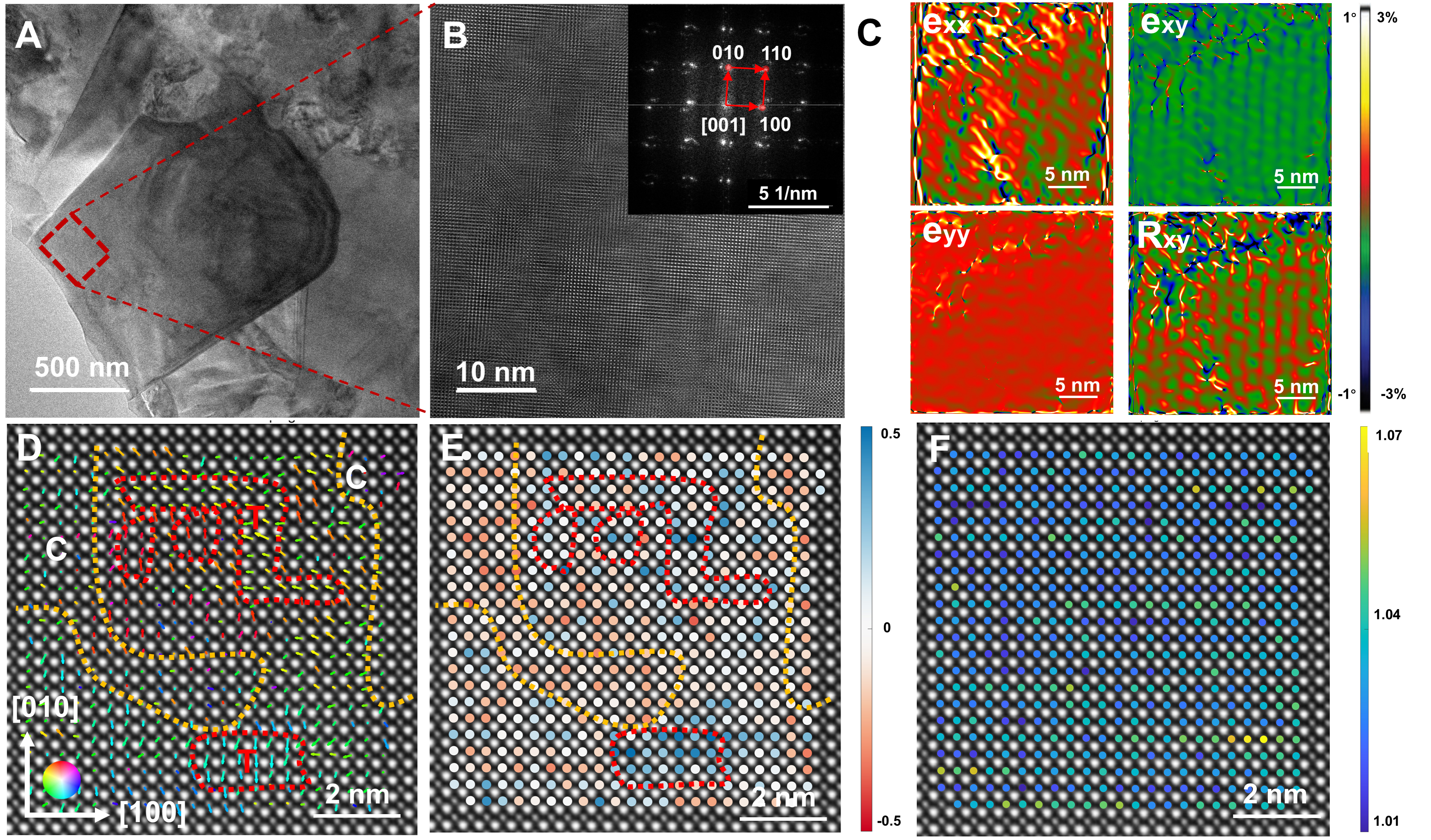
Figure 5. (A) TEM image of BTC4 ceramic; (B) Enlarged view of (A), with the inset showing the corresponding diffraction pattern; (C) Localized strain field images of (B) calculated by the Geometric phase analysis (GPA) method. The two-dimensional strain field is characterized by normal strain components exx and eyy, which describe lattice elongation or compression along the X and Y directions, respectively. The shear strain component exy represents in-plane lattice distortion due to shear deformation, while the rotation component Rxy quantifies local rigid-body lattice rotation. High-angle annular dark-field scanning transmission electron microscopy (HADDF-STEM) images of BTC4 ceramics; (D) the polarization vector, (E) the polarization strength of the B site, and (F) the c/a ratio. Polarization vectors were defined as the displacement between the B-site cations and the center of the four nearest neighboring A-site cations, with polarization strength corresponding to the absolute magnitude of these vectors. TEM: Transmission electron microscope; BTC: BaTi100-xCaxO3.