

fig10
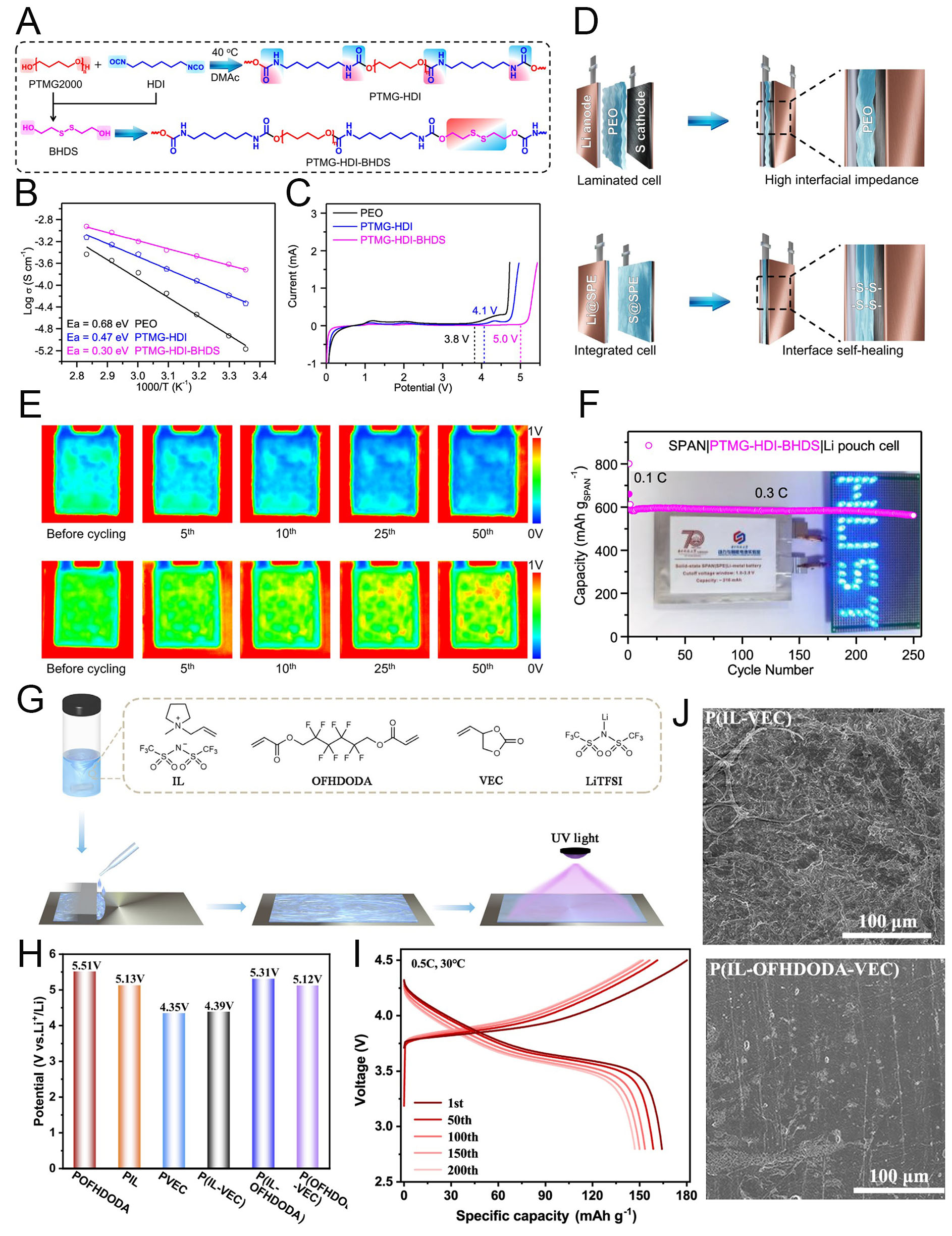
Figure 10. Interface stabilization and electrochemical performance enabled by SPEs. (A) Chemical structures of PTMG-HDI and PTMG-HDI-BHDS. (B) Temperature-dependent ionic conductivities of the SPEs. (C) Linear sweep voltammetry (LSV) of the SPEs. (D) Structure of a conventional laminated (top) and an integrated electrode/electrolyte (bottom) solid-state Li-S battery. (E) In-situ ultrasonic transmission images during cycling for Li|PEO|SPAN (top) and Li|PTMG-HDI-BHDS|SPAN (bottom).(F) Cycling performance and optical images (inset) of the as-fabricated SPAN|SPEs|Li pouch cell. Reproduced with permission[126]. (G) Schematic illustration of the preparation of P(IL-OFHDODA-VEC). (H) Electrochemical stability window (ESW) of PIL, POFHDODA, PVEC, P(IL-OFHDODA), P(IL-VEC), and P(OFHDODA-VEC). (I) Charge/discharge curves of the Li|P(IL-OFHDODA-VEC)|NCM523 full cell. (J) SEM images of Li metal after cycling with P(IL-VEC) and P(IL-OFHDODA-VEC). Reproduced with permission[127].