

fig9

Design and application of metal-organic framework-derived catalysts for oxygen reduction in energy conversion devices

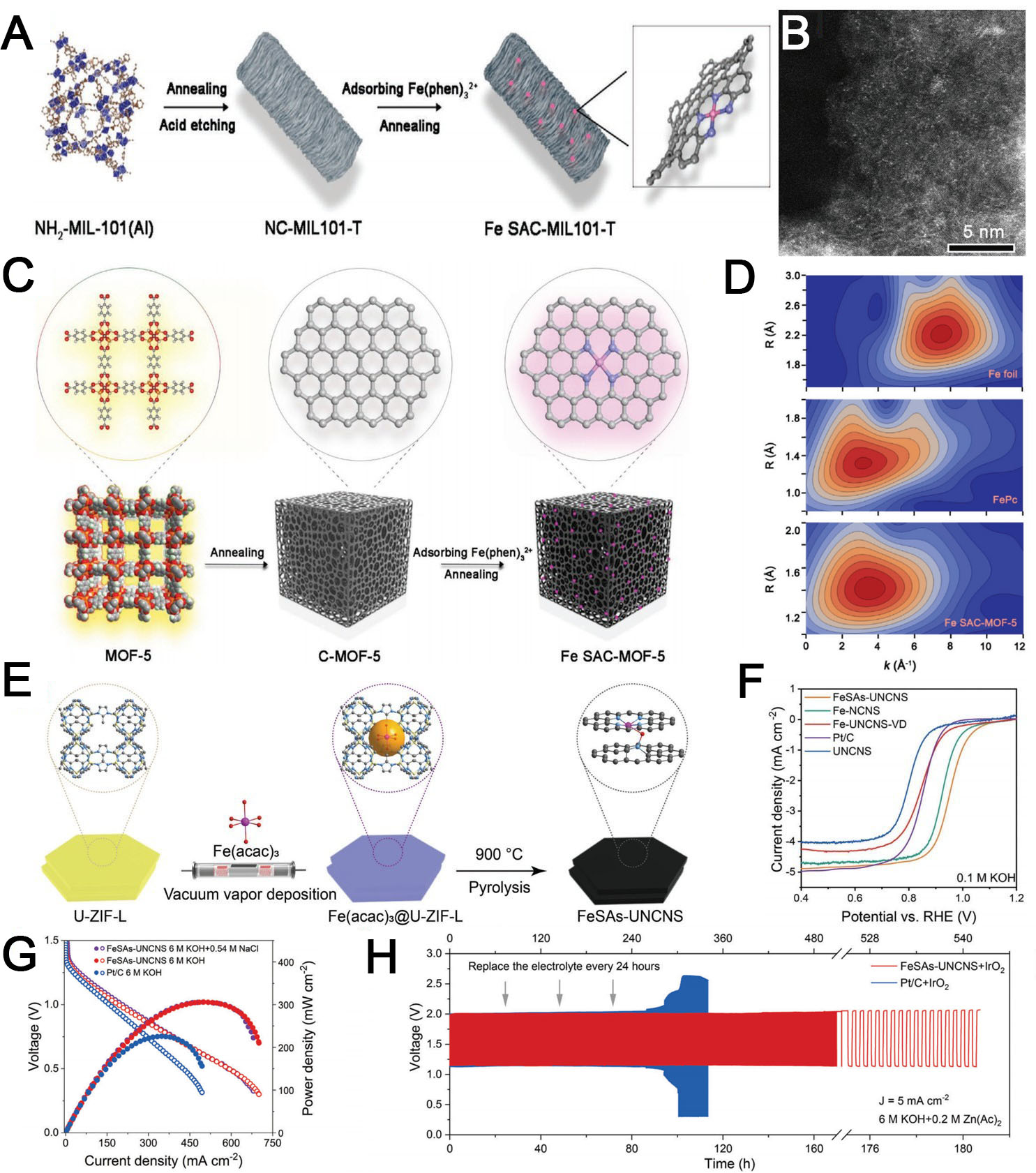
Figure 9. (A) Schematic of Fe SAC-MIL101-T and (B) aberration-corrected HAADF-STEM image of Fe SAC-MIL101-1000 (A and B reproduced with permission from Wiley-VCH, copyright 2021)[151]; (C) synthesis of the Fe SAC-MOF-5 catalyst; (D) wavelet-transformed k2-weighted EXAFS spectra of Fe SAC-MOF-5, FePc, and Fe foil (C and D reproduced with permission from Wiley-VCH, copyright 2021)[152]; (E) Synthetic scheme of FeSAs-UNCNS; (F) LSV curves recorded in an O2-saturated 0.1 M KOH solution at a rotation speed of 1,600 rpm and a sweep rate of 10 mV s-1; (G) polarization and power density curves of primary and simulated seawater-based Zn-air batteries (ZABs); (H) galvanostatic charge-discharge cycling curves of rechargeable ZABs at a current density of 5 mA cm-2 (reproduced with permission from Wiley-VCH, copyright 2024)[134]. HAADF-STEM: High-angle annular dark field-scanning transmission electron microscopy; EXAFS: extended X-ray absorption fine structure; SAC: single-atom catalyst; MIL: materials research institute lavoisier; MOF: metal-organic framework; UNCNS: ultrathin nitrogen-doped carbon nanosheets; LSV: linear sweep voltammetry.

Microstructures
ISSN 2770-2995 (Online)

Portico

All published articles are preserved here permanently:

https://www.portico.org/publishers/oae/

Portico

All published articles are preserved here permanently:

https://www.portico.org/publishers/oae/