

fig8
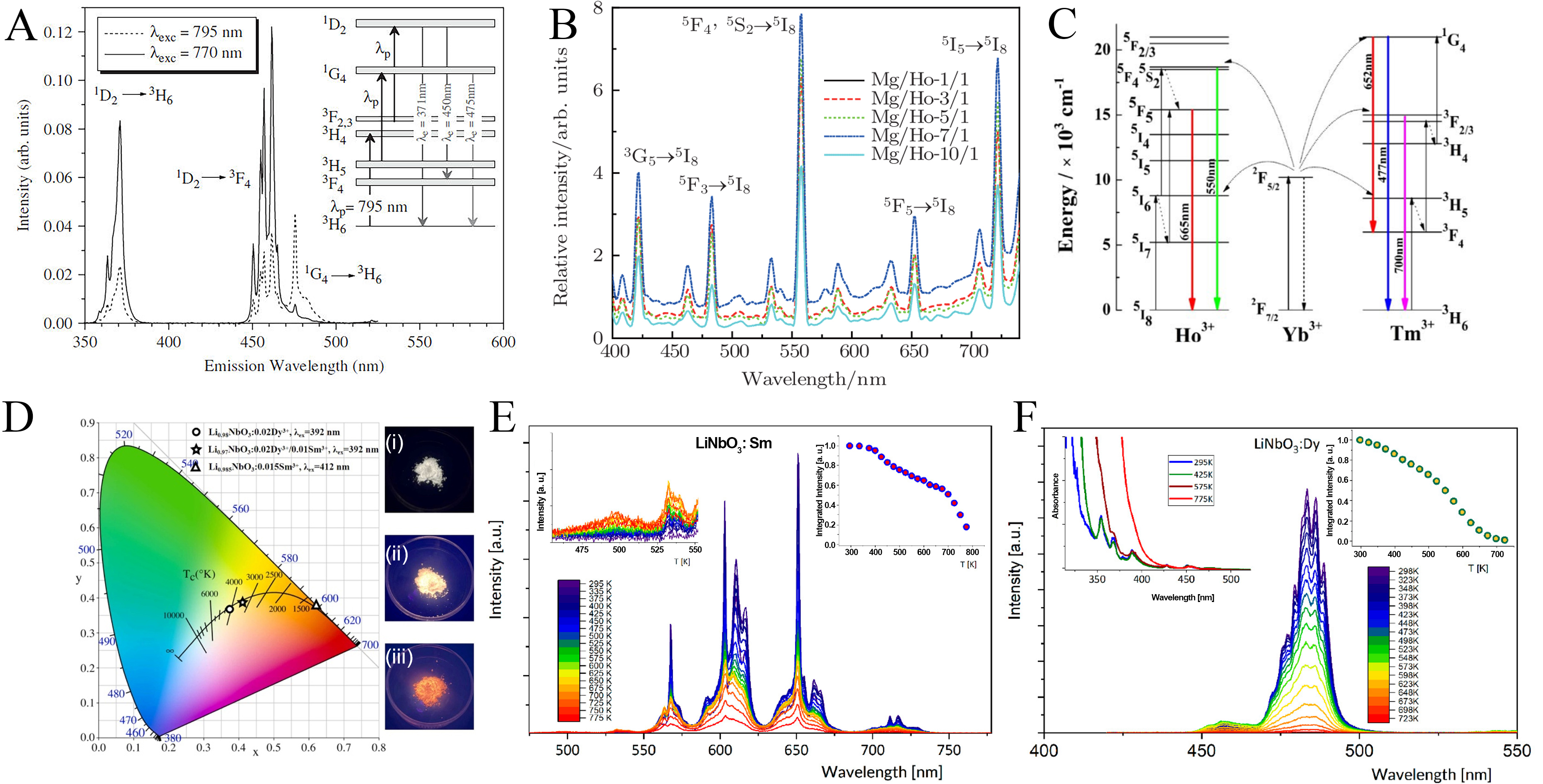
Figure 8. (A) Upconversion emission of LiNbO3:Tm3+ under two excitation wavelengths. The inset shows the relevant energy levels and optical transitions[111]. Reproduced from Ref.[111] with permission from the Elsevier; (B) Upconversion emission spectra of LiNbO3:Mg2+/Ho3+ with varying Mg concentrations under 808 nm excitation[19]; (C) Energy levels of Ho3+ ion as well as the proposed upconversion mechanism in LiNbO3:Mg2+,Ho3+[19]. Reproduced from Ref.[19] with permission from the Chinese Physics B; (D) CIE coordinates of LiNbO3:Dy3+/Sm3+ phosphors under near-UV excitation, with inset photographs taken under 365 nm[41]. Reproduced from Ref.[41] with permission from the Elsevier; (E) Temperature-dependent luminescence spectra of LiNbO3:Sm3+ under 402 nm excitation[114]; (F) Temperature-dependent luminescence spectra of LiNbO3:Dy3+ under 356 nm excitation[114]. Adapted from Lisiecki et al.[114] under the Creative Commons Attribution 4.0 International (CC BY 4.0) license. LiNbO3: Lithium niobate; CIE: Commission Internationale de l’Éclairage; UV: ultraviolet; Tm: thulium; Ho: holmium; Dy: dysprosium; Sm: samarium.