



Heteroepitaxial integration of freestanding ferroelectric BaTiO3 on BaZrO3 membranes
 0
0 Abstract
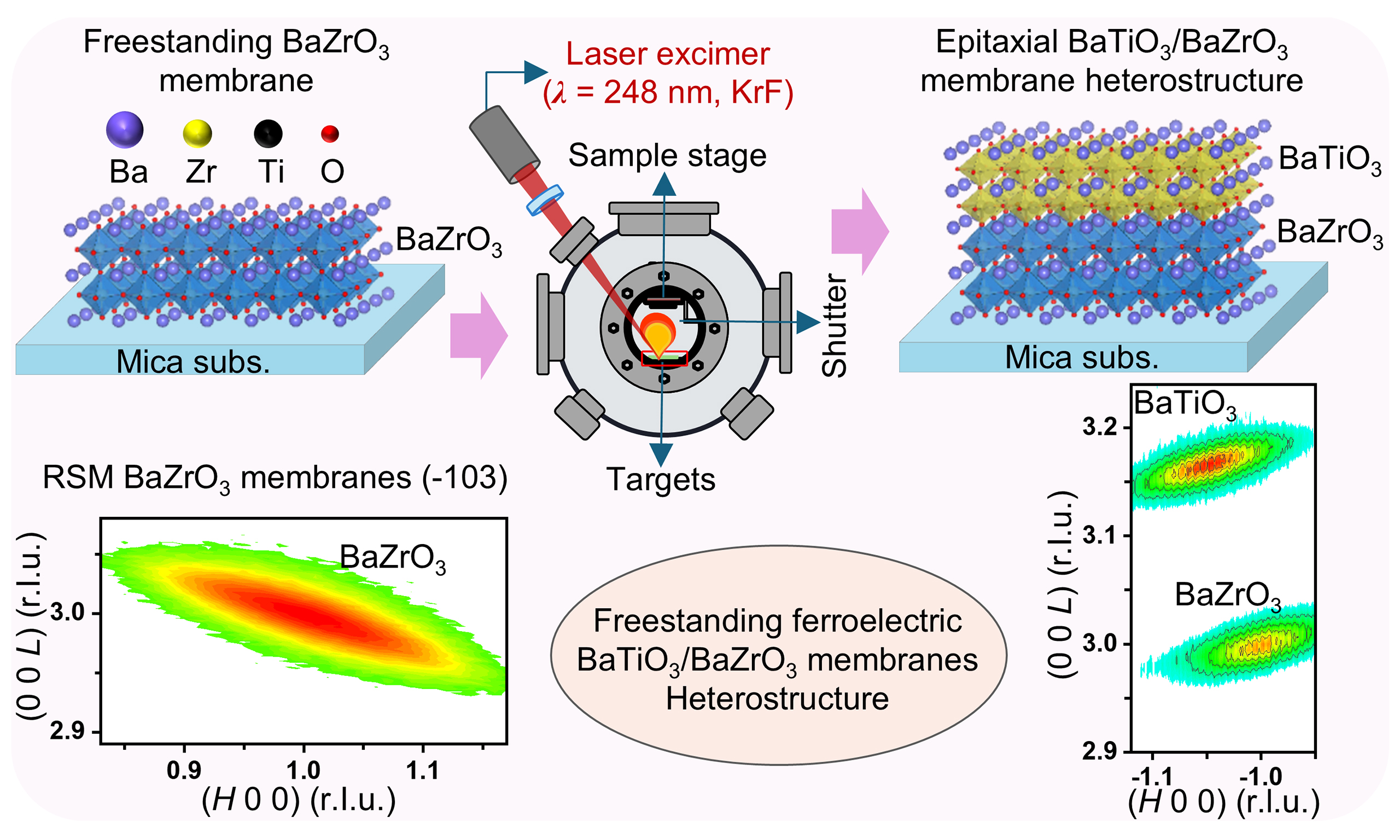
Freestanding oxide membranes, which are free from epitaxial constraint and substrate clamping unlike complex oxide thin-film heterostructures, provide a fascinating platform for realizing multi-functional devices via heterogeneous integration of freestanding membranes with different physical properties. For further applications of freestanding membranes to actual devices, single-crystalline nanomembranes are highly essential. Herein, we demonstrate the fabrication of freestanding BaZrO3 membranes with high crystallinity via BaZrO3/SrCuO2 bilayer thin films epitaxially grown on SrTiO3 (001) substrates, followed by selective etching of the sacrificial SrCuO2 layer. The exfoliated freestanding BaZrO3 membranes serve as a robust template layer for the epitaxial growth of ferroelectric BaTiO3, producing freestanding BaTiO3/BaZrO3 membrane heterostructures. The crystallinity and epitaxy of the as-fabricated freestanding heterojunctions is characterized by X-ray diffraction analyses. Raman spectroscopy also reveals that the upper layers of ferroelectric BaTiO3 are mainly in-plane polarized probably due to the biaxial in-plane tensile strain imposed by the lower BaZrO3 layer with cubic symmetry, although the initial tensile strain is progressively mitigated with the increasing thickness of the topmost BaTiO3 layer. The perovskite BaZrO3 membrane templates are of potential interest for designing strain-tuned heterojunctions of freestanding oxide membranes, where the associated physical properties can be manipulated compared with the bulk counterparts and/or epitaxial oxide thin-film heterostructures.
Keywords
INTRODUCTION
Perovskite ferroelectric oxides, with their ABO3 structure, are well-known for their rich electronic, structural, and electromechanical properties that can be precisely controlled in epitaxial thin films and heterostructures[1-5]. However, conventional rigid substrates impose mechanical constraints[6] that can diminish intrinsic responses through unavoidable effects such as lattice clamping[7-9], interfacial constraints[10], and thermal-mismatch stresses[11,12]. In recent years, freestanding single-crystal oxide membranes have emerged as an alternative route to decouple functional oxide layers from rigid substrates[13], enabling large strain gradients[14,15] and heterogeneous integration with non-oxide substrates (i.e., Si, quartz, metal foil, and polymers) while preserving the crystalline qualities of the exfoliated films[14,16,17]. These advances of the freestanding membrane heterojunctions have led to a deeper understanding of unusual functional properties and exotic interfacial phenomena which have been uncharted in the typical oxide thin-film epitaxy[18-20].
Multiple strategies for releasing the topmost film layers from complex oxide thin-film heterostructures and thereafter, for transferring the exfoliated membrane templates on various host substrates have been developed to synthesize freestanding oxide membranes with high crystallinity. A prevailing approach is to utilize a water-soluble Sr3Al2O6 sacrificial layer[21], enabling heterogeneous integration of freestanding oxide membranes attained by the subsequent epitaxial growth of complex oxides on the as-exfoliated single-crystalline freestanding membranes by lift-off in water[13,22,23]. Thanks to the pioneering work of freestanding membrane fabrication and heterostructuring via the sacrificial layer, a large variety of chemically etchable sacrificial layers have been found [Supplementary Table 1] and implemented to realize oxide-based freestanding membrane heterojunctions as follows: super-tetragonal non-perovskite Sr4Al2O7 as a high-integrity sacrificial layer[24], perovskite La0.7Sr0.3MnO3[25], YBa2Cu3O7-x[26], BaO[27], brownmillerite SrCoO2.5[28], and infinite-layer cuprate SrCuO2[23] etched by acid-based solutions in conjunction with complementary “remote epitaxy” techniques employing graphene layers to separate oxide film layers from the underlying substrates[29,30]. As a direct product of these key achievements in heterogeneously integrating freestanding membranes, it is therefore feasible to manufacture freestanding oxide membrane heterostructures representing monolithic crystallinity and atomically sharp heterointerfaces.
Perovskite BaTiO3 is of scientific and technological significance among various oxide-based ferroelectric materials due to its remarkable functionalities[31,32]. Over the last few decades, a wide range of physical properties of bulk BaTiO3 have been extensively explored[33,34], attracting enormous interest in the associated fields of oxide electronics[35,36]. In epitaxial BaTiO3 thin films, both ferroelectric and dielectric properties of the strained BaTiO3 films are greatly enhanced compared to the bulk counterparts owing to misfit strain arising from a lattice mismatch between the films and the underlying substrates[31,32,36,37]. For instance, the ferroelectric-to-paraelectric transitions of in-plane compressively strained BaTiO3 films occur at several hundred degrees higher temperatures than the bulk compounds[38]. It is intriguing that freestanding BaTiO3 membranes are super-elastic and ultra-flexible leading to reversible domain reconfiguration by mechanical bending, giant electromechanical responses, and dynamic strain-engineered polarization states that are unattainable in substrate-clamped films[39,40]. It has been also reported that continuous dipole rotation in super-elastic BaTiO3 membranes is accessible via reversible mechanical bending in addition to sizable piezoelectric and/or flexoelectric couplings[40]. However, systematic studies on bi-axially tensile-strained freestanding BaTiO3 membranes have been rare for in-depth understanding of microscopic polarization states and domain configurations.
For this aim, we choose oxide perovskite BaZrO3 as a base template layer for the secondary epitaxial growth of ferroelectric BaTiO3[31,41,42]. Ternary BaZrO3 has been identified as an effective template for strain regulation in BaTiO3. Recently, it has been demonstrated that cubic BaZrO3 substrates impose strong square-tensile-strain on BaTiO3, stabilize in-plane polarization states, and enable reversible control of ferroelectric and dielectric responses through strain engineering[31]. In addition to its strain-engineering capability, the band-insulating BaZrO3 is an excellent platform for heterogeneously integrating with ferroelectric materials and for fabricating thin-film based electronic devices due to its high dielectric permittivity and low dielectric loss[41-43]. In a structural point of view, the BaZrO3 has a cubic symmetry (Pm
In this work, we report the heteroepitaxial integration of ferroelectric BaTiO3 films on freestanding BaZrO3 membranes. A facile route is established to fabricate highly crystalline freestanding BaZrO3 membranes using chemically etchable SrCuO2 sacrificial layers on top of BaZrO3/SrCuO2 on SrTiO3 (001) substrates[23]. Furthermore, we demonstrate the heteroepitaxial growth of ferroelectric BaTiO3 on BaZrO3 membrane templates through comprehensive characterization including X-ray diffraction (XRD), reciprocal space mappings (RSMs), atomic force microscopy (AFM), and ultraviolet (UV)-Raman spectroscopy. The combination of ferroelectric BaTiO3 with freestanding BaZrO3 membranes in substrate-decoupled architectures provides an opportunity for dynamic strain and flexoelectric engineering of ferroelectric heterojunctions transferred on non-oxide substrates.
MATERIALS AND METHODS
Synthesis of BaZrO3, SrCuO2, and BaTiO3 pulsed laser deposition (PLD) targets
Cubic perovskite BaZrO3 powders were synthesized using a conventional solid-state reaction method. Barium carbonate (BaCO3 ≥ 99.99%, Sigma-Aldrich, St. Louis, Missouri, USA) and zirconium dioxide (ZrO2 ≥ 99.99%, US Research Nanomaterials, Houston, Texas, USA) were used as starting materials. Both powders were placed in the beaker and initially dried for 24 h in an electric oven. Then, stoichiometric amounts of high-purity, dried BaCO3 and ZrO2 powders were weighed to achieve a nominal Ba:Zr molar ratio of 1:1. The precursor powders were placed in a bottle with Zr balls and ethanol (1:1:3), and ball-milled for 24 h at
Fabrication of epitaxial BaZrO3/SrCuO2 bilayer thin films
BaZrO3/SrCuO2 bilayer thin films were fabricated on single-crystal SrTiO3 (001) substrates (< 0.1°, 10 mm × 10 mm × 0.5 mm, CrysTec, Köpenicker, Berlin, Germany) by PLD (DADA Korea Co., Ltd., South Korea). Growth began with the deposition of an SrCuO2 sacrificial layer [Supplementary Table 1], followed by the subsequent deposition of the BaZrO3 top layer. All depositions were carried out in a vacuum chamber with a base pressure of 1.1 × 10⁻⁷ Torr, equipped with ceramic SrCuO2 and BaZrO3 targets, and SrTiO3 (001) substrates were mounted on a heated stage. The substrate heater was stabilized at 617 °C, and the oxygen partial pressure was adjusted to 50 mTorr. A KrF excimer laser (λ = 248 nm, COMPex 201F, COHERENT Laser System, GmbH & Co. KG, Hans-Böckler-Straße 12, 37079 Gottingen, Germany) operating at 5 Hz with a laser energy density of 1.2 J cm-2 and a laser spot area of 7 mm2 was used for ablation. Prior to film deposition, the SrCuO2 and BaZrO3 targets were pre-ablated for 10 min to remove surface contaminants. Under these conditions, epitaxial SrCuO2 thin films with the average thickness of ~40 nm were deposited on SrTiO3 (001) substrates. Subsequently, the BaZrO3 target was rotated into the laser path, and the BaZrO3 layer
Fabrication of freestanding BaZrO3 membranes
Freestanding BaZrO3 membranes were synthesized by selectively etching the SrCuO2 sacrificial layers (for more details of etching conditions, see Supplementary Table 1) from the as-grown BaZrO3/SrCuO2 bilayer films on SrTiO3 (001) substrates. The samples were immersed in an aqueous etching solution composed of
Heteroepitaxial integration of ferroelectric BaTiO3 on freestanding BaZrO3 membranes
Ferroelectric BaTiO3 thin films were epitaxially grown on freestanding BaZrO3 membranes supported on bare and Au-coated mica substrates (9.9 mm Highest grid mica disc, MTI Corporation, Richmond, CA 94804, USA) by PLD. The substrate heater was set to 707 °C, and the oxygen partial pressure, laser repetition rate, and laser fluence were adjusted to 25 mTorr, 5 Hz, and 1.2 J cm-2, respectively. The BaTiO3 target was pre-ablated for 10 min before film deposition. BaTiO3 thin films with thicknesses of ~10, 25, 50, 100, and
X-ray diffraction (XRD) analyses
Structural characterization was performed using both laboratory and synchrotron XRD. θ-2θ scans of single-layer BaZrO3, SrCuO2, and BaTiO3 films in addition to bilayer BaZrO3/SrCuO2 heterostructures on SrTiO3 (001) and BaTiO3 films grown on freestanding BaZrO3 membranes/mica were collected with a four-circle X-ray diffractometer (Cu Kα1 radiation, λ = 1.5406 Å; monochromated; D8 Advance, Bruker, Germany). High-resolution synchrotron XRD was performed at the 3A beamline of the Pohang Accelerator Laboratory (PAL), POSTECH, using a six-circle diffractometer. RSMs were employed to evaluate the lattice parameters and to identify the in-plane lattice coherency. For BaZrO3, SrCuO2 single-layer, and BaZrO3/SrCuO2 bilayer films on SrTiO3 (001) substrates, RSMs around the (-103) Bragg diffractions of the SrTiO3 (001) substrates were performed using the laboratory diffractometers. The in-plane and out-of-plane lattice parameters were extracted from H- and L-scans. High-resolution RSMs of the as-transferred freestanding BaZrO3 membranes were obtained at PAL, and the corresponding lattice parameters derived from the obtained (-103) RSMs of the freestanding BaZrO3 membranes. Rocking-curve analyses were used to evaluate film crystallinity. Full-width at half maximum (FWHM) values of the thickness-dependent BaTiO3 films on freestanding BaZrO3 membranes/mica were determined from the Lorentzian fits of the (002) rocking curves. Similar measurements were performed for freestanding BaZrO3 membranes and freestanding ferroelectric BaTiO3/BaZrO3 heterojunctions using synchrotron XRD. The film thicknesses of BaZrO3, SrCuO2, and BaTiO3 single-layer films grown on SrTiO3 (001) substrates were evaluated by X-ray reflectivity (XRR). The observed thickness oscillations (i.e., Kiessig fringes) were fit using the LEPTOS software (Bruker, Germany).
Atomic force microscopy (AFM) measurements
Surface morphology was examined using AFM (Nanocute with Nanonavi-II Station, Nano Fine Tech, Japan) in ambient conditions. Measurements were performed on single-layer BaZrO3, SrCuO2, and BaTiO3 films, BaZrO3/SrCuO2 bilayer films on SrTiO3 (001) substrates and freestanding BaZrO3 membranes transferred onto mica and Pt/Si substrates. The dynamic force microscopy (DFM) tips with a spring constant of
Raman spectroscopy measurements
A continuous-wave He-Cd laser (325.0 nm, Kimmon Koha, Japan) was employed as the excitation source. The laser beam was focused onto the sample through a 50 × UV-enhanced objective lens (Mitutoyo, Japan), which was also used to collect the backscattered signal. The Raman-scattered light was dispersed by a spectrometer (IsoPlane 320, Princeton Instruments, USA) equipped with a 2,400 grooves mm-1 grating and subsequently detected with a back-illuminated charge-coupled device (PIXIS 400BRX, Princeton Instruments, USA).
RESULTS AND DISCUSSION
To investigate the feasibility of fabrication of freestanding ferroelectric BaTiO3/BaZrO3 membrane heterostructures, we first optimized the growth conditions of BaZrO3 [Supplementary Figure 2], SrCuO2 single-layer films [Supplementary Figure 3], and BaZrO3/SrCuO2 bilayer films on SrTiO3 (001) substrates [Figure 1]. The detailed growth conditions of single-layer and bilayer films are presented in the Materials and Methods section and Supplementary Materials. To synthesize the freestanding BaZrO3 membranes, we first prepared epitaxial BaZrO3 (~30 nm)/SrCuO2 (~40 nm) bilayer films on top of the SrTiO3 (001) substrates as depicted in Figure 1A. The XRD results showed that the as-grown BaZrO3/SrCuO2 bilayer thin films were highly crystalline and epitaxial [Figure 1B]. The thickness of each layer was determined using XRR (see Supplementary Figures 2 and 3). The rocking-curve measurements of the (002) SrCuO2 Bragg peaks in the BaZrO3/SrCuO2/SrTiO3 (001) heterostructures evidenced high crystalline quality with the FWHM value of ~0.06° as depicted in Figure 1C, which was almost close to that of single-layer SrCuO2 (~0.05°) (see Supplementary Figure 3 and Supplementary Table 2). However, the FWHM value (~0.08°) of the upper BaZrO3 layer was obtained from the rocking-curve result of the BaZrO3 (002) Bragg peak in the bilayer BaZrO3/SrCuO2 film (see Figure 1D and Supplementary Table 2), which was twice larger than that (FWHM ~0.04°) of the single-layer BaZrO3 thin film on SrTiO3 in (see the inset of Supplementary Figure 2). Along with the rocking-curve measurements of the BaZrO3/SrCuO2/SrTiO3 (001) heterostructures, the RSMs showed that the SrCuO2 layers were coherent with respect to the SrTiO3 substrates, while the BaZrO3 layers were partially relaxed [Figure 1E]. The extracted lattice parameters of both the SrCuO2 and BaZrO3 layers were summarized in Supplementary Table 3. The AFM topography images of the BaZrO3/SrCuO2 films exhibited higher surface roughness of ~1.17 nm [Figure 1F] compared with single-layer BaZrO3 (~0.23 nm) and SrCuO2 (~0.23 nm) films on SrTiO3 substrates [Supplementary Figures 2 and 3].
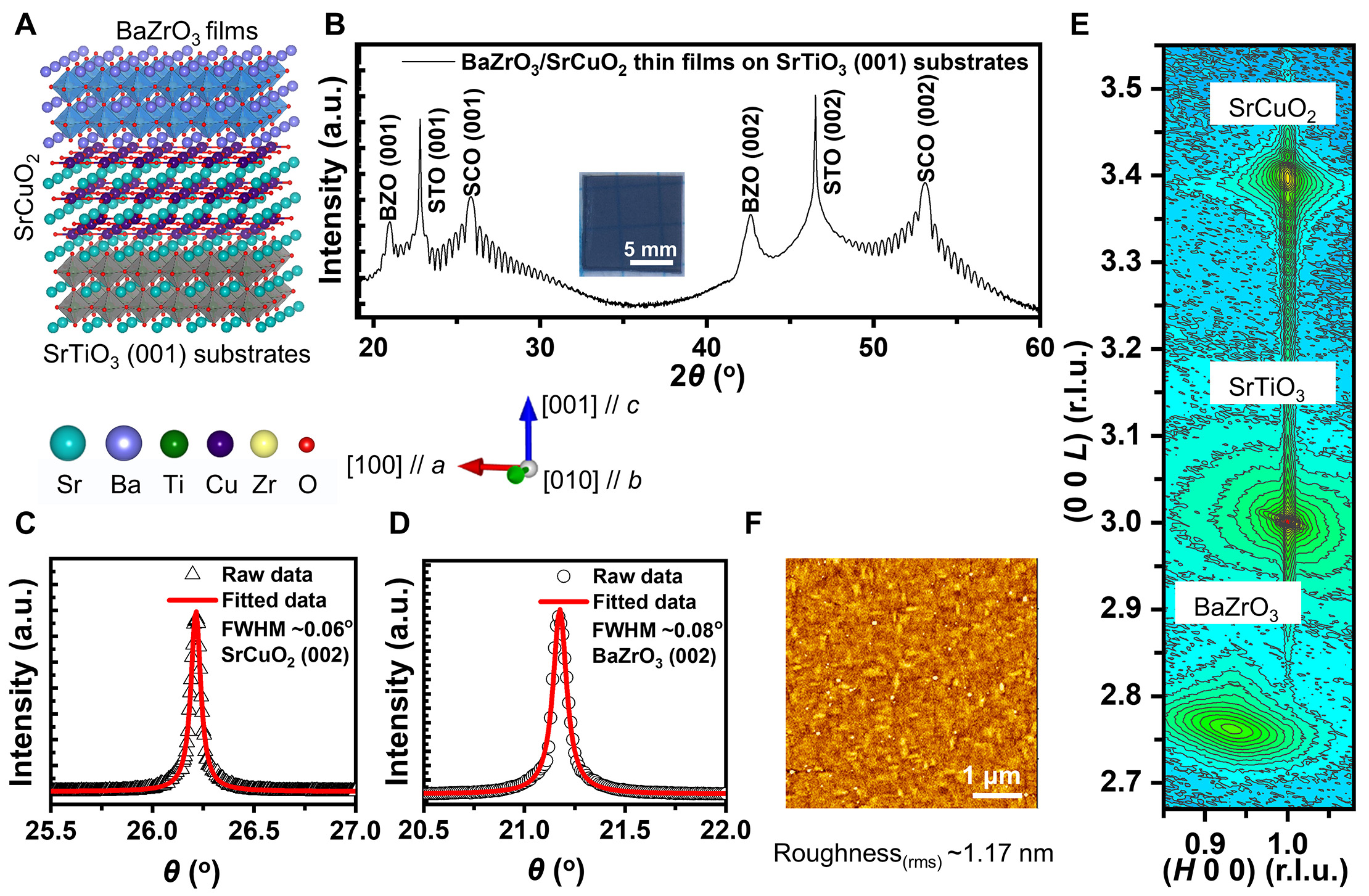
Figure 1. Synthesis and characterization of BaZrO3 (~30 nm)/SrCuO2 (~40 nm) bilayer thin films grown on SrTiO3 (001) substrates. (A) Schematic of epitaxial growth of BaZrO3/SrCuO2 bilayer thin films on SrTiO3 (001) substrates. (B) Synchrotron XRD θ-2θ scan of BaZrO3/SrCuO2 bilayer thin films, and optical image of bilayer sample (inset). (C and D) Rocking-curve measurements of the BaZrO3 (002) and SrCuO2 (002) peaks with the FWHM values of ~0.08° and ~0.06°, respectively. (E) RSMs of BaZrO3/SrCuO2 bilayer thin films around the (-103) Bragg peaks of SrTiO3 (001) substrates. (F) The AFM topography images of epitaxial BaZrO3/SrCuO2 bilayer thin films grown on SrTiO3 (001) substrates with surface roughness (rms) of ~1.17 nm.
To prepare freestanding BaZrO3 membranes, we first dissolved the sacrificial SrCuO2 (~40 nm) layer via chemical etching in a diluted KI etchant solution[23]. Next, the as-released freestanding BaZrO3 membranes were transferred to various non-perovskite host substrates (i.e., mica, Pt/Si, and Si) using the lift-off technique, as described in Figure 2A. The high-resolution XRD results showed that the crystallographic direction was mainly (001)-oriented with no secondary phase [Figure 2B and Supplementary Figure 4], indicating that the epitaxy of the as-transferred freestanding BaZrO3 membranes remained. The rocking curves of the (002) Bragg peak of freestanding BaZrO3 membranes revealed a FWHM value of ~0.31°
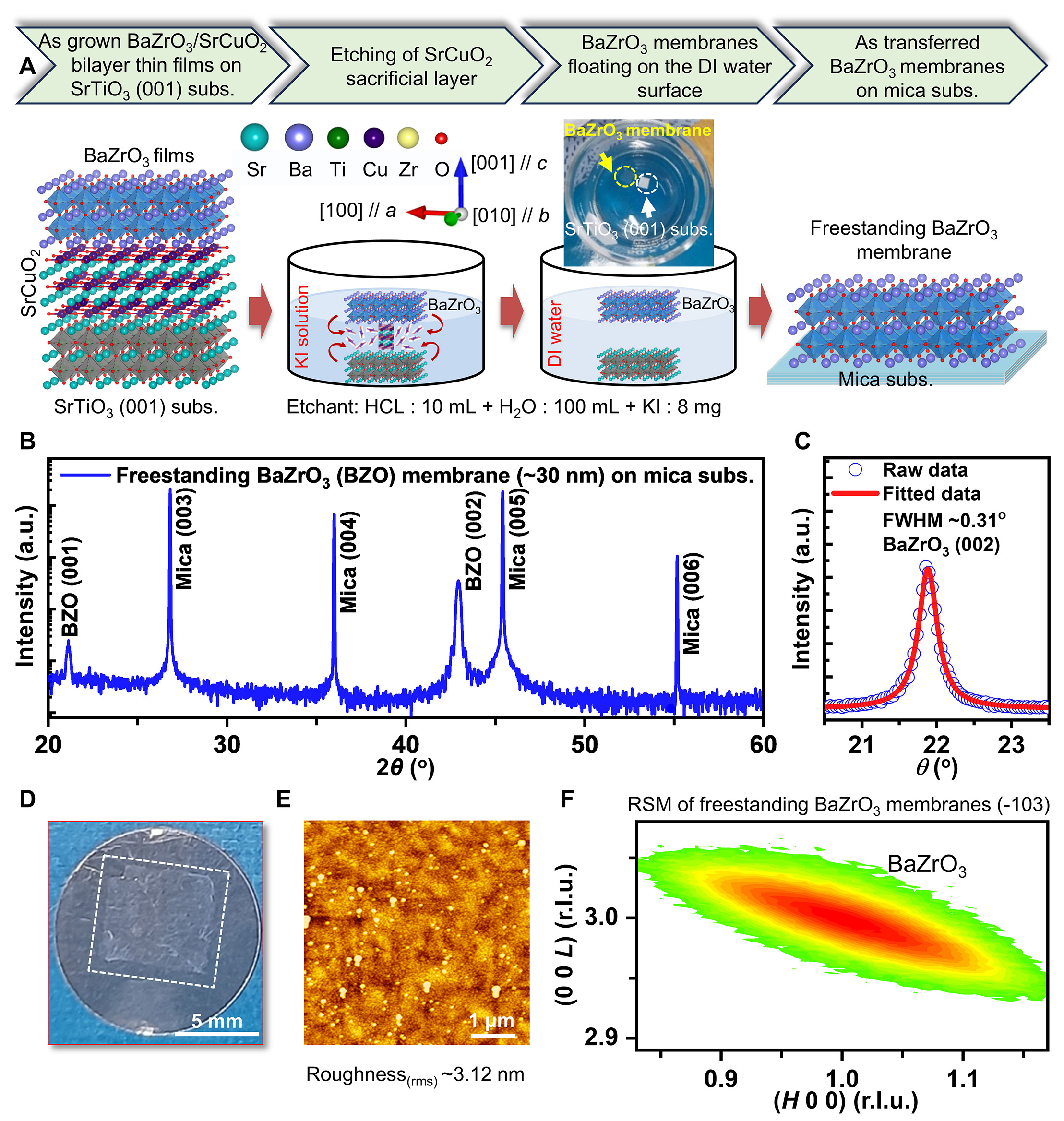
Figure 2. Synthesis and characterization of freestanding BaZrO3 (~30 nm) membranes. (A) Schematic figures of the fabrication of BaZrO3 membranes via etching of SrCuO2 sacrificial layers using KI solutions [HCL: 10 mL + H2O: 100 mL + KI: 8 mg]. (B and C) The XRD analyses of the as-transferred (5 × 5 mm2) single-crystalline freestanding BaZrO3 membranes on mica substrates and the corresponding rocking-curve data of the (002) BaZrO3 Bragg peaks. (D) Photographs of the as-transferred freestanding BaZrO3 membranes on mica substrates. (E) The AFM topography images of the as-transferred freestanding BaZrO3 membranes. (F) The RSMs data for verifying the BaZrO3 peaks positions around the (-103) Bragg peaks of the freestanding BaZrO3 membranes.
Prior to the synthesis of the freestanding ferroelectric BaTiO3/BaZrO3 heterojunctions, we first optimized PLD growth conditions of BaTiO3 single-layer films on SrTiO3 (001) substrates [Supplementary Figure 6]. Herein, the epitaxy and crystallinity of the as-grown BaTiO3 films were confirmed with the XRD θ-2θ scans and rocking curves of epitaxial BaTiO3 thin films, respectively. It appeared that the surface roughness of the BaTiO3 thin films was ~3.62 nm and the corresponding thickness was calibrated to ~25 nm through the XRR analyses.
To manufacture epitaxial freestanding ferroelectric BaTiO3/BaZrO3 membrane heterostructures further, we mounted the as-fabricated freestanding BaZrO3 membranes on mica in a vacuum chamber and directly deposited ferroelectric BaTiO3 (~25 nm) layers on top of the freestanding BaZrO3 membranes
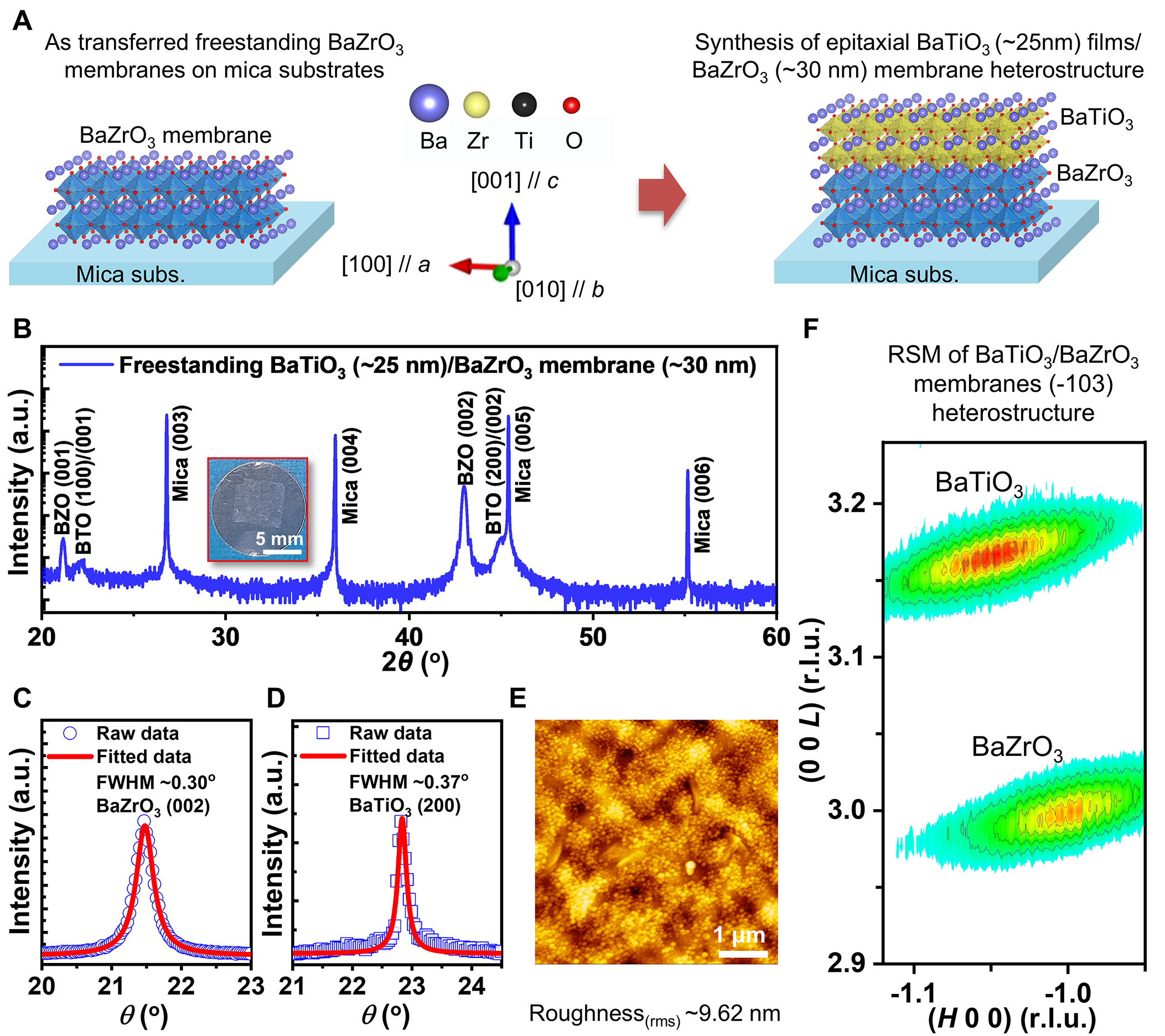
Figure 3. Synthesis and characterization of freestanding ferroelectric BaTiO3 (~25 nm)/BaZrO3 (~30 nm) membrane heterostructures. (A) Schematic figures of the as-transferred freestanding BaZrO3 membrane (5 × 5 mm2) and the following thin-film growth of ferroelectric BaTiO3 for manufacturing freestanding ferroelectric BaTiO3/BaZrO3 membrane heterojunctions on mica substrates. (B) The XRD analyses of the as-grown freestanding ferroelectric BaTiO3/BaZrO3 membrane heterostructures on mica substrates. The inset indicates photographs of the as-fabricated BaTiO3/BaZrO3 membrane heterojunctions. (C and D) Rocking-curve results of the BaZrO3 (002) and BaTiO3 (200) peaks in freestanding BaTiO3/BaZrO3 bilayer membranes. (E) The AFM topography images of the as-grown freestanding ferroelectric BaTiO3/BaZrO3 membrane heterostructures. (F) RSMs of freestanding BaZrO3/BaTiO3 bilayer membranes around the (-103) Bragg peaks of the freestanding BaZrO3 membranes.
To evaluate the epitaxial quality, rocking-curve measurements were performed on the (002) Bragg peak of BaZrO3 [Figure 3C] and the (200) Bragg peak of BaTiO3 [Figure 3D]. The FWHM value of ~0.37° for the (200) Bragg peak of BaTiO3 indicated the relatively poor crystallinity of the BaTiO3 layer compared to the BaZrO3 layer (~0.30°) [Supplementary Table 2]. From the θ-2θ scans, the out-of-plane lattice parameter of BaZrO3 was found to be ~4.211 Å, which was close to bulk cubic BaZrO3 (c = 4.189 Å)[31]
To investigate effects of film thickness on strain states and the associated domain configurations, we progressively changed the BaTiO3 film thickness from ~10 to ~140 nm while keeping the BaZrO3 membrane thickness constant (~30 nm), as shown in Figure 4A. The θ-2θ scans [Figure 4A] showed that all BaTiO3/BaZrO3 bilayer membranes with different thickness exhibited both (00l) peaks of BaZrO3 and (00l)/(h00) peaks of BaTiO3 implying that the bilayer membrane samples were almost epitaxial with no impurity phase. In rocking-curve results of the (200) Bragg peaks of the upper BaTiO3 layer [Figure 4B], we identified that the measured FWHM values varied with non-monotonic characteristics in the range of 0.02 to 0.41°. At the ultrathin limit of ~10 nm, the FWHM was as narrow as ~0.09°, indicative of high crystallinity of our BaTiO3/BaZrO3 bilayer thin-film membranes with little texturing. As the thickness increased, the FWHM increased (up to ~0.41° for 50-nm-thick BaTiO3/BaZrO3 bilayer membranes), probably due to thickness-induced strain relaxation and the linked defect formation. Remarkably, for thick BaTiO3/BaZrO3 bilayer membranes above ~100 nm, the FWHM became narrow again (~0.09° for 140-nm-thick bilayer membranes). Meanwhile, the (002) Bragg peaks of the lower BaZrO3 (~30 nm) membranes exhibited relatively large FWHM values (0.68°-1.14°) compared with the upper BaTiO3 films. This indicated that the thinner BaZrO3 membranes were more textured with the incorporating defects than the upper BaTiO3 film layer and nevertheless, the crystalline quality of the freestanding BaZrO3 membranes were good enough to hetero-epitaxially integrate the ferroelectric overlayers, serving as effective templates to manufacture single-crystalline freestanding ferroelectric heterojunctions.
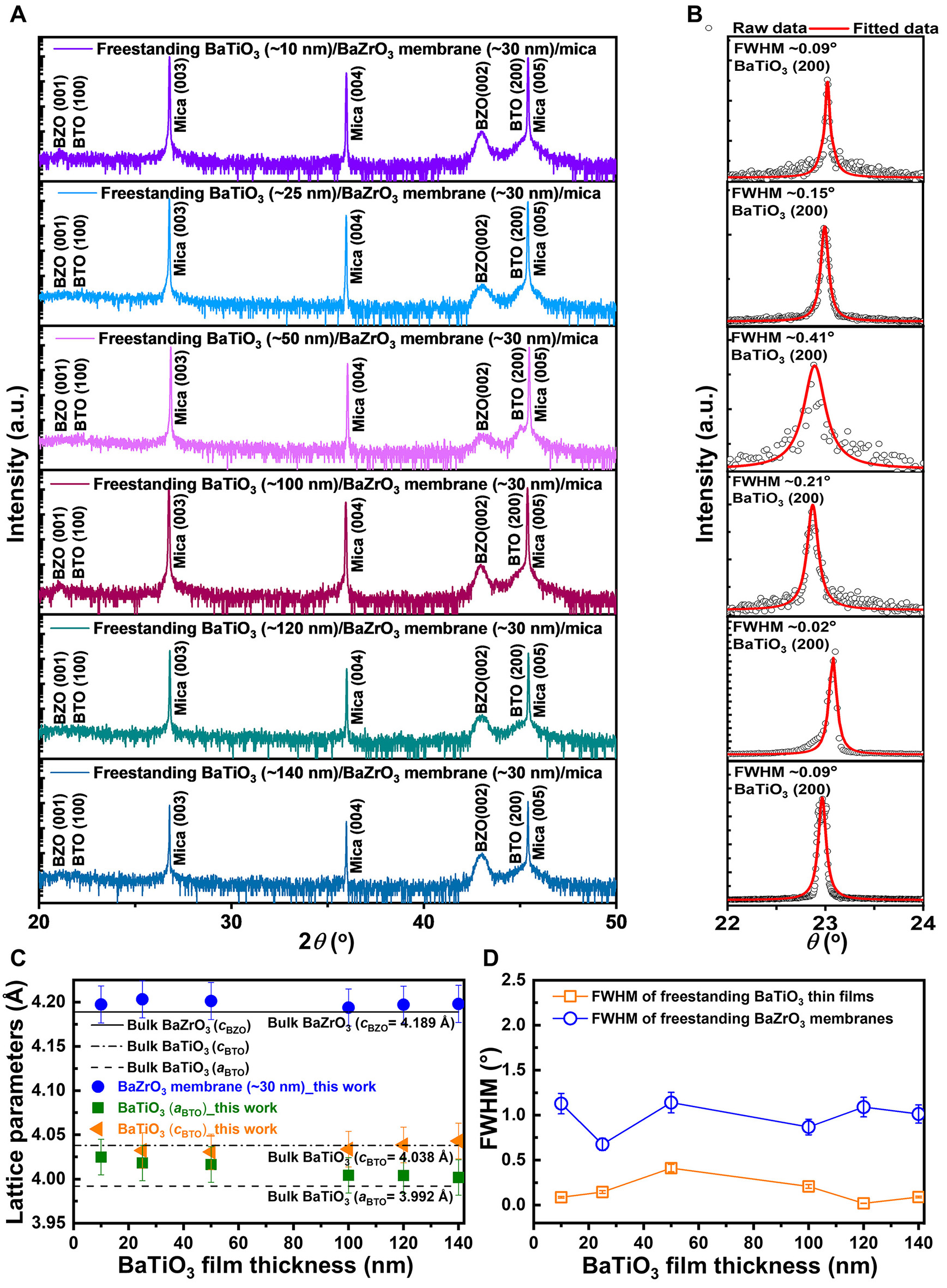
Figure 4. Thickness-dependent XRD analyses of freestanding BaTiO3/BaZrO3 membrane heterostructures on mica substrates. (A) The thickness-dependent XRD θ-2θ results of the as-grown freestanding ferroelectric BaTiO3/BaZrO3 membrane heterojunctions. (B) The thickness-dependent rocking-curve measurements of the BaTiO3 (200) peaks in freestanding BaTiO3/BaZrO3 heterojunctions. (C) Thickness-dependent evolution of out-of-plane lattice parameters of the BaTiO3 and BaZrO3 layers in BaTiO3/BaZrO3 bilayer membranes in comparison with bulk BaTiO3 and BaZrO3. (D) A plot of FWHM values of the BaZrO3 (002) and BaTiO3 (200) peaks as a function of the BaTiO3 film thickness. Error bars in (C and D) represent standard errors in the obtained lattice parameters and FWHM values, which are extracted from the Lorentzian fits of the XRD θ-2θ and rocking-curve results in (A and B), respectively.
Figure 4C represented the lattice parameters of freestanding BaZrO3 membranes and the as-integrated BaTiO3/BaZrO3 membrane heterostructures as a function of the BaTiO3 thickness, respectively. Regardless of the thickness, the freestanding BaZrO3 membranes (marked by blue solid circles) exhibited lattice parameters corresponding to the bulk cubic value (~4.189 Å), indicating that the as-released freestanding BaZrO3 membranes were fully relaxed close to cubic BaZrO3. This highlighted the advantage of the freestanding geometry, in which there was no substrate clamping and epitaxial constraint imposed by the underlying substrate and thereby, the cubic BaZrO3 membrane templates were suitable for the secondary film growth of ferroelectric BaTiO3. In the BaTiO3 films grown on freestanding BaZrO3 membranes, a clear tetragonal distortion was observed with concurrent tetragonal c (marked by orange solid triangles) and a (marked by green solid squares) lattice constants (for more details, see Supplementary Figure 7 and
As depicted in a plot of FWHM versus BaTiO3 film thickness [Figure 4D], the BaTiO3 film layers for all BaTiO3/BaZrO3 bilayer membranes exhibited sharper spectral shapes of the (200) diffraction peaks (denoted by orange open squares) compared with the (002) diffraction peaks (denoted by blue open circles) of underlying BaZrO3 membrane templates. Such enhancement of the crystallinity of the upper BaTiO3 layers, that was phenomenologically named epitaxial “self-healing” [Supplementary Figure 8A-C], would be attributed to strain redistribution and the resulting reduction of structural defects during the secondary thin-film growth of ferroelectric BaTiO3 overlayers via pulsed laser epitaxy. Particularly, the “self-healing” characteristics were likely to be applicable for realizing freestanding oxide membrane heterojunctions representing better crystallinity like oxide single crystals. It should be also noted that the as-integrated freestanding ferroelectric BaTiO3/BaZrO3 heterojunctions were scalable in the wide range of film thickness in conjunction with retention of high crystallinity. The “self-healing” behaviors were reminiscent of previous studies[46] on other freestanding perovskite oxides such as SrTiO3 and PbTiO3 membranes, where gradual strain relaxation and enhanced electromechanical responses have been reported[43,47-49]. Notably,
To gain more insight into the ferroelectric properties of the freestanding ferroelectric BaTiO3/BaZrO3 membrane heterostructures, UV-Raman spectroscopy was performed at room temperature. The obtained Raman spectra (λ = 325.0 nm, 1.5 mW) of our freestanding BaTiO3/BaZrO3 membrane heterojunctions exhibited the characteristic tetragonal BaTiO3 phonons, including the low-frequency polar A1(2TO)/E(3TO) modes (~268-305 cm-1) and the higher-frequency A1(3TO) near ~527 cm-1, together with the high-frequency E(4LO) branch (~720 cm-1), which was in good agreement with the reference Raman spectra of ferroelectric BaTiO3 powders (see Figure 5A)[52-54]. It was further interesting that polarization-resolved Raman measurements [Figure 5B] displayed strong intensity in the parallel geometry and pronounced suppression in cross polarization, consistent with tetragonal selection rules[53]. Considering that the Raman signals were highly susceptible to microscopic polarization directions and macroscopic domain structures in ferroelectric materials, it was therefore plausible that the as-fabricated freestanding BaTiO3/BaZrO3 heterojunctions were largely in-plane polarized due to biaxial tensile strain imposed by the underlying BaZrO3 membranes. Nevertheless, direct electrical and atomic-resolution TEM characterizations would provide conclusive evidences of ferroelectric properties and domain structures, respectively. Electrical measurements were previously implemented but extrinsically limited by inevitable structural disorder of the freestanding BaZrO3 membranes including nano-cracks, warping, and wrinkles, which caused unstable electrical contacts and irreproducible responses. Accordingly, this work mainly focused on establishing feasibility in the sample fabrication, structural integrity, and strain state of freestanding BaTiO3/BaZrO3 heterostructures using comprehensive structural analyses. Herein, Raman spectroscopy appeared as an indirect indicator of crystallographic symmetry and strain-driven polarization states in the as-fabricated BaTiO3/BaZrO3 heterojunctions.
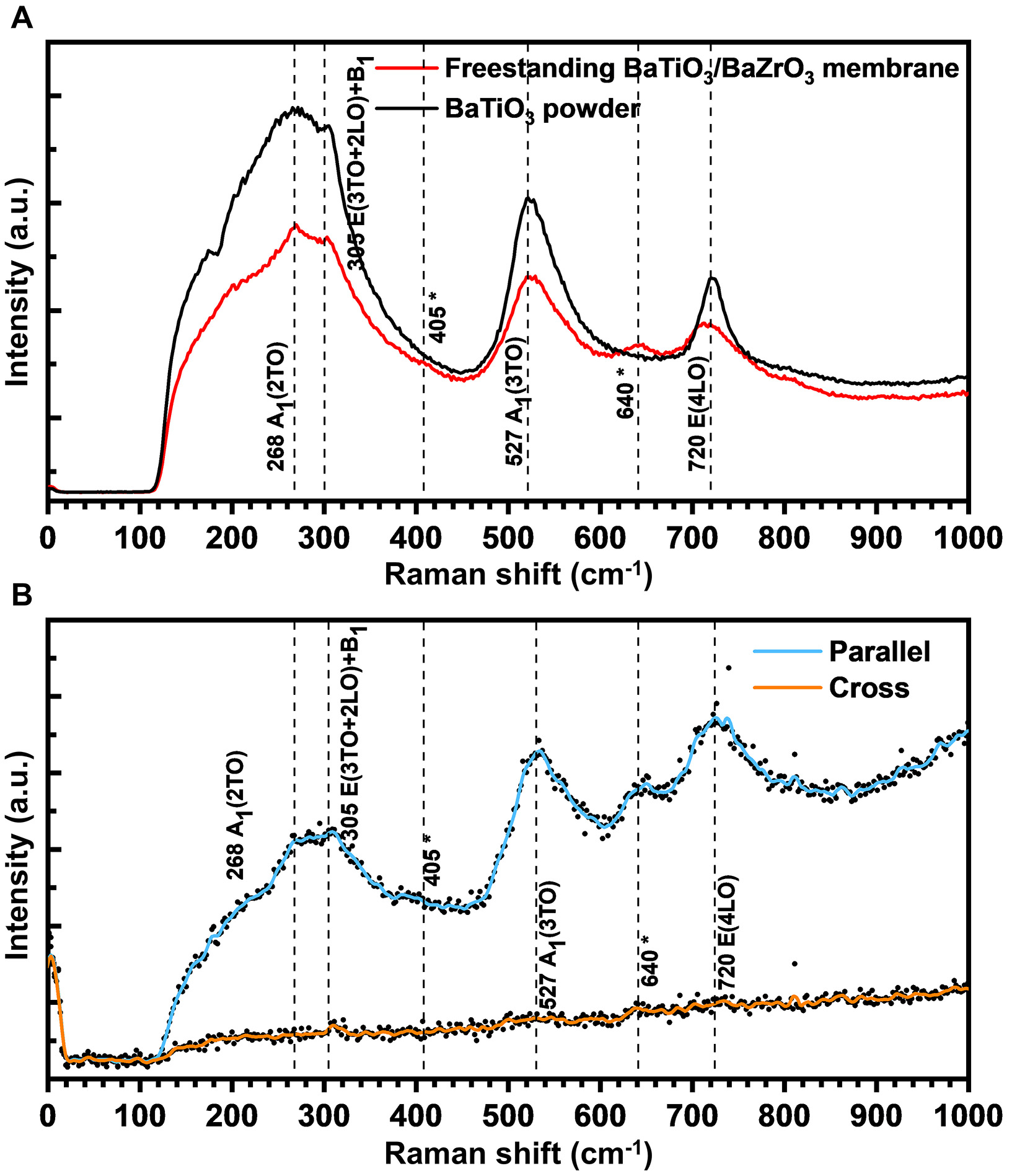
Figure 5. Raman spectra of freestanding ferroelectric BaTiO3 (~25 nm)/BaZrO3 (~30 nm) membrane heterostructures. (A) Raman spectra of the as-integrated freestanding BaTiO3/BaZrO3 membranes heterojunctions. The vertical dashed lines mark principal BaTiO3 phonons, and a strain-responsive mode appears near ~640 cm-1. (B) Polarization-resolved spectra (parallel versus cross) highlighting selection-rule consistency and the BaTiO3 overlayer origin of the principal features.
CONCLUSIONS
In summary, we realized a freestanding ferroelectric heterojunctions by epitaxially integrating BaTiO3 onto single-crystalline BaZrO3 membranes. We demonstrated that the as-fabricated freestanding ferroelectric BaTiO3/BaZrO3 membrane heterostructures were highly crystalline preserving an epitaxial scheme in conjunction with mechanical flexibility enabled by the removal of rigid substrate clamping. Structural analyses revealed that the underlying BaZrO3 freestanding membranes served as effective strain-regulating templates, stabilizing in-plane polarized domain configurations in the ferroelectric BaTiO3 layers while maintaining crystalline integrity. Potentially, our approaches for heterogeneous integration of freestanding oxide membranes via secondary thin-film epitaxy are applicable for rational design of oxide-based flexible microelectronics with strain-controlled ferroelectric domain structures representing enhanced functional properties.
DECLARATIONS
Authors’ contributions
Conception and design: Kim, T. H.
Sample fabrication, Sample characterization: Ahmad, M.; Sheeraz, M.; Kim, I. W.; Ahn, C. W.; Kim, T. H.
Raman spectroscopy: Lim, S.; Jang, J. W.; Lee, J. U.
Manuscript writing and revision: Ahmad, M.; Shin, Y. H.; Kim, J.; Kim, T. H.
Manuscript supervision: Shin, Y. H.; Kim, J.; Kim, T. H.
All authors have read and agreed to the published version of the manuscript.
Availability of data and materials
The data that support the findings of this study are available from the corresponding authors upon reasonable request.
AI and AI-assisted tools statement
Not applicable.
Financial support and sponsorship
T.H.K. acknowledges the support of National Research Foundation of Korea (NRF) grants funded by the Ministry of Science and ICT (MSIT) (RS-2025-00554405). This work was also supported by the Korea Institute of Science and Technology (KIST) (26E0181). M.S. acknowledges the support from the Basic Science Research Program through NRF (RS-2023-00249613). J.-U.L acknowledges the Global Learning & Academic research institution for Master’s, PhD students, and postdocs (G-LAMP) Program of the National Research Foundation of Korea (NRF) grant funded by the Ministry of Education (No. RS-2023-00285390) and the Ministry of Science and ICT (MSIT) (RS-2024-00399417). J.K. acknowledges the support from the Ministry of Science and ICT (MSIT) through the National Research Foundation of Korea (NRF): RS-2025-23324084 and RS-2025-25442460. J.K. acknowledges the support from the KAIST institutional program through project Nos. G04240058 and N11250020. Experiments at PLS-II were supported in part by MSIT and POSTECH.
Conflicts of interest
All authors declared that there are no conflicts of interest.
Ethical approval and consent to participate
Not applicable.
Consent for publication
Not applicable.
Copyright
© The Author(s) 2026.
Supplementary Materials
REFERENCES
1. Fernandez, A.; Acharya, M.; Lee, H. G.; et al. Thin-film ferroelectrics. Adv. Mater. 2022, 34, 2108841.
2. Li, T.; Deng, S.; Liu, H.; Chen, J. Insights into strain engineering: from ferroelectrics to related functional materials and beyond. Chem. Rev. 2024, 124, 7045-105.
3. Sando, D. Strain and orientation engineering in ABO3 perovskite oxide thin films. J. Phys. Condens. Matter. 2022, 34, 153001.
4. Choudhary, N.; Kharat, D.; Kaur, D. Structural, electrical and mechanical properties of magnetron sputtered NiTi/PZT/TiOx thin film heterostructures. Surf. Coat. Technol. 2011, 205, 3387-96.
5. Oh, Y. S.; Wang, L.; Lee, H.; Choi, W. S.; Kim, T. H. Polar perturbations in functional oxide heterostructures. Adv. Funct. Mater. 2023, 33, 2302261.
6. Li, Y. L.; Choudhury, S.; Liu, Z. K.; Chen, L. Q. Effect of external mechanical constraints on the phase diagram of epitaxial PbZr1-xTixO3 thin films - thermodynamic calculations and phase-field simulations. Appl. Phys. Lett. 2003, 83, 1608-10.
7. Pan, H.; Zhu, M.; Banyas, E.; et al. Clamping enables enhanced electromechanical responses in antiferroelectric thin films. Nat. Mater. 2024, 23, 944-50.
8. Griggio, F.; Jesse, S.; Kumar, A.; et al. Substrate clamping effects on irreversible domain wall dynamics in lead zirconate titanate thin films. Phys. Rev. Lett. 2012, 108, 157604.
9. Shi, Q.; Parsonnet, E.; Cheng, X.; et al. The role of lattice dynamics in ferroelectric switching. Nat. Commun. 2022, 13, 1110.
10. Ji, H.; Dolbow, J. E. On strategies for enforcing interfacial constraints and evaluating jump conditions with the extended finite element method. Int. J. Numer. Meth. Eng. 2004, 61, 2508-35.
11. Moridi, A.; Ruan, H.; Zhang, L.; Liu, M. Residual stresses in thin film systems: Effects of lattice mismatch, thermal mismatch and interface dislocations. Int. J. Solids Struct. 2013, 50, 3562-9.
12. Zhang, L.; Yuan, Y.; Lapano, J.; et al. Continuously tuning epitaxial strains by thermal mismatch. ACS Nano 2018, 12, 1306-12.
13. Choo, S.; Varshney, S.; Liu, H.; Sharma, S.; James, R. D.; Jalan, B. From oxide epitaxy to freestanding membranes: opportunities and challenges. Sci. Adv. 2024, 10, eadq8561.
14. Han, S.; Meng, Y.; Xu, Z.; et al. Freestanding membranes for unique functionality in electronics. ACS Appl. Electron. Mater. 2023, 5, 690-704.
15. Haque, M. A.; Saif, M. T. A. Strain gradient effect in nanoscale thin films. Acta Mater. 2003, 51, 3053-61.
16. Wang, Q.; Lu, Q.; Zhang, X.; et al. Emergent uniaxial magnetic anisotropy in high-integrity, uniform freestanding LaMnO3 membranes. ACS Appl. Mater. Interfaces 2024, 16, 68197-203.
17. Dai, L.; Zhao, J.; Li, J.; et al. Highly heterogeneous epitaxy of flexoelectric BaTiO3-δ membrane on Ge. Nat. Commun. 2022, 13, 2990.
18. Kum, H.; Lee, D.; Kong, W.; et al. Epitaxial growth and layer-transfer techniques for heterogeneous integration of materials for electronic and photonic devices. Nat. Electron. 2019, 2, 439-50.
19. Huang, Z.; Ariando,
20. Lee, Y.; Choi, S. H.; Kim, H.; Yoo, J. Epitaxy of emerging materials and advanced heterostructures for microelectronics and quantum sciences. Small Methods 2025, 9, 2401815.
21. Salles, P.; Caño, I.; Guzman, R.; et al. Facile chemical route to prepare water soluble epitaxial Sr3Al2O6 sacrificial layers for free‐standing oxides. Adv. Mater. Interfaces 2021, 8, 2001643.
22. Pesquera, D.; Fernández, A.; Khestanova, E.; Martin, L. W. Freestanding complex-oxide membranes. J. Phys. Condens. Matter 2022, 34, 383001.
23. Sheeraz, M.; Jung, M. H.; Kim, Y. K.; et al. Freestanding oxide membranes for epitaxial ferroelectric heterojunctions. ACS Nano 2023, 17, 13510-21.
24. Nian, L.; Sun, H.; Wang, Z.; et al. Sr4Al2O7: a new sacrificial layer with high water dissolution rate for the synthesis of freestanding oxide membranes. Adv. Mater. 2024, 36, e2307682.
25. Bakaul, S. R.; Serrao, C. R.; Lee, M.; et al. Single crystal functional oxides on silicon. Nat. Commun. 2016, 7, 10547.
26. Chang, Y. W.; Wu, P. C.; Yi, J. B.; et al. A fast route towards freestanding single-crystalline oxide thin films by using YBa2Cu3O7-x as a sacrificial layer. Nanoscale Res. Let. 2020, 15, 172.
27. Takahashi, R.; Lippmaa, M. Sacrificial water-soluble BaO layer for fabricating free-standing piezoelectric membranes. ACS Appl. Mater. Interfaces 2020, 12, 25042-9.
28. Peng, H.; Lu, N.; Yang, S.; et al. A Generic sacrificial layer for wide‐range freestanding oxides with modulated magnetic anisotropy. Adv. Funct. Mater. 2022, 32, 2111907.
30. Park, B. I.; Kim, J.; Lu, K.; et al. Remote epitaxy: fundamentals, challenges, and opportunities. Nano Lett. 2024, 24, 2939-52.
31. Lee, J. H.; Duong, N. X.; Jung, M. H.; et al. Reversibly controlled ternary polar states and ferroelectric bias promoted by boosting square-tensile-strain. Adv. Mater. 2022, 34, e2205825.
32. Choi, K. J.; Biegalski, M.; Li, Y. L.; et al. Enhancement of ferroelectricity in strained BaTiO3 thin films. Science 2004, 306, 1005-9.
33. Wang, X.; Deng, X.; Wen, H.; Li, L. Phase transition and high dielectric constant of bulk dense nanograin barium titanate ceramics. Appl. Phys. Lett. 2006, 89, 162902.
34. Panomsuwan, G.; Manuspiya, H. A comparative study of dielectric and ferroelectric properties of sol-gel-derived BaTiO3 bulk ceramics with fine and coarse grains. Appl. Phys. A 2018, 124, 713.
35. Lin, E. L.; Posadas, A. B.; Zheng, L.; et al. Atomic layer deposition of epitaxial ferroelectric barium titanate on Si (001) for electronic and photonic applications. J. Appl. Phys. 2019, 126, 064101.
36. Fortunato, E.; Barquinha, P.; Martins, R. Oxide semiconductor thin-film transistors: a review of recent advances. Adv. Mater. 2012, 24, 2945-86.
37. He, F.; Wells, B. O. Lattice strain in epitaxial BaTiO3 thin films. Appl. Phys. Lett. 2006, 88, 152908.
38. Damodaran, A. R.; Breckenfeld, E.; Chen, Z.; Lee, S.; Martin, L. W. Enhancement of ferroelectric Curie temperature in BaTiO3 films via strain-induced defect dipole alignment. Adv. Mater. 2014, 26, 6341-7.
39. Elangovan, H.; Barzilay, M.; Seremi, S.; et al. Giant superelastic piezoelectricity in flexible ferroelectric BaTiO3 membranes. ACS Nano 2020, 14, 5053-60.
40. Dong, G.; Li, S.; Yao, M.; et al. Super-elastic ferroelectric single-crystal membrane with continuous electric dipole rotation. Science 2019, 366, 475-9.
41. Azar, S. A.; Al-zoubi, I.; Mousa, A. A.; Masharfe, R. S.; Jaradat, E. K. Investigation of electronic, optical and thermoelectric properties of perovskite BaTMO3 (TM = Zr, Hf): First principles calculations. J. Alloys Compd. 2021, 887, 161361.
42. Vera, C. Y. R.; Ding, H.; Peterson, D.; et al. A mini-review on proton conduction of BaZrO3-based perovskite electrolytes. J. Phys. Energy 2021, 3, 032019.
43. Kolodiazhnyi, T.; Pulphol, P.; Vittayakorn, W.; Vittayakorn, N. Giant suppression of dielectric loss in BaZrO3. J. Eur. Ceram. Soc. 2019, 39, 4144-8.
44. Harbola, V.; Xu, R.; Hong, S. S. Experimental progress in freestanding oxide membranes designed by epitaxy. Adv. Phys. X. 2025, 10, 2450538.
45. Duong, N. X.; Bae, J.; Jeon, J.; et al. Polymorphic phase transition in BaTiO3 by Ni doping. Ceram. Int. 2019, 45, 16305-10.
46. Xu, C.; Liang, W.; Hong, P.; Hu, Y.; Yang, Z.; Pang, H. Lignin/graphene oxide composite coating loaded with zinc ions and its photothermal conversion and self-healing anticorrosion properties. Microstructures 2025, 5, 2025037.
47. Xu, R.; Huang, J.; Barnard, E. S.; et al. Strain-induced room-temperature ferroelectricity in SrTiO3 membranes. Nat. Commun. 2020, 11, 3141.
48. Huang, S.; Xu, S.; Ma, C.; et al. Ferroelectric order evolution in freestanding PbTiO3 films monitored by optical second harmonic generation. Adv. Sci. 2024, 11, e2307571.
49. Zhou, M.; Peng, K.; Tan, Y.; Yang, T.; Chen, L.; Nan, C. Domain evolution, dielectric and piezoelectric response in bent freestanding PbTiO3 ferroelectric nanowires. Acta Mater. 2025, 288, 120805.
50. Pesquera, D.; Parsonnet, E.; Qualls, A.; et al. Beyond substrates: strain engineering of ferroelectric membranes. Adv. Mater. 2020, 32, e2003780.
51. Degezelle, A.; Burcea, R.; Gemeiner, P.; et al. Strain‐induced polarization rotation in freestanding ferroelectric oxide membranes. Adv Electron Mater 2025, 11, e00266.
52. Didomenico, M.; Wemple, S. H.; Porto, S. P. S.; Bauman, R. P. Raman spectrum of single-domain BaTiO3. Phys Rev 1968, 174, 522-30.
53. Marssi, M. E.; Marrec, F. L.; Lukyanchuk, I. A.; Karkut, M. G. Ferroelectric transition in an epitaxial barium titanate thin film: Raman spectroscopy and x-ray diffraction study. J. Appl. Phys. 2003, 94, 3307-12.
Cite This Article
 Open Access
How to Cite
Download Citation
Export Citation File:
Type of Import
Tips on Downloading Citation
Citation Manager File Format
Type of Import
Direct Import: When the Direct Import option is selected (the default state), a dialogue box will give you the option to Save or Open the downloaded citation data. Choosing Open will either launch your citation manager or give you a choice of applications with which to use the metadata. The Save option saves the file locally for later use.
Indirect Import: When the Indirect Import option is selected, the metadata is displayed and may be copied and pasted as needed.
About This Article
Special Topic
Copyright

Data & Comments
Data
0










Comments
Comments must be written in English. Spam, offensive content, impersonation, and private information will not be permitted. If any comment is reported and identified as inappropriate content by OAE staff, the comment will be removed without notice. If you have any queries or need any help, please contact us at [email protected].