
fig13
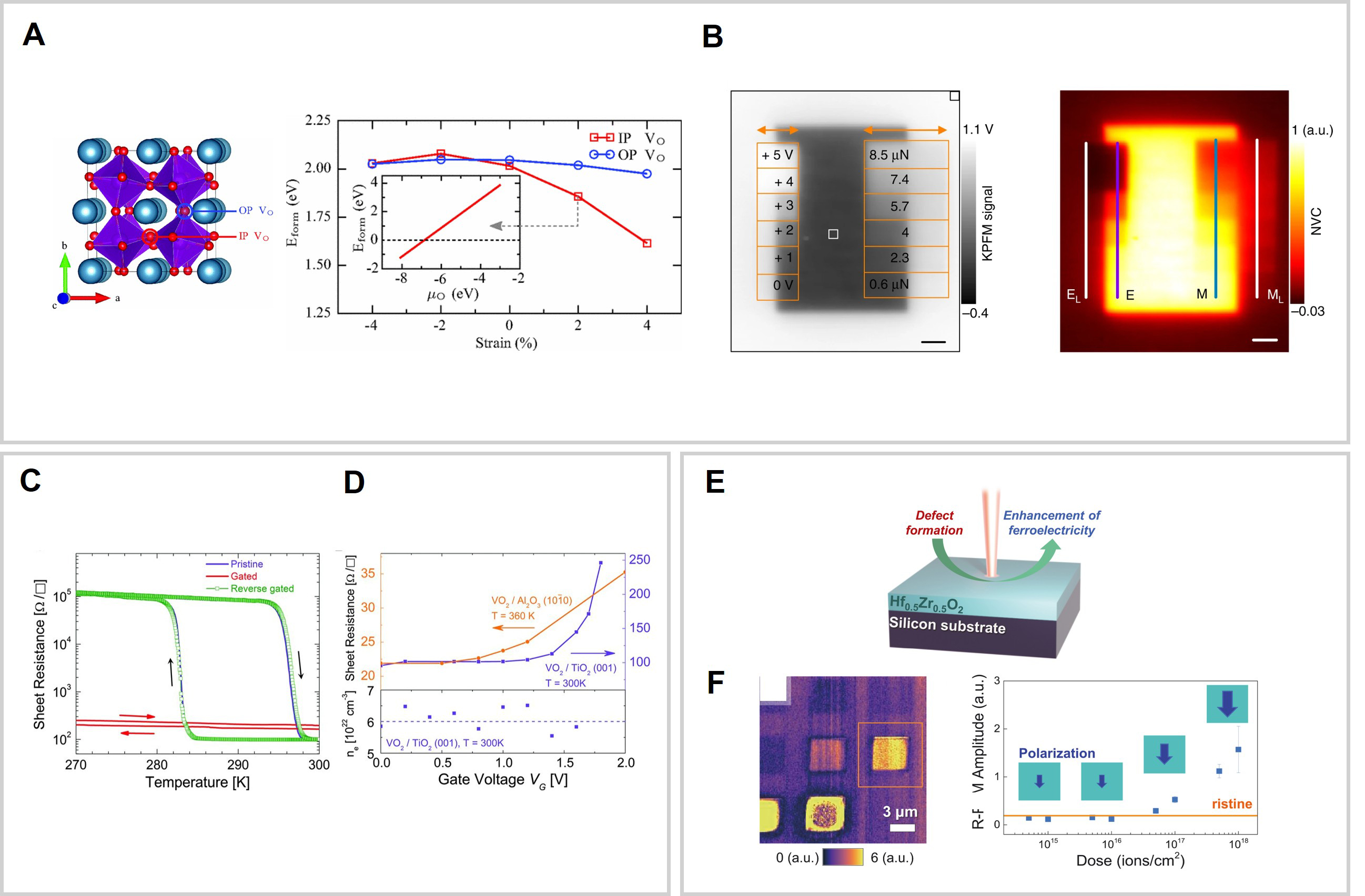
Figure 13. (A) Strain-mediated control of oxygen vacancies. First-principles calculation of the formation energy for oxygen vacancies (Vo) according to the strain in CaMnO3. Reproduced with permission[24]. Copyright 2013, American Physical Society; (B) Strain-mediated control of oxygen vacancies. KPFM image after electrical and mechanical scans between the Vo-enriched and pristine regions. Reproduced with permission[93]. Copyright 2017, Springer Nature; (C) Rs versus T for the same VO2 device in its pristine state and in gated (1.8 V) and reverse-gated (-0.8 V) states. (D) Sheet resistance for electrolyte-gated devices. (C and D) Reproduced with permission[94]. Copyright 2013, American Association for the Advancement of Science; (E) Ion bombardment-induced creation of Vo. (F) R-PFM image of a HZO thin film after ion bombardment and R-PFM amplitudes. (E and F) Reproduced with permission[95]. Copyright 2022, American Association for the Advancement of Science. KPFM: Kelvin probe force microscope; MIT: metal insulator transition; R-PFM: resonance piezoresponse force microscopy; HZO: hafnium zirconium oxide; NVC: normalised vacancy concentration.