

fig5

Selective <i>a</i>-domain switching by sub-coercive field in PbTiO<sub>3</sub> thin films

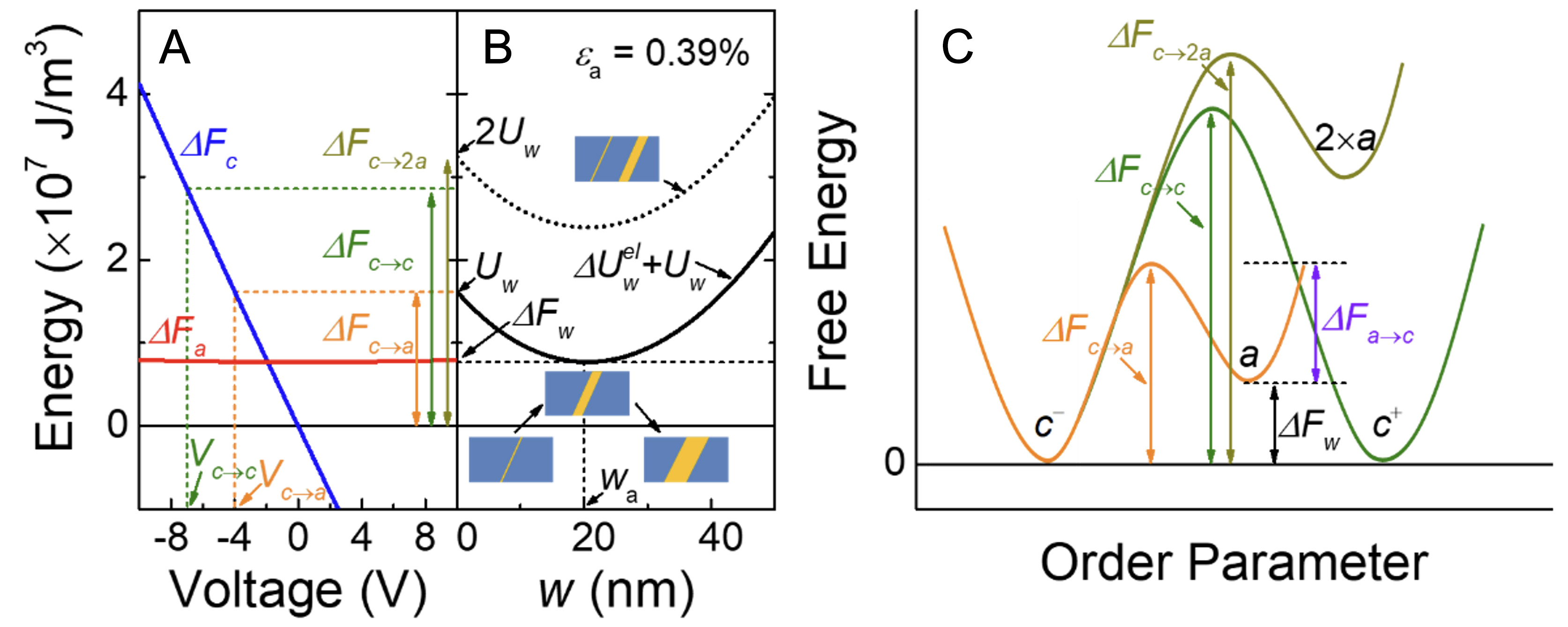
Figure 5. (A) Free energies of the pristine c-domain (ΔFc (V); black line) and newly formed a-domain (ΔFa (V) + ΔFw; red line) as a function of applied voltages. Coercive voltages for c- to a- (Vc→a) and c- to c- (Vc→c) domain switching and their corresponding free energies ΔFc→a (orange dashed line) and ΔFc→c (green dashed line) are indicated. Energy required for formation of a second a-domain (ΔFc→2a); brown arrow) is also shown; (B) Elastic energy ($$ \Delta U_{w}^{e l}\left(\varepsilon_{\mathrm{a}}\right)+U_{w} $$) as a function of a-domain width (w) for the first (black solid line) and second (black dotted line) a-domain formation in the c-domain matrix, considering surface energies of Uw and 2Uw, respectively. Blue rectangles and yellow parallelograms of varying width represent the c-domain and newly formed a-domain, respectively. wa indicates the average a-domain width (20 nm), and ΔFw corresponds to the elastic energy at wa. (C) Schematic energy barriers for the first (orange line) and second (brown line) a-domain formation and c- to c+ ferroelectric switching (green line), with corresponding free energies of ΔFc→a, ΔFc→2a, and ΔFc→c. The a-domain energy state is ΔFw, and the energy barrier for a- to c-domain switching is ΔFa→c at Va = 0.

Microstructures
ISSN 2770-2995 (Online)

Portico

All published articles are preserved here permanently:

https://www.portico.org/publishers/oae/

Portico

All published articles are preserved here permanently:

https://www.portico.org/publishers/oae/