

fig2
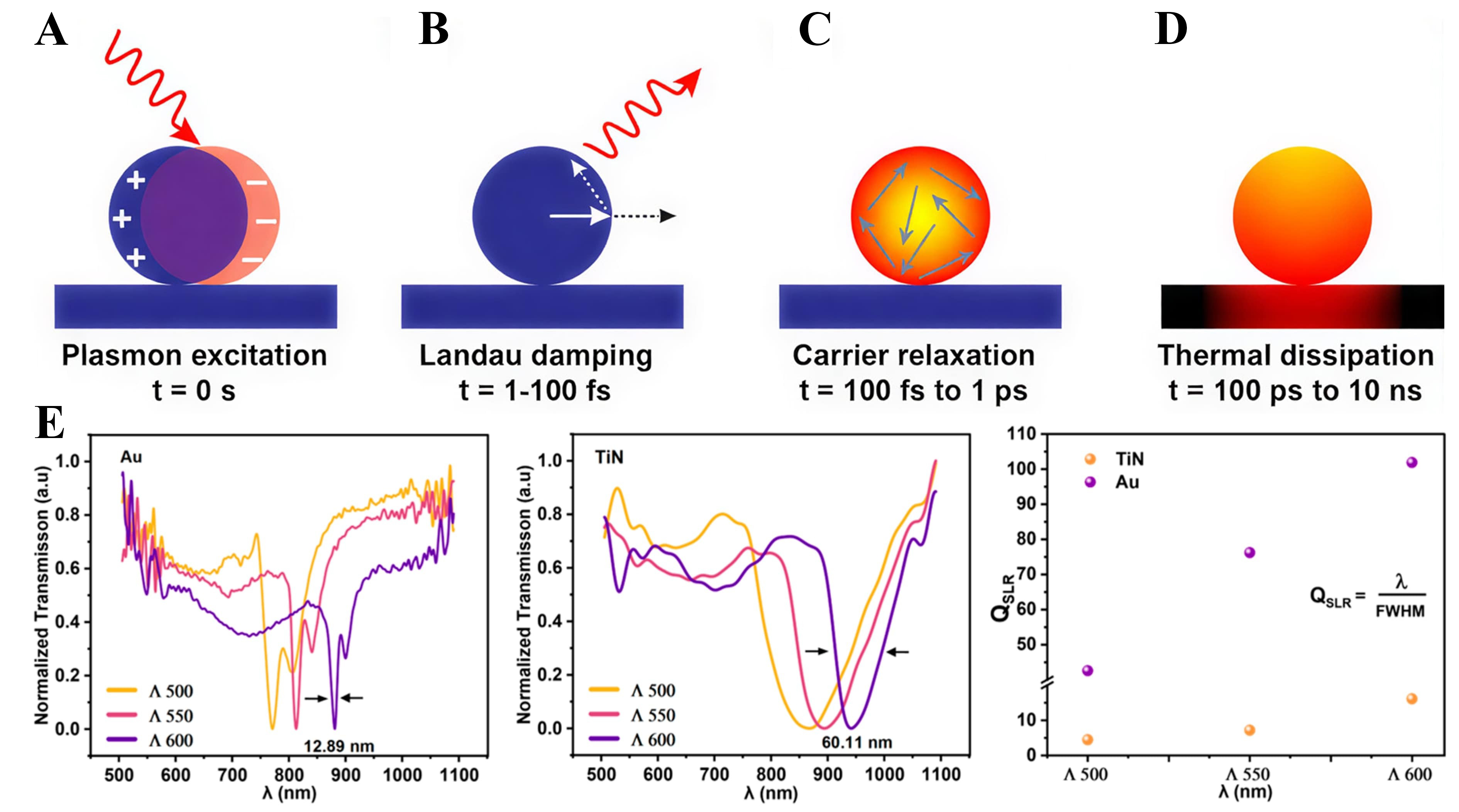
Figure 2. Ultrafast plasmon dynamics and lattice-controlled resonances. (A) LSPR excitation redirects the Poynting flux into the nanoparticle, resulting in near-field enhancement[45]; Copyright 2015, reproduced with permission. Published by the American Chemical Society. (B) Within 1 to 100 fs, Landau damping converts the plasmon into electron-hole excitations and permits radiative re-emission; this stage corresponds to a highly non-thermal carrier population (τnth)[45]. Copyright 2015, reproduced with permission. Published by American Chemical Society; (C) Over ~ 100 fs to 1 ps, electron-electron scattering drives energy redistribution toward a quasi-thermal distribution (τel)[45]. Copyright 2015, reproduced with permission. Published by the American Chemical Society; (D) From ~ 100 ps to 10 ns, phonon-mediated heat flow dissipates energy to the surroundings (τph)[45]. Copyright 2015, reproduced with permission. Published by the American Chemical Society; (E) Normalized transmission spectra of Au and TiN nanodisk arrays for lattice periods Λ = 500 to 600 nm (arrows indicate the FWHM at Λ = 600 nm) alongside the calculated surface-lattice-resonance quality factors QSLR=λ/FWHM[54]. Copyright 2025, reproduced with permission. Published by the Multidisciplinary Digital Publishing Institute. SLR: Surface-lattice resonance; FWHM: full-width half-maximum; LSPR: localized surface plasmon resonance.