

fig13
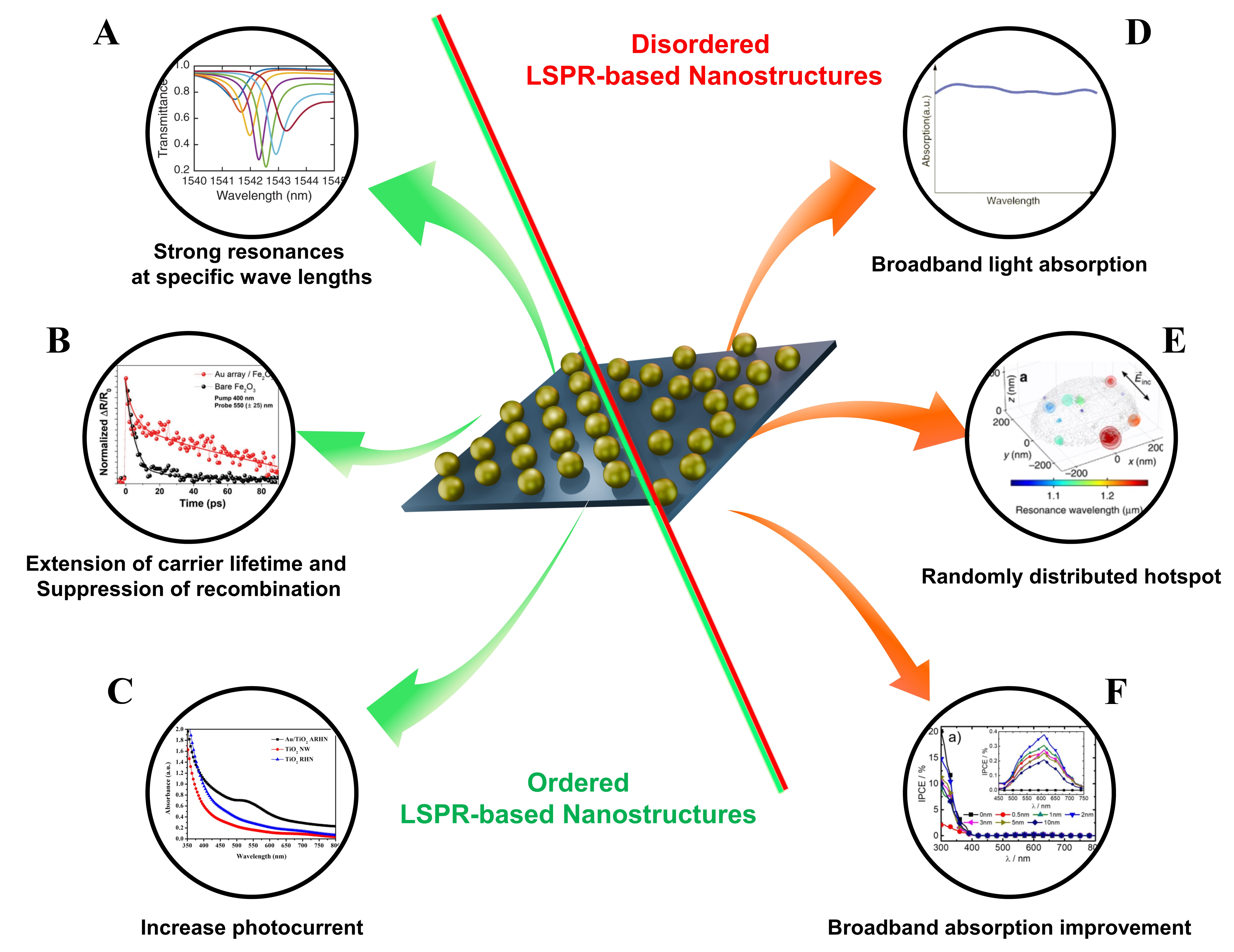
Figure 13. Comparison of ordered and disordered LSPR-based nanostructures. (A) Absorption of strong resonances at a specific wavelength[211]. Copyright 2021, published by Nature Publishing Group; (B) Transient absorption (TA) decay profiles at 550 nm for Au array/Fe2O3, showing suppressed short-time recombination and stabilized long-lived holes at the surface[212]. Copyright 2020, published by Wiley-VCH; (C) Absorption enhancement of TiO2 ARHN by scattering and visible-light absorption with photocurrent increase of Au/TiO2 ARHN by LSPR[200]. Copyright 2017, published by Springer Nature; (D) Broadband light absorption[217]. Copyright 2020, published by Springer Nature; (E) Randomly distributed plasmonic hotspots in a disordered gold nanosponge showing stochastic field localization across different resonance wavelengths[218]. Copyright 2018, published by Springer Nature; (F) IPCE spectra of Au NP-decorated TiO2 photoanodes formed by disordered LSPR nanostructures, showing broadband baseline enhancement across the visible range[219]. Copyright 2020, published by American Chemical Society. LSPR: Localized surface plasmon resonance; IPCE: incident photon-to-current efficiency; ARHN: hierarchical network deposited with Au nanoparticles; NP: nano-particle.