
fig8
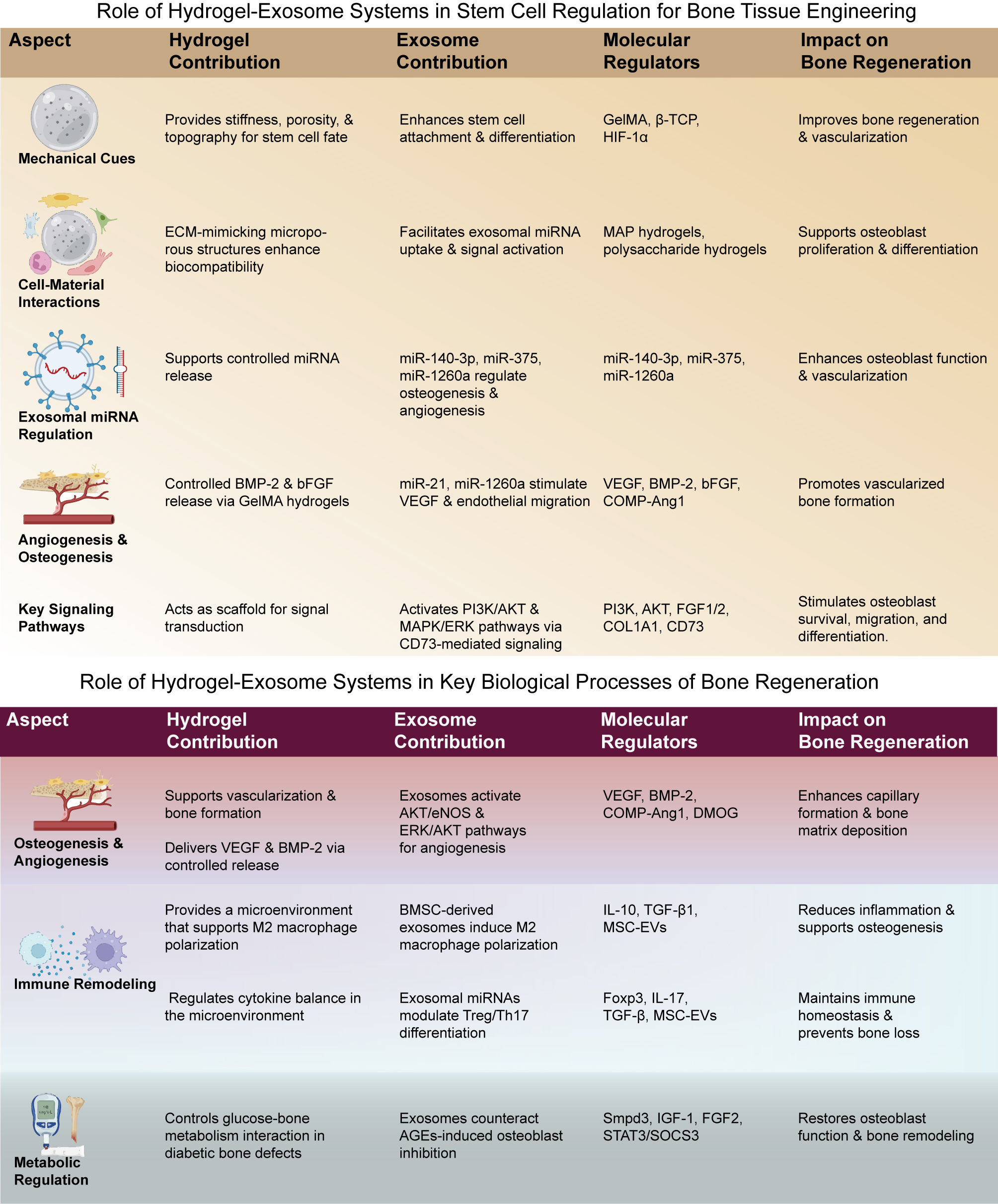
Figure 8. Hydrogel-exosome synergy in stem cell regulation for bone regeneration. Hydrogel contribution: Hydrogels provide critical mechanical cues such as stiffness, porosity, and topography that influence stem cell attachment and differentiation. They facilitate exosome integration by mimicking the extracellular matrix (ECM), supporting cell-material interactions essential for osteogenesis and angiogenesis. Furthermore, hydrogels enable the controlled release of molecules such as BMP-2 and bFGF, which enhance bone formation. Exosome Contribution: Exosomes play a crucial role in the regulation of key molecular factors, including miRNAs such as miR-140-3p, miR-375, and miR-1260a, which modulate osteogenesis and angiogenesis. They also activate essential pathways such as PI3K, AKT, MAPK/ERK, and VEGF signaling to promote endothelial migration, osteoblast function, and vascularization. Molecular Regulators: The interactions between hydrogel and exosome systems, particularly in the activation of PI3K/AKT and MAPK/ERK pathways, support osteoblast survival, migration, and differentiation, while promoting angiogenesis and immune modulation. Impact on Bone Regeneration: The combined hydrogel-exosome system significantly enhances bone regeneration by supporting osteoblast differentiation, improving vascularization, and regulating immune responses, providing an integrated solution for effective bone tissue engineering.